Modern digital communication depends heavily on networks that connect devices, systems, and applications across local and global environments. Every online activity, whether it involves sending a message, accessing a website, or running enterprise applications, relies on underlying network infrastructure. For many years, these networks were built using traditional methods that depended on manually configured hardware devices. While these systems were effective in earlier stages of computing, they gradually became difficult to manage as networks grew larger, more complex, and more dynamic.
Traditional networking is based on a decentralized model where each network device operates independently. Routers, switches, and firewalls are configured individually, and each device is responsible for making decisions based on local rules. This approach requires network administrators to manually configure every device whenever changes are needed. As organizations expand, this process becomes increasingly time-consuming and error-prone. Even small updates may require adjustments across multiple devices, leading to operational delays and inconsistent configurations.
Another challenge in traditional networking is limited visibility. Since each device operates independently, it can be difficult to obtain a complete view of the entire network. Administrators often need to access multiple systems to understand traffic patterns, identify issues, or apply policy changes. This fragmented approach reduces efficiency and makes it harder to respond quickly to network problems or security incidents.
As digital transformation accelerated, organizations began adopting cloud services, remote work models, and data-intensive applications. These changes placed new demands on network infrastructure. Networks needed to become more flexible, scalable, and responsive to real-time changes. Traditional architectures struggled to keep up with these requirements because they were built on static configurations that were not designed for rapid adaptation.
In response to these limitations, a new approach to network design emerged known as Software-Defined Networking. This model fundamentally changes how networks are built and managed by separating control functions from physical hardware. Instead of relying on individual devices to make independent decisions, SDN introduces a centralized intelligence system that controls how the entire network behaves.
At its core, Software-Defined Networking is a method of managing networks through software-based control mechanisms. It allows administrators to define how the network should operate using centralized applications rather than configuring each device individually. This shift introduces a higher level of abstraction, where network behavior is defined through software instructions rather than hardware-specific settings.
The key idea behind SDN is separation of concerns. In traditional networks, the control functions and data forwarding functions are tightly integrated within each device. In SDN, these functions are separated into distinct layers. This separation allows each layer to specialize in its role, improving efficiency and flexibility across the entire system.
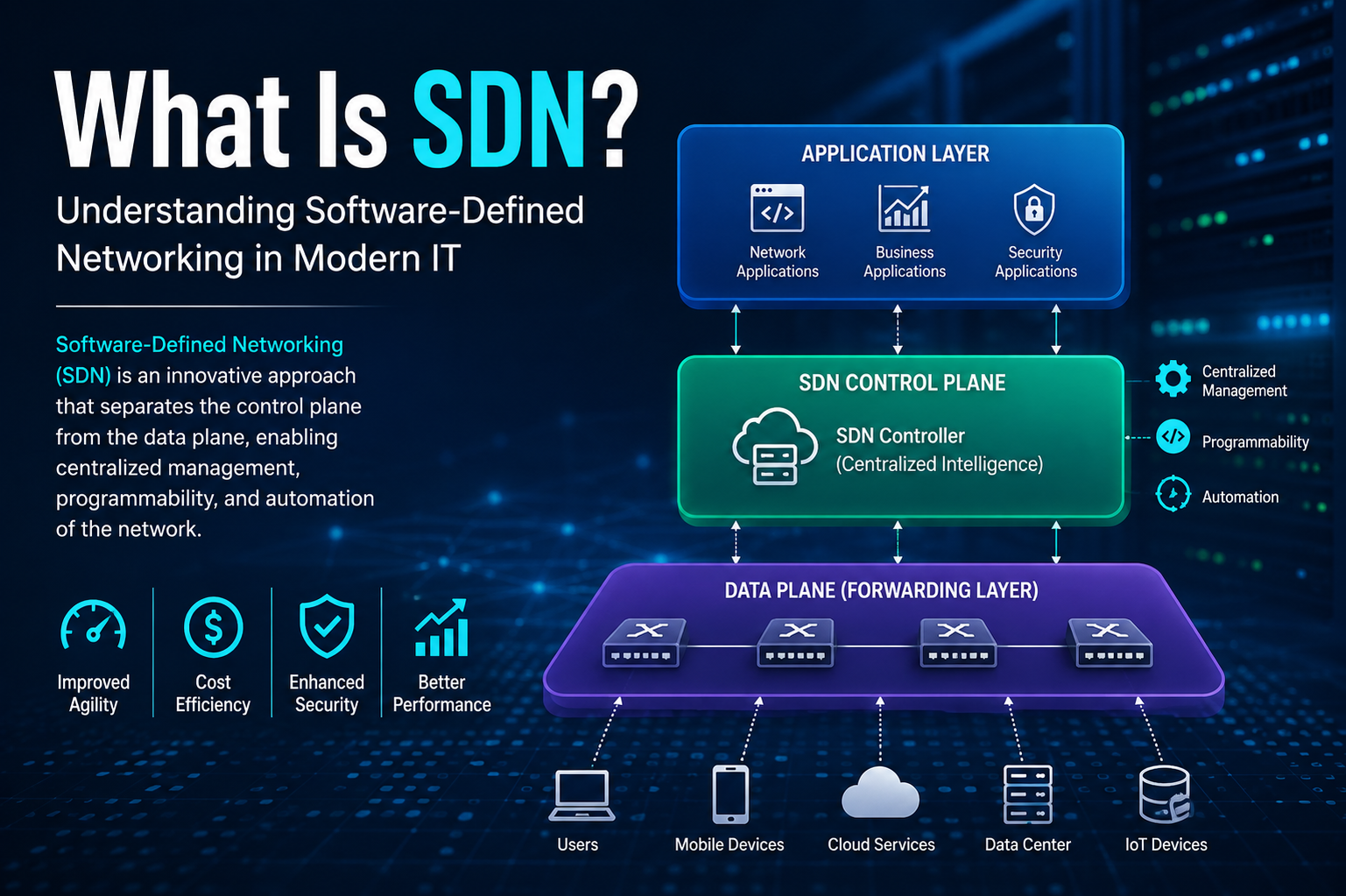
To understand SDN more clearly, it helps to think of it as a structured system with different functional layers working together. At a high level, these layers can be viewed as the application layer, the control layer, and the infrastructure layer. Each layer plays a specific role in ensuring that the network operates smoothly and efficiently.
The application layer is responsible for defining what the network should do. It translates business requirements, user needs, and operational goals into network policies. For example, an organization may want to prioritize video conferencing traffic, restrict access to certain services, or optimize bandwidth usage for critical applications. These requirements are expressed at the application layer, where they are converted into instructions for the rest of the network.
The control layer acts as the intelligence center of the SDN architecture. It interprets the requirements received from the application layer and determines how they should be implemented across the network. This layer maintains a global view of the entire network, allowing it to make informed decisions about traffic routing, resource allocation, and policy enforcement. Instead of relying on individual devices to make decisions, the control layer coordinates the behavior of all network components from a centralized position.
The infrastructure layer consists of the physical and virtual devices that handle actual data transmission. These include switches, routers, firewalls, and other networking equipment. In an SDN environment, these devices no longer make independent decisions about how traffic should be handled. Instead, they follow instructions received from the control layer. Their primary role is to forward data efficiently and report network status back to the controller.
This separation between decision-making and data forwarding is what gives SDN its flexibility. By centralizing control functions, the network becomes easier to manage and modify. Changes can be implemented through software updates rather than manual configuration of individual devices. This significantly reduces complexity and allows networks to adapt quickly to changing requirements.
One of the most important advantages of this architecture is its ability to improve network agility. In traditional systems, making changes to network behavior often requires significant effort and coordination. With SDN, modifications can be made centrally and applied across the entire network almost instantly. This allows organizations to respond quickly to new demands, such as deploying applications, adjusting security policies, or managing traffic surges.
Another important benefit is improved consistency. Because policies are defined centrally, they are applied uniformly across all network devices. This reduces the risk of configuration errors that can occur when changes are made manually on multiple devices. Consistent policy enforcement also improves security, as it ensures that all parts of the network follow the same rules.
SDN also enhances network visibility. Since the control layer maintains a global view of the network, administrators can monitor traffic patterns, device status, and system performance from a single point of control. This visibility makes it easier to detect anomalies, identify bottlenecks, and optimize network performance.
Scalability is another key advantage of SDN. As organizations grow, their networks must expand to accommodate new users, devices, and applications. Traditional networks often struggle with scaling because each new device requires individual configuration. SDN simplifies this process by allowing new devices to be integrated into the network without extensive manual setup. The centralized controller manages these devices automatically, ensuring they operate according to defined policies.
In addition to operational improvements, SDN also introduces new possibilities for innovation. By decoupling network control from hardware, SDN allows developers to create applications that interact directly with network behavior. These applications can automate tasks, optimize performance, or enhance security. This programmability transforms the network into a flexible platform that can be customized according to specific needs.
Security considerations also play an important role in the SDN model. While centralized control improves management efficiency, it also introduces new challenges. Because the control layer has a critical role in managing the entire network, it becomes a high-value target for potential threats. Protecting this layer requires strong security measures, including access controls, authentication mechanisms, and continuous monitoring.
At the same time, SDN provides opportunities to enhance security through centralized policy enforcement. Security rules can be defined once and applied consistently across the entire network. This reduces the likelihood of configuration inconsistencies that could create vulnerabilities. Additionally, the ability to monitor network activity from a central point improves the detection of suspicious behavior.
The transition from traditional networking to Software-Defined Networking represents a significant shift in how digital infrastructure is designed and managed. Instead of relying on static, device-level configurations, SDN introduces a dynamic, software-driven approach that prioritizes flexibility, scalability, and centralized control.
This shift reflects the growing demands of modern digital environments, where networks must support a wide range of applications, devices, and users while maintaining high levels of performance and security. As organizations continue to adopt cloud services, distributed systems, and data-driven applications, the need for adaptable and intelligent network architectures becomes even more important.
SDN provides the foundation for this new generation of networking by redefining how control and data functions are organized. Through its layered architecture and centralized intelligence, it enables networks to operate more efficiently and respond more effectively to changing conditions.
The next stage of understanding SDN involves exploring how each layer functions in detail and how they work together to create a fully integrated network system.
The Application Layer Where Network Intent Becomes Reality
In Software-Defined Networking, the application layer represents the point where human intent is translated into actionable network behavior. It is the most abstract level of the architecture, yet it plays one of the most influential roles in shaping how the entire network operates. Rather than dealing with hardware configurations or low-level routing decisions, this layer focuses on what the network should achieve in terms of business goals, user experience, and service delivery.
Modern organizations depend on networks that support a wide variety of applications, each with different performance, security, and reliability requirements. Some applications demand high bandwidth and low latency, such as video conferencing and real-time communication tools. Others prioritize security and controlled access, such as financial systems or internal databases. The application layer in SDN allows these requirements to be expressed clearly and consistently, without requiring direct interaction with underlying hardware devices.
At its core, the application layer acts as the “intent translator” of the network. It receives high-level requirements from business systems, administrators, or automated software tools and converts them into structured instructions. These instructions describe how traffic should be handled, which services should be prioritized, and what security measures should be enforced. Instead of configuring individual devices, administrators define desired outcomes, and the SDN system takes responsibility for implementing them.
One of the most important concepts associated with the application layer is network policy definition. Policies determine how different types of network traffic are treated. For example, an organization may define a policy that prioritizes communication for business-critical applications while limiting bandwidth for non-essential services during peak usage times. These policies ensure that network resources are allocated efficiently and aligned with organizational priorities.
Another essential function of the application layer is service orchestration. This involves coordinating multiple network functions to deliver a complete service experience. For instance, when a new application is deployed, it may require load balancing, secure access control, and optimized routing. Instead of configuring each of these elements separately, the application layer communicates these requirements in a unified manner. The SDN system then ensures that all necessary components work together seamlessly.
The application layer also plays a key role in network automation. In traditional networks, many tasks require manual intervention, such as updating configurations, deploying new services, or adjusting traffic rules. In an SDN environment, these tasks can be automated through applications that interact directly with the network controller. Automation reduces human error, speeds up deployment processes, and allows networks to respond more quickly to changing conditions.
For example, consider a scenario where network traffic suddenly increases due to a high-demand application or an unexpected event. An application in the SDN layer can detect this change and request adjustments such as increased bandwidth allocation or traffic rerouting. The system responds dynamically without requiring manual configuration changes across multiple devices. This level of responsiveness is a major improvement over traditional networking approaches.
Security is another important dimension of the application layer. Security applications define how threats should be detected, prevented, and mitigated across the network. Instead of relying solely on individual security devices, SDN allows security policies to be applied consistently across the entire infrastructure. This ensures that protective measures are not isolated but integrated into the overall network behavior.
Security applications at this layer may define rules for blocking suspicious traffic, isolating compromised devices, or enforcing strict access controls for sensitive resources. These rules are communicated to the control layer, which then ensures they are enforced across all relevant network devices. This centralized approach improves both consistency and effectiveness in network defense.
Another important aspect of the application layer is monitoring and analytics. Modern networks generate large volumes of data, including traffic flows, usage patterns, and system performance metrics. Applications at this layer collect and analyze this data to provide insights into how the network is functioning. These insights can be used to optimize performance, identify inefficiencies, or detect early signs of potential issues.
By analyzing network behavior over time, application-layer tools can identify trends that might not be immediately visible. For example, they may detect that certain applications consistently experience delays during specific hours or that particular network segments are underutilized. This information helps administrators make informed decisions about resource allocation and network optimization.
The application layer also supports dynamic service customization. In traditional networks, services are often static and require manual reconfiguration to change their behavior. In SDN, services can be adjusted dynamically based on changing requirements. This means that network behavior can adapt in real time to meet the needs of users and applications.
For instance, during peak business hours, a network might prioritize communication services and business applications. During off-peak hours, the same network might allocate more resources to backup processes or data synchronization tasks. This flexibility ensures that network resources are used efficiently throughout different operational conditions.
Another important characteristic of the application layer is abstraction. Abstraction allows users to interact with the network without needing to understand its underlying complexity. Instead of configuring routers, switches, or firewalls directly, administrators define high-level objectives. The SDN system then determines how to achieve those objectives using available network resources.
This abstraction significantly simplifies network management. It reduces the technical burden on administrators and allows them to focus on strategic planning rather than device-level configuration. It also reduces the risk of configuration errors, since policies are defined in a centralized and consistent manner.
In addition, the application layer enables interoperability between different network services. In complex environments, multiple applications often need to work together to deliver a complete solution. For example, a cloud-based service may require secure access, optimized routing, and real-time performance monitoring. The application layer coordinates these requirements and ensures that all necessary services are properly integrated.
This coordination is essential in modern digital environments, where systems are highly interconnected. Without a centralized mechanism for managing these interactions, network behavior can become inconsistent and difficult to control. The application layer ensures that all components operate according to a unified set of objectives.
Another important function of the application layer is policy enforcement at scale. In large organizations, manually enforcing policies across thousands of devices is not practical. SDN applications allow policies to be defined once and applied consistently across the entire network. This ensures uniform behavior regardless of network size or complexity.
Scalability is one of the strongest advantages of this approach. As networks grow, the application layer continues to manage policies without requiring additional manual configuration. New devices and services can be integrated into the network automatically, following the same set of defined rules.
The application layer also provides flexibility for innovation. Because it is software-driven, new applications can be developed to extend network capabilities. These applications can introduce new features such as advanced traffic optimization, intelligent routing, or enhanced security monitoring. This flexibility allows networks to evolve alongside changing technological needs.
In addition, the application layer supports integration with external systems. Many modern networks interact with cloud platforms, enterprise software, and third-party services. The ability to communicate with these systems allows SDN applications to coordinate network behavior with broader organizational processes.
As networks continue to evolve, the role of the application layer becomes increasingly important. It serves as the interface between human intent and machine execution, enabling networks to operate in a way that aligns with business objectives. Rather than managing technical details, administrators focus on defining outcomes, while the SDN system handles implementation.
This shift represents a fundamental change in how networks are managed. It transforms networking from a hardware-centric discipline into a software-driven environment where behavior is defined through applications and policies. The application layer is the foundation of this transformation, providing the tools needed to shape network behavior at a high level of abstraction.
Understanding the application layer is essential for grasping how Software-Defined Networking functions as a whole. It sets the stage for the control layer, which is responsible for interpreting these high-level instructions and converting them into actionable network configurations.
The Control Layer The Intelligence Center of Software-Defined Networking
If the application layer defines what a network should do, the control layer determines how those goals are achieved in practice. This layer is often described as the “brain” of Software-Defined Networking because it holds the intelligence that translates abstract requirements into concrete network behavior. It sits between high-level applications and physical infrastructure, acting as a critical intermediary that ensures both sides of the network operate in harmony.
In traditional networking, intelligence is distributed across individual devices. Each router or switch makes independent decisions about how to forward traffic based on locally stored rules. While this model worked in earlier, simpler environments, it becomes inefficient in modern networks where scale, speed, and flexibility are essential. The control layer in SDN removes this fragmentation by centralizing decision-making into a unified system.
At the heart of the control layer is a software component commonly referred to as the SDN controller. This controller maintains a global view of the entire network. Unlike individual devices that only see their immediate surroundings, the controller understands the full topology, traffic flows, and operational state of the network. This comprehensive visibility allows it to make informed and optimized decisions that consider the entire system rather than isolated segments.
One of the most important responsibilities of the control layer is translating high-level intent into actionable instructions. When the application layer defines a policy, such as prioritizing specific traffic or enforcing security restrictions, the controller interprets that request and determines how it should be implemented across the network. This translation process involves breaking down abstract requirements into specific configuration rules that can be applied to network devices.
For example, if an application requests improved performance for video communication, the control layer determines which network paths should be prioritized, which devices should handle the traffic, and how bandwidth should be allocated. These decisions are not made randomly. They are based on real-time data collected from the network, including traffic patterns, device status, and available resources.
The control layer also plays a major role in maintaining network consistency. Because it has a centralized view, it can ensure that policies are applied uniformly across all devices. This eliminates the inconsistencies that often occur in traditional networks where devices are configured individually. Consistency is especially important in large-scale environments where even small configuration differences can lead to performance issues or security vulnerabilities.
Another critical function of the control layer is path selection. In a network, data can travel through multiple possible routes between a source and a destination. The controller evaluates these options and selects the most efficient path based on current conditions. Factors such as congestion, latency, and device availability are taken into account. This dynamic routing capability allows SDN networks to adapt in real time to changing conditions.
The control layer also manages resource allocation. Networks have limited bandwidth and processing capacity, so these resources must be distributed efficiently. The controller analyzes network demands and allocates resources based on priority and availability. High-priority applications receive the necessary bandwidth and performance guarantees, while lower-priority traffic is managed accordingly. This ensures that critical services remain stable even during periods of high network usage.
In addition to performance optimization, the control layer is deeply involved in enforcing security policies. Security rules defined at the application layer are interpreted and applied across the network by the controller. This may include blocking unauthorized traffic, isolating suspicious devices, or restricting access to sensitive resources. Because enforcement is centralized, security policies remain consistent throughout the entire infrastructure.
The control layer also enables rapid response to network changes. Modern networks are highly dynamic, with frequent changes in traffic patterns, device status, and application demands. When changes occur, the controller quickly evaluates the impact and adjusts network behavior accordingly. This adaptability is one of the key advantages of SDN compared to traditional networking models.
For instance, if a network link becomes congested or fails, the controller can immediately reroute traffic through alternative paths. If a new application is deployed, it can allocate the necessary resources and enforce appropriate policies without requiring manual configuration on individual devices. This responsiveness ensures that the network remains stable and efficient even under unpredictable conditions.
Another important aspect of the control layer is coordination. In large networks, multiple devices and services must work together to deliver seamless communication. The controller ensures that these components operate in a synchronized manner. It manages interactions between different parts of the network, ensuring that changes in one area do not negatively impact others.
The control layer also acts as a central point for collecting network information. It continuously receives updates from infrastructure devices, including data about traffic flows, device health, and system performance. This feedback loop allows the controller to maintain an accurate and up-to-date view of the network. With this information, it can make better decisions and fine-tune network behavior over time.
This feedback mechanism is essential for adaptive networking. Rather than relying on static configurations, the network continuously evolves based on real-world conditions. If traffic patterns change, the controller adjusts routing decisions. If performance issues are detected, it reallocates resources. This dynamic behavior allows SDN networks to operate efficiently in complex environments.
Another key feature of the control layer is abstraction management. While the application layer deals with high-level intent, the infrastructure layer deals with physical hardware. The control layer bridges this gap by translating abstract instructions into device-specific configurations. This allows administrators and applications to interact with the network without needing to understand low-level hardware details.
This abstraction simplifies network management significantly. Instead of configuring individual devices, administrators define policies that describe desired outcomes. The controller then determines how to achieve those outcomes using available resources. This reduces complexity and minimizes the risk of configuration errors.
The control layer also supports scalability in large networks. As the number of devices increases, managing them individually becomes impractical. The centralized nature of the controller allows it to handle large-scale environments efficiently. It can coordinate thousands of devices, ensuring consistent behavior across the entire network without requiring manual intervention for each component.
In many implementations, the control layer is designed with redundancy and reliability in mind. Because it plays such a critical role in network operation, it must remain highly available. Systems are often designed with backup controllers or distributed control mechanisms to ensure continuous operation even if one component fails. This redundancy helps maintain network stability and prevents disruptions in service.
Another important function of the control layer is policy enforcement consistency. When multiple applications define different requirements, the controller must ensure that these policies do not conflict with one another. It evaluates all incoming instructions and determines how they can be applied in a way that maintains network stability and meets organizational priorities.
This requires careful conflict resolution and prioritization. For example, if one application requests maximum bandwidth while another requires strict security filtering, the controller must balance these demands based on predefined rules and available resources. This decision-making process is essential for maintaining a functional and efficient network environment.
The control layer also plays a role in network optimization. By analyzing traffic data and system performance, it can identify opportunities to improve efficiency. This may involve adjusting routing paths, redistributing workloads, or modifying resource allocations. Over time, these optimizations help improve overall network performance and reduce inefficiencies.
Another important aspect is the ability to support programmability. Because the control layer is software-driven, it can be extended or modified to support new functions. Developers can create custom logic that enhances how the controller manages the network. This flexibility allows organizations to tailor network behavior to their specific needs.
As networks continue to evolve, the control layer becomes increasingly central to their operation. It represents the intelligence that enables SDN to function as a dynamic and adaptive system. Without it, the separation between applications and infrastructure would not be possible.
The control layer’s ability to interpret intent, manage resources, enforce policies, and adapt to changing conditions makes it one of the most critical components of Software-Defined Networking. It transforms the network from a collection of independent devices into a coordinated system capable of intelligent decision-making.
Understanding the control layer is essential for grasping how SDN achieves its flexibility and efficiency. It serves as the bridge between abstract network goals and physical execution, ensuring that every part of the system works together to deliver consistent and optimized performance.
The next layer in the SDN architecture focuses on the physical and virtual devices that execute the instructions provided by the control layer, forming the foundation where all data transmission actually takes place.
The Infrastructure Layer Where Data Moves and Networks Take Physical Form
In Software-Defined Networking, the infrastructure layer represents the physical and virtual foundation on which all network communication depends. While the application layer defines intent and the control layer determines decisions, the infrastructure layer is where those decisions are executed in real time. It is the part of the network that actually carries data, connects devices, and enables communication between systems.
This layer consists of all networking hardware and virtual components responsible for forwarding traffic. These include switches, routers, firewalls, wireless access points, and virtual network functions running in software-based environments. In traditional networking models, these devices were not only responsible for moving data but also for making independent decisions about how traffic should be handled. In Software-Defined Networking, their role becomes more focused and streamlined.
Instead of operating autonomously, infrastructure devices in SDN follow instructions provided by the control layer. This separation allows them to specialize in performing high-speed data forwarding while leaving complex decision-making to centralized intelligence. As a result, the infrastructure layer becomes more efficient, consistent, and easier to manage at scale.
One of the key responsibilities of infrastructure devices is packet forwarding. Every piece of information transmitted across a network is broken into smaller units called packets. These packets contain data along with information about their destination. Infrastructure devices read this information and ensure that each packet is delivered to the correct location. In SDN, the rules that govern this process are defined externally by the controller rather than being determined locally.
Switches play a central role in the infrastructure layer. They connect devices within a network and direct traffic between them. In an SDN environment, switches no longer rely solely on built-in logic to determine where data should go. Instead, they receive forwarding instructions from the control layer. This allows for more precise and adaptable traffic management, especially in large and dynamic networks.
Routers also form an important part of the infrastructure layer. They are responsible for directing traffic between different networks. In SDN, routing decisions are no longer made independently by each router. Instead, the control layer calculates optimal paths and instructs routers on how to handle traffic. This centralized approach enables more efficient routing decisions that take into account the overall state of the network rather than isolated segments.
Firewalls within the infrastructure layer enforce security rules by monitoring and controlling incoming and outgoing traffic. In SDN, firewall behavior is defined centrally and distributed across multiple devices. This ensures that security policies remain consistent throughout the network. Instead of manually configuring each firewall, administrators define policies once, and the system applies them across all relevant points in the infrastructure.
Wireless access points also play a significant role in modern networks. They allow devices such as laptops, smartphones, and IoT systems to connect to the network without physical cables. In SDN environments, wireless access points are managed centrally, allowing for consistent configuration and seamless user connectivity across different locations.
In addition to physical hardware, the infrastructure layer also includes virtualized network components. These are software-based versions of traditional networking devices that run on servers or cloud platforms. Virtual switches, routers, and firewalls provide the same functionality as physical devices but with greater flexibility and scalability. This virtualization is especially important in modern cloud-based environments where resources must be allocated dynamically.
One of the most important characteristics of the infrastructure layer in SDN is its ability to respond to instructions in real time. When the control layer makes a decision, such as redirecting traffic or enforcing a security rule, infrastructure devices immediately implement those changes. This rapid response capability allows the network to adapt quickly to changing conditions.
Another important function of the infrastructure layer is feedback generation. While these devices primarily execute instructions, they also continuously send information back to the control layer. This information includes traffic statistics, device status, error reports, and performance metrics. This feedback is essential because it allows the control layer to maintain an accurate understanding of the network.
Without this continuous flow of information, the centralized intelligence of SDN would not be effective. The control layer depends on real-time data from infrastructure devices to make informed decisions. This creates a dynamic relationship where infrastructure devices both execute instructions and contribute information that shapes future decisions.
The infrastructure layer also plays a critical role in performance delivery. Since it is responsible for moving data across the network, its efficiency directly impacts overall network performance. SDN helps improve this performance by optimizing how traffic is distributed across available resources. The control layer can analyze network conditions and instruct infrastructure devices to adjust traffic flows accordingly.
Another important aspect of the infrastructure layer is scalability. As organizations grow, the number of devices connected to the network increases significantly. Traditional networks often struggle with this growth because each device requires individual configuration. In SDN, new infrastructure devices can be added more easily because they are automatically integrated into the centralized control system.
Once connected, these devices receive instructions from the controller and immediately become part of the larger network environment. This makes it easier to expand networks without disrupting existing configurations or requiring extensive manual setup. Scalability becomes a built-in feature rather than a complex challenge.
The infrastructure layer also contributes to network reliability. Because multiple devices can perform similar functions, networks can be designed with redundancy. If one device fails, traffic can be redirected through alternative paths without disrupting communication. The control layer detects these failures and quickly adjusts instructions to maintain connectivity.
Virtualization further enhances this reliability by allowing network functions to be replicated across different physical environments. If one system becomes unavailable, virtual components can be reassigned or recreated elsewhere. This flexibility helps ensure continuous operation even in the presence of hardware failures or maintenance activities.
Another important role of the infrastructure layer is supporting traffic segmentation. Segmentation involves dividing the network into smaller, isolated sections. This helps improve security and performance by controlling how traffic flows between different parts of the network. In SDN, segmentation rules are defined centrally and enforced across all infrastructure devices.
This approach reduces the risk of unauthorized movement within the network. Even if a device is compromised, segmentation can prevent attackers from easily accessing other parts of the infrastructure. This containment strategy is an important part of modern network security design.
The infrastructure layer also supports quality of service enforcement. Different types of traffic require different levels of performance. For example, real-time communication requires low latency, while file transfers may prioritize reliability over speed. SDN allows these requirements to be defined centrally and enforced consistently across infrastructure devices.
By managing traffic priorities at a system-wide level, SDN ensures that critical applications receive the necessary resources even during periods of high demand. This improves user experience and ensures that important services remain stable.
Another important function of the infrastructure layer is adaptability. Because it operates under the direction of the control layer, it can quickly adjust to changes in network conditions. If traffic patterns shift or new applications are introduced, infrastructure devices can be reconfigured automatically to accommodate these changes.
This adaptability is particularly important in modern environments where workloads are constantly changing. Cloud services, remote work, and dynamic applications require networks that can respond instantly to new demands. The infrastructure layer provides the physical capability to support this level of flexibility.
Despite its reduced decision-making role in SDN, the infrastructure layer remains essential. It provides the physical and virtual foundation that makes communication possible. Without it, the control and application layers would have no means of executing their instructions or delivering network services.
Understanding the infrastructure layer is crucial for understanding how Software-Defined Networking functions as a complete system. It represents the execution environment where all decisions made by higher layers are carried out. By separating intelligence from execution, SDN allows this layer to focus entirely on efficient and reliable data transmission.
The interaction between all three layers creates a fully coordinated network system. The application layer defines intent, the control layer interprets and manages decisions, and the infrastructure layer executes those decisions in real time. Together, they form a dynamic and flexible networking model that is fundamentally different from traditional architectures.
The next part of this discussion focuses on how these layers communicate with each other, forming the structured flow of information that allows Software-Defined Networking to function as a unified and intelligent system.
The infrastructure layer also plays a major role in supporting continuous network stability under heavy and unpredictable workloads. In modern digital environments, traffic patterns rarely remain constant, as user demand can shift rapidly depending on time, application usage, and external events.
During peak hours, the number of active connections can increase dramatically, placing significant pressure on switches, routers, and other forwarding devices. In a Software-Defined Networking environment, these devices do not independently decide how to handle congestion; instead, they rely on instructions from the control layer to redistribute traffic efficiently. This ensures that no single device becomes overwhelmed while others remain underutilized. The infrastructure layer therefore acts as a highly responsive execution system that carries out optimization decisions made at a higher level.
It continuously forwards packets while adapting to updated rules that help balance load across the network. This dynamic behavior is essential for maintaining performance consistency in large-scale enterprise systems. Without this adaptability, networks would experience delays, bottlenecks, and service interruptions during periods of high demand.
The infrastructure layer supports smooth user experiences by ensuring that data flows remain uninterrupted even when conditions change rapidly. It achieves this by applying forwarding rules that are frequently updated based on real-time analysis performed by the control layer. These updates may involve redirecting traffic through alternative paths, adjusting bandwidth allocation, or prioritizing certain types of communication over others.
Each adjustment is implemented directly at the device level, ensuring immediate effect across the network. In addition, infrastructure devices are designed to handle high-speed data processing, which is critical for maintaining low latency in communication-heavy applications. They are optimized to forward packets efficiently without introducing unnecessary delays, allowing the network to scale without sacrificing performance. This balance between speed and control is one of the key strengths of Software-Defined Networking.
Conclusion
Software-Defined Networking represents a major shift in how modern networks are designed, managed, and optimized. By separating network intelligence from physical infrastructure, SDN introduces a more flexible and efficient way of handling communication across digital systems. Instead of relying on individually configured devices, networks are now controlled through centralized software that defines behavior, manages traffic, and enforces policies across the entire environment.
This layered approach brings a new level of clarity to network operations. The application layer defines what the network should achieve, translating business needs into technical intent. The control layer acts as the decision-making center, interpreting those requirements and determining how they should be executed. The infrastructure layer then carries out those instructions by forwarding data and maintaining connectivity between devices. Together, these layers create a coordinated system where each part has a specific and well-defined role.
One of the most important benefits of SDN is adaptability. Networks can respond quickly to changing conditions without requiring manual configuration of individual devices. This makes it easier to support modern workloads such as cloud computing, remote access, and data-intensive applications. It also improves scalability, allowing organizations to expand their networks with less complexity and fewer operational challenges.
Another key advantage is improved visibility and control. Centralized management provides a complete view of network activity, making it easier to monitor performance, detect issues, and enforce consistent security policies. This level of insight is difficult to achieve in traditional networking models, where information is often fragmented across multiple devices.
As digital environments continue to grow in size and complexity, Software-Defined Networking provides a foundation for more intelligent, responsive, and efficient network systems. It reflects the ongoing evolution of networking from hardware-driven processes to software-controlled ecosystems designed for modern demands.