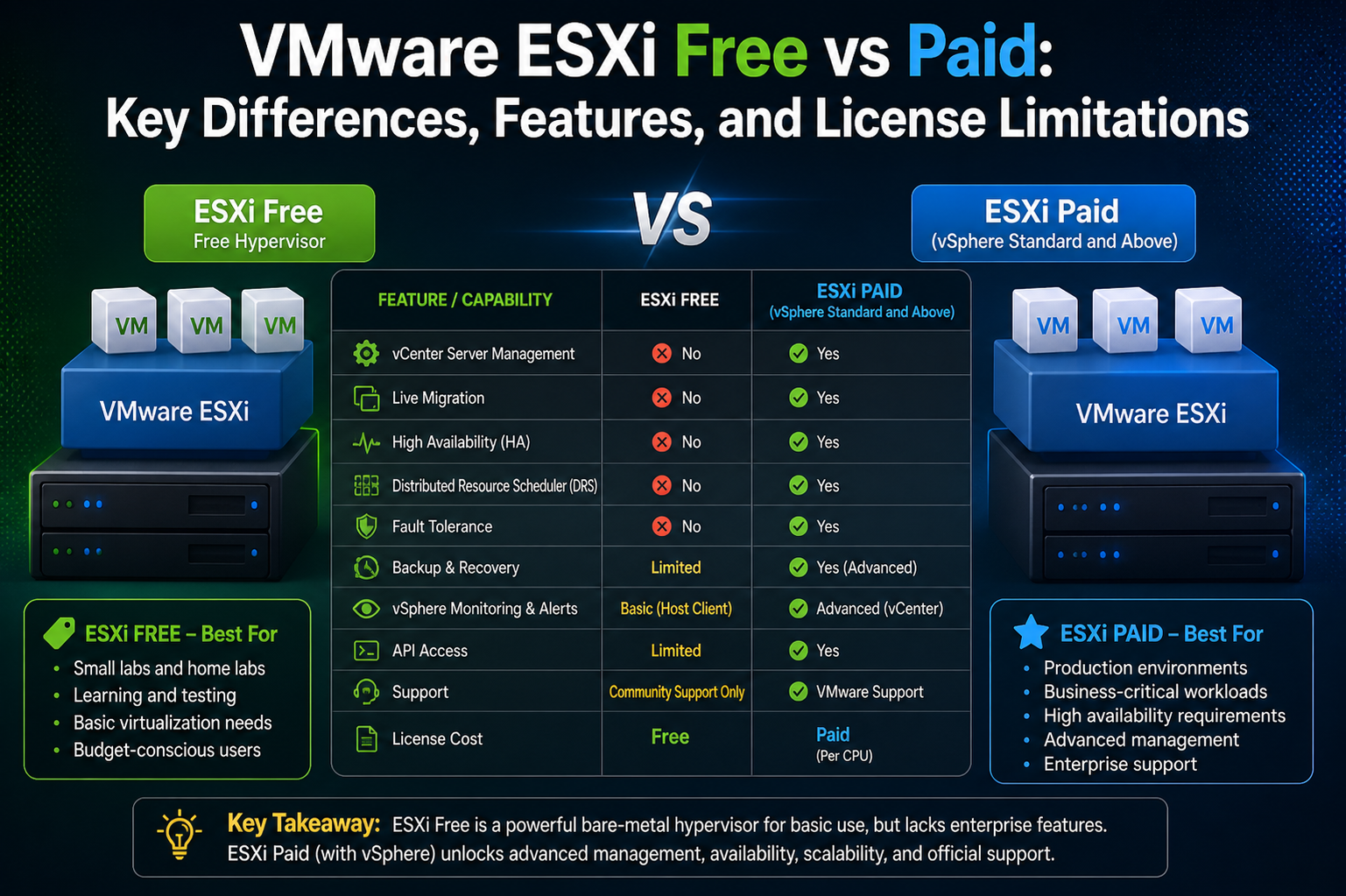
Modern data centers rely heavily on virtualization technologies to maximize efficiency, reduce hardware costs, and simplify infrastructure management. Instead of running a single operating system on a physical server, virtualization allows multiple independent systems to share the same hardware. Each of these systems operates as if it were running on its own dedicated machine, even though they are all hosted on a single physical server. At the center of this transformation is the hypervisor, a specialized software layer responsible for managing these virtual machines and ensuring they operate smoothly.
One of the most widely recognized hypervisors in enterprise computing environments is VMware ESXi. This platform has long been considered a cornerstone of virtualization infrastructure. Organizations across industries use it to host application servers, databases, development environments, and many other services. Its reliability and efficiency have made it a preferred choice for businesses seeking to consolidate workloads and optimize server utilization.
To understand the differences between the free and paid versions of VMware ESXi, it is important to first explore how the platform works and why it has become such a significant part of modern IT environments. The foundation of ESXi lies in its design as a bare-metal hypervisor. Unlike software that runs on top of an existing operating system, a bare-metal hypervisor installs directly onto physical hardware. Once installed, it takes control of the system’s CPU, memory, storage, and networking resources.
This direct interaction with hardware gives the hypervisor a high degree of efficiency. Virtual machines created on top of the hypervisor can access resources with minimal overhead. As a result, organizations can run multiple workloads on a single server while maintaining performance levels comparable to dedicated hardware systems. In practical terms, this means that a company that once required ten physical servers might now operate those same services on two or three powerful machines.
Virtual machines are the individual environments that run on top of the hypervisor. Each virtual machine behaves like a fully independent computer with its own operating system, applications, and configuration settings. A virtual machine can run operating systems such as Windows or Linux just like a traditional physical server. The hypervisor allocates portions of the physical server’s CPU, memory, and storage resources to each virtual machine, allowing them to operate simultaneously without interfering with one another.
This model offers significant advantages in terms of resource efficiency. In traditional server deployments, physical machines are often underutilized because they are dedicated to a single application or service. Virtualization allows multiple workloads to share the same hardware, ensuring that system resources are used more effectively. This approach reduces the number of physical servers required, lowering power consumption, cooling needs, and hardware maintenance costs.
Another advantage of virtualization is flexibility. Virtual machines can be created, modified, or removed quickly without needing new hardware. If an organization needs a new server for testing an application, a virtual machine can be deployed in minutes. When the testing is complete, that virtual machine can be deleted without leaving behind unused equipment. This level of agility has made virtualization essential for development teams, system administrators, and cloud service providers.
VMware ESXi serves as the engine that powers this entire process. Once installed on a physical server, it creates the environment in which virtual machines can run. Administrators can allocate resources to each virtual machine based on its requirements. For example, a database server might require more memory, while a web server might rely more heavily on CPU capacity. ESXi manages these allocations to ensure that each virtual machine receives the resources it needs.
In addition to managing hardware resources, ESXi also provides isolation between virtual machines. Even though multiple systems share the same physical hardware, they remain separated from each other at the hypervisor level. If one virtual machine experiences a crash or configuration issue, the others continue operating normally. This isolation improves reliability and prevents problems in one environment from affecting the entire server.
The architecture of ESXi is intentionally lightweight. Instead of including a full operating system with numerous background services, ESXi focuses specifically on virtualization functions. By minimizing unnecessary components, the platform reduces its attack surface and improves performance. This streamlined design also helps administrators maintain greater control over the virtualization environment.
For many years, VMware offered a free version of ESXi alongside its paid editions. The free version allowed individuals and organizations to install the same core hypervisor software without purchasing a license. This approach made it easier for users to experiment with virtualization technology or build small lab environments. Although the underlying hypervisor was identical to the enterprise editions, certain advanced capabilities were restricted in the free version.
Despite these restrictions, the free version of ESXi became extremely popular among technology enthusiasts and professionals who wanted to learn virtualization concepts. It allowed users to build home laboratories where they could experiment with different operating systems, test network configurations, and practice system administration tasks. Because the installation process was identical to the paid versions, users gained hands-on experience with the same technology used in enterprise data centers.
Small organizations also benefited from the availability of the free edition. Businesses with limited budgets could use it to consolidate servers and improve infrastructure efficiency without investing in enterprise licensing. For environments with only a few virtual machines, the basic hypervisor capabilities were often sufficient.
However, the free edition was designed primarily for limited scenarios rather than large production environments. While it allowed users to create and run virtual machines, several important features were unavailable. These limitations became increasingly noticeable as organizations expanded their virtual infrastructure. Tasks that were manageable in small deployments could become challenging when managing dozens or hundreds of virtual machines.
One of the defining aspects of the ESXi ecosystem is its integration with additional management tools. In enterprise environments, administrators rarely manage a single hypervisor host in isolation. Instead, they operate clusters of servers that host hundreds of virtual machines across multiple physical systems. Coordinating these systems requires centralized management tools that provide visibility and control across the entire infrastructure.
Within the virtualization ecosystem, centralized management platforms allow administrators to monitor performance, apply updates, configure networking, and manage storage resources across multiple hosts. These tools significantly simplify day-to-day operations. Without them, administrators would need to configure each hypervisor host individually, which can become time-consuming and error-prone.
The free edition of ESXi lacked integration with many of these advanced management capabilities. While it could run virtual machines effectively, it did not include the broader infrastructure management features required for large-scale environments. As a result, administrators often viewed it as suitable for experimentation or small deployments rather than mission-critical production systems.
In 2024, the availability of the free version of ESXi changed significantly when it was discontinued. This shift marked the end of a long period during which users could access the hypervisor without purchasing a license. The decision reflected broader changes in how virtualization platforms are packaged and delivered within the modern IT landscape.
Although the free edition is no longer available, understanding its role helps explain the differences between entry-level virtualization deployments and enterprise-grade infrastructure. The contrast between free and paid versions highlights the capabilities required for large-scale environments and the operational challenges that organizations face as their virtual infrastructure grows.
The story of ESXi, including both its free and paid forms, illustrates how virtualization has evolved over time. What began as a tool for consolidating servers has become the foundation of modern data centers and cloud computing platforms. Hypervisors now support thousands of virtual machines across global infrastructure networks, enabling organizations to deliver digital services with unprecedented flexibility and efficiency.
As virtualization technology continues to advance, the role of hypervisors remains central to IT infrastructure. Understanding how platforms like ESXi operate—and how licensing models affect their capabilities—provides valuable insight into the design and management of modern computing environments.
VMware ESXi Free vs Paid Edition Features, Limitations, and Licensing Differences
As virtualization became a core part of modern IT infrastructure, VMware ESXi evolved into one of the most trusted hypervisors for running enterprise workloads. While the core technology behind ESXi remains consistent across editions, the licensing model plays a major role in determining what features are available to users. Over time, VMware offered both free and paid versions of ESXi, each designed for different types of users and environments.
The free edition of ESXi was originally introduced to give individuals and small organizations access to enterprise-grade virtualization without upfront licensing costs. It allowed users to install the hypervisor directly on physical hardware and run virtual machines with basic functionality. Although this version used the same core engine as the paid editions, many advanced capabilities were intentionally restricted.
The paid versions of ESXi, on the other hand, are designed for enterprise environments where scalability, centralized management, high availability, and advanced automation are essential. These editions are typically integrated into a broader virtualization ecosystem that includes management tools and infrastructure services.
One of the most significant differences between free and paid ESXi lies in central management capabilities. In a paid environment, ESXi hosts are typically managed through a centralized system that allows administrators to control multiple servers from a single interface. This centralized management layer enables efficient monitoring, configuration, and maintenance of virtual infrastructure across multiple hosts.
Without this centralized management capability, the free version operates in isolation. Each ESXi host must be managed individually, which becomes increasingly inefficient as the number of servers grows. While this may not be an issue for small lab environments or testing setups, it becomes a major limitation in production environments where consistency and scalability are critical.
Another important difference involves advanced virtualization features such as live migration. In enterprise environments, virtual machines often need to move between physical hosts without downtime. This capability allows organizations to perform maintenance on servers, balance workloads, and ensure continuous service availability. Paid ESXi editions support this functionality, enabling virtual machines to be transferred between hosts while they remain operational.
The free edition does not support this type of live migration. As a result, virtual machines must remain on a single host, which limits flexibility and reduces resilience in case of hardware maintenance or failure. In environments where uptime is critical, this limitation becomes a significant constraint.
High availability is another key feature that distinguishes paid ESXi from the free version. In enterprise deployments, hardware failures are an unavoidable reality. Servers may experience unexpected issues due to hardware faults, power disruptions, or system crashes. High availability features ensure that when a physical host fails, virtual machines are automatically restarted on other available hosts within a cluster.
This automatic recovery process minimizes downtime and ensures that services remain accessible even during hardware failures. The free version of ESXi does not include this capability, meaning that if a host goes down, all virtual machines running on that host become unavailable until the issue is resolved.
Resource scalability also differs significantly between free and paid versions. While both editions allow users to run virtual machines, the free version imposes stricter limitations on hardware utilization and resource allocation. These restrictions can include limits on CPU usage, memory capacity, and the number of virtual machines that can run effectively.
Paid versions remove many of these constraints, allowing organizations to fully utilize modern server hardware. This is especially important in data center environments where servers may have large amounts of memory, multiple processors, and high-performance storage systems. Without licensing restrictions, enterprises can maximize their investment in hardware infrastructure.
Another area where paid ESXi versions provide added value is backup and data protection integration. Virtualization environments often require specialized backup methods that operate at the hypervisor level rather than within individual virtual machines. Paid ESXi editions support APIs that enable advanced backup solutions to interact directly with the hypervisor.
This approach allows backups to be performed more efficiently and with less impact on running systems. Instead of installing backup agents inside each virtual machine, data can be captured at the virtualization layer. The free version does not support these advanced interfaces, limiting backup options and making data protection more complex in larger environments.
Performance monitoring and optimization tools are also more advanced in paid versions of ESXi. In enterprise environments, administrators need detailed insights into how virtual machines and physical hosts are performing. This includes metrics such as CPU utilization, memory consumption, storage performance, and network activity.
Paid editions provide deeper integration with monitoring tools that collect and analyze this data across multiple hosts. These insights help administrators identify performance bottlenecks, optimize resource allocation, and ensure that workloads are distributed efficiently. Without these capabilities, managing performance in larger environments becomes more challenging.
Patch management and system updates are another area where differences are noticeable. In a large virtualization environment, keeping multiple ESXi hosts updated is essential for maintaining security and stability. Paid versions allow administrators to manage updates centrally, applying patches across multiple hosts in a coordinated manner.
This centralized update process reduces administrative effort and ensures consistency across the environment. In contrast, the free version requires manual updates on each individual host, which can be time-consuming and increases the risk of inconsistencies between systems.
Security features are also enhanced in paid ESXi editions. Enterprise environments require strict security controls to protect sensitive data and prevent unauthorized access. Paid versions support advanced authentication mechanisms, role-based access control, and integration with enterprise identity systems.
These features allow organizations to define precise access permissions for administrators and users, ensuring that only authorized individuals can make changes to the virtualization environment. The free version offers limited administrative control, making it less suitable for environments with strict security requirements.
Another important distinction is scalability in terms of infrastructure size. Paid ESXi versions are designed to support large clusters of physical servers working together as a unified system. These clusters can host hundreds or even thousands of virtual machines, distributed across multiple hosts.
The free version is not designed for such large-scale deployments. Its limitations make it more suitable for single-server setups or small-scale testing environments. As a result, organizations that require growth and expansion typically transition to paid licensing as their infrastructure needs increase.
Support availability is another major factor that differentiates free and paid ESXi. In enterprise environments, technical support is critical for maintaining uptime and resolving issues quickly. Paid licenses typically include access to professional support services, which provide assistance in troubleshooting, configuration, and performance optimization.
The free version does not include official support, meaning users must rely on community resources or internal expertise. While this may be sufficient for learning or experimentation, it is not ideal for production systems where rapid issue resolution is essential.
Despite these limitations, the free version of ESXi served an important role in the virtualization ecosystem. It allowed users to explore virtualization technology, build lab environments, and gain practical experience without financial investment. Many IT professionals used it as a learning platform to understand how virtual machines operate and how hypervisors manage system resources.
However, as IT infrastructures became more complex and enterprise requirements increased, the limitations of the free edition became more apparent. Organizations needed greater control, better scalability, and more advanced features to support modern workloads. This shift naturally led to increased adoption of paid ESXi editions.
Over time, VMware’s licensing strategy evolved alongside changes in the broader technology landscape. Virtualization is no longer just a standalone technology but a foundational layer for cloud computing, software-defined infrastructure, and hybrid environments. These advancements require tightly integrated systems that go beyond the capabilities of basic hypervisor functionality.
Paid ESXi editions are designed to support these modern environments by providing integration with advanced management systems, automation tools, and cloud infrastructure components. This allows organizations to build highly flexible and scalable virtual environments that can adapt to changing business needs.
As virtualization continues to evolve, the differences between free and paid editions highlight the growing importance of enterprise-grade features. While basic hypervisor functionality remains essential, modern IT environments demand much more than simple virtual machine hosting. They require intelligent management, automation, security, and scalability—all of which are primarily delivered through paid licensing models.
Real-World Use Cases, Migration Considerations, and Enterprise Adoption of VMware ESXi Licensing
As organizations expand their digital infrastructure, the choice between different virtualization licensing models becomes more than a technical decision. It becomes a strategic one that influences performance, scalability, operational efficiency, and long-term IT planning. VMware ESXi, as one of the most widely used hypervisors in enterprise environments, has played a central role in shaping how businesses approach server virtualization. Understanding how its free and paid editions are used in real-world scenarios helps clarify why enterprises eventually move toward licensed environments.
In practical deployments, the free version of ESXi was often used as an entry point into virtualization. Small businesses, students, and IT professionals frequently adopted it to explore how virtual machines operate without investing in licensing costs. It provided a functional environment where users could install operating systems, test applications, and simulate basic server setups. This made it especially valuable in learning environments, where understanding virtualization concepts is more important than scaling infrastructure.
Home labs were one of the most common use cases for the free edition. Many IT professionals built personal lab environments using spare hardware to simulate enterprise networks. Within these setups, ESXi allowed users to experiment with system administration tasks such as deploying virtual machines, configuring storage, and managing virtual networks. Even without advanced features, the free edition provided enough functionality to build a realistic learning environment.
Another common use case involved software testing and development. Developers often required isolated environments where they could deploy applications without affecting production systems. Virtual machines created through ESXi allowed them to test different operating systems, configurations, and application versions safely. Because virtual machines can be created and deleted quickly, development workflows became more flexible and efficient.
In some small-scale environments, the free version was also used for lightweight production workloads. Small businesses with limited budgets occasionally relied on a single ESXi host to run essential services such as file sharing, internal applications, or basic web hosting. While this approach could function in simple setups, it carried limitations that made it unsuitable for long-term enterprise growth.
As organizations expanded, the limitations of the free edition became more apparent. One of the first challenges encountered was the lack of centralized management. Managing individual hosts separately becomes increasingly difficult as the number of virtual machines grows. Without centralized visibility, administrators must manually configure each system, increasing the risk of inconsistency and configuration errors.
This operational complexity often becomes a driving factor in migration toward paid ESXi editions. Paid environments introduce centralized management tools that allow administrators to control multiple hosts from a single interface. This significantly improves operational efficiency, especially in environments with dozens or hundreds of virtual machines spread across multiple physical servers.
Another major factor influencing migration is scalability. As businesses grow, their computing demands increase. More applications, more users, and more data require additional virtual machines and physical infrastructure. Paid ESXi editions support larger clusters of hosts, allowing organizations to scale their environments without redesigning their architecture. This scalability ensures that infrastructure can grow alongside business needs.
High availability is another key reason organizations transition to paid licensing. In production environments, downtime can lead to financial loss, service disruption, and reduced customer satisfaction. Paid ESXi environments support features that automatically recover virtual machines when hardware failures occur. This ensures that services remain available even when individual servers experience issues.
For organizations running critical applications, this level of resilience is essential. Without high availability, a single hardware failure can result in multiple virtual machines becoming unavailable. Paid ESXi environments reduce this risk by distributing workloads across multiple hosts and enabling automatic recovery processes.
Data protection is another important consideration in migration decisions. Enterprise environments require reliable backup and recovery systems to protect against data loss. Paid ESXi editions support advanced integration with backup solutions that operate at the virtualization layer. This allows backups to be performed efficiently without placing additional load on individual virtual machines.
As organizations adopt more complex infrastructure, security requirements also increase. Paid ESXi environments provide stronger access control mechanisms, allowing administrators to define detailed permissions for different users. This ensures that only authorized personnel can modify configurations or access sensitive systems. In large organizations, this level of control is essential for maintaining compliance and protecting critical data.
Performance optimization is another area where paid editions provide significant advantages. In enterprise environments, virtual machines must share resources efficiently to avoid performance bottlenecks. Paid ESXi environments include advanced resource management features that dynamically allocate CPU, memory, and storage based on workload demands. This ensures that critical applications receive the resources they need while maintaining overall system balance.
Over time, organizations often adopt a phased migration approach when transitioning from free to paid ESXi environments. In the early stages, virtual machines may be running on isolated hosts with limited functionality. As infrastructure requirements grow, administrators begin introducing centralized management systems and additional hosts. This gradual transition allows organizations to scale their virtualization environment without disrupting existing workloads.
During migration, one of the first steps typically involves introducing centralized management software. Once this system is in place, multiple ESXi hosts can be connected and managed collectively. This shift immediately improves visibility and control over the entire virtual infrastructure. Administrators can then begin migrating workloads between hosts to balance performance and prepare for further scaling.
Another step in the migration process involves consolidating workloads. In many cases, multiple standalone ESXi hosts running the free edition are replaced with fewer, more powerful hosts managed under a paid licensing model. This consolidation improves efficiency and simplifies infrastructure management.
Organizations also benefit from improved monitoring capabilities after migration. Paid environments provide detailed insights into system performance, resource usage, and virtual machine behavior. This data helps administrators identify inefficiencies and optimize infrastructure for better performance and cost efficiency.
As virtualization continues to evolve, enterprises increasingly rely on ESXi as part of larger cloud and hybrid infrastructure strategies. Virtualization is no longer limited to on-premises data centers. Instead, it often forms the foundation for cloud integration, disaster recovery systems, and distributed computing environments. Paid ESXi editions are better suited for these advanced use cases because they offer the scalability and integration required for complex architectures.
Another important aspect of enterprise adoption is long-term operational stability. Paid ESXi environments are designed to support continuous operation with minimal disruption. Features such as centralized patch management, automated updates, and system monitoring ensure that infrastructure remains secure and up to date. This reduces administrative overhead and improves system reliability.
In contrast, the free version lacks these enterprise-focused capabilities, making it more suitable for temporary or non-critical environments. While it served an important role in introducing users to virtualization technology, its limitations become more pronounced as infrastructure requirements increase.
Ultimately, the decision to move from free to paid ESXi licensing is driven by the need for scalability, reliability, security, and operational efficiency. As organizations grow, their infrastructure must evolve to support increasing demands. Paid ESXi editions provide the tools necessary to manage this complexity effectively, enabling businesses to build stable and scalable virtual environments that support modern digital operations.
Through real-world usage patterns and migration strategies, it becomes clear that ESXi licensing is not just about cost differences. It reflects the level of control, resilience, and scalability required to operate in increasingly complex IT environments.
Enterprise Architecture, Operational Challenges, and the Future of VMware ESXi Licensing
As virtualization becomes deeply embedded in modern IT infrastructure, the role of hypervisors extends far beyond simply running virtual machines. In enterprise environments, platforms like VMware ESXi form the foundation of entire digital ecosystems that support business applications, cloud services, data storage systems, and remote operations. This evolution has significantly influenced how organizations design their infrastructure and why licensing models have become a critical part of strategic planning.
In large-scale environments, VMware ESXi is rarely deployed as a standalone system. Instead, it is integrated into a broader virtualization architecture that includes multiple physical hosts, shared storage systems, network virtualization layers, and centralized management platforms. This interconnected structure allows organizations to operate hundreds or even thousands of virtual machines across distributed hardware while maintaining centralized control and visibility.
One of the key architectural principles in enterprise virtualization is clustering. A cluster is a group of ESXi hosts that work together as a unified resource pool. Within a cluster, virtual machines can be distributed across multiple physical servers based on workload demands. This improves resource utilization and ensures that no single server becomes overloaded. Clustering also enables advanced features such as workload balancing and automated recovery, which are only available in paid ESXi environments.
In a properly designed enterprise architecture, centralized management plays a critical role. Administrators rely on management systems to coordinate all ESXi hosts within the environment. These systems provide a single point of control for configuring virtual machines, managing storage, monitoring performance, and applying updates. Without centralized management, operating large-scale virtualization environments would be extremely difficult and error-prone.
Another important architectural component is shared storage. In clustered environments, virtual machines often need to move between physical hosts without interruption. To support this, multiple ESXi hosts access the same storage systems. This allows virtual machine data to remain accessible regardless of which host is currently running the workload. Shared storage is essential for enabling advanced mobility features and maintaining high availability in enterprise environments.
While these architectural designs provide significant benefits, they also introduce operational challenges. One of the most common challenges is complexity. As virtualization environments grow, managing resources across multiple hosts becomes increasingly difficult. Administrators must ensure that configurations remain consistent, performance is optimized, and security policies are enforced across all systems.
Another challenge involves resource contention. In shared environments, multiple virtual machines compete for CPU, memory, and storage resources. If not properly managed, this can lead to performance degradation. Paid ESXi environments address this issue through advanced resource scheduling mechanisms that allocate resources dynamically based on workload priorities. These mechanisms help maintain stable performance even under heavy load.
Security management is another operational concern in large virtualization environments. With many virtual machines running on shared infrastructure, maintaining strict access control is essential. Enterprise ESXi deployments rely on centralized identity management systems and role-based access controls to ensure that only authorized users can modify critical configurations. This reduces the risk of unauthorized changes and improves overall system integrity.
Patch management also becomes more complex as infrastructure scales. Each ESXi host must be kept up to date to ensure security and compatibility. In large environments, manually updating each host would be inefficient and time-consuming. Paid ESXi environments provide centralized update mechanisms that allow administrators to apply patches across multiple hosts simultaneously. This ensures consistency and reduces administrative overhead.
Another operational challenge involves monitoring and troubleshooting. In distributed environments, identifying the source of performance issues can be difficult without proper visibility tools. Enterprise virtualization platforms provide detailed monitoring capabilities that allow administrators to track system performance, analyze resource usage, and identify bottlenecks. This visibility is essential for maintaining stable operations and resolving issues quickly.
As virtualization technology continues to evolve, organizations are also adopting hybrid and cloud-based infrastructures. In these environments, ESXi often serves as the foundation for integrating on-premises systems with cloud platforms. This allows businesses to extend their infrastructure beyond physical data centers while maintaining centralized control over virtual machines.
The shift toward hybrid environments has further increased the importance of advanced ESXi features. Workloads may need to move between local servers and cloud environments depending on demand, cost, or availability. Paid ESXi licensing supports the flexibility required for these dynamic environments, enabling seamless integration and workload portability.
Another trend shaping the future of virtualization is automation. Modern IT environments increasingly rely on automated processes to manage routine tasks such as provisioning, scaling, and resource allocation. ESXi environments with advanced licensing support integration with automation systems that reduce manual intervention and improve operational efficiency.
Automation allows virtual machines to be deployed automatically based on predefined templates, ensuring consistency across environments. It also enables dynamic scaling, where additional resources are allocated automatically when demand increases. This reduces the need for manual administration and helps organizations respond more quickly to changing workloads.
The evolution of virtualization has also influenced how licensing models are structured. The discontinuation of free ESXi reflects a broader shift toward integrated, enterprise-focused solutions. Modern virtualization environments are designed to operate as part of larger ecosystems rather than isolated systems. As a result, licensing models increasingly emphasize centralized management, scalability, and cloud integration.
For organizations, this shift means that virtualization is no longer just a technical decision but a strategic one. Choosing the right licensing model directly impacts infrastructure design, operational efficiency, and long-term scalability. Paid ESXi environments provide the flexibility needed to support growing workloads and evolving business requirements.
Looking ahead, virtualization is expected to continue evolving alongside cloud computing, edge computing, and containerized workloads. While ESXi remains a core component of many infrastructures, it is increasingly part of a broader ecosystem that includes multiple layers of abstraction and orchestration.
In this context, enterprise virtualization platforms will continue to focus on integration, automation, and scalability. Licensing models will likely evolve further to support these trends, emphasizing flexibility and centralized control. Organizations that rely on virtualization will need to adapt their infrastructure strategies to align with these developments.
Ultimately, VMware ESXi remains a foundational technology in modern IT architecture. Its role has expanded from simple virtual machine hosting to supporting complex, distributed, and cloud-integrated environments. The differences between free and paid editions highlight the growing demands of enterprise infrastructure and the need for advanced capabilities to manage them effectively.
As virtualization continues to advance, the importance of scalable, secure, and centrally managed environments will only increase. ESXi, particularly in its licensed forms, will remain a key component in enabling organizations to build resilient and efficient digital infrastructures capable of supporting future technological demands.
Performance, Resource Management, and Practical Decision-Making in VMware ESXi Licensing
In real-world virtualization environments, performance and resource management are just as important as features and licensing options. While VMware ESXi provides the core hypervisor technology needed to run virtual machines efficiently, the way resources are managed across hosts often determines how well an infrastructure performs under load. This is also where the differences between free and paid ESXi editions become more visible, especially in environments that are moving beyond basic usage and into production-scale operations.
At the heart of ESXi performance management is the concept of resource allocation. Every virtual machine running on an ESXi host depends on shared physical resources such as CPU, memory, disk, and network bandwidth. The hypervisor is responsible for dividing these resources among all active virtual machines in a way that ensures stability and fairness. In small environments, this process is relatively simple, but as the number of virtual machines grows, efficient resource scheduling becomes more complex and important.
Paid versions of ESXi provide advanced resource management features that help administrators control how resources are distributed. These tools allow priority-based allocation, meaning that critical virtual machines can be guaranteed more CPU or memory resources than less important workloads. This becomes essential in enterprise environments where some applications, such as databases or business systems, require consistent performance regardless of overall system load.
The free version of ESXi, while capable of running virtual machines, lacks many of these advanced controls. As a result, resource management is more limited and relies heavily on default hypervisor behavior. In small or non-critical environments, this may not create noticeable issues. However, in environments where multiple workloads compete for limited resources, performance inconsistencies can occur.
Another important aspect of performance in ESXi environments is memory optimization. The hypervisor uses techniques such as memory sharing and ballooning to ensure that physical memory is used efficiently. In paid enterprise environments, these mechanisms are combined with cluster-wide resource awareness, allowing multiple hosts to coordinate memory usage more effectively. This coordination helps prevent situations where one host becomes overloaded while others remain underutilized.
Storage performance is another critical factor in virtualization environments. Virtual machines depend heavily on storage systems for reading and writing data. In enterprise ESXi setups, shared storage systems are often used to support multiple hosts. Paid licensing enables advanced storage management features that help balance I/O workloads and optimize disk performance across the environment. Without these capabilities, storage bottlenecks can become a limiting factor in overall system performance.
Network performance also plays a key role in virtualization efficiency. Virtual machines communicate with each other and with external systems through virtual and physical network interfaces. Enterprise ESXi environments provide advanced networking features that allow administrators to segment traffic, prioritize bandwidth, and optimize network flow. These capabilities are particularly important in data centers where large volumes of traffic are processed continuously.
When comparing free and paid ESXi editions, performance differences are not always immediately visible in small deployments. A single host running a few virtual machines may perform similarly under both versions. However, as workloads increase and infrastructure becomes more complex, the limitations of the free edition become more apparent. The absence of centralized resource coordination and advanced performance tools can lead to inefficiencies that impact overall system stability.
This is why practical decision-making in virtualization environments often involves long-term planning rather than short-term functionality. Organizations must evaluate not only their current needs but also their future growth expectations. A system that works well for a small environment today may become difficult to manage as demand increases. Choosing a licensing model that supports scalability is therefore an important strategic consideration.
In many cases, organizations begin with basic or limited virtualization setups to reduce initial costs. Over time, as the number of virtual machines grows and operational requirements become more demanding, they transition toward paid ESXi environments. This transition allows them to introduce centralized management, improve performance control, and implement advanced features that support enterprise-level operations.
Another factor influencing this decision is operational efficiency. Managing multiple standalone ESXi hosts without centralized tools can require significant manual effort. Administrators must log into each system individually to monitor performance, apply updates, or adjust configurations. This approach not only increases workload but also raises the risk of inconsistencies across the environment. Paid ESXi environments reduce this burden by providing centralized control, allowing administrators to manage multiple hosts from a single interface.
Ultimately, the choice between free and paid ESXi is not just about cost or features, but about aligning virtualization infrastructure with organizational needs. While the free version may be sufficient for learning, testing, or small-scale usage, it lacks the performance optimization and scalability required for growing environments. Paid editions, on the other hand, provide the tools necessary to manage complex infrastructures efficiently and reliably.
As virtualization continues to play a central role in modern IT systems, understanding how performance and resource management differ across licensing models becomes increasingly important. Organizations that anticipate growth or require stable, high-performance environments typically find that investing in licensed ESXi infrastructure provides long-term operational benefits that outweigh initial costs.
Conclusion
VMware ESXi has established itself as one of the most important technologies in modern virtualization, forming the backbone of countless data centers and IT infrastructures worldwide. Its ability to run multiple virtual machines on a single physical server has transformed how organizations design, deploy, and manage computing resources. By abstracting hardware into flexible virtual environments, ESXi enables businesses to achieve higher efficiency, better resource utilization, and improved operational agility.
The comparison between free and paid ESXi editions highlights how licensing directly influences capability and scalability. The free version once served as an accessible entry point for individuals, students, and small-scale environments. It provided a practical way to learn virtualization concepts, experiment with system configurations, and run basic workloads without financial investment. However, its limitations in centralized management, scalability, performance optimization, and enterprise integration made it unsuitable for complex or production-level environments.
Paid ESXi editions, in contrast, are designed for enterprise-grade infrastructure where reliability, performance, and control are essential. Features such as centralized management, high availability, advanced resource scheduling, and integrated backup support enable organizations to operate large-scale virtual environments efficiently. These capabilities are critical in modern IT systems where downtime, inefficiency, or misconfiguration can have significant operational and financial consequences.
As virtualization environments grow, the importance of structured resource management and system coordination becomes increasingly clear. Paid ESXi environments provide the tools necessary to maintain stability across clusters of hosts while supporting workload distribution, security enforcement, and system monitoring. This ensures that organizations can scale their infrastructure without sacrificing performance or reliability