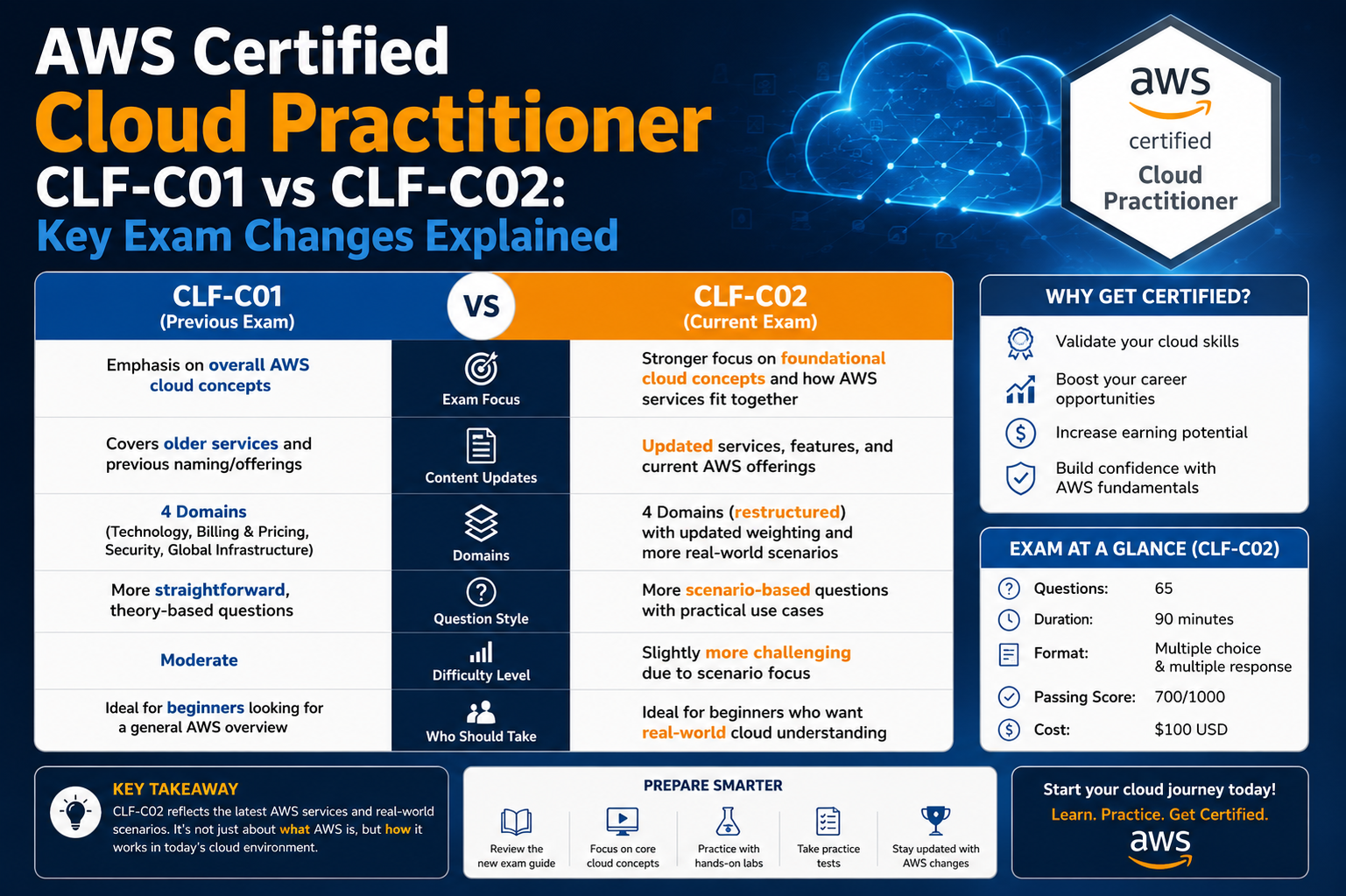
Cloud computing has transformed the way businesses build, manage, and scale technology. Over the last decade, organizations of every size have adopted cloud services to improve flexibility, reduce infrastructure costs, and accelerate innovation. As cloud platforms continue to evolve, certifications designed to validate cloud knowledge must also change. This is exactly why the AWS Certified Cloud Practitioner exam moved from the CLF-C01 version to the updated CLF-C02 version.
The Cloud Practitioner certification has long been considered the starting point for people entering the world of cloud computing. Unlike advanced certifications that focus heavily on engineering, architecture, or specialty skills, this exam was created to provide a broad understanding of cloud concepts, AWS services, security principles, and billing models. It acts as an introduction to the AWS ecosystem while helping learners develop familiarity with the language and ideas used in modern cloud environments.
When the CLF-C01 exam was first introduced, it focused on foundational cloud knowledge. At that time, AWS already offered a large number of services, but many of the newer innovations that dominate today’s cloud conversations were either still developing or not yet widely adopted. Topics such as machine learning integration, advanced security monitoring, serverless computing at scale, and intelligent automation had not yet become central areas of focus for entry-level learners.
As businesses began migrating more workloads to the cloud, expectations changed. Organizations no longer wanted employees to simply recognize basic AWS terminology. They needed people who could understand modern cloud operations, security responsibilities, scalability concepts, and the growing ecosystem of services used in real-world environments. The CLF-C02 exam was introduced to reflect these changing expectations.
Although the new version still serves as an entry-level certification, it places stronger emphasis on practical awareness and broader service familiarity. Instead of focusing only on core concepts, the updated exam introduces candidates to technologies and solutions that are now common across industries. This change helps ensure that certified individuals possess knowledge that aligns more closely with current cloud practices.
Why AWS Updated the Exam Structure
Certification exams are not static. Cloud platforms evolve constantly, and AWS introduces new services and improvements at an extremely rapid pace. A certification that remains unchanged for too long can eventually become outdated. As businesses adopt new technologies, certification objectives must adapt to ensure that learners remain relevant in the job market.
The shift from CLF-C01 to CLF-C02 was driven by several important factors. One of the most significant reasons was the increasing complexity of cloud environments. Organizations today rely on interconnected systems that combine networking, automation, analytics, machine learning, storage, and security services. Even entry-level professionals are expected to understand how these technologies fit together.
Another reason for the update was the growing importance of cybersecurity and governance. Cloud security concerns have become more prominent as organizations move sensitive workloads and customer data into cloud environments. Companies now prioritize identity management, compliance awareness, monitoring, and shared responsibility concepts more than ever before.
AWS also recognized the need to modernize the service coverage included in the exam. The CLF-C01 version focused heavily on traditional foundational services such as Amazon EC2, Amazon S3, and basic networking. While these services remain important, they no longer represent the full picture of cloud computing. Modern applications increasingly rely on serverless technologies, managed containers, automated scaling, and intelligent storage optimization.
The CLF-C02 exam therefore expands its focus to include a broader range of cloud services. Candidates are now expected to understand the purpose of newer tools and how they support real-world business solutions. This does not mean the exam suddenly became deeply technical. Instead, it encourages a more practical understanding of how AWS services are used together.
How the Domain Weighting Changed
One of the clearest differences between the old and new exams can be seen in the domain weighting adjustments. The overall exam structure remains similar, but the percentage allocated to each topic area has shifted to reflect modern cloud priorities.
The Cloud Concepts domain still forms a major portion of the exam, though its percentage weight has been slightly reduced. This indicates that foundational understanding remains important, but AWS now expects candidates to spend more time understanding practical services and security principles.
Security and Compliance experienced one of the largest increases in importance. This change highlights how critical cloud security has become in modern IT operations. Businesses today must comply with regulations, protect customer information, and manage access controls carefully. Because of this, AWS expects Cloud Practitioner candidates to understand more than just basic security terminology.
The Technology domain was expanded and renamed to better reflect the broader range of cloud services covered in the updated exam. This new focus includes modern infrastructure services, serverless solutions, and cloud-native technologies that are commonly used in scalable environments.
Billing and Pricing now receives slightly less emphasis than before. Cost management remains an important topic, but AWS appears to prioritize broader operational understanding over memorizing pricing structures. Candidates are still expected to understand pricing models, budgeting tools, and cost optimization concepts, but these topics no longer dominate the exam in the same way.
These changes collectively show that AWS wants entry-level certification holders to possess a more balanced understanding of cloud computing. Instead of focusing heavily on one area, the CLF-C02 exam encourages familiarity with security, operations, architecture awareness, and service integration.
The Growing Importance of Security Knowledge
One of the most noticeable shifts in the updated exam is the increased attention given to security and compliance. Security is no longer viewed as a specialized topic reserved only for cybersecurity teams. In modern cloud environments, everyone involved with cloud services must understand at least the fundamentals of protecting systems and data.
The Shared Responsibility Model is now emphasized more heavily in the CLF-C02 exam. This concept explains how security responsibilities are divided between AWS and the customer. AWS is responsible for securing the underlying infrastructure, while customers are responsible for securing their data, applications, configurations, and access permissions.
Understanding this model is essential because many cloud security incidents occur due to customer misconfigurations rather than failures in the cloud provider’s infrastructure. Candidates are expected to understand where AWS responsibility ends and where customer responsibility begins.
Identity and Access Management has also become a central topic in the updated exam. Modern organizations rely heavily on role-based access control to ensure that employees only have access to the systems and resources they need. Candidates must understand concepts such as users, groups, permissions, policies, and temporary credentials.
The increased emphasis on monitoring and threat detection services also reflects current industry trends. Businesses today must continuously monitor cloud environments for suspicious activity and potential security risks. Services related to threat detection, compliance monitoring, and security visibility are now more prominent within the certification objectives.
This stronger security focus benefits learners because it introduces important best practices early in their cloud journey. Even individuals pursuing non-technical roles can benefit from understanding how security principles influence cloud operations.
How Cloud Concepts Became More Business-Oriented
Although the updated exam includes broader service coverage, cloud concepts remain an important foundation. However, the way these concepts are presented has evolved.
The CLF-C02 exam places greater emphasis on how cloud technologies support business goals. Instead of focusing solely on technical definitions, the updated objectives encourage candidates to understand why organizations adopt cloud computing and how cloud services solve operational challenges.
One important addition is the AWS Cloud Adoption Framework. This framework helps organizations plan and manage cloud adoption strategies. It recognizes that cloud transformation involves more than just technology. Successful adoption also depends on governance, operations, people, business processes, and security planning.
Candidates are expected to understand the purpose of this framework and the general perspectives it includes. This reflects AWS’s effort to position cloud computing as both a technical and organizational transformation.
The updated exam also reinforces concepts such as scalability, elasticity, agility, and reliability. These ideas form the backbone of cloud computing and help explain why organizations migrate workloads away from traditional infrastructure.
Scalability refers to the ability of systems to handle increasing demand. Elasticity focuses on automatically adjusting resources based on workload requirements. Agility describes how quickly organizations can develop and deploy solutions using cloud services. Reliability emphasizes system availability and fault tolerance.
By understanding these concepts in practical business contexts, candidates develop a clearer picture of how cloud computing supports innovation and operational efficiency.
The Expansion of Cloud Services in the Exam
The AWS ecosystem has grown enormously over the years. While the CLF-C01 exam introduced learners to core services, the CLF-C02 version broadens that exposure significantly.
Modern cloud environments often rely on managed services that reduce operational overhead. AWS increasingly encourages customers to adopt serverless and managed solutions instead of maintaining traditional infrastructure manually.
As a result, the updated exam includes greater emphasis on services associated with serverless computing. Candidates are expected to understand how serverless architecture allows developers to run applications without managing physical servers directly.
This change reflects a broader industry trend toward automation and simplified infrastructure management. Organizations value solutions that reduce maintenance effort while improving scalability and efficiency.
Container technologies also receive more attention in the updated exam. Businesses increasingly use containers to package and deploy applications consistently across environments. While the exam does not require deep technical expertise, learners should understand the purpose of managed container services and how they fit into cloud-native architectures.
Storage services have also evolved significantly. Modern storage solutions include intelligent tiering and automated optimization capabilities that help organizations reduce costs while maintaining performance. The updated exam reflects these innovations by covering newer storage management concepts.
Networking awareness has similarly expanded. Candidates are now expected to recognize advanced networking solutions designed to improve connectivity between cloud environments, data centers, and global applications.
These additions help align the certification with the realities of modern cloud operations.
Machine Learning and Artificial Intelligence Enter the Conversation
One of the biggest signs of changing industry priorities is the inclusion of machine learning and artificial intelligence services in the CLF-C02 exam.
In earlier years, AI and ML technologies were often considered advanced topics reserved for specialists. Today, however, businesses across many industries use machine learning tools for automation, analytics, personalization, image recognition, speech processing, and customer service improvements.
AWS now expects Cloud Practitioner candidates to possess a basic awareness of these services and their business use cases. This does not mean candidates must understand complex machine learning algorithms. Instead, they should recognize how AWS provides managed services that make AI capabilities accessible to organizations.
For example, image recognition services can analyze photos and videos to identify objects, people, or patterns. Speech services can convert text into natural-sounding speech for customer interaction systems. Machine learning platforms allow developers and data scientists to build predictive models more efficiently.
The inclusion of these topics demonstrates how cloud computing continues to evolve beyond simple infrastructure hosting. Modern cloud platforms now support advanced innovation across countless industries.
Why CLF-C02 Better Reflects Modern Cloud Careers
The updated exam aligns more closely with the realities of modern cloud-related roles. In the past, entry-level cloud knowledge often centered on infrastructure basics. Today, cloud professionals work in environments that combine automation, security, analytics, managed services, and cross-functional collaboration.
Even non-technical employees frequently interact with cloud systems in some capacity. Business managers may oversee cloud projects. Financial analysts may evaluate cloud costs. Support teams may assist with cloud-based applications. Security personnel may monitor compliance and access management.
Because cloud computing touches so many business areas, the updated certification encourages broader awareness rather than narrow memorization. Candidates who prepare for the CLF-C02 exam gain exposure to concepts that appear throughout real cloud environments.
This broader focus makes the certification more valuable as a foundational credential. It introduces learners to the language, services, and principles that dominate cloud discussions across industries.
The exam also reflects how AWS wants cloud literacy to become more widespread. Organizations increasingly expect employees to understand at least the basics of cloud operations, regardless of whether they work directly in IT.
The Shift Toward Practical Awareness
One subtle but important change in the CLF-C02 exam is the emphasis on practical understanding instead of simple memorization.
The earlier exam version often focused on identifying services and recalling basic definitions. The updated version still includes foundational questions, but it also introduces more scenario-based thinking.
Candidates may encounter questions that ask which service best fits a particular business requirement or operational need. This encourages learners to understand the purpose of AWS services rather than simply memorizing names.
For example, instead of only identifying what a storage service does, candidates might need to recognize which storage option is most cost-effective for infrequently accessed data. Instead of merely defining identity management, they may need to identify the best approach for controlling temporary access.
This practical orientation better prepares learners for real-world cloud conversations. Businesses care less about whether someone can recite definitions and more about whether they understand how cloud solutions support operational goals.
The CLF-C02 exam therefore serves as both a certification and an introduction to cloud decision-making.
Exploring the New Topics and Services in CLF-C02
The transition from CLF-C01 to CLF-C02 introduced a wider range of AWS services into the certification objectives. This expansion reflects the growing complexity of cloud computing environments and the increasing number of tools organizations rely on daily. While the original exam focused primarily on foundational infrastructure services, the updated version acknowledges that cloud operations now extend far beyond virtual servers and basic storage.
Modern businesses depend on integrated ecosystems that combine automation, scalability, monitoring, analytics, networking, and security. As a result, the CLF-C02 exam was designed to expose learners to a broader overview of the AWS platform.
This change does not mean the certification became overwhelmingly technical. The exam remains accessible to beginners, but candidates are expected to recognize more services and understand their practical purposes. Instead of deeply configuring these services, learners should know when and why organizations use them.
The broader service coverage makes the certification more reflective of real-world cloud environments. Companies today rarely rely on just a few isolated cloud tools. They combine many AWS services together to build scalable and resilient systems.
The Increasing Focus on Serverless Computing
One of the biggest additions to the updated exam is the stronger emphasis on serverless computing. Over the last several years, serverless architecture has become one of the most important trends in cloud technology.
Traditional infrastructure management often requires organizations to provision, maintain, and scale servers manually. This process can consume time and resources, especially when traffic levels fluctuate unpredictably.
Serverless computing changes this model by allowing developers to run applications and services without managing physical or virtual servers directly. AWS automatically handles infrastructure provisioning, scaling, and maintenance behind the scenes.
The CLF-C02 exam introduces candidates to this concept more thoroughly than the older version. Learners are expected to understand why businesses adopt serverless solutions and how these services support efficiency and agility.
AWS Lambda represents one of the most important examples of serverless computing. It allows code to run in response to events without requiring dedicated server management. This enables organizations to build scalable applications while paying only for the compute time they actually use.
The updated exam also highlights the operational advantages of serverless systems. These include reduced maintenance requirements, faster deployment cycles, automatic scaling, and improved cost flexibility.
Businesses increasingly prefer serverless architectures because they allow development teams to focus on building applications instead of managing infrastructure. This shift toward abstraction reflects the broader direction of cloud computing itself.
The Role of Containers in Modern Cloud Applications
Another area that gained importance in the CLF-C02 exam is containerization. Containers have become widely used across the software industry because they allow applications to run consistently across different environments.
A container packages an application together with its dependencies, libraries, and runtime components. This ensures that the application behaves the same way regardless of where it is deployed.
Organizations use containers to improve portability, simplify deployment, and support modern development practices such as continuous integration and continuous delivery.
The updated exam introduces candidates to managed container services within AWS. While deep technical expertise is not required, learners should understand the purpose of container orchestration and why businesses use managed solutions instead of configuring everything manually.
Containers are especially important in microservices architectures, where applications are divided into smaller independent components. This approach improves scalability and flexibility because each component can be updated or scaled separately.
By including container awareness in the exam, AWS acknowledges that cloud-native application design has become mainstream. Even entry-level cloud professionals are now expected to recognize how containers fit into modern infrastructure strategies.
Storage Services Became More Sophisticated
Storage remains one of the foundational areas of cloud computing, but the CLF-C02 exam reflects how storage technologies have evolved.
Earlier versions of the certification focused mainly on core storage services and basic storage concepts. While these services are still important, the updated exam introduces candidates to more advanced storage optimization strategies.
Organizations today generate enormous amounts of data, ranging from customer records and analytics data to backups and media content. Managing this data efficiently requires storage solutions that balance performance, availability, and cost.
One important addition involves intelligent storage tiering. Modern storage services can automatically move data between pricing tiers based on access patterns. Frequently accessed data remains in faster storage classes, while rarely accessed data shifts to lower-cost tiers.
This approach helps organizations optimize expenses without sacrificing accessibility. Candidates preparing for the updated exam should understand why businesses adopt intelligent storage management and how cloud providers simplify this process.
The updated certification also reinforces the importance of durability, availability, and backup strategies. Cloud storage is not simply about saving files. Organizations must ensure that data remains protected, recoverable, and accessible across multiple environments.
Because cloud storage plays such a central role in digital transformation, AWS expanded its storage-related content to better match real operational requirements.
Networking Concepts Expanded Beyond the Basics
Networking has always been a key component of cloud computing, but the CLF-C02 exam introduces broader networking awareness than the earlier version.
The original exam primarily emphasized foundational networking concepts such as virtual private clouds and basic connectivity. The updated exam expands this scope to include more advanced networking services designed for modern enterprise environments.
Today’s organizations often operate hybrid infrastructures that combine cloud systems with on-premises data centers. They may also support global applications serving users across multiple geographic regions.
Because of this, AWS now expects candidates to understand how advanced networking services improve performance, reliability, and connectivity.
Global traffic routing services, accelerated networking solutions, and centralized connectivity architectures have become increasingly important in large-scale cloud environments.
The updated exam also highlights hybrid networking concepts more heavily. Many organizations continue using a combination of traditional infrastructure and cloud resources during long-term migration processes.
Understanding how cloud networks connect securely to on-premises systems is therefore an important area of cloud literacy.
Although the certification does not require deep networking configuration skills, candidates should recognize the purpose and benefits of these services.
Security Services Now Receive Greater Attention
Security services occupy a much larger role in the CLF-C02 exam than they did in the previous version. This reflects how cybersecurity concerns have become central to cloud adoption strategies.
Modern organizations face constant security challenges, including unauthorized access attempts, data breaches, compliance requirements, and operational vulnerabilities. Cloud providers now offer extensive managed security tools to help organizations monitor and protect their environments.
The updated exam introduces candidates to a broader range of security services focused on threat detection, compliance visibility, and automated monitoring.
Threat detection services analyze cloud activity to identify suspicious behavior and potential attacks. Security monitoring tools aggregate findings from multiple services to provide centralized visibility. Investigative tools help organizations examine unusual activity patterns and improve incident response.
AWS wants Cloud Practitioner candidates to understand the purpose of these services and recognize how they support secure cloud operations.
The increased security emphasis also reflects the reality that security is no longer isolated within specialized teams. Employees across departments must understand at least the basics of cloud security responsibilities.
By introducing these concepts at the foundational certification level, AWS encourages broader security awareness throughout the workforce.
The Rising Importance of Identity Management
Identity and access management became significantly more important in the updated exam. This change aligns with broader industry trends emphasizing zero-trust security models and least-privilege access principles.
Cloud environments often involve large numbers of users, applications, devices, and automated systems interacting with resources. Without proper access controls, organizations risk exposing sensitive systems and data.
The CLF-C02 exam therefore emphasizes concepts related to authentication, authorization, and permission management.
Candidates are expected to understand how organizations use identities, groups, policies, and roles to control access to cloud resources.
Temporary credentials also receive greater attention because modern cloud systems frequently rely on short-term access instead of permanent credentials. This approach improves security by reducing long-term exposure risks.
The updated exam highlights best practices associated with identity management, including minimizing excessive permissions and implementing multi-factor authentication.
These concepts are essential because access management mistakes remain one of the leading causes of cloud security incidents.
Machine Learning Services Became Part of Foundational Knowledge
One of the most noticeable additions to the CLF-C02 exam is the introduction of machine learning and artificial intelligence services.
Machine learning was once considered a highly specialized field requiring advanced technical expertise. However, cloud platforms have made AI tools far more accessible through managed services.
Businesses now use machine learning technologies across industries for tasks such as recommendation systems, fraud detection, image analysis, predictive analytics, and conversational interfaces.
AWS responded to this industry shift by incorporating awareness of AI services into the foundational certification.
Candidates preparing for the exam should understand the general purpose of key machine learning services and recognize common use cases.
For example, image analysis services can identify objects, text, and faces within media files. Speech services can convert written text into natural voice output. Managed machine learning platforms simplify the process of building predictive models.
The inclusion of these topics reflects how AI has become deeply integrated into cloud computing rather than existing as a completely separate discipline.
AWS wants even entry-level cloud professionals to recognize how organizations use intelligent services to improve customer experiences and operational efficiency.
Cost Management Tools Evolved Beyond Basic Pricing
Although billing and pricing receive slightly less weight in the updated exam, the content itself has become more modern and practical.
Earlier versions of the certification focused heavily on traditional pricing models such as on-demand usage and reserved capacity. While these topics remain important, AWS now expects candidates to understand broader cost optimization strategies.
Organizations increasingly use budgeting tools, spending analysis platforms, and flexible pricing models to control cloud expenses.
The updated exam introduces candidates to services that help businesses monitor usage trends, forecast costs, and manage budgets proactively.
Savings-focused pricing models also play a larger role in the updated objectives. These approaches allow organizations to reduce expenses by committing to long-term resource usage patterns.
Cost optimization has become an essential part of cloud operations because unmanaged cloud spending can increase rapidly in large environments.
The updated exam therefore encourages learners to think about cloud economics more strategically rather than viewing pricing as a collection of isolated numbers.
Monitoring and Operational Visibility Became More Important
Cloud environments require continuous monitoring to maintain performance, reliability, and security. The CLF-C02 exam reflects this operational reality by introducing broader awareness of monitoring concepts.
Modern organizations rely on observability tools to track system health, application performance, and resource utilization.
Monitoring services help teams detect problems early, analyze operational trends, and respond to incidents quickly.
The updated exam introduces candidates to the idea that cloud operations involve constant visibility and measurement.
Operational monitoring also supports scalability planning and cost optimization. By analyzing usage patterns, organizations can identify inefficiencies and adjust resources appropriately.
The inclusion of monitoring concepts reflects how cloud computing has evolved from static infrastructure management into dynamic operational ecosystems.
Hybrid and Multi-Environment Awareness
Another important shift in the CLF-C02 exam is the recognition that many organizations operate across multiple environments.
Cloud adoption rarely happens all at once. Many businesses continue maintaining on-premises systems while gradually migrating workloads to the cloud.
As a result, hybrid infrastructure models have become extremely common.
The updated certification introduces candidates to the idea that cloud systems often integrate with traditional environments rather than replacing them entirely.
Organizations may require secure connections between data centers and cloud resources, consistent operational management across environments, and flexible migration strategies.
This broader perspective helps learners understand that cloud computing exists within larger business ecosystems.
AWS expanded these topics because modern cloud professionals must recognize how different environments interact and support business continuity.
The Broader Business Context of Cloud Services
One of the most valuable aspects of the CLF-C02 update is its stronger focus on business outcomes.
Rather than presenting AWS services as isolated technical tools, the updated exam emphasizes how cloud technologies solve organizational challenges.
Businesses adopt cloud services to improve scalability, increase agility, accelerate innovation, reduce operational complexity, and support global operations.
The updated certification encourages candidates to think about cloud services from this broader perspective.
For example, organizations may use serverless solutions to accelerate product development, intelligent storage systems to reduce costs, or machine learning services to improve customer experiences.
This business-oriented approach makes the certification more accessible to non-technical professionals while also helping technical learners understand the strategic value of cloud computing.
The result is a certification that better reflects the real conversations happening within modern organizations.
Preparing for CLF-C02 and Understanding Its Career Value
One of the reasons the AWS Certified Cloud Practitioner certification remains so popular is its accessibility. Unlike advanced cloud certifications that require deep technical expertise, the CLF-C02 exam was designed for a wide range of learners.
The certification appeals to students, business professionals, managers, analysts, support staff, and aspiring cloud practitioners alike. It serves as an introduction to cloud computing concepts while helping candidates build confidence with AWS terminology and services.
Cloud technology now influences nearly every industry. Healthcare organizations use cloud systems to manage records and analytics. Financial institutions rely on cloud platforms for scalability and security. Retail businesses use cloud services to support e-commerce operations and customer personalization.
Because cloud computing has become so widespread, many professionals benefit from understanding the fundamentals even if they are not directly responsible for managing infrastructure.
The CLF-C02 exam recognizes this reality by balancing technical awareness with business understanding. Candidates are not expected to become cloud engineers immediately. Instead, they are expected to understand the language, concepts, and service categories that dominate cloud discussions.
This broad accessibility makes the certification valuable for career exploration. Many individuals use it as a starting point before deciding whether to specialize in architecture, security, networking, development, operations, or data analytics.
The Skills Candidates Develop While Preparing
Preparing for the CLF-C02 exam involves much more than memorizing service names. Candidates gradually develop a practical understanding of cloud operations and organizational technology strategies.
One of the most important skills gained during preparation is cloud literacy. This includes understanding core concepts such as scalability, elasticity, availability, and shared responsibility.
These ideas form the foundation of modern cloud environments. By learning them, candidates gain insight into why businesses adopt cloud technologies and how cloud platforms differ from traditional infrastructure.
Preparation also helps candidates become familiar with the structure of the AWS ecosystem. AWS offers hundreds of services, but the Cloud Practitioner certification introduces the major categories that organizations commonly use.
Candidates learn to recognize storage services, compute solutions, networking tools, monitoring platforms, and security systems.
Another important skill involves understanding how cloud services support business outcomes. Instead of viewing technology in isolation, candidates begin connecting cloud capabilities to operational goals such as cost optimization, agility, automation, and global scalability.
This broader perspective helps learners participate more effectively in technology-related conversations within organizations.
Understanding the Exam Experience
The CLF-C02 exam remains an entry-level certification, but candidates should not underestimate its scope. While it is less technical than advanced AWS certifications, it still requires meaningful preparation.
The exam includes multiple-choice and multiple-response questions designed to test conceptual understanding and service awareness.
Candidates are expected to recognize appropriate solutions for various scenarios rather than simply reciting definitions.
Many questions focus on identifying the best AWS service for a specific use case. Others test understanding of cloud benefits, pricing concepts, security responsibilities, and operational best practices.
The exam is timed, which means candidates must balance accuracy with pacing.
Because the updated version includes broader service coverage, learners benefit from studying consistently over time instead of relying solely on memorization.
One common mistake candidates make is focusing too heavily on isolated facts without understanding the relationships between services.
The CLF-C02 exam rewards practical awareness and conceptual understanding more than rote memorization.
Candidates who understand how AWS services solve business challenges often perform better than those who only memorize lists of features.
Why Hands-On Familiarity Matters
Although the certification is introductory, hands-on familiarity with cloud services can significantly improve understanding.
Many learners discover that concepts become easier to remember when they interact directly with cloud platforms.
Exploring the AWS environment helps candidates connect abstract ideas to practical experiences.
For example, viewing cloud dashboards, storage systems, identity management settings, and monitoring tools can make theoretical concepts feel more concrete.
Hands-on exploration also helps learners understand how cloud services are organized and how they interact.
Even simple activities such as navigating the AWS management console can build confidence and reduce confusion.
Candidates often find that practical familiarity improves their ability to interpret scenario-based questions during the exam.
The CLF-C02 exam does not require advanced deployment experience, but basic interaction with cloud environments can still provide valuable context.
This practical exposure also helps learners determine whether they want to pursue more advanced cloud certifications or technical career paths in the future.
The Importance of Cloud Security Awareness
One of the defining features of the CLF-C02 exam is its stronger emphasis on security knowledge.
This reflects a larger industry reality. Security is now considered a shared responsibility across organizations rather than the sole responsibility of dedicated cybersecurity teams.
As businesses move sensitive data and operations into the cloud, employees at many levels must understand security principles.
Candidates preparing for the updated exam learn foundational concepts related to identity management, access control, compliance awareness, and threat monitoring.
This knowledge is valuable even for non-technical roles.
Managers overseeing cloud projects benefit from understanding security responsibilities. Analysts evaluating cloud strategies need awareness of compliance considerations. Support teams working with cloud-based systems should recognize secure operational practices.
The exam therefore helps promote a culture of cloud security awareness.
This broader understanding becomes increasingly important as organizations face growing cybersecurity challenges.
How CLF-C02 Reflects Industry Trends
The updated certification mirrors several major trends shaping the technology industry.
One of these trends is the growing adoption of managed services. Organizations increasingly prefer solutions that reduce operational complexity and allow teams to focus on innovation.
Another major trend is the rise of automation and serverless computing.
Businesses now expect cloud systems to scale dynamically, recover automatically, and integrate efficiently with modern development workflows.
Artificial intelligence and machine learning also continue influencing cloud strategies across industries.
The inclusion of AI-related services in the exam demonstrates how these technologies have become part of mainstream cloud operations.
Hybrid infrastructure models represent another important trend reflected in the updated certification.
Many organizations continue operating across both cloud and traditional environments, requiring flexible networking and migration strategies.
By incorporating these trends into the certification objectives, AWS ensures that the CLF-C02 exam remains relevant to current cloud practices.
Common Challenges Learners Face
Many candidates initially underestimate the breadth of topics covered in the CLF-C02 exam.
Because the certification is labeled entry-level, some assume that minimal preparation is sufficient. However, the updated exam includes a wide range of concepts and services.
One challenge involves distinguishing between similar AWS services.
AWS offers many tools that overlap in functionality, especially within storage, networking, and compute categories.
Candidates must understand the primary purpose of each service and recognize which scenarios they best support.
Another common challenge is learning cloud terminology.
New learners often encounter unfamiliar concepts such as elasticity, fault tolerance, serverless architecture, and identity federation.
Building comfort with this language takes time and repeated exposure.
Security topics can also feel overwhelming for beginners.
The Shared Responsibility Model, access management principles, and compliance concepts may initially seem abstract.
However, understanding these topics becomes easier when learners connect them to real-world operational scenarios.
Time management during preparation is another important factor.
Because the exam covers multiple domains, candidates benefit from studying consistently instead of attempting to learn everything in a short period.
The Value of Foundational Cloud Knowledge
Even though the Cloud Practitioner certification is introductory, the knowledge gained during preparation can have long-term career value.
Cloud computing continues to influence nearly every area of technology and business operations.
Professionals who understand cloud fundamentals are often better equipped to adapt to changing workplace demands.
The certification also helps establish a common language within organizations.
When employees across departments understand cloud terminology and concepts, collaboration becomes easier.
Technical teams can communicate more effectively with business stakeholders. Managers can participate more confidently in cloud-related discussions.
The certification can also support career transitions.
Many individuals use the CLF-C02 exam as an entry point into cloud-focused roles.
After developing foundational knowledge, learners often continue exploring specialized areas such as cloud architecture, cybersecurity, DevOps, networking, or data engineering.
Even individuals who do not pursue technical careers can benefit from understanding how cloud technologies influence modern business operations.
Why the Updated Exam Better Matches Real Environments
One of the strongest advantages of the CLF-C02 exam is that it reflects how organizations actually use cloud services today.
The earlier certification version focused heavily on foundational concepts and core infrastructure services.
While these topics remain important, modern cloud environments involve much broader ecosystems.
Organizations now depend on automated scaling, intelligent monitoring, serverless architectures, advanced networking, managed databases, AI-powered services, and integrated security solutions.
The updated certification introduces candidates to these realities.
This broader perspective helps learners understand that cloud computing is not simply about renting servers.
It is about building flexible, scalable, secure, and innovative systems that support business goals.
By exposing candidates to a wider range of services and operational concepts, the CLF-C02 exam provides a more realistic introduction to modern cloud technology.
Conclusion
The transition from CLF-C01 to CLF-C02 represents a meaningful evolution in the AWS Certified Cloud Practitioner certification. While the core purpose of the exam remains the same, the updated version reflects the realities of today’s cloud-driven world far more accurately. Cloud computing is no longer limited to basic virtual machines and storage solutions. Modern organizations now depend on advanced security practices, serverless technologies, intelligent automation, scalable networking, and cloud-native services to power their operations. The CLF-C02 exam was designed to introduce learners to this broader and more modern cloud landscape.
One of the most significant changes in the updated exam is the increased emphasis on security and operational awareness. As businesses continue moving critical workloads to the cloud, understanding shared responsibility, identity management, and threat detection has become essential for professionals in both technical and non-technical roles. The exam now encourages candidates to think beyond memorization and develop a practical understanding of how AWS services support real business environments.
The broader coverage of modern AWS services also makes the CLF-C02 certification more relevant for current and future cloud careers. Topics such as serverless computing, intelligent storage, monitoring tools, and machine learning services highlight how rapidly cloud technology continues to evolve. Even at an entry level, candidates are now expected to recognize the role these services play in scalability, innovation, and digital transformation.
Another important aspect of the updated exam is its accessibility. The Cloud Practitioner certification remains one of the best starting points for individuals who want to build foundational cloud knowledge without diving deeply into complex technical configurations. It provides a clear overview of cloud concepts while helping learners become comfortable with the AWS ecosystem and the terminology used throughout the industry.
Ultimately, the move from CLF-C01 to CLF-C02 demonstrates AWS’s commitment to keeping its certifications aligned with real-world technology trends. The updated exam offers a more practical, modern, and business-focused introduction to cloud computing, making it a valuable first step for anyone interested in understanding the growing role of cloud technology in today’s digital economy.