In today’s digital economy, data has become one of the most valuable resources driving decision-making across industries. Organizations no longer rely solely on intuition or traditional experience when planning strategies. Instead, they depend on structured data analysis to understand customer behavior, optimize operations, and predict future trends. This shift has created a strong demand for professionals who can interpret raw data and turn it into meaningful insights.
What makes data skills especially important is their versatility. Nearly every sector, from healthcare and finance to marketing and logistics, now uses data-driven systems. Businesses collect vast amounts of information daily, but without skilled professionals to analyze it, that data remains underutilized. As a result, individuals who can bridge the gap between raw information and actionable insight are increasingly valued.
Another key factor behind the rising importance of data skills is the growing reliance on automation and artificial intelligence. While machines can process large volumes of data quickly, human analysts are still essential for defining problems, interpreting context, and making strategic decisions based on outputs. This combination of technical tools and human judgment makes data literacy a core requirement for modern professionals.
As competition increases in the job market, many individuals are turning to structured learning paths to build foundational data skills. These paths are often designed to introduce learners to essential concepts such as data cleaning, visualization, and interpretation. This is where entry-level certifications and certificate programs become particularly relevant, offering a starting point for those aiming to enter the field.
The choice between different learning pathways often depends on how individuals want to position themselves in the job market. Some prefer structured certification exams that validate technical competence, while others choose guided learning programs that emphasize hands-on experience and practical projects. Understanding these differences is crucial before committing to a specific path.
Understanding the Nature of Data Certifications and Certificates
Before comparing specific programs, it is important to understand the difference between a certification and a certificate in the context of data analytics. Although the terms are often used interchangeably in casual conversation, they represent fundamentally different approaches to skill validation.
A certification typically refers to a formal credential awarded after passing a standardized exam. This type of assessment is designed to measure a candidate’s knowledge against a defined set of industry-based objectives. Certifications often carry a strong sense of credibility because they require candidates to demonstrate proficiency under exam conditions, usually within a limited timeframe.
In contrast, a certificate is generally awarded upon completion of a structured learning program. Instead of relying on a single exam, certificate programs often involve multiple courses, quizzes, and practical assignments. The focus is more on gradual learning and skill development rather than high-pressure testing. This makes certificate programs especially appealing to beginners who prefer a guided educational experience.
Another key difference lies in evaluation style. Certifications tend to emphasize theoretical understanding and problem-solving under exam conditions. Certificate programs, on the other hand, prioritize real-world application through projects and exercises. This difference significantly influences how learners engage with the material and how they develop confidence in applying their skills.
The perception of these credentials in the job market also varies. Certifications are often seen as formal proof of technical competence, especially in structured corporate environments. Certificates, while valuable, are sometimes viewed more as evidence of a learning experience rather than standardized testing achievement. However, this perception is changing as employers increasingly recognize the value of project-based learning.
Understanding this distinction helps clarify why different individuals are drawn to different types of programs. Those who already have some technical background may prefer certification pathways, while complete beginners may feel more comfortable with structured certificate programs that guide them step by step.
Overview of CompTIA Data+ and Its Professional Positioning
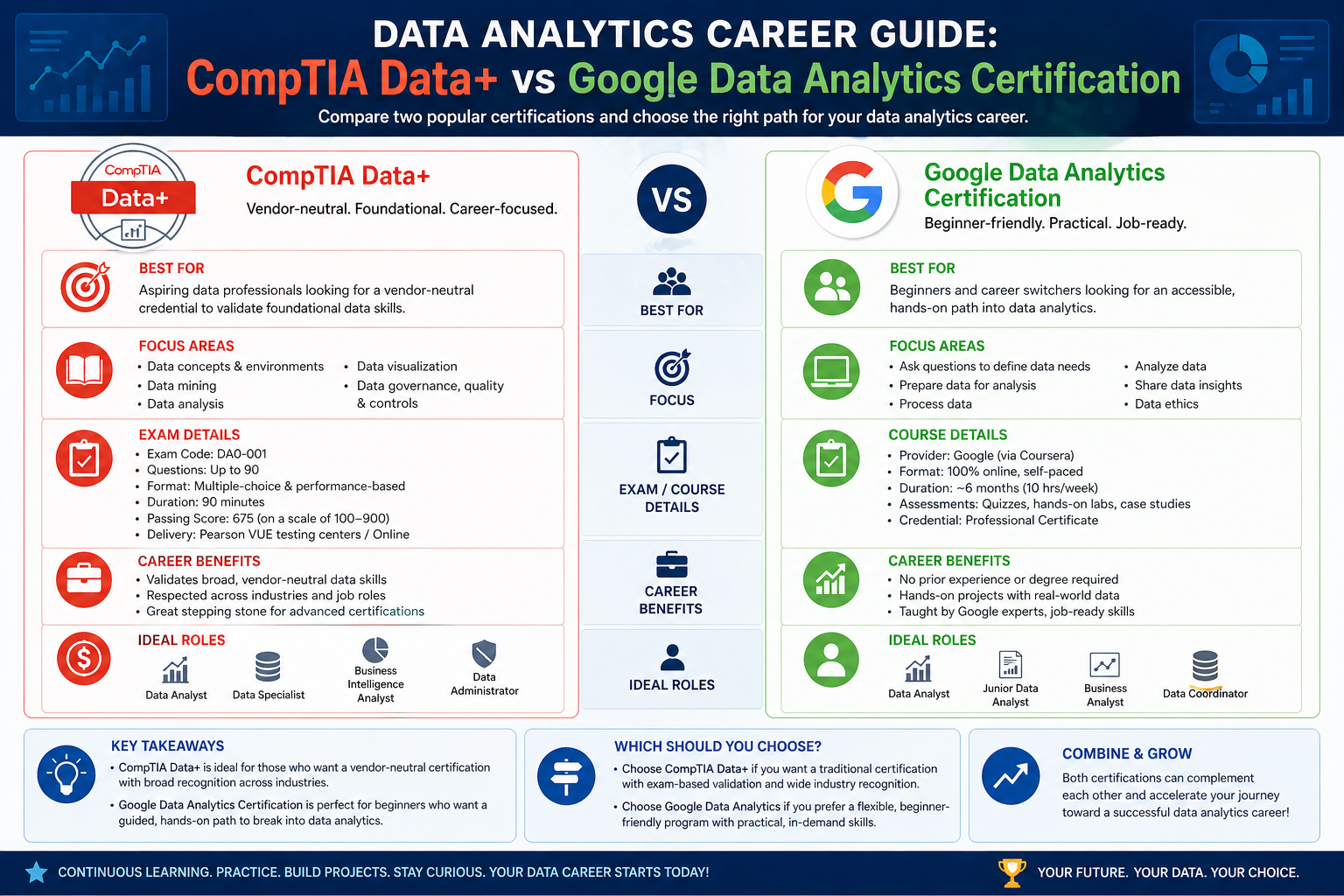
CompTIA Data+ is positioned as an entry-level certification designed for individuals who already have some exposure to business or IT environments. It focuses on validating the ability to work with data in structured professional settings. Rather than introducing the absolute basics, it assumes that learners have some foundational understanding of workplace systems and analytical thinking.
The certification emphasizes several core domains that reflect real-world data responsibilities. These include data concepts, data handling, statistical analysis, visualization techniques, and governance principles. Each of these areas contributes to a well-rounded understanding of how data is collected, processed, and used in decision-making processes within organizations.
One of the defining characteristics of this certification is its structured exam format. Candidates are required to demonstrate their knowledge through a timed assessment that includes both conceptual and applied questions. This format is designed to test not only theoretical understanding but also the ability to apply knowledge in practical scenarios.
CompTIA Data+ is often associated with roles that require analytical thinking within established business environments. These roles may involve interpreting datasets, preparing reports, or assisting in decision-making processes. The certification is particularly relevant for individuals aiming to work in departments such as finance, operations, marketing analytics, or IT support environments where data plays a central role.
Another important aspect of this certification is its focus on data governance and quality control. In many organizations, ensuring data accuracy and compliance is just as important as analysis itself. By including governance principles, the certification reflects the broader responsibilities of data professionals who must work within regulatory and organizational standards.
The positioning of CompTIA Data+ makes it suitable for individuals who are not entirely new to professional environments but are looking to formalize or enhance their data-related skills. It acts as a bridge between general workplace experience and specialized data analytics roles, providing a structured pathway into more technical responsibilities.
Understanding Google Data Analytics and Its Learning Approach
The Google Data Analytics program represents a different approach to learning data skills. Instead of focusing on certification through examination, it is structured as a guided learning journey that emphasizes hands-on experience. Learners progress through a series of instructional modules designed to gradually build their understanding of data concepts.
This program is particularly focused on accessibility. It is designed for individuals who may have little to no prior experience in data analysis. The content begins with fundamental concepts such as asking analytical questions, understanding datasets, and learning how data is used in everyday business contexts. From there, it gradually introduces more technical skills such as data cleaning, visualization, and basic programming concepts.
One of the most distinctive features of this learning approach is its emphasis on practical application. Instead of relying heavily on theoretical explanations, learners are encouraged to engage with real-world scenarios and case studies. This helps build confidence in applying data skills to realistic problems, which is often a critical requirement in entry-level job roles.
The structure of the program also supports flexible learning. Individuals can progress at their own pace, making it suitable for those who are balancing learning with other commitments such as work or education. This flexibility contributes to its popularity among career changers and beginners who need a less rigid learning environment.
Another important aspect of this approach is its focus on communication and storytelling with data. Beyond technical analysis, learners are introduced to the importance of presenting findings in a clear and understandable way. This includes learning how to create visual representations of data and explain insights to non-technical audiences.
The program also introduces learners to commonly used tools in the data industry. While it does not require advanced programming knowledge at the beginning, it gradually builds familiarity with tools and techniques that are widely used in entry-level data roles. This ensures that learners are exposed to practical skills that can be applied in real job environments.
Overall, this approach is designed to make data analytics more approachable for individuals who may feel intimidated by traditional technical certifications. It prioritizes learning progression, practical understanding, and confidence building over formal examination structures.
Differences in Learning Philosophy and Skill Development
The difference between these two pathways is not only structural but also philosophical. CompTIA Data+ follows a validation-based approach, where the primary goal is to prove competency through a standardized exam. This means learners are expected to reach a certain level of understanding before they can successfully earn the credential.
In contrast, the Google Data Analytics approach is developmental. Instead of focusing on proving knowledge at a single point in time, it emphasizes gradual skill-building through continuous learning. This allows learners to develop understanding over time, reinforcing concepts through repetition and application.
This distinction significantly affects how individuals experience learning. In a certification-based model, preparation is often concentrated and exam-focused. Learners typically study to pass a test, which can lead to structured but sometimes intense preparation periods. The emphasis is on accuracy, recall, and problem-solving under pressure.
In a certificate-based learning model, the experience is more exploratory. Learners engage with content in a step-by-step manner, often revisiting concepts multiple times through different contexts. This can lead to a deeper intuitive understanding of data concepts, especially for individuals who learn better through repetition and practice.
Another key difference lies in feedback mechanisms. Certification exams provide limited feedback, usually in the form of pass or fail results. Certificate programs, however, often include ongoing feedback through quizzes, assignments, and project-based evaluations. This allows learners to identify weaknesses and improve continuously.
Skill development also varies between the two approaches. Certification pathways tend to focus on breadth of knowledge across multiple domains, ensuring that learners have a broad understanding of the field. Certificate programs often emphasize depth in specific practical skills, particularly those needed for entry-level job performance.
These differences mean that each approach appeals to different types of learners. Some individuals prefer the structured challenge of certification exams, while others benefit more from guided, incremental learning experiences that build confidence over time.
How Background and Experience Shape the Choice
An individual’s background plays a significant role in determining which learning path is more suitable. People who already have experience in business, IT support, or related technical fields may find certification pathways more aligned with their existing skills. These individuals are often familiar with structured environments and may be comfortable preparing for standardized assessments.
On the other hand, individuals who are completely new to data or transitioning from unrelated fields often benefit from more guided learning environments. Without prior exposure to technical concepts, jumping directly into a certification exam may feel overwhelming. A structured learning program helps ease this transition by introducing concepts gradually.
Educational background also influences this decision. Those with degrees or training in analytical subjects such as business, economics, or computer science may already have a foundation that supports certification-based learning. Meanwhile, individuals from non-technical backgrounds may require more introductory-level support before engaging with formal assessments.
Work experience is another important factor. Professionals who have already worked in roles involving reporting, spreadsheets, or basic data handling may find it easier to adapt to certification content. In contrast, those without workplace exposure to data may need more practical, hands-on learning before pursuing formal validation.
Learning preferences also play a major role. Some individuals prefer structured environments with clear goals and deadlines, while others prefer flexible, self-paced learning. Understanding one’s own learning style can significantly impact the effectiveness of either approach.
Ultimately, the decision is influenced by a combination of prior experience, comfort with technical concepts, and preferred learning methods. These factors together determine how well an individual can adapt to the demands of each pathway and how effectively they can build a foundation in data analytics.
Early Career Opportunities in the Data Field
The data analytics field offers a wide range of entry-level opportunities, making it an attractive option for individuals beginning their careers. These roles typically involve working with datasets to support decision-making processes within organizations. While responsibilities may vary, they often include tasks such as organizing data, generating reports, and assisting in identifying trends.
Entry-level positions are often designed to help individuals build foundational experience in real-world environments. This includes working with data tools, collaborating with teams, and learning how data influences business decisions. Over time, these experiences contribute to professional growth and open doors to more advanced roles.
One of the key characteristics of early data roles is their cross-functional nature. Data professionals often work closely with departments such as marketing, finance, and operations. This exposure helps individuals understand how data is used across different areas of a business, broadening their perspective and skill set.
Another important aspect of early career development in this field is the emphasis on communication. Being able to explain data insights clearly is just as important as analyzing the data itself. Entry-level professionals are often expected to present findings in a way that is understandable to non-technical stakeholders.
The demand for data professionals continues to grow as organizations increasingly rely on data-driven decision-making. This growth has created a steady stream of opportunities for individuals with foundational data skills. Whether through structured certification or guided learning programs, both pathways aim to prepare individuals for these entry-level roles.
As individuals gain experience, they often progress into more specialized positions. These may involve deeper analysis, advanced visualization techniques, or strategic decision-making responsibilities. The early stage of a data career is therefore a critical foundation that shapes long-term professional development.
Exam Structure and Assessment Styles in Depth
One of the most defining differences between the two pathways lies in how knowledge is evaluated. The CompTIA Data+ certification follows a formal examination structure that is designed to measure a candidate’s ability to apply analytical concepts under controlled conditions. The assessment is time-bound and requires candidates to answer a combination of multiple-choice and scenario-based questions. This structure places emphasis on accuracy, speed, and conceptual understanding across a broad range of topics.
The nature of this exam means that learners must prepare in a highly structured way. They are expected to review multiple domains of knowledge and develop the ability to recall and apply information quickly. The exam environment also introduces an element of pressure, as candidates must demonstrate their competence within a limited timeframe without external assistance or reference material.
In contrast, the Google Data Analytics learning path does not rely on a single high-stakes examination. Instead, assessment is distributed across multiple stages of learning. Each module includes quizzes, exercises, and practical assignments that gradually build a learner’s understanding. This approach reduces pressure and allows individuals to reinforce their knowledge over time.
The final assessment in the Google pathway typically involves a project-based evaluation. This requires learners to apply the skills they have developed throughout the program to a realistic scenario. Instead of testing memorization, it evaluates problem-solving ability and practical application. This difference in structure significantly influences how learners prepare and engage with the material.
While the CompTIA approach rewards precision under exam conditions, the Google approach rewards consistency and applied understanding. Both methods aim to validate data skills, but they do so in fundamentally different ways that appeal to different learning styles and professional goals.
Technical Skills Breakdown and Tool Exposure
Another important distinction between these two learning paths is the type and depth of technical skills they emphasize. The CompTIA Data+ certification covers a wide range of analytical domains that focus on data handling, interpretation, and governance. Learners are expected to understand how data is structured, how it is cleaned, and how it is analyzed using statistical methods.
A strong emphasis is placed on understanding data environments and foundational concepts such as data types, data structures, and data formats. This includes familiarity with how data moves through systems and how it is stored and retrieved in business contexts. The certification also introduces statistical techniques that help professionals interpret trends and patterns within datasets.
Visualization is another key component, focusing on how data can be presented in meaningful ways. This includes understanding how charts, dashboards, and reports are used to communicate insights to decision-makers. The goal is to ensure that learners can not only analyze data but also present it effectively in professional settings.
The Google Data Analytics pathway takes a more tool-oriented approach. It introduces learners to commonly used applications and platforms in a practical context. Instead of focusing heavily on theoretical frameworks, it emphasizes how tools are used to solve real-world problems. This includes working with spreadsheets, data visualization platforms, and basic programming environments.
Learners are also introduced to data cleaning and transformation techniques that are essential in real-world analysis. This includes working with incomplete or messy datasets and preparing them for meaningful interpretation. The focus is on hands-on experience rather than abstract theory.
Another key difference lies in communication skills. The Google pathway places strong emphasis on explaining data insights in a way that is accessible to non-technical audiences. This includes structuring reports, creating visual narratives, and presenting findings clearly. While CompTIA also touches on communication, it is more embedded within technical domains rather than being a standalone focus.
Industry Recognition and Employer Expectations
Employer perception plays an important role in determining the value of any data credential. The CompTIA Data+ certification is often recognized in environments where formal validation of technical knowledge is important. It is commonly associated with structured corporate settings where standardized certifications are used as benchmarks for hiring and promotion decisions.
Because it is an exam-based certification, it is often viewed as a formal indicator of competency. Employers may interpret it as evidence that a candidate has met a defined industry standard in data analytics. This can be particularly valuable in organizations that prioritize certifications as part of their hiring criteria.
The Google Data Analytics certificate is generally recognized as an entry-level learning credential. Employers often view it as evidence that a candidate has been exposed to foundational data concepts and has completed structured training. It is especially relevant for roles where practical understanding and willingness to learn are more important than formal certification.
In many cases, employers value the combination of both types of credentials differently. A certification may be seen as proof of technical capability, while a certificate may be seen as evidence of practical exposure and learning commitment. The importance of each depends heavily on the specific job role and industry.
Industries such as finance, consulting, and enterprise IT environments may place more emphasis on formal certification. Meanwhile, startups, marketing teams, and business analytics roles may prioritize practical skills and project experience. This difference in expectations plays a significant role in shaping career decisions.
It is also important to recognize that employer expectations are evolving. Many organizations are shifting toward skills-based hiring, where demonstrated ability is valued more than formal credentials alone. This means that both pathways can be valuable depending on how effectively individuals apply what they have learned in real-world situations.
Learning Curve and Time Commitment Differences
The learning experience for each pathway differs significantly in terms of intensity and structure. The CompTIA Data+ certification typically requires a concentrated study approach. Learners must cover a broad range of topics and prepare for a timed exam, which often leads to structured study schedules and focused preparation periods.
This learning curve can feel steep for individuals who are not already familiar with data concepts. The need to understand both theoretical and applied aspects of data analytics means that learners must dedicate time to mastering multiple domains simultaneously. This can be challenging but also rewarding for those who prefer structured learning environments.
The Google Data Analytics pathway offers a more gradual learning curve. Since the content is divided into sequential modules, learners can progress at their own pace. This reduces pressure and allows individuals to revisit concepts as needed. The flexibility of this approach makes it more accessible to those who are balancing learning with other responsibilities.
Time commitment also varies significantly. Certification preparation often involves intensive study sessions over a shorter period, while certificate programs may span several months of flexible learning. This difference allows individuals to choose a pace that aligns with their personal schedules and learning preferences.
Another important aspect of the learning curve is retention. Structured exam preparation often requires repeated review to ensure long-term retention of concepts. In contrast, project-based learning encourages retention through application, as learners repeatedly use skills in practical scenarios.
Both approaches require discipline, but the nature of that discipline differs. One emphasizes focused preparation for a single assessment, while the other emphasizes consistent engagement over time. Understanding this difference helps learners choose a path that aligns with their learning habits.
Practical Application vs Theoretical Validation
A key distinction between these two pathways lies in how they balance practical application and theoretical validation. The CompTIA Data+ certification leans more toward validating theoretical understanding across multiple domains. It ensures that candidates have a broad knowledge base that can be applied in professional environments.
This theoretical foundation is important for roles that require structured analytical thinking. It ensures that professionals understand underlying principles such as statistical reasoning, data governance, and analytical frameworks. However, the application of these concepts often depends on workplace experience.
The Google Data Analytics pathway, on the other hand, emphasizes practical application from the beginning. Learners are encouraged to engage with real datasets and solve realistic problems. This hands-on approach helps build confidence in applying skills immediately in job-related scenarios.
The emphasis on practical work means that learners often develop a stronger sense of how data analysis functions in real environments. They learn how to clean data, identify trends, and communicate findings through actual projects rather than theoretical exercises alone.
This difference creates two distinct types of learning outcomes. One focuses on validated knowledge across a broad framework, while the other focuses on applied skills within specific contexts. Both are valuable, but they serve different purposes in professional development.
Data Ecosystem Skills and Analytical Foundations
Both learning pathways introduce learners to essential components of the data ecosystem, but they do so in different ways. The CompTIA Data+ certification provides a structured overview of how data flows through systems, emphasizing the importance of data integrity, structure, and lifecycle management.
This includes understanding how data is collected, stored, and maintained within organizational systems. It also covers the importance of ensuring data quality and compliance with organizational standards. These concepts are essential for roles that involve managing or overseeing data environments.
Statistical understanding is another key component. Learners are expected to grasp fundamental statistical concepts that support data interpretation. This includes understanding variability, probability, and trends within datasets. These concepts form the backbone of analytical decision-making.
The Google Data Analytics pathway introduces similar concepts but focuses more on their application. Instead of emphasizing theoretical definitions, it shows how these concepts are used in real-world analysis. Learners engage with data cleaning, transformation, and visualization as part of their workflow.
This applied approach helps learners understand how different components of the data ecosystem interact in practice. It reinforces the idea that data analysis is not just about numbers, but about interpreting information in context and communicating insights effectively.
Career Path Divergence After Each Credential
After completing either pathway, individuals often find themselves on slightly different career trajectories. Those who pursue the CompTIA Data+ certification may be better positioned for roles that require structured analytical responsibilities within established organizations. These roles often involve working with standardized data systems and following defined analytical procedures.
These positions may include responsibilities such as generating reports, analyzing operational data, and supporting decision-making processes within business units. Over time, professionals in these roles may progress into more specialized analytical or managerial positions.
Individuals who complete the Google Data Analytics pathway often begin in more flexible entry-level roles. These positions may involve supporting data projects, assisting with reporting tasks, or contributing to business insights through basic analysis. The emphasis is often on learning through experience and gradually expanding responsibilities.
As experience grows, individuals from both pathways can move into similar advanced roles. These may include senior analyst positions, specialized data roles, or strategic decision-making positions. The initial pathway influences the starting point, but long-term career growth depends heavily on experience and skill development.
The divergence is therefore more about entry points than long-term limitations. Both pathways can lead to similar outcomes over time, provided individuals continue to develop their skills and gain practical experience in the field.
Geographic and Market Demand Differences
The demand for data professionals is global, but the emphasis on specific credentials can vary by region. In some markets, formal certifications are highly valued due to structured hiring practices and standardized job requirements. In these environments, certifications like CompTIA Data+ may carry additional weight.
In other markets, especially those with rapidly growing tech industries, practical skills and project experience may be more important. Employers in these regions often prioritize demonstrated ability over formal credentials, making project-based learning paths equally valuable.
Remote work trends have also influenced this dynamic. As companies hire from a global talent pool, they increasingly focus on skills rather than geographic location or specific certifications. This shift has created more flexibility in how data professionals enter the field.
Market demand for data skills continues to grow across industries such as healthcare, finance, retail, and technology. This widespread demand ensures that individuals with either type of credential have opportunities to enter the field, provided they can demonstrate practical capability.
The variation in regional expectations means that learners must consider not only what they want to learn, but also where they intend to work. This can influence which pathway is more suitable based on local industry practices and employer preferences.
Real-World Skill Transfer and Day-to-Day Data Work
When individuals move from learning into actual data roles, the nature of their day-to-day work becomes the true test of how well their training has prepared them. Whether someone comes through CompTIA Data+ or the Google Data Analytics pathway, the workplace quickly shifts focus from structured learning to practical problem-solving under real constraints.
In most entry-level data positions, the core responsibility revolves around working with datasets that are rarely clean or complete. Data often arrives from multiple sources, sometimes inconsistent, and frequently requires significant preparation before any meaningful analysis can begin. This is where foundational skills learned through either pathway become directly relevant.
Professionals spend a considerable amount of time cleaning and organizing data. This includes identifying missing values, correcting inconsistencies, and ensuring that datasets follow a usable structure. While both learning paths introduce this concept, real-world applications often require more improvisation than structured exercises suggest.
Once data is prepared, the focus shifts to analysis. Analysts are expected to identify patterns, trends, and anomalies that can support business decisions. This stage requires both technical understanding and critical thinking. It is not enough to simply generate results; those results must be interpreted in a way that aligns with business objectives.
Communication plays a major role in daily work. Data professionals are often required to explain their findings to non-technical stakeholders. This means translating numbers into insights that can guide decisions. Clear communication is often just as important as analytical accuracy, especially in fast-moving business environments.
Visualization tools are frequently used to support this communication. Charts, dashboards, and summaries help simplify complex datasets into understandable formats. The ability to choose the right type of visualization is an important skill that develops over time through experience rather than theory alone.
Both CompTIA Data+ and Google Data Analytics introduce these concepts, but workplace experience is where they are fully developed. Real-world data work requires adaptability, as no two datasets or business questions are the same. This variability is what makes practical experience essential for long-term growth in the field.
Transitioning from Entry-Level to Intermediate Data Roles
After gaining initial experience, many data professionals begin transitioning into more complex and specialized roles. This progression is influenced more by practical experience than by the initial learning pathway. However, the foundation built through either CompTIA Data+ or Google Data Analytics plays an important role in this development.
At the intermediate level, responsibilities expand beyond basic reporting and analysis. Professionals may begin working on more advanced datasets, contributing to predictive analysis, or supporting strategic decision-making processes. These tasks require a deeper understanding of both data and business context.
One of the key differences at this stage is the level of independence expected. Entry-level roles often involve guided tasks and supervised work, while intermediate roles require more autonomy. Professionals are expected to identify problems, design analysis approaches, and present insights with minimal direction.
Technical expectations also increase. Intermediate roles may require familiarity with more advanced analytical techniques, improved data modeling skills, and greater efficiency in handling large datasets. While entry-level training provides a foundation, continued learning becomes essential for career progression.
Collaboration also becomes more complex. Data professionals at this stage often work closely with multiple departments, including management, product teams, and operations. This requires a strong ability to align data insights with business goals and communicate effectively across different teams.
The transition between entry-level and intermediate roles is not strictly defined by time but by demonstrated capability. Individuals who consistently apply their skills effectively and show initiative are more likely to progress quickly, regardless of which learning pathway they originally followed.
Evolving Role of Tools and Technology in Data Work
The data field is heavily influenced by rapidly evolving tools and technologies. As organizations adopt new systems, data professionals must continuously adapt to changing environments. This makes adaptability one of the most important long-term skills in the field.
In entry-level roles, professionals typically work with widely used tools that support data cleaning, analysis, and visualization. These tools are designed to simplify complex processes and make data more accessible. Both learning pathways introduce learners to these foundational tools, although the depth of exposure may vary.
As professionals advance, they often encounter more specialized tools and platforms. These may include advanced data visualization systems, database management environments, and analytical frameworks used for large-scale data processing. Mastering these tools requires ongoing learning and practical experience.
Automation is also playing an increasing role in data workflows. Many repetitive tasks, such as data cleaning and reporting, are now partially automated. This shifts the focus of data professionals toward interpretation, strategy, and decision support rather than manual processing.
Artificial intelligence is further transforming the field by enabling faster data analysis and predictive modeling. However, human oversight remains essential. Professionals are needed to define problems, validate outputs, and ensure that insights are meaningful and accurate within real-world contexts.
Both CompTIA Data+ and Google Data Analytics provide a foundation for understanding how data tools are used, but long-term success depends on continuous adaptation. The ability to learn new technologies quickly is often more valuable than mastery of a single toolset.
Long-Term Career Growth and Specialization Paths
As data professionals gain experience, they often begin to specialize in specific areas of the field. These specializations may be influenced by personal interest, industry demand, or organizational needs. Common areas of specialization include business analytics, operations analytics, marketing analytics, and technical data roles.
Business-focused roles typically involve working closely with decision-makers to interpret data and support strategic planning. These professionals focus on translating data insights into business actions. Strong communication and analytical thinking are essential in these roles.
Technical data roles, on the other hand, focus more on data infrastructure, modeling, and advanced analysis. These positions may require deeper technical expertise and a stronger understanding of data systems. Professionals in these roles often work with large datasets and complex analytical frameworks.
Some individuals choose to move into hybrid roles that combine both business and technical responsibilities. These roles require a balance of analytical skills and communication ability. They are particularly valuable in organizations that rely heavily on data-driven decision-making.
Over time, experienced professionals may progress into leadership positions. These roles involve overseeing data teams, defining analytical strategies, and ensuring that data practices align with organizational goals. Leadership in the data field requires both technical understanding and strong management skills.
The initial learning pathway—whether CompTIA Data+ or Google Data Analytics—does not limit long-term career options. Instead, it provides an entry point into the field. Continued learning, experience, and specialization ultimately determine long-term career direction.
Industry Trends Shaping the Future of Data Careers
The data industry is continuously evolving, influenced by technological advancements and changing business needs. One of the most significant trends is the increasing integration of data into everyday decision-making processes. Organizations are no longer treating data as a separate function but as a core part of operations.
This shift has increased demand for professionals who can interpret data quickly and accurately. Speed and accuracy are becoming equally important, especially in industries where real-time decisions are required. This places greater emphasis on both technical efficiency and analytical judgment.
Another major trend is the growing importance of data literacy across all job roles. Employees in non-technical positions are increasingly expected to understand and use data in their daily work. This broadens the scope of data education beyond traditional analyst roles.
The rise of cloud-based data systems has also transformed how data is stored and accessed. Professionals are now expected to work with distributed data environments that require new approaches to analysis and management. This shift is creating new opportunities for specialization.
Ethical considerations are becoming more prominent as well. Data privacy, security, and responsible use of information are now central concerns in many organizations. Professionals are expected to understand not only how to analyze data but also how to handle it responsibly.
These trends suggest that the demand for data skills will continue to grow, but the nature of those skills will also evolve. Continuous learning and adaptability will remain essential for long-term success in the field.
Choosing Between Structured Validation and Guided Learning
At the core of the decision between CompTIA Data+ and Google Data Analytics lies a broader choice about how individuals prefer to learn and validate their skills. One pathway emphasizes structured validation through examination, while the other emphasizes guided learning through practical experience.
Structured validation appeals to individuals who prefer clear benchmarks and formal recognition. It provides a defined measure of competence that can be recognized in traditional hiring environments. This approach is often favored by those who are comfortable with exam-based assessment and structured preparation.
Guided learning appeals to individuals who prefer gradual skill development and hands-on experience. It reduces pressure by spreading learning across multiple stages and emphasizes understanding through practice. This approach is often more accessible to those entering the field for the first time.
Both approaches ultimately aim to achieve the same goal: preparing individuals for careers in data analytics. The difference lies in the method of preparation rather than the outcome. Each pathway offers a different route to building foundational data skills.
In many cases, professionals may benefit from combining elements of both approaches over time. Initial learning through guided programs can build confidence, while formal certification can later validate and strengthen professional credibility. This combination reflects the increasingly flexible nature of modern career development in the data field.
Conclusion
CompTIA Data+ and the Google Data Analytics certificate both serve the same broader purpose—helping individuals build a foundation in data analytics—but they take very different routes to get there. One is a structured, exam-based validation of technical knowledge, while the other is a guided, hands-on learning journey designed to introduce complete beginners to the field more gradually and practically.
CompTIA Data+ is better suited for learners who already have some familiarity with IT, business systems, or structured analytical environments. Its focus on governance, statistical thinking, and formal assessment makes it a strong option for those aiming to demonstrate job-ready competence through a recognized certification. It aligns well with roles in more traditional or structured organizations where standardized credentials carry weight in hiring decisions.
The Google Data Analytics certificate, on the other hand, is designed for accessibility. It supports learners who are starting from scratch and prefer a more flexible, project-driven approach. Its strength lies in building confidence through practice, real-world scenarios, and step-by-step learning. This makes it particularly valuable for career changers or individuals exploring data for the first time.
Neither path is inherently better than the other. Their value depends on individual background, learning style, and career direction. Some may benefit from the structured challenge of certification preparation, while others may thrive in a more exploratory, hands-on learning environment.
Ultimately, both pathways can lead to similar entry points in the data field when combined with consistent practice and real-world experience. What matters most is not just the credentials earned, but the ability to apply data skills effectively, communicate insights clearly, and continue learning as tools and technologies evolve.