The modern IT industry presents a wide and often overwhelming range of certification options, each designed to validate specific technical skills, career stages, and vendor ecosystems. For individuals entering or progressing within information technology, this abundance creates a decision-making challenge that goes beyond simply choosing a popular credential. Every certification represents an investment of time, financial resources, and focused effort, and the return on that investment is not uniform across all career paths. Some certifications are highly specialized and cater to niche job roles, while others aim to establish foundational knowledge that applies broadly across multiple IT domains. In this environment, professionals are often required to think strategically about where they want their careers to go rather than reacting impulsively to trends or market popularity. The pressure is further intensified by the rapid evolution of cybersecurity threats and digital infrastructure, which constantly reshapes the skills employers prioritize. As organizations adopt cloud technologies, remote work systems, and complex hybrid environments, they increasingly expect candidates to demonstrate both theoretical understanding and practical awareness of security principles. This makes entry-level certifications particularly significant, as they often serve as the first structured validation of knowledge in a competitive job market. However, the challenge lies in distinguishing between certifications that merely add a credential to a resume and those that meaningfully contribute to long-term career growth. In this context, certifications like Security+ are often discussed because they sit at the intersection of accessibility and professional relevance, offering a baseline framework for understanding cybersecurity concepts without requiring extensive prior experience.
The Role of Security+ in the Modern Cybersecurity Ecosystem
Within the broader cybersecurity ecosystem, foundational certifications play a crucial role in establishing a common language of security principles across different job roles and industries. Security+ is frequently positioned as an entry-level benchmark that introduces individuals to essential security domains such as risk management, threat identification, network protection, and incident response. Its relevance stems from the fact that cybersecurity is no longer confined to specialized teams but is now integrated into nearly every aspect of IT infrastructure. Organizations of all sizes require personnel who can understand basic security controls and recognize potential vulnerabilities before they escalate into critical incidents. In this environment, Security+ serves as a bridge between general IT knowledge and more advanced security specialization. It helps learners transition from understanding how systems operate to understanding how those systems can be protected against evolving threats. This transition is particularly important as cyberattacks become more sophisticated and increasingly automated, requiring professionals at all levels to possess a baseline awareness of security principles. Additionally, Security+ aligns with industry expectations for standardized knowledge, making it a widely recognized credential across private companies, government institutions, and service providers. Its value is not solely in technical depth but in its ability to unify foundational concepts that can later be expanded through specialized training and experience. As cybersecurity continues to expand as a discipline, the role of such foundational certifications becomes even more significant, ensuring that professionals entering the field are not starting from isolated or inconsistent knowledge bases.
Core Skills Validated by Security+
Security+ focuses on validating a broad range of foundational cybersecurity skills that are considered essential for entry-level professionals entering the field. These skills include understanding different types of threats, recognizing vulnerabilities in systems and networks, applying basic security controls, and responding appropriately to security incidents. The certification also emphasizes the importance of risk management principles, ensuring that individuals are able to evaluate potential security risks in relation to business operations and technological environments. Another key aspect involves understanding cryptographic concepts and their role in protecting data integrity and confidentiality. While the certification does not require deep technical expertise in cryptography, it introduces essential terminology and use cases that are widely applied in real-world systems. Additionally, Security+ covers identity and access management principles, which are critical in controlling who can access systems and under what conditions. This includes foundational knowledge of authentication methods, authorization mechanisms, and secure access policies. Network security is also a central focus, as most modern cyber threats originate or propagate through interconnected systems. By introducing these core domains in a structured way, Security+ helps learners build a mental framework that can later be expanded with more advanced technical skills. The emphasis is not on mastering complex implementations but on developing the ability to recognize, interpret, and respond to security concepts in practical scenarios. This makes the certification particularly useful for individuals who are new to cybersecurity and need a structured starting point that connects theoretical knowledge with workplace relevance.
Entry-Level Accessibility and Learning Curve
One of the defining characteristics of Security+ is its accessibility to individuals who may not have extensive prior experience in cybersecurity or advanced IT systems. The certification is designed to accommodate learners from diverse backgrounds, including those transitioning from general IT support roles or even non-technical fields. This accessibility is achieved through a curriculum that focuses on conceptual understanding rather than deep technical specialization. As a result, the learning curve is structured to gradually introduce core security principles without overwhelming learners with overly complex implementations. However, this does not mean the certification is simplistic; rather, it is carefully balanced to ensure that foundational competence is developed in a meaningful way. Learners are expected to become familiar with a wide range of topics, which requires consistent study and conceptual clarity. The challenge often lies not in the depth of individual topics but in the breadth of knowledge required across multiple domains. This broad scope is intentional, as it reflects the interdisciplinary nature of cybersecurity roles in real-world environments. Entry-level professionals are often expected to understand how different components of IT systems interact from a security perspective, even if they are not directly responsible for implementing every layer of protection. Security+ supports this expectation by providing a structured pathway into cybersecurity thinking, helping learners build confidence as they progress through foundational concepts. For many individuals, this certification represents the first formal step into a structured cybersecurity learning journey, making its accessibility a key factor in its widespread adoption.
Industry Demand for Cybersecurity Professionals
The demand for cybersecurity professionals has increased significantly due to the growing complexity and frequency of digital threats faced by organizations worldwide. As businesses continue to rely heavily on digital infrastructure, the potential impact of cyberattacks has expanded beyond data loss to include financial disruption, reputational damage, and regulatory consequences. This evolving threat landscape has created a sustained need for professionals who can understand, identify, and mitigate security risks across various systems. The shortage of skilled cybersecurity personnel is frequently highlighted across industry reports, with many organizations reporting difficulty in filling entry-level and mid-level security roles. This gap between demand and available talent has made foundational certifications more relevant, as they provide a standardized way to evaluate baseline knowledge in candidates. Security+ is often referenced in this context because it represents a widely recognized entry point into the field. Employers value candidates who demonstrate awareness of security fundamentals, even if they lack extensive hands-on experience. This is because cybersecurity roles often require continuous learning and adaptation, making foundational understanding more important than initial specialization. Additionally, the increasing regulatory environment across industries has further amplified the need for security awareness. Organizations must comply with various data protection standards, which require employees at multiple levels to understand basic security responsibilities. As a result, the demand for cybersecurity skills is not limited to dedicated security teams but extends across IT departments and business operations, reinforcing the importance of foundational certifications as a stepping stone into the field.
How Employers Perceive Foundational Security Credentials
Employers typically view foundational security credentials as indicators of baseline knowledge rather than proof of advanced expertise. In the hiring process, such certifications help distinguish candidates who have taken the initiative to understand core security principles from those who have not engaged in structured learning. This distinction is particularly important in entry-level hiring, where practical experience may be limited or uneven across candidates. Security+ is often recognized as a standard credential that signals familiarity with essential cybersecurity concepts, making it useful for screening purposes in competitive job markets. However, employers also understand that certifications alone do not guarantee job performance, especially in complex environments where practical problem-solving and hands-on experience are critical. As a result, Security+ is generally viewed as a complementary qualification that enhances a candidate’s profile rather than defining it. In many cases, employers use it as a foundation upon which further skills assessment is conducted during interviews or practical evaluations. The value of the certification also varies depending on the type of organization and its operational requirements. Government-related roles or regulated industries may place higher importance on standardized certifications due to compliance requirements, while private sector organizations may prioritize practical experience and role-specific skills. Despite these differences, the presence of a foundational certification still contributes positively to a candidate’s credibility, particularly when combined with other relevant experience or education. This balanced perception reinforces the idea that Security+ is most effective as part of a broader career development strategy rather than a standalone qualification.
Vendor-Neutral Advantage in Early Career Development
One of the key characteristics that distinguishes Security+ from many other certifications is its vendor-neutral approach to cybersecurity education. Unlike certifications tied to specific technologies or platforms, Security+ focuses on universal security principles that apply across a wide range of systems and environments. This makes it particularly valuable for individuals at the beginning of their careers, as it allows them to develop a broad understanding of cybersecurity without being restricted to a single technology ecosystem. In early career development, this flexibility is important because it enables professionals to explore different areas of IT and security before committing to a specialization. A vendor-neutral foundation also helps learners adapt more easily to changing technologies, as the underlying principles of security remain consistent even when tools and platforms evolve. This adaptability is crucial in a field where new threats and solutions emerge regularly, requiring professionals to continuously update their knowledge. Additionally, a vendor-neutral certification helps reduce the risk of early specialization, which can sometimes limit career mobility if focused too narrowly. By starting with broad-based knowledge, individuals can later choose to specialize in areas such as network security, cloud security, or ethical hacking based on their interests and career opportunities. This approach aligns well with the progressive nature of IT careers, where foundational knowledge often serves as a stepping stone toward more advanced technical expertise. In this sense, Security+ plays an important role in shaping flexible and adaptable cybersecurity professionals who are capable of navigating diverse technical environments.
Security+ Exam Structure and Knowledge Domains
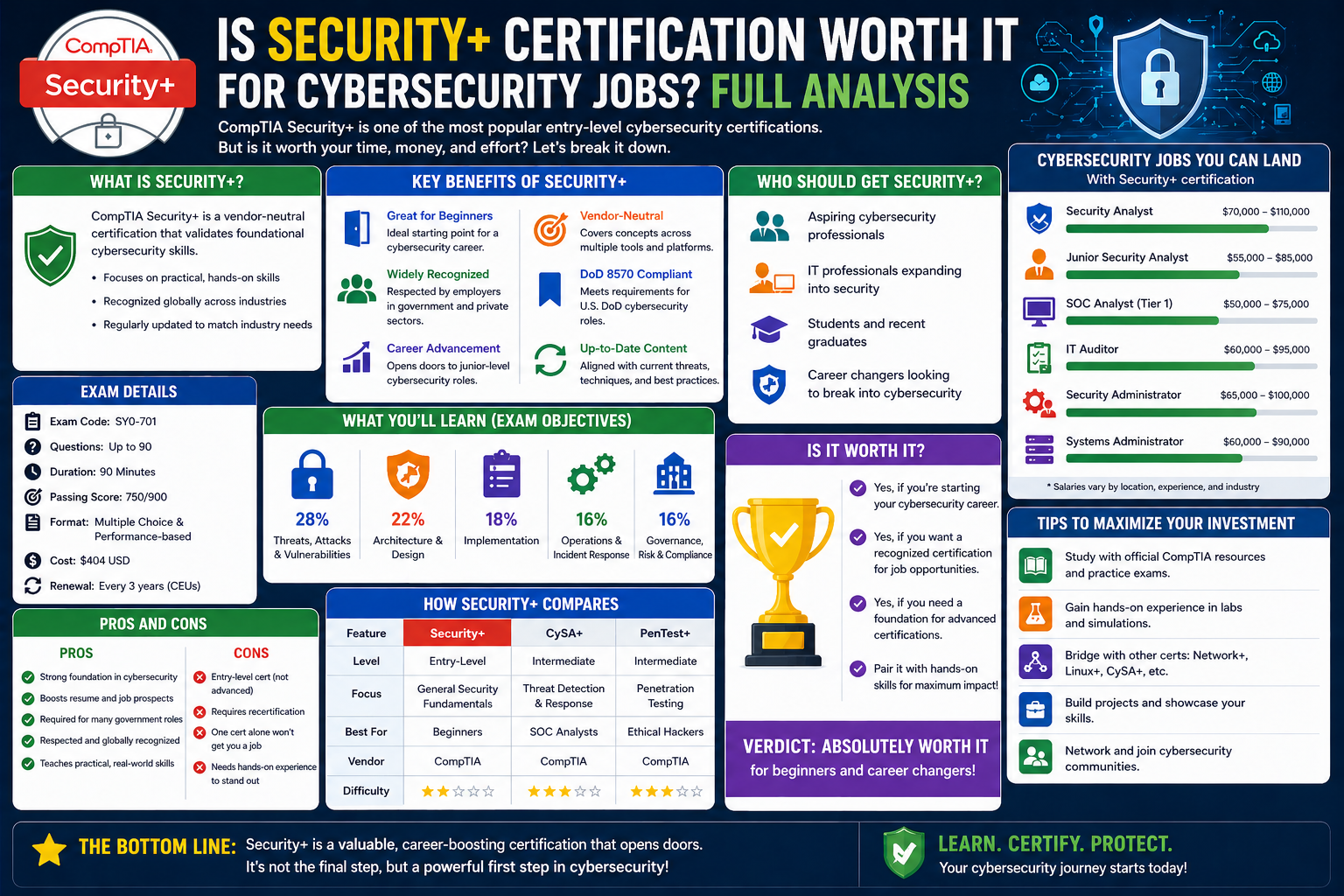
The Security+ certification is structured around a carefully designed framework that reflects the essential knowledge areas required in entry-level cybersecurity roles. Rather than focusing on a single specialized skill, the exam evaluates a candidate’s understanding across multiple interconnected domains. These domains typically include threats, attacks, and vulnerabilities; architecture and design; implementation of security controls; operations and incident response; and governance, risk, and compliance. Each of these areas represents a core aspect of how cybersecurity functions in real-world environments. The structure ensures that learners are not only memorizing definitions but also developing the ability to interpret security scenarios and apply appropriate responses. This broad coverage is intentional, as entry-level professionals are often expected to operate in dynamic environments where issues do not fall neatly into a single category. The exam format reinforces this by presenting situational questions that require analytical thinking rather than simple recall. Candidates must understand how different security concepts interact, such as how vulnerabilities in network design can lead to operational risks or how governance policies influence incident response procedures. This interconnected approach helps build a mindset that aligns with real-world cybersecurity operations. While the scope may appear wide, it is designed to ensure that individuals entering the field have a balanced understanding of essential principles before moving into deeper specialization. This structure also reflects the evolving nature of cybersecurity, where professionals are expected to understand both technical and procedural aspects of security management.
Real-World Job Roles Linked to Security+
One of the most important considerations when evaluating Security+ is its relevance to actual job roles in the cybersecurity and IT industry. The certification is commonly associated with entry-level positions that serve as gateways into the broader security field. These roles often include responsibilities that bridge general IT support and dedicated security functions. For example, positions such as security administrator, junior security analyst, IT support specialist with security responsibilities, and network support technician often align well with the foundational knowledge validated by Security+. In these roles, professionals may be responsible for monitoring systems for unusual activity, assisting in implementing security policies, or supporting incident response efforts under supervision. The emphasis is typically on awareness, observation, and support rather than independent decision-making for high-risk scenarios. This makes Security+ particularly valuable for individuals transitioning from general IT roles into security-focused positions. It provides employers with assurance that candidates understand essential security terminology and concepts, even if they have limited hands-on experience. Additionally, the certification can serve as a stepping stone toward more specialized roles such as penetration testing, cloud security, or security engineering. These advanced roles require deeper technical expertise, but they often expect candidates to already possess foundational knowledge similar to what Security+ provides. In this way, the certification functions as both an entry point and a transition tool, helping professionals move gradually from generalist roles into specialized cybersecurity careers.
Financial Investment and Return Considerations
The financial aspect of pursuing Security+ is an important factor for many individuals, especially those early in their careers or transitioning from unrelated fields. The cost of certification includes not only the exam fee but also study materials, practice resources, and the time invested in preparation. While the exam fee itself is relatively standardized, the overall investment can vary depending on the learning approach chosen by the candidate. Self-study using freely available resources may reduce costs, while structured learning materials or guided training can increase the overall expense. However, the financial evaluation of Security+ should not be limited to upfront costs alone. The potential return on investment is often measured in terms of improved job opportunities, salary growth, and career mobility. For entry-level professionals, even modest salary improvements can offset the initial cost of certification over time. More importantly, the certification can increase employability in competitive job markets, where candidates without formal validation of skills may struggle to stand out. It is also important to recognize that the financial return is not guaranteed solely by obtaining the certification. Its value depends heavily on how it is combined with practical experience, additional skills, and career direction. In some cases, individuals may find that Security+ serves more as a foundational stepping stone rather than a direct path to high-paying roles. This makes it essential to evaluate the certification as part of a broader career strategy rather than an isolated financial decision.
Government and Compliance-Driven Relevance
In certain sectors, particularly government and defense-related environments, Security+ holds a level of importance that extends beyond general career development. These environments often operate under strict regulatory and compliance frameworks that require personnel to meet standardized certification requirements. In such cases, Security+ is frequently recognized as a baseline credential for individuals who need access to sensitive systems or classified information. This is due to its alignment with widely accepted security standards that emphasize risk management, secure communication, and operational awareness. Unlike private sector roles, where certifications may serve primarily as competitive advantages, government-related positions often incorporate them as mandatory requirements. This distinction makes Security+ particularly relevant for individuals who intend to pursue careers in public sector IT or defense contracting. The certification ensures that professionals meet a minimum level of security understanding before being granted system access or responsibilities involving sensitive data. This requirement reflects the high-stakes nature of government operations, where security breaches can have significant national or organizational consequences. As a result, Security+ is not only a career development tool but also a compliance mechanism in certain contexts. Its standardized structure provides a consistent benchmark for evaluating candidates across different agencies and contractors, ensuring that foundational security knowledge is uniformly applied. This regulatory relevance adds dimension to the certification’s value, making it more than just an educational credential in specific industries.
Comparison with Other Entry-Level Certifications
When evaluating Security+, it is important to consider how it compares with other entry-level cybersecurity certifications available in the market. Different certifications often target similar audiences but vary in depth, recognition, and industry acceptance. Some alternatives focus on specific vendors or technologies, while others emphasize broader theoretical understanding. Security+ distinguishes itself through its balance of practical relevance and vendor-neutral design, which allows it to remain applicable across diverse IT environments. In contrast, vendor-specific certifications may offer deeper knowledge of particular systems but can limit flexibility in career progression if those systems are not widely used in certain job markets. Other entry-level certifications may also vary in terms of industry recognition, with some being more regionally or organizationally specific. Security+ tends to maintain a relatively consistent level of recognition across different sectors, making it a more universally accepted credential for foundational cybersecurity roles. However, it is not necessarily the most advanced or specialized option available. For individuals seeking rapid specialization, other certifications may provide more targeted skill development. This creates a trade-off between breadth and depth that candidates must carefully evaluate based on their career goals. Security+ is generally best suited for those who are still exploring the cybersecurity field or who require a broad foundational understanding before committing to a specific specialization path. Its comparative strength lies in its ability to serve as a neutral starting point in a highly fragmented certification landscape.
Learning Pathways and Preparation Approaches
Preparing for Security+ requires a structured approach to learning due to the wide range of topics covered in the certification framework. Unlike highly specialized certifications that focus on narrow technical domains, Security+ demands familiarity with multiple areas of cybersecurity. As a result, successful preparation often involves a combination of conceptual study and practical understanding. Learners typically begin by building a foundation in basic networking and system operations, as these concepts form the underlying structure for many security principles. From there, attention is gradually shifted toward understanding threats, vulnerabilities, and security controls. One of the key challenges in preparation is developing the ability to connect different concepts rather than studying them in isolation. For example, understanding how a network vulnerability can lead to data exposure requires integrating knowledge from multiple domains. Another important aspect of preparation involves scenario-based thinking, where learners practice applying theoretical knowledge to real-world situations. This helps bridge the gap between academic understanding and practical application. Consistent revision is also important due to the breadth of material covered, as learners must retain a wide range of definitions, processes, and frameworks. The preparation journey is often iterative, requiring repeated exposure to concepts to achieve full comprehension. While the certification is entry-level in nature, the volume of material ensures that disciplined study habits are essential for success. This structured learning process also contributes to long-term professional development, as it trains individuals to think systematically about cybersecurity challenges.
Common Challenges Faced by Learners
Despite being classified as an entry-level certification, Security+ presents several challenges that learners must overcome during preparation. One of the most common difficulties is the breadth of topics covered within a single exam framework. Because the certification spans multiple domains of cybersecurity, learners often find it challenging to allocate sufficient time to each area while maintaining overall retention. Another challenge lies in the conceptual nature of many topics, which require understanding rather than memorization. For individuals new to cybersecurity, terms and processes may initially appear abstract, making it difficult to connect them to real-world scenarios. Additionally, the scenario-based format of exam questions can be challenging because it requires analytical thinking rather than straightforward recall of information. Learners must interpret situational context and determine the most appropriate security response, which can be difficult without practical experience. Time management during preparation is another significant factor, as balancing study with professional or personal responsibilities can limit consistent progress. Furthermore, the rapidly evolving nature of cybersecurity means that learners must ensure their knowledge remains aligned with current practices rather than outdated concepts. This requires staying engaged with updated material and continuously reinforcing foundational understanding. Despite these challenges, the structured nature of the certification also provides a clear roadmap for overcoming them, helping learners gradually build competence across all required domains.
Career Progression Beyond Foundational Certification
Security+ is often viewed as the beginning of a longer career journey rather than an endpoint. Once foundational knowledge is established, professionals typically move toward more specialized areas of cybersecurity depending on their interests and career opportunities. This progression may involve focusing on areas such as network security, cloud security, penetration testing, or security operations. Each of these paths requires deeper technical expertise and more advanced problem-solving skills. The transition from foundational to specialized roles is often driven by hands-on experience gained in early job positions. Security+ helps facilitate this transition by providing a shared baseline of knowledge that is recognized across different areas of IT and cybersecurity. As professionals gain experience, they are able to identify specific areas of interest and develop targeted expertise. This progression is important because cybersecurity is a highly diverse field, and no single certification can cover all aspects in depth. Instead, foundational certifications serve as stepping stones that enable continuous learning and specialization. Over time, professionals may also take on leadership or strategic roles that require a broader understanding of security governance and risk management. In these roles, foundational knowledge remains relevant, even as technical responsibilities evolve. This long-term perspective highlights the importance of Security+ as part of an ongoing career development process rather than a standalone achievement.
Security+ in the Context of Modern Hiring Practices
Hiring practices in the IT and cybersecurity industry have evolved significantly, especially as organizations face a growing number of applicants for entry-level roles. Employers are no longer relying solely on academic degrees or informal experience to assess candidates. Instead, structured signals of knowledge, such as certifications, are increasingly used as part of initial screening processes. Security+ often appears in job descriptions not necessarily as a strict requirement, but as a preferred qualification that helps filter candidates who already understand foundational cybersecurity concepts. In practical terms, this means that resumes without any formal security validation may struggle to pass automated screening systems or recruiter reviews, particularly in competitive markets. However, Security+ is rarely the sole deciding factor in hiring decisions. Employers typically use it as an indicator of baseline readiness rather than job-specific expertise. During interviews, candidates are still evaluated based on problem-solving ability, communication skills, and practical understanding of IT environments. What Security+ does is improve visibility in the early stages of recruitment, increasing the likelihood of being considered for interviews. It also helps standardize expectations among candidates coming from diverse educational and professional backgrounds. In industries where applicants may have varying levels of exposure to cybersecurity concepts, this standardization becomes particularly valuable. As a result, Security+ functions as a leveling mechanism, ensuring that candidates share a minimum conceptual foundation before entering more detailed evaluation stages. This role within hiring pipelines reinforces its importance, even in cases where it is not explicitly required for employment.
The Psychological Impact of Certification Pursuit
Beyond technical knowledge and career advancement, pursuing a certification like Security+ can have a significant psychological impact on learners. For many individuals entering the IT field, structured certification pathways provide clarity in an otherwise complex and fragmented industry. Cybersecurity, in particular, can feel overwhelming due to its rapidly changing nature and broad scope of knowledge areas. Having a defined certification goal helps reduce uncertainty by providing a clear target for learning and progress measurement. This sense of direction can increase motivation and consistency in study habits, especially for individuals balancing work, education, or personal commitments. Completing structured milestones within the certification journey also builds confidence, reinforcing the belief that technical careers are achievable through disciplined learning. However, there is also a psychological challenge associated with certification preparation, particularly when learners encounter difficult or unfamiliar concepts. The breadth of Security+ can create a sense of cognitive overload if not approached systematically. This requires learners to develop resilience and patience as they gradually build understanding over time. Additionally, there can be pressure associated with expectations of immediate career transformation after certification completion. In reality, the certification serves more as a foundation rather than an instant career accelerator. Managing expectations is, therefore, an important part of the psychological experience. Overall, the process of preparing for Security+ contributes not only to technical growth but also to the development of persistence, structured thinking, and professional discipline.
The Role of Practical Experience Versus Certification Knowledge
One of the most important discussions surrounding Security+ is the balance between theoretical certification knowledge and practical, hands-on experience. While the certification validates understanding of core cybersecurity principles, real-world environments often present challenges that cannot be fully captured in exam scenarios. In practice, cybersecurity professionals must respond to dynamic threats, interact with complex systems, and make decisions under time pressure. These situations require more than conceptual awareness; they demand applied problem-solving skills developed through experience. Security+ provides the foundational language and framework needed to understand these environments, but it does not replace the value of practical exposure. For example, understanding incident response theory is different from actively participating in an actual security breach investigation. Similarly, knowing about network vulnerabilities is distinct from identifying and mitigating them in live systems. Employers recognize this distinction and often look for candidates who can demonstrate both certification knowledge and practical familiarity with IT environments. This is why Security+ is most effective when combined with internships, entry-level IT roles, or lab-based practice environments. The certification establishes credibility, while experience builds competence. Together, they form a more complete professional profile. This balance also highlights why Security+ should be viewed as a starting point rather than a complete qualification. It provides structure for learning, but real mastery develops through continuous application in real-world scenarios.
Cybersecurity Market Evolution and Long-Term Relevance
The cybersecurity market has undergone continuous evolution over the past decade, driven by increasing digital transformation across industries. As organizations adopt cloud computing, remote work systems, and interconnected digital services, the attack surface for cyber threats has expanded significantly. This expansion has created a sustained demand for professionals who understand how to protect digital assets in complex environments. Security+ remains relevant in this evolving landscape because it focuses on foundational principles that do not become obsolete quickly. While specific tools and technologies may change, the core concepts of risk management, access control, and threat identification remain consistent. This stability is important in a field where rapid technological change can otherwise make knowledge outdated within short timeframes. As cybersecurity continues to evolve, the nature of entry-level roles also shifts. Many organizations now expect even junior professionals to have awareness of cloud security, remote access risks, and hybrid infrastructure challenges. Security+ has adapted over time to reflect these changes, ensuring that its content remains aligned with current industry realities. However, its long-term relevance depends on its ability to maintain this alignment as new technologies emerge. Areas such as artificial intelligence, automation, and advanced threat detection are increasingly shaping the cybersecurity landscape. Foundational certifications like Security+ must continue to evolve to ensure they remain meaningful starting points for learners entering the field. Despite these changes, the underlying need for baseline security knowledge remains constant, reinforcing the ongoing importance of such certifications.
Transitioning from General IT to Security-Focused Roles
Many individuals pursuing Security+ are not entering cybersecurity directly but are transitioning from general IT roles such as technical support, system administration, or network assistance. This transition is common because IT infrastructure and cybersecurity are closely interconnected. Professionals working in general IT often encounter security-related issues as part of their daily responsibilities, even if their primary role is not security-focused. Security+ helps formalize this existing exposure by providing structured knowledge that connects operational tasks with security principles. For example, a system administrator may already understand user access management, but Security+ helps them understand the underlying security rationale and broader implications of access control policies. This shift in perspective is important for transitioning into dedicated cybersecurity roles. It allows professionals to move from reactive problem-solving to proactive risk management thinking. The certification also helps bridge knowledge gaps that may exist between general IT experience and specialized security requirements. In many cases, individuals transitioning into cybersecurity roles find that Security+ serves as a validation of skills they have partially developed on the job, while also filling in conceptual gaps. This combination of reinforcement and expansion makes the transition smoother and more structured. Over time, professionals who successfully transition often continue to build on this foundation through advanced certifications and practical experience in security operations environments.
Limitations of Foundational Certification Knowledge
While Security+ provides valuable foundational knowledge, it is important to recognize its limitations in the broader context of cybersecurity expertise. The certification is designed to introduce core concepts rather than develop advanced technical proficiency. As a result, it does not deeply cover specialized areas such as penetration testing, advanced network defense architecture, or complex cloud security configurations. Professionals relying solely on Security+ knowledge may find themselves underprepared for roles that require hands-on technical execution or deep system-level understanding. Another limitation is the lack of extensive real-world scenario complexity within the certification framework. While scenario-based questions are included, they cannot fully replicate the unpredictability and scale of actual cybersecurity incidents. Additionally, Security+ does not focus heavily on tool-specific expertise, meaning that individuals still need to learn practical tools and platforms used in real environments. This limitation is intentional, as the certification aims to remain vendor-neutral and broadly applicable. However, it also means that learners must continue their development beyond the certification to become fully job-ready in specialized roles. Another consideration is that the certification alone does not guarantee career advancement or salary growth. Its impact depends heavily on how it is combined with experience, additional learning, and professional development. Understanding these limitations is essential for setting realistic expectations and using the certification effectively as part of a broader career strategy.
Changing Threat Landscape and Skill Adaptation
The cybersecurity threat landscape is constantly evolving, with attackers developing increasingly sophisticated methods to exploit vulnerabilities in digital systems. This dynamic environment requires cybersecurity professionals to continuously adapt their skills and knowledge. Security+ plays an important role in this adaptation process by introducing learners to the foundational categories of threats and attack methods. However, the real challenge lies in applying this knowledge to emerging and unpredictable threat scenarios. Cyberattacks today often involve combinations of social engineering, malware deployment, network exploitation, and system misconfiguration. Understanding these interactions requires more than memorized definitions; it requires analytical thinking and situational awareness. As threats evolve, professionals must also understand how defensive strategies change in response. This includes awareness of security monitoring practices, incident response workflows, and preventive controls. Security+ provides the conceptual base for understanding these processes, but ongoing learning is required to stay current with new attack vectors. The rise of automated attacks and AI-assisted cyber threats further complicates the landscape, requiring professionals to develop adaptive thinking rather than relying solely on static knowledge. In this sense, foundational certifications act as starting points in a continuous learning cycle rather than fixed endpoints. The ability to adapt becomes one of the most important skills in cybersecurity, and Security+ contributes to building that adaptive mindset at an early stage in a professional’s career.
Role of Security+ in Cloud and Hybrid Environments
Modern IT infrastructures increasingly rely on cloud computing and hybrid environments that combine on-premises systems with cloud-based services. This shift has significantly changed the way cybersecurity is implemented and managed. Security+ addresses these changes by introducing foundational concepts related to cloud security, virtualization, and distributed systems. Understanding these concepts is essential for professionals working in environments where data and applications are no longer confined to traditional physical networks. In cloud environments, security responsibilities are often shared between service providers and customers, creating a need for a clear understanding of responsibility boundaries. Security+ helps introduce this shared responsibility model, enabling professionals to recognize which security tasks fall under their control and which are managed externally. Hybrid environments also introduce complexity in terms of access control, data flow, and system integration. Professionals must understand how security policies apply consistently across different platforms and infrastructures. While Security+ does not provide deep technical configuration skills for cloud platforms, it establishes the conceptual framework needed to understand these systems. This foundational understanding becomes increasingly important as organizations continue migrating critical workloads to cloud environments. As a result, Security+ remains relevant even in modern infrastructure contexts, as it prepares individuals to think about security in distributed and dynamic system architectures rather than static traditional networks.
Conclusion
The decision to pursue the Security+ certification ultimately comes down to how well it aligns with an individual’s current position, long-term goals, and willingness to invest in foundational learning. In a rapidly evolving IT and cybersecurity landscape, certifications serve as structured benchmarks that help professionals navigate an otherwise complex and fragmented field. Security+ stands out primarily because it focuses on establishing a broad and vendor-neutral understanding of cybersecurity principles rather than pushing learners into narrow specialization too early. This makes it particularly relevant for those who are either entering the industry for the first time or transitioning from general IT roles into security-focused positions.
One of the most important insights from examining Security+ is that its value is not fixed or universal. Instead, it changes depending on the learner’s experience level, career direction, and existing technical background. For someone with little to no cybersecurity exposure, the certification can serve as a crucial entry point that builds confidence, structure, and foundational awareness. It introduces essential concepts such as threat identification, risk management, access control, and incident response in a way that prepares learners for real-world thinking. For individuals already working in specialized IT roles, however, the certification may function more as a formal validation of existing knowledge rather than a transformative career milestone.
The certification also plays a significant role in shaping employability. While it is not always a strict requirement in private sector roles, it can improve visibility in competitive job markets and help candidates pass initial screening stages. Employers often view it as evidence that a candidate has taken the initiative to understand core cybersecurity principles, even if they lack extensive hands-on experience. In government or regulated environments, the importance of Security+ becomes even more pronounced, as it may be tied to compliance requirements or baseline eligibility for certain roles. This dual relevance across both private and public sectors contributes to its continued recognition in the industry.
However, it is equally important to understand what Security+ does not offer. It does not replace practical experience, nor does it guarantee immediate career advancement or significant salary increases on its own. Real-world cybersecurity work requires hands-on problem-solving, familiarity with tools and systems, and the ability to respond to unpredictable threats. These skills are developed through practice, on-the-job exposure, and continued learning beyond foundational certification material. Security+ should therefore be seen as a starting framework rather than a complete solution. It gives direction, but it does not complete the journey.
Another key takeaway is the importance of perspective when evaluating certifications. The IT industry is not static, and no single credential remains sufficient throughout an entire career. Professionals are expected to evolve continuously, adapting their skills to new technologies, threats, and infrastructure models such as cloud and hybrid environments. In this context, Security+ provides a stable foundation upon which more advanced knowledge can be built. It helps establish a shared understanding of cybersecurity principles that remain relevant even as tools and platforms change over time.
Ultimately, the true value of Security+ lies in its role as a gateway. It helps individuals move from curiosity about cybersecurity into structured learning, and from general IT awareness into a more security-conscious mindset. It encourages disciplined thinking, introduces essential terminology, and provides a common baseline that connects learners to the broader cybersecurity ecosystem. While it is not the most advanced or specialized certification available, its strength lies in accessibility and relevance across multiple career paths.
For those considering whether it is worth pursuing, the answer depends less on the certification itself and more on the direction of the career being built around it. When used strategically, Security+ can open doors, strengthen foundational knowledge, and provide clarity in a complex industry. When pursued without direction or expectation, its impact may feel limited. In the end, its real value is realized not simply in obtaining the certification, but in how effectively it is used as a stepping stone toward deeper expertise and long-term professional growth in cybersecurity.