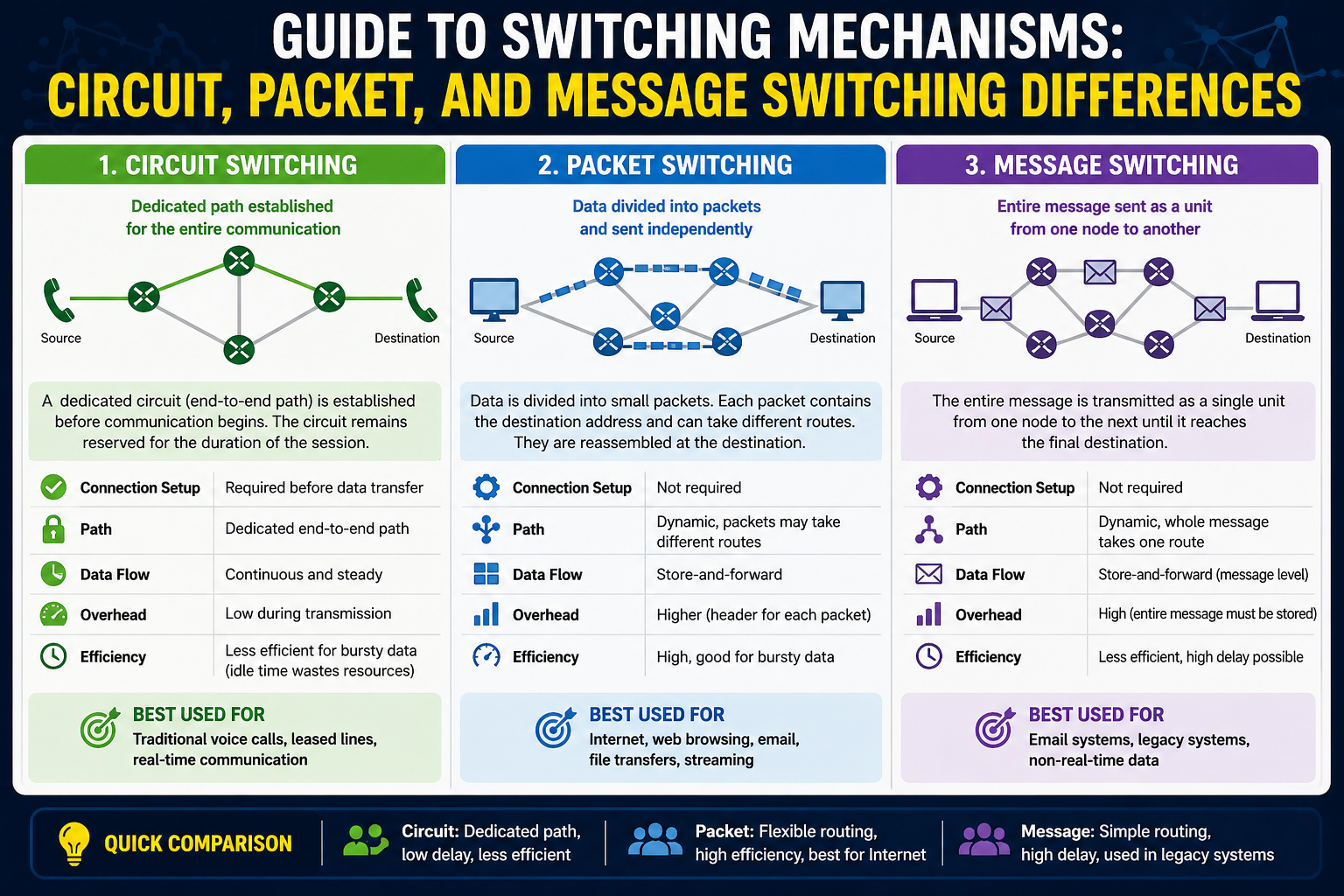
The development of switching mechanisms in computer networks has been driven by the continuous demand for faster, more reliable, and more scalable data transmission. In early networking environments, communication between devices was relatively simple and limited in scale. Networks were smaller, traffic loads were lighter, and the expectation for speed and efficiency was significantly lower than what is required in modern digital infrastructures. As organizations began expanding their digital systems and integrating more connected devices into their environments, the need for structured and intelligent data forwarding systems became increasingly important.
Switching mechanisms emerged as a core solution to the challenge of directing data efficiently from a source device to a destination device within a network. At its most basic level, switching refers to the process of receiving data packets on one interface and forwarding them out through another interface based on destination information. However, the internal methods used to perform this task have evolved significantly over time, transitioning from slower software-based approaches to highly optimized hardware-assisted systems.
In the earliest stages of networking, switches and routers relied heavily on general-purpose processing to analyze each incoming packet. Every packet was treated as a new event, requiring the device to examine its contents, determine the best path, and then forward it accordingly. While this method ensured accuracy, it introduced significant delays because the device had to perform repeated computations for every single packet. As traffic volumes increased, this approach quickly became inefficient.
To address these limitations, more advanced switching mechanisms were introduced. These new methods focused on reducing the amount of repeated processing required for similar traffic flows. Instead of treating every packet as completely unique, network devices began storing information about previously processed packets. This allowed subsequent packets with similar characteristics to be forwarded more quickly, reducing overall processing time and improving network performance.
Over time, switching evolved into multiple distinct categories based on how decisions were made inside the device. Some methods prioritized speed by using cached information, while others prioritized accuracy and flexibility by performing full route lookups for each packet. This evolution marked a significant shift in how networks handled traffic, laying the foundation for modern high-speed communication systems used in enterprise and service provider environments today.
As networking technology progressed further, switching mechanisms became tightly integrated with specialized hardware components. These components were designed to accelerate packet processing by reducing reliance on software-based decision-making. This transition played a major role in enabling modern networks to handle massive volumes of traffic with minimal latency.
How Packet Switching Operates in Modern Network Environments
Packet switching is a fundamental concept that underpins most modern communication networks. In a packet-switched environment, data is broken down into smaller units known as packets before being transmitted across the network. Each packet contains not only the actual data being sent but also additional information such as source address, destination address, and control information required for proper delivery.
Once packets are generated, they are transmitted independently across the network. Unlike traditional circuit-based communication methods, packet-switched networks do not require a dedicated communication path between the sender and receiver. Instead, each packet can take a different route depending on network conditions, available paths, and routing decisions made by intermediate devices.
Within this system, switching devices play a critical role in ensuring that packets reach their intended destination. When a packet arrives at a switching device, the device examines the destination information and determines where to forward it next. This decision-making process must be fast and efficient, especially in environments where large volumes of traffic are constantly flowing.
Modern packet switching relies heavily on structured forwarding logic that minimizes delays. Instead of recalculating the entire route for every packet, switching devices often use pre-established forwarding rules. These rules allow devices to quickly match incoming packets with known destinations and forward them without performing extensive computations each time.
In large-scale networks, packet switching also enables load distribution across multiple paths. Since packets do not need to follow a single fixed route, traffic can be balanced dynamically based on network conditions. This improves overall efficiency and helps prevent congestion in any single part of the network.
Another important aspect of packet switching is its ability to handle variable traffic patterns. Because packets are processed independently, networks can adapt to sudden changes in traffic volume without requiring major reconfiguration. This flexibility is one of the key reasons why packet switching is widely used in modern digital communication systems.
Despite its advantages, packet switching also introduces certain challenges. One of the primary concerns is packet delay variation, which occurs when packets arrive at their destination at different times due to varying network paths. Additionally, packets may sometimes be lost or arrive out of order, requiring additional mechanisms to ensure data integrity and proper sequencing.
Switching mechanisms within packet-switched networks are designed to mitigate these issues by optimizing forwarding efficiency and maintaining consistent performance levels. As a result, packet switching remains the dominant method for data transmission in contemporary networking environments.
Role of Switching in Enhancing Data Transmission Efficiency
Switching mechanisms are central to ensuring that data transmission within a network remains efficient, reliable, and scalable. Without switching, networks would struggle to handle even moderate levels of traffic, as every device would need to independently determine how to reach every other device. This would create excessive overhead and significantly slow down communication.
By introducing structured switching systems, networks are able to delegate forwarding decisions to specialized devices. These devices are designed specifically to handle traffic routing, allowing end devices to focus solely on generating and receiving data. This separation of responsibilities improves overall network performance and reduces processing burden on individual systems.
Efficiency in switching is achieved through a combination of intelligent decision-making and optimized data handling. When a switching device receives a packet, it must quickly determine the most appropriate action based on available information. This may involve checking internal memory structures, referencing stored forwarding data, or consulting routing information maintained within the device.
The speed at which these decisions are made has a direct impact on network performance. Faster decision-making results in lower latency and higher throughput, while slower processes can introduce delays and reduce overall efficiency. As a result, modern switching systems are designed with performance optimization as a primary objective.
Another key factor in switching efficiency is the ability to reduce redundant processing. In traditional systems, each packet would require a full analysis, even if it belonged to a previously seen traffic flow. Modern switching mechanisms address this issue by storing information about known flows, allowing subsequent packets to bypass full processing steps.
This reduction in redundant computation significantly improves network scalability. As traffic volumes increase, switching devices can continue to operate efficiently without becoming overwhelmed by processing demands. This is particularly important in enterprise environments, data centers, and cloud-based infrastructures where large-scale communication is constant.
Switching also contributes to efficient bandwidth utilization. By intelligently directing traffic through optimal paths, switching systems help ensure that network resources are used effectively. This reduces congestion, minimizes packet loss, and improves overall quality of service.
In addition to performance improvements, switching mechanisms also enhance network stability. By distributing traffic intelligently and avoiding unnecessary bottlenecks, networks can maintain consistent performance even under heavy load conditions. This stability is essential for applications that require continuous and reliable connectivity.
Process Switching Fundamentals and Packet Handling Behavior
Process switching represents one of the earliest and most basic methods of packet forwarding within network devices. In this approach, each incoming packet is treated individually and processed by the central CPU of the networking device. The device examines the packet, determines its destination, and then decides where to forward it based on routing information available at that moment.
When a packet arrives at a device using process switching, it is first received through an interface and then passed directly to the system’s processor. The processor is responsible for analyzing the packet header, extracting destination information, and performing a lookup to identify the appropriate outbound interface. Once this decision is made, the packet is forwarded accordingly.
This method is highly accurate because each packet is individually evaluated. However, it is also resource-intensive. Since every packet requires full CPU involvement, the processing overhead increases significantly as traffic volume grows. This makes process switching less suitable for high-performance environments where large amounts of data must be handled simultaneously.
The primary limitation of process switching lies in its reliance on software-based decision-making. Because the CPU must handle every packet, the overall throughput of the system is constrained by processor speed. As network demands increase, this limitation becomes more pronounced, leading to potential bottlenecks and delays.
Despite its inefficiencies, process switching played an important role in the early development of networking technologies. It provided a foundational mechanism for understanding how packet forwarding could be implemented in a controlled and structured manner. It also helped establish the basic principles of routing logic that continue to be used in more advanced switching systems today.
In environments where traffic levels are low or predictable, process switching can still function effectively. However, in modern high-speed networks, it is generally considered too slow for primary forwarding operations. Instead, it is often used as a fallback mechanism when other optimized methods are not available.
The packet handling behavior in process switching also involves repeated lookups for each individual packet. This means that even if multiple packets are destined for the same location, the device does not automatically reuse previous decisions. Instead, it processes each packet independently, which increases computational load and reduces efficiency.
As networking technology advanced, the limitations of process switching became more apparent, leading to the development of faster and more efficient switching mechanisms that reduce reliance on CPU-based processing.
Internal Memory Handling and Packet Forwarding Behavior
Within network switching devices, internal memory structures play a crucial role in determining how packets are processed and forwarded. These memory systems store important information that allows the device to make quick forwarding decisions without needing to reprocess every packet from scratch.
When a packet arrives, the switching device must determine where it should be sent next. To do this efficiently, it relies on stored data that maps destination information to specific forwarding actions. This reduces the need for repeated computation and significantly improves processing speed.
In simpler switching mechanisms, this memory is updated dynamically as new traffic flows are observed. When a packet is processed for the first time, the device may store relevant forwarding information so that subsequent packets with similar characteristics can be handled more quickly. This approach helps reduce CPU workload and improves overall efficiency.
The relationship between memory and forwarding behavior is critical in understanding how modern switching systems operate. Instead of treating every packet as an isolated event, the system builds a form of memory-based awareness that allows it to recognize patterns in traffic flow.
This internal memory handling also enables faster decision-making in high-traffic environments. By storing previously computed results, the device can avoid unnecessary repetition and focus on forwarding packets as quickly as possible. This is especially important in environments where latency must be minimized.
However, maintaining internal memory also introduces complexity. The system must ensure that stored information remains accurate and up to date, particularly in dynamic networks where routes and conditions can change frequently. If outdated information is used, it can lead to incorrect forwarding decisions.
As a result, switching devices must continuously manage and update their internal memory structures to ensure optimal performance. This balance between speed and accuracy is a key aspect of switching design and directly influences how efficiently a network operates.
Early Software-Based Forwarding Limitations and Performance Challenges
Early switching systems relied heavily on software-based forwarding mechanisms, where packet processing was handled primarily by the central CPU. While this approach provided flexibility and simplicity, it introduced significant performance limitations as network demands increased.
One of the main challenges of software-based forwarding was the heavy reliance on general-purpose processing power. Since each packet required full CPU analysis, the system quickly became overloaded under high traffic conditions. This led to increased latency and reduced throughput, especially in larger networks.
Another limitation was the inability to efficiently scale with growing traffic volumes. As more devices were added to the network and data transmission increased, the processing demands on the switching device grew proportionally. Without specialized hardware acceleration, the system struggled to maintain consistent performance.
Software-based forwarding also lacked efficient caching mechanisms in its early implementations. Without the ability to store and reuse forwarding decisions effectively, the system repeatedly performed the same computations for similar packets. This redundancy further reduced efficiency and increased processing delays.
Additionally, early forwarding systems were limited in their ability to handle complex routing scenarios. As networks became more interconnected, routing decisions required more sophisticated logic, which placed even greater strain on software-based processing systems.
These challenges highlighted the need for more advanced switching mechanisms that could reduce dependency on CPU processing and introduce faster, more efficient methods of packet handling. Over time, this led to the development of hardware-accelerated switching techniques that significantly improved network performance and scalability.
MAC Address Learning and CAM Table Operations in Layer 2 Switching
In Ethernet-based networks, switching at Layer 2 relies heavily on the ability of a device to learn and store information about connected endpoints. This learning process is essential for forwarding frames efficiently within a local network segment. At the core of this mechanism is a specialized memory structure known as the CAM table, which plays a fundamental role in how switches make forwarding decisions.
When a Layer 2 switch receives a frame, it examines the source MAC address and the port on which the frame arrived. This information is used to build an internal mapping between MAC addresses and physical interfaces. Over time, the switch develops a dynamic understanding of where devices are located within the network. This allows it to forward future frames directly to the correct destination port without flooding the entire network.
The CAM table, which stands for Content Addressable Memory table, is designed for extremely fast lookups. Unlike traditional memory systems that require sequential searching, CAM allows the switch to search for data based on content rather than location. This means that the switch can instantly determine whether a MAC address exists in its table and retrieve the associated forwarding information in a single operation.
As devices communicate within the network, the CAM table is continuously updated. Entries are added when new MAC addresses are detected and refreshed when existing devices remain active. If a device becomes inactive for a period of time, its entry may eventually be removed to free up space for new entries. This dynamic behavior ensures that the switch maintains an accurate representation of the network topology.
The efficiency of CAM tables is critical in high-speed switching environments. Since modern networks may contain thousands of devices communicating simultaneously, the ability to perform rapid lookups is essential for maintaining low latency. Without CAM-based switching, the process of determining where to forward frames would become significantly slower and less scalable.
The CAM table also helps prevent unnecessary flooding of network traffic. In cases where the destination MAC address is already known, the switch can forward the frame directly to the appropriate port. This reduces network congestion and improves overall performance by limiting broadcast traffic.
TCAM Architecture and Its Role in Advanced Packet Filtering
While CAM tables are optimized for simple exact-match lookups, more complex networking requirements demand a more flexible and powerful memory structure. This is where TCAM, or Ternary Content Addressable Memory, becomes essential. TCAM extends the capabilities of CAM by allowing for three possible matching states: 0, 1, and wildcard (don’t care).
This additional flexibility enables TCAM to support more advanced forwarding decisions, particularly in environments where packet classification is required. Instead of matching only exact values, TCAM can evaluate patterns and ranges, making it ideal for tasks such as access control, quality of service classification, and policy-based routing.
When a packet arrives at a switching device that utilizes TCAM, the device compares multiple fields within the packet header against stored rules. These rules may include source and destination IP addresses, protocol types, or port numbers. Because TCAM can evaluate multiple conditions simultaneously, it significantly speeds up the decision-making process.
One of the most important advantages of TCAM is its ability to perform parallel searches. Unlike traditional memory systems that process queries one at a time, TCAM evaluates all entries simultaneously. This allows the switch or router to identify the best matching rule in a single operation, regardless of the complexity of the filtering criteria.
However, TCAM is also more resource-intensive than standard CAM. It consumes more power and is more expensive to implement, which means it is typically used only in high-performance networking devices where advanced packet classification is required. Despite these limitations, its ability to handle complex decision-making tasks makes it indispensable in modern enterprise and service provider networks.
TCAM is often used in conjunction with access control lists and routing policies. These policies define how different types of traffic should be handled as they pass through the network. By using TCAM, the device can quickly determine whether a packet should be permitted, denied, or forwarded based on predefined rules.
The integration of TCAM into switching architectures represents a significant advancement in network intelligence. It allows devices to move beyond simple destination-based forwarding and incorporate more sophisticated decision-making processes that enhance security, performance, and traffic management.
Routing Information Base and Network Decision Structures
The Routing Information Base, commonly referred to as the RIB, is a critical component in routing and switching architectures that handle Layer 3 forwarding decisions. It serves as a centralized repository of all known network routes, including those learned dynamically through routing protocols and those configured manually by network administrators.
The RIB contains comprehensive routing information that includes destination networks, next-hop addresses, and associated metrics. This information is used to determine the most efficient path for forwarding packets toward their destination. Unlike fast hardware-based lookup tables, the RIB is typically maintained in software and updated continuously as network conditions change.
When multiple routes exist to the same destination, the RIB evaluates each option based on routing metrics such as administrative distance, cost, and path preference. The best route is then selected and installed into the forwarding structure used by the switching hardware. This separation between route calculation and packet forwarding is a key aspect of modern network design.
The RIB does not directly participate in the forwarding of individual packets. Instead, it acts as a decision-making database that feeds optimized routing information into faster forwarding mechanisms. This ensures that the most accurate and efficient routes are always available for use by the forwarding engine.
In dynamic networks, the RIB plays an essential role in adapting to changes such as link failures or topology updates. When a change is detected, routing protocols update the RIB with new information, and the system recalculates the best available paths. This allows the network to maintain continuous connectivity even in the presence of disruptions.
The relationship between the RIB and forwarding structures highlights the layered nature of modern networking systems. While the RIB focuses on decision-making and route selection, other components are responsible for executing those decisions at high speed.
Fast Switching Mechanisms and Cached Forwarding Behavior
Fast switching represents a significant improvement over traditional process switching by introducing a caching mechanism that reduces repetitive computation. Instead of performing a full route lookup for every incoming packet, fast switching stores the results of previous lookups in a cache. This allows subsequent packets belonging to the same flow to be forwarded more quickly.
When the first packet in a flow arrives at a device using fast switching, it is processed using standard routing logic. The device performs a full lookup to determine the best path for the packet and then stores this information in a cache. This cached entry includes details about the destination network and the appropriate outgoing interface.
For subsequent packets with the same destination characteristics, the switch bypasses the full routing lookup process. Instead, it retrieves the forwarding information directly from the cache and forwards the packet immediately. This significantly reduces processing overhead and improves overall performance.
Fast switching is particularly effective in environments where traffic patterns are stable and predictable. In such cases, many packets share similar characteristics, allowing the cache to be reused frequently. This reduces CPU utilization and increases forwarding speed.
However, fast switching also has limitations. The cache must be continuously managed to ensure accuracy, especially in networks where routes change frequently. If a route changes but the cache is not updated immediately, packets may be forwarded incorrectly. This requires mechanisms to invalidate or refresh cached entries when network topology changes occur.
Despite these challenges, fast switching marked an important step in the evolution of packet forwarding. It introduced the concept of flow-based optimization, where repeated traffic patterns are recognized and processed more efficiently. This idea continues to influence modern switching architectures.
Cisco Express Forwarding and Hardware-Based Packet Processing
Cisco Express Forwarding represents a major advancement in switching technology by shifting packet forwarding decisions away from software-based processing and into hardware-optimized structures. Unlike earlier methods that relied heavily on CPU involvement, this approach uses precomputed tables that allow for extremely fast packet forwarding.
At the core of this mechanism is the Forwarding Information Base, which contains optimized routing entries derived from the Routing Information Base. The FIB is designed for rapid lookups and is structured to support high-speed hardware access. Alongside the FIB, adjacency tables are used to store Layer 2 rewrite information required for forwarding packets to the next hop.
When a packet arrives, the switching device performs a quick lookup in the FIB to determine the appropriate next hop. It then uses the adjacency table to determine the correct Layer 2 encapsulation details. This entire process is executed with minimal CPU involvement, allowing for near-instantaneous forwarding decisions.
One of the key advantages of this architecture is its scalability. Because forwarding decisions are precomputed and stored in hardware-accessible structures, the system can handle extremely high traffic volumes without degradation in performance. This makes it ideal for large enterprise networks and service provider environments.
Cisco Express Forwarding also improves consistency in packet handling. Since all packets belonging to a given destination follow the same precomputed path, variability in forwarding behavior is minimized. This leads to more predictable network performance and reduced latency variation.
Another important aspect of this mechanism is its ability to support distributed processing. In systems where multiple forwarding engines are present, each engine can independently access the FIB and make forwarding decisions without relying on a central processor. This distributed approach enhances redundancy and resilience within the network.
Centralized Versus Distributed Switching Architectures
Switching architectures can be broadly categorized into centralized and distributed models, each with distinct operational characteristics and performance implications. In centralized switching, all packet forwarding decisions are made by a single central processing unit. This means that every packet must be processed through a central point before being forwarded to its destination.
While centralized switching is simpler in design, it can become a bottleneck in high-traffic environments. As the number of packets increases, the central processor may struggle to keep up with demand, leading to delays and reduced performance. This limitation becomes more pronounced in large-scale networks with multiple connected devices generating continuous traffic.
In contrast, distributed switching architectures distribute the forwarding workload across multiple processing units. Each unit is capable of making independent forwarding decisions based on locally available information. This reduces the load on any single processor and significantly improves scalability.
Distributed switching systems often rely on shared forwarding tables that are synchronized across multiple devices or modules. Each forwarding engine can access this shared information and make decisions independently, allowing for parallel processing of network traffic.
This architecture improves both performance and reliability. If one forwarding engine fails, others can continue operating without interruption. This redundancy ensures that the network remains operational even in the presence of hardware failures.
The shift from centralized to distributed switching reflects the broader evolution of network design toward decentralization and parallel processing. As networks continue to grow in size and complexity, distributed architectures provide the scalability and resilience required to maintain high levels of performance.
Relationship Between FIB Structures and High-Speed Forwarding
The Forwarding Information Base is a critical component in high-speed switching systems, particularly those that rely on hardware-based forwarding mechanisms. It serves as a streamlined version of the Routing Information Base, containing only the essential information required for packet forwarding.
Unlike the RIB, which contains comprehensive routing data and is used for decision-making, the FIB is optimized for speed. It includes only the best available routes, eliminating redundant or less optimal paths. This allows forwarding devices to perform lookups quickly and efficiently.
The FIB is updated whenever changes occur in the routing environment. When new routes are learned or existing routes become invalid, the RIB recalculates the best paths and updates the FIB accordingly. This ensures that forwarding decisions are always based on the most current network information.
In high-performance switching systems, the FIB is often implemented in hardware or specialized memory structures that allow for extremely fast access times. This enables devices to forward packets at line rate, even under heavy traffic conditions.
The efficiency of the FIB is one of the key reasons modern networks are able to handle large volumes of traffic without performance degradation. By separating route computation from packet forwarding, the system ensures that each function is optimized for its specific role.
Distributed Forwarding Behavior in Scalable Network Systems
Distributed forwarding is a technique used in advanced network architectures to improve scalability and resilience by allowing multiple forwarding engines to operate independently. In this model, each forwarding engine is responsible for processing a portion of the network traffic using shared routing information.
Each engine maintains access to a synchronized forwarding database, which contains the necessary information for making forwarding decisions. When a packet arrives, it is processed by the nearest or most appropriate forwarding engine, which determines the next hop based on locally available data.
This approach reduces dependency on centralized processing and allows the network to handle significantly higher traffic volumes. Because multiple engines can process packets simultaneously, overall throughput is greatly increased.
Distributed forwarding also enhances fault tolerance. If one forwarding engine fails, others can continue operating without disruption. This ensures continuous network availability and reduces the impact of hardware failures.
The scalability of distributed forwarding makes it particularly well-suited for large data centers and service provider networks, where traffic loads are high and performance requirements are strict.
Centralized Control Planes and Their Role in Switching Architectures
In modern networking systems, switching is not only about how packets move through hardware paths but also about how decisions are made before those packets are forwarded. This decision-making layer is commonly referred to as the control plane, and its structure plays a major role in determining how efficiently a network operates. In centralized control plane designs, routing decisions and forwarding logic are computed in a single logical location before being distributed to switching devices.
A centralized control plane gathers information from across the network, including topology updates, routing changes, and link status information. It processes this data to compute optimal paths for data transmission. Once these paths are determined, they are distributed to individual switches or forwarding devices, which use the information to handle actual packet forwarding.
This design simplifies network management because all decision-making logic is concentrated in one place. Network administrators can apply policies, update routing rules, and monitor changes from a unified system. However, the centralized nature also introduces potential scalability challenges, especially in very large or highly dynamic environments where constant updates are required.
When traffic patterns change rapidly, the centralized control plane must continuously recompute routing decisions and distribute updates to all connected devices. This can introduce delays between a network change and its reflection in forwarding behavior. Despite this limitation, centralized control remains useful in environments where consistency and simplified management are prioritized.
Switching devices operating under centralized control still rely on local forwarding tables for packet handling. The key difference is that these tables are populated and updated by the central system rather than being independently learned or computed by each device. This separation between decision-making and execution is fundamental to understanding modern switching architecture.
The centralized model also plays an important role in ensuring policy consistency across the network. Since all decisions originate from a single logic source, it becomes easier to enforce uniform rules for traffic handling, security filtering, and routing behavior. This reduces the risk of configuration inconsistencies that could arise in fully decentralized systems.
Distributed Control Planes and Autonomous Switching Behavior
In contrast to centralized models, distributed control planes allow each network device to independently participate in decision-making processes. Instead of relying on a single central system, each switch or router contributes to the overall understanding of the network topology and computes its own forwarding decisions based on shared information.
In a distributed control plane, routing protocols play a central role in exchanging information between devices. Each device learns about network changes from its neighbors and updates its internal routing database accordingly. These updates are then used to compute local forwarding decisions.
This distributed approach enhances scalability because there is no single point responsible for all decision-making. As the network grows, additional devices can be added without significantly increasing the burden on any central system. Each device simply participates in the existing routing exchange process.
Another advantage of distributed control is resilience. If one device fails, the rest of the network can continue operating without disruption. Since each device maintains its own view of the network, there is no dependency on a central controller for continued operation.
However, distributed control planes also introduce complexity. Because each device makes its own decisions, there is a possibility of temporary inconsistencies during network convergence. When changes occur, it takes time for all devices to update their routing tables and reach a consistent state.
Despite this, distributed control remains widely used in large-scale networks because of its scalability and fault tolerance. It forms the basis of many modern routing protocols that enable dynamic and adaptive network behavior.
Hardware Acceleration and ASIC-Based Switching Performance
As network traffic demands increased, traditional software-based switching methods became insufficient to handle high-speed data transmission efficiently. To address this challenge, hardware acceleration technologies were introduced, enabling switching operations to be performed directly within specialized hardware components rather than relying solely on general-purpose CPUs.
Application-Specific Integrated Circuits, commonly known as ASICs, are designed specifically for network processing tasks. These chips are optimized for high-speed packet forwarding, allowing them to perform switching operations much faster than software-based systems. By embedding forwarding logic directly into hardware, ASICs significantly reduce processing delays.
When a packet arrives at a device equipped with ASIC-based switching, the packet is processed directly by hardware forwarding engines. These engines use precomputed tables, such as the FIB and adjacency tables, to determine the correct forwarding path. Because these operations occur at hardware speed, latency is minimized, and throughput is maximized.
ASIC-based switching also reduces CPU load significantly. Since forwarding decisions are handled by dedicated hardware, the central processor is free to perform other tasks such as management, monitoring, and control plane operations. This separation of responsibilities improves overall system efficiency.
Another important aspect of hardware acceleration is consistency. Since forwarding decisions are executed in hardware, packet processing becomes highly deterministic. This reduces variability in latency and ensures stable performance even under heavy load conditions.
However, ASIC-based systems are less flexible than software-based systems. Because the logic is embedded in hardware, making changes to switching behavior may require firmware updates or hardware upgrades. Despite this limitation, the performance benefits make ASIC-based switching essential in modern high-speed networks.
Flow-Based Switching and Traffic Optimization Techniques
Flow-based switching represents an important evolution in packet forwarding strategies, where network devices treat groups of packets as part of a single logical flow rather than processing each packet independently. A flow is typically defined by a combination of parameters such as source address, destination address, protocol type, and port numbers.
When a new flow is detected, the switching device performs a full routing lookup to determine the best path for that flow. This information is then stored in a flow table. Subsequent packets belonging to the same flow are forwarded using the stored information, avoiding repeated lookups.
This approach significantly improves efficiency because most network traffic consists of multiple packets belonging to the same communication session. By recognizing and optimizing these flows, switching devices reduce processing overhead and increase forwarding speed.
Flow-based switching also enables more advanced traffic management techniques. For example, network devices can apply quality of service policies at the flow level, ensuring that important traffic receives priority handling. This allows networks to support applications with varying performance requirements.
In addition to performance optimization, flow-based switching also improves monitoring and analysis capabilities. Because traffic is grouped into flows, it becomes easier to track communication patterns and identify network behavior trends. This information can be used for troubleshooting and optimization purposes.
However, flow-based systems require memory resources to maintain flow tables. In environments with a large number of simultaneous flows, this can become a limiting factor. Proper management of flow entries is therefore essential to maintain system performance.
Conclusion
Switching mechanisms form the backbone of modern network communication, shaping how data moves efficiently across increasingly complex and high-demand environments. From early process-based forwarding methods to advanced hardware-accelerated systems, the evolution of switching reflects the broader transformation of networking itself—from simple connectivity models to highly optimized, intelligent infrastructures capable of supporting global-scale digital communication.
At the core of this evolution is the continuous effort to reduce latency, improve throughput, and minimize unnecessary processing overhead. Early switching methods, such as process switching,g demonstrated how packet-by-packet CPU-based handling could ensure accuracy but struggled under higher traffic loads due to their computational intensity. As networks expanded, these limitations became more apparent, driving the development of faster mechanisms like fast switching, which introduced caching concepts to reduce repetitive lookups and improve performance.
The introduction of hardware-assisted technologies such as Cisco Express Forwarding marked a significant turning point in switching design. By separating control plane decision-making from data plane execution, modern systems were able to achieve near line-rate forwarding speeds. The use of structures such as the FIB and adjacency tables allowed networks to bypass complex software processing during packet forwarding, ensuring faster and more consistent delivery of data.
Memory-based technologies such as CAM and TCAM further enhanced switching intelligence. CAM enabled rapid exact-match lookups for MAC address forwarding, while TCAM extended this capability to support more complex, policy-driven decisions. Together, these memory systems allowed switches to evolve from simple forwarding devices into intelligent traffic management systems capable of handling security policies, quality of service rules, and advanced filtering requirements at hardware speed.
The distinction between centralized and distributed switching architectures also highlights the adaptability of modern networking systems. Centralized models offer simplicity and unified control, while distributed models provide scalability, resilience, and improved fault tolerance. In large-scale environments, distributed forwarding ensures that no single processing point becomes a bottleneck, enabling networks to grow while maintaining high performance.
Equally important is the role of flow-based switching and load-balancing techniques, which optimize how traffic is distributed across available network paths. These mechanisms ensure efficient use of bandwidth, reduce congestion, and improve overall user experience by maintaining consistent performance even under heavy traffic conditions.
Security considerations have also become deeply integrated into switching mechanisms. Modern switches are no longer passive forwarding devices; they actively enforce policies, filter traffic, and contribute to network defense strategies. This integration ensures that performance and security coexist within the same infrastructure layer without compromising efficiency.
Ultimately, the development of switching mechanisms represents a continuous journey toward greater speed, intelligence, and scalability. Each advancement builds upon previous limitations, introducing new levels of optimization that allow networks to meet the demands of today’s data-driven world. As digital ecosystems continue to expand, switching technologies will remain a critical foundation, ensuring that communication remains fast, reliable, and secure across all layers of modern networking systems.