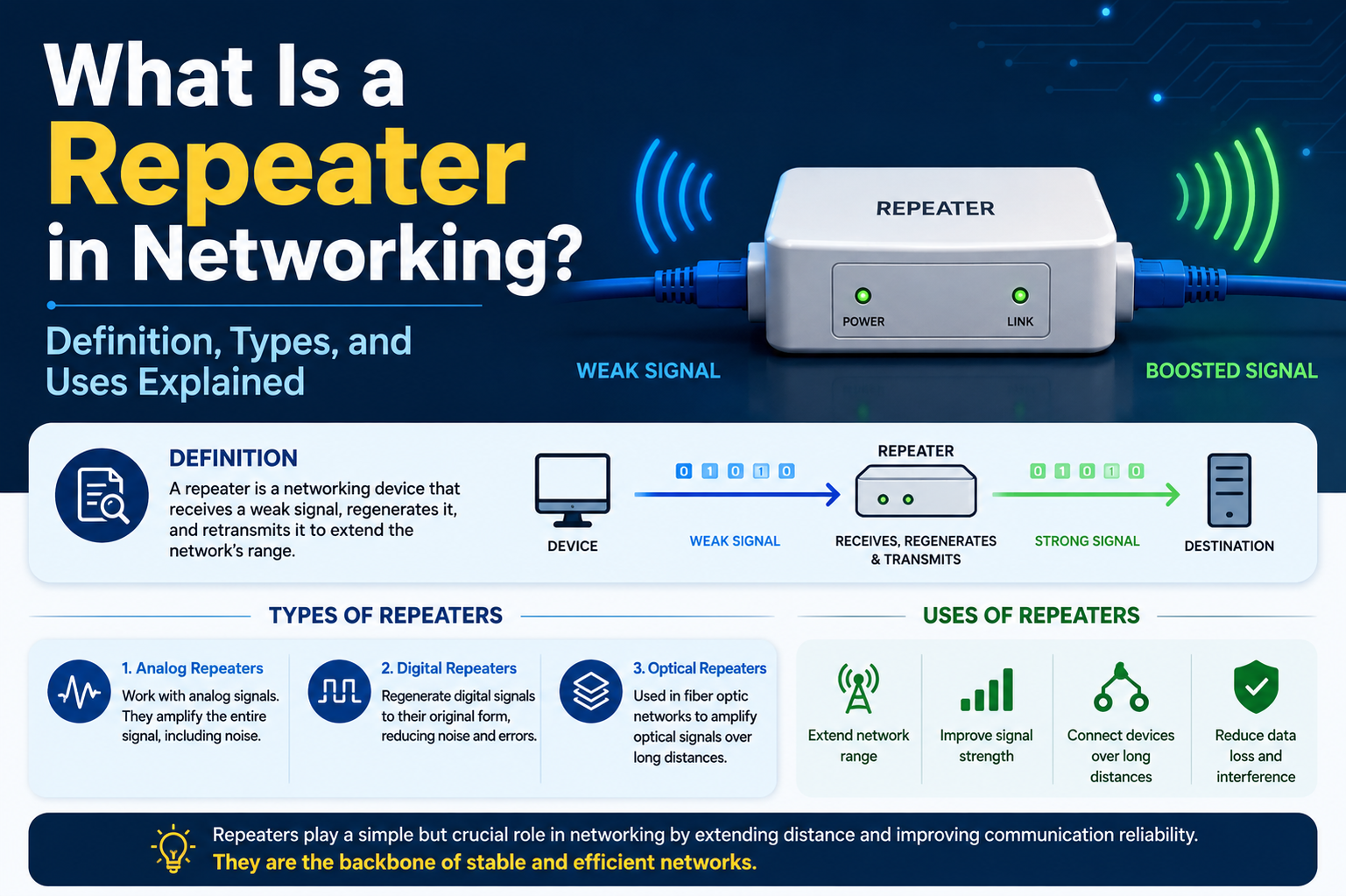
A repeater is one of the simplest yet most important devices in networking. Its main purpose is to strengthen a weak signal so that it can travel farther without losing quality. In any communication system, whether wired or wireless, signals naturally weaken as they move across distance. This weakening is known as attenuation, and it can lead to poor performance, lost data, or even complete communication failure. A repeater solves this problem by receiving a weak signal, regenerating it, and sending it forward at full strength.
To understand why this matters, it helps to imagine how data travels in a network. Information is transmitted as electrical or optical signals through cables or wireless waves. As these signals move, they gradually lose strength due to resistance, interference, or environmental obstacles like walls and physical distance. Without a device to restore the signal, the communication would eventually become too weak to be useful. This is where repeaters play their role as signal boosters, ensuring that data continues its journey reliably.
Repeaters are especially important in large buildings, campuses, industrial environments, and outdoor networks where distances between devices can be significant. For example, in a long cable connection between two floors of a building, a signal may weaken before reaching its destination. A repeater placed along the path restores the signal, allowing communication to continue without interruption. This makes it possible to design networks that cover much larger areas than would otherwise be feasible.
Although repeaters are sometimes confused with other networking devices, their function is quite different. They do not analyze data, make routing decisions, or manage traffic. Instead, they operate purely at the physical level of communication. Their only responsibility is to receive incoming signals, clean them, and transmit them again at full strength. This simplicity is what makes them efficient for extending network reach without adding complexity.
In the broader structure of networking systems, repeaters are associated with the physical layer, which is the first layer in the conceptual model used to describe how data moves across networks. This layer deals only with raw signal transmission. It does not interpret data or determine where it should go. A repeater fits perfectly into this layer because it focuses entirely on maintaining signal strength without altering the content of the data itself.
One way to understand a repeater is to compare it to a relay runner in a race. The runner does not change the message they are carrying; they simply ensure it reaches the next stage without slowing down. Similarly, a repeater ensures that data continues moving across the network without degradation. It acts as a bridge between two points where the signal would otherwise become too weak to travel.
Another important aspect of repeaters is that they are transparent to the network. Devices on either side of a repeater do not need to be aware of its presence. From their perspective, they are communicating directly, even though the signal is being refreshed in the middle. This makes repeaters easy to integrate into existing network designs without requiring major configuration changes.
Despite their simplicity, repeaters play a crucial role in maintaining communication reliability. Without them, network designers would be limited by strict distance constraints. Every cable or wireless connection would have a maximum effective range, and beyond that range, communication would break down. By using repeaters, networks can extend far beyond those natural limits.
Repeaters also help reduce the impact of environmental interference. In real-world conditions, signals are affected by electrical noise, physical obstructions, and competing signals from other devices. As a signal weakens, it becomes more vulnerable to distortion. A repeater restores the signal to its original clarity, reducing the chance of errors during transmission.
In modern networking environments, repeaters may exist in different forms. In wired networks, they are physical devices placed along cables. In wireless networks, similar functionality is achieved through wireless range extenders that boost Wi-Fi signals. Although the technology varies, the principle remains the same: strengthen and extend the signal.
Understanding repeaters is essential for anyone studying networking because they represent one of the foundational concepts of signal transmission. Even though modern systems often rely on more advanced infrastructure, the basic idea of signal regeneration remains central to how data moves across large-scale networks. Repeaters provide the groundwork for understanding more complex networking devices and systems.
How Repeaters Work, Their Functions, and Their Role in Network Performance
The working principle of a repeater is based on a simple but powerful idea: detect a weak signal, regenerate it, and retransmit it at full strength. Although the concept is straightforward, the process is essential for maintaining data integrity across long communication paths. Without this function, signals would degrade to the point where information becomes unreadable or corrupted.
When a signal enters a repeater, the device first receives it in its weakened state. This signal may have lost strength due to distance, interference, or physical obstacles. The repeater does not interpret the meaning of the signal; instead, it focuses on its electrical or optical characteristics. It then reconstructs the signal, removing noise and restoring its original shape and strength before sending it onward.
This process is known as signal regeneration. Unlike simple amplification, which only increases signal strength, regeneration also cleans the signal. This is important because weak signals are often distorted. If only amplification were used, the distortion would also be strengthened. By regenerating the signal, the repeater ensures that errors are minimized and data remains accurate.
Repeaters also help maintain signal timing. In digital communication, timing is important because data is transmitted in structured intervals. If a signal becomes distorted, these intervals can become unclear, leading to errors. A repeater restores proper timing, ensuring that the receiving device interprets the data correctly.
One of the most important functions of repeaters is extending network reach. In both wired and wireless systems, there is a natural limit to how far a signal can travel before it becomes too weak. Repeaters extend this limit by acting as intermediate points that refresh the signal along the way. This allows networks to span large distances, such as across buildings, campuses, or industrial facilities.
Another key function is maintaining signal integrity. As signals travel, they are affected by various types of interference, including electromagnetic noise and physical obstacles. This can introduce errors into the transmitted data. Repeaters help remove this noise by reconstructing the signal in a clean form, ensuring that the information remains accurate from source to destination.
Repeaters also contribute to overall network stability. By reducing signal loss and improving transmission quality, they help prevent communication breakdowns. This is especially important in environments where consistent connectivity is required, such as business operations, data centers, or communication systems.
However, repeaters are not without limitations. One important consideration is latency. Since repeaters process and regenerate signals, they introduce a small delay in transmission. In most cases, this delay is minimal and not noticeable to users, but in highly sensitive systems, it can be a factor in network design.
Another consideration is placement. The effectiveness of a repeater depends heavily on where it is installed. If placed too close to the source or destination, it may not effectively extend the signal. If placed too far, it may fail to properly receive the weak signal. The optimal position is usually somewhere along the midpoint of the signal path, where it can receive and transmit effectively.
Repeaters also vary in terms of interface compatibility. In wired networks, they may support different types of connections such as Ethernet or fiber optics. In wireless systems, they operate by receiving and retransmitting radio signals. Despite these differences, the underlying function remains consistent.
From a performance perspective, repeaters are valuable because they allow networks to scale beyond physical limitations. Without them, network designers would need to rely on shorter cable runs or additional infrastructure to maintain signal strength. Repeaters simplify this by extending coverage without significantly increasing complexity.
They are particularly useful in environments with physical barriers. Thick walls, long corridors, and large open spaces can all weaken signals. Repeaters help overcome these challenges by restoring signal strength at key points in the network. This ensures that users experience consistent connectivity regardless of their location within the network area.
In addition, repeaters contribute to more efficient network design. Instead of over-engineering infrastructure to maintain signal strength across long distances, designers can strategically place repeaters to achieve the same result more cost-effectively. This makes them a practical solution in both small and large-scale networks.
Overall, repeaters play a critical role in ensuring that data can travel reliably across networks. Their ability to regenerate and extend signals makes them an essential component in maintaining communication quality in environments where distance and interference would otherwise be limiting factors.
Deployment, Real-World Applications, and Modern Relevance of Repeaters
Deploying repeaters effectively requires careful planning, as their placement directly influences network performance. A repeater must be positioned where it can receive a sufficiently strong signal to regenerate it properly. If the signal is too weak at the input stage, the repeater cannot restore it effectively. Because of this, network design often involves analyzing signal strength across different points to determine optimal installation locations.
In practical network layouts, repeaters are commonly placed between devices that are too far apart for direct communication. This is especially useful in long cable runs or large wireless coverage areas. By placing a repeater at a midpoint, the signal can be refreshed before it becomes too degraded, ensuring continuous communication.
Environmental factors also play a major role in deployment decisions. Physical obstacles such as walls, floors, and machinery can interfere with signal transmission. Electrical interference from other devices can also impact performance. As a result, repeaters are often installed in locations that minimize exposure to such disruptions while still maintaining effective signal coverage.
Power reliability is another important consideration. Since repeaters actively process and retransmit signals, they require a consistent power supply. In critical environments, backup power systems may be used to ensure that repeaters continue functioning even during power interruptions. This helps maintain network stability and prevents communication breakdowns.
In real-world applications, repeaters are widely used in both wired and wireless networks. In wired environments, they help extend Ethernet or fiber optic connections across long distances. In wireless environments, similar functionality is achieved through devices that extend Wi-Fi coverage, ensuring that users can access the network even in distant or obstructed areas.
Large buildings, campuses, and industrial facilities often rely on repeaters to maintain consistent connectivity. Without them, signal strength would diminish significantly as distance increases, leading to unreliable communication. By strategically placing repeaters, network designers can ensure that coverage remains consistent throughout the entire environment.
Repeaters also play a role in outdoor communication systems. In environments where infrastructure is spread across wide areas, such as transportation systems or remote installations, repeaters help bridge gaps between communication points. This ensures that data can travel across long distances without interruption.
Despite their usefulness, modern networking technologies have introduced more advanced alternatives in some cases. Devices such as switches, routers, and wireless access points often include built-in signal management capabilities that reduce the need for standalone repeaters. However, the fundamental concept of signal regeneration remains important across all of these technologies.
In many modern systems, repeaters are still used as part of larger network designs rather than as standalone solutions. They complement other devices by extending reach where necessary and ensuring that weaker sections of the network remain functional. This makes them a flexible and adaptable component in both legacy and modern infrastructures.
As networks continue to evolve, the role of repeaters is also changing. In highly advanced systems, signal regeneration may occur automatically within network hardware or through software-defined infrastructure. Even so, the underlying principle remains the same: signals must be maintained at sufficient strength to ensure reliable communication.
Understanding how repeaters function in real-world environments provides valuable insight into how networks are designed and maintained. It highlights the importance of signal integrity, distance management, and infrastructure planning in creating reliable communication systems.
Advanced Concepts, Limitations, Design Strategies, and the Evolving Role of Repeaters in Modern Networks
As networking systems have grown more complex, the role of repeaters has also become more nuanced. While the basic idea of regenerating weak signals remains unchanged, modern network environments require a deeper understanding of how repeaters interact with larger infrastructure, how they perform under different conditions, and where their use is most effective compared to more advanced technologies. This part explores the practical realities, design considerations, and evolving relevance of repeaters in contemporary networking.
To begin with, it is important to understand that repeaters operate at the most fundamental level of communication systems. They do not interpret data, make decisions about routing, or manage traffic flow. Instead, they exist purely to maintain signal strength across physical distances. This simplicity is both their greatest strength and their main limitation. Because repeaters do not process data beyond signal regeneration, they cannot optimize traffic, prioritize packets, or adapt intelligently to network conditions.
This limitation becomes more noticeable in complex networks where data flow is dynamic and highly variable. In such environments, devices that can make intelligent decisions about traffic management often replace or complement repeaters. However, even in advanced systems, the core function of signal regeneration remains necessary, and the principles behind repeaters continue to influence modern network design.
One of the key limitations of repeaters is their inability to distinguish between useful signals and noise beyond basic regeneration. While they can clean and restore signals to a certain extent, they cannot make contextual decisions about data quality or security. This means that if a corrupted signal is received and still recognizable as a signal, the repeater will regenerate it without evaluating its content. In modern networks where data integrity and security are critical, this limitation must be carefully considered during system design.
Another important factor is signal delay. Although repeaters introduce only minimal latency, in large networks with multiple repeaters chained together, delays can accumulate. This can impact time-sensitive applications such as real-time communication, high-frequency trading systems, or synchronized industrial operations. While each individual delay may be small, the cumulative effect can become significant in large-scale deployments.
Network designers must also consider signal degradation patterns when planning repeater placement. Signals do not degrade in a perfectly linear manner. Instead, their strength can fluctuate due to environmental interference, cable quality, and electromagnetic noise. This makes it essential to analyze real-world conditions rather than relying solely on theoretical distance limits. Proper placement of repeaters requires understanding how signals behave in specific environments rather than applying a universal rule.
In structured cabling systems, repeaters are often placed at carefully calculated intervals. These intervals are not arbitrary; they are based on the maximum effective transmission distance of the medium being used. For example, copper cables have different signal loss characteristics compared to fiber optic cables. Fiber optic systems can transmit data over much longer distances without significant degradation, which reduces the need for frequent signal regeneration. However, even fiber-based networks may require repeaters in extremely long-distance or high-capacity environments.
Environmental factors also play a critical role in repeater performance. Temperature variations, electromagnetic interference, and physical obstructions can all impact signal quality. In industrial environments, for example, heavy machinery can generate electromagnetic noise that disrupts communication signals. In such cases, repeaters must be strategically placed and sometimes shielded to ensure proper operation. Understanding the physical environment is just as important as understanding the technical specifications of the network.
Another important design consideration is redundancy. In critical systems, relying on a single repeater can introduce a potential point of failure. If a repeater fails, the signal path beyond it may become unusable. To prevent this, network architects often design redundant paths or deploy multiple repeaters in parallel configurations. This ensures that even if one device fails, communication can continue through an alternative route. Redundancy is especially important in systems where downtime is not acceptable.
Power stability is another essential factor in repeater deployment. Because repeaters actively regenerate signals, they require continuous electrical power. In environments where power interruptions are possible, backup systems are often used to maintain operation. Without power continuity, even the most well-designed network can experience significant disruptions. This is why repeaters in critical environments are often connected to backup power sources to ensure uninterrupted functionality.
As networks scale, the role of repeaters becomes more integrated into broader infrastructure planning. Instead of being standalone devices placed arbitrarily along cables, they are now considered part of a larger ecosystem of connectivity tools. Their placement is often coordinated with other network components such as switches, routers, and access points to ensure balanced signal distribution and optimal performance.
In wireless environments, the concept of repeaters takes on a slightly different form. Wireless repeaters receive signals from a wireless source and retransmit them to extend coverage. This is particularly useful in large buildings or areas with signal-blocking materials such as concrete or metal. However, wireless repeaters must be carefully positioned to avoid creating overlapping interference zones, which can reduce overall network performance.
One of the more subtle challenges in repeater-based systems is signal overlap. When multiple repeaters are placed too close together, their signals can interfere with each other, leading to reduced efficiency. This phenomenon requires careful calibration during installation to ensure that each repeater operates within its optimal range without overlapping excessively with others. Proper spacing and configuration are essential to maintaining network clarity.
Despite their limitations, repeaters remain highly relevant in many types of network environments. Their simplicity, reliability, and cost-effectiveness make them a practical solution for extending connectivity in situations where more complex infrastructure is unnecessary or impractical. In many cases, they serve as a foundational layer that supports more advanced networking technologies.
In modern hybrid networks, repeaters often coexist with intelligent devices that handle traffic management and routing. While routers and switches determine how data flows through a network, repeaters ensure that the physical signal remains strong enough to support that flow. This division of responsibility allows each device to focus on its specific function, creating a more efficient overall system.
The evolution of networking has also influenced how repeaters are integrated into system design. In earlier network architectures, repeaters were often deployed as standalone units placed manually along cable routes. In modern systems, their functionality is sometimes embedded into other devices, reducing the need for separate hardware. However, the underlying principle of signal regeneration remains unchanged.
Another important aspect of modern repeater usage is scalability. As organizations expand their networks, the ability to extend connectivity without redesigning the entire infrastructure becomes essential. Repeaters provide a scalable solution by allowing incremental expansion of network coverage. Instead of replacing existing infrastructure, additional repeaters can be added to extend reach as needed.
Security considerations are also increasingly relevant in repeater-based systems. Although repeaters do not process data content, they still transmit all signals they receive. This means that if a network is not properly secured, sensitive information could potentially be propagated through extended segments of the network. As a result, repeaters must be used in conjunction with appropriate security measures to ensure data protection.
In high-performance computing environments, repeaters are often used selectively rather than extensively. This is because such environments prioritize minimal latency and maximum efficiency. While repeaters help extend signal reach, they also introduce small delays that may not be acceptable in highly optimized systems. In these cases, alternative infrastructure designs are often preferred.
Another emerging consideration is energy efficiency. As networks grow larger, power consumption becomes an important factor. Repeaters consume energy continuously while operating, and in large-scale deployments, this can contribute to overall power usage. Modern network design increasingly takes energy efficiency into account, balancing the need for signal extension with sustainability considerations.
Looking at future trends, the role of repeaters is likely to continue evolving rather than disappearing. Even as more intelligent and integrated networking solutions emerge, the fundamental need to maintain signal integrity across distance remains unchanged. Whether through dedicated devices or embedded functionality, the concept of signal regeneration will continue to be a core part of networking systems.
They are simple in concept but essential in function. Their limitations require careful planning, but their benefits make them indispensable in many environments. As networks become more complex and distributed, understanding how repeaters fit into broader system design becomes increasingly important for creating reliable and scalable communication infrastructures.
Real-World Applications, Troubleshooting Scenarios, and How Repeaters Fit Into Modern Networking Systems
In practical networking environments, repeaters are not just theoretical devices explained in textbooks. They are actively used in real-world systems where signal loss is a daily challenge. Whether in homes, offices, industrial sites, or large public infrastructures, repeaters play a quiet but essential role in keeping communication stable and reliable across distance and obstacles.
One of the most familiar uses of repeaters is in extending network coverage in large buildings. In environments such as multi-floor offices, hospitals, or educational campuses, a single network source is rarely enough to cover every corner effectively. Walls, floors, and structural materials weaken signals as they travel, creating dead zones where connectivity becomes unreliable. By placing repeaters at strategic points, the network signal can be refreshed and extended into areas that would otherwise suffer from weak or inconsistent connectivity.
In residential settings, repeaters are often used to solve similar problems on a smaller scale. Modern homes may include multiple rooms, thick walls, and multiple electronic devices competing for wireless signals. A repeater placed between the main router and distant rooms helps ensure that devices such as laptops, phones, and smart home systems maintain a stable connection. This improves both speed and reliability without requiring a complete redesign of the home network.
Industrial environments present a different set of challenges where repeaters become even more important. Factories, warehouses, and production facilities often include heavy machinery, metal structures, and long distances between networked systems. These conditions can significantly weaken or distort signals. Repeaters help maintain communication between control systems, sensors, and monitoring equipment, ensuring that operations continue smoothly without interruptions caused by signal degradation.
Outdoor and large-area networks also rely heavily on repeaters. In environments such as transportation systems, utility networks, or remote monitoring setups, signals must travel across vast distances where direct communication is not possible. Repeaters act as intermediate points that keep the signal alive across these extended paths. Without them, many large-scale communication systems would simply not function effectively.
While repeaters are generally reliable, they can still experience issues that affect network performance. One common problem is weak input signal strength. Since a repeater can only regenerate what it receives, if the incoming signal is already too degraded, the output will also be weak or unstable. This is why placement is critical. A repeater must be positioned where it can still receive a clean and usable signal.
Another common issue is interference. In environments with many electronic devices, signals can become disrupted by electromagnetic noise. This interference can reduce the effectiveness of a repeater, leading to inconsistent performance. In such cases, adjusting the placement of the repeater or reducing nearby sources of interference can improve results.
Power-related issues are also a frequent cause of repeater failure. Since repeaters require continuous power to function, any interruption can immediately affect network connectivity. In critical environments, this is often addressed by using backup power systems to ensure uninterrupted operation. Without stable power, even a perfectly designed network can experience sudden communication breakdowns.
Overloading is another potential issue, especially in wireless environments. When too many devices rely on a single repeater, performance can degrade due to bandwidth limitations. This does not mean the repeater is failing, but rather that it is being pushed beyond its optimal capacity. In such cases, adding additional repeaters or redistributing network load can help restore performance.
Troubleshooting repeater-related issues often begins with basic signal testing. Understanding where the signal is strong and where it weakens helps identify whether the repeater is placed correctly. If performance issues are detected, repositioning the device is often one of the simplest and most effective solutions. Even small adjustments in location can significantly improve signal quality.
Another useful troubleshooting approach involves isolating network segments. By testing connectivity before and after the repeater, it becomes easier to determine whether the device is functioning properly or if the issue lies elsewhere in the network. This step-by-step method helps avoid unnecessary changes to the entire system.
Maintenance also plays an important role in ensuring long-term repeater performance. Over time, environmental factors such as dust, heat, and humidity can affect hardware efficiency. Regular inspection helps ensure that devices remain clean, properly ventilated, and free from physical damage. In many cases, simple maintenance routines can prevent larger connectivity problems from developing.
Firmware and configuration updates may also be necessary in more advanced repeater systems. While basic repeaters operate passively, modern network extenders may include software components that require periodic updates. Keeping these systems current ensures compatibility with evolving network standards and improves overall performance stability.
From a system design perspective, repeaters are often integrated into larger network strategies rather than used in isolation. They work alongside routers, switches, and access points to create a complete communication infrastructure. Each device serves a specific purpose, and repeaters fill the critical role of maintaining signal strength across physical distances.
In modern networking, there is also a growing trend toward integrating repeater-like functionality into other devices. Many advanced networking systems now include built-in signal extension features, reducing the need for standalone repeaters. However, the underlying principle remains the same: signals must be refreshed to maintain quality over distance.
Despite technological advancements, repeaters continue to be relevant because they solve a fundamental problem that exists in all communication systems. No matter how advanced the network becomes, physical distance and environmental interference will always affect signal strength. Repeaters provide a straightforward and effective way to address this challenge.
In complex network environments, repeaters also contribute to redundancy planning. By ensuring that multiple signal paths exist, they help maintain connectivity even if part of the network fails. This redundancy is especially important in systems where downtime is not acceptable, such as critical communication networks or operational control systems.
Another important real-world consideration is scalability. As networks expand, repeaters allow incremental growth without requiring major infrastructure changes. Instead of redesigning the entire system, additional repeaters can be added to extend coverage as needed. This flexibility makes them a practical solution for growing organizations and expanding networks.
In wireless communication systems, repeaters also help bridge gaps caused by signal-blocking materials. Buildings constructed with concrete, metal, or dense insulation often create dead zones where wireless signals struggle to penetrate. A repeater placed strategically within or between these areas helps restore connectivity and ensures consistent coverage.
Ultimately, repeaters function as foundational support devices within broader networking systems. While they may not perform complex decision-making or data processing, their role in maintaining signal strength is essential for reliable communication. Without them, many of the networks that modern society depends on would face significant limitations in coverage and stability.
As networking environments continue to evolve, repeaters remain a key part of the infrastructure that supports communication across distance, obstacles, and complexity.
The Future of Repeaters, Emerging Network Technologies, and How Signal Extension Is Evolving
As networking technology continues to advance, the role of repeaters is also evolving in ways that reflect broader changes in how digital communication systems are designed. While the core purpose of a repeater—strengthening and regenerating weak signals—remains unchanged, the way this function is delivered, integrated, and optimized is becoming increasingly sophisticated. Understanding this evolution helps clarify where repeaters fit in modern and future network architectures.
One of the most significant shifts affecting repeaters is the widespread adoption of high-speed fiber optic communication. Fiber optics transmit data using light rather than electrical signals, which greatly reduces signal loss over long distances. Compared to traditional copper-based systems, fiber networks can carry data much farther before requiring regeneration. This reduces the frequency of standalone repeaters in some environments, but it does not eliminate the need for signal boosting entirely. Instead, it shifts where and how signal regeneration is applied.
In fiber-based systems, signal regeneration is often handled by more advanced devices that combine amplification, error correction, and signal reshaping. These systems perform similar functions to traditional repeaters but operate at much higher speeds and with greater precision. Even so, the underlying principle remains the same: as signals travel over long distances, they must be restored to maintain reliability.
Wireless communication has also transformed how signal extension is handled. In modern wireless networks, traditional repeaters have largely been replaced or enhanced by devices that perform multiple functions, such as signal distribution, channel management, and interference reduction. These devices extend coverage while also managing network traffic more intelligently than basic repeaters. However, the foundational idea of receiving and retransmitting signals still applies.
Another important development is the rise of mesh networking. In a mesh network, multiple devices work together to relay signals across a distributed system. Instead of relying on a single repeater placed between two points, each device can act as a relay for others. This creates a dynamic and self-healing network structure where data can take multiple paths to reach its destination. While mesh systems are more advanced, they still rely on the same core concept of signal forwarding that repeaters introduced.
Cloud-based networking and virtualization have also influenced how signal extension is understood. In these environments, physical distance becomes less relevant from a user perspective, but the underlying infrastructure still depends on physical signal transmission. Data centers, server clusters, and distributed systems still rely on physical links that may require signal regeneration at various points. Even if the complexity is hidden from users, repeaters or repeater-like functions remain essential behind the scenes.
Edge computing is another emerging trend that indirectly affects the role of repeaters. In edge computing systems, processing is moved closer to the source of data generation. This reduces the need for long-distance data transmission, which in turn reduces some of the traditional use cases for repeaters. However, edge networks are often highly distributed, meaning that signal extension is still necessary within localized clusters of devices. In this context, repeaters or their functional equivalents help maintain connectivity between edge nodes.
Artificial intelligence is also beginning to influence how networks manage signal distribution. Intelligent systems can now analyze network conditions in real time and adjust routing, load balancing, and signal strength dynamically. While this reduces reliance on static repeater placement, it does not eliminate the need for signal regeneration. Instead, AI-enhanced networks may determine when and where repeater-like functions are needed and activate them more efficiently.
Energy efficiency is becoming another important factor in network design. As global data usage increases, reducing power consumption in networking infrastructure has become a priority. Traditional repeaters consume continuous power while operating, so modern systems are increasingly designed to minimize unnecessary signal regeneration. This has led to more adaptive systems that only boost signals when required, rather than doing so continuously regardless of network conditions.
In parallel, hardware integration is changing the way repeaters are deployed. Instead of being standalone devices placed manually in a network, signal regeneration functionality is often built directly into other networking equipment. Switches, routers, and access points may now include internal mechanisms that perform repeater-like functions automatically. This reduces physical complexity while maintaining the same underlying purpose of extending signal reach.
Despite these advancements, the fundamental challenges that repeaters address have not disappeared. Distance, interference, and signal degradation remain inherent characteristics of all physical communication systems. No matter how advanced the technology becomes, signals still weaken over distance and must be restored in some form to ensure reliable communication.
This is why the concept of the repeater continues to remain relevant even in highly modernized networks. While the physical form of repeaters may change or become embedded within other systems, the function itself is still necessary. In many ways, repeaters represent one of the most enduring principles in networking: information must be actively maintained as it travels through physical space.
Looking toward the future, it is likely that signal extension will become even more seamless and less visible to end users. Instead of dedicated devices performing regeneration at specific points, networks will increasingly rely on distributed intelligence and integrated hardware to maintain signal quality automatically. However, this does not mean the end of repeaters as a concept—it means their function will become more deeply embedded within the network itself.
Another future direction involves the increasing scale of global connectivity. As networks expand across continents, oceans, and space-based systems, long-distance communication will continue to require signal regeneration at various stages. Whether through satellites, undersea cables, or terrestrial infrastructure, the need to maintain signal integrity across vast distances will remain constant.
Satellite communication systems already demonstrate this principle in action. Signals transmitted between ground stations and satellites often require amplification and regeneration as they travel through space. While the technology used in these systems is more advanced than traditional repeaters, the underlying purpose is identical: ensure that signals remain strong and usable across extreme distances.
As communication systems become more interconnected and complex, the importance of understanding foundational concepts like repeaters becomes even greater. Even if the technology evolves, the principles behind it remain consistent. Signal degradation, interference, and distance will always exist in some form, and therefore signal regeneration will always be necessary.
In this sense, repeaters represent more than just a specific device—they represent a fundamental solution to a universal networking challenge. Whether implemented as standalone hardware, embedded functionality, or intelligent software-driven processes, the idea of restoring and extending signals will continue to shape the design of communication systems for years to come.
Conclusion
Repeaters are one of the most fundamental building blocks in networking, designed to solve a simple but critical problem: signal degradation over distance. As data travels through cables or wireless space, it naturally loses strength due to resistance, interference, and environmental obstacles. Without intervention, this weakening would eventually make communication unreliable or impossible. A repeater addresses this issue by receiving a weak signal, regenerating it, and transmitting it again at full strength, allowing networks to extend far beyond their natural physical limits.
Throughout the discussion, it becomes clear that repeaters play a quiet but essential role in both small-scale and large-scale networks. In homes, they help eliminate Wi-Fi dead zones and improve connectivity in distant rooms. In offices and campuses, they ensure that communication remains stable across multiple floors and buildings. In industrial and outdoor environments, they support large systems where long-distance communication is unavoidable. Despite their simplicity, their impact on network reliability is significant.
One of the key strengths of repeaters lies in their straightforward design. They do not interpret data, make routing decisions, or manage traffic. Instead, they focus entirely on maintaining signal quality at the physical layer. This simplicity makes them easy to deploy and integrate into existing systems. However, it also means they have limitations, particularly in terms of intelligence and adaptability. They cannot analyze data or optimize network paths, which is why they are often used alongside more advanced networking devices.
As networking technology has evolved, the role of repeaters has also changed. In modern systems, their function is often integrated into more complex devices such as routers, switches, and wireless access points. In some cases, signal regeneration is handled automatically by intelligent systems that adjust performance dynamically based on network conditions. Even though the physical form of repeaters may be less visible today, their underlying principle remains deeply embedded in network design.
Looking ahead, the importance of signal regeneration will not disappear. Even with advancements like fiber optics, cloud computing, mesh networks, and AI-driven infrastructure, signals still face physical limitations such as distance and interference. These challenges ensure that the core idea behind repeaters continues to remain relevant, even if the implementation becomes more advanced or distributed.
Ultimately, understanding repeaters provides a foundation for understanding how networks function at a basic level. They represent one of the earliest and most important solutions to the problem of maintaining communication over distance. While technology will continue to evolve, the need to strengthen and preserve signals will always remain a core requirement in any communication system.