In modern computer networks, stability and reliability are built on a foundation of carefully designed protocols and protective mechanisms. One of the most important areas where this becomes visible is within Layer 2 switching environments, where devices communicate using Ethernet switching logic. In such environments, preventing loops and maintaining a predictable network structure is essential. This is where concepts like Spanning Tree Protocol and BPDU Guard become highly relevant.
BPDU Guard is a protective feature designed to safeguard switching networks from unintended or malicious disruptions. At a basic level, it works by monitoring specific types of network control messages known as Bridge Protocol Data Units, commonly referred to as BPDUs. These messages are essential for maintaining the structure of a switched network because they help switches understand the topology and determine how data should flow without creating loops.
However, not every device connected to a network should be participating in this topology exchange. End-user devices such as laptops, desktops, printers, and mobile devices are not designed to send or receive these control messages. Their role in the network is to consume and generate data traffic, not to influence how the network itself is structured. This distinction is critical for maintaining network integrity.
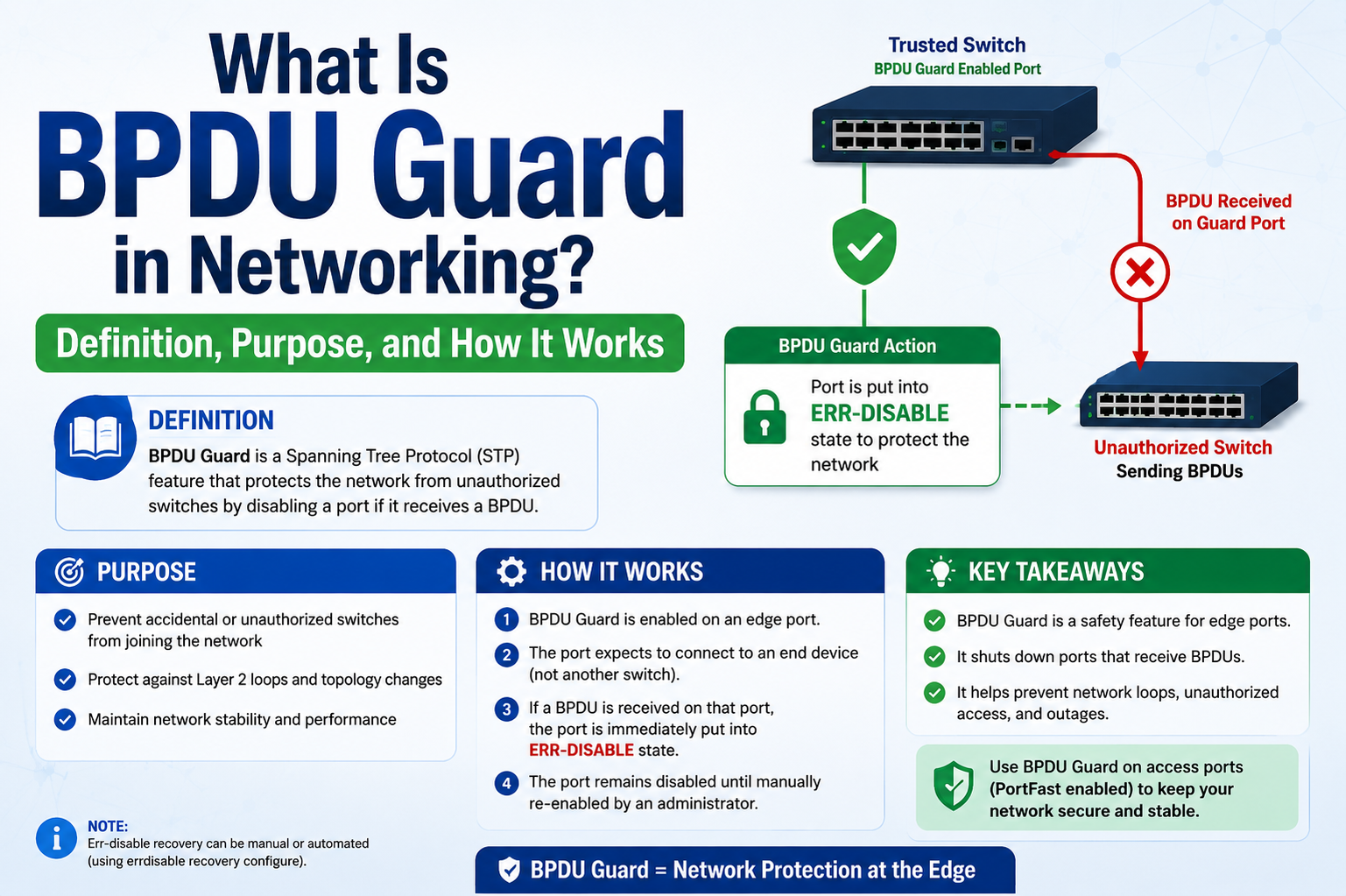
BPDU Guard ensures that only appropriate devices participate in topology-related communication. When enabled on a network port, it monitors incoming traffic for BPDU messages. If such messages are detected on a port that is expected to connect only end devices, BPDU Guard responds by immediately placing that port into a disabled state. This action prevents the connected device from influencing the network’s switching behavior.
The importance of this mechanism becomes clearer when considering how Spanning Tree Protocol operates. In a switched network, multiple paths between devices can create loops, which may lead to broadcast storms and severe performance issues. Spanning Tree Protocol solves this problem by selecting a single active path and blocking redundant ones. It relies on a logical hierarchy where one switch is elected as the central reference point, often referred to as the root bridge.
The root bridge plays a critical role in determining how data flows across the network. It is selected based on specific criteria, including priority values and hardware identifiers. Once established, it serves as the reference point for all other switches in the network. All topology decisions revolve around maintaining a loop-free structure centered on this root device.
BPDU messages are the communication method used by switches to share information about the network topology and maintain this structure. These messages help ensure that all switches agree on the current layout and can adjust accordingly if changes occur. Without this communication, the network could become unstable or develop loops.
The security concern arises when unauthorized devices attempt to send BPDU messages into the network. In some cases, a misconfigured or malicious device could attempt to influence the spanning tree topology by introducing false information. If successful, this could disrupt the entire network structure, potentially causing traffic misdirection or downtime.
BPDU Guard is designed to prevent such scenarios by ensuring that only trusted network ports participate in BPDU exchange. It is typically applied to edge ports, which are connections leading directly to end-user devices. These ports are expected to carry regular data traffic only, not control messages related to network structure.
By enforcing this separation, BPDU Guard adds a layer of protection that strengthens overall network stability. It ensures that the foundational structure of the network remains controlled by authorized switches only, reducing the risk of unintended disruptions.
How BPDU Guard Works and Its Interaction with Network Protocols
To understand how BPDU Guard operates in practice, it is important to examine its behavior within a live switching environment. The mechanism is not complex in terms of configuration logic, but its impact on network behavior is significant. It operates as a monitoring and enforcement tool that reacts instantly to specific types of network activity.
When BPDU Guard is enabled on a switch port, that port is placed under continuous observation for incoming BPDU messages. Under normal circumstances, a port connected to an end device should never receive such messages. Therefore, the presence of a BPDU on that port is treated as an abnormal condition.
Once a BPDU is detected, BPDU Guard immediately takes action by disabling the port. This state is commonly referred to as an error-disabled condition. In this state, the port stops forwarding traffic entirely, effectively isolating the connected device from the network. This reaction is intentional and serves as a protective measure to prevent further potential impact.
This behavior is particularly important in environments where network security and stability are priorities. Instead of allowing potentially harmful topology changes to propagate through the network, BPDU Guard stops the process at the point of entry. This ensures that the rest of the network remains unaffected by the abnormal condition.
The interaction between BPDU Guard and Spanning Tree Protocol is also important to understand. While Spanning Tree Protocol focuses on preventing loops by controlling path selection, BPDU Guard focuses on protecting the integrity of the devices participating in that process. In other words, Spanning Tree Protocol maintains structure, while BPDU Guard protects that structure from unauthorized influence.
There is also a distinction between BPDU Guard and other related protective mechanisms. Some features are designed to influence how switches respond to unexpected topology information, while BPDU Guard takes a more direct approach by shutting down affected ports entirely. This makes it a more aggressive but highly effective safeguard in edge environments.
In typical deployments, BPDU Guard is used on ports that connect to end-user devices. These are often access layer ports in a network architecture. Since these devices are not expected to participate in switching decisions, any BPDU activity on these ports is considered suspicious or misconfigured.
The immediate shutdown behavior of BPDU Guard serves two purposes. First, it prevents the connected device from interfering with the network topology. Second, it alerts network administrators that an unusual condition has occurred. The disabled state acts as a clear indicator that requires investigation before the port can be restored.
Restoring a port that has been disabled by BPDU Guard typically requires manual intervention. This ensures that the underlying issue is addressed rather than allowing the same condition to reoccur repeatedly. It reinforces the idea that network stability depends not only on automation but also on proper configuration and oversight.
From a design perspective, BPDU Guard is considered a preventive control mechanism. It does not react to general network issues but instead targets a very specific type of behavior. This precision makes it highly effective in environments where network roles are clearly defined.
As networks grow in size and complexity, the importance of such targeted safeguards increases. Large networks often include hundreds or thousands of devices, making manual oversight impractical. Features like BPDU Guard help maintain structure and consistency across these environments by enforcing rules automatically at the edge of the network.
Real-World Deployment, Network Design Considerations, and Operational Impact
In real-world enterprise networks, BPDU Guard is an essential component of Layer 2 security and stability design. Its deployment is closely tied to how network architects structure access layers and define the behavior of edge connections. Understanding its practical application requires looking at how networks are built and managed at scale.
One of the primary considerations when deploying BPDU Guard is identifying which ports should have it enabled. Typically, it is applied to access ports that connect directly to end-user devices. These include workstations, printers, phones, and other non-network infrastructure devices. These ports are not expected to participate in switching decisions or send topology-related information.
In contrast, uplink ports that connect switches to other switches are not suitable for BPDU Guard. These links are part of the core network structure and rely on BPDU communication to maintain proper topology awareness. Applying BPDU Guard in these areas would disrupt normal network operation and cause unnecessary failures.
Proper network design ensures a clear separation between access and distribution layers. This separation is what allows BPDU Guard to function effectively without interfering with legitimate network operations. When correctly implemented, it strengthens the overall architecture by enforcing role-based behavior at the port level.
From an operational perspective, BPDU Guard also plays an important role in troubleshooting and network monitoring. When a port enters an error-disabled state due to BPDU detection, it provides a clear signal that something unusual has occurred. This helps network teams quickly identify potential configuration issues or unauthorized devices.
In some cases, BPDU Guard may trigger due to misconfigured devices rather than malicious activity. For example, if a user connects a small unmanaged switch to an access port, that device may begin sending BPDU messages unintentionally. BPDU Guard will detect this behavior and disable the port, preventing the device from affecting the network.
This behavior highlights an important aspect of network design: enforcement of expected behavior. Networks are designed with assumptions about how devices should behave. BPDU Guard ensures that these assumptions are maintained consistently, even when unexpected devices are introduced.
From a performance standpoint, BPDU Guard has minimal overhead. It does not actively interfere with normal traffic unless a violation is detected. This makes it an efficient safeguard that operates silently under normal conditions while providing strong protection when needed.
In large-scale environments, BPDU Guard is often deployed through centralized configuration policies. This ensures consistency across multiple switches and reduces the risk of misconfiguration. By standardizing its application, network administrators can maintain uniform protection across the entire access layer.
Another important consideration is network resilience. While BPDU Guard is designed to protect the network, it can also cause temporary disruptions if triggered. Therefore, proper documentation and monitoring practices are essential to ensure that any disabled ports are quickly identified and restored after investigation.
Over time, BPDU Guard has become a standard best practice in enterprise network design. It is not considered an optional feature but rather a fundamental part of securing Layer 2 environments. Its role in preventing topology manipulation and unintended network behavior makes it a key component of modern switching infrastructure.
As networks continue to evolve, the principles behind BPDU Guard remain highly relevant. Even with advancements in automation, cloud networking, and software-defined infrastructure, the need to control and protect fundamental switching behavior remains unchanged. BPDU Guard continues to serve as a simple yet powerful mechanism for ensuring that network structure remains stable, predictable, and secure.
Advanced BPDU Guard Behavior, Failure Scenarios, and Its Role in Modern Enterprise Network Security
As enterprise networks continue to evolve in size, complexity, and automation, the role of foundational Layer 2 protection mechanisms like BPDU Guard becomes even more important. While it may appear to be a simple feature on the surface, its behavior in real-world environments reveals a deeper level of operational significance. In modern networks, BPDU Guard is not just a safeguard against misconfigurations—it is a critical enforcement tool that preserves structural integrity in environments where switching behavior must remain strictly controlled.
To understand BPDU Guard at a more advanced level, it is useful to begin by examining what happens beyond the basic “disable the port” response. When BPDU Guard triggers, the port is placed into an error-disabled state, but this state has broader implications for network operations. In enterprise environments, an error-disabled port is not just a local issue; it often triggers monitoring alerts, logs, and sometimes automated remediation workflows depending on how the network is managed.
This reaction is intentional. Modern networks rely heavily on visibility and rapid response systems. When BPDU Guard disables a port, it is effectively generating a high-priority signal that something unusual has occurred at the edge of the network. This signal can then be consumed by network monitoring tools, allowing administrators to identify potential issues quickly without manually inspecting every switch.
One of the most important aspects of BPDU Guard behavior is its deterministic nature. Unlike some network mechanisms that gradually adapt or adjust to conditions, BPDU Guard responds immediately and decisively. The moment a BPDU is detected on a protected port, the response is absolute: the port is shut down. This behavior eliminates ambiguity and ensures that no unauthorized topology influence can propagate further into the network.
This strict enforcement model is particularly valuable in large enterprise environments where thousands of endpoints may be connected simultaneously. In such environments, even a small misconfiguration or unauthorized device can have widespread effects if not contained quickly. BPDU Guard acts as a localized containment mechanism, ensuring that potential issues remain isolated at the point of entry.
However, this aggressive behavior also introduces operational considerations. One of the most common real-world scenarios involving BPDU Guard is accidental triggering due to user behavior. For example, when an end user connects a small unmanaged switch or a network bridge device to an access port, that device may begin transmitting BPDU messages. From the perspective of BPDU Guard, this behavior is indistinguishable from a potentially malicious device attempting to influence the spanning tree topology.
As a result, the port is disabled, and the connected user loses network connectivity. While this outcome may initially appear disruptive, it is actually a protective response. Without BPDU Guard, such a device could introduce instability into the spanning tree domain, potentially causing topology recalculations, traffic rerouting, or even temporary network loops.
This highlights an important principle in network security design: prevention often takes priority over convenience. BPDU Guard is designed to favor network integrity over uninterrupted access. In enterprise environments, maintaining a stable and predictable network structure is far more important than allowing unrestricted device behavior at the edge.
Another important scenario involves misconfigured network infrastructure. In some cases, a device that is intended to operate as a simple endpoint may accidentally be configured in a way that enables switching behavior. For instance, a virtualized system or improperly configured server may begin participating in Layer 2 bridging activities. If such a device is connected to a BPDU Guard-enabled port, the resulting BPDU transmission will immediately trigger the protection mechanism.
These scenarios emphasize the importance of proper network design and configuration management. BPDU Guard does not differentiate between intentional and unintentional behavior. It simply enforces a rule: edge ports must not participate in spanning tree communication. This simplicity is what makes it effective, but it also means that administrators must understand their network topology clearly to avoid unintended disruptions.
From a failure analysis perspective, BPDU Guard events are often valuable diagnostic indicators. When a port enters an error-disabled state due to BPDU detection, it provides a clear signal that something unexpected is occurring at that endpoint. This can help network engineers quickly identify issues such as unauthorized devices, incorrect cabling, or misconfigured hardware.
In many enterprise environments, these events are logged and analyzed over time to identify patterns. For example, repeated BPDU Guard triggers on specific ports may indicate a recurring user behavior or a misconfigured device that needs correction. In this sense, BPDU Guard not only protects the network in real time but also contributes to long-term operational insight.
Another advanced aspect of BPDU Guard is its relationship with network convergence behavior. Spanning Tree Protocol relies on rapid communication between switches to maintain a loop-free topology. When a BPDU Guard event occurs, it effectively removes a port from participating in this process. While this does not directly affect the rest of the network, it does influence how edge connectivity is maintained.
In stable environments, this isolation has minimal impact. However, in highly dynamic networks where devices frequently connect and disconnect, BPDU Guard events can become more common. This requires careful planning to ensure that edge devices are properly categorized and that BPDU Guard is applied only where appropriate.
In modern network architectures, especially those that incorporate automation and centralized management, BPDU Guard plays a role in enforcing policy consistency. Network automation systems often assume that edge ports behave predictably. BPDU Guard helps enforce this assumption by ensuring that no edge device can unexpectedly influence topology behavior.
This becomes particularly important in large-scale deployments such as campuses, data centers, and distributed enterprise environments. In these settings, manual oversight of every port is not practical. Instead, networks rely on predefined policies that are applied consistently across all devices. BPDU Guard fits naturally into this model by acting as a passive enforcement layer that requires no continuous management once configured.
Another advanced consideration is the interaction between BPDU Guard and network redundancy designs. In redundant topologies, multiple paths exist between switches to ensure availability in case of failure. Spanning Tree Protocol manages these paths by selectively blocking redundant links. BPDU Guard ensures that edge devices cannot interfere with this process by injecting unauthorized topology information.
Without BPDU Guard, a compromised or misconfigured device at the edge could potentially influence spanning tree decisions, leading to suboptimal path selection or temporary instability. By enforcing strict boundary control at access ports, BPDU Guard ensures that only trusted infrastructure devices participate in topology decisions.
From a security architecture perspective, BPDU Guard is part of a broader philosophy known as defense at the edge. This approach focuses on enforcing rules as close to the source of potential issues as possible. Instead of relying solely on centralized control mechanisms, edge-based protections ensure that problems are contained before they can spread.
This principle is widely used in modern networking design because it improves both performance and security. By stopping unwanted behavior at the access layer, BPDU Guard reduces the need for complex recovery mechanisms deeper in the network.
Another important dimension of BPDU Guard is its role in operational discipline. In well-designed networks, every port has a clearly defined purpose. Access ports are meant for end devices, while trunk ports are meant for inter-switch communication. BPDU Guard helps enforce this discipline by ensuring that access ports do not behave like trunk ports under any circumstances.
This enforcement reduces ambiguity in network behavior. When a BPDU Guard event occurs, it immediately indicates a violation of expected design principles. This clarity is valuable for both troubleshooting and long-term network maintenance.
In environments with high security requirements, BPDU Guard is often combined with other Layer 2 protection mechanisms. These may include features that control address learning, limit traffic types, or restrict unauthorized configuration changes. Together, these mechanisms form a layered defense strategy that strengthens overall network resilience.
Despite its effectiveness, BPDU Guard is not a standalone solution. It is part of a larger ecosystem of network protection tools that work together to maintain stability. Its strength lies in its simplicity and predictability. It does not attempt to interpret complex scenarios or make adaptive decisions. Instead, it enforces a single clear rule consistently across all edge ports.
As enterprise networks continue to adopt more automation, virtualization, and cloud integration, the importance of such deterministic controls remains high. Even in highly dynamic environments, certain foundational rules must remain unchanged. BPDU Guard represents one of these foundational controls.
In summary, BPDU Guard operates at a critical intersection of network stability, security, and operational discipline. Its advanced behavior reveals that it is more than just a simple port protection feature. It is a structural enforcement mechanism that ensures the integrity of Layer 2 networks in environments where complexity is constantly increasing.
BPDU Guard in Enterprise Design, Troubleshooting Depth, and Operational Best Practices
In modern enterprise networks, BPDU Guard is not just a configuration feature—it is a design principle embedded into how Layer 2 boundaries are enforced. As networks scale and become more distributed, ensuring predictable behavior at the edge becomes essential. BPDU Guard plays a critical role in maintaining that predictability by strictly controlling which ports are allowed to participate in Spanning Tree Protocol communication.
At the design level, BPDU Guard is closely tied to the concept of edge port classification. Network architects carefully distinguish between infrastructure ports and access ports during planning. Infrastructure ports connect switches to other switches and form the backbone of the spanning tree topology. These ports must actively exchange Bridge Protocol Data Units to maintain loop-free paths. In contrast, access ports connect end devices that should never influence network topology decisions.
This separation is what makes BPDU Guard effective. It is intentionally applied to access ports where BPDU activity is unexpected. By enforcing this boundary, network designers ensure that only trusted infrastructure devices participate in topology calculations, while end devices remain isolated from control-plane interactions.
One of the most important design considerations is consistency. In large networks, inconsistent BPDU Guard deployment can lead to unpredictable behavior. For example, if some access ports are protected while others are not, similar devices may behave differently depending on their connection point. This inconsistency can complicate troubleshooting and increase operational risk. As a result, many enterprise environments apply BPDU Guard uniformly across all access layer ports using centralized configuration policies.
From an operational standpoint, BPDU Guard introduces a clear and immediate response mechanism for detecting abnormal behavior. When a port is placed into an error-disabled state, it provides a strong signal that something has violated expected network assumptions. This makes it an important diagnostic tool in addition to being a protective feature.
Troubleshooting BPDU Guard events requires understanding both the symptom and the underlying cause. The symptom is straightforward: a port stops forwarding traffic. However, the cause may vary widely. It could be a user connecting an unauthorized switch, a misconfigured device attempting to bridge traffic, or even a virtualized system incorrectly participating in Layer 2 forwarding.
Identifying the root cause often begins with examining which port has been disabled and what type of device is connected to it. In many cases, the issue is not malicious but accidental. Users may connect small unmanaged switches to expand connectivity in an office environment without realizing the impact on spanning tree behavior. These devices often begin sending BPDU messages, which triggers BPDU Guard.
Another common scenario involves lab or test environments where network engineers intentionally connect devices that simulate switching behavior. If these environments are connected to production networks without proper isolation, BPDU Guard will immediately detect and disable the affected ports. This reinforces the importance of separating experimental setups from production infrastructure.
Once a BPDU Guard event occurs, the affected port remains in an error-disabled state until it is manually or automatically recovered, depending on network configuration policies. This deliberate persistence is part of its safety design. It ensures that the underlying condition is reviewed before the port is restored, preventing repeated disruption.
In large-scale environments, repeated BPDU Guard events can indicate broader design or user behavior issues. For example, if multiple ports across a floor or department are frequently disabled, it may suggest that users are connecting unauthorized devices or that network access policies are unclear. In such cases, BPDU Guard acts as an early warning system, highlighting areas where network usage does not align with design expectations.
From a best practices perspective, one of the most important principles is clear port role definition. Every switch port should have a clearly defined purpose before deployment. Access ports should be explicitly designated for end devices, while trunk ports should be reserved for inter-switch communication. BPDU Guard relies on this clarity to function effectively.
Another best practice is ensuring that BPDU Guard is used in combination with other Layer 2 protection mechanisms. While BPDU Guard focuses on preventing topology manipulation through BPDU messages, other features may focus on limiting MAC address behavior, controlling dynamic learning, or preventing address spoofing. Together, these mechanisms create a layered defense model that strengthens overall network security.
Operational teams also benefit from monitoring and alerting systems that integrate with BPDU Guard events. When a port enters an error-disabled state, automated systems can generate alerts that notify administrators immediately. This reduces the time between incident occurrence and response, improving overall network reliability.
In addition, documentation plays a key role in managing BPDU Guard effectively. Clear records of which ports are protected and why they are configured that way help ensure consistent troubleshooting and reduce confusion during incident response. Without proper documentation, it can be difficult to determine whether a BPDU Guard event is expected or indicates a misconfiguration.
Another important operational consideration is recovery strategy. In some environments, ports disabled by BPDU Guard are manually re-enabled after investigation. In others, automated recovery mechanisms may be used, where ports are restored after a defined interval. Each approach has trade-offs. Manual recovery provides greater control and safety, while automated recovery improves uptime but requires careful monitoring to avoid repeated failures.
Scalability is also an important factor in enterprise environments. As networks grow, the number of access ports increases significantly. Managing BPDU Guard manually at scale becomes impractical, which is why automated configuration approaches are commonly used. These approaches ensure that all access ports follow consistent security policies without requiring individual configuration.
In highly dynamic environments, such as those with frequent device changes or large user populations, BPDU Guard helps maintain stability by enforcing strict boundaries at the edge. Even as devices are added, removed, or moved between ports, the underlying rule remains consistent: end devices must not participate in spanning tree communication.
This consistency is what makes BPDU Guard a foundational element of Layer 2 security. It does not attempt to interpret intent or adapt to complex scenarios. Instead, it enforces a simple rule with absolute consistency. This simplicity is a strength because it reduces ambiguity and ensures predictable behavior across all edge ports.
As enterprise networks continue to evolve toward greater automation and integration with cloud systems, the importance of deterministic controls like BPDU Guard remains high. Even in environments where network behavior is increasingly software-driven, the physical and logical boundaries of Layer 2 switching still require strict enforcement.
Ultimately, BPDU Guard represents a critical intersection of design discipline, operational control, and security enforcement. It ensures that the edge of the network remains stable, predictable, and resistant to unintended topology influence, making it an essential component of modern enterprise switching environments.
BPDU Guard in Modern Networks, Advanced Security Architecture, and Future Role in Evolving Enterprise Environments
As enterprise networking continues to evolve into highly dynamic, automated, and distributed systems, foundational Layer 2 mechanisms like BPDU Guard remain surprisingly relevant. Even though modern networks increasingly rely on software-defined infrastructure, cloud integration, and automation frameworks, the underlying behavior of Ethernet switching has not changed. Spanning Tree Protocol is still essential for loop prevention, and BPDU Guard continues to serve as a critical enforcement layer that protects the integrity of that system.
To understand the long-term importance of BPDU Guard, it is necessary to look at how enterprise networks are changing. Today’s networks are no longer confined to a single physical location or a simple hierarchical design. Instead, they span across data centers, branch offices, cloud environments, and remote user locations. This expansion increases complexity and introduces more potential points of failure or misconfiguration.
In such environments, the edge of the network becomes one of the most important control points. Every endpoint connection represents a potential entry point for unintended behavior. BPDU Guard is specifically designed to enforce strict control at this edge, ensuring that only properly configured infrastructure devices can influence Layer 2 topology decisions.
At a conceptual level, BPDU Guard reflects a core principle of secure network design: trust must be explicitly defined rather than assumed. In traditional switching environments, it is assumed that only network switches will send and receive Bridge Protocol Data Units. However, in real-world deployments, this assumption can be violated by misconfigurations, unauthorized devices, or unexpected network behavior. BPDU Guard enforces this trust boundary by ensuring that any violation results in immediate containment.
This containment model is one of the reasons BPDU Guard is widely used in enterprise environments. Instead of allowing questionable behavior to propagate through the network, it isolates the issue at the point of detection. This prevents instability from spreading and ensures that the rest of the network remains unaffected.
In modern security architecture, this approach aligns closely with the principle of least privilege. Each network port is given only the level of functionality it requires. End device ports are not allowed to participate in topology management, while infrastructure ports are given the necessary permissions to maintain network structure. BPDU Guard enforces this separation automatically and consistently.
As networks become more automated, BPDU Guard also plays an important role in maintaining system integrity within automated workflows. Many modern enterprise networks use orchestration tools to configure switches, assign roles to ports, and manage network policies at scale. These systems assume that access ports behave consistently according to predefined rules. BPDU Guard helps guarantee that assumption remains valid even when human error or unexpected device behavior occurs.
Without such enforcement mechanisms, automation systems could be compromised by incorrect assumptions about network behavior. For example, if an endpoint device were to send BPDU messages and influence spanning tree decisions, automated systems might incorrectly interpret network topology changes. BPDU Guard prevents this by eliminating the possibility of unauthorized topology influence at the edge.
Another important aspect of BPDU Guard in modern environments is its relationship with virtualization and containerized systems. In many enterprise networks, servers no longer operate as single physical machines with simple network interfaces. Instead, they host multiple virtual machines or containerized workloads, each with its own virtual network interfaces.
In some cases, these virtualized environments can introduce complex networking behavior that resembles switching at Layer 2. If not properly configured, they may generate BPDU-like traffic or interact with bridging mechanisms in unexpected ways. When such systems are connected to access ports, BPDU Guard can detect this behavior and prevent it from affecting the broader network.
This highlights an important design consideration in modern infrastructure: not all “end devices” are simple anymore. The definition of an endpoint has expanded to include complex software-defined systems that may behave unpredictably at the network layer. BPDU Guard provides a safeguard against these complexities by enforcing strict behavioral boundaries.
From a security architecture perspective, BPDU Guard is part of a broader set of Layer 2 protection mechanisms that work together to secure the switching environment. While BPDU Guard focuses specifically on preventing unauthorized participation in spanning tree operations, other mechanisms address different risks such as MAC address spoofing, DHCP abuse, or unauthorized VLAN access.
Together, these controls form a multi-layered defense strategy that protects both the control plane and data plane of the network. BPDU Guard’s role in this strategy is unique because it operates at the topology level, ensuring that the fundamental structure of the network cannot be manipulated by unauthorized devices.
In large enterprise environments, this type of protection is essential. A single topology disruption at Layer 2 can have cascading effects throughout the network, potentially impacting multiple services, applications, and user groups. BPDU Guard reduces this risk by ensuring that only trusted devices can influence the structure of the spanning tree domain.
Another important dimension of BPDU Guard in modern networks is its role in operational resilience. Networks today are expected to operate continuously with minimal downtime, even during configuration changes or unexpected events. BPDU Guard contributes to this resilience by providing fast, deterministic failure containment.
When a violation occurs, the affected port is immediately isolated, preventing further propagation of the issue. This rapid response helps maintain overall network stability even when individual components fail or behave unexpectedly. In this sense, BPDU Guard acts as a localized fail-safe mechanism that protects the broader system.
However, this protective behavior also introduces operational challenges. In highly dynamic environments where devices frequently connect and disconnect, BPDU Guard events may occur more frequently. This requires careful operational management to distinguish between expected and unexpected triggers.
For example, in environments where users frequently connect personal networking devices or small switches, BPDU Guard may be triggered unintentionally. While this is technically correct behavior from a network protection standpoint, it can create operational noise that must be managed through user education and network design refinement.
This highlights an important balance in network engineering: security mechanisms must be strong enough to protect the network but also predictable enough to avoid unnecessary disruption. BPDU Guard achieves this balance by being simple in its logic but strict in its enforcement.
In terms of network evolution, BPDU Guard is likely to remain relevant even as new technologies emerge. While software-defined networking and intent-based networking introduce higher levels of abstraction, they still rely on underlying switching behavior that must be protected. Even in highly virtualized environments, physical and logical Layer 2 boundaries still exist and must be enforced.
As networks become more distributed across cloud and edge environments, the concept of a “network edge” itself becomes more complex. Devices may connect from remote locations, branch offices, or temporary environments. In all these cases, the need to control Layer 2 behavior remains unchanged. BPDU Guard continues to provide a reliable enforcement mechanism for these edge scenarios.
Another important trend influencing BPDU Guard’s relevance is the increasing use of zero-trust networking principles. Zero-trust models assume that no device should be trusted by default, regardless of its location within the network. Instead, every device must be explicitly verified and restricted according to its role.
BPDU Guard aligns naturally with this philosophy. It assumes that any unexpected BPDU message at the edge is a violation of expected behavior and responds by immediately restricting that device’s network access. This strict enforcement model is consistent with zero-trust principles and reinforces the idea that trust must always be explicitly defined.
From a future perspective, it is also possible that BPDU Guard functionality will become even more integrated into automated network policy systems. Instead of being configured manually on individual switches, it may be dynamically applied based on network intent, device classification, or behavioral analysis.
For example, future network systems may automatically classify a port as an access or infrastructure connection based on connected device behavior. BPDU Guard could then be applied automatically as part of a broader policy enforcement framework. This would reduce manual configuration while maintaining strong security enforcement at the edge.
Despite these potential advancements, the fundamental principle behind BPDU Guard will remain unchanged. The idea that end devices should not participate in spanning tree topology decisions is a core assumption of Ethernet switching. As long as this assumption exists, a mechanism like BPDU Guard will continue to be necessary.
In conclusion, BPDU Guard is far more than a simple configuration feature. It is a foundational enforcement mechanism that supports network stability, security, and operational consistency across modern enterprise environments. Its role extends from basic edge protection to integration with advanced security architectures and automated systems.
Even as networks evolve toward greater abstraction and automation, the need for deterministic, edge-based protection remains constant. BPDU Guard continues to fulfill this role by ensuring that the structural integrity of Layer 2 networks is preserved under all conditions, making it an enduring and essential component of enterprise networking design.
Conclusion
BPDU Guard plays a vital role in maintaining the stability and security of modern Ethernet networks. Within switched network environments, especially those that rely on the Spanning Tree Protocol to prevent loops, maintaining strict control over which devices can influence the network topology is essential. BPDU Guard provides that protection by ensuring that only authorized infrastructure devices are able to exchange bridge protocol data units, while user-facing ports remain isolated from spanning tree participation.
One of the main strengths of BPDU Guard lies in its simplicity. The concept is straightforward: if a port that is meant to connect to an end device begins receiving BPDU messages, the switch immediately disables that port to prevent potential disruption. This direct and decisive action protects the network from both accidental misconfigurations and intentional attacks. By stopping unexpected BPDU traffic at the edge, the feature ensures that the spanning tree structure remains stable and predictable.
In real-world network environments, edge ports connect to a wide variety of devices including computers, printers, wireless access points, and other endpoint technologies. These devices should never attempt to act like switches or participate in topology decisions. BPDU Guard enforces that expectation, creating a clear boundary between infrastructure components and user devices. This separation helps maintain an organized and secure network architecture.
Another important benefit of BPDU Guard is how well it integrates with broader network security practices. It works effectively alongside other Layer 2 protection mechanisms, forming part of a comprehensive defense strategy that protects both network performance and operational reliability.
As networks grow more complex and interconnected, safeguards like BPDU Guard remain essential. By preventing unauthorized devices from interfering with spanning tree operations, it helps preserve the integrity of the switching environment. For network engineers and administrators, implementing BPDU Guard is a simple yet powerful step toward building a resilient and well-protected network infrastructure.