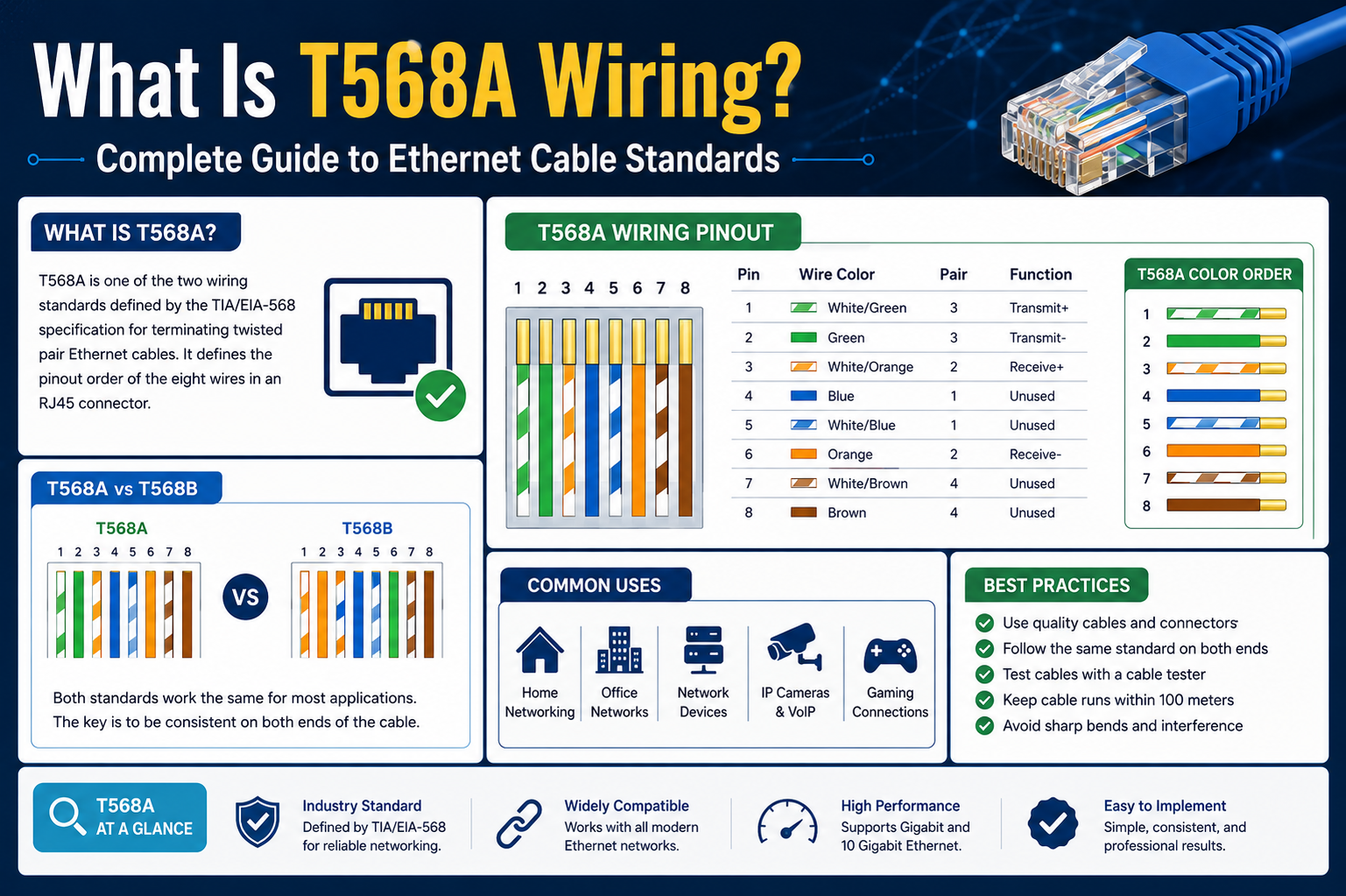
T568A wiring is a standardized method used in networking to organize and arrange the internal wires of an Ethernet cable in a specific order. This arrangement ensures that data can travel correctly between network devices such as computers, switches, routers, and patch panels. Without a standardized wiring system, network communication would become unreliable because devices would not be able to properly interpret the signals being transmitted through the cable.
At its core, Ethernet cabling consists of eight individual wires grouped into four twisted pairs. These pairs are carefully arranged inside the cable to reduce interference and maintain signal quality. The T568A standard defines exactly how these wires should be positioned when they are connected to an RJ45 connector, which is the common plug used for Ethernet cables. Each wire is assigned a specific pin, and the correct order is essential for proper communication.
The purpose of T568A wiring is consistency. When every cable in a network follows the same standard, devices can communicate without confusion or mismatch. This is especially important in structured cabling systems where large numbers of connections are made between different hardware components. Even a small error in wiring order can result in connectivity issues or complete communication failure.
The standard itself was developed as part of broader telecommunications guidelines designed to unify how network cables are installed. Before standards like T568A existed, different organizations used different wiring methods, which created compatibility problems. The introduction of a universal standard helped solve these issues by ensuring that all Ethernet cables follow the same structure.
Inside a typical Ethernet cable, the wires are color-coded into four main pairs: green, orange, blue, and brown. Each pair contains one solid-colored wire and one striped wire. These colors are not random; they are part of the standard that helps technicians correctly identify and terminate each wire. In T568A wiring, these color-coded wires follow a specific sequence when inserted into an RJ45 connector.
One important aspect of T568A wiring is that it defines not only the order of wires but also how they interact across a network connection. When two devices are connected using properly wired cables, the transmit and receive functions align correctly, allowing data to flow smoothly in both directions. This alignment is crucial for maintaining stable network performance.
T568A wiring is commonly used in many networking environments, particularly in residential, commercial, and government installations. It is often preferred in structured cabling systems where consistency across multiple buildings or locations is required. In some cases, organizations are required to use this standard to ensure uniformity across all their network infrastructure.
Another important feature of T568A wiring is its relationship with the physical structure of Ethernet cables. The twisted pair design helps reduce electromagnetic interference, which can disrupt data transmission. By combining this physical design with a standardized wiring order, T568A ensures that both the electrical and logical aspects of communication work together efficiently.
Although T568A is a widely used standard, it is not the only wiring method available. There is another commonly used standard known as T568B, which uses a slightly different arrangement of wire pairs. While both standards function similarly, they are not identical, and mixing them incorrectly within a network can lead to communication issues.
Understanding T568A wiring is an important step for anyone learning about networking. It provides a foundation for how data is physically transmitted through cables and helps explain how devices are able to communicate reliably over wired connections. Without standards like T568A, modern networking systems would not function with the same level of consistency and reliability.
How T568A Wiring Works, Pin Assignments, and Cable Structure Explained
To understand how T568A wiring works in practice, it is important to look closely at how Ethernet cables are physically constructed and how each wire is assigned to a specific role. Inside every Ethernet cable are eight wires arranged into four twisted pairs. These pairs are designed to reduce interference and maintain signal clarity as data travels through the cable.
In the T568A standard, each wire is assigned to a specific pin within an RJ45 connector. This connector contains eight pins, and each wire must be inserted in the correct order for the cable to function properly. The sequence of wire placement is what defines the T568A standard and ensures compatibility between devices.
The arrangement of wires in T568A follows a precise pattern. Each twisted pair is separated and positioned according to the standard so that transmit and receive signals align correctly between devices. This alignment allows data to flow efficiently without confusion or signal mismatch. If the wires are placed in the wrong order, communication between devices can fail completely.
The color coding system used in T568A wiring plays a key role in ensuring accuracy during installation. Each pair consists of one solid-colored wire and one striped wire. These color pairs are used as visual guides for technicians when terminating cables. The green pair is placed first, followed by other pairs in a specific sequence that ensures proper alignment of signals.
Another important aspect of T568A wiring is the physical structure of the cable itself. Inside the outer protective sheath, the twisted pairs are arranged around a central support structure. This internal design helps maintain cable integrity and reduces the impact of bending or physical stress. The twisting of the pairs also helps cancel out electromagnetic interference, which can otherwise distort signals.
When a cable is terminated using the T568A standard, each wire is carefully inserted into the RJ45 connector and secured. This process requires precision because even a small mistake in wire order can result in connectivity problems. Once properly terminated, the connector ensures that each wire makes contact with the correct pin, allowing data to flow as intended.
The role of T568A wiring becomes especially important when considering how Ethernet communication works. Data is transmitted in electrical signals that must be accurately received and interpreted by the destination device. If the wiring is incorrect, the signals may arrive in the wrong order or become misinterpreted, leading to errors or failed connections.
T568A wiring is also closely connected to structured cabling systems. In such systems, cables are installed in a planned and organized manner throughout buildings or campuses. Using a standardized wiring method ensures that all connections follow the same structure, making maintenance and troubleshooting easier over time.
One of the key advantages of T568A wiring is its consistency. When all cables follow the same standard, network technicians can quickly identify and resolve issues without having to guess how a cable is wired. This reduces downtime and improves overall network reliability.
In addition to consistency, T568A wiring also supports interoperability. Devices connected through properly wired cables can communicate regardless of manufacturer or model. This universality is one of the reasons Ethernet has become the dominant standard for wired networking.
It is also important to understand that T568A wiring is part of a larger system of networking standards. It works alongside other protocols and hardware components to ensure smooth communication across complex networks. While the wiring itself is physical, its role is deeply integrated into the logical structure of data transmission.
By understanding how T568A wiring works at a structural level, it becomes easier to appreciate how modern networks function. Every connection, from a simple home setup to a large enterprise system, depends on the correct arrangement of these small but critical components.
Real-World Use, Differences with T568B, and Practical Importance of T568A Wiring
In real-world networking environments, T568A wiring plays a crucial role in ensuring that communication systems remain stable, consistent, and reliable. It is widely used in structured cabling systems where large networks require standardized installation practices. This includes office buildings, educational institutions, government facilities, and commercial infrastructure where multiple devices must communicate seamlessly.
One of the most important aspects of T568A wiring in practical use is its consistency across installations. When technicians follow the same wiring standard across an entire network, it becomes much easier to manage, expand, and troubleshoot the system. Consistent wiring ensures that every connection behaves predictably, reducing the likelihood of configuration errors or compatibility issues.
T568A wiring is also significant because of its relationship with another common standard known as T568B. While both standards serve the same purpose, they differ in the arrangement of certain wire pairs. Specifically, the green and orange pairs are swapped between the two standards. Despite this difference, both can function correctly as long as they are used consistently within a network.
However, problems arise when both standards are mixed incorrectly. If one end of a cable uses T568A and the other uses T568B without intention, the connection may become a crossover configuration. While crossover cables can be useful in specific scenarios, accidental mismatches can lead to network communication failures. This is why maintaining consistency is critical in structured environments.
In some environments, particularly government or regulated installations, T568A is preferred or even required to ensure uniformity across all systems. This helps prevent confusion when multiple contractors or teams work on the same infrastructure. A single standard ensures that every installation follows the same rules, regardless of location or project scale.
From a practical perspective, T568A wiring also simplifies long-term maintenance. When network technicians revisit a system years after installation, having a consistent wiring standard makes it easier to understand how everything is connected. This reduces troubleshooting time and improves overall system efficiency.
T568A wiring is also important in network scalability. As organizations grow, they often need to add new devices, extend cabling, or upgrade infrastructure. A standardized wiring system allows these changes to be made without disrupting existing connections. This flexibility is essential in modern network environments where expansion is common.
In wireless and hybrid networks, T568A wiring still plays a foundational role. Even though wireless communication has become more widespread, most wireless systems still rely on wired infrastructure behind the scenes. Access points, routers, and switches are all connected using Ethernet cables, many of which follow the T568A standard.
Another important real-world consideration is troubleshooting. When network issues occur, technicians often begin by checking physical connections. If all cables follow a known standard like T568A, it becomes much easier to identify whether a problem is caused by wiring or by another part of the system. This structured approach reduces diagnostic complexity.
T568A wiring also contributes to overall network performance by ensuring signal integrity. Properly arranged twisted pairs reduce interference and maintain clean signal transmission. This helps prevent data errors and improves communication stability across the network.
In modern networking environments, the importance of T568A wiring remains strong even as technology evolves. While higher-level systems handle routing, switching, and data management, the physical layer still depends on correct wiring standards to function properly. Without this foundation, even the most advanced networks would struggle to operate effectively.
Ultimately, T568A wiring represents a fundamental principle in networking: structure and consistency at the physical level are essential for reliable communication.
Advanced Structured Cabling Concepts, Installation Practices, Troubleshooting, and the Evolving Role of T568A Wiring in Modern Networks
As networking systems grow larger and more complex, T568A wiring becomes more than just a basic cable termination standard. It turns into part of a broader structured cabling philosophy that focuses on consistency, reliability, and long-term scalability. Understanding T568A at an advanced level means looking beyond color codes and pin assignments and focusing on how it fits into real-world installation practices, performance optimization, troubleshooting, and modern network design strategies.
At the heart of structured cabling is the idea that a network should be predictable, organized, and easy to manage over time. T568A wiring contributes directly to this goal by ensuring that every Ethernet connection follows the same logical structure. When technicians install thousands of cables across a large facility, consistency becomes critical. Without a standardized wiring method, even small differences between installations could lead to confusion, delays, and communication failures.
One of the most important advanced concepts in T568A wiring is signal integrity over distance. While Ethernet cables are designed to carry signals efficiently, they are still affected by resistance, capacitance, and electromagnetic interference. As cable length increases, these effects become more noticeable. Proper T568A termination helps minimize these issues by ensuring that twisted pairs remain correctly aligned, preserving the balance of electrical signals as they travel.
Twisted pair geometry plays a major role here. Each pair of wires in an Ethernet cable is twisted at a specific rate to cancel out external interference and internal crosstalk. Crosstalk occurs when signals from one pair interfere with another pair inside the same cable. If wires are incorrectly terminated or untwisted too far during installation, this interference increases and network performance degrades. T568A wiring standards help reduce this risk by enforcing consistent pairing and termination practices.
In professional installations, technicians follow strict guidelines when preparing cables. One important rule is to maintain the twist of each pair as close as possible to the termination point. If too much of the cable is untwisted during connector installation, the carefully engineered balance of the cable is disrupted. Even though the wiring order may still follow T568A correctly, the physical quality of the connection can still be compromised.
Cable management is another essential aspect of advanced T568A implementation. In large network environments, hundreds or even thousands of cables may run through conduits, racks, and ceiling spaces. Poor organization can lead to physical stress on cables, accidental disconnections, and difficulty in troubleshooting. Proper labeling, routing, and separation of cable types help maintain the integrity of T568A-based installations over time.
Another important consideration is environmental impact on cabling performance. Temperature, humidity, and physical pressure can all affect Ethernet cables. In industrial environments, cables may be exposed to heat sources, vibration, or electromagnetic noise from machinery. In such cases, maintaining proper T568A wiring standards becomes even more important because any additional degradation in signal quality can significantly impact network reliability.
Shielding is sometimes used in combination with T568A wiring in environments with high interference. Shielded twisted pair cables include an additional layer that protects signals from external noise. Even with shielding, correct wiring remains essential. If the internal pairs are not properly terminated according to T568A standards, shielding alone cannot guarantee stable performance.
Another advanced aspect of T568A wiring is its role in large-scale network segmentation. In enterprise environments, networks are often divided into multiple segments for performance, security, and management reasons. These segments are connected through structured cabling systems where T568A ensures that physical connections remain consistent across different sections of the infrastructure. This consistency simplifies expansion and reduces the risk of configuration errors when new segments are added.
Patch panels are another critical component in structured cabling systems that rely heavily on T568A wiring. A patch panel acts as an organized termination point where multiple cables converge. Each cable must be terminated according to a standard like T568A to ensure that connections remain uniform across the system. When patch panels are properly wired, network administrators can easily reconfigure connections without physically altering permanent cabling.
Testing and certification of cables is also an essential part of advanced T568A implementation. After installation, cables are tested to ensure they meet performance standards. These tests measure factors such as continuity, signal loss, crosstalk, and overall transmission quality. Even if a cable is wired correctly according to T568A, poor installation practices can still lead to substandard performance. Testing ensures that both wiring accuracy and physical quality meet required specifications.
Troubleshooting T568A-based systems requires a methodical approach. When network issues arise, technicians often begin by isolating whether the problem is physical or logical. Physical issues usually involve cable damage, incorrect termination, or interference, while logical issues involve configuration or software settings. T568A wiring simplifies this process because consistent standards make it easier to eliminate wiring errors as a variable.
One common troubleshooting scenario involves intermittent connectivity. This can occur when a cable is partially damaged or when a termination is not secure. In T568A systems, even a small misalignment in wire placement can cause unstable connections. Technicians often inspect connectors for loose contacts, improper crimping, or incorrect wire sequence when diagnosing such issues.
Another frequent issue is signal degradation over long cable runs. Ethernet standards define maximum cable lengths, and exceeding these limits can result in reduced performance or connection loss. Even within acceptable distances, poor termination or environmental interference can degrade signal quality. T568A wiring helps reduce this risk, but it cannot eliminate physical limitations entirely.
Modern networks also require consideration of speed requirements. As Ethernet technology has evolved from lower speeds to multi-gigabit and beyond, the importance of precise wiring standards has increased. Higher speeds require more accurate signal transmission, which makes proper adherence to T568A wiring even more critical. At higher frequencies, even minor inconsistencies in wiring can lead to significant performance issues.
Another advanced concept is backward compatibility. Many modern networks still rely on legacy infrastructure alongside newer systems. T568A wiring provides a stable foundation that supports this coexistence. Because it is a standardized method, it can be used across different generations of networking equipment without requiring major changes to physical infrastructure.
In hybrid network environments that combine wired and wireless systems, T568A wiring remains a foundational element. Wireless access points, for example, still depend on wired Ethernet connections to function. These connections are often installed using structured cabling systems that follow T568A standards. Even though end users interact with wireless signals, the underlying infrastructure is still heavily dependent on correctly wired Ethernet connections.
Scalability is another major advantage of T568A in advanced network design. As organizations grow, they often expand their networks incrementally. A standardized wiring system allows new devices, floors, or buildings to be added without disrupting existing infrastructure. This scalability is one of the reasons structured cabling systems remain widely used in enterprise environments.
From a design perspective, engineers often plan networks with future expansion in mind. T568A wiring supports this approach by providing a predictable and repeatable method for cable installation. This reduces complexity when upgrading systems or integrating new technologies into existing networks.
Security considerations also play a role in advanced cabling systems. While T568A wiring itself does not provide security features, its consistency helps support secure network design. When physical infrastructure is predictable and well-documented, it becomes easier to identify unauthorized changes or physical tampering. Structured cabling systems often include controlled access to network rooms and patch panels to maintain physical security.
Energy efficiency is another modern consideration. As networks grow, power consumption becomes increasingly important. While T568A wiring itself does not consume power, efficient cabling design reduces the need for signal retransmission and minimizes network errors, indirectly improving overall system efficiency.
Another evolving aspect is the integration of smart infrastructure monitoring. Modern network systems may include sensors that monitor cable performance, temperature, and signal quality in real time. While these systems operate at a higher level than basic wiring standards, they still depend on correctly installed physical infrastructure. T568A wiring ensures that the foundation of this infrastructure remains stable and reliable.
In large data centers, T568A wiring is part of highly organized cabling systems that support thousands of connections. In these environments, even small wiring inconsistencies can lead to significant operational issues. Structured cabling standards ensure that every connection follows the same rules, making large-scale management possible.
Ultimately, advanced T568A wiring practices highlight an important principle in networking: physical structure determines system reliability. No matter how advanced network software or hardware becomes, it still depends on properly installed and standardized cabling. T568A remains a critical part of this foundation, ensuring that modern networks operate efficiently, consistently, and at scale.
It looks like the prefetched widget results aren’t relevant to T568A wiring, so I’ll continue the article normally.
Practical Installation Techniques, Common Mistakes, and Real-World Use of T568A Wiring in Structured Cabling
In real networking environments, understanding T568A wiring is not just about memorizing a color sequence or pin layout. It is about applying a standardized method correctly in physical installations where precision directly impacts network performance. In structured cabling systems, even a small mistake during termination can lead to communication failure, intermittent connectivity, or reduced data speeds. This is why professional installation practices around T568A wiring are so important.
One of the first things technicians focus on during installation is preparation of the cable itself. Ethernet cables used with T568A wiring consist of four twisted pairs protected by an outer sheath. Before termination, the outer jacket is carefully stripped to expose the internal wires. However, this step must be done with caution. If too much of the cable is exposed, the twists in the pairs may be undone, which weakens the cable’s ability to resist interference.
Maintaining the twist of each pair is critical because the twisting pattern is what protects the signal from electromagnetic interference and crosstalk. In T568A wiring, each pair must remain tightly twisted as close as possible to the point of termination. If the wires are untwisted too early, the signal quality can degrade even if the color order is perfectly correct. This is one of the most common installation mistakes in structured cabling.
Once the cable is prepared, the next step is arranging the wires in the correct T568A order. This process requires careful attention to detail because each wire must align with a specific pin inside the RJ45 connector. The order determines how signals are transmitted and received between devices. Even a single misplaced wire can result in a non-functional connection.
Technicians often straighten the wires before insertion to ensure they fit neatly into the connector. If the wires are bent or misaligned, they may not make proper contact with the metal pins inside the connector. This can lead to weak or unstable connections that are difficult to diagnose later.
Crimping is another important stage in the installation process. Once the wires are correctly positioned inside the RJ45 connector, a crimping tool is used to secure them in place. This step permanently locks the wires into the connector and ensures electrical contact with the pins. A poorly crimped connector can cause intermittent connectivity issues that may appear randomly during network use.
One of the most common mistakes in T568A wiring installations is mixing standards unintentionally. Since T568A and T568B are very similar, it is easy for installers to accidentally use different standards on opposite ends of a cable or across different parts of a network. This inconsistency can lead to communication problems that are difficult to identify without proper testing.
Another frequent issue is incomplete insertion of wires into the connector. If the wires do not reach the very end of the RJ45 plug, they may not properly connect with the metal contacts. This can result in partial connectivity where the network appears to work but experiences frequent dropouts or reduced performance.
After installation, testing becomes an essential step in ensuring that T568A wiring has been implemented correctly. Cable testers are used to verify continuity, pin alignment, and signal integrity. These tests help confirm that each wire is connected to the correct pin and that there are no breaks or miswirings in the cable. In professional environments, testing is not optional; it is a standard part of installation quality control.
In real-world deployments, T568A wiring is widely used in structured cabling systems because of its consistency and compatibility with standardized network designs. Large office buildings, educational institutions, and data centers rely on uniform wiring practices to ensure that network infrastructure remains manageable over time. When every cable follows the same standard, troubleshooting and expansion become significantly easier.
T568A wiring also plays an important role in long-term network maintenance. As networks grow and change, technicians often need to trace cables, replace damaged sections, or upgrade hardware. A consistent wiring standard allows them to quickly understand how the system is structured without needing to re-evaluate each connection individually. This reduces downtime and improves operational efficiency.
In many environments, T568A is preferred for its alignment with structured cabling guidelines that emphasize uniformity across installations. This is especially important in large-scale networks where multiple teams may be responsible for different parts of the infrastructure. A single standard ensures that everyone follows the same approach, reducing the risk of inconsistency.
Another practical advantage of T568A wiring is its compatibility with modern network speeds. As Ethernet technology has evolved to support higher data rates, the importance of precise wiring has increased. Higher speeds require better signal integrity, and properly installed T568A cabling helps maintain the electrical balance needed for reliable high-speed communication.
In addition to performance, safety is also an important consideration in professional installations. Poorly terminated cables can generate heat, suffer from physical stress, or become vulnerable to damage over time. Following T568A wiring standards ensures that cables are installed in a way that minimizes these risks and supports long-term durability.
In modern network environments, T568A wiring is often integrated into larger infrastructure systems that include patch panels, switches, and structured cable trays. These systems are designed to organize and simplify complex networks, making them easier to manage. T568A provides the foundation that allows these systems to function in a predictable and organized manner.
Even as networking technology continues to evolve, the importance of correct physical wiring remains unchanged. No matter how advanced network devices become, they still depend on properly structured cabling to transmit data effectively. T568A wiring remains a key part of this foundation, ensuring that communication between devices is stable, consistent, and reliable.
Advanced Troubleshooting, Network Design Integration, Industry Standards, and the Future Role of T568A Wiring
As networking systems continue to grow in size and complexity, T568A wiring remains a foundational element that quietly supports everything from basic connectivity to enterprise-scale infrastructure. While earlier discussions focused on what T568A is and how it is installed, this final part explores how it behaves in advanced troubleshooting scenarios, how it integrates into large-scale network design, how it aligns with industry standards, and how its role is evolving in modern and future networking environments.
At an advanced level, troubleshooting T568A wiring requires a structured and methodical approach. Network problems are often assumed to be software-related, but in many real-world cases, the root cause lies in the physical layer. This is where T568A wiring becomes critically important. Because it defines the exact order and placement of wires inside Ethernet cables, any deviation from this standard can create subtle but serious connectivity issues.
One of the most common advanced troubleshooting scenarios involves intermittent connectivity. Unlike a complete failure, intermittent issues are more difficult to diagnose because the network appears to function normally at times and then suddenly fails. In many cases, this is caused by poor termination of T568A wiring. A wire that is not fully seated in the RJ45 connector or a crimp that is slightly loose can cause unstable contact, leading to unpredictable behavior.
Another complex issue is signal degradation that occurs without obvious physical damage. In these cases, the cable may appear intact, but internal wiring inconsistencies are affecting performance. For example, if the twisted pairs in a T568A cable are accidentally untwisted too far during installation, the cable becomes more susceptible to electromagnetic interference. This can result in slower speeds, packet loss, or increased error rates, even though continuity tests may still pass.
Advanced troubleshooting also involves identifying cross-standard mismatches. Although T568A and T568B are functionally similar, mixing them incorrectly within a network can lead to communication issues. In some cases, devices may still connect but perform poorly or inconsistently. Identifying these mismatches requires careful inspection of both ends of the cable and comparison against the expected standard.
Cable testing tools play an important role in diagnosing these issues. Professional testers can verify pin-to-pin continuity, detect split pairs, measure signal attenuation, and identify near-end crosstalk. These measurements help determine whether a T568A cable has been correctly installed or whether physical layer issues are affecting performance. In large networks, systematic testing is often required to isolate faulty segments among hundreds or thousands of connections.
Beyond troubleshooting, T568A wiring plays a significant role in network design architecture. In structured cabling systems, networks are designed in layers that separate physical infrastructure from logical configuration. T568A belongs to the physical layer, but its impact extends upward into how networks are organized and managed. A consistent wiring standard allows designers to build predictable systems where devices can be added, moved, or changed without disrupting the overall structure.
In enterprise environments, network design often follows a hierarchical model. At the lowest level, end devices such as computers, printers, and access points connect to network outlets. These outlets are wired using T568A standards and terminate at patch panels. From there, connections are routed through switches and distribution layers. This layered structure depends heavily on consistent wiring practices, because any inconsistency at the physical level can propagate upward and affect the entire network.
Scalability is one of the most important benefits of using T568A in structured design. As organizations grow, they often need to expand their network infrastructure without redesigning everything from scratch. Because T568A provides a consistent wiring method, new cables and devices can be added seamlessly. This reduces complexity and ensures that expansion does not introduce unexpected compatibility issues.
Another important aspect of network design is redundancy. In critical systems, redundancy ensures that if one path fails, another can take over. While redundancy is often discussed in terms of routing and switching, it also depends on physical cabling. T568A wiring ensures that redundant paths are consistent and predictable, which simplifies failover configurations and reduces the risk of misalignment between backup systems.
In large data centers, T568A wiring contributes to highly organized cable management systems. These environments may contain thousands of cables running between servers, switches, and storage systems. Without strict wiring standards, such complexity would quickly become unmanageable. T568A ensures that every connection follows the same structure, making it easier to trace, replace, or upgrade individual cables without disrupting the system.
Industry standards play a major role in the continued relevance of T568A. It is part of a broader set of structured cabling guidelines that define how network infrastructure should be installed and maintained. These standards ensure interoperability between different manufacturers, devices, and installations. Without such standards, networking equipment would be far less compatible, and large-scale systems would be significantly more difficult to manage.
In regulated environments, adherence to T568A is not just a recommendation but often a requirement. This ensures uniformity across installations and prevents inconsistencies that could arise when multiple contractors or teams are involved. Standardization reduces ambiguity and ensures that every installation follows the same technical rules, regardless of location or organization.
From a performance perspective, T568A wiring supports modern high-speed Ethernet standards by maintaining precise signal integrity. As network speeds increase, the margin for error in cabling decreases. Even small inconsistencies in wiring can have a greater impact at higher frequencies. Proper T568A termination helps ensure that electrical signals remain balanced and stable, supporting reliable high-speed communication.
Another important consideration is electromagnetic compatibility. In modern environments filled with electronic devices, electromagnetic interference is a constant challenge. T568A wiring, combined with twisted pair design, helps reduce the impact of this interference. This is essential in environments such as offices, industrial facilities, and data centers where multiple systems operate in close proximity.
As networks evolve, automation is beginning to influence how physical infrastructure is managed. Intelligent monitoring systems can now detect cable performance issues in real time, including degradation that may originate from improper wiring or physical damage. While these systems operate at a higher level than T568A itself, they still rely on correctly installed cabling as a foundation. Without proper physical wiring, even the most advanced monitoring systems cannot function effectively.
Looking toward the future, the role of T568A wiring is expected to evolve rather than disappear. In many modern systems, physical wiring standards are increasingly integrated into modular hardware solutions. Switches, access points, and structured cabling components often include built-in mechanisms that simplify installation and reduce human error. However, the underlying principle of standardized wiring remains essential.
Emerging technologies such as edge computing, distributed systems, and hybrid cloud architectures continue to rely on physical network infrastructure. Even though much of the computing logic has moved to virtual environments, the data still travels through physical cables at some point. This means that T568A wiring continues to play a foundational role in ensuring that data can move reliably between physical endpoints.
In wireless networks, the importance of structured cabling is sometimes overlooked, but it remains critical. Wireless access points depend on wired connections for backhaul communication. These wired connections are typically installed using standardized wiring methods such as T568A. Without reliable physical infrastructure, wireless networks would not be able to function at scale.
Another future trend is increased network densification. As more devices connect to networks, especially in smart environments and IoT ecosystems, the demand for reliable physical connectivity increases. Even though many devices communicate wirelessly, they still depend on wired infrastructure behind the scenes. T568A wiring ensures that this infrastructure remains stable and scalable.
Sustainability is also becoming an important factor in network design. Efficient cabling reduces the need for frequent repairs, replacements, and reconfigurations. By maintaining consistent standards like T568A, organizations can extend the lifespan of their infrastructure and reduce waste. This contributes to more sustainable network operations over time.
In conclusion, T568A wiring is far more than a simple color-coded standard. It is a critical component of modern networking that influences installation practices, troubleshooting methods, system design, and long-term scalability. Its importance extends across industries, environments, and technologies, forming a reliable foundation for communication systems that power both everyday connectivity and large-scale digital infrastructure.
Another important area where T568A wiring continues to prove its value is disaster recovery and infrastructure resilience. In large organizations, network downtime can disrupt communication, operations, and access to critical systems. Because of this, companies invest heavily in structured cabling systems that are reliable, easy to repair, and simple to document. T568A wiring supports these goals by creating a uniform installation framework that technicians can quickly understand during emergency maintenance situations.
When physical infrastructure follows a single standard, damaged connections can be replaced faster and with fewer mistakes. This becomes especially important in environments such as hospitals, financial institutions, manufacturing facilities, and government buildings where network availability is essential. Technicians working under pressure benefit from knowing that every Ethernet connection follows the same wiring structure throughout the facility.
T568A also contributes to long-term infrastructure planning. Many organizations design networks expected to remain operational for years or even decades. During that time, hardware may change repeatedly, but the cabling infrastructure often remains in place. A consistent standard ensures that older installations remain compatible with newer technologies, reducing the need for complete rewiring projects. This ability to support long-term adaptability is one reason why T568A wiring continues to remain relevant even as networking technology rapidly evolves.
Conclusion
T568A wiring remains one of the most important standards in modern Ethernet networking because it provides the consistency and structure needed for reliable communication between devices. By defining a specific arrangement for the eight wires inside an Ethernet cable, T568A ensures that data signals are transmitted accurately and efficiently across networks of all sizes. Whether used in a small home setup or a massive enterprise infrastructure, this standard helps maintain stable and predictable connectivity.
Throughout the discussion, it becomes clear that T568A is much more than a simple wiring sequence. It plays a major role in structured cabling systems, network organization, troubleshooting, scalability, and long-term infrastructure management. Properly terminated T568A cables reduce signal interference, maintain data integrity, and support the high-speed communication required by modern networking technologies.
Another key strength of T568A wiring is its ability to simplify maintenance and future expansion. When every cable follows the same standard, technicians can troubleshoot issues more quickly and install new hardware without creating compatibility problems. This consistency is especially valuable in large organizations where networks continue to grow and evolve over time.
T568A also demonstrates the importance of the physical layer in networking. Advanced switches, routers, wireless systems, and cloud technologies all depend on reliable cabling underneath. No matter how sophisticated network software becomes, communication still relies on properly installed physical connections to move data from one point to another.
Ultimately, T568A wiring represents the balance between simplicity and reliability. It is a standardized approach that continues to support stable networking environments while allowing systems to grow, adapt, and perform efficiently in an increasingly connected world.