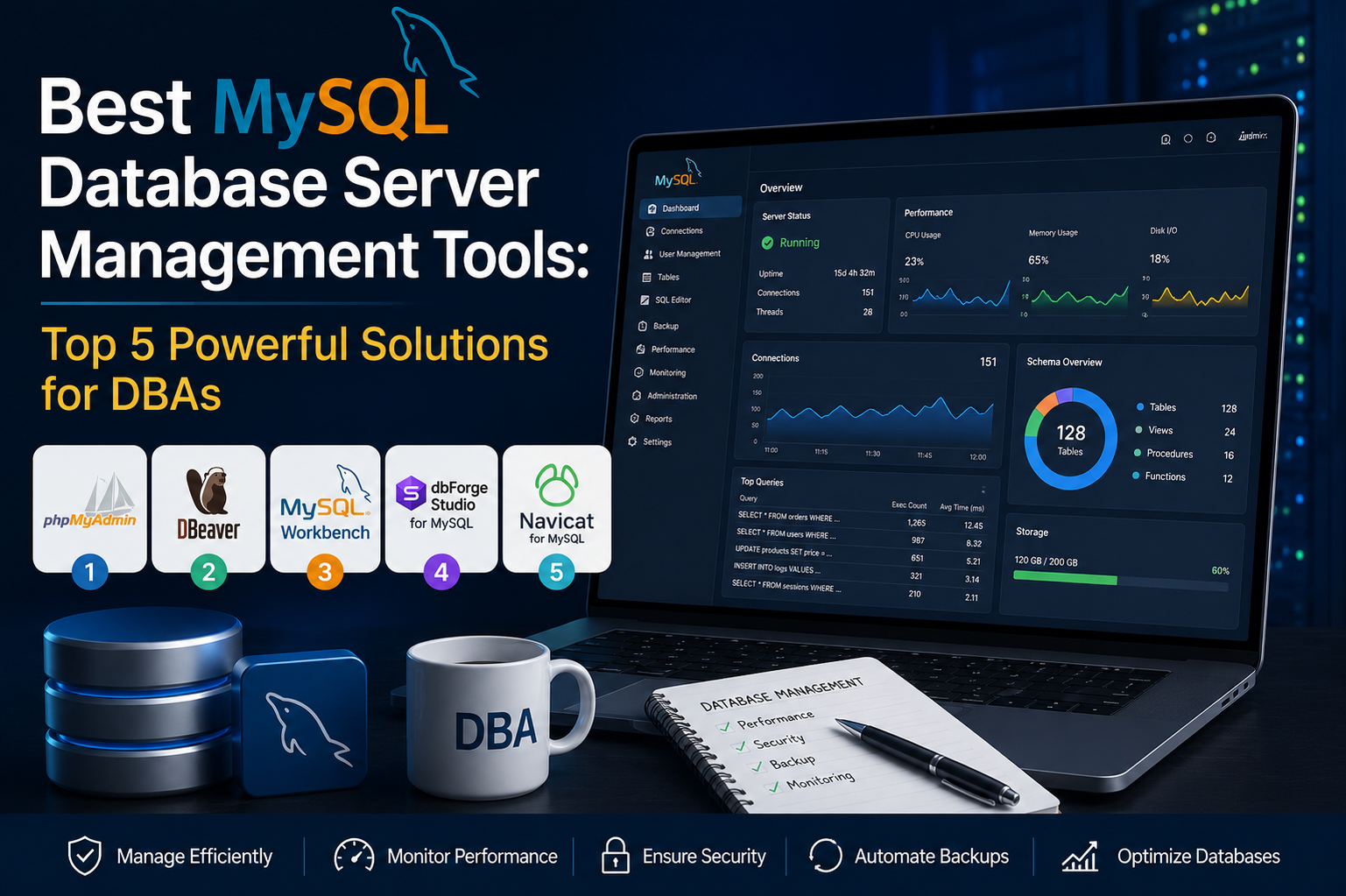
Modern businesses generate enormous amounts of information every day. Customer records, financial transactions, website activity, inventory details, analytics, and application data all need to be stored securely and accessed quickly. Behind much of this digital infrastructure is a database system designed to organize and manage information efficiently. Among the many database technologies available today, MySQL has become one of the most widely used relational database management systems in the world.
MySQL has earned its popularity because it combines reliability, flexibility, speed, and accessibility. Small startups, independent developers, enterprise organizations, educational institutions, and large-scale online platforms all use MySQL in different ways. It powers web applications, business systems, e-commerce stores, mobile apps, and countless internal platforms that people depend on daily.
At the center of every MySQL environment is the database server. The server is responsible for storing information, processing requests, controlling user access, handling queries, and ensuring that applications can retrieve and update data efficiently. While the database itself contains the information, the server acts as the engine that keeps everything functioning properly.
Managing a MySQL database server is not a simple task. Database administrators and developers must monitor performance, configure settings, protect data, manage permissions, optimize queries, and maintain stability. As databases grow larger and more complex, these responsibilities become increasingly demanding. This is why server management tools have become essential in modern database administration.
A good management tool simplifies tasks that would otherwise require extensive command-line work. It provides visual interfaces, monitoring dashboards, automation features, and centralized controls that help administrators work more efficiently. Instead of manually entering dozens of commands, administrators can manage databases visually, review performance metrics in real time, and troubleshoot issues faster.
The importance of database management tools becomes even clearer in environments where uptime and performance are critical. A poorly managed server can lead to slow applications, failed transactions, security vulnerabilities, or even complete system outages. Businesses rely heavily on data availability, so having tools that support stability and monitoring is essential for long-term success.
To understand why these tools matter, it is useful to first explore how MySQL works and what makes database server management such an important responsibility.
MySQL is built on the relational database model. In this structure, data is organized into tables composed of rows and columns. Each table stores a specific type of information, such as customer details, product listings, or order histories. Relationships between tables allow databases to organize complex information in a logical and efficient way.
The language used to interact with MySQL is Structured Query Language, commonly known as SQL. SQL allows users to create databases, retrieve records, insert information, update data, and manage permissions. Even though SQL itself is relatively readable, managing an entire server environment through commands alone can become difficult, especially in large systems with multiple databases and users.
Database servers often support many simultaneous connections. A web application with thousands of users may generate continuous requests to the database every second. The server must process these requests quickly while maintaining consistency and preventing data corruption. This requires efficient memory usage, optimized indexing, strong security controls, and constant monitoring.
One of the challenges database administrators face is balancing performance and stability. Faster query execution is important, but servers must also remain reliable under heavy workloads. Poorly written queries, missing indexes, or insufficient server resources can dramatically reduce performance. Without proper tools, identifying these issues can consume significant time and effort.
Another major responsibility is security management. Databases often store sensitive information, including customer data, business records, and financial details. Administrators must control user permissions carefully, ensuring that only authorized individuals can access or modify data. They must also maintain backups and recovery plans in case of hardware failures, software errors, or cyberattacks.
As organizations expand, databases usually become more complex. Multiple applications may connect to the same server, different departments may require separate access levels, and data volumes may increase rapidly. In these situations, visual management tools help administrators maintain organization and efficiency.
Graphical management tools are especially useful because they reduce the learning curve for users who may not be deeply experienced with command-line administration. While advanced administrators often prefer command-line interfaces for certain tasks, graphical tools provide a more accessible way to visualize structures, monitor systems, and manage configurations.
Many modern tools combine database development features with server management capabilities. This means developers can write queries, design schemas, manage users, monitor performance, and configure servers from a single interface. This integrated approach improves workflow efficiency and reduces the need to switch between different applications.
One of the most recognized tools in the MySQL ecosystem is MySQL Workbench. This application is widely used because it combines database development and administration into one environment. Developers can create and model databases visually, while administrators can configure servers and monitor system performance.
MySQL Workbench provides dashboards that display server health information in real time. Administrators can review memory usage, active connections, query activity, and server status through a visual interface. Instead of manually checking logs or running repeated commands, users can quickly identify unusual behavior and respond more effectively.
Another valuable aspect of MySQL Workbench is its visual query management system. Writing SQL queries becomes easier because users can organize scripts, execute commands, and review results within the same environment. This improves productivity and helps reduce errors during development or troubleshooting.
Server configuration is another area where management tools prove useful. MySQL servers contain numerous settings related to memory allocation, cache sizes, connection limits, and storage engines. Adjusting these settings manually requires technical knowledge and careful editing of configuration files. Management tools simplify this process by presenting settings in a more understandable format.
Performance optimization is one of the most important tasks in database administration. As databases grow, inefficient queries can slow down applications significantly. Some tools include query analysis features that identify slow operations and suggest improvements. These insights help administrators optimize indexing strategies and improve response times.
Backup management is another critical area. Data loss can have devastating consequences for organizations of any size. Reliable backup systems ensure that information can be restored if problems occur. Management tools often include backup scheduling, export options, and recovery support that make this process easier and more reliable.
Another major concern is server monitoring. Database servers operate continuously, often around the clock. Monitoring tools allow administrators to track resource usage, identify unusual activity, and receive alerts when problems arise. Early detection can prevent small issues from becoming major outages.
Many organizations now rely on cloud infrastructure, which introduces additional management challenges. Cloud-hosted MySQL servers may scale dynamically, support distributed applications, and require remote administration. Modern management tools increasingly support remote connections and cloud integrations, making it easier to manage servers regardless of physical location.
Cross-platform compatibility is another important feature. Organizations often use a mix of operating systems, including Windows, Linux, and macOS. Good database tools support multiple environments, allowing teams to work consistently across different systems.
Open-source tools remain especially popular in the MySQL community because they provide flexibility and affordability. Smaller businesses and independent developers often prefer open-source solutions that offer strong functionality without expensive licensing requirements. Open-source communities also contribute regular improvements, updates, and feature enhancements.
Ease of use has become a major factor in tool selection. Earlier database tools often focused heavily on technical functionality while neglecting usability. Modern applications aim to provide cleaner interfaces, intuitive navigation, and simplified workflows. This trend helps newer administrators learn more quickly while still supporting advanced capabilities for experienced professionals.
Collaboration is another growing consideration in database management. Development teams frequently work together on shared databases and applications. Some tools support collaborative workflows by organizing queries, managing shared connections, and simplifying version control integration.
Database visualization has also become increasingly valuable. Visual schema diagrams help teams understand relationships between tables and identify structural issues more easily. Instead of interpreting complex textual definitions, users can view database architecture graphically.
As data-driven systems continue to expand, scalability becomes essential. A database that works well for a small application may struggle as usage grows. Effective management tools help administrators anticipate growth by monitoring trends and identifying bottlenecks before they affect performance.
Automation is another important advancement in modern database management. Repetitive tasks such as backups, maintenance checks, and monitoring alerts can often be automated. This reduces manual workload and minimizes the risk of human error. Automation also allows administrators to focus on strategic improvements rather than routine maintenance.
For businesses operating globally, uptime is especially critical. Applications may need to remain available continuously across multiple time zones. Even brief interruptions can affect revenue, customer trust, and productivity. Reliable server management tools support high availability by helping administrators monitor performance and respond quickly to problems.
The role of database administrators has evolved significantly over time. Earlier database environments were often smaller and more isolated. Today, administrators frequently manage distributed systems, cloud services, analytics platforms, and high-volume transaction environments. As responsibilities expand, management tools become increasingly important for maintaining control and efficiency.
Developers also benefit from server management tools because database performance directly affects application behavior. Slow queries, unstable connections, or configuration issues can create poor user experiences. Integrated management environments allow developers to identify problems earlier during development and testing.
Educational environments also rely heavily on MySQL tools. Students learning database administration often begin with graphical interfaces because they make concepts easier to understand. Visual representations of tables, queries, and server settings help learners build confidence before moving into advanced administration tasks.
In many organizations, choosing the right management tool depends on factors such as team size, technical expertise, infrastructure complexity, and budget. Some teams prioritize simplicity and accessibility, while others require advanced monitoring and optimization capabilities. There is no universal solution that fits every situation.
However, the common goal remains the same across all environments: maintaining stable, secure, and efficient database operations. Effective server management tools help organizations achieve this goal by simplifying administration, improving visibility, and reducing operational risk.
The continued growth of digital services ensures that database management will remain a crucial technical discipline for years to come. As applications generate larger amounts of data and user expectations continue to rise, the demand for reliable MySQL server management tools will only increase.
Exploring the Top MySQL Server Management Tools in Depth
Choosing the right tool for managing a MySQL database server can significantly influence productivity, system reliability, and overall database performance. Every organization has different needs, and administrators often evaluate tools based on ease of use, monitoring capabilities, scalability, security management, and development support. While some applications focus heavily on visual simplicity, others provide advanced administrative controls designed for complex enterprise environments.
Modern MySQL management tools are no longer limited to executing queries or editing tables. They now serve as complete environments for monitoring performance, configuring servers, handling backups, optimizing databases, and assisting developers throughout the application lifecycle. Some are ideal for beginners learning database administration, while others cater to experienced professionals managing high-volume production systems.
Understanding the strengths of different tools helps administrators and development teams choose solutions that align with their workflow and technical requirements. Each tool approaches server management differently, and these differences often shape how efficiently teams can operate and maintain their databases.
Among the most widely recognized tools for MySQL administration is MySQL Workbench. Developed specifically for the MySQL ecosystem, this application has become a standard choice for developers and database administrators around the world. Its popularity comes from its balance between accessibility and advanced functionality.
MySQL Workbench combines several important database management functions within a unified interface. Users can model database structures visually, create and test SQL queries, administer servers, manage users, and monitor system health without switching between separate applications. This integrated approach simplifies workflows and helps teams remain organized.
One of the strongest features of MySQL Workbench is its visual database design capability. Database structures can become highly complex, especially in systems with dozens or hundreds of interconnected tables. Visual modeling tools allow administrators and developers to see relationships between tables clearly, making it easier to understand architecture and identify design problems.
Schema management becomes much more manageable in large environments when visual diagrams are available. Teams can track relationships, identify redundant structures, and plan future expansions more effectively. For developers working collaboratively, these visual representations improve communication because database designs become easier to interpret.
The server administration component of MySQL Workbench is equally valuable. Administrators can configure server settings through graphical menus rather than editing configuration files manually. This reduces the likelihood of mistakes and allows less experienced users to understand server options more easily.
Performance dashboards are another important feature. Real-time monitoring gives administrators visibility into memory consumption, active connections, query execution, and server load. When performance issues occur, visual indicators help identify bottlenecks faster than traditional command-line diagnostics alone.
MySQL Workbench also simplifies backup and restoration processes. Administrators can export databases, schedule maintenance operations, and recover information more efficiently through the interface. In production environments where downtime must be minimized, streamlined backup management is essential.
Although MySQL Workbench is highly capable, some users prefer tools with even simpler interfaces and broader database compatibility. This is one reason why Beekeeper Studio has gained attention among developers and administrators in recent years.
Beekeeper Studio is known for its clean and modern interface. Unlike some traditional database applications that appear cluttered or highly technical, Beekeeper Studio focuses on usability and simplicity. This makes it especially attractive to developers who want quick access to database operations without navigating overly complex menus.
One of the defining strengths of Beekeeper Studio is its accessibility. Users can connect to databases quickly, browse tables easily, and execute queries in a streamlined environment. The application is designed to reduce friction, helping users focus on development and data management tasks rather than configuration complexity.
The query editor in Beekeeper Studio is particularly user-friendly. Features such as tabbed queries, syntax highlighting, and organized result displays improve workflow efficiency. Developers working with multiple queries simultaneously benefit from the application’s clean layout and responsive interface.
Another advantage is its support for multiple database systems beyond MySQL. Many organizations operate mixed database environments that include PostgreSQL, SQLite, or other relational systems. Tools that support multiple platforms reduce the need to learn entirely different interfaces for each database technology.
Open-source availability also contributes to Beekeeper Studio’s popularity. Organizations and independent developers often appreciate tools that can be customized and improved through community contributions. Open-source projects tend to evolve rapidly because users actively participate in identifying issues and suggesting enhancements.
Despite its simplicity, Beekeeper Studio still provides practical management features. Users can organize saved queries, manage connections securely, and interact with databases visually without requiring advanced command-line knowledge. This makes the tool especially appealing to smaller teams and developers who prioritize speed and convenience.
While some tools focus on desktop-based administration, others emphasize browser-based accessibility. One of the best-known examples of this approach is phpMyAdmin.
phpMyAdmin has remained popular for many years because it allows administrators to manage MySQL databases directly through a web browser. This accessibility makes it especially useful in web hosting environments, remote administration scenarios, and lightweight deployments where installing desktop applications may not be practical.
Because phpMyAdmin operates through a browser interface, administrators can access their databases from various devices and operating systems without requiring dedicated software installations. This flexibility has contributed significantly to its widespread adoption among web developers and hosting providers.
The interface provides tools for performing many common administrative tasks, including creating databases, managing tables, editing records, configuring permissions, importing data, and exporting backups. These operations can all be completed visually, which makes the platform approachable for users with limited command-line experience.
User management is one of phpMyAdmin’s particularly useful features. Administrators can create accounts, assign privileges, and restrict access through the graphical interface. Since database security often depends on carefully managed permissions, having an accessible interface for user administration simplifies an important responsibility.
phpMyAdmin also supports direct SQL execution, allowing advanced users to run custom queries whenever necessary. This combination of visual tools and manual query support provides flexibility for both beginners and experienced administrators.
Another strength of phpMyAdmin is its lightweight deployment model. Since it operates as a web application, it can be integrated easily into server environments. Hosting providers frequently include it as part of their control panels because it offers a convenient way for customers to manage databases independently.
However, browser-based management tools also require careful security practices. Since remote access is often involved, administrators must ensure that authentication, encryption, and permission settings are properly configured to protect sensitive data.
For users seeking more advanced administrative functionality, dbForge Studio for MySQL offers a feature-rich environment designed for professional database management and development.
dbForge Studio combines database administration, SQL development, server management, and performance optimization into a comprehensive platform. Its interface is designed to support both experienced professionals and users who may still be learning advanced database concepts.
One of the standout features of dbForge Studio is its extensive SQL editing environment. Writing and managing complex queries becomes easier because the platform includes intelligent assistance tools such as auto-completion, syntax validation, and query formatting. These features help reduce errors and improve development speed.
Database comparison and synchronization capabilities are also important strengths. In environments where multiple versions of databases exist, administrators often need to compare schemas and synchronize changes between systems. Manual comparison can be time-consuming and error-prone, especially in large databases. Automated comparison tools help simplify this process significantly.
Server management features within dbForge Studio provide administrators with detailed visibility into system performance and resource usage. Monitoring tools help identify inefficient queries, connection issues, and server bottlenecks before they become severe operational problems.
The platform also supports advanced backup and restore operations. Reliable recovery mechanisms are essential for protecting business continuity, and integrated tools help administrators manage backup strategies more effectively.
Database documentation is another valuable capability offered by dbForge Studio. As database systems grow larger, maintaining clear documentation becomes increasingly difficult. Automated documentation tools help teams keep track of structures, relationships, and configuration details more efficiently.
For organizations that rely heavily on collaborative development, tools like dbForge Studio improve coordination between developers and administrators. Shared environments benefit from features that support version tracking, schema management, and organized workflows.
Monitoring-focused tools represent another important category of MySQL server management software. While development and administration interfaces are valuable, some environments require deeper visibility into server performance and operational health. This is where dedicated monitoring platforms become especially important.
MySQL Monitoring tools are designed to provide continuous oversight of database servers. Instead of focusing primarily on development workflows, these applications prioritize performance tracking, alert systems, uptime management, and resource analysis.
One of the most important functions of monitoring software is early problem detection. Database performance issues rarely appear suddenly without warning. Memory usage may gradually increase, query response times may slow, or connection counts may rise unexpectedly. Monitoring tools track these trends continuously and alert administrators before severe disruptions occur.
Real-time monitoring dashboards provide visibility into critical metrics such as CPU usage, disk activity, memory allocation, replication status, and active sessions. These insights help administrators understand how servers behave under different workloads.
Automated alert systems are particularly valuable in production environments. Instead of manually checking server status constantly, administrators can configure notifications for specific thresholds or unusual events. Alerts may indicate server downtime, failed backups, excessive resource consumption, or replication delays.
Performance reporting is another important feature. Historical data allows administrators to analyze long-term trends and identify recurring issues. This information supports capacity planning and helps organizations prepare for future growth.
Query analysis is often integrated into monitoring platforms as well. Slow queries are one of the most common causes of poor database performance. Monitoring tools can identify inefficient operations, highlight problematic queries, and provide insights that support optimization efforts.
High-availability environments especially benefit from monitoring systems. Organizations that depend on uninterrupted database access need rapid detection and response capabilities. Even small interruptions can affect customer experiences, financial transactions, or operational workflows.
Scalability is another important consideration when evaluating management tools. Smaller applications may function adequately with basic interfaces, but larger infrastructures often require enterprise-grade monitoring and automation capabilities. As databases grow, management complexity increases dramatically.
Cloud adoption has also influenced the evolution of MySQL management tools. Many organizations now operate hybrid or fully cloud-based infrastructures, requiring remote administration capabilities and distributed monitoring support. Modern tools increasingly include cloud-friendly features that simplify management across multiple environments.
Security management continues to remain a central responsibility for database administrators. Strong authentication, encryption, permission control, and audit tracking are essential components of secure database operations. Many modern tools include features that help administrators review user activity, manage credentials, and maintain compliance standards.
Ease of learning is another important factor that influences tool selection. Some database platforms contain powerful features but require extensive technical expertise to operate effectively. Others focus on simplicity and accessibility, helping newer administrators become productive more quickly.
In practice, many organizations use multiple tools together rather than relying on a single solution. Developers may prefer lightweight query environments, while administrators depend on advanced monitoring systems and backup platforms. Combining specialized tools often provides greater flexibility and operational efficiency.
The growing importance of data-driven applications ensures that MySQL management tools will continue evolving rapidly. Administrators and developers increasingly expect intelligent automation, better visualization, stronger security integration, and cloud-native support.
As database infrastructures become larger and more interconnected, effective management tools are no longer optional conveniences. They are essential components of maintaining reliable, secure, and high-performing MySQL server environments.
MySQL Server Management Strategies, Workflows, and Real-World Optimization Practices
As MySQL environments grow in size and complexity, the conversation shifts away from simply choosing a management tool and moves toward how those tools are actually used in real operational workflows. In practical database administration, tools are only as effective as the strategies behind them. A well-chosen application can still deliver poor results if it is not integrated into a structured approach for monitoring, optimization, security, and scaling.
Modern database teams rarely rely on a single tool for everything. Instead, they build layered workflows where different tools serve different purposes—development, administration, monitoring, performance tuning, and troubleshooting. Understanding how these layers interact is essential for maintaining stable and efficient MySQL server environments.
One of the most important aspects of effective database management is workflow design. A MySQL server does not operate in isolation; it supports applications, users, analytics systems, and sometimes multiple services at the same time. Each interaction creates workload pressure that must be managed carefully.
In well-structured environments, developers and administrators typically divide responsibilities. Developers focus on writing efficient queries and designing schemas, while database administrators ensure that servers remain stable, secure, and optimized. Management tools act as the bridge between these roles, providing shared visibility into system behavior.
When teams work without clear workflows, problems often arise. Queries may be deployed without performance testing, server settings may be adjusted without understanding long-term effects, and monitoring alerts may be ignored or misinterpreted. Over time, these issues accumulate and lead to instability. Structured workflows prevent this by introducing consistency and accountability into database operations.
A central component of any MySQL workflow is performance analysis. Database performance is influenced by many factors, including query design, indexing strategies, server configuration, and hardware limitations. Even small inefficiencies can have large effects when scaled across millions of operations.
Performance optimization usually begins with query behavior. Poorly structured queries are one of the most common causes of slow database performance. When a query retrieves unnecessary data, uses inefficient joins, or lacks proper indexing, the server must work harder than necessary. This increases response time and consumes additional resources.
Management tools help identify these issues by providing visibility into query execution patterns. Instead of manually analyzing logs, administrators can use visual tools to detect slow operations and repeated performance bottlenecks. This allows teams to focus optimization efforts where they matter most.
Indexing strategy is another critical factor in performance. Indexes allow the database to locate data quickly without scanning entire tables. However, excessive or poorly designed indexes can also reduce performance by increasing storage overhead and slowing down write operations. Finding the right balance requires careful analysis and continuous monitoring.
Server configuration also plays a major role in performance outcomes. MySQL servers rely on memory allocation settings, cache structures, and connection limits to manage workload efficiently. If these parameters are not aligned with actual usage patterns, performance degradation can occur even if queries are well optimized.
This is where management tools become particularly useful. Instead of manually editing configuration files, administrators can use interfaces that provide clearer visibility into system settings. Some tools even offer recommendations based on observed server behavior, helping administrators make informed adjustments.
Beyond performance, security is one of the most important responsibilities in database management. MySQL databases often contain sensitive information such as user credentials, financial records, and business data. Protecting this information requires careful control of access and permissions.
Access control is typically managed through user roles and privileges. Each user or application connecting to the database should have only the minimum level of access required to perform its tasks. Overly permissive configurations increase the risk of data leaks or accidental modifications.
Management tools simplify this process by providing structured interfaces for user administration. Instead of manually executing permission commands, administrators can visually assign roles and review access levels. This reduces complexity and helps prevent configuration errors.
Another important security practice is monitoring user activity. Understanding who is accessing the database, when they are connecting, and what actions they are performing helps identify suspicious behavior early. Some monitoring systems track login attempts, query execution patterns, and unusual activity spikes.
Backup and recovery strategies are also essential for protecting data integrity. No system is immune to failure, whether due to hardware issues, software bugs, or external attacks. Regular backups ensure that data can be restored in the event of unexpected disruption.
Effective backup strategies are not limited to simply copying data. They also involve scheduling, versioning, storage management, and recovery testing. Management tools often help automate these processes, reducing the risk of human error and ensuring consistency.
As databases scale, automation becomes increasingly important. Large systems generate too much activity for manual monitoring alone. Automation helps manage repetitive tasks such as performance checks, backup execution, alert handling, and routine maintenance operations.
Automated monitoring systems continuously track server health and trigger alerts when anomalies occur. This allows administrators to respond quickly to potential issues before they escalate into serious problems. Without automation, critical warning signs might be missed due to workload or human oversight.
Scaling MySQL environments introduces additional complexity. As data volume grows, queries become more expensive to execute, storage requirements increase, and network traffic intensifies. A system that performs well under small workloads may struggle significantly under larger demands.
One common approach to scaling is database optimization before infrastructure expansion. Improving query efficiency, refining indexing strategies, and eliminating unnecessary operations can often extend the life of existing hardware. This approach is cost-effective and reduces unnecessary system complexity.
When optimization alone is not enough, horizontal or vertical scaling strategies are introduced. Vertical scaling involves increasing the capacity of a single server by adding more resources such as memory or processing power. Horizontal scaling distributes workload across multiple servers to handle higher demand.
Both approaches require careful planning. Distributed systems introduce challenges related to synchronization, replication, and consistency. Management tools help administrators monitor these environments and ensure that data remains accurate across all nodes.
Replication management is especially important in distributed MySQL systems. Replication allows data from one server to be copied to others, ensuring redundancy and improving read performance. However, replication delays or configuration errors can lead to inconsistencies. Monitoring tools help detect these issues early.
Another important aspect of scaling is load balancing. When multiple database servers are available, traffic must be distributed evenly to avoid overloading a single system. Load balancing improves performance and ensures better resource utilization.
As environments grow more complex, visibility becomes increasingly important. Administrators must be able to see how data flows through the system, where bottlenecks occur, and how resources are being consumed. Visualization tools help simplify this complexity by turning raw data into understandable insights.
One of the challenges in large-scale MySQL management is maintaining consistency across environments. Development, testing, and production systems often need to remain synchronized. Without proper coordination, schema differences or configuration mismatches can cause unexpected behavior.
Change management practices help address this issue. Instead of making direct modifications in production environments, changes are typically tested in controlled environments first. Once validated, they are deployed in a structured and predictable manner.
Database migration is another area where careful planning is required. Moving data between servers or upgrading database versions must be handled with precision to avoid downtime or data loss. Management tools often assist in this process by providing structured migration workflows.
Troubleshooting is another critical responsibility in MySQL administration. When issues occur, administrators must quickly identify the root cause. Problems may originate from query inefficiencies, server resource limitations, network issues, or configuration errors.
Effective troubleshooting requires both visibility and experience. Management tools provide diagnostic information, but interpreting that information correctly depends on understanding how MySQL systems behave under different conditions.
Logging plays an important role in debugging. Server logs capture important events such as query execution details, errors, warnings, and system messages. Analyzing logs helps administrators reconstruct events leading up to an issue and identify corrective actions.
As MySQL systems evolve, integration with other technologies becomes increasingly common. Databases now often operate alongside caching systems, analytics platforms, application servers, and cloud services. This interconnected environment requires tools that can support complex architectures.
Modern management tools are gradually adapting to these needs by offering broader integration capabilities. They are no longer limited to isolated database interaction but instead support full ecosystem visibility.
Another growing trend is the use of intelligent automation in database management. Instead of relying solely on manual configuration, systems are beginning to incorporate adaptive behaviors that respond to workload changes automatically. This includes dynamic resource allocation, automated indexing suggestions, and performance tuning recommendations.
Artificial intelligence and machine learning are also beginning to influence database management systems. These technologies can analyze usage patterns, detect anomalies, and suggest optimizations based on historical behavior. While still evolving, they represent a significant shift in how database systems may be managed in the future.
User experience is also becoming a central focus. Earlier database tools were primarily designed for technical experts, but modern systems aim to make database management more accessible without sacrificing depth or control. Cleaner interfaces, simplified navigation, and guided workflows help reduce complexity.
Despite these advancements, the fundamental principles of MySQL management remain consistent. Performance, security, reliability, and scalability continue to define successful database administration. Tools evolve, but these core responsibilities remain unchanged.
Ultimately, effective MySQL server management depends on the combination of strong tools and disciplined operational practices. Tools provide the visibility and control needed to manage complex systems, while structured workflows ensure that those capabilities are applied consistently and effectively.
As data continues to grow in importance across all industries, the role of database administration becomes even more critical. MySQL management tools will continue to evolve, but their purpose will remain focused on helping teams maintain stable, efficient, and secure data environments in an increasingly demanding digital landscape.
MySQL Management, Advanced Optimization, and Evolving Database Architectures
As MySQL systems scale beyond simple applications and small teams, database management shifts into a more sophisticated discipline that blends architecture design, operational reliability, automation, and deep performance engineering. At this level, managing a database server is no longer just about running queries or monitoring basic metrics. It becomes a continuous process of balancing performance, resilience, scalability, and governance across complex, often distributed environments.
Enterprise MySQL systems typically support mission-critical applications where downtime, latency, or data inconsistency can have significant consequences. These systems may serve millions of users, process large volumes of transactions in real time, or power analytics pipelines that influence business decisions. In such environments, even small inefficiencies can scale into major operational issues.
This is where advanced database management practices and tools become essential. Rather than focusing on isolated server tasks, administrators must adopt a holistic view of the entire data ecosystem. This includes infrastructure design, replication strategies, query optimization at scale, observability systems, security enforcement, and automated recovery processes.
One of the defining characteristics of enterprise MySQL environments is architectural complexity. Instead of a single database server handling all operations, systems are often distributed across multiple nodes. These may include primary servers, replicas, load balancers, caching layers, and analytics clusters. Each component plays a specific role in maintaining performance and availability.
Replication is a fundamental concept in these environments. It allows data from a primary database to be copied to one or more secondary systems. This improves redundancy and enables read scaling, as queries can be distributed across replicas instead of overwhelming a single server. However, replication introduces challenges such as lag, conflict resolution, and consistency management.
Replication lag occurs when secondary servers fall behind the primary server in processing updates. This can result in outdated data being served to applications. In high-precision systems, even slight delays can cause inconsistencies in reporting, transaction processing, or user interactions. Monitoring replication health becomes a critical responsibility in these environments.
Advanced management tools help administrators track replication status in real time. They visualize synchronization delays, highlight bottlenecks, and provide alerts when replication performance degrades. Without these insights, identifying replication issues manually would be extremely difficult in large-scale systems.
Another important architectural consideration is high availability. Enterprise MySQL systems are designed to remain operational even in the event of hardware failure, network disruption, or software crashes. High availability setups typically involve multiple redundant servers that can take over responsibilities if the primary system fails.
Failover mechanisms ensure continuity by automatically redirecting traffic to a standby server when a failure is detected. This process must be fast and reliable to minimize downtime. Management tools often assist by monitoring server health and triggering failover procedures when necessary.
In addition to availability, consistency is a major concern in distributed MySQL systems. When multiple servers handle read and write operations, ensuring that all nodes reflect the same data state becomes challenging. Different consistency models may be applied depending on system requirements, ranging from strict consistency to eventual consistency.
Transaction management plays a key role in maintaining data integrity. MySQL uses the concept of transactions to ensure that operations are completed reliably. A transaction groups multiple operations into a single unit, which either fully succeeds or fully fails. This prevents partial updates that could corrupt data relationships.
Conclusion
Managing MySQL database servers effectively is a foundational requirement for any organization that depends on reliable, scalable, and high-performing data systems. As modern applications continue to grow in complexity, the importance of using the right management tools becomes even more evident. These tools are not just conveniences; they are essential components that help ensure stability, security, and efficiency across database environments.
Throughout the exploration of MySQL server management tools, it becomes clear that each solution serves a specific purpose. Some tools focus on simplifying database development and query execution, while others emphasize performance monitoring, server administration, or advanced optimization. This diversity allows teams to choose solutions that match their technical needs, skill levels, and infrastructure requirements.
Tools such as graphical database interfaces improve accessibility by reducing dependence on command-line operations, making database management more approachable for beginners while still supporting advanced functionality for experienced administrators. Monitoring tools add another layer of control by providing real-time insights into system health, helping detect issues before they escalate into serious problems. Meanwhile, advanced administration platforms offer deeper capabilities for query optimization, backup management, and server configuration.
A key takeaway is that no single tool is sufficient for all scenarios. Instead, effective MySQL management often involves a combination of tools working together within a structured workflow. This layered approach allows organizations to balance ease of use with technical depth, ensuring that both development and operational needs are met.
Ultimately, successful database management depends not only on the tools themselves but also on how they are used. Proper planning, consistent monitoring, regular optimization, and strong security practices all contribute to a healthy MySQL environment. When combined with the right tools, these practices enable organizations to maintain high availability, protect critical data, and support long-term scalability.
As data continues to grow in importance across every industry, mastering MySQL server management remains a valuable and future-ready skill for developers and database professionals alike.