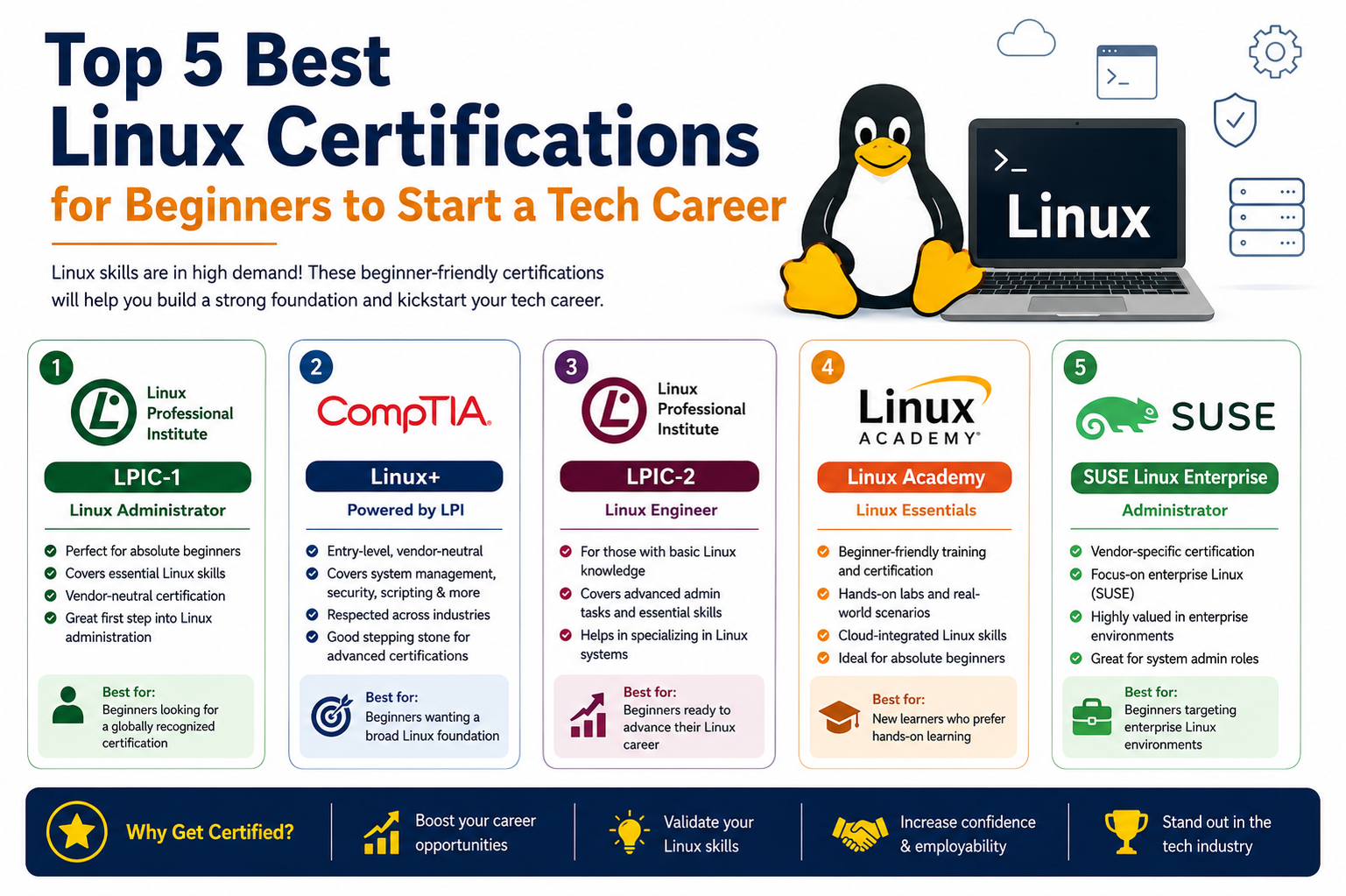
In today’s technology landscape, Linux has become one of the most widely used operating systems across servers, cloud platforms, embedded systems, and enterprise environments. For anyone entering IT, understanding Linux is no longer optional; it has become a core skill that supports nearly every modern infrastructure role. From web hosting environments to large-scale cloud deployments, Linux quietly powers a significant portion of the digital world. This widespread adoption is one of the main reasons beginners often explore structured certifications to guide their learning journey.
For newcomers, Linux can feel unfamiliar at first because it behaves differently from more commonly used desktop operating systems. Instead of relying heavily on graphical interfaces, Linux often emphasizes command-line interaction, system configuration through text-based files, and a deeper understanding of how computing resources are managed. This shift in thinking is usually the first challenge beginners encounter. However, it is also the point where structured learning becomes extremely valuable, especially through entry-level certifications designed to introduce core concepts in a controlled and progressive manner.
A beginner-friendly certification path typically starts with foundational knowledge. This includes understanding what Linux is, how it evolved from open-source development efforts, and how its community-driven model differs from proprietary operating systems. Beginners are also introduced to basic system navigation, file structures, user permissions, and the philosophy behind open-source collaboration. These concepts are not just technical details; they shape how Linux systems are maintained, secured, and scaled in real environments.
One of the earliest milestones in this journey is learning how users interact with Linux systems. Unlike traditional operating systems where most tasks are performed using graphical tools, Linux encourages efficiency through commands. This means beginners gradually become comfortable executing tasks like navigating directories, managing files, and viewing system information using textual commands. Over time, this approach develops a deeper awareness of how the system operates under the surface.
Another key area of foundational learning involves understanding file permissions and security structure. Linux is designed as a multi-user system, meaning that multiple users can interact with the same machine while maintaining strict boundaries between their access levels. This introduces beginners to concepts like ownership, read-write-execute permissions, and administrative control. These principles are essential because they form the backbone of Linux security and system stability.
Alongside system navigation and security basics, beginners also start exploring how Linux fits into broader IT environments. Linux is not an isolated technology; it integrates with networks, cloud services, and application ecosystems. Even at an early stage, learners begin to see how Linux supports web servers, database systems, and enterprise applications. This broader perspective helps them understand why Linux skills are in demand across industries.
At this foundational level, certification frameworks are designed to introduce structured learning without overwhelming complexity. They focus on gradual exposure to core ideas rather than advanced administration tasks. One of the key benefits of this approach is that learners can confirm their interest in Linux before committing to more demanding technical paths. This early stage acts as a filtering point where individuals can decide whether they want to pursue system administration, cybersecurity, DevOps, or cloud engineering roles that rely heavily on Linux.
Beginners are also encouraged to develop familiarity with system behavior under different conditions. This includes understanding how processes run in the background, how memory is allocated, and how system resources are monitored. While these topics may seem advanced at first, they are introduced in simplified forms to build intuition. Over time, this intuition becomes essential for troubleshooting and system management tasks.
Another important aspect of early Linux learning is exposure to open-source philosophy. Unlike proprietary systems where software development is controlled by a single organization, Linux thrives on community contributions. This means that improvements, bug fixes, and new features often come from a global network of developers. Understanding this model helps beginners appreciate the collaborative nature of Linux development and its rapid evolution over time.
As learners progress through foundational concepts, they begin to see patterns in system behavior. For example, many administrative tasks in Linux follow consistent logic, such as reading configuration files, modifying settings through commands, and restarting services to apply changes. This consistency reduces the learning curve over time and allows beginners to build confidence as they practice.
A key transition point in this stage is moving from passive understanding to active experimentation. Beginners start applying commands in controlled environments, observing system responses, and gradually building familiarity with real-world scenarios. This hands-on experience is essential because Linux is ultimately a practical skill that requires interaction rather than memorization.
At this stage, learners also begin to understand how Linux systems are used in professional environments. Servers running websites, cloud infrastructure powering applications, and security systems protecting data often rely on Linux. This realization helps connect theoretical knowledge with real-world applications, making the learning process more meaningful.
Another important concept introduced early is system logging and monitoring. Linux systems continuously generate logs that record activities, errors, and system events. Learning how to interpret these logs helps beginners understand what is happening behind the scenes. This skill becomes particularly useful when diagnosing system issues or analyzing performance behavior.
As foundational knowledge grows, learners gradually become ready to explore structured certification paths. These certifications serve as milestones that validate understanding and provide direction for deeper specialization. They also help organize learning into manageable stages, ensuring that beginners do not skip essential concepts.
By the time learners reach this point, they typically have a basic understanding of command-line usage, system structure, file permissions, and introductory networking concepts. This creates a strong base for progressing into more formal certification tracks that focus on system administration and operational skills. The transition from foundational knowledge to certification-based learning marks an important step in developing professional-level Linux expertise.
The early stage of Linux learning is not about mastering every detail but about building comfort with the environment. It is about understanding how systems think, how they behave, and how users interact with them. Once this foundation is established, learners can move toward structured certifications that refine and expand their abilities in more specialized directions.
Understanding How Linux Certifications Shape Technical Growth and Career Direction
Entering the world of Linux certifications often feels less like choosing a single path and more like navigating a structured ladder of increasing responsibility. Each certification represents a different layer of technical maturity, beginning with basic operational awareness and gradually moving toward advanced system administration and enterprise-scale management. What makes this progression valuable is not just the certificates themselves, but the way each stage builds a specific type of thinking required in real IT environments.
At the earliest level of formal recognition, beginner-oriented certifications focus on shaping familiarity rather than mastery. These entry points are designed to validate that a learner understands the fundamental behavior of Linux systems and can perform basic tasks confidently. At this stage, the emphasis is on recognizing system components, navigating interfaces, understanding user roles, and becoming comfortable with everyday interactions in a Linux environment.
As learners move beyond initial exposure, the focus begins to shift toward structured operational knowledge. This is where certification paths start to differentiate themselves in terms of depth and expectations. Some frameworks remain vendor-neutral, emphasizing general principles that apply across distributions, while others begin to introduce more structured administrative thinking. The difference between these approaches is important because it influences how skills are applied in real-world environments.
Vendor-neutral certification paths typically emphasize adaptability. Instead of focusing on a specific Linux distribution, they encourage learners to understand concepts that apply broadly across systems. This includes system management, process handling, storage configuration, and basic networking. The advantage of this approach is that it prepares individuals for a wide range of environments, making their skills transferable across different organizations and technologies.
As learners gain confidence, they begin to encounter certifications that require a more practical understanding of system behavior. At this stage, the focus shifts toward operational consistency. Instead of simply recognizing commands or concepts, candidates are expected to apply them in structured scenarios that resemble real administrative tasks. This includes managing users, configuring services, monitoring system performance, and responding to system issues.
One important transition in this journey is the move from theoretical understanding to applied problem-solving. Early certifications introduce concepts in isolation, but intermediate stages require learners to connect multiple ideas at once. For example, managing a service might involve understanding how system processes interact, how configuration files influence behavior, and how permissions affect accessibility. This layered thinking is essential for anyone aiming to work in system administration or infrastructure support roles.
As certification levels progress, the complexity of system responsibilities increases significantly. Learners are no longer just interacting with a system; they are responsible for maintaining its stability and ensuring its proper functioning under varying conditions. This includes understanding how to diagnose issues when systems behave unexpectedly and how to implement corrective actions without disrupting ongoing operations.
At a more advanced beginner-to-intermediate stage, certifications begin to explore automation and efficiency concepts. This is where learners are introduced to the idea that system administration is not only about manual execution but also about optimizing repetitive tasks. Understanding how systems can be managed more efficiently becomes an important skill, especially in environments where scalability and consistency are essential.
Security awareness also becomes more prominent at this stage. While early learning focuses on basic permissions and user access, intermediate certifications introduce broader security considerations. This includes understanding how systems can be protected against unauthorized access, how logs can be used to detect anomalies, and how system configurations can be hardened to reduce vulnerabilities. These concepts are critical because Linux systems are often deployed in environments where security is a primary concern.
As learners continue advancing, they encounter certifications that emphasize deeper administrative capabilities. These certifications are designed to test not just knowledge, but the ability to manage systems in more complex and realistic environments. Tasks at this level often include managing network services, configuring storage solutions, handling system backups, and ensuring service availability across multiple users or devices.
At this stage, understanding system architecture becomes increasingly important. Instead of viewing Linux as a single operating system, learners begin to see it as a collection of interconnected services. Each service plays a role in maintaining overall system functionality, and administrators must understand how these services interact with each other. This systems-level thinking is a defining characteristic of more advanced Linux professionals.
Another key development at this level is the introduction of troubleshooting as a core skill. Unlike earlier stages where issues are simplified or isolated, real-world environments present complex and layered problems. A single issue might involve multiple components, such as network connectivity, service configuration, or resource limitations. Learning how to systematically diagnose and resolve such problems is a critical milestone in Linux expertise.
As certification paths progress further, they begin to reflect real enterprise environments. This is where learners encounter scenarios that mirror production systems used in organizations. These environments often involve strict uptime requirements, large-scale infrastructure, and multiple interconnected services. Managing such systems requires not only technical knowledge but also the ability to make decisions under constraints.
At this level, system reliability becomes a central focus. Learners are expected to understand how to maintain stable environments, reduce downtime, and ensure consistent performance. This includes managing system updates, handling resource allocation, and ensuring that services remain available even under high demand. These responsibilities reflect the expectations placed on professional system administrators.
Another important aspect of advanced certification stages is the ability to work with enterprise-specific Linux environments. Some systems are designed specifically for commercial use and include additional tools, configurations, and management frameworks. Working with these environments requires an understanding of both general Linux principles and platform-specific behaviors. This combination of knowledge allows administrators to adapt to specialized systems used in large organizations.
As learners move through this progression, they also begin to understand the importance of documentation and procedural consistency. In professional environments, system changes must be carefully recorded and executed in a controlled manner. This ensures that systems remain stable and that changes can be tracked or reversed if necessary. Learning to follow structured processes becomes just as important as technical execution.
Another significant development in advanced stages is the emphasis on scalability. Systems are rarely static in professional environments; they must grow and adapt as organizational needs evolve. This requires an understanding of how to manage multiple systems simultaneously, how to distribute workloads, and how to ensure consistent configuration across different environments.
At this point, certification paths begin to reflect roles that involve responsibility over entire systems rather than individual tasks. Learners are expected to understand how different components of an infrastructure interact and how changes in one area can affect the overall system. This holistic perspective is essential for managing complex IT environments.
The progression through Linux certification levels also highlights an important shift in mindset. Early learning is task-oriented, focusing on individual commands and actions. As learners advance, the focus shifts toward system thinking, where the goal is to understand relationships between components rather than isolated operations. This shift is what separates basic users from professional administrators.
By the time learners reach more advanced certification stages, they are expected to operate with a high level of independence. They must be able to analyze system behavior, identify underlying causes of issues, and implement solutions without relying on step-by-step guidance. This level of autonomy is essential in real-world IT environments, where systems often require immediate and informed responses.
Throughout this progression, one consistent theme remains: Linux is not just a tool but an ecosystem. Understanding its structure, behavior, and evolution requires continuous learning and adaptation. Each certification level represents a deeper layer of this ecosystem, gradually revealing more complex aspects of system management and operation.
As learners move closer to professional-level certifications, they begin to see how Linux integrates into broader technological landscapes. It connects with cloud platforms, supports enterprise applications, and forms the backbone of many digital infrastructures. This interconnectedness reinforces the importance of mastering not just isolated skills but a comprehensive understanding of system behavior across environments.
The journey through Linux certifications is therefore not linear in the traditional sense. It is a layered progression where each stage builds upon the previous one, expanding both technical capability and conceptual understanding. This structured growth ensures that learners are not only gaining knowledge but also developing the ability to apply it effectively in increasingly complex situations.
How Linux Certifications Translate into Real-World IT Roles and Professional Expectations
Linux certifications only become meaningful when they are viewed through the lens of real job environments. In professional settings, systems are not studied in isolation; they are part of larger infrastructures that include cloud services, networking layers, security controls, and application deployments. This means that each certification level ultimately reflects a set of responsibilities rather than just theoretical knowledge. Understanding this connection helps clarify why certain certifications are valued differently depending on the role and industry context.
In most IT environments, Linux knowledge is closely tied to operational stability. Servers running business applications, hosting platforms, and internal services often rely on Linux-based systems because of their reliability and flexibility. This creates a demand for professionals who can not only understand Linux concepts but also maintain systems under real operational pressure. Certifications help map this progression by gradually aligning learning outcomes with job expectations.
At the entry level, individuals who complete foundational Linux certifications are typically prepared for support-oriented roles. These roles may involve assisting with system monitoring, performing basic troubleshooting, or handling routine administrative tasks under supervision. The focus is not on making architectural decisions but on developing familiarity with system behavior. In these environments, consistency and attention to detail matter more than advanced technical expertise.
As professionals move forward in their Linux learning journey, they begin to transition into roles that require more independence. This is where intermediate-level certifications become relevant. At this stage, individuals are expected to manage systems more directly, configure services, and respond to technical issues with less reliance on predefined instructions. The ability to interpret system behavior becomes more important than simply executing commands.
In many organizations, this stage aligns with roles such as junior system administrator or infrastructure support engineer. These positions require a balance between technical skill and operational awareness. Professionals must understand how different system components interact, how services depend on each other, and how changes in one area can impact overall system stability. This interconnected thinking is a key milestone in Linux proficiency.
As experience grows, Linux professionals often move into more specialized or advanced operational roles. These positions require a deeper understanding of system architecture and performance optimization. Instead of focusing solely on individual systems, professionals begin to manage environments that involve multiple servers, networked services, and distributed workloads. At this level, efficiency and scalability become central concerns.
One of the most important aspects of this progression is the shift from reactive to proactive system management. Early-stage roles often involve responding to issues after they occur, while more advanced roles focus on preventing problems before they impact operations. This includes monitoring system health, analyzing performance trends, and identifying potential risks in advance. Linux certifications at higher levels reflect this shift by emphasizing system stability and advanced troubleshooting capabilities.
Vendor-neutral certifications play a significant role in shaping adaptable professionals. These certifications focus on concepts that apply across different Linux distributions, allowing individuals to work in a variety of environments without being restricted to a specific ecosystem. This flexibility is particularly valuable in organizations that use diverse infrastructure stacks. Professionals with this background are often able to transition between roles more easily because their skills are not tied to a single platform.
In contrast, enterprise-focused Linux certifications are designed to align closely with specific production environments. These certifications emphasize real-world operational tasks that reflect the requirements of large-scale organizations. Professionals working in such environments are often responsible for maintaining mission-critical systems, where downtime can have significant consequences. As a result, the focus shifts toward precision, reliability, and structured system management.
Understanding the difference between these two approaches is important when choosing a certification path. Vendor-neutral certifications build a broad foundation, while enterprise-focused certifications deepen specialization. In practice, many professionals benefit from exposure to both, as this combination allows them to operate effectively in a wide range of technical environments.
Beyond certifications themselves, employers place significant value on practical problem-solving ability. In real-world scenarios, system issues rarely appear in isolation. A performance slowdown, for example, may involve multiple contributing factors such as resource limitations, misconfigured services, or network delays. Professionals are expected to analyze these situations systematically rather than relying on predefined solutions.
This is where Linux knowledge becomes more than just theoretical understanding. It becomes a framework for reasoning about system behavior. Professionals learn to observe system logs, monitor resource usage, and identify patterns that reveal underlying problems. This analytical approach is often what distinguishes experienced administrators from those who are still developing their skills.
Another critical expectation in professional environments is the ability to work with automation and repeatable processes. Modern IT infrastructure relies heavily on consistency, especially in environments where multiple systems must be managed simultaneously. Instead of manually configuring each system, professionals are expected to apply standardized processes that ensure uniform behavior across infrastructure components.
This shift toward automation reflects broader industry trends, particularly in cloud computing and DevOps practices. Linux systems often serve as the foundation for these environments, making Linux expertise a prerequisite for understanding modern deployment pipelines. Professionals who understand how to manage Linux systems effectively are better equipped to work in environments where automation and scalability are essential.
As Linux becomes increasingly integrated into cloud platforms, the role of system administrators continues to evolve. Instead of focusing solely on physical or virtual servers, professionals now manage hybrid environments that include cloud-based resources, containerized applications, and distributed services. This complexity requires a deeper understanding of system interactions and resource management.
Certifications that emphasize system administration and operational control help prepare learners for these environments by reinforcing core principles such as service management, process monitoring, and system configuration. These skills remain relevant even as underlying technologies change, because the fundamental behavior of Linux systems remains consistent across platforms.
One of the challenges beginners often face is understanding how to progress strategically through certification levels. Without a clear direction, it is easy to focus too heavily on memorization rather than practical understanding. In professional environments, however, success depends on the ability to apply knowledge in dynamic situations. This means that learning must extend beyond structured study into hands-on exploration and real-world problem solving.
A common mistake among learners is attempting to move too quickly into advanced topics without fully understanding foundational concepts. Linux systems are highly interconnected, and gaps in basic knowledge can create difficulties when working with more complex scenarios. For example, misunderstanding file permissions or process management can lead to challenges in troubleshooting system behavior at higher levels.
Another frequent issue is treating certifications as isolated achievements rather than parts of a continuous learning process. In reality, each certification builds on the previous one, reinforcing earlier concepts while introducing new layers of complexity. Approaching certifications as a structured progression rather than standalone goals helps create a more stable learning foundation.
Practical experience is another essential component of Linux skill development. While certifications provide structured knowledge, real proficiency comes from applying that knowledge in varied situations. This includes experimenting with system configurations, observing how changes affect system behavior, and learning from unexpected outcomes. This type of experiential learning is difficult to replicate through theory alone.
In many professional environments, Linux expertise is also closely tied to collaboration. System administrators often work alongside network engineers, security specialists, and application developers. This requires not only technical knowledge but also the ability to communicate system behavior clearly and effectively. Understanding how to explain technical issues in practical terms is an often-overlooked but essential skill.
As technology continues to evolve, Linux remains deeply embedded in modern infrastructure. Its role in cloud computing, cybersecurity, and distributed systems ensures that demand for Linux professionals remains strong. However, the nature of that demand continues to shift toward more integrated and automation-focused roles. This means that professionals must continuously adapt their skills to remain relevant.
Another important aspect of professional Linux work is understanding system resilience. Modern systems are expected to remain operational even under varying loads and conditions. This requires knowledge of redundancy, failover mechanisms, and resource distribution strategies. Linux systems are often designed with these principles in mind, making them well-suited for high-availability environments.
In advanced operational settings, professionals also deal with system optimization. This involves analyzing performance metrics, identifying bottlenecks, and adjusting configurations to improve efficiency. These tasks require both technical understanding and analytical thinking, as improvements often involve balancing multiple system constraints.
Security remains a constant consideration across all levels of Linux administration. Professionals must understand how to protect systems from unauthorized access, ensure data integrity, and maintain compliance with organizational policies. This includes monitoring system activity, managing access controls, and applying security updates in a controlled manner.
As Linux systems continue to evolve within enterprise and cloud environments, the expectations placed on professionals also expand. The ability to manage complexity, maintain stability, and adapt to changing infrastructure requirements becomes increasingly important. Certifications serve as structured markers along this journey, but long-term success depends on continuous learning and practical engagement with real systems.
Ultimately, Linux expertise is built through a combination of structured knowledge, hands-on experience, and problem-solving ability. Certifications provide the framework, but professional competence develops through sustained interaction with systems in real-world environments.
The Expanding Linux Ecosystem and How Professionals Build Long-Term Mastery
The modern Linux landscape is far larger and more interconnected than it appears at first glance. What once began as a server-focused operating system has now evolved into a foundational layer for cloud computing, container platforms, cybersecurity systems, embedded devices, and large-scale distributed infrastructure. For learners progressing through Linux certifications, this expansion changes not only what needs to be learned but also how skills are applied in real environments.
One of the most important shifts in today’s IT world is the movement from isolated system administration toward ecosystem-driven infrastructure management. Linux is no longer just something installed on a physical or virtual machine and maintained manually. Instead, it is deeply embedded in automated environments where systems are created, configured, scaled, and removed dynamically based on demand. This shift has redefined what it means to be proficient in Linux.
In traditional environments, administrators focused on maintaining individual servers. They would log into systems, apply updates, manage services, and ensure uptime. While these responsibilities still exist, they are now part of a broader, more automated framework. Modern infrastructure often involves hundreds or thousands of Linux instances that are managed through orchestration tools rather than manual intervention. This means professionals must understand not only Linux itself but also how it integrates into automated workflows.
A key element of this transformation is the rise of cloud-based infrastructure. Linux serves as the backbone for most cloud environments because of its stability, flexibility, and scalability. In these systems, servers are often temporary, created on demand and destroyed when no longer needed. This dynamic behavior requires a different mindset compared to traditional system administration. Instead of focusing on long-term configuration of a single system, professionals must think in terms of repeatable, scalable configurations that can be applied consistently across many instances.
Another major development shaping Linux expertise is the widespread adoption of containerization. Containers allow applications to run in isolated environments while sharing the same underlying system kernel. This approach has fundamentally changed how software is deployed and managed. Linux plays a central role in this ecosystem because container technologies are built on its core features. Understanding how processes, file systems, and resource isolation work in Linux becomes essential for working effectively with containerized applications.
As these technologies become more common, the expectations placed on Linux professionals continue to evolve. Employers are no longer only looking for individuals who can manually configure systems. They now expect professionals to understand how Linux operates within automated pipelines, distributed architectures, and scalable environments. This requires a deeper level of conceptual understanding and adaptability.
One of the most important skills in this modern landscape is system thinking. Instead of focusing on individual commands or isolated tasks, professionals must understand how different components interact within a larger ecosystem. For example, a web application might depend on a Linux server, which in turn relies on network configurations, storage systems, and security policies. A change in one area can affect multiple layers of the system. Recognizing these relationships is essential for maintaining stability.
This interconnected nature of systems also influences how troubleshooting is performed. In complex environments, issues are rarely caused by a single factor. A performance problem might involve resource limitations, network latency, application misconfiguration, or underlying hardware constraints. Effective troubleshooting requires the ability to analyze multiple layers simultaneously and identify patterns that point to the root cause.
As Linux environments become more complex, automation plays an increasingly important role. Manual system management is no longer practical at scale. Instead, professionals rely on automated processes to configure systems, deploy applications, and manage updates. This shift requires an understanding of how Linux behaves in automated contexts, including how configuration files are applied, how services are initialized, and how system states are maintained consistently.
Another important aspect of modern Linux environments is security at scale. In traditional setups, security might involve configuring individual systems manually. In modern environments, security must be enforced consistently across large numbers of systems. This includes managing access controls, ensuring secure communication between services, and monitoring system activity for anomalies. Linux provides many built-in tools for this purpose, but professionals must understand how to apply them effectively in distributed environments.
As learners progress beyond foundational certifications, they often begin to specialize based on their interests and career goals. Some move toward system administration roles focused on infrastructure management, while others shift toward cloud engineering, DevOps practices, or cybersecurity. Each of these paths relies on Linux knowledge but applies it in different ways.
System administration roles tend to focus on maintaining stability, managing resources, and ensuring that systems operate reliably. These roles require strong attention to detail and a deep understanding of system behavior. Cloud-oriented roles, on the other hand, emphasize scalability, automation, and integration with external services. These professionals must understand how Linux systems operate within dynamic environments where resources are continuously adjusted.
DevOps-oriented roles introduce another layer of complexity. In these environments, Linux is often part of continuous integration and deployment pipelines. Systems are automatically built, tested, and deployed using predefined workflows. Professionals in these roles must understand both Linux system behavior and the automation tools that control infrastructure. This combination of skills allows them to manage fast-moving environments where rapid deployment is essential.
Cybersecurity roles also rely heavily on Linux knowledge. Many security tools and monitoring systems operate on Linux-based platforms. Understanding system behavior is critical for identifying vulnerabilities, analyzing threats, and implementing protective measures. Security professionals often need to examine system logs, monitor network activity, and understand how attackers might exploit system weaknesses.
Across all these roles, one consistent expectation remains: the ability to adapt. Linux environments are highly flexible, and systems can vary significantly between organizations. Professionals must be able to adjust their knowledge to different configurations, distributions, and operational models. This adaptability is often more valuable than memorizing specific commands or procedures.
Another important dimension of Linux expertise is understanding distribution differences. While the core Linux kernel remains consistent, different distributions package and manage systems in unique ways. Some are designed for enterprise environments, while others are optimized for flexibility, security, or performance. Professionals must be aware of these differences because they affect how systems are configured and maintained.
In enterprise environments, consistency is often more important than variety. Organizations prefer standardized configurations that can be replicated across systems. This reduces complexity and improves reliability. Linux professionals working in such environments must understand how to apply consistent configurations and maintain system uniformity at scale.
As systems grow more complex, monitoring and observability become critical. Professionals must be able to track system performance, identify bottlenecks, and respond to changes in real time. Linux provides various mechanisms for observing system behavior, including logs, metrics, and process monitoring tools. Understanding how to interpret this information is essential for maintaining system health.
A significant challenge in modern Linux environments is managing change effectively. Systems are constantly evolving, with updates, configuration changes, and new deployments occurring regularly. Without proper control, these changes can introduce instability. Professionals must understand how to manage system evolution in a controlled manner, ensuring that updates do not disrupt existing functionality.
Another important skill is understanding resource management. Linux systems must efficiently allocate CPU, memory, storage, and network resources to different processes. In high-demand environments, improper resource allocation can lead to performance issues or system failures. Professionals must be able to identify resource constraints and adjust configurations accordingly.
As learners advance further in their Linux journey, they often encounter environments that require collaboration across multiple technical domains. Linux systems rarely operate in isolation; they interact with databases, network services, application layers, and cloud platforms. This interconnectedness means that Linux professionals must be able to communicate effectively with specialists from other areas of IT.
Communication becomes especially important when diagnosing system issues. Technical problems often span multiple domains, and resolving them requires coordination between different teams. The ability to clearly describe system behavior and potential causes is a valuable skill that complements technical expertise.
Another important aspect of long-term Linux mastery is continuous learning. The Linux ecosystem evolves rapidly, with new tools, technologies, and practices emerging regularly. Professionals must stay engaged with these changes to remain effective in their roles. This does not necessarily mean learning every new tool in depth, but rather understanding how changes affect core system behavior.
Hands-on experience remains one of the most important factors in developing Linux expertise. While structured learning provides foundational knowledge, real understanding comes from working with systems directly. This includes experimenting with configurations, observing system responses, and learning from unexpected outcomes. Over time, this experience builds intuition about how systems behave under different conditions.
Another critical element of expertise is the ability to design systems rather than just manage them. At advanced levels, professionals are often involved in planning infrastructure layouts, determining how services should interact, and ensuring that systems are scalable and resilient. This requires a combination of technical knowledge and strategic thinking.
In large-scale environments, reliability becomes a central concern. Systems must be designed to handle failures gracefully and continue operating even under stress. This involves understanding redundancy, failover mechanisms, and distributed system design. Linux plays a key role in supporting these architectures because of its stability and flexibility.
As professionals gain more experience, they often develop specialized areas of focus. Some may concentrate on performance optimization, while others focus on security, automation, or cloud infrastructure. These specializations allow professionals to deepen their expertise in specific domains while still maintaining a broad understanding of Linux systems.
Despite these specializations, a strong foundation in Linux fundamentals remains essential. Concepts such as process management, file systems, permissions, and networking continue to be relevant regardless of how advanced a role becomes. This is why structured certification paths emphasize foundational knowledge before introducing more complex topics.
Ultimately, Linux expertise is not defined by a single certification or skill set. It is the result of continuous interaction with systems, ongoing learning, and the ability to adapt to evolving technologies. Certifications provide structure and direction, but long-term mastery comes from experience and engagement with real-world systems that are constantly changing and growing in complexity.
Conclusion
The journey through Linux certifications is less about reaching a final destination and more about developing a continuously evolving skill set that grows with the technology itself. From the earliest stages of understanding basic system navigation and command-line interaction to managing complex, distributed infrastructures in modern cloud environments, each step builds a deeper layer of technical confidence and practical ability.
For beginners, Linux often feels unfamiliar at first because it introduces a different way of thinking about computing. Instead of relying heavily on graphical interfaces, it encourages direct interaction with the system through commands, configuration files, and structured logic. This shift can seem challenging, but it also lays the foundation for stronger technical understanding. Early certifications help simplify this transition by focusing on core concepts such as file management, user permissions, system structure, and basic networking awareness.
As learners progress, they begin to move beyond simple interactions and into more structured system administration tasks. At this stage, Linux is no longer just a learning environment but a working platform where real system responsibilities are introduced. Managing services, troubleshooting issues, and maintaining system stability become part of the learning process. Certifications at this level reinforce not only technical knowledge but also problem-solving skills that are essential in professional IT roles.
Further along the path, Linux expertise expands into broader infrastructure concepts. Systems are no longer viewed as isolated machines but as interconnected components within larger environments. Cloud platforms, container technologies, automation tools, and security frameworks all rely heavily on Linux as a foundation. This makes Linux knowledge increasingly valuable across multiple domains, including system administration, DevOps, cloud engineering, and cybersecurity.
What makes Linux certifications particularly effective is their structured progression. Each level builds on the previous one, ensuring that learners develop a strong foundation before moving into more advanced topics. This gradual approach helps prevent knowledge gaps and encourages deeper understanding rather than surface-level familiarity. However, certifications alone are not enough. Real expertise comes from applying knowledge in practical environments, where systems behave dynamically and require adaptive thinking.
In professional settings, Linux skills are measured not just by what a person knows, but by how effectively they can respond to real-world challenges. System reliability, performance optimization, security management, and automation all require a combination of theoretical understanding and hands-on experience. As technology continues to evolve, professionals must also remain adaptable, continuously learning and refining their skills.