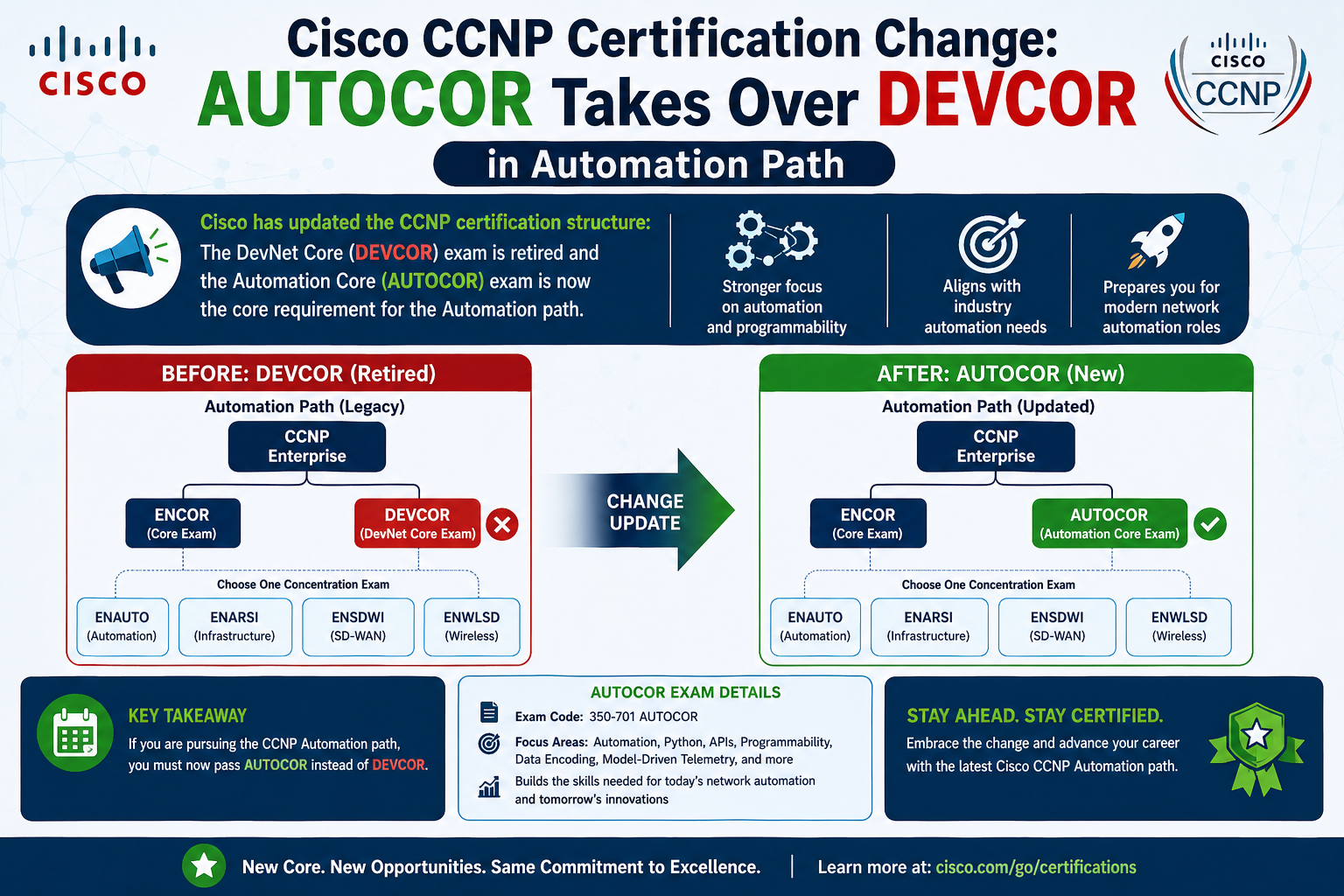
Cisco’s certification ecosystem has always evolved in response to changes in how modern networks are built and managed. The transition from DevNet Professional Certifications to Cisco Automation Certifications marks one of the most significant structural shifts in recent years. At the center of this transformation is the rebranding of the DEVCOR exam into AUTOCOR, a move designed to better reflect the realities of today’s enterprise networking environments.
This change is not simply a renaming exercise. It represents a broader shift in philosophy, where automation is no longer treated as a specialist skill reserved for developers, but as a core competency for network engineers. As organizations scale their infrastructure across hybrid environments, cloud platforms, and distributed systems, the demand for professionals who can automate, orchestrate, and optimize networks has increased significantly.
The introduction of AUTOCOR signals Cisco’s intention to align certification content with these evolving industry expectations. Instead of focusing primarily on application-centric development, the updated certification framework emphasizes operational automation, infrastructure management, and integration across multiple systems.
This transformation reflects a deeper recognition of how network engineering roles have changed. Engineers are now expected to operate in environments where manual configuration alone is no longer sustainable. Automation tools, programmable interfaces, and policy-driven infrastructure have become essential components of modern IT operations. AUTOCOR is positioned as a certification that validates this expanded skill set.
From DevNet Origins to Cisco Automation Identity
The original DevNet program was introduced to bridge the gap between software development and network engineering. It was designed for professionals who needed to build applications that interacted with Cisco platforms through APIs and programmable interfaces. At the time, this approach was innovative because it introduced a developer mindset into traditionally infrastructure-focused environments.
However, over time, the role of automation in networking began to shift. It was no longer just about building applications that interacted with networks. Instead, automation became a fundamental part of how networks were designed, deployed, and maintained. Infrastructure as Code, continuous integration pipelines, and real-time telemetry systems started becoming standard in enterprise environments.
As this transformation accelerated, Cisco recognized that the DevNet identity no longer fully represented the scope of skills required by modern engineers. The term “DevNet” implied a strong focus on development, which did not fully capture the operational and infrastructure-driven reality of today’s automation workflows.
The rebranding to Cisco Automation Certifications reflects this expanded scope. It shifts the identity away from pure development and toward a more holistic understanding of automation across the entire network lifecycle. This includes design, deployment, monitoring, optimization, and ongoing management of infrastructure systems.
The renaming of DEVCOR to AUTOCOR is a central part of this transition. It signals that the certification is no longer primarily about building applications, but about executing automation strategies within real enterprise environments.
Understanding the Role of AUTOCOR in Modern Network Engineering
AUTOCOR is designed to validate a candidate’s ability to work with automation technologies in practical, production-level environments. Unlike earlier certification models that focused heavily on theoretical development or isolated scripting tasks, AUTOCOR emphasizes the application of automation across complex, multi-layered network systems.
Modern enterprises rely on networks that span data centers, cloud platforms, and edge environments. These networks must be resilient, scalable, and adaptable to rapid change. Manual configuration methods are no longer sufficient to manage this level of complexity. Instead, engineers must rely on automation frameworks that can deploy configurations consistently, monitor system behavior in real time, and respond dynamically to operational changes.
AUTOCOR reflects this reality by focusing on the integration of multiple tools and methodologies. It is not limited to a single technology or platform. Instead, it encourages a broad understanding of how different automation components work together within a unified system.
This includes the use of scripting languages for automation logic, infrastructure definition tools for environment provisioning, and orchestration systems for workflow management. It also extends to observability and telemetry systems that provide insights into network performance and reliability.
By positioning AUTOCOR at the center of the Cisco Automation Certification track, Cisco is reinforcing the idea that automation is not an isolated discipline. It is an integrated skill set that spans across multiple layers of IT infrastructure.
The Shift in Skill Expectations for Network Professionals
One of the most important aspects of the transition from DEVCOR to AUTOCOR is the change in skill expectations for certification candidates. In earlier models, candidates were often evaluated on their ability to develop applications that interacted with Cisco platforms through APIs. While this remains relevant, it is no longer the primary focus.
In the AUTOCOR framework, candidates are expected to demonstrate a deeper understanding of how automation is applied in real-world network environments. This includes working with infrastructure provisioning tools, managing configuration consistency across distributed systems, and implementing automated workflows that support operational efficiency.
Network engineers are increasingly required to understand how automation interacts with broader system architecture. This means being able to design workflows that not only deploy configurations but also monitor system health, respond to alerts, and integrate with security and compliance frameworks.
The emphasis has shifted from isolated coding tasks to end-to-end automation thinking. Engineers must understand how changes in one part of the system can impact the entire network lifecycle. This requires a more holistic approach to problem-solving, where automation is used as a strategic tool rather than just a technical implementation detail.
Core Technologies Integrated into AUTOCOR
The AUTOCOR exam reflects the growing importance of several key technologies that are now central to network automation. These technologies are not treated as optional enhancements but as core components of modern infrastructure workflows.
One of the most important areas is programmable network automation using scripting languages. Python remains a foundational tool in this space, allowing engineers to create flexible automation scripts that interact with network devices and services. However, the focus is no longer just on writing scripts, but on integrating those scripts into larger automation systems.
Infrastructure as Code is another major component of the AUTOCOR framework. This approach allows engineers to define and manage infrastructure through code-based templates rather than manual configuration. Tools associated with this methodology enable consistent deployment of environments across different platforms, reducing errors and improving scalability.
Configuration management and orchestration systems also play a significant role. These systems ensure that network configurations remain consistent across large environments and can be updated automatically when changes are required. This reduces the risk of configuration drift and improves operational stability.
In addition, AUTOCOR introduces a stronger emphasis on observability and telemetry. Modern networks generate large volumes of operational data, and engineers must be able to interpret this data to understand system performance. Automation is increasingly used to process this information in real time, enabling faster decision-making and more efficient incident response.
The Expanding Role of Infrastructure as Code
Infrastructure as Code has become one of the most transformative concepts in modern IT operations, and its importance is clearly reflected in the AUTOCOR certification structure. Instead of manually configuring hardware or virtual environments, engineers now define infrastructure using declarative code models.
This approach brings several advantages. It improves consistency, reduces human error, and enables faster deployment of complex environments. It also allows infrastructure to be version-controlled, making it easier to track changes and roll back configurations when necessary.
In the context of AUTOCOR, Infrastructure as Code is not treated as a standalone concept. It is integrated into broader automation workflows that include deployment pipelines, configuration management systems, and monitoring tools.
Engineers are expected to understand how infrastructure definitions move through different stages of the lifecycle, from initial development to testing, deployment, and ongoing maintenance. This lifecycle approach ensures that infrastructure remains aligned with organizational requirements and operational standards.
The integration of Infrastructure as Code into automation certification reflects a broader industry trend toward treating infrastructure as software. This shift requires engineers to adopt new ways of thinking about system design and management.
Automation in Enterprise Network Operations
Enterprise networks today are far more complex than they were in the past. They span multiple environments, support a wide range of applications, and must operate with high levels of reliability and security. Automation plays a critical role in managing this complexity.
Within AUTOCOR, automation is positioned as a core operational capability. It is used to streamline repetitive tasks, enforce configuration consistency, and enable faster response to system events. This reduces the burden on network teams and allows them to focus on higher-value strategic work.
Automation also plays a key role in scaling infrastructure. As organizations grow, manual processes quickly become inefficient and error-prone. Automated systems allow networks to scale dynamically without requiring proportional increases in operational overhead.
Another important aspect of automation in enterprise environments is its role in compliance and governance. Automated systems can enforce policy rules consistently across all parts of the network, ensuring that configurations remain aligned with organizational standards.
This operational perspective is a key reason why Cisco has shifted the focus from development-centric skills to execution-oriented automation capabilities. AUTOCOR reflects this shift by emphasizing real-world application rather than isolated technical exercises.
The Growing Influence of AI in Network Automation
Artificial intelligence is becoming an increasingly important component of network automation strategies. While still evolving, AI technologies are already being used to enhance monitoring, optimize performance, and predict potential system issues before they occur.
Within the AUTOCOR framework, AI is introduced as part of the broader automation ecosystem. Engineers are expected to understand how AI-driven tools can support decision-making processes and improve operational efficiency.
This includes the use of machine learning models to analyze network telemetry data, identify patterns, and detect anomalies. It also involves integrating AI systems into automation workflows to enable more intelligent responses to network events.
However, the integration of AI into network automation also introduces new challenges. Engineers must understand how to use these tools responsibly, ensuring that automated decisions remain transparent, reliable, and secure.
The inclusion of AI concepts in AUTOCOR reflects Cisco’s recognition that future network environments will increasingly rely on intelligent systems. Automation is no longer just about executing predefined tasks. It is becoming a dynamic process that adapts to changing conditions in real time.
Transitioning from DEVCOR to AUTOCOR in Practice
The transition from DEVCOR to AUTOCOR is designed to be gradual, allowing professionals time to adapt to the new structure. Existing knowledge from DEVCOR remains relevant, particularly in areas such as API usage, version control, and automation best practices.
However, the emphasis has shifted significantly toward operational automation and infrastructure management. Professionals transitioning to AUTOCOR will need to expand their understanding of how automation is applied in large-scale enterprise environments.
This includes developing familiarity with multi-platform automation tools, understanding infrastructure lifecycle management, and working with integrated monitoring systems.
The transition reflects a broader shift in how Cisco defines automation expertise. It is no longer sufficient to understand how to build automation tools. Engineers must also understand how to deploy, manage, and optimize them within complex systems.
The AUTOCOR certification represents this new standard, positioning itself as a central qualification for professionals working in modern network environments.
The New Structure of Cisco Automation Certifications and the AUTOCOR Exam Framework
The redesign of Cisco’s certification ecosystem introduces a more structured and layered approach to automation learning. With the shift from DevNet Professional to Cisco Automation Certifications, the entire framework has been reorganized to better reflect how automation is applied in real enterprise environments. At the center of this redesign is AUTOCOR, which replaces DEVCOR and becomes the core professional-level certification in the automation track.
The structure is no longer centered on isolated skill domains. Instead, it is built around interconnected operational layers that mirror real network workflows. This change is important because modern networks are not managed through single tools or single processes. They rely on continuous interaction between configuration systems, orchestration engines, monitoring platforms, and security layers.
AUTOCOR reflects this complexity by structuring its focus around integrated automation capabilities rather than standalone development tasks. Each area of study is designed to reinforce how automation functions across the full lifecycle of network operations.
The new structure also reflects a shift in how Cisco expects professionals to think. Instead of viewing automation as an enhancement to networking, it is now treated as the foundation of network operations. This means that every skill area within AUTOCOR is tied directly to real-world operational scenarios rather than theoretical constructs.
Network Automation as a Multi-Platform Discipline
One of the defining characteristics of AUTOCOR is its emphasis on multi-platform automation. Modern enterprise environments rarely rely on a single vendor or technology stack. Instead, they integrate multiple systems that must work together seamlessly.
Network automation in this context involves coordinating across different platforms, devices, and services. Engineers are expected to design automation workflows that can operate across heterogeneous environments without losing consistency or control.
This includes working with different types of network devices, cloud services, and virtualization platforms. Each of these environments may use different interfaces, configuration models, and operational behaviors. AUTOCOR focuses on building the skills required to unify these differences through automation logic.
The ability to manage multi-platform environments is becoming essential as organizations adopt hybrid and multi-cloud architectures. Networks are no longer confined to a single data center or cloud provider. They are distributed across multiple environments that must be managed as a cohesive system.
AUTOCOR reflects this reality by emphasizing interoperability and abstraction. Engineers must be able to create automation workflows that are flexible enough to operate across different systems while maintaining consistency in outcomes.
The Role of Python in Modern Network Automation
Python continues to play a central role in network automation, and its importance remains strong in the AUTOCOR certification framework. However, the way Python is used has evolved significantly.
In earlier certification models, Python was often treated as a scripting language used to automate specific tasks. In the AUTOCOR environment, Python is positioned as a foundational tool for building scalable automation systems.
This includes using Python to interact with APIs, process structured data, and orchestrate complex workflows. It also involves integrating Python scripts into larger automation pipelines that span multiple systems and services.
The focus is no longer just on writing functional scripts. Instead, it is on designing maintainable and reusable automation components. This requires a deeper understanding of software design principles, modular architecture, and error handling in distributed environments.
Python is also increasingly used in conjunction with other automation tools. Rather than operating in isolation, it serves as a glue layer that connects different parts of the automation ecosystem.
AUTOCOR reflects this evolution by emphasizing Python’s role in end-to-end automation workflows rather than standalone scripting tasks.
Infrastructure as Code and Declarative Network Design
Infrastructure as Code has become a defining principle in modern network engineering, and its role within AUTOCOR has been significantly expanded. Instead of treating infrastructure as something that is manually configured, engineers are expected to define systems using declarative models.
This approach shifts the focus from “how to configure a system” to “what the system should look like.” The automation engine then takes responsibility for implementing the desired state.
This model introduces a more predictable and scalable approach to infrastructure management. It reduces configuration drift, improves consistency, and enables version control for infrastructure definitions.
In AUTOCOR, Infrastructure as Code is closely tied to automation workflows. It is not treated as a separate discipline but as an integral part of network operations.
Engineers are expected to understand how infrastructure definitions are created, validated, deployed, and updated. They must also understand how these definitions interact with other systems, such as monitoring tools and security policies.
Declarative design also introduces a new way of thinking about troubleshooting. Instead of manually inspecting configurations, engineers analyze differences between desired and actual states. This makes problem resolution faster and more structured.
CI/CD Pipelines in Network Automation Environments
Continuous Integration and Continuous Deployment pipelines have become essential in modern automation workflows. Originally associated with software development, these pipelines are now widely used in network operations.
AUTOCOR incorporates CI/CD concepts as a core part of its framework. Engineers are expected to understand how automation changes move through structured pipelines before being deployed into production environments.
This includes version control integration, automated testing, validation stages, and deployment mechanisms. Each stage of the pipeline plays a role in ensuring that changes are safe, consistent, and reliable.
The integration of CI/CD into network automation represents a major shift in operational culture. It introduces a more disciplined and controlled approach to change management.
Instead of applying changes directly to production systems, changes are first validated through automated processes. This reduces the risk of errors and improves system stability.
AUTOCOR emphasizes the importance of pipeline design as part of the broader automation strategy. Engineers must understand not only how to use pipelines but also how to design them effectively for complex network environments.
GitOps and Version-Controlled Network Operations
GitOps is another important concept integrated into the AUTOCOR framework. It extends the principles of version control into operational environments, allowing infrastructure and configuration changes to be managed through Git-based workflows.
In a GitOps model, the source of truth for system configuration is stored in a version control system. Any changes to the infrastructure are made through controlled updates to this repository.
This approach provides several advantages. It improves transparency, enables rollback capabilities, and ensures that all changes are tracked and auditable.
AUTOCOR reflects the growing importance of GitOps by emphasizing its role in automation pipelines. Engineers are expected to understand how version control systems interact with deployment tools and infrastructure managers.
This model also improves collaboration between teams. By centralizing configuration definitions, different stakeholders can work within a unified system without introducing inconsistencies.
GitOps is particularly valuable in large-scale environments where multiple teams manage different parts of the infrastructure. It ensures that all changes follow a consistent process, regardless of who makes them.
Observability and Telemetry in Automated Networks
Modern networks generate vast amounts of operational data. This includes performance metrics, system logs, event streams, and behavioral patterns. Observability tools are used to make sense of this data and provide actionable insights.
AUTOCOR places significant emphasis on observability as part of its automation framework. Engineers are expected to understand how telemetry data is collected, processed, and used to drive automation decisions.
Observability is not just about monitoring system health. It is about understanding how systems behave under different conditions and using that information to improve performance and reliability.
In automated environments, observability systems are often integrated directly into automation workflows. This allows systems to respond dynamically to changes in network conditions.
For example, if performance metrics indicate congestion, automation systems can adjust configurations or reroute traffic without manual intervention.
AUTOCOR reflects this integration by treating observability as a core component of automation design rather than an external monitoring function.
Security Automation and Policy Enforcement
Security has become a critical component of network automation. As networks become more dynamic and distributed, maintaining consistent security policies across all environments has become increasingly challenging.
AUTOCOR incorporates security automation as a key domain of study. Engineers are expected to understand how security policies can be enforced automatically across different systems.
This includes automating the configuration of firewalls, access controls, and encryption settings. It also involves integrating security checks into automation pipelines.
One of the key advantages of security automation is consistency. Manual security configurations are prone to errors and inconsistencies. Automation ensures that policies are applied uniformly across the entire infrastructure.
AUTOCOR also emphasizes the importance of embedding security into the automation lifecycle. Instead of treating security as a separate layer, it is integrated into every stage of automation design and deployment.
This approach aligns with modern security models where protection is built into the infrastructure rather than added as an afterthought.
Multi-Cloud and Hybrid Network Automation Challenges
As organizations adopt multi-cloud strategies, network automation becomes significantly more complex. Different cloud providers use different tools, APIs, and operational models. Managing these environments requires a unified automation approach.
AUTOCOR addresses these challenges by focusing on abstraction and interoperability. Engineers must understand how to design automation systems that can operate across multiple cloud platforms without requiring platform-specific logic.
Hybrid environments introduce additional complexity because they combine on-premises infrastructure with cloud-based systems. Automation must bridge these environments seamlessly.
This requires careful coordination between different tools and systems. AUTOCOR emphasizes the importance of designing workflows that can operate consistently regardless of where resources are located.
Multi-cloud automation also introduces challenges related to performance, latency, and data consistency. Engineers must consider these factors when designing automation strategies.
Edge Computing and Distributed Automation Models
Edge computing has added another layer of complexity to modern network environments. Instead of centralizing all processing in data centers, workloads are now distributed closer to end users.
This shift requires new approaches to automation. Systems must be able to operate in environments where connectivity may be intermittent and resources are limited.
AUTOCOR reflects this trend by including distributed automation models as part of its framework. Engineers are expected to understand how automation can be applied in edge environments where traditional centralized control may not be possible.
This includes designing lightweight automation workflows that can operate independently while still maintaining synchronization with central systems.
Edge automation also introduces new challenges related to data consistency and system coordination. AUTOCOR encourages engineers to think about how distributed systems can remain aligned even when operating in disconnected environments.
Operational Lifecycle Thinking in Automation Design
One of the most important shifts in AUTOCOR is the emphasis on lifecycle thinking. Instead of focusing on individual tasks or tools, engineers are encouraged to think about the entire lifecycle of network operations.
This includes design, deployment, configuration, monitoring, optimization, and decommissioning. Each stage of the lifecycle is interconnected, and automation plays a role in every phase.
Lifecycle thinking ensures that automation systems are designed with long-term sustainability in mind. It reduces fragmentation and improves system coherence.
AUTOCOR reflects this approach by encouraging engineers to design automation workflows that span the entire operational lifecycle rather than focusing on isolated tasks.
This holistic perspective is essential in modern network environments, where systems are constantly evolving and adapting to new requirements.
AI-Driven Network Automation and Intelligent Decision Systems in AUTOCOR
One of the most significant expansions in the Cisco Automation Certification framework is the integration of artificial intelligence into network operations. AUTOCOR reflects a shift toward intelligent systems that are capable of not only executing predefined automation tasks but also making data-driven decisions based on real-time network behavior.
In modern enterprise environments, networks generate massive volumes of telemetry data every second. This includes traffic patterns, device performance metrics, application behavior, and security signals. Traditional automation systems operate based on fixed rules, but AI-driven automation introduces adaptability into this process.
AUTOCOR emphasizes understanding how machine learning models can analyze historical and real-time data to detect anomalies, predict failures, and optimize network performance. Instead of reacting to issues after they occur, AI-enabled automation allows systems to anticipate problems before they impact users.
This represents a major evolution in network engineering. Engineers are no longer just configuring automation scripts; they are now working with systems that can learn and adapt over time. This requires a new mindset where automation is viewed as a dynamic and evolving process rather than a static set of instructions.
The integration of AI into automation workflows also introduces new responsibilities. Engineers must understand how to validate AI-generated decisions, ensure transparency in automated actions, and manage the risks associated with autonomous systems.
Model-Driven Automation and Data-Centric Network Operations
AUTOCOR places strong emphasis on model-driven automation, where network behavior is defined through structured data models rather than manual configuration. This approach allows systems to interpret network intent and translate it into operational actions.
In a model-driven environment, networks are described using standardized data structures that represent configurations, policies, and operational states. These models serve as the foundation for automation systems to execute consistent and predictable actions across the infrastructure.
This shift toward data-centric operations is significant because it separates intent from execution. Engineers define what the network should achieve, and automation systems determine how to implement that intent across different environments.
Model-driven automation also improves scalability. As networks grow in size and complexity, maintaining manual configurations becomes increasingly difficult. Data models provide a consistent framework that can be applied across large and distributed systems.
AUTOCOR reflects this evolution by requiring a deep understanding of how structured data flows through automation systems and how it is used to drive operational decisions.
Network Intent and Policy-Based Automation Design
A key concept in modern automation frameworks is network intent. Instead of configuring individual devices manually, engineers define high-level objectives that describe desired network behavior.
AUTOCOR integrates this concept by focusing on policy-based automation design. In this model, engineers specify policies that define how the network should behave under different conditions. Automation systems then interpret these policies and apply them across the infrastructure.
This approach reduces complexity and improves consistency. Instead of managing thousands of individual configuration changes, engineers manage a smaller set of high-level policies that govern system behavior.
Policy-based automation also improves agility. Changes to network behavior can be implemented by updating policies rather than reconfiguring individual devices. This allows organizations to respond more quickly to changing business requirements.
AUTOCOR emphasizes understanding how policies are structured, how they are enforced, and how they interact with other automation components. Engineers must also understand how conflicts between policies are resolved in complex environments.
Automated Troubleshooting and Self-Healing Networks
One of the most advanced concepts in modern network automation is the idea of self-healing systems. These are networks that can detect issues, diagnose root causes, and apply corrective actions automatically.
AUTOCOR introduces this concept as part of its broader focus on operational automation. Engineers are expected to understand how automated troubleshooting systems function and how they can be designed to reduce downtime.
In traditional environments, troubleshooting is a manual and time-consuming process. Engineers must analyze logs, inspect configurations, and correlate events across multiple systems. Automation transforms this process by using telemetry data and predefined logic to identify issues in real time.
Self-healing networks take this a step further by executing corrective actions automatically. For example, if a network device becomes unresponsive, automation systems can reroute traffic or restart services without human intervention.
This capability requires careful design to ensure that automated actions do not introduce additional risks. AUTOCOR emphasizes the importance of defining safe operational boundaries for automated remediation processes.
Risk Management in Automated Network Systems
As automation becomes more autonomous, managing risk becomes increasingly important. AUTOCOR introduces structured approaches to understanding and controlling risks in automated environments.
One of the primary risks in automation is unintended system behavior. When multiple automated processes interact, unexpected outcomes can occur if dependencies are not properly managed.
Another risk is over-automation, where too many processes are automated without sufficient oversight. This can lead to situations where systems behave unpredictably or make decisions that conflict with organizational policies.
AUTOCOR emphasizes the importance of designing automation systems with clear safeguards. This includes implementing validation steps, approval workflows, and rollback mechanisms.
Engineers are also expected to understand how to monitor automated systems for anomalies. This ensures that any unintended behavior can be quickly detected and corrected.
Risk management in automation is not about limiting automation but about ensuring that it operates safely and predictably within defined boundaries.
Governance and Compliance in Automated Environments
Enterprise networks operate under strict governance and compliance requirements. AUTOCOR reflects this reality by incorporating governance principles into automation design.
In automated environments, governance ensures that all changes to the network comply with organizational policies and regulatory standards. This includes access controls, configuration standards, and audit requirements.
Automation systems must be designed in a way that enforces these rules consistently. This reduces the risk of human error and ensures that compliance is maintained across all systems.
AUTOCOR emphasizes the importance of embedding governance into automation workflows rather than treating it as a separate process. This means that compliance checks are integrated directly into automation pipelines.
Auditability is another key aspect of governance. Automated systems must maintain detailed records of all actions taken, including who initiated changes and what systems were affected.
This level of transparency is essential in large-scale enterprise environments where accountability and traceability are critical.
Evolution of Network Engineer Roles in Automation-Centric Environments
The introduction of automation-centric certifications like AUTOCOR reflects a broader transformation in the role of network engineers. Traditional network engineering focused heavily on manual configuration and hardware management.
In modern environments, these responsibilities are increasingly replaced by automation-driven tasks. Engineers now spend more time designing automation workflows, analyzing system behavior, and optimizing network performance.
This shift requires a different skill set. Instead of focusing solely on device-level configuration, engineers must understand software design principles, data modeling, and system integration.
AUTOCOR reflects this evolution by positioning network engineers as automation architects rather than configuration technicians. This means they are responsible for designing systems that manage themselves rather than manually controlling each component.
This change also impacts collaboration within IT teams. Network engineers now work more closely with software developers, data engineers, and security professionals to build integrated automation systems.
Automation Architecture Patterns in Enterprise Networks
AUTOCOR introduces the concept of automation architecture patterns, which define standardized ways of designing automation systems in enterprise environments.
These patterns help ensure consistency and scalability across different implementations. Instead of building automation systems from scratch, engineers can use established patterns that have been proven to work in similar environments.
Common architecture patterns include centralized automation models, distributed automation systems, and hybrid approaches that combine both strategies.
Centralized models rely on a single automation engine that manages all network operations. Distributed models allow automation to be executed closer to the network edge, improving performance and resilience.
Hybrid models combine elements of both approaches, allowing organizations to balance control and flexibility.
AUTOCOR emphasizes understanding the strengths and limitations of each pattern. Engineers must be able to select the appropriate architecture based on organizational requirements and operational constraints.
Data Flow and Event Processing in Automation Systems
Modern automation systems rely heavily on event-driven architectures. In these systems, changes in network state generate events that trigger automated responses.
AUTOCOR covers how data flows through these systems and how events are processed in real time. This includes understanding how telemetry data is collected, filtered, and analyzed before triggering automation workflows.
Event-driven automation enables systems to respond dynamically to changing conditions. Instead of relying on scheduled tasks or manual triggers, systems react immediately to network events.
This improves responsiveness and reduces downtime. For example, if a network device experiences a failure, an event can trigger automatic rerouting of traffic.
AUTOCOR emphasizes the importance of designing efficient event processing pipelines that can handle large volumes of data without introducing delays or bottlenecks.
Operational Resilience Through Automation Design
Operational resilience refers to the ability of a network to maintain functionality even under adverse conditions. Automation plays a critical role in achieving this resilience.
AUTOCOR introduces principles for designing resilient automation systems that can withstand failures and continue operating under stress.
This includes implementing redundancy in automation workflows, designing fallback mechanisms, and ensuring that critical processes can recover automatically from failures.
Resilience also involves designing systems that can adapt to changing conditions. Automated systems must be flexible enough to handle unexpected scenarios without requiring manual intervention.
AUTOCOR emphasizes that resilience is not a single feature but a design principle that must be integrated into every layer of automation architecture.
Strategic Impact of Automation on Enterprise IT Operations
Automation is no longer just a technical enhancement; it has become a strategic component of enterprise IT operations. AUTOCOR reflects this shift by emphasizing the broader organizational impact of automation.
Automated systems reduce operational costs, improve efficiency, and enable faster deployment of services. They also allow organizations to scale their infrastructure without significantly increasing operational overhead.
From a strategic perspective, automation enables IT teams to focus on innovation rather than repetitive tasks. This allows organizations to respond more quickly to market changes and technological advancements.
AUTOCOR highlights the importance of aligning automation strategies with business objectives. Engineers must understand how automation decisions impact overall organizational performance.
This strategic alignment ensures that automation is not implemented in isolation but as part of a broader digital transformation initiative.
Future Direction of Cisco Automation Certification Ecosystem
The introduction of AUTOCOR represents a broader direction in Cisco’s certification strategy. The focus is shifting toward integrated, intelligent, and adaptive systems that reflect real-world enterprise environments.
Future developments in automation certifications are likely to include deeper integration with artificial intelligence, expanded focus on distributed systems, and increased emphasis on autonomous network operations. As enterprise networks become more complex and geographically dispersed, certification frameworks will need to reflect challenges such as real-time decision-making, cross-domain orchestration, and self-optimizing infrastructure behavior.
This evolution reflects the ongoing transformation of the IT industry, where automation is becoming the foundation of infrastructure management. Traditional manual configuration approaches are steadily being replaced by intent-based and policy-driven models, where systems are expected to interpret requirements and execute changes dynamically across hybrid and multi-cloud environments.
AUTOCOR serves as a step in this direction, preparing professionals for environments where networks are not only automated but also intelligent, adaptive, and self-managing. In the coming years, it is likely that Cisco will further refine this ecosystem by incorporating more advanced concepts such as predictive analytics, autonomous remediation, and AI-assisted network design.
Another expected direction is tighter integration between security automation and operational automation, ensuring that protection mechanisms evolve in real time alongside infrastructure changes. This will further reduce human intervention in routine operations while increasing reliance on intelligent systems capable of continuous optimization.
Overall, the certification ecosystem is moving toward a model where networking professionals must understand not only how systems operate, but how they learn, adapt, and evolve within increasingly autonomous digital environments.
This direction also suggests a growing emphasis on cross-domain automation, where networking, security, cloud, and application delivery are managed through unified automation frameworks rather than isolated tools. As organizations adopt more complex digital ecosystems, professionals will be expected to understand how automation workflows interact across different layers of infrastructure, ensuring consistency, reliability, and scalability.
In addition, future certification updates may place greater importance on observability-driven automation, where system behavior is continuously analyzed to trigger intelligent responses without manual input. This will further strengthen the role of automation as a decision-making layer within enterprise IT operations. Ultimately, Cisco’s certification ecosystem is evolving toward a future where engineers are not just managing networks, but designing intelligent systems that continuously optimize themselves in response to changing conditions and business needs.
Conclusion
The transition from DEVCOR to AUTOCOR marks a clear shift in how Cisco defines modern network engineering and automation expertise. Rather than focusing primarily on development-oriented skills, the new certification structure reflects the operational reality of today’s enterprise environments, where automation is deeply embedded in every layer of network design, deployment, and management.
AUTOCOR represents more than a rebranded exam. It signals a change in mindset from isolated scripting and application development toward integrated, infrastructure-wide automation. This includes working across multi-platform environments, managing infrastructure as code, implementing CI/CD pipelines, and leveraging real-time telemetry to support intelligent decision-making. Each of these areas reflects how modern networks are no longer static systems but dynamic, continuously evolving ecosystems.
Another important aspect of this shift is the growing influence of AI, observability, and policy-driven automation. Networks are increasingly expected to self-monitor, self-correct, and adapt to changing conditions without constant manual intervention. AUTOCOR captures this evolution by emphasizing skills that support automation at scale, including risk management, governance, and resilient architecture design.
For network professionals, this transition also reflects a change in career expectations. Engineers are no longer viewed solely as system configurators but as automation architects responsible for designing intelligent and scalable infrastructure systems. This elevates the role of networking professionals and aligns their skill sets more closely with broader software engineering and cloud operations disciplines.
As enterprise environments continue to expand across cloud, hybrid, and edge architectures, automation will remain a central pillar of IT strategy. AUTOCOR is positioned as a certification that prepares professionals for this reality, ensuring they can operate effectively in environments where speed, consistency, and intelligence define success.