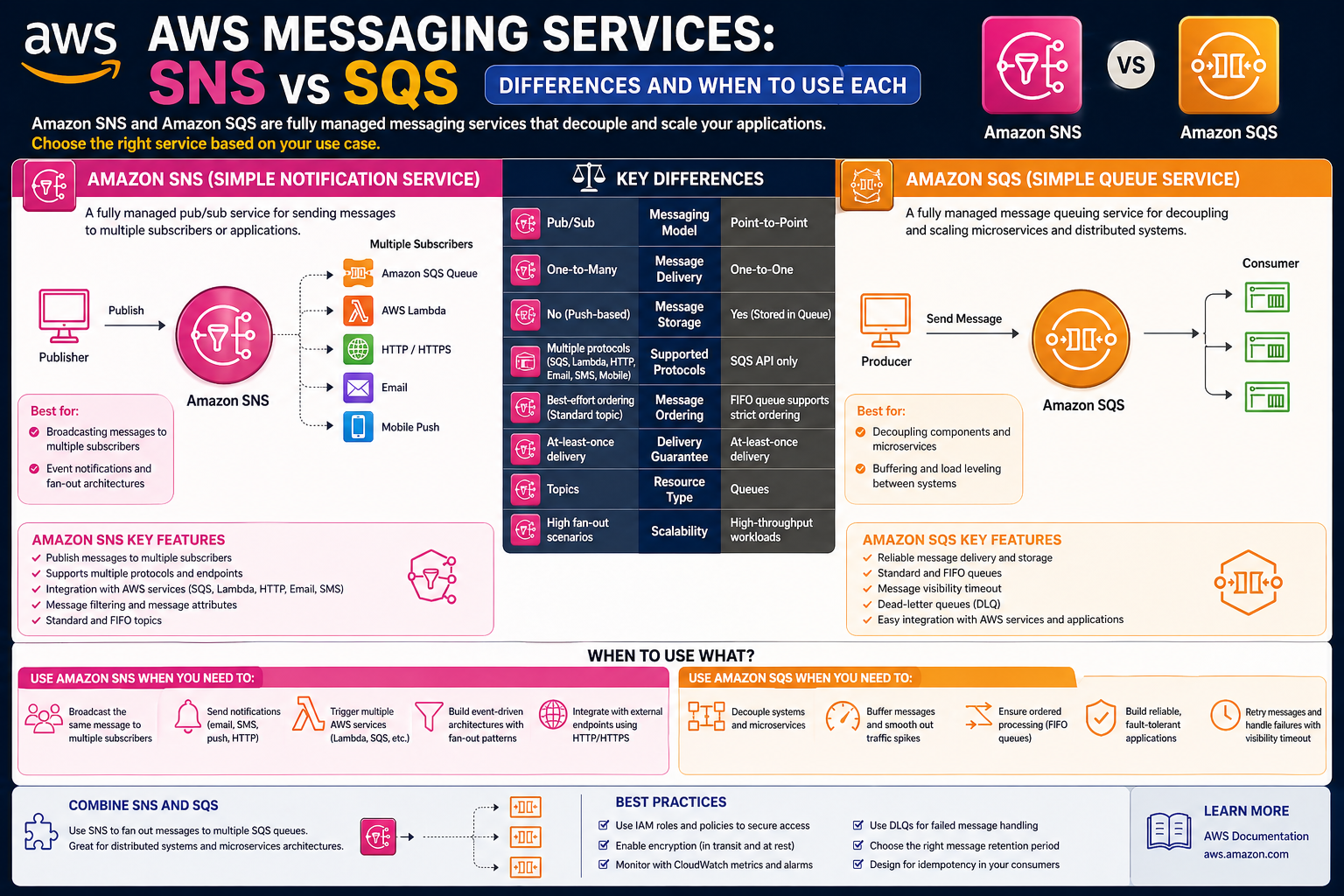
Modern applications rarely operate as single, self-contained programs. Instead, they are built as distributed systems made up of multiple services that communicate with each other across networks. This communication is often the backbone of how data moves, how actions are triggered, and how systems remain responsive under heavy load.
In such environments, direct communication between services can quickly become complex and fragile. If one service depends heavily on another being available at all times, any failure or delay can cascade through the entire system. This is where messaging systems come into play. They act as intermediaries that allow services to exchange information without needing to be directly connected at every moment.
Messaging systems generally fall into two broad patterns: notification-based communication and queue-based communication. Notification-based systems are designed to broadcast information quickly to multiple recipients, while queue-based systems focus on storing messages until a receiving service is ready to process them. These two approaches form the foundation of AWS messaging tools like SNS and SQS.
Why AWS Messaging Services Exist
As cloud architectures evolved, the need for decoupled systems became more important. Decoupling means separating components so that each part of an application can function independently without requiring constant interaction with others. This approach improves scalability, reliability, and flexibility.
Without messaging services, developers would need to build custom communication layers between services. This often leads to tightly coupled systems where one service directly depends on another’s availability. Such systems are harder to scale and maintain, especially when workloads fluctuate or when services are updated independently.
AWS introduced messaging services to solve this problem by providing fully managed tools that handle communication between distributed components. These services remove the need to manage infrastructure for message delivery, retries, buffering, or scaling. Instead, developers can focus on application logic while AWS handles the complexity of message transport.
Among these services, Amazon SNS and Amazon SQS are two of the most widely used, each designed for different communication patterns.
Introduction to Amazon SNS
Amazon Simple Notification Service (SNS) is a messaging service designed for real-time communication. Its primary purpose is to send messages from one source to multiple recipients instantly. This makes it ideal for scenarios where information needs to be broadcast quickly and simultaneously.
SNS operates on a publish-subscribe model. In this model, a publisher sends messages to a central topic, and subscribers receive those messages based on their subscription preferences. A topic acts as a communication channel that connects publishers with multiple subscribers.
Unlike traditional messaging systems that rely on storage and retrieval, SNS focuses on immediate delivery. When a message is published, it is pushed out to all subscribed endpoints without waiting for acknowledgment from the receivers.
SNS supports multiple types of endpoints, including email, SMS, HTTP/HTTPS endpoints, AWS Lambda functions, and other AWS services. This flexibility allows it to act as a central hub for event distribution across a wide variety of systems.
How SNS Message Flow Works
The message flow in SNS is designed for speed and simplicity. It begins when a publisher sends a message to a topic. The topic then evaluates its list of subscribers and immediately forwards the message to each one.
This process is often referred to as a fanout mechanism because a single message spreads out to multiple destinations at the same time. Each subscriber receives the same message independently, and there is no requirement for them to interact with each other.
The system does not store messages for long periods. Once a message is delivered, SNS considers the job complete. This makes SNS highly efficient for real-time notifications but not suitable for scenarios where message persistence or delayed processing is required.
SNS topics can also be configured with filtering rules, allowing subscribers to receive only specific types of messages. This adds flexibility by ensuring that each subscriber gets only relevant information rather than all published events.
Key Capabilities of SNS
One of the defining characteristics of SNS is its ability to deliver messages instantly at scale. It is built to handle a large number of messages per second without requiring manual scaling or infrastructure management.
SNS also integrates easily with other AWS services. For example, it can trigger serverless functions, send alerts based on monitoring data, or distribute updates across multiple systems. This makes it a powerful tool for event-driven architectures.
Another important capability is its support for multiple delivery protocols. Whether the target is a mobile device, a web service, or another AWS component, SNS can format and deliver messages appropriately.
Because it operates on a push-based model, SNS eliminates the need for subscribers to continuously check for new messages. This reduces unnecessary processing and ensures immediate delivery when events occur.
Real-World Scenarios for SNS
SNS is commonly used in situations where timely communication is critical. One of the most common examples is system alerts. When monitoring tools detect unusual activity or performance thresholds are exceeded, SNS can immediately notify administrators or trigger automated responses.
It is also widely used in user notification systems. For instance, when a user acts such as placing an order or changing account settings, SNS can send confirmation messages through email or SMS channels.
Another important use case is event broadcasting. In modern applications built with microservices, one service may need to inform multiple other services about an event. SNS can distribute this event simultaneously, ensuring all dependent systems react consistently.
SNS is also useful in mobile applications where real-time updates are required. Whether it is a status update, a reminder, or a system alert, SNS can push notifications directly to devices without delay.
Introduction to Amazon SQS
Amazon Simple Queue Service (SQS) is a messaging system designed around the concept of a queue. Unlike SNS, which focuses on immediate message distribution, SQS is built for storing messages until they are processed by a receiving system.
A queue acts as a buffer between different components of an application. Producers send messages to the queue, and consumers retrieve and process them at their own pace. This decouples the sending and receiving processes, allowing each to operate independently.
SQS is particularly useful in environments where workloads vary or where processing tasks require time. Instead of overwhelming a system with incoming requests, messages can be stored safely in the queue until resources are available to handle them.
This design helps maintain system stability even under heavy load. It ensures that no messages are lost and that processing can continue smoothly even if one part of the system experiences delays.
How SQS Message Flow Works
The message flow in SQS follows a producer-consumer pattern. A producer sends a message to the queue, where it is stored securely. A consumer then retrieves the message when ready and processes it.
Unlike SNS, SQS does not push messages to consumers. Instead, consumers actively check the queue for new messages. This process is known as polling. There are two types of polling: short polling and long polling.
Short polling checks the queue at regular intervals, even if no messages are present. Long polling waits until a message becomes available before responding, which reduces unnecessary requests and improves efficiency.
Once a message is processed successfully, it is removed from the queue. If processing fails, the message can be returned to the queue for another attempt or moved to a separate handling area for failed messages.
This ensures that messages are not lost and can be retried or reviewed later if needed.
Core Characteristics of SQS
SQS is designed with durability and reliability in mind. Messages are stored redundantly across multiple servers to ensure they are not lost in case of hardware failure. This makes it suitable for critical workloads where data integrity is important.
Messages in SQS can be retained for a defined period, allowing systems to process them even if there is a delay. This buffering capability helps smooth out traffic spikes and prevents system overload.
Another important characteristic is scalability. SQS automatically adjusts to handle large volumes of messages without requiring manual intervention. Whether the system is processing a few messages or millions, it maintains consistent performance.
SQS also supports different delivery models, including standard queues for high throughput and ordered processing options when message sequence matters.
Where SQS Fits in Modern Applications
SQS plays a key role in asynchronous processing. In many applications, tasks do not need to be completed immediately. Instead, they can be queued and processed in the background. This improves responsiveness and allows user-facing systems to remain fast and efficient.
It is commonly used in scenarios such as background job processing, task distribution, and workload balancing. For example, when a user uploads a file, the upload can be acknowledged immediately, while processing tasks such as resizing or analysis are handled later through SQS.
SQS is also valuable in microservices architectures where services need to communicate without being tightly connected. Instead of calling each other directly, services can exchange messages through a queue, ensuring better resilience and flexibility.
By acting as a buffer between systems, SQS helps manage unpredictable workloads and ensures that applications remain stable even under varying demand.
Deep Differences Between SNS and SQS in Messaging Architecture
Understanding the difference between Amazon SNS and Amazon SQS requires moving beyond basic definitions and looking at how each service behaves under real architectural conditions. Although both are messaging services, they are designed around fundamentally different communication models. SNS is built for immediate distribution of information, while SQS is designed for controlled, reliable message processing over time.
In practical systems, this difference becomes very important. When services are loosely connected and need to react instantly to events, SNS is often the preferred choice. When systems require guaranteed processing, buffering, or workload control, SQS becomes more suitable. These differences shape how modern cloud applications are designed at scale.
The contrast between push-based and pull-based communication is the most defining distinction. SNS pushes messages out to subscribers immediately, while SQS stores messages until a consumer retrieves them. This single difference influences reliability, scalability patterns, system design complexity, and even cost efficiency in certain architectures.
Push vs Pull Communication Models in AWS Messaging
SNS operates on a push-based model, which means the service takes responsibility for delivering messages to all subscribers as soon as they are published. This approach reduces latency because messages do not wait in any intermediate storage layer. Instead, they are immediately forwarded to endpoints such as APIs, email systems, Lambda functions, or mobile devices.
This push behavior makes SNS highly effective for real-time systems where speed is critical. Notifications, alerts, and event broadcasts all benefit from this immediate delivery pattern. However, because SNS does not retain messages for long periods, there is less control over message processing after delivery.
SQS uses a pull-based model, which places responsibility on consumers. Messages are stored inside a queue, and consumer applications actively request messages when they are ready to process them. This creates a controlled environment where workloads can be managed more effectively.
The pull model introduces intentional delay, but this delay is what makes SQS powerful in systems that require stability. Instead of overwhelming a service with incoming requests, messages are processed at a sustainable pace. This ensures better reliability and prevents system overload during traffic spikes.
Message Persistence and Reliability Differences
One of the most important distinctions between SNS and SQS is message persistence. SNS is designed for transient communication, meaning messages exist only long enough to be delivered. Once the message is successfully sent to subscribers, it is no longer stored by the system.
This design works well for notifications, but becomes limiting when message durability is required. If a subscriber is unavailable at the time of delivery and does not have retry mechanisms in place, the message may be lost.
SQS, on the other hand, is built around persistence. Messages are stored in the queue for a configurable retention period. This allows consumers to process messages even if they are temporarily unavailable or experiencing delays.
This persistence is critical in systems where message loss is unacceptable. It also supports retry mechanisms, where failed messages can be reprocessed automatically or moved to a separate queue for further inspection. This improves fault tolerance and ensures that important data is not lost during system failures.
Scalability Behavior in SNS and SQS
Both SNS and SQS are highly scalable services, but they scale in different ways based on their design principles.
SNS scales by distributing messages simultaneously to a large number of subscribers. Since each message is pushed independently, the system can handle large fanout operations without requiring complex coordination. This makes SNS highly efficient for broadcasting events across multiple services.
However, this scalability is tied to delivery speed rather than processing control. As the number of subscribers increases, SNS must manage more concurrent delivery operations, which can increase system load on downstream services.
SQS scales by managing queue depth and consumer throughput. Instead of pushing messages out, it accumulates messages and allows consumers to process them at their own pace. This decoupling allows SQS to handle sudden spikes in traffic without affecting system stability.
For example, if thousands of messages are sent in a short period, SQS simply stores them in the queue. Consumers can then scale independently to process messages as resources become available. This separation of concerns is one of the reasons SQS is widely used in large-scale distributed systems.
Delivery Guarantees and Message Processing Models
SNS typically operates with at-least-once delivery semantics, meaning a message is delivered at least once but may occasionally be delivered multiple times. This requires downstream systems to be designed in a way that can handle duplicate messages safely.
Because SNS focuses on speed and broadcast efficiency, it does not guarantee strict ordering or deduplication in standard configurations. This makes it less suitable for systems that require strict sequencing or transactional consistency.
SQS offers stronger delivery guarantees depending on the type of queue used. Standard queues provide high throughput with at-least-once delivery, while FIFO queues ensure strict ordering and exactly-once processing behavior within defined constraints.
This makes SQS more suitable for workflows where order matters, such as financial transactions, task pipelines, or sequential processing systems. The ability to enforce ordering ensures that messages are processed in the correct sequence, reducing the risk of inconsistent system states.
Fanout Architecture Using SNS and SQS Together
One of the most powerful architectural patterns in AWS messaging is combining SNS and SQS. This approach uses SNS as a broadcast layer and SQS as a buffering and processing layer.
In this setup, SNS publishes a message to a topic, and multiple SQS queues subscribe to that topic. Each queue receives a copy of the message independently. This allows different services to process the same event in isolation without interfering with each other.
For example, one queue might handle billing updates, another might manage inventory changes, and another might trigger analytics processing. Each system receives the same event but processes it according to its own logic and speed requirements.
This fanout pattern provides both real-time distribution and reliable processing. SNS handles immediate delivery, while SQS ensures that messages are not lost and can be processed safely even under heavy load.
Decoupling Microservices with SNS and SQS
Modern applications are often built using microservices, where each service performs a specific function independently. In such architectures, communication between services must be carefully managed to avoid tight coupling.
SNS helps achieve loose coupling by allowing services to publish events without knowing who will receive them. This event-driven approach ensures that services remain independent and scalable.
SQS strengthens this decoupling by introducing buffering between services. Instead of calling each other directly, services communicate through queues. This prevents cascading failures and allows each service to operate at its own pace.
When combined, SNS and SQS provide a powerful decoupling mechanism. SNS handles event distribution, while SQS ensures reliable processing. This combination is widely used in modern cloud-native applications.
Handling Failures and Retry Mechanisms
Failure handling is a critical part of any distributed system. SNS and SQS handle failures in very different ways due to their underlying design.
In SNS, failure handling depends on the subscriber. If a delivery attempt fails, SNS may retry based on configuration, but long-term storage of failed messages is not guaranteed. This places responsibility on downstream systems to implement their own retry logic.
SQS provides built-in mechanisms for handling failures. If a message is not processed successfully, it can be returned to the queue after a visibility timeout. This allows other consumers to retry processing the message.
Additionally, SQS supports dead-letter queues, where repeatedly failed messages are moved for further inspection. This prevents problematic messages from blocking normal processing flows and provides visibility into system errors.
These retry and failure-handling capabilities make SQS more robust for mission-critical workloads where message loss or processing failure must be avoided.
Latency Considerations in SNS and SQS
Latency is another key factor when choosing between SNS and SQS. SNS is optimized for low-latency delivery. Messages are pushed immediately to subscribers, making it suitable for time-sensitive notifications.
This low latency is ideal for real-time alerts, user notifications, and event broadcasting systems where delays must be minimized.
SQS introduces intentional latency because messages must be stored and retrieved by consumers. This additional step adds delay but improves reliability and control.
In many systems, this trade-off is acceptable because processing speed is less important than processing accuracy and reliability. SQS prioritizes stability over immediacy, making it better suited for background processing tasks.
Security and Access Control in Messaging Systems
Both SNS and SQS integrate with AWS security mechanisms, allowing fine-grained access control over who can publish, subscribe, send, or receive messages.
SNS uses topic-based access policies to control which systems can publish or subscribe. This ensures that only authorized services can interact with message topics.
SQS uses queue-based policies that define who can send messages, receive messages, or modify queue behavior. This allows strict control over message consumption and processing.
Encryption is also supported in both services, ensuring that messages are protected in transit and at rest. This is particularly important in systems that handle sensitive data or operate in regulated environments.
Operational Complexity and System Design Impact
From a system design perspective, SNS is simpler to use because it focuses on broadcasting messages without requiring complex consumer logic. It reduces architectural overhead by handling message distribution automatically.
SQS introduces more operational considerations because it requires consumers to manage message retrieval, processing, and acknowledgment. However, this added complexity also provides greater control and reliability.
In large systems, architects often choose based on the balance between simplicity and control. SNS is preferred for lightweight event distribution, while SQS is preferred for controlled processing workflows.
In many cases, both services are used together to achieve a balance between immediacy and reliability, allowing systems to scale efficiently while maintaining strong processing guarantees.
Real-World Architecture Patterns Using SNS and SQS
In modern cloud systems, Amazon SNS and Amazon SQS are rarely used in isolation. Instead, they are combined in architectural patterns that solve specific problems related to scalability, reliability, and system decoupling. These patterns emerge naturally in distributed systems where different services must react to events, process workloads asynchronously, and maintain consistency across large infrastructures.
One of the most common patterns is event-driven architecture, where systems respond to events rather than direct requests. In this model, SNS acts as the event broadcaster, while SQS acts as the processing buffer. This separation ensures that events are distributed quickly and reliably, while processing is handled independently by downstream systems.
Another widely used pattern is workload buffering, where SQS absorbs traffic spikes and ensures that backend systems are not overwhelmed. This is especially useful in systems with unpredictable traffic, such as e-commerce platforms, media processing pipelines, or user-generated content systems.
By combining SNS and SQS, architects can design systems that are both responsive and resilient. SNS ensures immediate communication, while SQS ensures controlled processing, creating a balanced architecture that adapts to varying workloads.
Event-Driven Systems and SNS Role in Broadcasting
Event-driven systems rely on the concept of events triggering actions across multiple components. In such systems, SNS plays a central role as the event distribution layer. When an event occurs, such as a database update, user action, or system alert, SNS publishes this event to all interested subscribers.
This broadcasting capability allows multiple services to react independently to the same event. For example, when a new user registers, one service might handle email verification, another might update analytics, and another might trigger onboarding workflows.
SNS ensures that all these services receive the event at nearly the same time, without requiring direct communication between them. This reduces dependencies and allows each service to evolve independently without affecting others.
The ability to broadcast events in real time makes SNS a foundational component in modern event-driven architectures, especially in systems where responsiveness is critical.
SQS as a Buffer for Controlled Processing
While SNS handles immediate distribution, SQS is responsible for controlled processing. It acts as a buffer between event generation and event consumption, ensuring that systems can handle messages at a sustainable pace.
In many real-world systems, workloads are not evenly distributed. There are peak times when a large number of messages are generated in a short period. Without buffering, this can overwhelm backend services and lead to system instability.
SQS solves this problem by storing messages until consumers are ready to process them. This allows systems to smooth out traffic spikes and maintain consistent performance even under heavy load.
For example, in a video processing system, users may upload large numbers of videos at once. Instead of processing all videos immediately, SQS stores processing tasks in a queue. Worker services then process videos gradually based on available resources.
This buffering mechanism ensures that no tasks are lost and that system performance remains stable even during high-demand periods.
Microservices Communication with SNS and SQS
Microservices architecture relies heavily on communication between independent services. SNS and SQS provide two complementary ways to handle this communication without creating tight coupling.
SNS enables event broadcasting between services. When one service acts, it can publish an event without knowing which services will consume it. This allows for a flexible and scalable system design where new services can be added without modifying existing ones.
SQS enables asynchronous communication between services. Instead of calling each other directly, services place messages in queues. Other services then process these messages when ready. This reduces dependencies and ensures that failures in one service do not immediately affect others.
Together, SNS and SQS create a robust communication layer for microservices. SNS distributes events, while SQS ensures reliable processing. This combination is widely used in cloud-native architectures to improve resilience and scalability.
Scaling Distributed Systems with SNS and SQS
Scalability is one of the most important challenges in distributed systems. As user demand grows, systems must be able to handle increased traffic without degrading performance.
SNS scales by distributing messages to multiple subscribers simultaneously. Since each subscriber receives messages independently, the system can handle large-scale event distribution without bottlenecks. This makes SNS suitable for high-volume notification systems.
SQS scales by decoupling message production and consumption. Messages are stored in a queue and processed independently by consumers. This allows systems to scale horizontally by adding more consumers without changing the message flow.
In practice, SNS handles the distribution layer, while SQS handles the processing layer. This separation allows each layer to scale independently based on demand, improving overall system efficiency.
For example, in a large e-commerce system during a sale event, SNS can broadcast order events to multiple services, while SQS ensures that order processing, inventory updates, and shipping workflows are handled in a controlled and scalable manner.
Latency Trade-Offs in Large-Scale Architectures
Latency is an important factor when designing messaging systems. SNS is optimized for low latency, making it suitable for real-time communication. Messages are delivered almost instantly to subscribers, enabling fast reactions to events.
This low latency is essential in systems such as monitoring dashboards, alerting systems, and real-time user notifications, where immediate response is required.
SQS introduces additional latency because messages must be stored and retrieved. This delay is intentional and helps ensure that systems are not overwhelmed. While this makes SQS slower than SNS, it improves reliability and stability.
In many architectures, this trade-off is acceptable because processing tasks do not need to happen instantly. Instead, they need to be processed correctly and reliably. SQS ensures that even if processing is delayed, messages are not lost.
The combination of SNS and SQS allows architects to balance latency and reliability based on system requirements.
Message Ordering and Consistency Models
Message ordering is another important difference between SNS and SQS. SNS does not guarantee the strict ordering of messages. Since messages are delivered to multiple subscribers independently, the order in which they are received may vary.
This is acceptable in systems where order does not matter, such as notifications or event broadcasts.
SQS provides stronger ordering guarantees when using FIFO queues. In these configurations, messages are processed in the exact order they are received. This is important for systems where sequence matters, such as financial transactions, inventory updates, or workflow pipelines.
Consistency models in messaging systems determine how predictable message processing is. SNS prioritizes speed and distribution, while SQS prioritizes controlled and predictable processing.
Understanding these differences helps architects choose the right service based on whether ordering or speed is more important.
Error Handling and System Resilience
Error handling is a critical aspect of distributed systems. SNS and SQS handle errors differently due to their design.
In SNS, error handling depends on the subscriber system. If a delivery fails, SNS may attempt retries, but long-term recovery depends on the receiving system. This means downstream services must be designed to handle failures independently.
SQS provides built-in resilience mechanisms. If a message is not processed successfully, it can be returned to the queue after a visibility timeout. This allows other consumers to retry processing the message.
Additionally, SQS supports dead-letter queues, where repeatedly failed messages are stored separately for analysis. This prevents problematic messages from blocking normal processing and improves system stability.
This built-in error handling makes SQS more suitable for critical workloads where reliability is essential.
Security Models in SNS and SQS Architectures
Security is a key consideration in any distributed system. SNS and SQS both integrate with AWS security frameworks to ensure secure message handling.
SNS uses topic-based policies to control who can publish or subscribe to messages. This ensures that only authorized services can interact with specific topics.
SQS uses queue-based policies that define who can send, receive, or manage messages. This provides fine-grained control over message access and processing.
Both services support encryption at rest and in transit, ensuring that sensitive data remains protected throughout the messaging lifecycle.
In enterprise environments, these security features are essential for maintaining compliance and protecting critical data.
Performance Considerations in High-Volume Systems
Performance is influenced by how messages are handled under load. SNS performs well in scenarios where messages need to be distributed quickly to many subscribers. Its push-based model ensures minimal delay in delivery.
However, performance can be affected if downstream subscribers are slow or unresponsive, since each delivery attempt depends on the receiving endpoint.
SQS performs well in high-volume systems because it decouples message production from consumption. Messages are stored in a queue, allowing producers to continue sending messages without waiting for processing.
Consumers can scale independently, which improves overall system throughput. This makes SQS ideal for systems with unpredictable workloads or batch processing requirements.
In combination, SNS handles distribution efficiently, while SQS ensures that processing remains stable under heavy load.
Designing Hybrid Messaging Systems in AWS
Hybrid messaging systems combine SNS and SQS to achieve both speed and reliability. In these architectures, SNS acts as the initial event distributor, while SQS handles downstream processing.
This design allows systems to respond quickly to events while ensuring that processing is reliable and scalable.
For example, when a new transaction occurs, SNS can broadcast the event to multiple SQS queues. Each queue then processes the event independently, allowing different services to perform tasks such as logging, analytics, or fulfillment.
This hybrid approach is widely used in modern cloud architectures because it provides flexibility, scalability, and fault tolerance in a single system design.
By combining the strengths of both services, architects can build systems that handle complex workflows efficiently while maintaining high availability and reliability across distributed components.
Extended Design Thinking in SNS and SQS Architectures
When building large-scale distributed systems, the decision between SNS and SQS is rarely isolated. It is deeply connected to how the entire architecture is structured, how services evolve, and how operational reliability is maintained under changing workloads. In practice, architects often think beyond individual services and focus on how messaging patterns influence system behavior as a whole.
One important consideration is how systems evolve as they scale. Early-stage applications may not require strict separation between components, and simple direct communication might seem sufficient. However, as user demand grows and services become more specialized, direct coupling introduces limitations. SNS and SQS gradually become essential at this stage because they introduce structure without forcing rigid dependencies.
SNS contributes to architectural flexibility by allowing new services to be added without modifying existing publishers. This means systems can evolve organically, with new consumers subscribing to existing topics as needed. This flexibility is particularly valuable in fast-growing platforms where new features are frequently introduced.
SQS contributes by ensuring that system growth does not compromise stability. As workloads increase, queues absorb the pressure, allowing backend systems to scale independently. This prevents cascading failures, where one overloaded service impacts the entire system.
Operational Resilience in Real-World Environments
Operational resilience refers to how well a system continues functioning under stress, failures, or unexpected load conditions. In distributed systems, resilience is not optional; it is a fundamental requirement. SNS and SQS both contribute to resilience, but in different ways.
SNS improves resilience at the communication layer by ensuring that events are distributed quickly and consistently. Even if one subscriber fails, other subscribers can still receive and process the message. This ensures that failures are isolated rather than system-wide.
SQS improves resilience at the processing layer. By storing messages until they are successfully processed, it ensures that temporary outages or performance issues do not result in data loss. Systems can recover gracefully by reprocessing messages when resources become available.
This separation of concerns allows architects to design systems that degrade gracefully instead of failing. Even under heavy stress or partial outages, core functionality can continue operating.
Data Flow Control and System Predictability
Another important aspect of messaging systems is how data flows through the architecture. Predictability in data flow ensures that systems behave consistently under different conditions.
SNS provides a highly dynamic data flow model. Messages are broadcast immediately, and multiple systems may react in parallel. This creates a highly responsive but less controlled flow of information. While this is useful for real-time systems, it requires careful design to avoid unintended side effects.
SQS introduces controlled data flow. Messages move through the system in a structured manner, processed one step at a time by consumers. This makes system behavior more predictable and easier to debug. Developers can trace message lifecycles and understand exactly how data moves through the system.
Predictability becomes especially important in systems involving financial operations, order processing, or compliance-sensitive workflows, where consistency is more important than speed.
Hybrid Event Processing Pipelines
In advanced cloud architectures, SNS and SQS are often used together to build event processing pipelines. These pipelines consist of multiple stages, where each stage handles a specific part of the workflow.
SNS typically acts as the entry point of the pipeline. It receives events from applications and distributes them to multiple processing queues. Each SQS queue then represents a different processing stage or service responsibility.
For example, a single event, such as a user placing an order, can trigger multiple independent workflows. One queue may handle payment processing, another may manage inventory updates, and another may trigger shipment workflows. Each queue operates independently, ensuring that delays in one process do not affect others.
This pipeline structure allows systems to scale horizontally across multiple business functions while maintaining separation of concerns. It also improves fault isolation because failures in one pipeline stage do not impact others.
Cost Efficiency and Resource Optimization
Cost efficiency is an important consideration in cloud architecture design. Both SNS and SQS follow pay-as-you-go pricing models, but their usage patterns influence overall cost differently.
SNS is cost-efficient for high-volume event distribution because it eliminates the need for constant polling or storage. Messages are delivered instantly, reducing overhead on both the system and subscribers. However, costs can increase if there are many subscribers receiving large volumes of messages.
SQS introduces costs based on message storage and retrieval operations. While this may seem more expensive in high-throughput systems, it often leads to better resource utilization because consumers process messages at a controlled rate. This prevents unnecessary scaling of backend services.
In many cases, combining SNS and SQS leads to more efficient resource usage overall. SNS handles distribution efficiently, while SQS ensures that processing capacity is used effectively without overloading systems.
Fault Isolation and System Boundaries
Fault isolation is the ability of a system to prevent failures in one component from affecting others. SNS and SQS both contribute significantly to improving fault isolation in distributed architectures.
SNS isolates failures at the delivery level. If one subscriber fails, others can continue receiving messages without interruption. This ensures that system-wide communication remains intact even when individual components fail.
SQS isolates failures at the processing level. If a consumer fails or becomes unresponsive, messages remain safely stored in the queue. Other consumers can continue processing messages, ensuring continuity of operations.
This separation of failure domains is critical in large systems where multiple services operate independently. It ensures that no single point of failure can disrupt the entire architecture.
Long-Term Architectural Evolution with Messaging Systems
As systems mature, messaging infrastructure often becomes one of the most important foundations of the architecture. SNS and SQS evolve from simple communication tools into core components that define how services interact.
Over time, systems tend to shift from synchronous communication models toward asynchronous, event-driven models. This shift improves scalability, reduces coupling, and increases resilience. SNS and SQS play a central role in enabling this transformation.
SNS encourages systems to think in terms of events rather than direct requests. This mindset shift allows architectures to become more modular and extensible.
SQS reinforces this shift by introducing controlled processing pipelines that support long-running, complex workflows. Together, they support the evolution of systems from simple applications into highly scalable distributed platforms.
Conclusion
Amazon SNS and Amazon SQS are often discussed together because they both solve the same fundamental problem: enabling communication between distributed systems. However, their design philosophies are different enough that they serve distinct roles within modern cloud architectures. SNS is built for fast, real-time event distribution, while SQS is designed for reliable, controlled message processing over time. Understanding this distinction is essential when designing scalable and resilient applications in the cloud.
SNS excels in situations where immediacy matters. It pushes messages instantly to multiple subscribers, making it ideal for notifications, alerts, and event broadcasting. Its simplicity and speed allow systems to react quickly to changes without introducing significant overhead. However, this speed comes with limited persistence, meaning it is not designed to guarantee long-term message storage or strict processing control.
SQS, in contrast, focuses on reliability and stability. It stores messages until they are processed, allowing systems to handle workloads at their own pace. This makes it especially valuable in environments with unpredictable traffic or time-consuming processing tasks. Features like message retention, retry handling, and dead-letter queues make it a strong choice for mission-critical workflows where message loss cannot be tolerated.
When used together, SNS and SQS create a powerful hybrid model that balances real-time communication with reliable processing. SNS handles immediate distribution of events, while SQS ensures that each event is processed safely and independently by downstream systems. This combination supports event-driven architectures, microservices communication, and large-scale distributed applications.
Choosing between SNS and SQS is not about selecting one over the other, but about understanding how each fits into a broader system design. In many cases, the most effective architectures use both services together, leveraging the strengths of each to build systems that are fast, scalable, and highly resilient in complex cloud environments.