Copper cabling is one of the oldest and most foundational technologies in the history of modern communication networks. Long before fiber optics, wireless communication, and cloud computing became dominant, copper wires formed the backbone of global data transmission systems. Even today, despite major technological advancements, copper remains widely used across homes, offices, industrial environments, and enterprise networks. Its continued relevance is not accidental; it is the result of decades of refinement, standardization, and practical utility in real-world networking.
At its core, copper cabling works by transmitting electrical signals through conductive metal pathways, typically made from highly purified copper. These electrical signals represent binary data—ones and zeros—that are interpreted by networking equipment such as switches, routers, network interface cards, and servers. The simplicity of this method is one of its greatest strengths. Unlike more complex transmission systems, copper-based networking does not require sophisticated light sources or optical alignment. Instead, it relies on well-understood electrical principles that have been used in telecommunications for more than a century.
In modern Ethernet networks, copper cabling has evolved into standardized categories, each designed to support specific performance levels, distances, and interference resistance capabilities. These categories represent incremental improvements in bandwidth, shielding, and signal integrity.
One of the most widely deployed types is Category 5e cabling. This standard became extremely popular because it struck a strong balance between cost and performance. It supports gigabit-level transmission speeds over distances up to 100 meters under ideal conditions. This makes it suitable for residential networks, small offices, classrooms, and general-purpose business environments. Its widespread adoption was driven by its affordability and ease of installation, allowing network deployment at scale without significant cost barriers.
However, as digital applications became more demanding—particularly with the rise of streaming services, cloud-based applications, and high-volume data transfer—limitations of older copper standards became more noticeable. This led to the development of Category 6 cabling, which introduced improvements in signal integrity and reduced interference. Cat6 cabling supports higher speeds and better performance in environments where multiple cables run in close proximity.
Despite these improvements, Cat6 has a key limitation: distance sensitivity at higher speeds. While it can support high throughput, performance decreases over longer cable runs, particularly when operating at maximum speed. This makes it more suitable for structured environments such as server rooms, network racks, and office wiring closets, where cable distances are naturally shorter and more controlled.
To address both performance and distance limitations, Category 6a was introduced. This version includes significantly improved shielding, allowing it to maintain higher speeds over the full 100-meter standard Ethernet distance. The additional shielding reduces electromagnetic interference and crosstalk between adjacent cables, which is particularly important in dense networking environments such as enterprise offices or data centers.
Category 6a represents a more future-focused approach to copper networking. It is designed to support modern applications that require consistent high-speed performance without degradation across longer distances. However, this improvement comes with trade-offs in cost and cable thickness. The added shielding increases material usage and makes installation slightly more complex compared to earlier categories.
Beyond Cat6a, Category 7 cabling pushes performance even further by enhancing shielding and improving resistance to external interference. It is often used in environments where maximum signal stability is required. While it does not dramatically increase raw speed beyond Cat6a in most practical scenarios, it improves reliability in electrically noisy environments such as industrial facilities or areas with heavy machinery.
Despite these advancements, copper cabling has inherent physical limitations. One of the most significant is signal attenuation—the gradual loss of signal strength as data travels through the cable. Electrical signals weaken over distance, which limits how far copper can reliably transmit data without amplification or regeneration. This is why Ethernet standards enforce strict distance limits, typically around 100 meters per segment.
Another major limitation is susceptibility to electromagnetic interference. Because copper relies on electrical signals, it can be affected by nearby electrical equipment, power lines, lighting systems, and industrial machinery. This interference can distort signals and reduce network reliability. Shielding improvements in higher categories help mitigate this issue, but they cannot eliminate it entirely.
Heat and environmental conditions can also influence copper performance. High temperatures may affect resistance within the cable, while physical bending or damage can degrade signal quality. These factors make proper installation and cable management important considerations in copper-based networks.
Despite these limitations, copper remains highly relevant due to its cost-effectiveness and accessibility. It is significantly cheaper than fiber optic alternatives and requires less specialized equipment to install and maintain. Network technicians can terminate copper cables using relatively simple tools, and troubleshooting is generally straightforward due to the direct electrical nature of the signals.
This ease of use has made copper the default choice for endpoint connectivity in most network environments. Devices such as desktop computers, printers, IP phones, surveillance cameras, and wireless access points commonly rely on copper Ethernet connections. In these scenarios, high-speed long-distance transmission is not required, making copper an efficient and practical solution.
Another major advantage of copper cabling is compatibility. Most networking hardware is designed with copper interfaces built in, meaning organizations can deploy or expand networks without replacing existing equipment. This backward compatibility is particularly valuable in environments where gradual upgrades are preferred over complete infrastructure replacement.
Copper cabling also plays an important role in hybrid network designs. Even in advanced enterprise environments where fiber optic infrastructure is heavily used, copper still connects the final link between network switches and end-user devices. This layered approach allows organizations to balance performance, cost, and practicality.
Over time, copper technology has continued to evolve alongside increasing network demands. Improvements in shielding, signal processing, and manufacturing quality have extended its useful lifespan in modern networking. While it may not match the performance capabilities of fiber optics, it remains a critical part of global networking infrastructure.
In practice, copper cabling is not being replaced but rather repositioned within network architecture. Its role has shifted toward localized, short-distance communication where cost efficiency and simplicity are more important than extreme performance. This allows fiber optics to take over high-performance backbone roles while copper continues to serve endpoint connectivity needs.
Fiber Optic Cable in Modern Networking — High-Speed Communication, Architecture, and Real-World Applications
Fiber optic cabling represents one of the most significant breakthroughs in modern networking technology. Where copper cables rely on electrical signals traveling through metal conductors, fiber optics transmit data using pulses of light traveling through extremely thin strands of glass or plastic. This fundamental difference transforms not only how data is transmitted, but also the speed, distance, and reliability that networks can achieve.
At the core of fiber optic technology is the principle of light transmission. Data is encoded into light signals using specialized transmitters, typically laser diodes or LEDs depending on the type of fiber being used. These light pulses travel through the fiber core and are guided by internal reflection, bouncing along the walls of the fiber without escaping. This phenomenon, known as total internal reflection, allows data to travel extremely long distances with very little signal loss compared to electrical transmission in copper cables.
One of the most important advantages of fiber optics is its ability to maintain signal integrity over distance. Unlike copper, where electrical resistance gradually weakens the signal, light in fiber optic cables experiences minimal attenuation. This allows fiber networks to span from a few meters inside a data center to hundreds of kilometers across cities, countries, and even continents. In fact, global internet infrastructure heavily depends on fiber optic cables laid under oceans, connecting entire continents into a unified communication system.
Fiber optic cabling is generally divided into two primary categories: single-mode fiber and multi-mode fiber. Each type is engineered for specific performance and distance requirements, and both play important roles in modern networking environments.
Single-mode fiber is designed for long-distance, high-performance communication. It uses a very narrow core, typically around 8 to 10 microns in diameter, which allows only a single light path or mode to travel through the fiber. This eliminates modal dispersion, a phenomenon where multiple light paths interfere with each other and reduce signal clarity. Because of this design, single-mode fiber can transmit data over extremely long distances—often tens or even hundreds of kilometers without significant degradation.
In addition to distance, single-mode fiber supports extremely high bandwidth. Modern implementations can handle data rates reaching hundreds of gigabits per second, and ongoing advancements continue to push these limits further. This makes it essential for backbone infrastructure, including telecommunications networks, intercity connections, and large-scale cloud service providers.
However, the precision required for single-mode transmission also makes it more complex and expensive. The equipment used to generate and receive the light signals must be highly accurate, and installation requires careful alignment and specialized tools. Even minor imperfections in connectors or splicing can impact performance, making skilled installation essential.
Multi-mode fiber, in contrast, is designed for shorter distances and more cost-sensitive environments. It uses a wider core, typically 50 or 62.5 microns, which allows multiple light paths to travel simultaneously. While this makes the system easier to work with and less expensive to deploy, it also introduces modal dispersion, which limits both distance and maximum bandwidth.
Despite these limitations, multi-mode fiber is widely used in environments such as data centers, campus networks, and enterprise buildings. In these settings, distances between switches, servers, and storage systems are relatively short, making multi-mode an efficient and cost-effective solution. It provides high-speed communication within localized environments without the need for long-distance capability.
One of the most significant advantages of fiber optics is its immunity to electromagnetic interference. Unlike copper cables, which rely on electrical signals, fiber uses light and is therefore unaffected by nearby electrical equipment, radio frequency interference, or power fluctuations. This makes fiber ideal for environments where electrical noise is unavoidable, such as industrial facilities, manufacturing plants, and large data centers filled with high-density electronic equipment.
Another important advantage is security. Because fiber optic cables do not emit electromagnetic signals in the same way copper cables do, they are much more difficult to tap or intercept without physically accessing the cable. This makes fiber a preferred choice for environments where data security and confidentiality are critical concerns, including financial systems, government infrastructure, and large enterprise networks.
Fiber optics also offer superior scalability compared to copper. As network demand increases, fiber infrastructure can often support higher speeds simply by upgrading transceivers at the endpoints, without replacing the physical cabling. This makes fiber a more future-ready solution in environments where long-term growth is expected.
In contrast, copper cabling often requires physical replacement when bandwidth limits are reached. This difference significantly impacts long-term infrastructure planning and total cost of ownership, especially in large-scale networks.
Despite its advantages, fiber optic technology does come with challenges. One of the most significant is cost. Fiber cables themselves are more expensive than copper, and the equipment required to transmit and receive optical signals adds additional expense. Installation also requires specialized skills, precision tools, and careful handling to avoid damaging the fragile glass fibers inside the cable.
Fiber is also more physically delicate than copper. While copper cables can tolerate bending and rough handling to some extent, fiber cables must be installed with proper bend radius considerations. Excessive bending or pressure can cause signal loss or even physical damage to the fiber strands.
Repair and troubleshooting can also be more complex. Diagnosing issues in fiber networks often requires specialized diagnostic equipment to test signal strength and identify faults. Splicing or repairing fiber cables requires precision techniques that are more advanced than typical copper termination methods.
Despite these challenges, fiber optics have become the backbone of modern communication infrastructure. Internet service providers rely heavily on fiber to deliver high-speed broadband services to homes and businesses. Data centers use fiber to connect thousands of servers and storage systems efficiently. Enterprises deploy fiber to interconnect buildings and support high-bandwidth applications such as virtualization, cloud computing, and real-time analytics.
Fiber optics also play a critical role in global connectivity. Submarine fiber optic cables span oceans, connecting continents and enabling global communication in real time. These systems form the foundation of the internet, carrying vast amounts of data between countries at incredible speeds.
In modern network design, fiber is increasingly used as the core transport medium, while copper is reserved for edge and endpoint connections. This layered approach allows networks to combine the strengths of both technologies. Fiber provides high-speed, long-distance backbone connectivity, while copper delivers cost-effective and flexible access at the user level.
As digital demands continue to grow, fiber optic technology is expected to become even more important. Emerging applications such as cloud computing, artificial intelligence, 5G networks, and edge computing require extremely high bandwidth and low latency—conditions that fiber is uniquely suited to support.
At the same time, advancements in fiber technology continue to push performance boundaries even further. Improvements in optical amplification, wavelength multiplexing, and signal processing are enabling higher data rates and more efficient use of existing infrastructure.
In this evolving landscape, fiber optics are not just an upgrade over copper—they represent a foundational shift in how global communication systems are built and scaled.
Fiber vs Copper Cable Comparison — Performance, Cost, Design Choices, and Real-World Network Planning
Choosing between fiber optic and copper cabling is one of the most important design decisions in any modern network. It is not simply a question of which technology is “better,” but rather which technology is more suitable for a specific role within a network architecture. In real-world deployments, both fiber and copper are used together, each serving distinct purposes based on performance requirements, distance, environment, and budget.
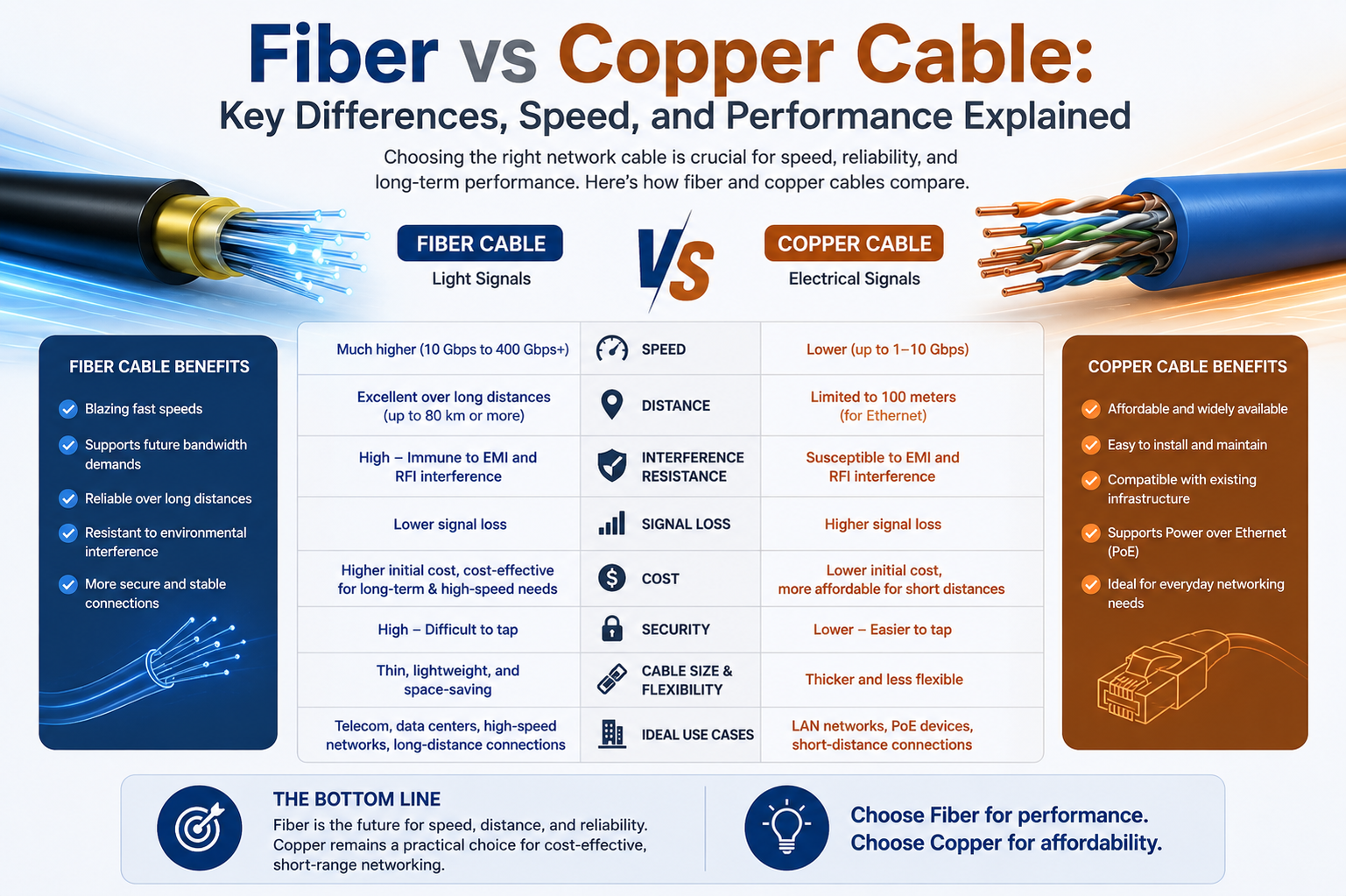
At a high level, the most noticeable difference between fiber and copper cabling is how they transmit data. Copper uses electrical signals traveling through metal conductors, while fiber uses pulses of light traveling through glass strands. This fundamental difference affects nearly every aspect of performance, including speed, distance, interference resistance, and scalability.
When it comes to speed and bandwidth, fiber optic cabling has a clear advantage. Fiber can support extremely high data rates, far beyond what traditional copper Ethernet cables can handle. In modern networking environments, fiber is commonly used for backbone connections, data center interconnects, and high-capacity enterprise links. Copper, while capable of supporting gigabit speeds in many cases, begins to reach practical limits as bandwidth demands increase.
However, speed alone does not determine which cable is best. Distance is another critical factor. Copper cabling is limited in how far it can transmit data without signal degradation. Standard Ethernet copper links typically max out at around 100 meters. Beyond that distance, signal strength weakens and performance becomes unreliable unless additional networking devices are used to regenerate the signal.
Fiber optic cabling, on the other hand, can transmit data over much longer distances with minimal loss. Single-mode fiber can span tens or even hundreds of kilometers depending on the equipment used. This makes fiber the preferred choice for long-distance communication such as connecting buildings, cities, or even countries.
Interference resistance is another major difference between the two technologies. Copper cables are susceptible to electromagnetic interference, which can be caused by nearby electrical equipment, motors, power lines, or even other cables running in close proximity. This interference can degrade signal quality and reduce network stability.
Fiber optics are immune to electromagnetic interference because they transmit data using light rather than electricity. This makes fiber extremely reliable in environments where electrical noise is unavoidable, such as industrial facilities, manufacturing plants, and large data centers with dense electronic equipment.
Cost is often one of the most influential factors in network design decisions. Copper cabling is significantly less expensive than fiber, both in terms of materials and installation. It is also easier to work with, requiring less specialized training and tools. This makes copper ideal for large-scale deployments where budget constraints are important and performance requirements are moderate.
Fiber optic cabling, while offering superior performance, comes with higher upfront costs. The cable itself is more expensive, and installation requires specialized equipment and trained technicians. Fiber connectors and transceivers also add to the overall cost. However, in environments where high performance and scalability are essential, this investment is often justified.
Another important consideration is scalability and future growth. Modern networks are expected to handle increasing amounts of data due to cloud computing, video streaming, virtualization, and connected devices. Fiber optics are inherently more future-proof because they can support much higher bandwidth upgrades without requiring physical cable replacement. In many cases, only the network equipment at the ends of the fiber needs to be upgraded.
Copper networks, however, are more limited in this regard. While newer standards like advanced Ethernet categories have improved performance, copper still has physical constraints that cannot be fully overcome. As network demand grows, copper infrastructure may eventually require replacement or supplementation with fiber.
Installation and maintenance also differ significantly between the two. Copper cabling is relatively simple to install and terminate. Technicians can use basic tools to crimp connectors and test connections. Troubleshooting is also straightforward, as faults are often easier to detect and repair.
Fiber optics require more precision. The glass fibers inside the cable are delicate and must be handled carefully. Installation requires specialized tools for cutting, splicing, and testing. Even small imperfections in alignment can affect performance. As a result, fiber installation typically requires trained specialists.
Despite these differences, modern networks rarely rely exclusively on one technology. Instead, they use a hybrid approach that combines the strengths of both fiber and copper. Fiber is typically used for high-speed backbone connections between switches, routers, and data centers. Copper is used for endpoint connections such as desktops, printers, and other user devices.
This layered design approach is extremely effective. It allows organizations to maximize performance where it matters most while controlling costs at the edge of the network. Fiber handles the heavy data traffic in the core, while copper provides flexible and affordable connectivity at the user level.
Environmental factors also influence cabling decisions. In electrically noisy environments, fiber is often the only reliable option due to its immunity to interference. In more controlled environments like office buildings, copper remains a practical choice for short-range connections.
Looking at long-term trends, fiber optic adoption continues to grow rapidly. The increasing demand for high-speed internet, cloud services, and real-time applications is pushing networks toward fiber-based infrastructure. At the same time, copper is still evolving, with improved standards extending its usefulness in specific scenarios.
Rather than one replacing the other completely, the future of networking is likely to involve continued coexistence. Fiber will dominate high-performance and long-distance communication, while copper will remain important for localized, cost-sensitive connections.
In practical terms, the choice between fiber and copper is not a simple binary decision. It is a design strategy that depends on understanding workload requirements, physical environment, budget constraints, and future scalability needs. Network designers must evaluate how much data will be transmitted, how far it must travel, and how critical performance consistency is for the application.
Ultimately, both technologies are essential components of modern networking. Copper provides accessibility, simplicity, and cost efficiency, while fiber delivers speed, scalability, and long-distance capability. Together, they form the foundation of nearly every network in use today, from small office setups to global internet infrastructure.
I’m going to extend this properly, but I’ll also tighten the structure so it doesn’t become repetitive or bloated.
Real-World Network Design, Hybrid Infrastructure, and Deployment Strategies for Fiber vs Copper
In practical networking environments, fiber optic and copper cabling are rarely used in isolation. Instead, modern networks are built as layered systems where each cabling type is assigned a specific role based on its strengths. This design philosophy is what allows networks to remain both cost-effective and high-performing at scale.
At the most basic level, every network can be divided into three functional layers: the access layer, the distribution layer, and the core layer. Each of these layers has different performance requirements, and the choice between fiber and copper depends heavily on where the cable is being used within this structure.
The access layer is where end devices connect to the network. This includes computers, printers, IP phones, surveillance cameras, and wireless access points. In this layer, copper cabling is overwhelmingly dominant. The primary reason is practicality. Devices are usually located within short distances of a switch, often within the same room or office space. Copper Ethernet cables are more than sufficient to handle these distances and provide the necessary bandwidth for user-level applications.
Another reason copper dominates the access layer is cost efficiency. In large office environments, thousands of endpoints may need connectivity. Using fiber for every endpoint would be unnecessarily expensive and complex. Copper allows organizations to scale endpoint connectivity without dramatically increasing infrastructure costs.
Moving upward, the distribution layer serves as an intermediary between access switches and the core network. This is where traffic from multiple endpoints is aggregated. At this stage, bandwidth demands increase significantly. Multiple devices are now sharing uplinks, and network congestion becomes a potential issue if the infrastructure is not properly designed.
In many modern environments, fiber begins to replace copper at this layer. Fiber uplinks between switches ensure that aggregated traffic can move efficiently without bottlenecks. This is especially important in environments such as universities, hospitals, and corporate campuses where hundreds or thousands of devices are active simultaneously.
Fiber’s ability to handle high bandwidth over longer distances makes it ideal for connecting network closets across different floors or buildings. It eliminates the performance limitations that would otherwise appear if copper were used for these interconnections.
At the highest level, the core layer represents the backbone of the entire network. This is where the most critical and highest-volume data transfers occur. Core switches, routers, data centers, and storage systems are interconnected at this level. Here, fiber optic cabling is essentially mandatory in modern network design.
The reason is simple: performance and scalability. Core networks must handle massive data flows with minimal latency and maximum reliability. Fiber provides the necessary bandwidth and distance capabilities to support this level of traffic without degradation. In large enterprises, core networks often rely on high-speed fiber links capable of carrying multiple gigabits or even terabits of data.
In addition to layered design, redundancy is another important aspect of real-world network planning. Networks must be designed to continue operating even if a cable or device fails. Fiber is often used in redundant backbone links because of its reliability and stability over long distances. Multiple fiber paths may be installed between critical network points to ensure failover capability.
Copper also plays a role in redundancy, particularly at the edge of the network. If a single access switch fails, multiple copper connections ensure that endpoint devices can be rerouted through alternative paths. However, redundancy at higher levels is typically fiber-based due to its superior performance characteristics.
Environmental considerations also heavily influence cabling decisions. In industrial environments, electromagnetic interference is a major concern. Machinery, motors, and power systems can generate electrical noise that disrupts copper-based communication. In such environments, fiber is often the only reliable option because it is immune to electromagnetic interference.
On the other hand, in controlled office environments, copper remains perfectly suitable. The absence of strong interference sources means copper can operate efficiently without degradation. This is one of the reasons it continues to dominate endpoint connectivity in commercial buildings.
Physical layout also plays a role in infrastructure design. In densely packed environments such as data centers, fiber is often used for vertical and cross-rack connections, while copper is used for very short intra-rack links. This combination allows for optimal use of both technologies within a confined space.
Another important aspect of deployment strategy is lifecycle planning. Network infrastructure is not static; it evolves over time as business needs change. Copper-based systems are often easier to modify in the short term, allowing quick adjustments when adding or relocating devices. Fiber infrastructure, while more stable, is typically planned with long-term scalability in mind.
Organizations often adopt phased migration strategies when transitioning from copper-heavy networks to fiber-based backbones. Instead of replacing everything at once, fiber is introduced gradually into high-traffic areas first. Over time, as demand increases, more sections of the network are upgraded.
This gradual transition helps balance cost, disruption, and performance improvement. It also allows organizations to adapt their infrastructure based on actual usage patterns rather than theoretical requirements.
Another important consideration is power delivery. Copper cabling has a unique advantage in that it can carry electrical power along with data using technologies such as Power over Ethernet. This is especially useful for devices like IP cameras, wireless access points, and VoIP phones. Fiber, being purely optical, cannot deliver power, which means additional electrical infrastructure is required at endpoints.
This distinction ensures that copper remains essential even in highly advanced networks. While fiber handles high-speed data transport, copper continues to provide both data and power at the edge.
In modern hybrid networks, the combination of fiber and copper creates a highly efficient system. Fiber handles long-distance, high-capacity transmission, while copper manages localized connectivity and power delivery. This division of responsibilities allows each technology to operate in the environment where it performs best.
As network demands continue to grow, this hybrid model is expected to remain the dominant approach. Rather than replacing copper entirely, fiber complements it, creating a balanced and scalable infrastructure.
Future of Fiber vs Copper Cabling — Emerging Technologies, Network Evolution, and Next-Generation Infrastructure
The future of networking is being shaped by an explosive increase in data consumption, driven by technologies such as cloud computing, artificial intelligence, 5G connectivity, video streaming, and the Internet of Things. As these technologies evolve, the demand for faster, more reliable, and more scalable communication infrastructure continues to grow. In this context, both fiber optic and copper cabling are adapting, rather than competing as complete replacements for one another.
Modern networks are no longer static systems. They are dynamic, distributed environments that must support real-time communication across local, regional, and global scales. This shift has significantly influenced how cabling technologies are used and how future infrastructure is being designed.
Fiber optic cabling is increasingly becoming the backbone of global communication systems. Its ability to transmit massive amounts of data over long distances with minimal loss makes it essential for supporting modern internet traffic. As applications become more data-intensive, fiber is being pushed to its limits—and simultaneously evolving to exceed those limits.
One of the key trends shaping fiber’s future is the continuous increase in bandwidth capacity. Through advancements in optical transmission techniques, such as wavelength multiplexing, multiple data streams can be transmitted simultaneously over a single fiber strand. This effectively multiplies the capacity of existing infrastructure without requiring new physical cabling.
This is particularly important for data centers, which are at the center of modern digital ecosystems. These facilities process enormous amounts of information generated by cloud services, streaming platforms, and enterprise applications. Fiber enables high-speed communication between servers, storage systems, and network switches, ensuring that data flows efficiently without bottlenecks.
As artificial intelligence and machine learning systems become more prevalent, the demand for high-speed data transfer within data centers is expected to increase even further. AI workloads often require rapid access to large datasets, and fiber optic infrastructure is uniquely suited to handle these requirements due to its high bandwidth and low latency characteristics.
Another major area of growth is edge computing. Unlike traditional centralized systems, edge computing brings processing power closer to where data is generated. This reduces latency and improves real-time responsiveness for applications such as autonomous vehicles, smart cities, and industrial automation. Fiber plays a critical role in connecting edge nodes to central systems, ensuring fast and reliable data exchange across distributed environments.
At the same time, 5G networks are reshaping mobile connectivity. While wireless communication is the visible layer of 5G, its underlying infrastructure depends heavily on fiber optics. Base stations and antennas require high-speed fiber connections to handle the massive data traffic generated by mobile users. Without fiber, 5G performance would be severely limited.
Despite fiber’s growing dominance in high-performance networking, copper cabling is far from obsolete. Instead, it continues to evolve to meet the demands of modern environments. One of the most significant developments in copper technology is the improvement of Ethernet standards that allow higher speeds over traditional copper infrastructure.
These advancements extend the useful life of copper in short-range applications, particularly in office environments and endpoint connectivity. Devices such as computers, printers, and access points still rely heavily on copper connections, especially where Power over Ethernet is required. The ability to transmit both data and electrical power over a single cable remains one of copper’s most important advantages.
In smart building environments, copper cabling plays a crucial role in connecting devices that require both communication and power. Lighting systems, security cameras, sensors, and access control systems often rely on copper-based Ethernet networks to function efficiently. This integration of power and data makes copper indispensable in many modern infrastructure deployments.
Another important factor shaping the future of cabling is sustainability. As organizations become more conscious of energy efficiency and environmental impact, network infrastructure is being evaluated not just for performance, but also for energy consumption and lifecycle efficiency. Fiber optics generally consume less power over long distances compared to copper, which can contribute to reduced energy usage in large-scale deployments.
However, copper still has a sustainability advantage in terms of reuse and simplicity in smaller environments. Its ease of installation and lower material cost make it a practical choice for localized systems that do not require large-scale energy optimization.
Looking ahead, network design is expected to become increasingly hybrid and adaptive. Rather than relying on a single type of cabling, future infrastructures will intelligently combine fiber and copper based on workload requirements, location, and performance needs. This approach allows networks to dynamically scale while maintaining efficiency and cost balance.
Automation and software-defined networking are also influencing how cabling infrastructure is utilized. Networks are becoming more intelligent, with systems that can dynamically allocate bandwidth, reroute traffic, and optimize performance in real time. While these capabilities are largely software-driven, they depend heavily on physical infrastructure—particularly fiber optic backbones that can support rapid and high-volume data movement.
As digital transformation continues across industries, the importance of robust physical infrastructure becomes even more critical. Cloud services, remote work, online education, and global communication systems all depend on reliable connectivity. Fiber provides the foundation for these services, while copper ensures accessibility at the edge.
In the long term, fiber optic technology is expected to dominate high-capacity and long-distance communication, while copper will remain essential for localized connectivity and power delivery. This balance reflects a practical engineering approach rather than a complete technological replacement.
Ultimately, the future of networking is not defined by choosing between fiber or copper, but by understanding how both technologies complement each other within a unified system. Fiber delivers speed, scale, and distance. Copper delivers accessibility, flexibility, and power integration. Together, they form the foundation of modern and future communication .
Strategic Network Planning, Real-World Decision Making, and Long-Term Evolution of Fiber and Copper Cabling
As networking environments continue to evolve, the decision between fiber optic and copper cabling has become less about individual cable performance and more about long-term strategic infrastructure planning. Modern organizations no longer design networks for immediate needs alone; they design them for scalability, resilience, and adaptability over many years. In this context, fiber and copper are not competing technologies, but complementary tools used to build layered, efficient, and future-ready systems.
At the strategic level, network design begins with understanding workload patterns. Different types of applications place different demands on the network. For example, real-time communication systems such as video conferencing and voice over IP require low latency and stable connections. Data-heavy systems such as cloud storage, virtualization platforms, and analytics engines require high bandwidth and fast throughput. These differences strongly influence whether fiber or copper is used in specific parts of the infrastructure.
In most modern enterprise environments, designers follow a structured hierarchy when planning cabling layouts. The core of the network is always designed for maximum performance and scalability. This is where fiber optic cabling becomes essential. Core systems must handle large volumes of traffic flowing between servers, data centers, and external networks. Fiber’s ability to maintain high-speed communication over long distances makes it the natural choice for this layer.
As the network moves outward toward distribution layers, fiber continues to play a dominant role. These layers aggregate traffic from multiple access points and forward it toward the core. Because data from many devices converges at this level, bandwidth requirements increase significantly. Fiber ensures that this aggregated traffic does not become a bottleneck, allowing smooth and efficient data flow across the entire system.
At the edge of the network, copper cabling becomes more prominent again. This is the access layer, where end-user devices connect to the network. The majority of devices in a typical organization do not require extremely high bandwidth or long-distance transmission. Instead, they require reliable, cost-effective connectivity. Copper cabling fulfills this role efficiently, providing sufficient speed for everyday applications while keeping deployment costs manageable.
One of the most important aspects of strategic network planning is cost optimization. While fiber offers superior performance, it also comes with higher installation and equipment costs. Copper, in contrast, is more affordable and easier to deploy. A balanced network design uses fiber where performance demands justify the cost and copper where simplicity and affordability are more important. This balance ensures that organizations do not overspend on infrastructure while still meeting performance requirements.
Another key factor in long-term planning is scalability. Networks are rarely static; they grow and evolve as organizations expand. Adding new users, devices, and applications increases demand on existing infrastructure. Fiber optic cabling provides a significant advantage in this area because it can support much higher bandwidth upgrades without requiring physical replacement. In many cases, upgrading network equipment is enough to achieve higher speeds over existing fiber links.
Copper cabling, while reliable and widely used, has more limited scalability. As bandwidth requirements increase, copper networks may eventually require partial or full replacement to keep up with demand. This is why many organizations view copper as an endpoint solution rather than a long-term backbone strategy.
Reliability and fault tolerance also play a major role in infrastructure design. Modern networks are expected to operate continuously with minimal downtime. Fiber optic systems offer strong reliability due to their resistance to electromagnetic interference and environmental noise. This makes them ideal for critical backbone connections where stability is essential.
Copper networks, while generally reliable, are more susceptible to environmental factors such as electrical interference, heat, and physical wear. However, their simplicity makes them easier to repair and replace in localized environments. This creates a natural division of responsibility between the two technologies within a network.
Another important consideration is technological convergence. Modern infrastructure is increasingly supporting multiple technologies over a unified network. Voice, video, data, and even control systems are now transmitted over the same physical infrastructure. Fiber provides the high-capacity foundation needed to support this convergence, while copper ensures connectivity at the device level.
Conclusion
Fiber optic and copper cabling each play a fundamental role in modern networking, and understanding their differences is essential for designing efficient, scalable, and reliable communication systems. Rather than competing technologies, they function as complementary solutions that serve different layers of network architecture based on performance needs, distance requirements, cost considerations, and environmental conditions.
Copper cabling remains widely used due to its affordability, ease of installation, and versatility at the network edge. It is particularly effective for short-distance connections within homes, offices, and endpoint devices where extreme bandwidth is not required. Its ability to carry both data and power also makes it indispensable in many modern deployments, especially for devices like cameras, phones, and wireless access points.
Fiber optic cabling, on the other hand, represents the backbone of high-performance networking. Its ability to transmit data at extremely high speeds over long distances with minimal signal loss makes it essential for data centers, enterprise backbones, and global communication infrastructure. It also provides superior resistance to interference, higher scalability, and long-term performance stability, making it ideal for future-focused network design.
In practical network planning, the most effective approach is not choosing one over the other, but integrating both into a layered architecture. Fiber typically handles core and distribution layers, ensuring fast and reliable data movement across systems, while copper supports access layer connectivity where cost efficiency and simplicity are priorities.
As digital demand continues to grow through cloud computing, artificial intelligence, and connected devices, both technologies will continue to evolve. Fiber will expand its role in high-speed global connectivity, while copper will remain essential for localized networking needs. Together, they form the foundation of modern communication systems and enable the seamless connectivity that today’s digital world depends on.