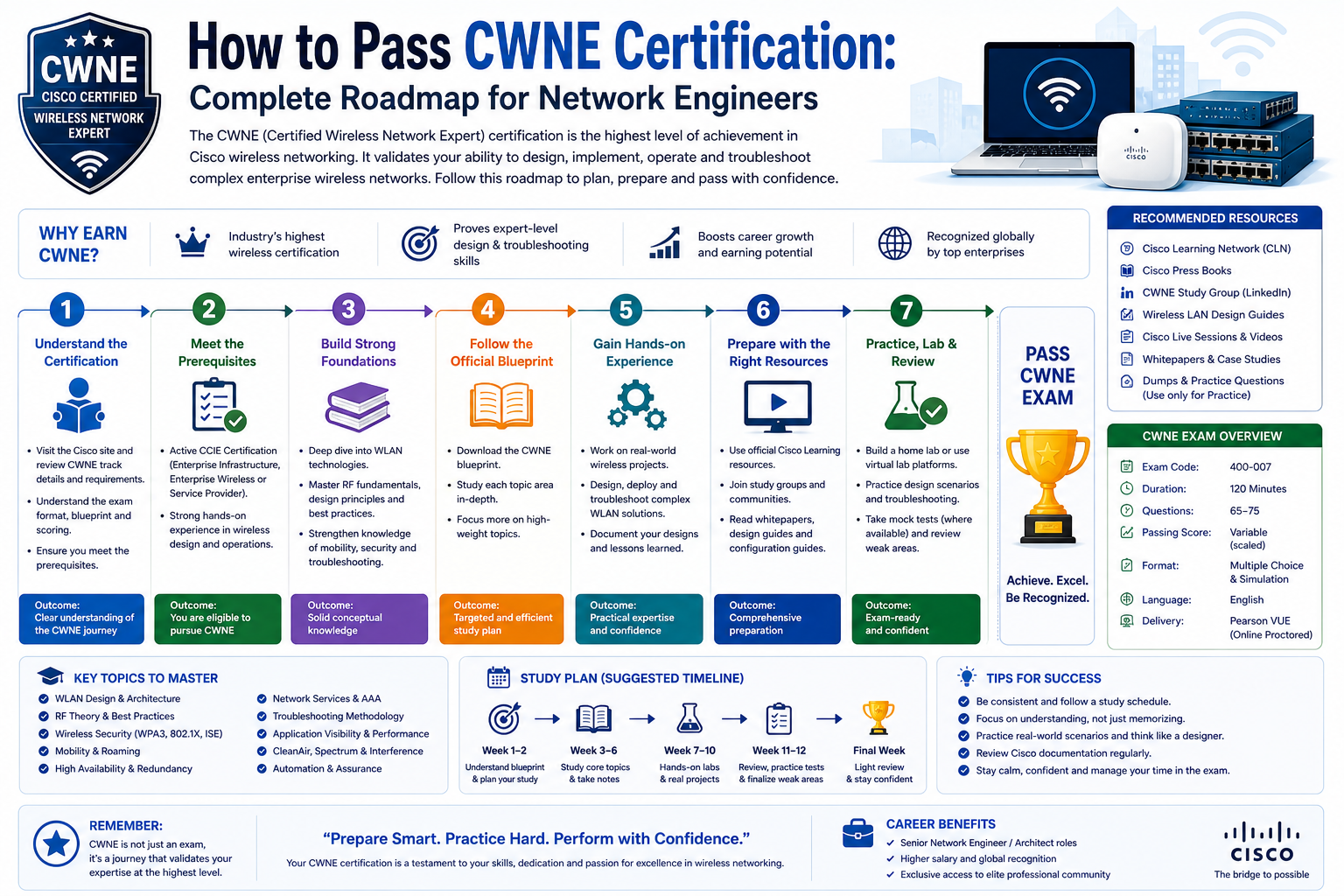
The Certified Wireless Network Expert (CWNE) certification represents one of the highest levels of recognition in enterprise WiFi and wireless networking expertise. Unlike many traditional certifications that rely on a single standardized exam, CWNE follows a different philosophy entirely. It is not awarded through a single test but instead through a structured combination of advanced certifications, real-world experience, professional credibility, and peer validation.
This makes CWNE less of a conventional certification and more of a professional milestone that reflects deep technical ability, practical deployment knowledge, and a proven history of contribution to the wireless networking field. It is designed for individuals who are not just capable of operating wireless networks but who understand them at a fundamental level—how they behave, how they fail, how they are designed, and how they evolve in real environments.
In many ways, CWNE is positioned as a capstone achievement. It is intended for professionals who have already mastered intermediate and advanced wireless topics and are ready to demonstrate expertise that extends beyond theory into real-world execution and thought leadership.
Unlike certifications that focus on passing an exam and moving on, CWNE emphasizes a journey. That journey includes foundational learning, progressive specialization, applied experience, and finally, validation by industry peers who assess whether a candidate truly meets expert-level expectations.
The Philosophy Behind the CWNE Certification Path
The CWNE certification structure is built on a philosophy that expertise cannot be measured by a single exam alone. Wireless networking, particularly in enterprise environments, involves a combination of physics, protocol behavior, security design, infrastructure planning, and troubleshooting under real-world constraints. No single test can fully capture all of these dimensions.
Instead, CWNE requires candidates to build competence in stages. Each stage reinforces a different layer of understanding. Foundational knowledge ensures the candidate understands the principles of WiFi. Intermediate certifications develop analytical and design thinking. Advanced certifications refine security, architecture, and problem-solving skills. Finally, real-world experience and peer validation ensure that knowledge has been applied effectively in professional environments.
This layered structure reflects how wireless networking itself works. Networks are not built in isolation; they are designed, tested, deployed, monitored, and continuously improved. CWNE mirrors this lifecycle by requiring professionals to demonstrate mastery across multiple dimensions rather than focusing on theoretical exam performance alone.
The philosophy also emphasizes credibility through community validation. Instead of the relying purely on test scores, CWNE includes recommendations and professional endorsements. This ensures that candidates are not only technically capable but also recognized by others in the field as competent practitioners.
Why CWNE Differs From Traditional Certifications
Most IT certifications follow a predictable model: study materials are provided, an exam is taken, and a passing score results in certification. CWNE does not follow this model. There is no single exam that grants the certification. Instead, it functions as an application-based expert designation.
This distinction is important because it changes the entire approach to preparation. Rather than focusing on exam memorization or test-taking strategies, candidates must focus on building a complete professional profile. This includes technical depth, practical experience, documented work, and community involvement.
Another major difference is that CWNE evaluates consistency over time. A candidate cannot simply prepare for a few months and pass. The requirements ensure that expertise is developed through sustained engagement with wireless networking systems in real operational environments.
This structure makes CWNE more comparable to professional board certifications in fields such as medicine or engineering licensure. It validates that an individual has not only studied the subject but has also demonstrated the ability to apply it responsibly and effectively in complex scenarios.
The Role of Foundational Knowledge in Wireless Networking
At the core of the CWNE journey is foundational wireless knowledge. Before advancing into specialized areas, candidates are expected to understand how WiFi fundamentally operates. This includes understanding radio frequency behavior, signal propagation, interference, and the structure of wireless communication.
Wireless networking is unique because it operates in an invisible medium. Unlike wired networks, where physical cables and switches provide clear points of reference, wireless systems rely on electromagnetic waves that behave differently depending on the environment, distance, and obstacles.
A strong foundation requires understanding how signals travel through space, how they degrade, and how multiple devices interact within shared spectrum. Without this knowledge, higher-level concepts such as optimization, security design, or troubleshooting become difficult to grasp in meaningful ways.
Foundational knowledge also includes understanding the evolution of WiFi standards. Over time, wireless technologies have progressed from early 802.11 implementations to modern high-density, high-speed enterprise environments. Each generation introduces new capabilities as well as new complexities.
Professionals pursuing CWNE must be comfortable interpreting these changes and understanding how backward compatibility, channel width adjustments, and spectrum usage affect real-world deployments.
CWNA and Its Role in Building Wireless Competence
The first major step in the CWNE journey is the Certified Wireless Network Administrator (CWNA) level. This certification establishes the baseline knowledge required for all advanced wireless study. It focuses on core principles that govern how wireless networks operate.
CWNA emphasizes understanding RF behavior, including how signals propagate through different environments and how obstacles such as walls, furniture, and distance affect performance. It also introduces key concepts such as noise, interference, and signal-to-noise ratio, which are essential for diagnosing performance issues in real deployments.
Another important area covered at this stage is the structure of wireless frames and communication processes. Wireless devices do not communicate in a simple linear fashion; instead, they use structured frame exchanges that ensure reliability, coordination, and collision avoidance.
Understanding these mechanisms allows professionals to interpret what is happening at a packet level, even when using high-level monitoring tools. This ability becomes essential in enterprise environments where performance issues are often subtle and require deep analysis.
CWNA also introduces the concept of wireless site behavior. Unlike wired networks, wireless networks are heavily influenced by physical environment. Small changes in placement, density, or interference can significantly impact performance. CWNA builds awareness of these environmental factors and prepares candidates for more advanced design and analysis work.
Building Analytical Thinking Through CWAP-Level Concepts
After establishing foundational knowledge, professionals move toward more advanced analytical understanding, often associated with CWAP-level concepts. This stage focuses on interpreting wireless behavior at a deeper level, particularly from a protocol and signal analysis perspective.
At this stage, wireless networking becomes less about general understanding and more about interpretation. Professionals learn to analyze how frames are transmitted, how devices contend for airtime, and how collisions and retransmissions affect performance.
One of the key areas of focus is understanding physical and data link layer behavior. Wireless networks operate across multiple layers, and performance issues often arise from interactions between these layers rather than a single isolated problem.
For example, signal interference may not immediately result in a connection failure but may instead cause retransmissions, latency increases, or reduced throughput. Understanding how to identify these patterns is essential for advanced troubleshooting.
Analytical thinking also extends to understanding how wireless devices behave under load. In high-density environments such as offices, campuses, or public venues, multiple devices compete for limited spectrum resources. This competition affects performance in ways that are not always visible without detailed analysis.
Professionals at this stage learn to interpret capture data, identify inefficiencies, and understand how protocol-level decisions impact user experience. This analytical skill set forms the backbone of advanced wireless engineering.
The Evolution of Wireless Design Thinking
Wireless design is one of the most important aspects of enterprise networking, and it requires a different mindset than traditional network design. Unlike wired systems, where capacity and structure are relatively predictable, wireless environments are highly dynamic.
Design thinking in wireless networking involves anticipating how users will interact with the network in real environments. This includes considering device density, user movement, application requirements, and physical obstacles.
A well-designed wireless network must balance coverage and capacity. Coverage ensures that users can connect across the entire environment, while capacity ensures that performance remains stable even under load. Achieving this balance requires careful planning and a deep understanding of RF behavior.
Design professionals must also consider channel planning, access point placement, and power settings. These decisions directly influence how devices connect and how efficiently they communicate.
Another important aspect of wireless design is scalability. Networks must be designed not only for current requirements but also for future growth. This includes accommodating additional users, new devices, and evolving application demands.
Wireless design is not static. It is a continuous process that evolves as environments change. This makes design thinking an ongoing discipline rather than a one-time activity.
Introduction to Security Considerations in Wireless Networks
Security is a critical component of any wireless environment. Because wireless signals travel through open space, they are inherently more exposed than wired communications. This makes them more susceptible to interception, unauthorized access, and various forms of attack.
Understanding wireless security begins with encryption methods and authentication mechanisms. These systems ensure that only authorized devices can access the network and that data remains protected during transmission.
Security also involves understanding vulnerabilities specific to wireless environments. These include rogue access points, spoofing attacks, and misconfigured security settings. Each of these risks can compromise network integrity if not properly managed.
In enterprise environments, security is not just a technical requirement but also a compliance requirement. Organizations often must adhere to industry regulations that define how data must be protected and how access must be controlled.
Wireless security professionals must also understand monitoring systems that detect unusual activity. These systems help identify potential threats before they escalate into serious incidents.
Security in wireless networking is an ongoing responsibility. As new threats emerge and technologies evolve, security practices must adapt accordingly.
The Importance of IoT and Emerging Wireless Technologies
Modern wireless environments are no longer limited to traditional computing devices such as laptops and smartphones. The rise of the Internet of Things (IoT) has expanded wireless networks to include a wide variety of connected devices.
These devices operate under different constraints and often use different communication protocols. Some may not rely on standard WiFi but instead use alternative wireless technologies designed for low power consumption and specialized use cases.
Understanding IoT in the context of wireless networking requires awareness of how these devices interact with existing infrastructure. They may introduce additional traffic, require different security considerations, or operate in environments with limited resources.
As wireless ecosystems expand, professionals must be able to integrate diverse technologies into a cohesive network architecture. This requires flexibility and a willingness to adapt to new standards and communication models.
Emerging technologies also introduce new design and performance considerations. As device density increases and application requirements evolve, wireless networks must scale in complexity while maintaining reliability and efficiency.
Professional Growth and Real-World Application of Wireless Expertise
Beyond technical knowledge, CWNE-level expertise emphasizes real-world application. Wireless professionals are expected to have experience working in enterprise environments where networks are not theoretical but operational.
This includes troubleshooting performance issues, designing scalable systems, implementing security policies, and optimizing network behavior under real conditions. Practical experience is essential because wireless environments are influenced by unpredictable factors that cannot always be replicated in controlled settings.
Professionals at this level must also be able to communicate technical concepts effectively. This includes explaining complex wireless behavior to non-technical stakeholders and documenting network designs and decisions clearly.
Real-world experience also involves collaboration. Wireless networks are rarely managed by a single individual. They involve coordination between network engineers, security teams, system administrators, and business stakeholders.
As a result, CWNE-level professionals must be able to operate effectively within multidisciplinary teams while maintaining technical leadership in their area of expertise.
Advancing Beyond Foundations: The Professional-Level CWNE Certification Layer
As candidates progress deeper into the CWNE pathway, the focus shifts away from foundational wireless understanding and moves toward specialized expertise. At this stage, the learning journey becomes less about general principles and more about mastering distinct domains of wireless networking such as design, security, and advanced system behavior.
This phase is where professionals begin to separate theoretical knowledge from applied engineering capability. Each certification at this level contributes a specific perspective on wireless networks, ensuring that candidates develop a balanced and multidimensional understanding of enterprise WiFi environments.
Rather than treating wireless networking as a single discipline, the CWNE structure divides it into complementary areas of specialization. These areas reinforce one another, helping professionals understand not only how wireless networks function but also how they are planned, protected, optimized, and maintained at scale.
CWDP and the Evolution of Wireless Network Design Thinking
The CWDP-level focus introduces a deeper and more structured approach to wireless design. At this stage, design is no longer about simply placing access points or ensuring coverage. Instead, it becomes a disciplined engineering process that considers performance, scalability, environmental constraints, and user experience simultaneously.
Wireless design at an advanced level requires the ability to anticipate how networks will behave under real-world conditions. Unlike wired systems, wireless networks are influenced by constantly changing variables such as physical movement, interference sources, and fluctuating device density.
A design-focused professional must consider how users interact with space. For example, environments such as offices, stadiums, warehouses, and educational institutions all present unique challenges. Each environment requires a tailored approach to ensure consistent connectivity and performance.
In enterprise design thinking, capacity becomes just as important as coverage. A network may technically reach every corner of a building, but still fail if too many devices compete for limited airtime. Advanced design therefore focuses on balancing density, throughput, and efficiency.
Another important aspect of design thinking is predictive modeling. Instead of relying solely on post-deployment troubleshooting, professionals use structured methodologies to predict how wireless signals will behave in a given environment. This allows for more accurate planning and reduces the likelihood of performance issues after deployment.
Design expertise also involves understanding trade-offs. Increasing access point density may improve capacity but can also introduce interference challenges. Similarly, increasing transmit power may extend coverage but reduce overall efficiency in dense environments. These trade-offs require careful evaluation and experience-based judgment.
CWSP and the Security Architecture of Wireless Networks
Wireless security represents one of the most critical dimensions of enterprise networking. As organizations increasingly rely on wireless infrastructure for mission-critical operations, the importance of securing these networks has grown significantly.
At an advanced level, wireless security is not limited to encryption protocols or authentication methods. It expands into a broader security architecture that includes policy design, threat mitigation, monitoring systems, and regulatory compliance.
Security professionals must understand how attackers exploit weaknesses in wireless environments. Unlike wired networks, wireless systems broadcast signals that can be intercepted if not properly secured. This creates unique risks such as unauthorized access, spoofing, and rogue device infiltration.
A strong security architecture begins with proper authentication frameworks. These frameworks ensure that only authorized users and devices can connect to the network. However, authentication alone is not sufficient. Encryption must also be applied to protect data integrity during transmission.
Another important area of focus is wireless intrusion detection and prevention. These systems continuously monitor the airspace for unusual or malicious activity. They help identify rogue access points, unauthorized connections, and suspicious behavior patterns that may indicate a security breach.
Security also extends into policy enforcement. Organizations must define clear rules regarding device access, network usage, and data handling. These policies must be consistently applied across all wireless environments to ensure compliance and reduce risk.
In regulated industries, security requirements become even more complex. Standards such as HIPAA, financial regulations, and government compliance frameworks require strict controls over data transmission and access management. Wireless security professionals must ensure that networks align with these requirements while maintaining usability and performance.
CWISA and the Expansion of Wireless Beyond WiFi
Modern wireless ecosystems are no longer limited to traditional WiFi networks. The rise of Internet of Things technologies has introduced a wide range of new communication protocols and wireless systems that operate alongside or outside standard 802.11 environments.
CWISA-level concepts focus on understanding these alternative wireless systems and how they integrate into broader network architectures. These systems often prioritize low power consumption, long-range communication, or specialized industrial applications.
Unlike traditional WiFi, which is designed for high-speed data transfer, many IoT systems are optimized for efficiency and scalability rather than bandwidth. This creates unique design and integration challenges for network professionals.
A key aspect of this expansion is interoperability. Wireless professionals must understand how different technologies coexist within the same environment. In many enterprise deployments, WiFi networks operate alongside IoT sensors, industrial controllers, and monitoring systems.
Each of these systems has different performance characteristics and communication requirements. Successfully integrating them requires careful planning and an understanding of how wireless spectrum is shared and managed.
Another important consideration is network segmentation. IoT devices often require isolation from core enterprise systems to reduce security risks. This introduces additional design complexity and requires careful architecture planning.
As wireless ecosystems continue to evolve, professionals must stay aware of emerging standards and technologies. The expansion of wireless communication beyond traditional WiFi represents a significant shift in how networks are designed and managed.
Building a Professional Wireless Portfolio for CWNE Submission
One of the most important aspects of the CWNE process is the development of a professional portfolio. Unlike traditional certifications that rely on exam performance, CWNE requires candidates to demonstrate real-world expertise through documented evidence of their work.
This portfolio serves as a comprehensive representation of a candidate’s experience, skills, and contributions to the field of wireless networking. It typically includes documentation of projects, design implementations, troubleshooting case studies, and professional achievements.
A strong portfolio is not simply a collection of technical tasks. It must demonstrate depth of understanding, problem-solving ability, and impact on real-world environments. Each entry should reflect meaningful contributions to wireless network design, optimization, or security.
Candidates are expected to show evidence of working in enterprise environments where wireless systems are deployed at scale. This includes environments such as corporate offices, educational institutions, healthcare facilities, or large public venues.
The portfolio must also reflect consistency over time. It is not enough to present isolated examples of technical work. Instead, the documentation should demonstrate sustained involvement in wireless engineering across multiple projects and scenarios.
Another important aspect of portfolio development is clarity. Technical work must be explained in a way that is understandable to reviewers who may come from different backgrounds. This requires strong communication skills in addition to technical expertise.
The Role of Professional Endorsements in CWNE Validation
Unlike many certifications that rely solely on testing, CWNE incorporates a peer validation process. This involves professional endorsements from individuals who can confirm the candidate’s expertise and experience in wireless networking.
These endorsements serve as an external verification mechanism. They ensure that candidates are not only self-reporting their abilities but are also recognized by others in the industry as competent professionals.
Endorsers are typically individuals who have worked directly with the candidate or have sufficient knowledge of their professional capabilities. These may include colleagues, supervisors, or other wireless experts.
The endorsement process is structured to ensure independence and authenticity. Endorsers provide their evaluations without influence from the candidate, ensuring that the assessment remains objective.
This peer-based validation adds an important layer of credibility to the CWNE designation. It reflects the idea that expertise in complex technical fields is best evaluated not only through testing but also through real-world collaboration and professional recognition.
In many cases, endorsements also reflect the candidate’s reputation within the wireless community. Professionals who actively contribute to discussions, projects, and knowledge sharing are more likely to be recognized and recommended by peers.
Writing Technical Essays as a Demonstration of Expertise
Another critical component of the CWNE application process is the submission of technical essays. These essays are designed to evaluate a candidate’s ability to communicate complex wireless concepts clearly and effectively.
The essays typically focus on real-world experiences rather than theoretical explanations. Candidates are expected to describe specific projects or challenges they have encountered and explain how they approached and resolved them.
The goal of these essays is not to teach reviewers new information but to demonstrate depth of understanding and practical reasoning. Candidates must show how they analyze problems, make design decisions, and apply technical knowledge in real environments.
Each essay must reflect a different aspect of wireless networking experience. This ensures that candidates demonstrate breadth as well as depth of knowledge.
Writing these essays requires careful thought and clarity. Technical detail must be balanced with readability. The narrative should be structured in a way that allows reviewers to understand both the problem and the solution without unnecessary complexity.
One of the most common challenges candidates face is condensing complex technical work into a limited word count while still maintaining clarity and completeness. This requires strong analytical writing skills and the ability to prioritize key information.
The CWNE Application Packet and Submission Structure
The CWNE application is structured as a comprehensive submission packet that brings together all required elements of the certification process. This includes certifications, experience verification, endorsements, publications, and technical essays.
Each component serves a specific purpose in validating the candidate’s expertise. Certifications demonstrate formal knowledge, experience verifies real-world application, endorsements confirm peer recognition, and essays showcase communication ability.
The application process requires careful organization. Candidates must ensure that all documentation is complete, accurate, and presented in a structured format. Missing or unclear information can delay the review process or result in rejection.
The submission is reviewed by a panel of experienced professionals who evaluate each application based on established criteria. These reviewers assess not only technical competence but also overall professional readiness for expert-level recognition.
The review process is detailed and multi-staged. Applications are examined for completeness, technical depth, consistency, and evidence of real-world expertise. Each stage ensures that only qualified candidates progress further in the evaluation process.
Professional Experience Requirements and Real-World Validation
A significant requirement for CWNE eligibility is documented professional experience in enterprise wireless environments. This ensures that candidates have practical exposure to complex network deployments.
Experience must be relevant and verifiable. It is not enough to have casual or limited exposure to wireless systems. Candidates must demonstrate sustained involvement in designing, managing, or troubleshooting enterprise-scale wireless networks.
This requirement ensures that CWNE professionals are not only theoretically knowledgeable but also capable of handling real-world challenges. Wireless environments are often unpredictable, and experience plays a critical role in developing effective problem-solving skills.
Professional experience also contributes to decision-making ability. In real deployments, engineers must make trade-offs between performance, cost, scalability, and security. These decisions cannot be learned solely through study; they require hands-on exposure.
Experience validation is typically supported through documentation such as resumes, project descriptions, and professional references. These elements help establish the authenticity and depth of the candidate’s involvement in wireless networking.
The Final Stage of CWNE Preparation and the Shift From Competence to Expert Judgment
At the final stage of the CWNE journey, the focus shifts away from learning new technical domains and moves toward demonstrating mastery through judgment, synthesis, and professional maturity. This is the point where a candidate is no longer evaluated on what they know alone, but on how effectively they apply that knowledge in complex, real-world wireless environments.
Wireless networking at this level is not about isolated skills. It becomes an integrated discipline where design, security, analysis, troubleshooting, and communication all intersect. The expectation is that a CWNE candidate can move fluidly between these domains and make decisions that balance technical constraints with operational reality.
This final stage is what distinguishes an expert from an experienced practitioner. Many professionals can configure networks or troubleshoot issues, but CWNE-level expertise requires the ability to understand why problems occur, how systems interact, and what long-term implications design decisions will have.
At this point, candidates are expected to demonstrate not only technical competence but also consistency, clarity of thought, and the ability to defend their decisions in a structured and professional manner.
Integrating Wireless Design, Security, and Analysis Into a Unified Skill Set
One of the most important aspects of CWNE-level expertise is the ability to integrate multiple wireless disciplines into a unified approach. In real enterprise environments, problems rarely fall neatly into a single category. A performance issue may involve design limitations, security misconfigurations, and RF interference simultaneously.
This requires professionals to think beyond isolated troubleshooting techniques and instead adopt a systems-level perspective. Every decision in a wireless network affects other components, often in subtle but significant ways.
For example, increasing access point density might improve capacity in one area but introduce co-channel interference in another. Similarly, tightening security settings may improve protection but reduce compatibility with legacy devices or impact roaming behavior.
CWNE-level professionals must be able to evaluate these trade-offs holistically. This means understanding not just how to fix a problem, but how that fix will influence the overall behavior of the network.
This integrated thinking also applies to troubleshooting. Instead of focusing solely on symptoms, experts must trace issues back to root causes that may span multiple layers of the network stack. This often involves combining packet analysis, RF interpretation, and infrastructure review.
The ability to synthesize information from different sources is one of the defining traits of advanced wireless engineers.
Real-World Wireless Problem Solving at Expert Level
At the CWNE level, problem solving becomes less about following predefined procedures and more about interpreting complex and often ambiguous situations. Wireless networks do not always fail in obvious ways. Instead, they may exhibit subtle degradation that requires careful investigation.
For example, users may experience intermittent connectivity, slow performance in specific areas, or inconsistent roaming behavior. These issues may not be immediately reproducible, making them difficult to diagnose using standard methods.
Expert-level troubleshooting involves gathering data from multiple perspectives. This includes RF measurements, client behavior analysis, network logs, and environmental observations. Each of these data points provides part of the overall picture.
The challenge lies in correlating this information into a coherent explanation. CWNE professionals must be able to identify patterns that are not immediately visible and connect seemingly unrelated symptoms to underlying causes.
This level of problem solving often requires iterative investigation. Initial hypotheses may need to be refined or discarded as new data emerges. Flexibility and analytical discipline are both essential in this process.
Another important aspect is prioritization. In enterprise environments, multiple issues may exist simultaneously. Experts must determine which problems have the highest impact and address them in a way that minimizes disruption to users.
This requires not only technical skill but also an understanding of business impact and operational priorities.
Wireless Network Optimization and Long-Term Performance Management
Beyond initial deployment and troubleshooting, CWNE-level professionals are also responsible for ongoing optimization of wireless networks. Optimization is a continuous process that ensures networks remain efficient as conditions change over time.
Wireless environments are dynamic. User density fluctuates, new devices are introduced, and physical environments evolve. These changes can all impact network performance.
Optimization involves monitoring network behavior and making adjustments to improve efficiency. This may include modifying access point placement, adjusting power levels, or refining channel allocation strategies.
However, optimization is not just about making reactive changes. It also involves anticipating future requirements and proactively adjusting network design to accommodate growth.
For example, an increase in mobile device usage may require changes to roaming configurations or capacity planning. Similarly, the introduction of new applications with higher bandwidth demands may necessitate redesigning portions of the network.
CWNE professionals must also understand how optimization decisions interact with user experience. A technically efficient configuration is not always the best solution if it negatively impacts usability.
The goal of optimization is to achieve a balance between performance, reliability, and user satisfaction over the long term.
The Importance of Wireless Documentation and Knowledge Articulation
At the expert level, documentation becomes a critical part of professional practice. CWNE candidates are expected to clearly document their work, not only for personal reference but also for communication with teams, stakeholders, and review boards.
Wireless documentation serves multiple purposes. It provides a record of design decisions, explains configuration choices, and outlines troubleshooting processes. It also ensures that knowledge is transferable across teams and time periods.
In enterprise environments, networks are often managed by multiple engineers over time. Without proper documentation, critical knowledge can be lost, leading to inefficiencies or repeated mistakes.
CWNE-level documentation must be clear, structured, and technically accurate. It should explain not just what was done, but why it was done. This includes describing alternative options that were considered and explaining the reasoning behind final decisions.
Another important aspect is accessibility. While documentation must be technically detailed, it should also be understandable to professionals who may not have specialized wireless expertise.
Effective communication is a key indicator of expertise. A professional who can explain complex wireless behavior in a clear and structured way demonstrates a deeper level of understanding than one who relies solely on technical jargon.
Professional Communication and Wireless Leadership Skills
CWNE certification is not only about technical ability but also about professional presence within the wireless community. At this level, individuals are often expected to act as subject matter experts within their organizations and sometimes within broader professional networks.
This involves the ability to communicate complex ideas to different audiences. Technical teams may require detailed explanations of RF behavior or protocol interactions, while management teams may need high-level summaries focused on business impact.
The ability to translate between these levels of understanding is a key leadership skill in wireless engineering. It ensures that technical decisions are aligned with organizational goals and that stakeholders understand the implications of network changes.
Leadership in wireless networking also involves mentoring and knowledge sharing. Experienced professionals often contribute to the development of others by guiding less experienced engineers, reviewing designs, and providing insight into complex issues.
This collaborative aspect of wireless engineering is essential because networks are rarely managed in isolation. They are part of larger IT ecosystems that require coordination between multiple teams.
CWNE-level professionals are expected to demonstrate maturity in communication, collaboration, and technical leadership.
The Role of Publications and Knowledge Contribution in CWNE
A defining element of CWNE qualification is the requirement for professional knowledge contribution. This reflects the expectation that experts not only consume knowledge but also contribute to the broader wireless community.
Knowledge contribution can take many forms, including technical writing, presentations, training sessions, or long-term educational content. The key requirement is that the content demonstrates deep understanding of wireless networking concepts and real-world application.
This requirement ensures that CWNE professionals are actively engaged in advancing the field rather than solely applying existing knowledge. It reflects a broader philosophy that expertise includes both understanding and sharing knowledge.
Writing about wireless topics requires the ability to translate complex technical behavior into structured explanations. This is not simply a matter of describing systems but of interpreting them in a way that others can learn from.
In many cases, professionals find that writing about their experiences helps deepen their own understanding. By articulating concepts clearly, they are forced to organize their thoughts and identify gaps in their knowledge.
This reflective process contributes to professional growth and reinforces the expertise required at the CWNE level.
The CWNE Application Review and Evaluation Dynamics
Once all components of the CWNE application are assembled, the submission enters a structured review process. This process is designed to evaluate both technical competence and professional readiness.
The review is conducted by experienced wireless professionals who assess applications based on established criteria. These reviewers examine certifications, experience documentation, endorsements, and written submissions to determine whether the candidate meets expert-level standards.
The evaluation process is not purely mechanical. It involves judgment and interpretation. Reviewers must assess the quality of experience, the depth of understanding demonstrated in essays, and the credibility of endorsements.
Applications are often reviewed in multiple stages. Initial checks focus on completeness and eligibility. Subsequent stages involve deeper technical evaluation and peer review discussions.
One of the key aspects of this process is consistency. Candidates must demonstrate that their expertise is not limited to isolated achievements but reflects sustained performance over time.
The review process ensures that CWNE certification maintains its credibility as a high-level professional designation.
Professional Identity and Recognition Through CWNE Achievement
Achieving CWNE certification represents more than technical validation. It signifies recognition within the wireless networking community as an expert practitioner.
This recognition often influences professional identity. CWNE-certified individuals are frequently viewed as technical leaders within their organizations and are entrusted with complex wireless design and troubleshooting responsibilities.
The certification also reflects a commitment to ongoing learning. Wireless technology continues to evolve, and maintaining expert-level knowledge requires continuous engagement with new developments, standards, and best practices.
CWNE professionals are expected to remain active in the field, adapting to changes in technology and contributing to its evolution.
This ongoing responsibility distinguishes CWNE from many other certifications. It is not a final endpoint but a recognition of sustained expertise and continued professional development.
The Broader Impact of CWNE-Level Expertise in Enterprise Environments
CWNE-level professionals play a critical role in enterprise IT environments. Wireless networks have become foundational to modern business operations, supporting everything from communication and collaboration to mission-critical applications.
As a result, the quality of wireless design and management directly impacts organizational performance. Poorly designed networks can lead to productivity loss, user frustration, and operational inefficiencies.
CWNE professionals help mitigate these risks by ensuring that wireless systems are designed, implemented, and maintained according to best practices. Their expertise contributes to network reliability, performance optimization, and security resilience.
In many organizations, CWNE-level engineers also influence strategic decisions related to infrastructure investment and technology adoption. Their insights help shape long-term planning and ensure that wireless systems can support future business needs.
This strategic role highlights the importance of deep technical expertise combined with practical experience and communication skills.
Evolving Expectations for Wireless Experts in Modern Networks
As wireless technology continues to evolve, expectations for experts in the field also increase. Modern networks are more complex, more densely populated, and more integrated with other systems than ever before.
Emerging technologies such as high-density WiFi environments, IoT ecosystems, and cloud-managed networking platforms are reshaping how wireless systems are designed and operated.
CWNE-level professionals must remain adaptable in this evolving landscape. They must continuously update their knowledge and refine their skills to stay aligned with technological advancements.
This ongoing evolution reinforces the idea that wireless expertise is not static. It is a dynamic discipline that requires continuous engagement, learning, and professional growth.
Conclusion
The CWNE certification represents far more than a technical credential; it reflects a complete professional journey through the discipline of wireless networking. Unlike traditional certifications that focus on passing a single exam, CWNE is built on the idea that true expertise emerges through layered learning, sustained real-world experience, and validation from peers who understand the demands of enterprise wireless environments.
Throughout the CWNE pathway, professionals move from foundational concepts such as RF behavior and 802.11 fundamentals into more specialized domains including advanced analysis, network design, and wireless security. Each stage builds upon the previous one, gradually shaping a more complete and practical understanding of how wireless systems function in real operational environments.
What makes CWNE especially distinctive is its emphasis on applied knowledge. Candidates are not only expected to understand theory but to demonstrate how that knowledge is used to solve real-world problems, design scalable networks, and maintain secure and efficient wireless infrastructures. This ensures that CWNE holders are not just learners of wireless technology but active practitioners capable of handling complex enterprise challenges.
Equally important is the role of professional credibility. The inclusion of experience requirements, peer endorsements, and written contributions ensures that CWNE-certified professionals are recognized not only for their technical skills but also for their ability to communicate, collaborate, and contribute to the broader wireless community.
In modern IT environments, where wireless connectivity forms the backbone of communication and productivity, the value of such expertise continues to grow. CWNE professionals are uniquely positioned to lead wireless strategy, guide infrastructure decisions, and support the evolving demands of high-density, high-performance networks.
Ultimately, CWNE stands as a mark of sustained dedication, deep technical mastery, and professional maturity in the field of wireless networking.