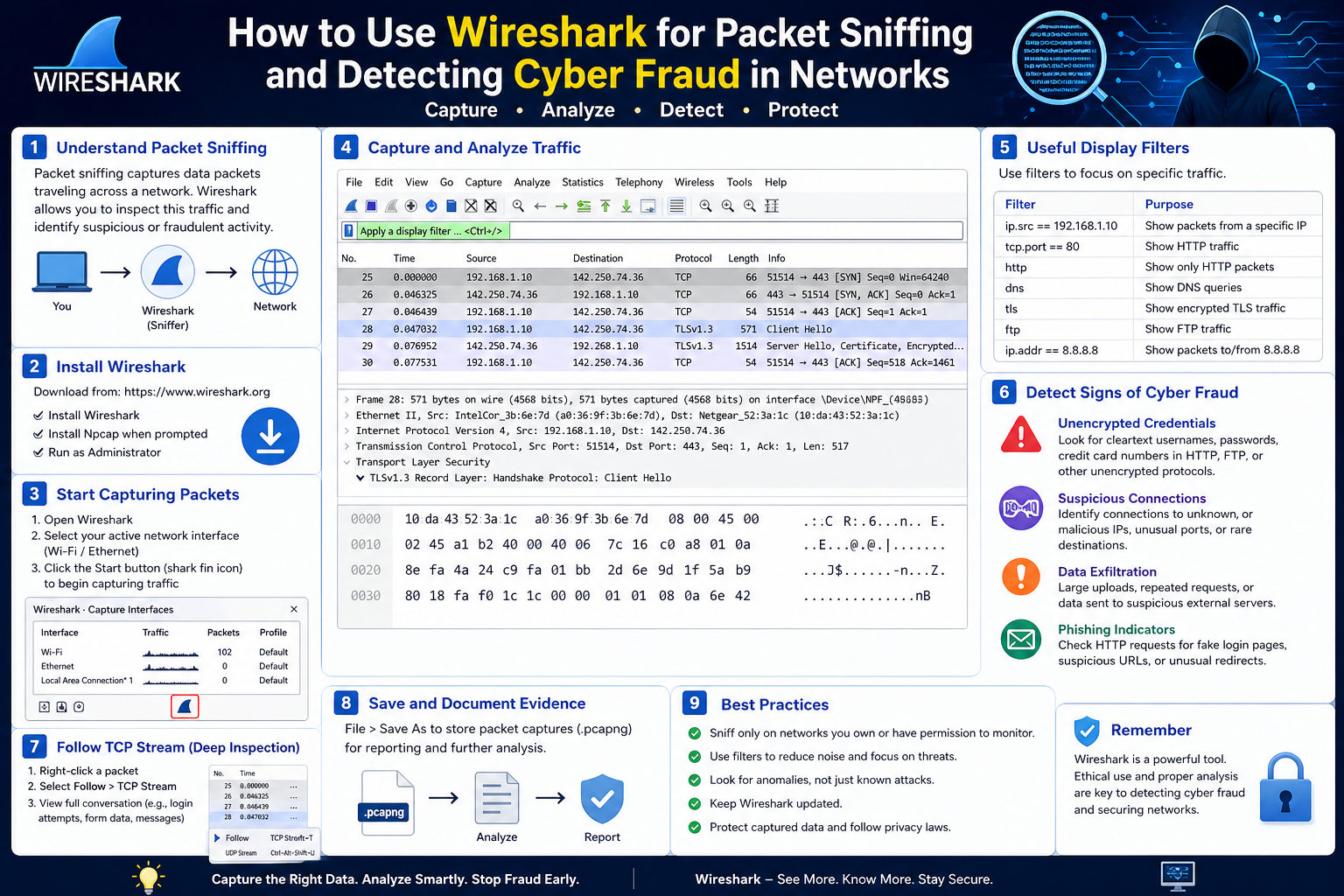
Packet sniffing is the process of observing and analyzing data as it travels across a network. Every action performed on the internet—opening a website, sending an email, streaming a video—gets broken down into small units of data called packets. These packets move through routers, switches, and network devices until they reach their destination, where they are reassembled into meaningful information.
In simple terms, packet sniffing is like observing traffic on a busy highway. Each vehicle represents a packet carrying a piece of information. By watching the traffic flow, you can learn where vehicles are coming from, where they are going, how fast they are moving, and whether anything unusual is happening.
In enterprise environments, this visibility becomes especially important. Networks are no longer simple systems with a few computers. They are complex ecosystems involving cloud services, remote workers, mobile devices, APIs, and third-party integrations. Within this complexity, packet sniffing provides a way to understand what is actually happening beneath the surface.
While it is often associated with troubleshooting, packet sniffing also plays a major role in cybersecurity and fraud detection. It allows analysts to observe patterns that are invisible at the application level, making it possible to identify suspicious behavior even when no obvious signs of attack are present.
How Network Packets Travel Across Systems
To understand packet sniffing properly, it is important to understand what a packet is. When data is sent across a network, it is not transmitted as a single block. Instead, it is divided into smaller chunks for efficiency and reliability. Each packet contains two main parts:
The header, which includes metadata such as source and destination IP addresses, protocol type, and routing instructions.
The payload, which contains the actual data being transmitted.
As packets move across networks, they pass through multiple devices that read the header information to determine where to send them next. These devices do not need to inspect the payload unless specifically configured to do so.
This structure allows networks to be highly scalable and efficient, but it also creates opportunities for analysis. By observing packet headers and flow behavior, it becomes possible to reconstruct communication patterns without directly accessing the content itself.
In enterprise environments, this ability is extremely valuable. Even when data is encrypted, packet metadata still reveals useful information such as timing, frequency, destination endpoints, and traffic volume. These signals often provide early indicators of abnormal or malicious activity.
The Role of Packet Sniffing in Enterprise Security
Organizations typically think of security in terms of firewalls, antivirus systems, and access controls. While these tools are important, they primarily focus on prevention and detection at specific points in the network. Packet sniffing adds another layer by offering continuous visibility into how data behaves after it enters the network.
One of the key challenges in modern cybersecurity is that attackers rarely rely on obvious or single-point intrusion methods. Instead, they often blend into normal network activity. This is where packet sniffing becomes useful. It allows analysts to detect subtle changes in traffic behavior that may indicate compromise.
For example, if a workstation suddenly begins communicating with unfamiliar external servers at regular intervals, this could indicate the presence of unauthorized software. Similarly, unusually large data transfers during off-peak hours may suggest data exfiltration attempts.
In fraud-related scenarios, packet analysis can also reveal proxy usage, identity masking behavior, or unusual routing patterns that suggest traffic is being redirected through unauthorized channels. These insights are often not visible through standard system logs.
Introduction to Wireshark as a Packet Analysis Tool
One of the most widely used tools for packet analysis is Wireshark. It is designed to capture and inspect network traffic in real time or from saved data files. What makes it particularly valuable is its ability to present complex network data in a structured and readable format.
Wireshark works by capturing packets directly from a network interface. Once captured, each packet is decoded and displayed with detailed information such as timestamps, protocol layers, source and destination addresses, and packet length.
Instead of requiring manual interpretation of raw binary data, Wireshark organizes everything into a hierarchical view. This makes it easier to trace communication flows and identify relationships between different network events.
In enterprise environments, Wireshark is often used for both troubleshooting and investigative purposes. It helps identify issues such as slow network performance, misconfigured devices, or unexpected traffic spikes. However, its value extends far beyond simple diagnostics.
Security teams also use Wireshark to investigate suspicious behavior, analyze attack patterns, and validate whether security controls are functioning correctly. Because it provides raw visibility into network traffic, it becomes a powerful tool for uncovering hidden activity.
How Wireshark Captures and Interprets Network Traffic
Wireshark operates by placing the network interface card (NIC) into a mode that allows it to capture all visible packets passing through that interface. This is often referred to as promiscuous mode. In this state, the system is not limited to only receiving packets addressed to it but can observe a broader range of traffic.
Once packets are captured, Wireshark processes them using a decoding engine that understands hundreds of network protocols. Each packet is dissected layer by layer, allowing analysts to see details from Ethernet frames up to application-level protocols such as HTTP or DNS.
This layered visibility is crucial because it allows investigators to move between different levels of abstraction. For example, they can start by identifying a suspicious IP address and then drill down into the specific types of requests being made, timing patterns, and communication frequency.
Even when payload data is encrypted, Wireshark can still provide meaningful insights through metadata. This includes handshake behavior, certificate exchanges, packet sizes, and timing intervals, all of which can help identify unusual activity patterns.
The Importance of Metadata in Network Analysis
One of the most powerful aspects of packet sniffing is the ability to analyze metadata. While encrypted communication hides the actual content of messages, it does not hide structural information.
Metadata includes details such as:
Source and destination IP addresses
Packet size and frequency
Protocol types being used
Connection duration
Timing between requests
This information can reveal patterns that are highly useful in both troubleshooting and fraud detection scenarios.
For instance, if a device is consistently sending small packets to an external server every few seconds, this could indicate beaconing behavior often associated with malware. Similarly, a sudden increase in outbound traffic volume might suggest data leakage.
In enterprise environments, these patterns are often more important than the content itself because they provide early warning signals. Attackers may encrypt their data, but they cannot easily hide the fact that communication is occurring.
Limitations of Packet Sniffing in Encrypted Environments
While packet sniffing is powerful, it does have limitations. The most significant challenge today is encryption. Most modern internet traffic uses secure protocols such as HTTPS, which encrypt the payload of packets.
This means that while tools like Wireshark can still capture packets, they cannot directly read the content inside encrypted transmissions without additional decryption keys or advanced configurations.
However, encryption does not make packet sniffing useless. Instead, it shifts the focus from content analysis to behavioral analysis. Analysts must rely on indirect indicators such as traffic patterns, endpoint behavior, and protocol usage.
For example, even if the contents of a web request are encrypted, it is still possible to observe which domains are being contacted, how often connections are made, and how much data is exchanged. These signals are often enough to detect anomalies.
Packet Sniffing as a Tool for Fraud Awareness
Fraud in enterprise networks does not always resemble traditional financial scams or identity theft. Instead, it often manifests as unauthorized access, hidden data channels, or compromised systems being used for external communication.
Packet sniffing helps expose these behaviors by providing visibility into network activity that would otherwise remain hidden. For example, a compromised device might begin communicating with unfamiliar servers located in different geographic regions. Even without knowing the exact content of these communications, analysts can flag the behavior as suspicious.
In some cases, fraud involves the use of proxy networks that route traffic through multiple compromised systems. This technique helps attackers disguise their location and avoid detection. Packet analysis can help identify unusual routing patterns that suggest such behavior is occurring.
Enterprise networks are especially attractive targets for these types of activities because they often contain high-value data and have large amounts of legitimate traffic that can be used to mask malicious behavior.
Early Indicators of Suspicious Network Activity
One of the key advantages of packet sniffing is the ability to detect early warning signs of compromise. These indicators are often subtle and may not trigger traditional security alerts.
Some examples include unexpected connections to external IP addresses, repeated failed connection attempts, unusual protocol usage, or irregular packet timing patterns. Individually, these events may seem harmless, but when analyzed together, they can reveal a larger pattern of concern.
Over time, consistent monitoring of packet-level data helps build a baseline of normal network behavior. Once this baseline is established, deviations become easier to identify and investigate.
This concept of behavioral baselining is central to modern network security practices and forms the foundation for more advanced detection techniques explored in later sections.
Moving Beyond Basic Packet Observation
Once the fundamentals of packet sniffing are understood, the next step is learning how to interpret deeper network behavior. At a surface level, packet capture tools show a continuous stream of communication between devices. However, the real value comes from identifying patterns hidden within that stream.
In enterprise environments, normal network traffic follows predictable structures. Devices communicate with known servers, applications behave consistently, and data flows in expected directions. When something deviates from this baseline, it often signals a deeper issue.
Advanced packet analysis focuses less on individual packets and more on relationships between them. This includes timing patterns, repetition cycles, endpoint consistency, and protocol usage trends. These behavioral indicators are often more important than the actual content of the packets.
Fraud detection in networks relies heavily on this type of interpretation. Instead of looking for obvious signs of malicious activity, analysts search for subtle inconsistencies that suggest abnormal behavior.
Understanding Network Layers and Behavioral Visibility
Network communication is structured across multiple layers, commonly described using the OSI model. Each layer plays a specific role in how data is transmitted and interpreted.
At the lower layers, physical and data link communication handles raw transmission between devices. At higher layers, protocols such as TCP, HTTP, and DNS manage how applications communicate over the internet.
Packet sniffing tools like Wireshark allow analysts to view data across these layers simultaneously. This layered visibility is important because different types of fraud or intrusion manifest at different levels.
For example, unusual MAC address behavior may indicate local network spoofing, while abnormal DNS queries may suggest command-and-control communication. At the application layer, unexpected HTTP requests can reveal unauthorized web activity.
Understanding how these layers interact allows analysts to correlate events across the entire network stack. This makes it possible to identify complex fraud scenarios that would otherwise remain hidden.
Identifying Anomalous Traffic Patterns in Enterprise Networks
One of the most effective ways to detect fraud is by identifying anomalies in traffic patterns. Normal enterprise traffic tends to follow predictable rhythms. Employees log in during working hours, applications communicate with known services, and data transfers occur at consistent rates.
Anomalous behavior disrupts this rhythm. It may appear as sudden spikes in outbound traffic, unexpected communication during off-hours, or repeated connections to unfamiliar external systems.
For example, a workstation that suddenly begins sending large volumes of encrypted data to a remote server could indicate unauthorized data transfer. Even if the content is encrypted, the volume and timing alone can raise suspicion.
Similarly, a device that begins communicating with multiple geographically dispersed IP addresses in a short period of time may be participating in a proxy network or botnet infrastructure.
These patterns are often the first indicators of compromised systems within enterprise environments.
DNS Behavior as a Hidden Indicator of Fraud
Domain Name System activity is one of the most overlooked sources of forensic information in packet analysis. Every time a device connects to a website or service, it typically performs a DNS query to resolve a domain name into an IP address.
Under normal conditions, DNS queries are relatively predictable. Devices frequently access known domains such as internal services, cloud platforms, or commonly used applications.
However, malicious activity often introduces unusual DNS patterns. These may include frequent requests to newly registered domains, randomized subdomains, or domains that resolve to rapidly changing IP addresses.
These behaviors are commonly associated with command-and-control infrastructure used by attackers. By monitoring DNS traffic, analysts can detect early signs of compromise even when other network activity appears normal.
DNS analysis becomes especially powerful when combined with packet-level inspection, as it helps connect domain behavior with actual traffic flows.
The Role of Encryption in Modern Fraud Techniques
Encryption has become a standard part of internet communication. While it protects user privacy, it also creates challenges for network visibility. Attackers often take advantage of encryption to hide malicious activity within legitimate-looking traffic.
Encrypted traffic cannot easily be inspected at the payload level without decryption keys. However, packet sniffing still provides valuable metadata even when encryption is present.
This includes information such as handshake timing, certificate exchanges, session duration, and packet size distribution. These elements can reveal suspicious behavior even when content is inaccessible.
For instance, encrypted connections that are unusually short-lived but highly frequent may indicate automated data exchange. Similarly, repeated connections to the same external endpoint using encrypted channels can suggest covert communication.
Fraud detection in encrypted environments, therefore, relies heavily on indirect analysis rather than direct inspection.
Proxy Networks and Traffic Masking Techniques
One of the more advanced fraud techniques involves the use of proxy networks. These systems route traffic through multiple intermediary nodes to hide the source of communication.
In enterprise environments, compromised devices can be turned into proxy nodes without the user’s knowledge. Once infected, a device may begin forwarding traffic for external actors, effectively becoming part of a distributed network.
This behavior is difficult to detect using traditional security tools because the traffic often appears legitimate. However, packet analysis can reveal inconsistencies in routing patterns.
For example, a device that suddenly begins handling large volumes of traffic unrelated to its normal function may be acting as a proxy node. Similarly, unusual geographic routing patterns can indicate that traffic is being relayed through unexpected regions.
These proxy-based fraud systems are particularly dangerous because they blend into normal enterprise traffic and can remain undetected for long periods.
Browser-Based Hijacking and Hidden Network Activity
A growing method of network compromise involves browser-based attacks. Instead of installing traditional malware, attackers use browser extensions or scripts to manipulate network traffic directly within the browsing environment.
These extensions may appear harmless, offering useful features or productivity enhancements. However, behind the scenes, they can redirect traffic through external proxy services or inject hidden requests into normal browsing activity.
Because browsers are widely used in enterprise environments, they provide an effective vector for subtle network manipulation. The traffic generated by these extensions often blends with legitimate web activity, making it difficult to distinguish.
Packet analysis can help identify these behaviors by examining request timing, destination inconsistencies, and unusual background communication patterns.
In some cases, browser-based hijacking may cause consistent background traffic even when the user is not actively browsing, which becomes a key indicator of compromise.
Detecting Data Exfiltration Through Packet Patterns
Data exfiltration refers to the unauthorized transfer of information from a network. This is one of the most serious forms of enterprise fraud because it often involves sensitive or confidential data.
Detecting exfiltration using packet analysis requires careful observation of outbound traffic patterns. While small amounts of data transfer are normal, large or consistent uploads to external servers can be suspicious.
Attackers often attempt to disguise exfiltration by breaking data into smaller chunks or spreading it across multiple connections. However, packet sniffing tools can still detect the overall pattern of increased outbound activity.
Timing analysis is also important. If data transfers occur at unusual times, such as late at night or during periods of low network usage, they may warrant further investigation.
Even when encryption is used, volume and frequency remain strong indicators of potential data leakage.
The Importance of Baseline Network Behavior
Effective fraud detection depends on understanding what normal network behavior looks like. Without a baseline, it is difficult to identify anomalies with confidence.
Baseline behavior includes typical traffic volumes, common communication endpoints, regular usage times, and expected protocol distribution. Once this baseline is established, deviations become easier to detect.
For example, if a department typically communicates only with internal servers and known cloud platforms, any new external communication may be worth investigating.
Baseline analysis is not static. Networks evolve, and what is considered normal today may change as new applications and services are introduced. Continuous monitoring is therefore essential.
Packet-level visibility helps maintain an up-to-date understanding of network behavior by providing real-time insights into communication patterns.
Correlating Multiple Indicators for Fraud Detection
Individual anomalies in network traffic do not always indicate fraud. However, when multiple indicators appear together, the likelihood of malicious activity increases significantly.
For example, unusual DNS queries combined with increased encrypted traffic and unfamiliar external connections may suggest coordinated malicious behavior.
Correlation analysis involves combining different types of packet-level observations to form a complete picture of network activity. This approach reduces false positives and improves detection accuracy.
In enterprise environments, this type of analysis is often performed continuously to identify emerging threats before they escalate into full-scale incidents.
By examining relationships between packets, endpoints, and communication patterns, analysts can uncover hidden structures within network traffic that point toward fraud or compromise.
Transitioning From Observation to Investigation
As packet analysis becomes more advanced, the focus shifts from simply observing network traffic to actively investigating suspicious behavior. At this stage, the analyst is no longer just watching packets move through a system but is trying to understand the intent behind the communication.
Enterprise fraud detection relies heavily on this investigative mindset. Instead of asking “what is happening on the network,” the question becomes “why is this happening, and does it align with expected behavior?”
Tools like Wireshark allow analysts to move fluidly between broad overviews of traffic and detailed inspection of individual packet exchanges. This flexibility is essential when dealing with complex fraud scenarios where malicious activity is intentionally disguised as normal traffic.
The investigation begins by narrowing down traffic segments of interest. This may include filtering by IP address, protocol type, or time range. Once a suspicious pattern is identified, deeper inspection of packet sequences can reveal the structure of communication between devices.
Filtering Techniques for Targeted Packet Analysis
In large enterprise networks, millions of packets may be captured within minutes. Without filtering, meaningful analysis becomes nearly impossible. Filtering allows analysts to focus only on relevant traffic.
Filters can be based on multiple criteria such as source and destination IP addresses, protocol types, or specific port numbers. For example, isolating DNS traffic can help identify unusual domain resolution patterns, while filtering HTTP or HTTPS traffic can highlight web-based anomalies.
Targeted filtering is especially important in fraud detection because attackers often blend malicious traffic with legitimate communication. By narrowing the dataset, analysts can identify subtle irregularities that would otherwise remain hidden.
Another important filtering approach involves time-based analysis. Examining traffic within a specific time window can reveal bursts of activity that correlate with suspicious events.
Following the Flow of Suspicious Communication
One of the most powerful investigative techniques in packet analysis is following a complete communication stream. Instead of analyzing isolated packets, the analyst reconstructs an entire session between two endpoints.
This approach helps reveal the full context of communication, including request sequences, response patterns, and timing relationships.
In fraud investigations, following a stream can uncover hidden behaviors such as staged data transfers or multi-step command sequences. These patterns often indicate automated or scripted activity rather than normal human interaction.
For example, a compromised system may first establish a connection, then perform authentication-like behavior, followed by data transmission. Each step may appear normal in isolation, but together they form a recognizable malicious pattern.
Detecting Command-and-Control Communication Patterns
One of the most critical aspects of enterprise fraud detection is identifying command-and-control (C2) communication. This refers to the hidden channels used by attackers to remotely control compromised systems.
C2 traffic is often designed to appear harmless. It may use standard protocols, mimic legitimate web traffic, or blend into normal background activity.
However, packet-level analysis can reveal subtle indicators. These include consistent periodic connections, small but frequent data exchanges, or communication with unusual external endpoints.
C2 systems often rely on predictable timing intervals, where infected devices “check in” regularly with external servers. This behavior creates a detectable rhythm in network traffic.
Even when encrypted, these patterns can still be observed through metadata analysis, making packet sniffing an essential tool for identifying hidden control channels.
Investigating Proxy-Based Fraud Infrastructure
Proxy-based fraud is increasingly common in enterprise environments. In these scenarios, compromised devices are used to route traffic for external actors, effectively disguising the true origin of communication.
This creates a complex web of traffic that can be difficult to trace without detailed packet analysis. Instead of direct connections, data may pass through multiple intermediary nodes before reaching its destination.
Investigators use packet analysis to identify inconsistencies in routing behavior. For example, a device that suddenly begins handling large volumes of unrelated outbound traffic may be acting as part of a proxy chain.
Another indicator is inconsistent geographic routing. If traffic appears to originate from a corporate network but consistently terminates in unexpected global locations, it may suggest proxy manipulation.
These patterns are often subtle, requiring careful correlation of multiple data points across time and network layers.
Identifying Malware-Like Communication Behavior
Malware often exhibits distinct communication patterns that differ from normal application behavior. These patterns can include frequent small packet exchanges, repetitive connection attempts, or communication with dynamically changing endpoints.
Packet sniffing allows analysts to observe these behaviors in real time. Even when malware attempts to disguise itself, its communication structure often reveals its presence.
For example, malware may attempt to maintain persistence by regularly contacting a remote server. These “heartbeat” communications are often uniform in size and timing, making them distinguishable from normal user activity.
Another common pattern involves burst-like data transmission, where large amounts of data are sent in short intervals. This may indicate data harvesting or system scanning activity.
Browser-Based Fraud and Invisible Network Channels
Modern fraud techniques increasingly rely on browser-based mechanisms. Instead of installing visible software, attackers use browser extensions, scripts, or embedded processes to manipulate network behavior.
These methods are particularly difficult to detect because browsers are inherently trusted applications in enterprise environments. As a result, their network activity is often assumed to be legitimate.
However, packet analysis can reveal hidden communication channels initiated by browser processes. These may include background requests to unfamiliar domains or continuous data exchange with external services.
In some cases, browser-based fraud may involve silent proxy routing, where user traffic is redirected without a visible indication. This creates a scenario where normal browsing activity becomes a vehicle for hidden data transmission.
By examining packet timing and destination patterns, analysts can identify discrepancies between expected and actual browser behavior.
Detecting Data Leakage Through Subtle Traffic Changes
Data leakage is one of the most sensitive forms of enterprise fraud. It often occurs gradually and may not involve large, obvious transfers of data.
Instead, attackers attempt to exfiltrate information in small increments over time. This makes detection challenging because individual packets appear harmless.
However, when analyzed collectively, these small transfers create a recognizable pattern. Packet sniffing tools can detect gradual increases in outbound traffic volume or repeated communication with external endpoints.
Timing analysis is also important. Data leakage often occurs during periods of low monitoring activity, such as overnight hours or weekends.
Even when encryption is used, the volume and consistency of outbound traffic can indicate potential leakage behavior.
Behavioral Correlation Across Multiple Devices
Enterprise fraud is rarely limited to a single device. Instead, compromised systems often operate as part of a larger network of infected endpoints.
Packet analysis allows investigators to correlate behavior across multiple devices. This involves comparing traffic patterns, communication endpoints, and timing behavior across the entire network.
If multiple devices begin communicating with the same external server or exhibit synchronized traffic patterns, this may indicate coordinated malicious activity.
This type of correlation is essential for identifying distributed fraud systems, where attackers use multiple compromised machines to mask their operations.
By analyzing network-wide patterns, investigators can move beyond isolated incidents and identify broader infrastructure-level threats.
Identifying Lateral Movement Within Networks
Lateral movement refers to the process by which attackers move from one compromised system to another within the same network. This is a common strategy used in enterprise fraud and intrusion scenarios.
Packet sniffing can help detect lateral movement by observing internal communication patterns between devices that do not normally interact.
For example, if a workstation begins communicating with administrative servers or other endpoints it has no business reason to contact, this may indicate lateral movement activity.
These interactions often involve authentication attempts, file transfers, or remote command execution patterns.
By analyzing internal packet flows, investigators can map how an attacker is navigating through the network environment.
Understanding Timing Anomalies in Network Traffic
Timing is one of the most powerful indicators in packet analysis. Normal network behavior follows predictable timing structures based on human activity and application design.
When these timing patterns are disrupted, it may indicate automated processes or malicious activity.
For example, extremely regular communication intervals may suggest scripted behavior rather than human interaction. Similarly, bursts of activity at unusual hours may indicate background processes operating without user knowledge.
Timing anomalies are especially useful when combined with other indicators such as unusual destinations or unexpected data volumes.
Even when individual packets appear normal, timing irregularities can reveal hidden automation or coordination.
Building a Complete Picture of Fraud Through Packet Analysis
Advanced packet analysis involves combining multiple investigative techniques into a unified understanding of network behavior.
Instead of focusing on individual anomalies, analysts build a comprehensive picture that includes traffic patterns, communication flows, timing behavior, and endpoint relationships.
This holistic approach allows for more accurate identification of fraud and reduces the likelihood of false positives.
By continuously observing network traffic and correlating multiple data points, it becomes possible to detect sophisticated fraud schemes that operate below the surface of traditional security systems.
The combination of packet-level visibility, behavioral analysis, and correlation techniques creates a powerful framework for understanding and identifying complex network threats.
The Growing Complexity of Enterprise Network Traffic
Modern enterprise networks are far more complex than traditional corporate systems. With cloud adoption, remote work environments, mobile devices, and hybrid infrastructures, network traffic is no longer contained within a single physical boundary. Instead, data flows continuously between on-premises systems, cloud platforms, third-party APIs, and external services.
This complexity creates both opportunity and risk. On one hand, businesses gain flexibility and scalability. On the other hand, visibility becomes harder to maintain. Packet sniffing plays a crucial role in restoring that visibility by allowing analysts to observe traffic patterns regardless of where the data originates or terminates.
In such environments, even legitimate applications generate large volumes of background traffic. Software updates, synchronization services, and API calls create constant noise. Within this noise, malicious activity can easily hide. This is why deep packet inspection and behavioral analysis are increasingly important for maintaining security awareness.
Advanced Threats and Evasive Communication Techniques
Attackers today rarely rely on simple or direct communication methods. Instead, they use layered and adaptive techniques designed to avoid detection. One common approach involves mimicking legitimate application behavior so that malicious traffic blends seamlessly with normal operations.
For example, malicious software may use standard web protocols such as HTTPS to communicate with external servers. It may also randomize communication intervals or distribute traffic across multiple endpoints to avoid detection patterns.
Another advanced technique involves domain generation algorithms, where malicious systems continuously generate new domain names for communication. This makes it difficult for traditional security tools to block traffic based on static lists.
Packet analysis helps counter these techniques by focusing on behavior rather than identity. Even when domain names or IP addresses change frequently, underlying communication patterns often remain consistent. These patterns include timing structure, packet size distribution, and repeated session behaviors.
The Impact of Remote Work on Network Visibility
The shift toward remote and hybrid work environments has significantly expanded the attack surface for enterprise networks. Employees now connect from home networks, public Wi-Fi, and mobile hotspots, introducing a wide range of unpredictable traffic conditions.
This distributed environment makes it more difficult to establish a consistent baseline for normal behavior. Devices may connect from different locations, use different networks, and interact with cloud services in varying ways.
Packet sniffing becomes especially valuable in this context because it focuses on data behavior rather than physical location. Regardless of where a device connects from, its network activity still follows identifiable patterns.
For instance, a compromised device will often exhibit abnormal communication regardless of whether it is on a corporate network or a home connection. This consistency allows analysts to detect fraud even in highly distributed environments.
Machine-Like Behavior as a Key Detection Signal
One of the most important indicators in modern fraud detection is the presence of machine-like behavior within network traffic. Human-generated activity tends to be irregular, with natural variations in timing, frequency, and data usage.
In contrast, automated systems and malicious scripts often produce highly structured and repetitive traffic patterns. These patterns can include uniform packet sizes, consistent timing intervals, or continuous background communication without user interaction.
Packet sniffing tools can detect these subtle differences by analyzing traffic at scale. Over time, even sophisticated attackers struggle to perfectly replicate human variability, making behavioral detection a powerful security mechanism.
This type of analysis is particularly useful in identifying botnet activity, automated data scraping, and unauthorized background processes operating within enterprise systems.
Role of Internal Lateral Communication in Fraud Detection
Internal network communication is often overlooked in fraud detection strategies. Many organizations focus heavily on external threats while assuming internal traffic is safe. However, compromised systems frequently use internal communication channels to spread or escalate privileges.
Lateral movement within a network allows attackers to gain access to more sensitive systems after initial compromise. This movement often involves authentication attempts, file sharing, or remote service interaction between devices that normally do not communicate.
Packet-level visibility helps identify these unusual internal interactions. For example, a workstation accessing administrative servers without a clear business justification may indicate suspicious activity.
By analyzing internal traffic flows, analysts can map relationships between devices and identify unexpected communication paths that may indicate deeper compromise.
Importance of Long-Term Traffic Pattern Analysis
Short-term observation of network traffic can reveal immediate anomalies, but long-term analysis provides a much deeper understanding of system behavior. Over time, networks develop stable communication patterns that reflect organizational workflows and application usage.
By continuously monitoring packet data, analysts can build historical profiles of normal activity. These profiles make it easier to identify gradual changes that might otherwise go unnoticed.
For example, a slow increase in outbound encrypted traffic over several weeks may indicate data exfiltration that is being carefully staged to avoid detection. Similarly, gradual shifts in DNS behavior may suggest the introduction of unauthorized services or infrastructure.
Long-term analysis also helps distinguish between temporary anomalies and persistent threats, improving the accuracy of fraud detection efforts.
Correlation Between Application Behavior and Network Activity
Another important aspect of advanced packet analysis is correlating application behavior with network activity. In enterprise environments, applications are expected to behave in predictable ways based on their function.
When network activity does not align with expected application behavior, it becomes a potential indicator of compromise. For example, a document editing application generating continuous external network requests would be highly unusual.
Packet sniffing allows analysts to connect application-level behavior with underlying network traffic, creating a more complete understanding of system activity. This correlation helps identify hidden processes or injected behaviors that may not be visible through standard monitoring tools.
Evolving Role of Packet Analysis in Security Operations
Packet analysis is no longer just a troubleshooting tool. It has become an integral part of modern security operations. As threats become more sophisticated, organizations are increasingly relying on deep network visibility to detect and respond to incidents.
Instead of reacting to alerts after damage has occurred, packet-level monitoring enables earlier detection of suspicious behavior. This shift from reactive to proactive security significantly improves an organization’s ability to prevent fraud and minimize risk.
In many cases, packet analysis serves as the final layer of verification when other security tools raise concerns. It provides the raw evidence needed to confirm whether an incident is genuine or a false alarm.
Human Decision-Making vs Automated Network Behavior
One of the most overlooked aspects of packet analysis is the difference between human-driven actions and system-driven automation. In enterprise environments, most network activity is generated by applications rather than direct user interaction. This creates a layered environment where multiple automated processes operate simultaneously, each contributing to overall traffic flow.
Fraud detection becomes more effective when analysts understand this distinction. Human behavior tends to be irregular and context-dependent, while automated systems follow strict logic and repetition. Packet sniffing helps expose this difference by highlighting consistency patterns that do not align with natural usage.
For example, a user browsing the internet will generate varied request timing, different session lengths, and inconsistent navigation paths. In contrast, malicious automation often produces uniform intervals, repetitive requests, and predictable communication cycles. Recognizing this contrast helps identify unauthorized processes that attempt to mimic legitimate user activity.
The Importance of Endpoint Communication Mapping
Another critical dimension of packet analysis is endpoint relationship mapping. Every device within a network communicates with a set of known and unknown endpoints. Over time, these relationships form a communication graph that reflects organizational behavior.
When fraud occurs, this graph often changes in subtle but noticeable ways. New endpoints may appear suddenly, or existing devices may begin interacting with services they have never used before. These changes are often early indicators of compromise.
By continuously mapping endpoint communication, analysts can identify deviations from established patterns. Even if individual packets appear harmless, their relationships within the broader network structure may reveal suspicious intent.
This approach is particularly useful in detecting stealthy fraud operations that avoid large data transfers and instead rely on small, distributed interactions across multiple systems.
Another important dimension of packet sniffing is contextual awareness within mixed traffic environments. In enterprise systems, multiple applications often share the same network paths, which can obscure the origin of specific communication patterns. By analyzing packet context—such as session origin, application signatures, and sequence continuity—analysts can better separate legitimate operations from hidden fraudulent activity. This becomes especially useful when multiple services are active simultaneously on a single device, as attackers often rely on this overlap to conceal malicious communication within normal workflows. Packet-level inspection helps isolate these interactions and preserve clarity even in highly congested network environments.
Conclusion
Packet sniffing has become an essential part of modern network visibility, especially in enterprise environments where traffic is complex, distributed, and constantly evolving. Tools like Wireshark allow analysts to move beyond surface-level monitoring and gain a detailed view of how data actually flows between systems. This visibility is critical not only for troubleshooting performance issues but also for identifying hidden fraud activities that often blend into normal network behavior.
As enterprise networks grow in scale and sophistication, fraud techniques have also become more advanced. Attackers increasingly rely on encryption, proxy networks, browser-based manipulation, and distributed infrastructure to hide their actions. However, even when the content of communication is concealed, packet-level metadata continues to reveal meaningful patterns such as timing anomalies, unusual traffic volumes, and suspicious communication endpoints.
The real strength of packet analysis lies in its ability to uncover relationships and behaviors rather than just isolated events. By observing patterns across multiple layers of the network, analysts can detect early signs of compromise, identify abnormal communication flows, and track potential fraud activity before it escalates.
Ultimately, packet sniffing serves as a foundational capability in network security, providing the clarity needed to understand, investigate, and respond to modern digital threats effectively.