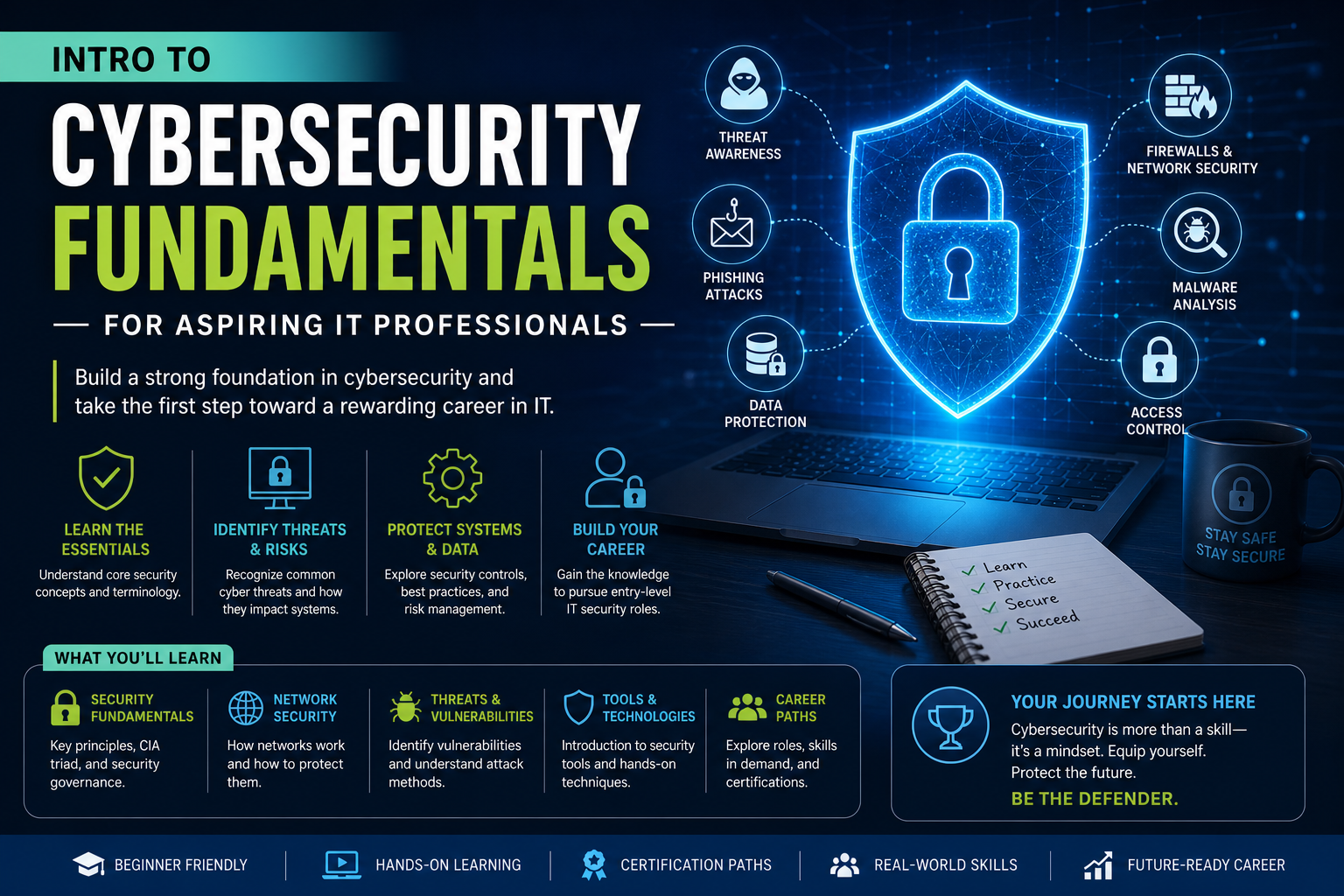
Cybersecurity refers to the practice of protecting computers, networks, systems, and data from unauthorized access, damage, or disruption. In today’s digital environment, nearly every activity depends on technology in some form. From sending messages and storing personal files to running entire businesses and critical infrastructure, digital systems have become deeply integrated into everyday life. Because of this dependence, security is no longer an optional consideration but a fundamental requirement.
To understand cybersecurity properly, it helps to think of it as an extension of physical security in the real world. Just as buildings have locks, alarms, guards, and surveillance systems, digital environments also rely on layers of protection. However, unlike physical spaces, digital systems are constantly exposed to invisible and automated threats that can originate from anywhere in the world. This makes cybersecurity a constantly evolving discipline.
Another important aspect of cybersecurity is that it is not limited to technical professionals. Every user who interacts with a device connected to a network plays a role in maintaining security. Whether someone is browsing the internet, sending emails, or accessing applications, each action has the potential to either strengthen or weaken a system’s defenses. This shared responsibility makes cybersecurity both a technical field and a behavioral discipline.
Modern cybersecurity also involves understanding how systems are built and how they can fail. Every system has vulnerabilities, whether due to software flaws, misconfigurations, or human error. The goal of cybersecurity is not to achieve perfect security, which is impossible, but to reduce risk to an acceptable level while maintaining functionality and usability.
Why Cybersecurity Matters Beyond Technology
Cybersecurity is often misunderstood as purely a technical issue, but its impact extends far beyond computers and networks. It affects finance, healthcare, government operations, education systems, and even personal relationships. When digital systems are compromised, the consequences can include financial loss, privacy violations, service disruptions, and reputational damage.
Organizations rely heavily on digital infrastructure to operate efficiently. A disruption in these systems can halt business operations, delay services, and cause widespread inconvenience. For example, if a company’s internal systems are compromised, employees may lose access to essential tools, communication platforms, or stored data. This demonstrates how deeply cybersecurity is tied to organizational stability.
On a personal level, cybersecurity affects how individuals manage their identities online. Personal data such as passwords, financial details, and private communications are constantly at risk of exposure. Once compromised, this information can be misused in ways that are difficult to reverse. This highlights the importance of protecting digital identity as carefully as physical identity.
Cybersecurity also plays a role in maintaining trust in digital systems. People are more likely to use online services when they believe their data is safe. If trust is broken due to security failures, it can have long-term effects on how technology is adopted and used. In this sense, cybersecurity is not just about protection but also about enabling progress and innovation.
The Core Idea: Thinking Like a Defender
At the heart of cybersecurity is a way of thinking that focuses on protection, anticipation, and resilience. Instead of only reacting to problems after they occur, cybersecurity encourages individuals and organizations to think ahead and prepare for potential risks. This defensive mindset is essential in a landscape where threats are constantly evolving.
Thinking like a defender means assuming that systems can and will be targeted. Rather than relying on the assumption that nothing bad will happen, cybersecurity professionals design systems with the expectation that failures or attacks are possible. This leads to stronger, more resilient structures that can withstand unexpected events.
Another key aspect of this mindset is understanding that security is not a single action but a continuous process. Systems must be monitored, updated, and improved regularly. Threats do not remain static, so defenses cannot remain static either. This ongoing cycle of improvement is a defining feature of cybersecurity thinking.
Defensive thinking also involves prioritizing risks. Not all threats are equally dangerous, and not all systems require the same level of protection. Understanding what needs the most attention allows security efforts to be more efficient and effective. This helps in allocating resources wisely while still maintaining strong protection.
Everyday Cybersecurity vs Organizational Security
Cybersecurity operates at multiple levels, ranging from individual behavior to large-scale organizational systems. At the personal level, cybersecurity involves simple but important habits such as using strong passwords, recognizing suspicious messages, and keeping software updated. These actions form the foundation of digital safety for individuals.
At the organizational level, cybersecurity becomes more complex and structured. Companies must manage large networks, multiple users, sensitive data, and critical systems. This requires formal policies, specialized tools, and trained professionals who can enforce security measures consistently across the organization.
While the scale differs, the underlying principles remain similar. Both personal and organizational cybersecurity rely on awareness, prevention, and response. The difference lies in complexity and coordination. Organizations must manage security across many systems and users simultaneously, which increases the potential points of failure.
One of the most important connections between personal and organizational security is human behavior. Even the most advanced security systems can be weakened by simple mistakes made by users. This is why education and awareness are crucial at every level. Understanding how actions impact security helps reduce risks significantly.
Threat Landscape and How Attacks Actually Happen
Cyber threats come in many forms, and they continue to evolve as technology advances. Some attacks are highly technical, exploiting vulnerabilities in software or systems. Others rely on psychological manipulation, tricking individuals into revealing sensitive information. Understanding this landscape is essential to building effective defenses.
One common method used in cyberattacks is exploiting weaknesses in software. These weaknesses, often called vulnerabilities, can exist in operating systems, applications, or network configurations. Attackers search for these weaknesses and use them to gain unauthorized access or control over systems.
Another major category of threats involves deception. Instead of breaking into systems directly, attackers may attempt to manipulate users into voluntarily providing access. This can involve impersonation, misleading messages, or creating a sense of urgency to encourage mistakes. These methods highlight the importance of awareness in cybersecurity.
Automated attacks also play a significant role in the threat landscape. Many attacks are carried out by programs that scan networks for weaknesses continuously. This means that systems can be targeted at any time without direct human involvement. The scale and speed of these attacks make them particularly challenging to defend against.
Human Behavior as a Security Factor
Human behavior is one of the most significant elements in cybersecurity. Even the most advanced systems can be compromised if users are not careful or informed. This makes people both a strength and a vulnerability in digital security.
Many security issues arise from simple mistakes, such as using weak passwords, reusing credentials, or ignoring security warnings. These actions may seem minor, but they can create serious risks when combined with other vulnerabilities. Understanding the consequences of these behaviors is essential for improving overall security.
Another important factor is trust. People naturally trust familiar interfaces, messages, or requests. Attackers often exploit this tendency by imitating legitimate sources. This makes it difficult to distinguish between genuine and malicious communication without careful attention.
Training and awareness play a crucial role in shaping secure behavior. When individuals understand how threats work, they are better equipped to recognize and avoid them. This reduces the likelihood of successful attacks and strengthens the overall security environment.
The Role of Risk in Cybersecurity Thinking
Cybersecurity is fundamentally about managing risk rather than eliminating it completely. Every system has vulnerabilities, and every action carries some level of risk. The goal is to understand these risks and reduce them to acceptable levels.
Risk in cybersecurity is determined by two main factors: the likelihood of an event occurring and the potential impact if it does occur. By evaluating these factors, it becomes possible to prioritize security efforts more effectively. High-risk areas receive more attention, while lower-risk areas may require fewer resources.
This approach allows organizations to balance security with usability. Overly strict security measures can make systems difficult to use, while weak security can leave systems exposed. Finding the right balance is a key part of cybersecurity planning.
Risk management also involves preparing for uncertainty. Not all threats can be predicted, so systems must be designed to handle unexpected situations. This includes having backup systems, recovery plans, and monitoring mechanisms in place.
Building Blocks of Digital Protection
Cybersecurity is built on several foundational components that work together to protect systems. These components form layers of defense that address different types of risks and threats.
One of the most important building blocks is identity management. This involves ensuring that users are properly identified and that their access is controlled. By verifying identity, systems can ensure that only authorized individuals can access sensitive information.
Another key component is data protection. Information must be safeguarded both when it is stored and when it is transmitted. This ensures that even if data is intercepted, it cannot be easily understood or misused.
System security is also essential. This involves protecting the underlying infrastructure, including servers, networks, and devices. Secure configurations, regular updates, and monitoring all contribute to maintaining system integrity.
Together, these building blocks create a layered approach to security. Each layer adds additional protection, making it more difficult for threats to succeed.
Authentication and Identity Thinking
Authentication is the process of verifying that a user or system is who they claim to be. This is a fundamental part of cybersecurity because it controls access to systems and data. Without proper authentication, unauthorized access becomes much easier.
Identity thinking in cybersecurity involves ensuring that every user has a unique and verifiable identity. This allows systems to track actions and enforce appropriate access levels. Different users may have different permissions depending on their role or responsibilities.
Strong authentication methods often involve multiple factors. Instead of relying on a single piece of information, such as a password, systems may require additional verification steps. This makes it more difficult for unauthorized users to gain access.
Identity management also includes maintaining records of user activity. This helps detect unusual behavior and provides accountability. If something goes wrong, it becomes easier to trace the source and understand what happened.
Data Protection and Encryption Mindset
Data protection is a central concern in cybersecurity because data is often the primary target of attacks. Protecting data involves ensuring its confidentiality, integrity, and availability.
Encryption is one of the most important tools used for data protection. It transforms readable information into a coded format that can only be understood with the correct key. This ensures that even if data is intercepted, it remains unreadable to unauthorized parties.
A strong data protection mindset assumes that data may be exposed at some point and prepares accordingly. This means that even if systems are compromised, the data itself remains secure or unusable to attackers.
Data protection also involves controlling access to information. Not all users need access to all data, so restricting access helps reduce risk. Proper data classification ensures that sensitive information receives the appropriate level of protection.
Monitoring, Detection, and Awareness
Monitoring systems is essential for identifying potential security issues. Continuous observation allows organizations to detect unusual activity and respond quickly to threats. Without monitoring, attacks may go unnoticed for long periods.
Detection involves identifying patterns that indicate possible security incidents. This requires analyzing system behavior and recognizing deviations from normal activity. Early detection can significantly reduce the impact of an attack.
Awareness is closely connected to monitoring. When users and systems are aware of potential risks, they are more likely to notice suspicious behavior. This collective awareness strengthens overall security.
Effective monitoring systems also generate alerts when certain conditions are met. These alerts help security teams respond quickly and take appropriate action. Speed of response is often critical in minimizing damage.
Incident Response Thinking
Incident response refers to the process of handling security breaches or attacks when they occur. Even with strong defenses, incidents can still happen, making response planning essential.
Incident response thinking involves being prepared for different types of scenarios. This includes identifying potential threats, establishing response procedures, and ensuring that resources are available when needed.
A key part of incident response is minimizing damage. The faster a threat is contained, the less impact it will have on systems and data. This requires coordination, communication, and clear procedures.
Another important aspect is learning from incidents. After an event occurs, analyzing what happened helps improve future defenses. This continuous learning process strengthens security over time.
Continuous Improvement in Security
Cybersecurity is not a static field. It evolves constantly as new technologies emerge and new threats develop. Because of this, continuous improvement is essential.
Systems must be regularly updated to address new vulnerabilities. Security practices must also evolve to reflect changing threat landscapes. This ongoing adaptation ensures that defenses remain effective over time.
Continuous improvement also involves reviewing existing security measures. What worked in the past may no longer be sufficient. Regular evaluation helps identify weaknesses and opportunities for improvement.
Training and awareness also contribute to continuous improvement. As people become more informed, they make better decisions, reducing the likelihood of security incidents.
Expanding the Cybersecurity Mindset into Real-World Practice
Moving beyond foundational ideas, cybersecurity becomes more meaningful when applied to real environments. In practice, cybersecurity is not a single discipline but a combination of many interconnected domains working together to protect systems. These domains include network security, application security, cloud protection, endpoint defense, governance, and human behavior management.
At this level, cybersecurity shifts from general awareness to structured implementation. Organizations begin to define rules, deploy tools, and assign responsibilities to ensure security is consistently enforced. This structured approach is necessary because modern systems are too complex to be secured through informal practices alone.
Cybersecurity practice also requires understanding how different systems interact. A weakness in one area can affect the entire environment. For example, a misconfigured application may expose data that is stored securely elsewhere. This interconnectedness makes cybersecurity a holistic discipline rather than a collection of isolated tasks.
Professionals working in this field must therefore think across multiple layers at once. They must consider how users interact with systems, how data flows through networks, how applications are built, and how infrastructure is maintained. This multi-layered perspective is essential for building resilient systems.
Network Security as the Foundation of Digital Defense
Networks form the backbone of modern communication systems. Every time data is sent between devices, it travels through a network. Because of this, securing networks is one of the most critical aspects of cybersecurity.
Network security involves controlling traffic, preventing unauthorized access, and ensuring that data is transmitted safely. This includes monitoring data flows, identifying unusual patterns, and blocking malicious activity. Without strong network security, even well-protected systems can become vulnerable.
One of the key principles in network security is segmentation. This involves dividing a network into smaller sections so that if one part is compromised, the damage does not spread easily. Segmentation limits the reach of potential attacks and makes systems easier to manage.
Another important concept is perimeter defense. Although modern security no longer relies solely on a single boundary, controlling entry points into a network remains essential. Firewalls, intrusion detection systems, and access controls all contribute to managing this perimeter.
Network security also requires constant observation. Because networks are dynamic, new devices and connections are constantly being added. This makes ongoing monitoring essential to ensure that only legitimate activity is taking place.
Understanding Application Security in Depth
Applications are the tools that users interact with directly, making them a frequent target for attackers. Application security focuses on ensuring that software is designed, built, and maintained in a secure manner.
One of the main challenges in application security is complexity. Modern applications often consist of many components working together, including databases, APIs, user interfaces, and external integrations. Each of these components can introduce vulnerabilities if not properly secured.
Secure development practices are essential in preventing vulnerabilities from being introduced during the coding process. This includes validating user input, managing authentication properly, and ensuring that sensitive data is handled correctly.
Another important aspect is testing. Applications must be tested not only for functionality but also for security weaknesses. This includes identifying potential entry points that could be exploited by attackers.
Application security also involves continuous updates. As new vulnerabilities are discovered, applications must be patched to address them. Failure to maintain applications over time can lead to increasing security risks.
The Expanding Role of Cloud Security
Cloud computing has transformed how organizations store and manage data. Instead of relying solely on local infrastructure, many systems now operate in cloud environments that are accessed over the internet. While this offers flexibility and scalability, it also introduces new security challenges.
Cloud security focuses on protecting data, applications, and services that operate in cloud environments. Because cloud systems are shared and distributed, traditional security approaches must be adapted to fit this new model.
One of the key principles in cloud security is shared responsibility. This means that both the cloud provider and the organization using the cloud have roles in maintaining security. Understanding this division of responsibility is critical for effective protection.
Access control is especially important in cloud environments. Since resources can be accessed remotely, ensuring that only authorized users have access becomes a top priority. Misconfigured access settings are one of the most common causes of cloud security issues.
Data protection in the cloud also requires careful attention. Sensitive information must be encrypted both in storage and during transmission. Additionally, organizations must ensure that backups and recovery systems are properly configured.
Endpoint Security and Device-Level Protection
Endpoints refer to the devices that connect to a network, such as laptops, smartphones, and desktops. These devices often serve as entry points into larger systems, making them important targets for attackers.
Endpoint security focuses on protecting individual devices from threats. This includes antivirus software, device encryption, and monitoring tools that detect suspicious behavior.
One of the challenges in endpoint security is diversity. Different devices may run different operating systems, applications, and configurations. This makes it difficult to apply a single security approach across all endpoints.
Another challenge is user behavior. Since endpoints are directly used by individuals, human actions can significantly impact security. Downloading unsafe files, using unsecured networks, or ignoring updates can all create vulnerabilities.
Effective endpoint security requires a combination of technology and policy. Devices must be protected by security tools, but users must also follow safe practices to ensure overall protection.
Governance, Risk, and Compliance Thinking
Cybersecurity is not only a technical discipline but also an organizational responsibility. Governance, risk, and compliance (often grouped together) define how security is managed at a structural level.
Governance refers to the policies and frameworks that guide security practices. It ensures that organizations have clear rules and responsibilities for protecting systems and data. Without governance, security efforts can become inconsistent and ineffective.
Risk management involves identifying potential threats and evaluating their impact. This allows organizations to prioritize their security efforts and allocate resources effectively. Risk management is an ongoing process that adapts as new threats emerge.
Compliance ensures that organizations follow legal and regulatory requirements related to security. Many industries have specific rules about how data must be protected, and failing to comply can result in penalties or legal consequences.
Together, governance, risk, and compliance create a structured approach to cybersecurity that goes beyond technical implementation. They ensure that security is integrated into organizational decision-making.
Identity Management and Access Control Systems
Identity management is a core component of cybersecurity that focuses on ensuring users are properly identified and granted appropriate access. This system determines who can access what resources and under what conditions.
Access control systems enforce rules about permissions. Not all users need the same level of access, so systems are designed to restrict access based on roles or responsibilities. This principle is often referred to as least privilege.
Authentication methods are used to verify identity before granting access. These methods may include passwords, security tokens, or biometric verification. Strong authentication reduces the likelihood of unauthorized access.
Identity systems also track user activity. This helps maintain accountability and provides visibility into how systems are being used. Monitoring identity behavior can also help detect anomalies that may indicate security issues.
Threat Intelligence and Understanding Attack Patterns
Threat intelligence involves gathering and analyzing information about potential security threats. This helps organizations understand how attacks occur and how to defend against them more effectively.
Attack patterns often repeat across different environments. By studying these patterns, cybersecurity professionals can identify common tactics used by attackers. This knowledge helps in predicting and preventing future attacks.
Threat intelligence also includes monitoring external sources of information about emerging risks. New vulnerabilities and attack techniques are constantly being discovered, making it important to stay informed.
By understanding threats in advance, organizations can strengthen their defenses before attacks occur. This proactive approach is a key element of modern cybersecurity strategy.
Social Engineering as a Psychological Attack Method
Not all cyberattacks rely on technical weaknesses. Many attacks exploit human psychology instead. This is known as social engineering, and it is one of the most effective methods used by attackers.
Social engineering involves manipulating individuals into revealing information or performing actions that compromise security. This can include impersonation, deception, or creating urgency to influence behavior.
One reason social engineering is effective is that it targets trust. People are naturally inclined to trust familiar or authoritative sources. Attackers exploit this tendency to gain access to sensitive information.
Preventing social engineering attacks requires awareness and skepticism. Users must be trained to question unexpected requests and verify information before acting. This behavioral defense is just as important as technical security measures.
Security Operations and Continuous Monitoring
Security operations involve the ongoing monitoring and management of security systems. This includes detecting threats, responding to incidents, and maintaining overall system health.
Continuous monitoring allows organizations to identify suspicious activity as it happens. This real-time visibility is essential for quick response and damage limitation.
Security operations centers often serve as centralized hubs for managing security activity. These teams analyze alerts, investigate incidents, and coordinate responses.
The effectiveness of security operations depends on speed and accuracy. Rapid detection and response can significantly reduce the impact of security incidents.
Incident Handling and Structured Response Processes
When a security incident occurs, a structured response is necessary to minimize damage and restore normal operations. Incident handling involves a series of steps designed to contain, investigate, and resolve security issues.
The first step is identification, where unusual activity is detected and confirmed as a potential incident. Once identified, containment measures are applied to prevent further damage.
After containment, the focus shifts to investigation. Understanding how the incident occurred helps prevent similar issues in the future. This phase often involves analyzing logs, system behavior, and user activity.
Recovery involves restoring systems to normal operation. This may include repairing damaged systems, restoring data from backups, and ensuring that vulnerabilities are addressed.
Cybersecurity Architecture and System Design Thinking
Cybersecurity architecture refers to the design of secure systems from the ground up. Instead of adding security after systems are built, architecture integrates security into every layer of design.
This approach ensures that systems are resilient by default. Security considerations are included in decisions about infrastructure, applications, and data management.
Architectural thinking also involves understanding dependencies between systems. A weakness in one component can affect others, so designs must account for these relationships.
Strong architecture reduces complexity and improves maintainability. It creates systems that are easier to secure, monitor, and manage over time.
Evolution of Cybersecurity Roles in Modern Organizations
Cybersecurity roles have become more specialized as the field has grown. Instead of general responsibilities, professionals often focus on specific areas such as network defense, cloud security, or incident response.
Each role contributes to a larger security ecosystem. Analysts monitor systems, engineers build defenses, and architects design secure structures. This division of responsibilities allows for greater expertise and efficiency.
As organizations continue to rely on digital systems, the demand for specialized cybersecurity roles continues to grow. This creates a wide range of career opportunities across different technical domains.
Cybersecurity roles also require continuous learning. As technologies evolve, professionals must adapt to new tools, threats, and methodologies.
Integration of Automation and Security Intelligence
Automation plays an increasing role in cybersecurity. Many security tasks involve repetitive processes that can be automated to improve efficiency and accuracy.
Automated systems can monitor networks, detect anomalies, and respond to certain types of threats without human intervention. This allows security teams to focus on more complex issues.
Security intelligence systems also use data analysis to identify patterns and predict potential risks. This helps organizations move from reactive security to proactive defense.
Automation does not replace human judgment but enhances it. Human oversight is still necessary to interpret complex situations and make strategic decisions.
Cybersecurity as a Strategic Discipline in Modern Organizations
As cybersecurity matures, it becomes less about isolated technical controls and more about strategic decision-making that shapes how organizations operate. At this level, cybersecurity is deeply embedded into business strategy, influencing how systems are designed, how data is handled, and how services are delivered. It is no longer treated as a supporting function but as a core requirement for operational success.
Organizations increasingly recognize that security is directly tied to resilience. A secure organization is not one that avoids all attacks, but one that can continue functioning even when disruptions occur. This shift in thinking has changed how leaders approach technology investments, risk planning, and workforce development.
Cybersecurity strategy involves aligning security goals with organizational objectives. Instead of focusing only on preventing attacks, organizations aim to ensure continuity, protect reputation, and maintain trust. This broader perspective makes cybersecurity a business enabler rather than just a technical safeguard.
At the same time, strategic cybersecurity requires long-term planning. Threats evolve continuously, and systems must be designed with adaptability in mind. This means anticipating future risks, investing in scalable defenses, and building flexible architectures that can respond to change.
Security Culture and Organizational Behavior
One of the most important aspects of cybersecurity strategy is the development of a strong security culture. A security culture refers to the shared attitudes, behaviors, and practices that influence how people within an organization approach security.
In a strong security culture, every individual understands their role in protecting systems and data. Security is not seen as a burden but as a shared responsibility. This mindset significantly reduces the likelihood of human error, which is one of the most common causes of security incidents.
Building such a culture requires consistent education, reinforcement, and leadership support. Employees must understand not only what actions to take but also why those actions matter. When people understand the consequences of poor security practices, they are more likely to adopt safer behaviors.
Behavioral reinforcement also plays a key role. Regular reminders, training sessions, and real-world examples help keep security awareness active. Over time, secure behavior becomes a habit rather than a conscious effort.
Leadership involvement is equally important. When organizational leaders prioritize security, it sends a clear message that cybersecurity is a priority at all levels. This top-down influence helps integrate security into daily operations.
Advanced Risk Management and Decision-Making
As cybersecurity becomes more complex, risk management evolves into a sophisticated decision-making process. Instead of simply identifying threats, organizations must evaluate trade-offs, allocate resources, and prioritize actions based on impact and probability.
Risk is no longer viewed as a static concept but as a dynamic and evolving factor. New technologies introduce new risks, while changing business models alter existing ones. This requires continuous reassessment and adjustment.
Decision-making in cybersecurity often involves balancing security with usability. Highly secure systems can sometimes be difficult to use, while overly convenient systems may introduce vulnerabilities. Finding the right balance is a constant challenge.
Risk tolerance also varies between organizations. Some environments, such as financial institutions or healthcare systems, require extremely low tolerance for risk due to the sensitivity of their data. Others may accept higher levels of risk in exchange for flexibility or innovation.
To manage this complexity, organizations rely on structured frameworks that help categorize, assess, and respond to risks. These frameworks provide consistency in decision-making and ensure that risks are addressed systematically rather than reactively.
Cybersecurity in Critical Infrastructure Systems
Cybersecurity becomes even more critical when applied to essential infrastructure systems such as energy grids, transportation networks, healthcare systems, and communication networks. These systems are vital to public safety and national stability.
Unlike typical business systems, critical infrastructure cannot afford prolonged downtime. Any disruption can have widespread consequences, affecting large populations and essential services. This makes resilience a key focus in securing such environments.
Security in these systems must account for both digital and physical components. Many infrastructure systems combine software, hardware, and industrial control systems. Protecting these interconnected elements requires specialized knowledge and approaches.
Another challenge is legacy systems. Many critical infrastructure environments rely on older technologies that were not originally designed with modern cybersecurity threats in mind. Securing these systems requires careful integration of new protections without disrupting essential operations.
Coordination between multiple stakeholders is also necessary. Government agencies, private companies, and regulatory bodies often work together to maintain infrastructure security. This adds complexity but also strengthens overall resilience.
The Expanding Role of Artificial Intelligence in Security
Artificial intelligence is increasingly influencing how cybersecurity is implemented and managed. AI systems can analyze large volumes of data, detect patterns, and identify anomalies much faster than traditional methods.
One of the key advantages of AI in cybersecurity is its ability to process continuous streams of information. Modern networks generate massive amounts of data, making manual analysis impractical. AI helps filter this data and highlight potential security issues.
AI can also improve threat detection by identifying subtle patterns that may indicate malicious activity. These patterns are often too complex for human analysts to detect consistently.
However, AI also introduces new challenges. Attackers can use AI to develop more sophisticated attacks, creating an ongoing cycle of adaptation between defenders and attackers. This dynamic makes cybersecurity a constantly evolving field.
Additionally, AI systems must be carefully trained and monitored. Poorly designed AI models can produce false positives or miss critical threats, making human oversight essential.
Identity, Privacy, and Digital Trust Systems
Identity management has become a central pillar of cybersecurity in the digital age. As individuals and organizations interact across multiple platforms, maintaining accurate and secure identity systems is essential.
Digital identity systems ensure that users are properly authenticated and that their actions can be tracked and verified. This helps maintain accountability and prevents unauthorized access.
Privacy is closely connected to identity management. As more personal data is stored and processed digitally, protecting that information becomes increasingly important. Privacy-focused security measures aim to ensure that data is only accessible to authorized individuals.
Digital trust systems are built on the idea that users must be able to trust the systems they interact with. This trust is established through consistent security practices, transparent policies, and reliable system behavior.
Maintaining trust requires ongoing effort. Any breach or failure can significantly impact how users perceive a system’s reliability. This makes trust one of the most valuable assets in cybersecurity.
Modern Threat Evolution and Adaptive Attacks
Cyber threats are constantly evolving, becoming more sophisticated and adaptive over time. Attackers no longer rely on simple methods but instead use complex strategies that combine technical exploitation with psychological manipulation.
One of the most concerning trends is the increasing automation of attacks. Automated systems can scan vast networks, identify vulnerabilities, and launch attacks at scale without human intervention.
Another trend is targeted attacks. Instead of broad, indiscriminate attempts, attackers often focus on specific organizations or individuals. These attacks are more difficult to detect and can be highly damaging.
Adaptive attacks are particularly challenging because they change behavior based on defenses. If one method is blocked, attackers may switch strategies, making static defenses less effective.
This evolving threat landscape requires equally adaptive defenses. Security systems must be able to learn, adjust, and respond dynamically to new attack patterns.
Defensive Depth and Layered Security Architecture
A key principle in cybersecurity defense is the concept of layered security. Instead of relying on a single protective measure, systems use multiple layers of defense to reduce the likelihood of successful attacks.
Each layer serves a different purpose. Some layers focus on preventing unauthorized access, while others detect suspicious activity or respond to incidents. Together, they create a more resilient security posture.
This approach ensures that even if one layer fails, others remain in place to provide protection. It significantly reduces the risk of complete system compromise.
Layered security also improves detection capabilities. Multiple systems monitoring different aspects of activity increase the chances of identifying threats early.
Designing effective layered security requires careful planning. Each layer must complement the others without creating unnecessary complexity or performance issues.
Cybersecurity in Remote and Hybrid Work Environments
The rise of remote and hybrid work has significantly changed the cybersecurity landscape. Employees now access organizational systems from various locations and devices, increasing the complexity of security management.
Remote environments introduce new risks, such as unsecured networks, personal devices, and inconsistent security practices. These factors make it more difficult to maintain centralized control.
To address these challenges, organizations implement distributed security measures. These include secure access protocols, device management systems, and encrypted communication channels.
Identity verification becomes especially important in remote environments. Since users are not physically present in a controlled location, digital authentication methods must be more robust.
Monitoring also becomes more complex. Security systems must track activity across multiple networks and devices, ensuring consistent protection regardless of location.
Cybersecurity Governance and Policy Enforcement
Governance plays a critical role in ensuring that cybersecurity practices are consistently applied across an organization. It establishes the rules, responsibilities, and expectations for security behavior.
Policies define how systems should be used, how data should be handled, and how incidents should be managed. These policies provide structure and consistency.
Enforcement ensures that policies are actually followed. Without enforcement, even well-designed policies may be ineffective. This may involve automated controls, audits, or monitoring systems.
Governance also ensures accountability. Clear roles and responsibilities help ensure that security tasks are properly assigned and managed.
Effective governance requires regular review and updates. As technology and threats evolve, policies must be adjusted to remain relevant and effective.
Digital Forensics and Post-Incident Analysis
When security incidents occur, digital forensics plays a crucial role in understanding what happened. This involves collecting and analyzing digital evidence to reconstruct events.
Forensic analysis helps identify how an attack was carried out, what systems were affected, and what data may have been compromised. This information is essential for recovery and prevention.
The process must be carefully controlled to ensure that evidence is preserved accurately. Any modification of data can affect the integrity of the investigation.
Post-incident analysis also helps organizations improve their defenses. By understanding weaknesses that were exploited, security measures can be strengthened to prevent similar incidents in the future.
Conclusion
Cybersecurity is no longer a narrow technical discipline limited to protecting computers or preventing isolated attacks. It has evolved into a broad, interconnected field that influences how individuals, organizations, and entire societies operate in a digital world. At its core, cybersecurity is about managing risk, protecting information, and ensuring that systems remain reliable even in the presence of constant and evolving threats.
Understanding cybersecurity requires more than learning tools or technologies. It demands a shift in thinking—one that combines awareness, discipline, and adaptability. Whether it is a simple personal habit like using strong passwords or a complex organizational strategy involving layered defenses and incident response planning, every action contributes to a larger security ecosystem.
As digital systems continue to expand, so does the importance of human behavior in maintaining security. Technology alone cannot solve cybersecurity challenges. People remain both the strongest defense and the most common point of vulnerability. This makes education, awareness, and consistent practice essential at every level.
The field also continues to evolve rapidly with advancements such as cloud computing, artificial intelligence, and remote work environments. These innovations bring new opportunities but also introduce new risks, requiring continuous adaptation and learning.
Cybersecurity is ultimately about resilience rather than perfection. No system can be completely immune to threats, but strong design, proper governance, and informed behavior can significantly reduce impact and ensure recovery when incidents occur.
In this way, cybersecurity becomes not just a technical requirement but a mindset—one that values caution, preparation, and continuous improvement in an increasingly connected world.