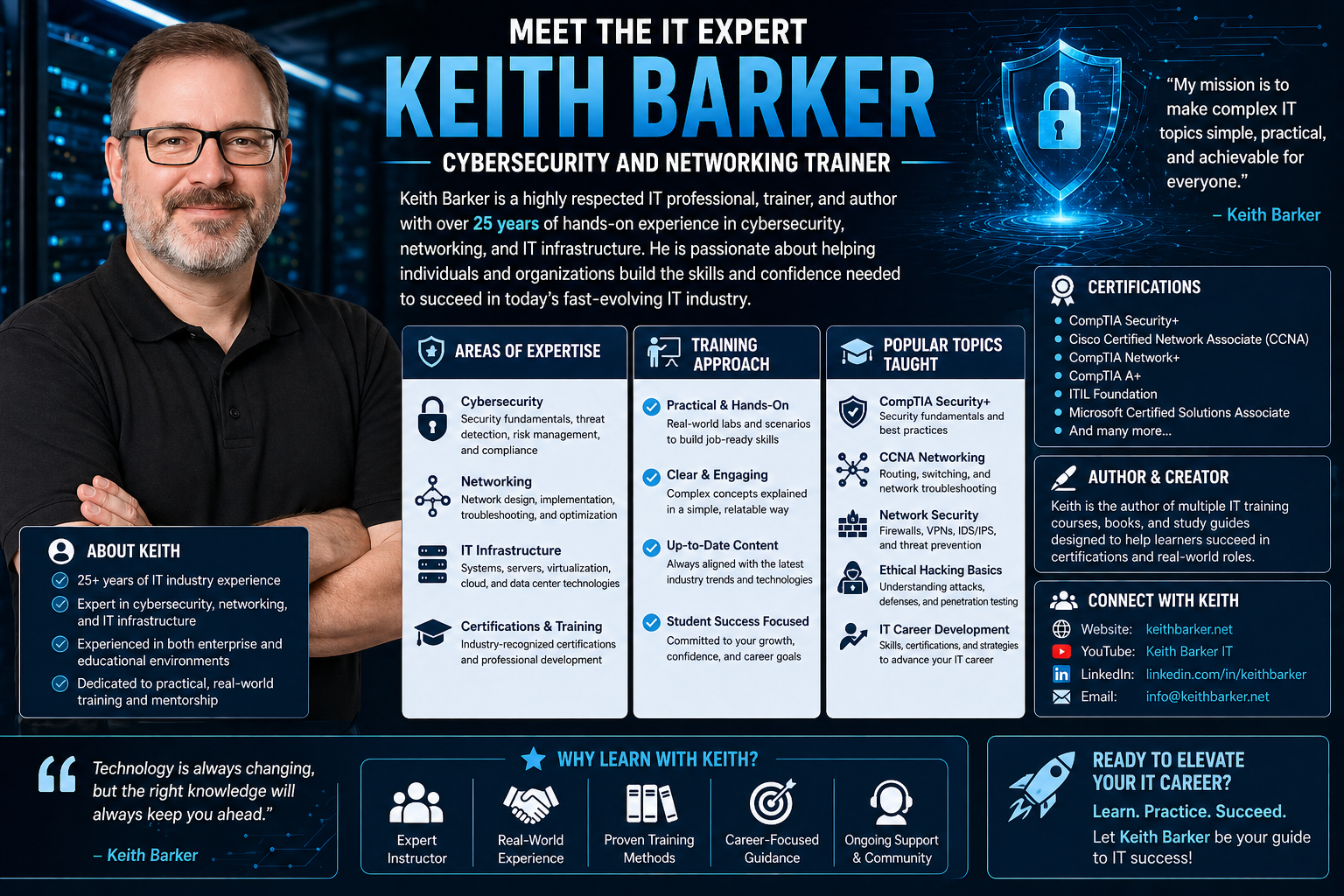
Keith Barker’s journey into technology began with curiosity rather than a predefined career plan. Long before formal training or structured learning environments became part of his life, he was drawn to understanding how systems worked beneath the surface. That curiosity was not limited to computers alone but extended to any system that followed logical patterns or required structured thinking to operate effectively.
During his early exposure to work environments, he observed how information moved through systems and how small technical processes could influence larger operational outcomes. This observation stage played a significant role in shaping his analytical mindset. Instead of simply using tools or following instructions, he naturally gravitated toward questioning how and why those tools functioned in specific ways.
What made this curiosity particularly impactful was the way it evolved into persistence. Whenever he encountered a technical concept that was not immediately clear, he would revisit it repeatedly until the underlying logic made sense. This habit of revisiting unfamiliar ideas became one of the foundational traits that later defined his approach to IT learning and instruction.
Over time, this curiosity turned into structured exploration. Rather than random experimentation, there was a growing desire to understand systems in a way that allowed consistent problem-solving. This shift marked the beginning of a mindset that would later become essential in networking, security, and infrastructure environments where clarity and precision are critical.
Transition from non-IT role to networking career begins
Before stepping fully into the IT field, Keith Barker’s professional environment was not originally centered around technology. His exposure to structured systems began in a setting where operational efficiency and accuracy were essential, but advanced computing knowledge was not yet the primary focus of his role. This environment became an unexpected gateway into the world of IT.
While working in a banking-related role, he encountered systems that required interaction with early forms of digital infrastructure. These systems sparked a deeper interest in understanding how data was processed, stored, and transmitted. Instead of viewing technology as a background tool, he began to see it as a central component of modern operations.
This transition period was marked by self-driven learning. Without formal academic direction in the beginning, he relied on experimentation, observation, and incremental skill-building. He started exploring networking concepts and system configurations in parallel with his daily responsibilities, gradually building a bridge between operational work and technical understanding.
The turning point came when his growing interest aligned with an opportunity to enter a more technical environment. This shift allowed him to move from general operational exposure to a dedicated focus on computer networking. It was in this phase that he began to formalize his understanding of how systems communicate, how networks are structured, and how data flows across interconnected environments.
The early career stage was not defined by instant mastery but by steady progression. Each new concept was built on the last, creating a layered understanding that would later become essential in both real-world problem-solving and teaching complex IT topics in an accessible way.
Building foundational skills in networking and systems thinking
As Keith Barker moved deeper into the IT field, the importance of foundational knowledge became increasingly clear. Networking was not simply about memorizing protocols or configurations; it required a structured way of thinking that connected individual components into a complete system.
This stage of development focused heavily on understanding how different layers of technology interact. Instead of isolating concepts, he began to see how each part of a network contributes to the overall function of communication systems. This systems-thinking approach allowed him to break down complex environments into manageable and understandable parts.
One of the most significant aspects of this phase was the emphasis on repetition and reinforcement. Concepts were not treated as one-time lessons but as ideas that required revisiting in different contexts. Each revisit provided new insight, often revealing connections that were not initially obvious.
Hands-on exposure played a critical role in solidifying these foundational skills. By working directly with systems, configurations, and real network behavior, theoretical knowledge became practical understanding. This combination of theory and practice created a strong base that would later support advanced topics in cybersecurity and enterprise networking.
Equally important was the development of patience in learning. Technical systems often behave in ways that require careful observation rather than immediate conclusions. Learning to slow down, analyze outputs, and understand cause-and-effect relationships became a defining part of this foundational stage.
Developing a lifelong learning approach in technology
One of the defining characteristics of Keith Barker’s professional journey is his commitment to continuous learning. In the field of IT, where technologies evolve rapidly, staying static is not an option. This reality shaped a mindset where learning is not viewed as a phase but as an ongoing process.
A key realization early in his career was that revisiting familiar topics often leads to new insights. Even when a subject appears fully understood, returning to it after gaining additional experience can reveal deeper layers of complexity. This pattern reinforced the idea that mastery is not a fixed destination but an evolving state.
This approach also encouraged adaptability. As new technologies emerged, they were not seen as separate challenges but as extensions of existing knowledge. By connecting new concepts to established foundations, learning became more efficient and less overwhelming.
Another important aspect of this mindset is intellectual humility. Recognizing that there is always more to learn helps maintain openness to change. In technical environments, where assumptions can lead to errors, this mindset supports better decision-making and more accurate problem-solving.
This philosophy also influences how knowledge is shared. Instead of focusing on static instruction, the emphasis is placed on helping others develop the ability to learn independently. This creates a cycle where learning becomes self-sustaining rather than dependent on external input.
The evolution of troubleshooting as a core professional skill
Troubleshooting is one of the most essential skills in IT, and over time, it becomes more refined through experience and exposure. Keith Barker’s approach to troubleshooting developed through real-world scenarios where systems did not behave as expected and required structured analysis to identify root causes.
At its core, troubleshooting is about understanding deviation. When a system behaves differently from expected outcomes, the goal is to determine what changed, where it changed, and why it changed. This requires both technical knowledge and logical reasoning.
Early experiences in troubleshooting often involve trial and error, but over time, patterns begin to emerge. Recognizing these patterns allows for faster diagnosis and more efficient resolution of issues. This pattern recognition becomes one of the most valuable aspects of advanced technical work.
Another important element is discipline. Effective troubleshooting requires a methodical approach rather than random experimentation. Each step should be intentional, with clear reasoning behind every action. This reduces the risk of introducing additional issues while resolving existing ones.
Documentation and observation also play a crucial role. Keeping track of system behavior, changes made, and outcomes observed helps build a reference framework that can be used in future scenarios. Over time, this creates a mental library of problem-solving experiences that strengthens overall capability.
Understanding mistakes and operational discipline in IT environments
In technical environments, mistakes are not only common but also valuable learning opportunities when approached correctly. Keith Barker’s perspective on mistakes emphasizes their role in reinforcing discipline and improving system awareness.
One of the most important lessons in operational environments is the significance of structured change processes. Making adjustments to live systems without proper preparation can lead to unintended consequences. This understanding highlights the importance of controlled environments and careful planning before implementation.
Mistakes often reveal gaps in understanding. When an unexpected outcome occurs, it forces a deeper examination of assumptions and configurations. This process of reflection helps strengthen future decision-making and reduces the likelihood of repeating similar errors.
Operational discipline also involves understanding the impact of actions within shared systems. In environments where multiple components are interconnected, even small changes can have wide-reaching effects. This awareness encourages careful consideration before executing modifications.
Over time, this disciplined approach becomes second nature. Actions become more deliberate, planning becomes more detailed, and outcomes become more predictable. This shift is essential for maintaining stability in complex technical environments.
Communication and human skills in technical careers
Technical expertise alone is not sufficient for long-term success in IT environments. The ability to communicate clearly and effectively is equally important. Keith Barker’s perspective highlights the importance of translating complex technical ideas into language that others can understand.
Communication in IT involves more than explaining concepts. It requires understanding the audience and adjusting the level of detail accordingly. Whether interacting with technical peers or non-technical stakeholders, clarity remains the primary objective.
Human skills such as patience, empathy, and listening also play a significant role. Many technical challenges involve collaboration, and effective teamwork depends on mutual understanding and respect. Being able to listen carefully to problems and respond thoughtfully improves both efficiency and outcomes.
Another important aspect is the ability to simplify complexity without losing accuracy. Technical systems can be highly detailed, but effective communication focuses on the essential elements needed to understand the situation. This balance is critical in both learning and operational environments.
These skills also enhance leadership capabilities within technical teams. When communication is clear and structured, collaboration becomes more effective, and problem-solving becomes more efficient.
The philosophy behind effective technical training
Teaching technical concepts requires more than just knowledge; it requires an understanding of how people learn. Keith Barker’s approach to training emphasizes clarity, structure, and engagement with real-world context.
A key principle in effective training is starting with fundamentals. Strong foundational knowledge allows learners to build confidence and gradually progress to more complex topics. Without this base, advanced concepts often become difficult to retain or apply.
Another important element is making abstract ideas tangible. Technical systems can sometimes feel disconnected from practical use, so linking concepts to real-world behavior helps improve comprehension. This connection between theory and practice strengthens retention.
Engagement also plays a critical role in learning. When learners are actively involved in the process, they are more likely to retain information and apply it effectively. Encouraging curiosity and exploration supports deeper understanding.
Effective training also recognizes that learning is not linear. Individuals progress at different rates, and revisiting concepts multiple times is often necessary. This reinforces the idea that repetition and reinforcement are essential parts of the learning process.
Continuous discovery in revisiting known technologies
One of the most interesting aspects of working in technology is that familiar subjects can still reveal new insights over time. Keith Barker’s experience highlights how revisiting known technologies often leads to deeper understanding rather than repetition.
As experience grows, the perspective on previously learned concepts changes. What once seemed complex becomes clearer, and new connections between ideas begin to emerge. This layered understanding is a natural result of continued exposure and practice.
This process of rediscovery also reinforces the importance of staying engaged with foundational topics. Even advanced professionals benefit from revisiting core principles, as they often form the basis for more complex systems.
In addition, technological environments themselves evolve. Tools, protocols, and systems change over time, meaning that even familiar concepts can take on new forms or applications. Staying open to these changes ensures continued relevance and adaptability.
This ongoing cycle of learning, revisiting, and refining knowledge creates a dynamic professional journey. Instead of reaching a final point of mastery, it encourages continuous growth and intellectual development across the entire career path.
Entry into advanced networking environments
As Keith Barker progressed beyond foundational IT experience, his work naturally shifted toward more complex networking environments where systems were no longer isolated but deeply interconnected across multiple layers of infrastructure. This stage of development introduced him to scenarios where performance, reliability, and scalability were no longer optional considerations but essential requirements.
In these environments, networks were designed to support large volumes of traffic and multiple user groups, each with different operational needs. The complexity of these systems required a deeper understanding of routing behavior, switching logic, and the way data flows across distributed architectures. Instead of focusing on individual devices, attention shifted toward entire ecosystems of communication.
This transition also required a more disciplined approach to analysis. Issues were rarely caused by a single factor, and problems often emerged from interactions between multiple systems. Understanding these relationships became critical for maintaining stability and ensuring consistent performance.
At this stage, technical thinking evolved from reactive problem-solving to proactive system awareness. Rather than waiting for issues to occur, the focus began to include anticipating potential points of failure and understanding how design decisions could influence long-term behavior.
This period marked a significant expansion in perspective, where networking was no longer viewed as a collection of isolated tools but as a living structure that required continuous observation, adjustment, and refinement.
Expanding into cybersecurity-focused thinking
As networking systems grew more complex, security considerations naturally became more prominent. The increasing interconnectivity of systems introduced new risks, making it essential to understand how data could be protected while still allowing efficient communication.
This shift toward cybersecurity-focused thinking required a change in mindset. Instead of only ensuring that systems worked correctly, there was now a need to evaluate how they could be misused or compromised. This dual perspective—functionality and protection—became a defining characteristic of advanced IT environments.
Security concepts introduced new layers of abstraction, including access control, authentication mechanisms, and traffic inspection processes. These elements required careful configuration and ongoing monitoring to maintain system integrity. Understanding how these mechanisms interact with network infrastructure became a core part of professional development.
Another important aspect of this stage was recognizing that security is not a static condition but an ongoing process. Threats evolve, systems change, and new vulnerabilities emerge over time. This dynamic nature of security reinforced the importance of continuous learning and adaptation.
The integration of security thinking into networking practice also influenced how systems were designed. Rather than adding security as an afterthought, it became embedded into the architecture from the beginning. This shift represented a more mature and holistic approach to IT infrastructure design.
Working within enterprise-scale infrastructure environments
As experience deepened, exposure to enterprise-scale environments introduced a new level of operational complexity. These systems were characterized by high availability requirements, strict performance expectations, and a need for seamless integration across multiple platforms.
In such environments, even small configuration changes could have widespread effects. This required a heightened level of precision and careful planning before implementation. Every adjustment needed to be evaluated not only for its immediate impact but also for its potential long-term consequences.
Enterprise systems also introduced the challenge of scale. Unlike smaller environments where issues could be quickly isolated, large infrastructures require structured methodologies for identifying and resolving problems. This included analyzing logs, monitoring system behavior, and correlating data across multiple sources.
Collaboration became increasingly important in these environments. No single individual could manage all aspects of a large infrastructure, so teamwork and communication played a critical role in maintaining stability. Understanding how to work effectively within technical teams became just as important as technical expertise itself.
This stage reinforced the importance of consistency and discipline. Enterprise environments depend on predictable behavior, and maintaining that predictability requires adherence to established processes and best practices.
Growth into virtualization and modern infrastructure concepts
As technology continued to evolve, virtualization emerged as a major shift in how infrastructure was designed and managed. Instead of relying solely on physical hardware, systems could now be abstracted into virtual environments, allowing greater flexibility and efficiency.
This transition required a new way of thinking about resources. Compute, storage, and networking components were no longer fixed entities but dynamic elements that could be allocated and reallocated as needed. Understanding how these virtual layers interact with underlying physical systems became essential.
Virtualization also introduced new challenges in performance management. Since multiple virtual systems could operate on shared physical resources, careful monitoring was required to ensure stability and avoid resource contention. This added another layer of complexity to system design and troubleshooting.
In addition, virtualization expanded the scope of networking knowledge. Virtual switches, distributed networks, and software-defined components became integral parts of modern infrastructure. These technologies require both conceptual understanding and practical experience to be managed effectively.
This stage of development represented a significant expansion in technical scope, where traditional networking knowledge had to be integrated with emerging virtualization concepts to create fully functional systems.
Transition into structured technical instruction environments
As experience accumulated, there was a natural progression toward sharing knowledge in a more structured and intentional way. This transition into technical instruction environments was not simply about presenting information but about helping others develop practical understanding through guided learning.
In structured teaching environments, clarity becomes a central requirement. Complex topics must be broken down into manageable segments that build progressively on one another. This ensures that learners can follow the logical progression of concepts without becoming overwhelmed.
Another important aspect of this transition is the need to anticipate common misunderstandings. Learners often interpret technical concepts in different ways, so effective instruction requires identifying potential points of confusion and addressing them proactively.
This phase also emphasized the importance of real-world relevance. Technical concepts become significantly more meaningful when they are connected to practical scenarios. This helps learners understand not only how systems work but also why they are designed in specific ways.
The shift into structured instruction also reinforced the value of patience. Learning occurs at different speeds for different individuals, and effective instruction requires adaptability to meet diverse learning needs.
Refining hands-on learning methodologies
One of the most impactful developments in technical education is the emphasis on hands-on learning. Rather than relying solely on theoretical explanations, practical engagement with systems allows learners to directly observe how concepts behave in real environments.
Hands-on methodologies provide immediate feedback, which is essential for reinforcing understanding. When learners interact directly with systems, they can see the results of their actions and adjust their understanding accordingly. This creates a more active and engaging learning experience.
This approach also helps bridge the gap between knowledge and application. Understanding a concept in theory does not always guarantee the ability to apply it in practice. Hands-on experience ensures that learners develop both comprehension and execution skills.
Another benefit of this methodology is the development of problem-solving confidence. When learners are exposed to real scenarios, they learn how to navigate uncertainty and troubleshoot issues independently. This builds resilience and adaptability in technical environments.
Over time, hands-on learning becomes a foundational principle in technical instruction, shaping how complex topics are introduced and reinforced.
Evolving teaching methods through learner interaction
As technical instruction experience grows, learner feedback becomes an essential component of refining teaching methods. Each interaction provides insight into how concepts are being understood and where additional clarity may be needed.
This iterative process allows teaching approaches to evolve naturally. Instead of relying on static methods, instruction becomes dynamic and responsive to learner needs. This adaptability improves overall effectiveness and engagement.
Learner interaction also highlights the diversity of perspectives in technical understanding. Different individuals approach problems in different ways, and observing these variations provides valuable insight into how instruction can be improved.
Another important aspect of this evolution is the ability to simplify complex ideas without losing accuracy. As feedback is incorporated, explanations become more refined and accessible while maintaining technical depth.
This continuous refinement process ensures that instruction remains relevant and effective across different learning environments and experience levels.
Changes in the networking and cybersecurity industry landscapes
Over time, the networking and cybersecurity industries have undergone significant transformation. New technologies, evolving threats, and increasing system complexity have all contributed to a rapidly changing landscape.
One of the most notable changes is the shift toward integrated systems. Instead of isolated technologies, modern environments often involve multiple interconnected platforms working together. This requires professionals to understand a broader range of tools and concepts.
Security considerations have also become more deeply embedded in system design. Rather than being treated as a separate layer, security is now integrated throughout infrastructure architecture. This reflects a more comprehensive approach to protecting systems and data.
Automation and orchestration have introduced additional changes. Many routine tasks are now managed through automated processes, reducing manual intervention and increasing efficiency. However, this also requires a deeper understanding of how automated systems operate.
These industry shifts emphasize the importance of adaptability. Professionals must continuously update their knowledge to remain effective in environments that are constantly evolving.
Integrating multi-vendor environments in real-world systems
Modern IT environments often involve technologies from multiple vendors working together within a single infrastructure. This creates both opportunities and challenges in system design and management.
One of the key challenges in multi-vendor environments is ensuring compatibility. Different systems may use different protocols, interfaces, or configuration methods, requiring careful planning to ensure seamless integration.
This complexity also increases the importance of standardization. By relying on common protocols and best practices, systems can be designed to function cohesively despite underlying differences.
Another important aspect is troubleshooting across vendor boundaries. When issues arise, it is often necessary to understand how different systems interact and where potential points of failure may exist.
Working in multi-vendor environments strengthens overall technical adaptability, as it requires familiarity with a wide range of tools and approaches.
Scenario-based problem solving in technical environments
One of the most effective ways to develop technical expertise is through scenario-based problem solving. This approach involves working through realistic situations that reflect actual challenges encountered in professional environments.
Scenario-based learning encourages critical thinking by presenting complex situations that require analysis and decision-making. Instead of following predefined steps, learners must evaluate conditions and determine appropriate actions.
This method also helps develop situational awareness. Understanding how different systems behave under various conditions allows for more accurate predictions and faster problem resolution.
Another advantage is the development of structured thinking. By working through scenarios, learners learn how to break down complex problems into smaller, manageable components.
This approach closely mirrors real-world IT environments, where issues rarely present themselves in simple or isolated forms.
The relationship between certification culture and practical expertise
In the IT industry, certification culture plays a significant role in professional development. Certifications provide structured validation of knowledge, but they do not always fully represent practical capability.
A key distinction exists between theoretical understanding and real-world application. While certifications measure knowledge of concepts, practical expertise is demonstrated through the ability to apply that knowledge in dynamic environments.
This distinction highlights the importance of balancing both aspects. Structured learning provides a foundation, while hands-on experience develops deeper understanding and problem-solving ability.
Over time, professionals learn that real value comes from combining knowledge with execution. The ability to troubleshoot, adapt, and solve unexpected problems is often more impactful than theoretical familiarity alone.
This perspective reinforces the idea that continuous learning and practical engagement are both essential for long-term success in technical fields.
Evolving identity as an educator in advanced IT learning environments
As Keith Barker’s career progressed, his identity within the IT world gradually expanded beyond hands-on technical roles into a more structured educational focus. This evolution was not an abrupt shift but a natural extension of years spent working closely with complex systems, troubleshooting real-world issues, and refining technical understanding through continuous exposure.
The transition into education brought a new perspective on how technical knowledge is formed and shared. Instead of focusing solely on solving problems within live environments, attention began to shift toward helping others understand how those problems are identified and resolved. This required a deeper awareness of how learners think, how they interpret technical concepts, and how those concepts can be made more accessible without losing their depth.
One of the key realizations during this stage was that technical expertise alone is not enough to create effective learning experiences. The ability to structure information, anticipate confusion points, and build logical progression paths becomes equally important. This understanding shaped a more intentional approach to communication and explanation.
Over time, the role of educator became closely tied to that of practitioner. Rather than separating teaching from real-world experience, both elements began to reinforce each other. Practical exposure informed teaching methods, while teaching reinforced and refined technical understanding.
This dual identity created a continuous cycle of improvement where knowledge was not only applied but also reinterpreted through the lens of instruction. It allowed complex topics to be broken down into more understandable segments while still maintaining their technical integrity.
Designing realistic learning environments for technical mastery
One of the most important aspects of effective IT education is the creation of environments that closely mirror real-world systems. Without this realism, learners may understand concepts in theory but struggle to apply them in practical situations.
In advanced technical training environments, the focus shifts toward replicating operational conditions where systems interact dynamically. This includes scenarios where configurations must be adjusted, networks must be analyzed, and unexpected behaviors must be resolved.
These environments are designed to encourage exploration and experimentation. Instead of simply following instructions, learners are encouraged to observe system behavior, test hypotheses, and evaluate outcomes. This approach strengthens problem-solving skills and builds confidence in handling unfamiliar situations.
Another important aspect of realistic learning environments is variability. Real systems rarely behave in predictable ways, so exposure to different scenarios helps prepare learners for a wide range of possibilities. This includes both expected operations and unexpected disruptions.
By engaging with environments that simulate real-world complexity, learners develop a more practical understanding of how systems function under pressure. This bridges the gap between theoretical knowledge and operational competence.
Strengthening foundational understanding through layered learning
In technical education, layered learning is a method that builds understanding gradually by introducing concepts in a structured sequence. Each layer builds upon the previous one, creating a strong foundation for more advanced topics.
This approach ensures that learners are not overwhelmed by complexity at early stages. Instead, they are guided through a logical progression where each concept is fully understood before moving to the next level.
Foundational knowledge plays a critical role in this process. Without a strong base, advanced topics can become difficult to interpret or apply. By reinforcing core principles repeatedly, learners develop long-term retention and deeper comprehension.
Layered learning also allows for reinforcement through repetition. Concepts are revisited in different contexts, helping to strengthen understanding and reveal new connections between ideas.
This method is particularly effective in technical fields where systems are highly interconnected. Understanding how individual components relate to larger structures is essential for developing overall competence.
Over time, layered learning creates a structured mental framework that supports both learning and problem-solving. It allows complex systems to be understood as interconnected layers rather than isolated elements.
Developing a cybersecurity-oriented mindset in modern systems
In modern IT environments, cybersecurity is no longer an optional consideration but a fundamental aspect of system design and operation. Developing a cybersecurity-oriented mindset involves thinking beyond functionality and considering how systems can be protected, monitored, and maintained securely.
This mindset begins with awareness of potential risks. Every system interaction presents opportunities for unauthorized access, data exposure, or operational disruption. Understanding these risks is the first step toward building resilient systems.
Another important element is the concept of layered defense. Instead of relying on a single protective mechanism, multiple layers of security are implemented to reduce vulnerability. This includes authentication systems, access controls, monitoring tools, and network segmentation.
Cybersecurity thinking also involves continuous evaluation. Threats evolve, and systems must be regularly assessed to ensure they remain secure. This requires ongoing attention to configuration, behavior analysis, and anomaly detection.
In addition, security considerations must be integrated into system design from the beginning. Retrofitting security into existing systems is often less effective than building it into the architecture from the start.
This mindset shifts the focus from reactive defense to proactive protection, where potential risks are anticipated and mitigated before they can impact system stability.
Understanding cloud and hybrid infrastructure environments
The rise of cloud computing has significantly transformed how IT systems are designed and managed. Instead of relying solely on physical infrastructure, organizations now use a combination of cloud-based and on-premises systems.
This hybrid approach introduces new levels of flexibility and scalability. Resources can be dynamically allocated based on demand, allowing systems to adapt more efficiently to changing requirements.
However, this flexibility also introduces complexity. Managing distributed environments requires a clear understanding of how different components interact across multiple platforms. Data flow, latency, and integration all become critical considerations.
Hybrid infrastructure also requires careful planning for connectivity and security. Ensuring that cloud and on-premises systems communicate effectively while maintaining secure boundaries is essential for operational stability.
Another important aspect is resource optimization. Cloud environments allow for scalable usage, but without proper management, resources can become inefficiently utilized. Understanding how to balance performance and cost is an important part of modern infrastructure design.
This evolution in infrastructure has expanded the scope of IT expertise, requiring professionals to understand both traditional systems and cloud-native architectures.
Deepening virtualization concepts and abstraction layers
Virtualization plays a central role in modern IT environments by introducing abstraction between physical hardware and operational systems. This abstraction allows multiple virtual systems to run on shared physical resources, improving efficiency and flexibility.
Understanding virtualization requires a shift in perspective. Instead of focusing on individual physical components, attention moves toward logical systems that operate independently of underlying hardware.
This abstraction introduces additional layers of complexity. Virtual machines, virtual networks, and storage virtualization all interact within a shared environment, requiring careful management to ensure stability and performance.
One of the key challenges in virtualization is resource allocation. Since multiple systems share the same physical infrastructure, proper distribution of resources is essential to prevent performance degradation.
Virtualization also enhances system portability. Environments can be replicated, moved, or scaled with greater ease compared to traditional physical systems. This flexibility is a major advantage in modern IT operations.
Over time, virtualization has become a foundational concept that influences how entire infrastructures are designed and managed.
Communication dynamics in technical education environments
Effective communication is a critical component of technical education. Complex concepts must be translated into clear and understandable explanations that resonate with learners at different levels of experience.
One of the most important aspects of communication in technical environments is clarity. Technical accuracy must be maintained, but information must also be presented in a way that is accessible and logically structured.
Another important element is pacing. Introducing too much information at once can overwhelm learners, while insufficient detail can lead to confusion. Finding the right balance is essential for effective knowledge transfer.
Communication in technical education also involves adaptability. Different learners interpret information in different ways, so explanations often need to be adjusted based on feedback and understanding levels.
Non-verbal elements such as structure, emphasis, and repetition also play a role in reinforcing key ideas. These elements help ensure that important concepts are retained and understood correctly.
Over time, communication becomes a refined skill that enhances both teaching effectiveness and learner engagement.
Evolution of technical content creation workflows
Creating structured technical content requires a combination of planning, organization, and practical experience. Over time, workflows evolve to support the efficient development of educational material that remains accurate and relevant.
A key part of this process is structuring information in a logical sequence. Concepts must flow naturally from one to another, ensuring that learners can follow the progression without confusion.
Another important aspect is consistency. Maintaining a consistent approach to explanation helps learners build familiarity with the material and reduces cognitive load.
Content creation also involves continuous refinement. As systems evolve and new technologies emerge, educational material must be updated to reflect current practices and standards.
Practical experience plays a significant role in this process. Real-world exposure ensures that content remains grounded in actual system behavior rather than theoretical assumptions.
Over time, content creation becomes an iterative process where each revision improves clarity, accuracy, and effectiveness.
Industry transformation through automation and intelligent systems
The IT industry has undergone a significant transformation with the introduction of automation and intelligent systems. Many tasks that were previously performed manually are now handled through automated processes.
Automation improves efficiency by reducing repetitive tasks and allowing systems to operate with greater consistency. This shift enables professionals to focus on higher-level problem-solving and system design.
However, automation also introduces new complexities. Understanding how automated systems operate is essential for maintaining control and ensuring reliability. Misconfigured automation can lead to unintended outcomes if not properly managed.
Intelligent systems further expand this landscape by introducing adaptive behavior. These systems can analyze data, make decisions, and adjust operations based on changing conditions.
This evolution requires professionals to develop new skills related to system orchestration, monitoring, and validation. Traditional technical knowledge must now be combined with an understanding of automated workflows.
The result is a more dynamic IT environment where systems are increasingly self-managing but still require human oversight and strategic direction.
Mentorship influence and learner transformation dynamics
Mentorship plays a powerful role in technical education by providing guidance, structure, and encouragement throughout the learning process. It helps bridge the gap between theoretical knowledge and practical application.
One of the key aspects of mentorship is individualized support. Each learner has different strengths, weaknesses, and learning styles, and effective mentorship adapts to these differences.
Mentorship also encourages confidence-building. As learners progress through increasingly complex topics, having structured support helps them navigate challenges more effectively.
Another important element is motivation. Technical learning can be demanding, and consistent encouragement helps learners stay engaged and focused on long-term goals.
Over time, mentorship contributes to transformation. Learners develop not only technical skills but also problem-solving abilities, analytical thinking, and professional confidence.
This transformation is one of the most impactful outcomes of structured technical education.
Continuous curiosity and professional discipline in long-term IT careers
Long-term success in IT requires a balance of curiosity and discipline. Curiosity drives exploration and learning, while discipline ensures consistency and reliability in professional practice.
Curiosity encourages continuous improvement. Even familiar technologies can reveal new insights when revisited with a fresh perspective or additional experience.
Discipline ensures that technical work is performed accurately and consistently. This includes following structured processes, maintaining system integrity, and adhering to best practices.
Together, these qualities create a sustainable approach to professional growth. Curiosity keeps knowledge expanding, while discipline ensures that knowledge is applied effectively.
In rapidly evolving technical environments, this balance becomes essential for long-term relevance and success.
Conclusion
Across more than two decades in information technology, Keith Barker’s professional journey reflects the steady evolution of a practitioner who grew alongside the industry itself. From early exposure to systems and networking fundamentals to working within increasingly complex enterprise environments, his path illustrates how curiosity, discipline, and continuous learning can shape a long and meaningful technical career.
What stands out in his experience is not only the depth of technical exposure but also the consistency of mindset. Whether dealing with networking foundations, cybersecurity principles, or modern virtualized infrastructures, the emphasis has always remained on understanding how systems truly operate rather than relying on surface-level familiarity. This approach has helped build a perspective where troubleshooting, analysis, and structured thinking become core strengths.
Equally important is the transition from practitioner to educator. Sharing technical knowledge requires more than expertise; it demands clarity of thought, patience, and the ability to break down complex systems into understandable components. Over time, this shift has contributed to a style of communication that prioritizes practical understanding and real-world relevance over abstraction.
In fast-changing IT landscapes, adaptability becomes essential. Technologies evolve, tools change, and infrastructure models shift, but the underlying principles of problem-solving and system thinking remain constant. Keith Barker’s journey highlights how staying grounded in fundamentals while embracing new developments creates long-term professional resilience.
Beyond technical ability, the importance of communication, collaboration, and structured thinking remains central to success in IT environments. These human-centered skills ensure that technical knowledge can be effectively applied in team settings and operational contexts.
Ultimately, this professional narrative demonstrates that sustained growth in technology is not defined by a single achievement or milestone, but by continuous engagement, reflection, and the willingness to keep learning across every stage of a career.