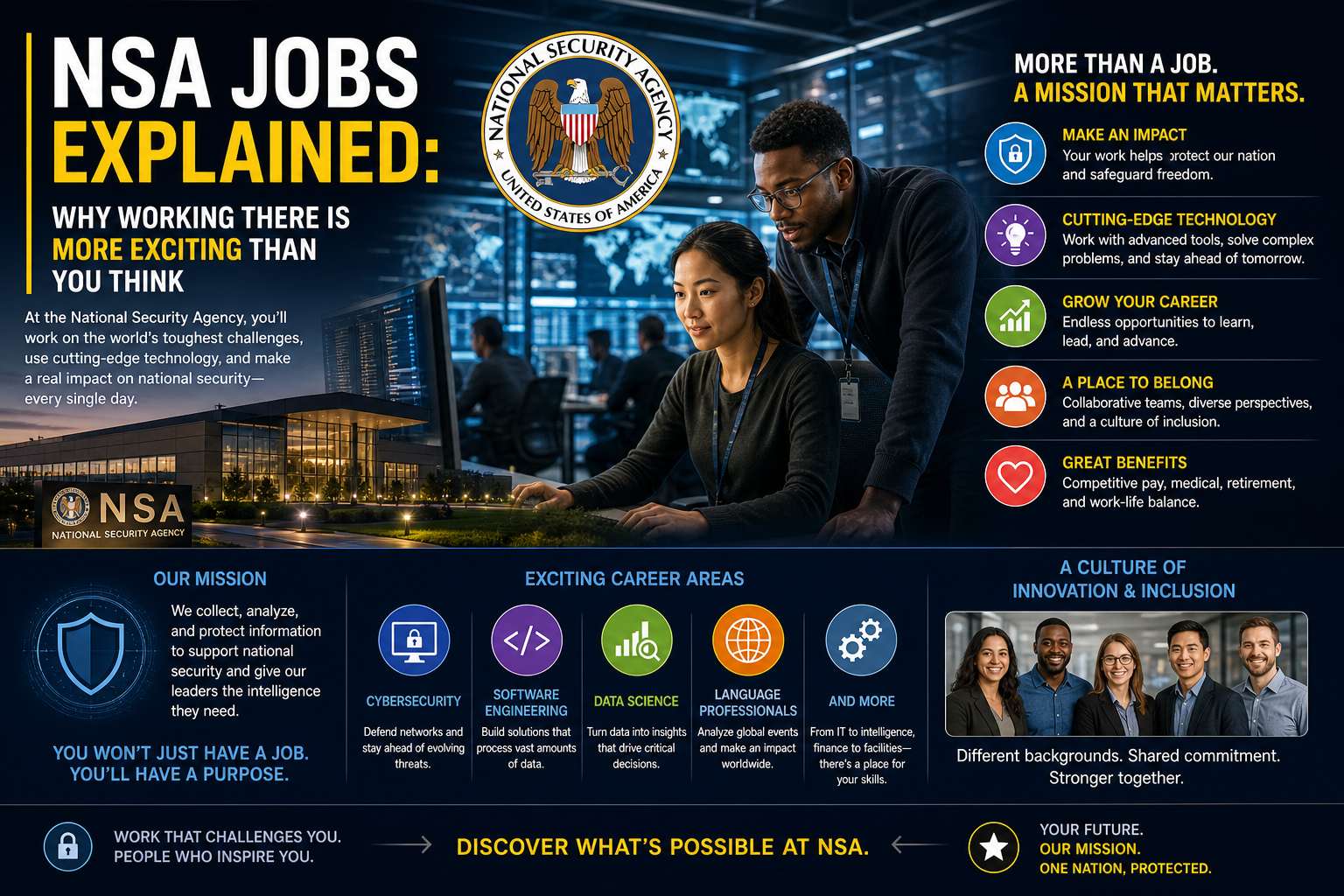
The National Security Agency (NSA) is one of the most widely recognized yet least openly understood intelligence organizations in the United States. At its core, the agency exists to support national security through the collection, analysis, and protection of information. This includes working with signals intelligence—often referred to as intercepted communications—and ensuring that sensitive government and defense communications remain secure.
A major part of the NSA’s responsibility involves monitoring foreign communications and identifying potential threats before they reach U.S. interests. This kind of work requires processing massive amounts of data from various global sources, filtering meaningful intelligence from noise, and ensuring that any actionable insights are delivered to decision-makers in a timely manner.
At the same time, the agency is responsible for defending U.S. communication systems. That means securing military networks, protecting government data infrastructure, and anticipating potential cyber threats before they can cause harm. The dual nature of this mission—offense in intelligence gathering and defense in cybersecurity—makes the organization unique compared to most traditional workplaces in the technology or security sectors.
While public discussions often simplify or dramatize the NSA’s activities, the actual mission is more structured and technical. It revolves around data analysis, cryptography, cybersecurity engineering, and intelligence coordination rather than the exaggerated narratives often found in popular culture.
The Working Environment: More Structured Than Secretive
Despite its reputation, the NSA’s physical and professional environment is more similar to a large-scale technology campus or government research facility than a cinematic intelligence hub. Employees typically work in secure office complexes designed with strict access control systems. These facilities prioritize safety, confidentiality, and operational efficiency rather than theatrics.
Inside, the environment includes standard office spaces, collaborative rooms, data centers, and technical labs. Many employees describe the atmosphere as highly structured but not unusual compared to other large government or tech organizations. The difference lies not in appearance, but in the sensitivity of the work being conducted.
Security is a defining feature of the workplace. Employees pass through multiple layers of clearance checks before entering secure areas. Access to certain departments is restricted based on clearance level and job responsibility. These measures are not designed to create secrecy for its own sake but to ensure that sensitive national security data is protected from unauthorized access.
Although the environment is highly controlled, it still supports collaboration. Teams often work together across disciplines such as engineering, linguistics, mathematics, and intelligence analysis. This interdisciplinary structure allows complex problems to be addressed from multiple perspectives.
The Range of Work: Far Beyond Cybersecurity Stereotypes
When people think about intelligence agencies, they often imagine cybersecurity professionals analyzing digital threats or cryptographers decoding encrypted messages. While these roles do exist and are extremely important, the actual scope of work at the NSA is much broader.
The agency employs professionals across a wide variety of fields. These include engineers who design secure communication systems, mathematicians who develop encryption models, linguists who interpret foreign communications, analysts who identify intelligence patterns, and technical specialists who maintain critical infrastructure.
There are also many non-technical roles that are essential to daily operations. Administrative staff, legal experts, logistics personnel, and human resources professionals all contribute to maintaining the organization’s structure and efficiency. Like any large institution, the NSA relies on a wide ecosystem of professionals to function effectively.
Within the technical space, cybersecurity is one of the most dynamic areas. Professionals may work on analyzing malware, securing networks, or identifying vulnerabilities in systems used by government agencies. Other teams focus on cryptanalysis, which involves studying and breaking complex encryption methods used in foreign communications.
In some roles, employees work on defensive strategies that protect U.S. systems from cyberattacks. In others, they may study offensive techniques used by foreign entities in order to strengthen national defense capabilities. The combination of these responsibilities creates a constantly evolving technical landscape that requires continuous learning and adaptation.
Daily Work Life and Professional Expectations
Working at the NSA involves a high level of responsibility, but the day-to-day experience is often structured and methodical rather than dramatic or fast-paced in the way media sometimes suggests.
Employees typically work within specialized teams where tasks are assigned based on expertise and clearance level. Much of the work involves analyzing data, writing reports, developing tools, or maintaining systems that support intelligence operations. Meetings, collaboration sessions, and technical briefings are also common.
The nature of the work requires attention to detail and disciplined thinking. Even small errors in analysis or system configuration can have significant consequences, so precision is highly valued. Employees are expected to follow strict protocols when handling sensitive information and to maintain confidentiality at all times.
Unlike many private-sector technology roles that may emphasize rapid product development or commercial output, NSA work is driven by national security priorities. This means timelines can vary depending on urgency, and projects may shift based on evolving global events or intelligence needs.
At the same time, the agency invests in structured workflows and internal systems designed to support efficiency. Employees are provided with tools, resources, and training to ensure they can perform their roles effectively in a secure environment.
The Importance of Security Clearance in the Workplace
One of the defining aspects of working in such an environment is the requirement for security clearance. Before gaining access to sensitive information, employees must undergo extensive background checks that evaluate their personal history, financial stability, associations, and overall trustworthiness.
The clearance process is detailed and time-consuming, often involving interviews, documentation reviews, and in some cases, polygraph examinations. The goal is not only to assess past behavior but also to determine reliability in handling classified information.
Once granted, clearance levels determine what information an employee is allowed to access. Higher levels of clearance allow access to more sensitive data, but they also come with stricter oversight and accountability.
Security clearance also has long-term career implications. Many professionals who obtain clearance find that it becomes a valuable credential in the broader defense and cybersecurity industry. It can open doors to specialized roles that require verified trust and access eligibility.
However, clearance also introduces certain restrictions. Employees must be cautious about discussing their work, even with close friends or family members. In many cases, they are not permitted to disclose specific details about their job responsibilities or projects.
This requirement contributes to the perception of secrecy surrounding the agency, but it is primarily a matter of national security protocol rather than mystery or exclusivity.
Skills and Knowledge Areas Commonly Found in the Workforce
The range of skills required in this environment is broad and often highly specialized. Technical professionals may need expertise in network security, systems engineering, data analysis, programming concepts, and digital forensics. Others may rely more heavily on analytical reasoning, language proficiency, or mathematical modeling.
In cybersecurity-related roles, understanding how networks function is essential. This includes knowledge of how data flows across systems, how vulnerabilities are identified, and how malicious activity can be detected and prevented.
Cryptography is another important area, involving the study of secure communication methods and encryption techniques. Professionals working in this field may analyze complex algorithms or design systems intended to protect sensitive information from unauthorized access.
Analytical roles often require the ability to interpret large datasets and identify patterns that may indicate security threats or intelligence insights. This requires not only technical skill but also critical thinking and attention to detail.
Linguistic and cultural expertise is also valuable, especially in intelligence analysis. Professionals in these areas may work with foreign communications or help interpret context that is essential for accurate assessment of global events.
Collaboration Across Disciplines
One of the more interesting aspects of the NSA’s working environment is the level of interdisciplinary collaboration. Unlike workplaces where roles are strictly siloed, intelligence work often requires multiple areas of expertise to come together.
For example, a cybersecurity issue might involve engineers identifying a vulnerability, analysts interpreting the potential impact, and linguists providing context about the origin of a threat. This kind of collaboration ensures that complex problems are addressed from multiple angles.
Teams often rely on structured communication methods to ensure clarity and security. Information is shared carefully, and access is granted based on necessity. Despite these restrictions, collaboration remains a key part of operational effectiveness.
This interconnected approach reflects the complexity of modern security challenges, where technical systems, human behavior, and global events are deeply intertwined.
The Nature of Responsibility in Intelligence Work
Working in a national security environment carries a strong sense of responsibility. Decisions made within this space can have real-world implications, including the protection of national infrastructure and the prevention of security threats.
Employees are often aware that their work contributes to larger systems that operate beyond public visibility. While individual tasks may seem technical or routine, they often form part of broader intelligence efforts that support national defense strategies.
This sense of responsibility can be motivating for those who enjoy structured problem-solving and meaningful impact. At the same time, it requires discipline, confidentiality, and adherence to strict ethical and operational standards.
The work environment is designed to support this responsibility through training, oversight, and clear procedural guidelines. Employees are not expected to operate in isolation but are instead supported by systems that ensure accountability and accuracy.
Professional Structure and Career Progression
Career paths within the organization are typically structured with opportunities for growth and specialization. Entry-level roles often focus on developing foundational skills, while more advanced positions involve leadership, strategy, or highly specialized technical expertise.
Employees may transition between roles over time, gaining exposure to different areas of intelligence work. This flexibility allows for continuous learning and adaptation, which is important in a field that evolves rapidly due to technological and geopolitical changes.
Training and internal development are common, with an emphasis on keeping skills current. As technologies change, professionals are expected to update their knowledge and adapt to new tools and methodologies.
Career progression is generally based on performance, expertise, and experience within specialized domains. Because of the sensitive nature of the work, advancement also depends on maintaining security standards and reliability over time.
The Diversity of Career Paths Within the NSA
One of the most overlooked aspects of working in a large intelligence organization is just how many different career paths exist within it. While cybersecurity roles often receive the most attention, they represent only a portion of the overall workforce.
The agency recruits professionals from a wide range of disciplines, including computer science, engineering, mathematics, linguistics, behavioral science, international studies, and data analytics. Each of these fields contributes to the broader mission in different ways, creating a workforce that is far more diverse in skill set than many people expect.
Technical professionals might work on securing communication systems, analyzing network vulnerabilities, or developing tools that support intelligence analysis. Meanwhile, analysts might focus on interpreting complex datasets or identifying patterns in global communications. Linguists may translate or contextualize foreign information, ensuring that intelligence reports are accurate and meaningful.
Even within a single discipline, roles can vary significantly. A cybersecurity engineer might focus on defensive infrastructure one year and shift toward threat modeling or system design the next. This flexibility reflects the evolving nature of digital security challenges.
The variety of career paths also means that employees often have opportunities to transition between roles over time. This internal mobility allows professionals to expand their skill sets and explore different aspects of intelligence work without leaving the organization.
The Cybersecurity Landscape Inside Intelligence Work
Cybersecurity within a national security environment is fundamentally different from most commercial settings. Instead of focusing primarily on protecting consumer data or corporate systems, the emphasis is on safeguarding critical national infrastructure and analyzing threats from highly sophisticated adversaries.
Professionals working in this area may be responsible for identifying vulnerabilities in government networks, studying malware used in cyberattacks, or designing systems that can withstand advanced intrusion attempts. The complexity of these tasks often requires deep technical expertise and continuous adaptation.
Threat actors in this space are not typical hackers. They may include foreign governments, organized cybercrime groups, or highly coordinated digital operations. This means that cybersecurity professionals must think beyond standard defense strategies and consider long-term, evolving threats.
Work in this field often involves analyzing patterns of behavior rather than isolated incidents. For example, a single network anomaly might not be significant on its own, but when combined with other indicators, it could reveal a coordinated attempt to breach a system.
This analytical approach requires both technical knowledge and critical thinking. Professionals must be able to interpret incomplete information and make informed judgments under conditions of uncertainty.
The Role of Cryptography and Information Security
Cryptography plays a central role in intelligence and cybersecurity operations. At its core, cryptography is the science of securing information through mathematical techniques that make data unreadable without proper authorization.
Within the NSA environment, cryptographic work may involve designing encryption systems, analyzing foreign encryption methods, or testing the strength of existing security protocols. This field is highly mathematical and often requires strong analytical reasoning skills.
Encryption systems are constantly evolving as technology advances. As computing power increases, older cryptographic methods become vulnerable, requiring continuous innovation to stay ahead of potential threats. This creates an environment where research and development are essential components of daily work.
Information security also extends beyond encryption. It includes ensuring that systems are configured correctly, access is properly controlled, and sensitive data is protected at every stage of its lifecycle. Even small security flaws can create significant vulnerabilities if not addressed.
Professionals working in this area often collaborate with engineers, analysts, and other specialists to ensure that systems are both functional and secure. The work is highly detail-oriented and requires precision in both design and implementation.
Intelligence Analysis and the Interpretation of Data
While technical cybersecurity roles focus on systems and infrastructure, intelligence analysis centers on interpreting information. This involves examining large volumes of data to identify patterns, trends, and potential threats.
Analysts may work with communications data, geopolitical information, or technical signals that require interpretation. The goal is not simply to collect information but to understand its meaning and relevance in a broader context.
This type of work requires strong analytical reasoning and the ability to connect seemingly unrelated pieces of information. A single data point may not be meaningful on its own, but when combined with other indicators, it can reveal important insights.
Analysts often work under time-sensitive conditions, especially when dealing with potential security threats. They must be able to process information quickly while maintaining accuracy and avoiding assumptions that are not supported by evidence.
The work also requires strong communication skills, as analysts must translate complex findings into clear reports that can be understood by decision-makers. These reports often inform strategic decisions at high levels of government.
Linguistic and Cultural Intelligence Roles
Language specialists play an important role in intelligence operations. Their work involves translating, interpreting, and analyzing foreign communications to provide context and meaning.
This goes beyond simple translation. Linguistic professionals must understand cultural nuance, idiomatic expressions, and regional context in order to accurately interpret information. Misinterpretation can lead to incorrect conclusions, making precision extremely important.
In many cases, linguistic analysis is combined with technical intelligence. For example, a communication may need both translation and contextual analysis to determine its relevance to security concerns.
Cultural intelligence is equally important. Understanding the political, social, and historical background of a region can help analysts interpret information more effectively. Without this context, data may be misleading or incomplete.
These roles require not only language proficiency but also critical thinking and analytical skills. Professionals must be able to move between linguistic detail and broader strategic interpretation.
The Technical Depth of Network Operations
Network operations represent one of the most technically demanding areas within intelligence work. Professionals in this field are responsible for understanding how digital communication systems function at a deep level.
This includes studying network architecture, monitoring data flows, and identifying potential vulnerabilities that could be exploited by adversaries. It also involves ensuring that systems remain operational and secure under a variety of conditions.
Network professionals often work with complex systems that span multiple layers of infrastructure. These systems must be monitored continuously to detect unusual activity that could indicate a security breach or attempted intrusion.
The work requires familiarity with both hardware and software systems, as well as an understanding of how different components interact. Even small configuration errors can create vulnerabilities that may be exploited.
In addition to defensive responsibilities, network professionals may also study offensive techniques used by adversaries. This helps them anticipate potential threats and develop strategies to mitigate them.
Security Culture and Operational Discipline
Working in a highly secure environment requires a strong culture of discipline and responsibility. Employees are expected to follow strict procedures when handling information, accessing systems, and communicating with colleagues.
This culture is not based on restriction alone but on the need to maintain integrity in sensitive operations. Even small lapses in judgment can have significant consequences, so consistency and attention to detail are highly valued.
Operational discipline extends to all aspects of work, including documentation, reporting, and system usage. Employees are trained to follow established protocols to ensure that information is handled correctly at every stage.
This structured environment can feel very different from typical private-sector workplaces, where flexibility and rapid experimentation are often encouraged. In intelligence work, however, stability and accuracy are more important than speed alone.
Despite the strict nature of the environment, the culture also emphasizes professionalism and collaboration. Employees are encouraged to communicate effectively within secure boundaries and to support one another in achieving mission objectives.
Tools, Systems, and Technical Infrastructure
The technical infrastructure used in intelligence environments is highly advanced and designed to support large-scale data processing and analysis. These systems handle massive volumes of information and require specialized tools for monitoring and interpretation.
Professionals may work with custom-built software platforms, secure communication networks, and analytical tools designed specifically for intelligence applications. These systems are often not publicly available and are tailored to meet specific operational needs.
The complexity of these tools means that employees must undergo training to use them effectively. Understanding how to navigate secure systems, interpret data outputs, and manage workflows is essential for daily operations.
In addition to proprietary systems, professionals also rely on foundational technologies such as databases, operating systems, and network protocols. A strong understanding of these underlying technologies is essential for troubleshooting and analysis.
As technology evolves, systems are continuously updated to improve performance and security. This requires ongoing learning and adaptation from employees across technical roles.
Problem-Solving in High-Stakes Environments
One of the defining characteristics of intelligence work is the need to solve complex problems under conditions of uncertainty. Unlike controlled environments where all variables are known, intelligence professionals often work with incomplete or evolving information.
This requires a structured approach to problem-solving. Analysts and engineers must evaluate available data, identify potential explanations, and assess risks before drawing conclusions.
In many cases, decisions must be made quickly, especially when dealing with potential security threats. This creates a balance between speed and accuracy, where both factors must be carefully managed.
Collaboration plays an important role in this process. Different specialists contribute their expertise to build a more complete understanding of the situation. Technical experts, analysts, and linguists may all work together on a single problem.
The ability to remain objective is also critical. Professionals must rely on evidence rather than assumptions and avoid bias when interpreting data. This ensures that decisions are based on reliable information.
Professional Growth and Skill Development Pathways
Skill development is a continuous process in intelligence-related careers. Because technology and global threats evolve rapidly, professionals must regularly update their knowledge and adapt to new tools and methodologies.
Training programs are often structured to support both technical and analytical growth. Employees may receive instruction in advanced cybersecurity techniques, data analysis methods, or specialized intelligence tools depending on their role.
Over time, professionals may choose to specialize in a particular area or broaden their expertise across multiple domains. This flexibility allows for personalized career development based on individual interests and strengths.
Experience also plays a significant role in professional growth. As employees gain exposure to complex projects, they develop deeper understanding and improved decision-making skills.
The emphasis on continuous learning ensures that the workforce remains capable of responding to evolving challenges in the global security environment.
The Intersection of Technology and National Security
Modern intelligence work exists at the intersection of technology and national security. As digital systems become more integrated into daily life, the importance of securing these systems continues to grow.
Cybersecurity is no longer a specialized concern limited to technical teams. It is now a fundamental aspect of national defense strategy. This shift has increased demand for professionals who understand both technology and security implications.
The integration of artificial intelligence, data analytics, and advanced computing has further transformed the field. These technologies enable faster analysis and more sophisticated threat detection, but they also introduce new challenges.
Professionals must understand not only how these technologies function but also how they can be exploited or defended. This requires a combination of technical expertise and strategic thinking.
The evolving nature of technology ensures that intelligence work remains dynamic, requiring constant adaptation and innovation across all areas of operation.
The Culture of Secrecy and Professional Boundaries
One of the most defining aspects of working in an intelligence environment is the culture of secrecy. Unlike most organizations where employees can freely discuss projects, share achievements, or describe their daily tasks, intelligence work operates under strict communication boundaries.
This does not mean the workplace is isolating or overly restrictive in a personal sense. Instead, it means that information sharing is tightly controlled to protect sensitive operations. Employees are trained from the beginning to understand what can and cannot be discussed outside approved channels.
Even within the workplace, information is shared on a need-to-know basis. This structure ensures that sensitive data is only accessible to individuals who require it for their specific responsibilities. While this may seem limiting from the outside, it is essential for maintaining operational security.
Over time, employees become accustomed to these boundaries. Many describe it as a shift in mindset rather than a limitation. Conversations outside of work tend to avoid specific job details, which can create a unique separation between professional and personal life.
Despite these restrictions, workplace relationships still form naturally. Colleagues collaborate closely within their teams, often building strong professional trust. The difference is that these relationships are grounded in shared responsibility rather than shared public discussion of work.
Ethical Complexity in Intelligence Work
Working in intelligence naturally involves ethical considerations that are more complex than in most other fields. The core mission involves balancing national security interests with privacy concerns, global politics, and legal frameworks.
Employees are often aware that their work exists within a broader public debate about surveillance, security, and individual rights. However, within the organization, ethical guidelines are clearly defined and governed by law and oversight structures.
Professionals are trained to operate within these frameworks. This means ensuring that all actions are authorized, documented, and consistent with legal standards. Ethical responsibility is not left to personal interpretation alone but is embedded in procedures and oversight mechanisms.
At the same time, the nature of the work means that decisions can carry significant consequences. Even technical tasks may indirectly contribute to larger strategic outcomes. This creates a sense of responsibility that extends beyond immediate job functions.
For many professionals, this aspect of the work becomes one of the most intellectually challenging parts of their career. It requires not only technical skill but also an understanding of broader implications and accountability structures.
Balancing Privacy, Security, and Public Perception
Public perception of intelligence agencies is often shaped by limited information, media representation, and political debate. As a result, there can be a gap between how the organization is viewed externally and how it operates internally.
From the inside, the focus is primarily on mission execution, technical problem-solving, and national security objectives. From the outside, discussions often center around privacy concerns, oversight, and transparency.
Employees are generally aware of this contrast, but their day-to-day work is guided by internal procedures and legal frameworks rather than public narratives. The emphasis is on accuracy, security, and compliance.
The challenge of balancing privacy and security is not abstract. It directly influences how systems are designed, how data is handled, and how operations are conducted. Professionals working in technical roles must consider these factors when building or maintaining systems.
This balancing act is one of the most complex aspects of modern intelligence work. It requires constant evaluation of risk, necessity, and impact in a rapidly changing technological environment.
Long-Term Career Development and Internal Mobility
A long-term career in an intelligence organization often looks different from traditional corporate paths. Instead of moving between companies, professionals frequently move between roles, departments, or areas of specialization within the same organization.
This internal mobility is supported through structured career development programs. Employees may begin in entry-level technical or analytical positions and gradually transition into more advanced or specialized roles over time.
Career progression is influenced by experience, performance, and demonstrated expertise. As employees build their skills, they may take on more complex responsibilities or leadership roles within their teams.
One of the advantages of this structure is continuity. Employees can develop deep institutional knowledge while still exploring new areas of interest. This creates a balance between specialization and adaptability.
Over time, many professionals develop hybrid skill sets. For example, someone who begins in technical cybersecurity may later move into strategic analysis, systems design, or operational leadership.
This flexibility allows careers to evolve in response to both personal interests and organizational needs.
Training, Learning, and Skill Expansion
Continuous learning is a core part of professional life in intelligence environments. Because technology and global threats evolve rapidly, employees must constantly update their knowledge and skills.
Training is often structured and role-specific. New employees typically undergo foundational instruction that covers systems, protocols, and security procedures. As they progress, more advanced training becomes available.
This may include technical instruction in areas such as network security, data analysis, cryptography, or systems engineering. It may also include analytical training focused on interpretation, reasoning, and intelligence reporting.
Learning is not limited to formal training programs. Much of it happens through on-the-job experience, mentorship, and collaboration with more experienced professionals.
Employees are encouraged to develop both depth and breadth in their skills. Depth allows for specialization in a particular area, while breadth enables collaboration across disciplines.
This combination is especially important in intelligence work, where problems often require multiple perspectives and areas of expertise.
The Role of Mentorship and Institutional Knowledge
Mentorship plays a significant role in professional development. Experienced employees often guide newer team members, helping them understand both technical systems and organizational culture.
This transfer of knowledge is important because much of the work involves specialized systems and procedures that are not commonly found in other industries.
Institutional knowledge also plays a key role. Understanding how systems evolved, why certain procedures exist, and how past challenges were resolved helps employees make better decisions in the present.
Mentorship is not always formal. It often occurs naturally through collaboration, observation, and shared problem-solving. Over time, employees build networks of professional relationships that support their growth.
This environment encourages continuous improvement and knowledge sharing within secure boundaries.
Work-Life Structure and Professional Expectations
The structure of work in intelligence environments is often more stable and predictable than people might expect. While certain situations may require urgent attention, much of the work follows established schedules and workflows.
Employees typically work within defined roles and responsibilities. This structure helps ensure clarity, accountability, and efficiency in operations.
However, the nature of national security work means that flexibility is sometimes required. Unexpected events or emerging threats may require shifts in priorities or increased workload for certain teams.
Despite this, organizations place importance on maintaining sustainable work practices. Long-term effectiveness depends on employee well-being, focus, and consistency.
The balance between structure and adaptability is a defining feature of the work environment.
The Psychological Aspect of Working in High-Responsibility Roles
Working in a high-security, high-responsibility environment can have a psychological dimension that is often overlooked. Employees are aware that their work contributes to national security outcomes, which can create a sense of seriousness and focus.
At the same time, the structured nature of the environment provides stability. Clear procedures, defined roles, and strong oversight help reduce ambiguity in decision-making.
For some individuals, the confidentiality of the work creates a unique mental separation between professional and personal life. Because work details cannot be widely discussed, employees often develop a strong internal sense of professional identity.
This dynamic is not inherently positive or negative—it simply reflects the nature of the environment. Some people find it motivating, while others may prefer more open or externally visible work.
The ability to handle responsibility, maintain focus under pressure, and work within structured boundaries becomes an important part of long-term success in such roles.
Technology Evolution and Constant Adaptation
One of the most consistent features of intelligence work is the pace of technological change. Systems, tools, and methods evolve rapidly, requiring professionals to stay continuously updated.
Cybersecurity threats also evolve in parallel. As defensive systems improve, adversaries develop more sophisticated techniques. This creates an ongoing cycle of adaptation and response.
Professionals must therefore be comfortable with change. Tools that are standard today may be replaced or significantly updated in a short period of time.
This environment encourages a mindset of continuous learning rather than fixed expertise. Success depends not only on what someone knows, but on how quickly they can learn and apply new knowledge.
Technological evolution also creates opportunities for innovation. Employees often contribute to improving systems, developing new tools, or refining analytical methods.
Collaboration Across Security and Intelligence Domains
Modern intelligence work is highly interconnected. Cybersecurity, intelligence analysis, engineering, linguistics, and policy considerations often overlap in practical operations.
Collaboration between these domains ensures that complex challenges are addressed holistically. A technical vulnerability, for example, may require both engineering solutions and analytical interpretation of its potential impact.
This interconnected structure reflects the complexity of modern global systems. No single discipline is sufficient on its own to address all aspects of security challenges.
Teams are therefore structured to encourage communication across specialties while maintaining necessary security boundaries. This balance allows for both depth of expertise and breadth of understanding.
Career Longevity and Evolving Professional Identity
Over time, professionals working in intelligence environments often experience a shift in how they view their careers. Early stages may focus heavily on technical learning and adaptation, while later stages emphasize leadership, mentorship, or strategic thinking.
Career longevity is supported by the variety of roles available and the continuous evolution of the field. Employees are rarely confined to a single narrow path unless they choose to specialize deeply in one area.
Professional identity often becomes closely tied to problem-solving, analysis, and contribution to larger systems rather than external recognition. Because much of the work is not publicly visible, internal satisfaction and professional accomplishment play a larger role.
This creates a unique career dynamic where motivation is often driven by impact, complexity, and responsibility rather than public acknowledgment.
The Evolving Nature of Intelligence Work in a Digital World
As global communication systems become more interconnected, intelligence work continues to evolve. Digital infrastructure, cloud computing, artificial intelligence, and global networks have transformed the scale and complexity of information systems.
This evolution has expanded both the opportunities and challenges faced by professionals in the field. Systems are more powerful but also more complex and potentially vulnerable.
The role of intelligence organizations has therefore become more integrated into the broader digital ecosystem. Protecting information, analyzing threats, and understanding global digital activity are now deeply interconnected tasks.
This ongoing transformation ensures that the field remains dynamic, requiring constant adaptation and long-term engagement from its workforce.
Continued Reflection: Adaptability, Responsibility, and the Human Side of Intelligence Work
One of the most consistent realities of working in an intelligence environment is the need for adaptability. Technology does not stand still, and neither do the methods used by adversaries. As systems become more advanced, so do the techniques used to exploit them. This creates a constant cycle where professionals must adjust, relearn, and refine their approaches.
Adaptability is not just technical—it is also mental. Employees need to be comfortable with uncertainty, especially when working with incomplete information or rapidly changing situations. In many roles, decisions are made based on probabilities, patterns, and informed judgment rather than absolute certainty. This requires confidence in analytical reasoning and trust in established processes.
Another important dimension is responsibility. Even when individual tasks seem small or routine, they often contribute to larger systems that have national or global implications. This awareness shapes how professionals approach their work. Precision, consistency, and accountability become everyday habits rather than occasional expectations.
At the same time, there is a strong human element behind the technical environment. Despite the focus on systems, data, and security, the work is ultimately carried out by people collaborating toward shared objectives. Team discussions, problem-solving sessions, and informal knowledge sharing all play a role in maintaining operational effectiveness.
Over time, many professionals develop a deep respect for the complexity of the systems they work with. What may appear as simple data on the surface often represents layers of technical structure, human behavior, and global context. Understanding this depth becomes part of professional growth.
There is also a gradual shift in perspective that comes with experience. Early in a career, the focus is often on learning tools and mastering technical skills. Later, the emphasis tends to move toward judgment, efficiency, and mentoring others. This evolution reflects not only personal growth but also the increasing responsibility that comes with experience.
Ultimately, intelligence work exists in a space where technology, analysis, and human judgment intersect. It is a field defined not just by secrecy or complexity, but by continuous learning, structured responsibility, and the ability to operate effectively in an ever-changing global environment.
Conclusion
Working in an environment like the NSA is often surrounded by assumptions shaped more by fiction, media narratives, and speculation than by everyday reality. In practice, the organization functions less like a dramatic spy agency and more like a highly structured, technically advanced institution focused on national security, data analysis, and cyber defense. The work is serious, methodical, and deeply tied to the challenges of a rapidly evolving digital world.
Across all roles—whether in cybersecurity, intelligence analysis, linguistics, engineering, or support functions—the common thread is responsibility. Employees operate within strict frameworks designed to protect sensitive information and ensure that operations align with legal and ethical standards. This structure may feel restrictive from an outside perspective, but internally it provides clarity, stability, and purpose in handling complex and high-stakes tasks.
Another defining feature of this environment is specialization paired with collaboration. No single role operates in isolation. Instead, professionals from different backgrounds contribute their expertise to solve interconnected problems. Technical specialists, analysts, and language experts often work side by side, combining their perspectives to form a more complete understanding of global and digital threats. This interdisciplinary approach is essential in addressing challenges that are too complex for any one field alone.
Career development within such an organization is also distinct. Rather than rapid job-hopping or short-term project cycles, professional growth tends to be long-term and layered. Employees build deep expertise over time, often transitioning between roles or expanding their skill sets as new needs emerge. Continuous learning is not optional but built into the nature of the work itself, driven by constant technological change and evolving security demands.
Despite the secrecy surrounding the organization, the human element remains central. Behind every system, analysis, and decision are professionals working collaboratively under structured conditions. Their work may not always be visible to the public, but it contributes to broader efforts in maintaining secure communication systems and responding to global digital challenges.
Ultimately, a career in this field is defined by complexity, discipline, and ongoing adaptation. It is not simply about technology or intelligence gathering, but about operating within a system where accuracy, responsibility, and awareness of broader impact are essential. For those who value structured problem-solving, technical depth, and meaningful contribution to large-scale security efforts, it represents a demanding but highly specialized professional path.