The field of cybersecurity has expanded rapidly as organizations increasingly rely on digital systems to store, process, and protect sensitive information. With this expansion, the demand for professionals who can actively defend systems against threats has also grown. Among the many certifications available in this space, the Systems Security Certified Practitioner (SSCP) stands out as a credential focused on hands-on technical security skills.
The SSCP is designed to validate the ability of an IT professional to implement, monitor, and administer security controls within operational environments. Unlike more strategic certifications that emphasize governance or leadership, this certification focuses on the practical side of security work. It addresses the day-to-day responsibilities that ensure systems remain secure, stable, and resilient against attacks.
In many organizations, security is not just about designing policies but about enforcing them in real systems. This is where SSCP-certified professionals typically operate. They work closely with networks, systems, access controls, and security configurations, ensuring that theoretical security principles are applied correctly in real-world infrastructure.
What makes the SSCP particularly notable is its position in the cybersecurity certification hierarchy. It is often viewed as an entry-to-intermediate level credential that bridges foundational IT knowledge and more advanced security expertise. This positioning makes it appealing to professionals transitioning into cybersecurity or those already working in IT roles who want to specialize further.
The Purpose and Philosophy Behind SSCP Certification
The SSCP certification was developed to address a growing need for practitioners who can handle operational security responsibilities. Many cybersecurity frameworks emphasize policy creation and risk management at higher levels, but organizations also require skilled professionals who can translate those policies into technical implementation.
The core philosophy behind the SSCP is grounded in practical application. It is not designed to test abstract theories alone, but rather to evaluate whether a professional can actively secure systems in a functioning environment. This includes managing configurations, handling incidents, monitoring infrastructure, and ensuring secure access to resources.
Another important aspect of the certification is its vendor-neutral nature. This means the knowledge and skills tested are not tied to any specific technology provider. Instead, the focus is on universal security principles that can be applied across different platforms, tools, and organizational environments. This is particularly important in cybersecurity, where professionals often work with a wide range of systems and technologies.
The certification also aligns with globally recognized security standards, which adds to its relevance across different industries. Organizations in both the public and private sectors value credentials that demonstrate a standardized level of competence, especially when dealing with sensitive data and critical infrastructure.
Positioning of SSCP in the Cybersecurity Career Path
For many professionals, the SSCP serves as an important stepping stone in their cybersecurity journey. It is often pursued by individuals who already have some experience in IT but are looking to move into more security-focused roles. This makes it especially relevant for system administrators, network technicians, and IT support professionals who want to specialize.
One of the key strengths of the SSCP is that it introduces structured security thinking without requiring extensive prior experience in cybersecurity. While some advanced certifications require years of specialized work, SSCP is more accessible while still maintaining a strong technical depth.
In terms of career progression, the SSCP can help individuals transition from general IT roles into positions that involve direct security responsibilities. These roles often include working with firewalls, intrusion detection systems, identity management systems, and secure network configurations.
At the same time, the SSCP also serves as a preparatory foundation for more advanced certifications. Professionals who later aim for leadership or architectural roles in cybersecurity often build on the knowledge gained through SSCP before progressing further. It effectively acts as a bridge between entry-level IT knowledge and advanced security expertise.
Core Areas of Knowledge Covered by SSCP
The SSCP certification covers a broad range of technical security domains that reflect the real-world responsibilities of cybersecurity practitioners. Each domain focuses on a specific area of operational security, ensuring that certified professionals have a well-rounded understanding of system protection.
One of the primary areas is access control systems, which involve managing who can access what within an organization. This includes authentication mechanisms, authorization processes, and identity management systems. Proper access control is essential for preventing unauthorized entry into sensitive systems and data environments.
Another important area is security operations and administration. This involves monitoring systems for suspicious activity, responding to incidents, and maintaining security tools and infrastructure. Professionals working in this area are often responsible for ensuring that security systems function correctly and that threats are detected and addressed quickly.
Network security is also a significant component of the certification. This includes understanding how data moves across networks, how to secure communication channels, and how to protect against network-based attacks. Given that most cyber threats target networked systems, this area is critical for maintaining overall security.
Systems and application security are also included, focusing on securing servers, operating systems, and applications from vulnerabilities. This requires knowledge of configuration management, patching, and secure deployment practices.
Finally, the certification includes aspects of risk identification and response. While not as strategic as higher-level certifications, it still emphasizes the importance of recognizing potential threats and responding appropriately within operational environments.
Technical Depth and Practical Orientation
One of the defining characteristics of the SSCP certification is its strong emphasis on technical depth. Unlike certifications that focus primarily on policy or management concepts, SSCP requires an understanding of how security mechanisms function at a technical level.
For example, rather than simply knowing that access control is important, a candidate is expected to understand how authentication systems work, how permissions are configured, and how identity verification is enforced across systems. This level of detail ensures that professionals can actively implement security controls rather than just conceptualize them.
The practical orientation of the certification also means that it aligns closely with real job responsibilities. Many of the skills tested are directly applicable to daily tasks in IT security environments. This includes configuring security tools, analyzing system logs, managing user permissions, and responding to security alerts.
This hands-on approach makes the certification particularly valuable for individuals who prefer technical work over managerial responsibilities. It provides a structured way to validate skills that are often learned through experience but not always formally recognized.
The Role of SSCP in Entry-Level Cybersecurity Careers
Cybersecurity is a field where practical experience is highly valued, but breaking into the industry can be challenging for newcomers. The SSCP plays an important role in helping bridge this gap by providing a structured validation of skills that employers can recognize.
For individuals transitioning from general IT roles, the certification can demonstrate readiness for security-focused responsibilities. This is especially useful for those who may already have technical experience but lack formal recognition in cybersecurity.
In many cases, employers look for evidence that a candidate understands security principles and can apply them in real environments. The SSCP provides this evidence by confirming knowledge across multiple operational domains.
It is also important to note that while the certification can help open doors, it does not replace experience. Instead, it complements existing technical skills and helps individuals position themselves for entry-level security roles where they can continue building hands-on expertise.
Relationship Between SSCP and Broader Security Frameworks
Cybersecurity does not exist in isolation; it operates within broader organizational frameworks that include governance, compliance, and risk management. While SSCP focuses on operational security, it still aligns with these larger structures.
Professionals who hold this certification are often responsible for implementing security policies defined by higher-level frameworks. This means they play a crucial role in ensuring that organizational security strategies are executed correctly at the technical level.
This connection between strategy and execution is essential for maintaining a strong security posture. Without skilled practitioners who understand both the tools and the underlying principles, even the best-designed security policies can fail in practice.
The SSCP helps ensure that professionals are not only technically capable but also aware of the importance of aligning their work with organizational security objectives. This balance between technical execution and policy awareness is a key strength of the certification.
SSCP as a Foundation for Long-Term Career Development
While the SSCP is often considered an entry-to-intermediate certification, its value extends beyond initial career development. It lays the groundwork for long-term growth in cybersecurity by building a strong technical foundation.
Professionals who begin their cybersecurity journey with SSCP often find it easier to progress into more advanced roles because they already understand core operational concepts. This includes familiarity with security tools, incident response processes, and system protection techniques.
Over time, this foundation can support transitions into more specialized or leadership-oriented roles. Whether an individual chooses to focus on technical expertise or move into management, the knowledge gained through SSCP remains relevant.
The certification also encourages continuous learning, which is essential in a field that evolves rapidly. Cybersecurity threats and technologies change frequently, and professionals must continuously update their skills to remain effective. The SSCP provides a baseline of structured knowledge that can be expanded through experience and further study.
Industry Relevance and Practical Demand for Skills
The demand for cybersecurity professionals continues to grow as organizations face increasing risks from cyber threats. This has created a strong need for individuals who can handle operational security tasks effectively.
SSCP-certified professionals are often valued for their ability to work directly with security systems and infrastructure. Their skills are applicable in a wide range of environments, including corporate IT departments, government agencies, and technology service providers.
Because the certification emphasizes practical knowledge, it aligns closely with real-world job requirements. Employers often seek individuals who can contribute immediately to security operations, and SSCP helps demonstrate that capability.
This relevance is particularly important in environments where security incidents must be handled quickly and effectively. Professionals with operational security training are often at the front line of defending systems against threats.
Evolving Role of Operational Security Professionals
As cybersecurity continues to evolve, the role of operational security professionals is becoming increasingly important. Organizations are no longer focused solely on preventing attacks but also on detecting and responding to them in real time.
This shift has increased the importance of roles that involve active system monitoring, incident response, and infrastructure protection. SSCP-certified professionals are well-positioned to contribute in these areas due to their technical focus.
The growing complexity of IT environments, including cloud systems and distributed networks, has also expanded the scope of operational security. Professionals must now understand a wider range of technologies and security challenges than ever before.
This evolution reinforces the relevance of certifications that emphasize hands-on skills and practical knowledge. The SSCP fits into this category by focusing on real-world security operations rather than purely theoretical concepts.
SSCP in Real-World Cybersecurity Job Roles
The SSCP certification becomes especially meaningful when viewed through the lens of actual job roles in cybersecurity environments. Unlike purely theoretical credentials, it aligns closely with positions that require daily interaction with systems, networks, and security tools. These roles exist across industries such as finance, healthcare, government, telecommunications, and technology services, where operational security is a constant requirement.
In many organizations, SSCP-certified professionals work in environments where they are directly responsible for maintaining system integrity. This includes monitoring logs for suspicious activity, managing user permissions, responding to alerts, and ensuring that security configurations remain intact after system updates or infrastructure changes.
A common characteristic of these roles is their hands-on nature. Professionals are not simply advising on security—they are actively implementing it. For example, they may configure firewall rules, investigate unauthorized access attempts, or ensure that encryption protocols are correctly applied across communication channels.
This practical exposure makes SSCP particularly relevant for individuals who prefer working directly with systems rather than focusing solely on policy or management. It provides a structured way to validate skills that are often learned on the job but not always formally documented.
How SSCP Aligns With Operational Security Workflows
Operational security is the backbone of cybersecurity in any organization. It involves the continuous monitoring, maintenance, and improvement of security systems that protect digital assets. The SSCP certification is closely aligned with this operational layer.
In real-world environments, security is not a one-time implementation but a continuous process. Systems must be updated, vulnerabilities patched, access rights reviewed, and threats monitored in real time. SSCP-certified professionals are trained to understand and participate in these ongoing workflows.
One of the key aspects of operational security is incident response. When a security breach or suspicious activity occurs, teams must act quickly to contain and investigate the issue. SSCP training emphasizes the procedures and technical understanding required to support these responses effectively.
Another important workflow is system hardening, which involves configuring systems in a way that reduces vulnerabilities. This includes disabling unnecessary services, applying security patches, and enforcing strict access controls. Professionals with SSCP knowledge are often involved in ensuring these practices are consistently applied across infrastructure.
Monitoring is another critical component. Security operations teams rely on logs, alerts, and monitoring tools to detect unusual behavior. SSCP-certified individuals are trained to interpret this data and identify potential security threats before they escalate.
SSCP Versus Higher-Level Security Certifications in Practice
One of the most common comparisons in cybersecurity education is between SSCP and more advanced certifications such as CISSP. While both are issued within the same certification ecosystem, they serve very different purposes in real-world job functions.
SSCP is primarily focused on technical execution. It is designed for professionals who work directly with systems and security tools. These individuals are responsible for implementing security controls, maintaining infrastructure, and responding to operational incidents.
In contrast, higher-level certifications like CISSP are more aligned with strategic decision-making. They focus on governance, risk management, security architecture, and leadership responsibilities. Professionals at this level are often responsible for designing security programs rather than implementing individual controls.
In practical workplace terms, SSCP-certified professionals are often the ones configuring systems, while CISSP-level professionals are more likely to define the policies guiding those configurations.
This distinction is important because it highlights the complementary nature of these certifications. One is not necessarily better than the other; instead, they represent different stages and responsibilities within a cybersecurity career.
For individuals early in their career or transitioning from general IT roles, SSCP provides a more accessible entry point. It builds the technical foundation required before moving into more complex strategic roles later in their professional journey.
The Seven Core Domains as Operational Skill Sets
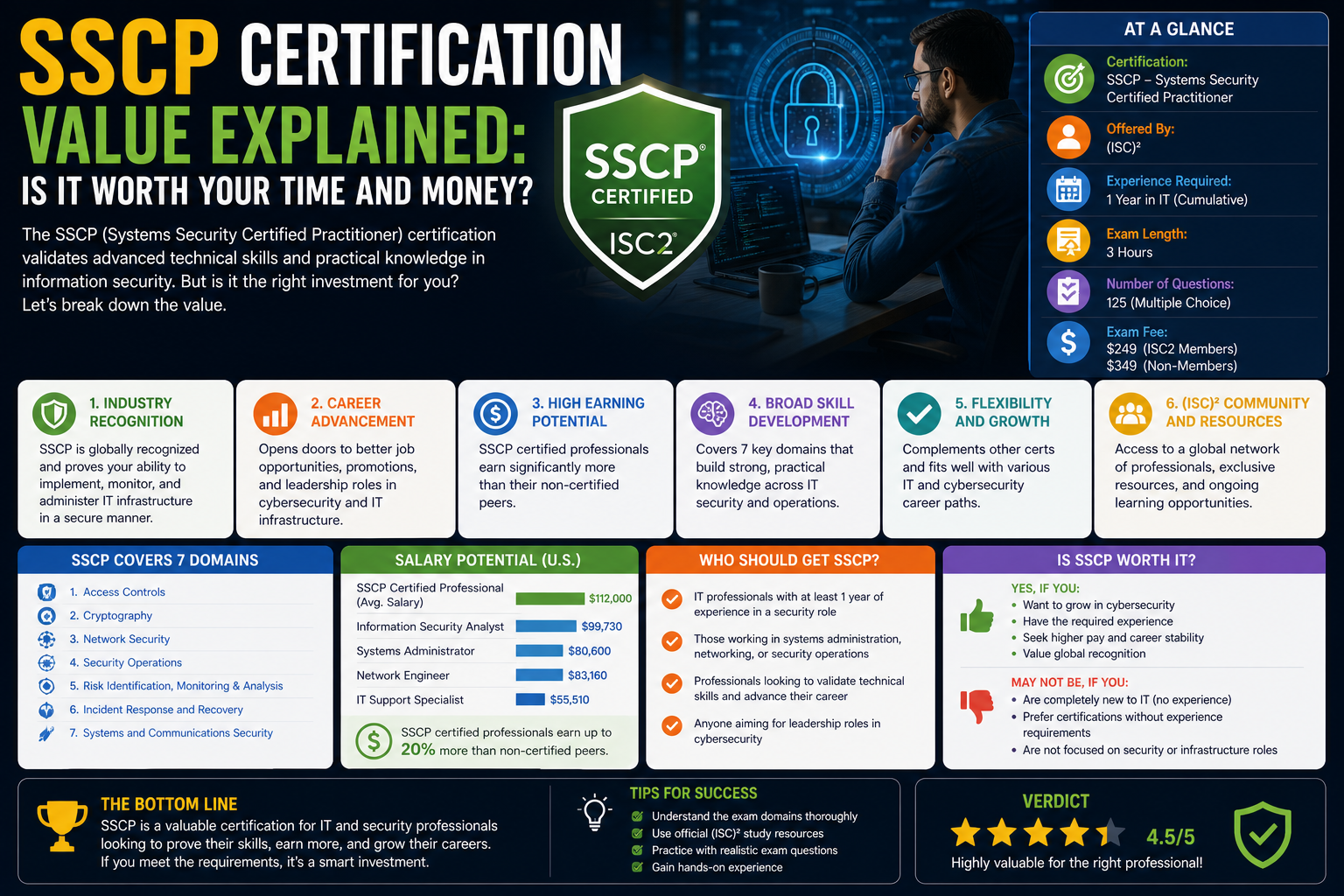
The SSCP certification is structured around seven core domains, each of which reflects a specific area of operational security responsibility. These domains are not abstract academic categories; they represent real skills used in daily cybersecurity work.
One domain focuses on access controls, which are essential for managing who can access systems and data. In practice, this involves configuring authentication systems, managing user roles, and ensuring that permissions are correctly assigned. Poor access control is one of the most common causes of security breaches, making this domain highly relevant.
Another domain addresses security operations and administration. This is one of the most active areas in cybersecurity, involving continuous monitoring of systems, handling alerts, and managing security tools. Professionals working in this domain often act as the first line of defense against cyber threats.
Network security is another critical area. This includes protecting data as it moves across internal and external networks. In real environments, this involves configuring firewalls, managing intrusion detection systems, and securing communication protocols.
Systems and application security focus on protecting the infrastructure that runs business operations. This includes servers, operating systems, and software applications. Security professionals in this area must ensure that systems are properly configured and regularly updated to reduce vulnerabilities.
Other domains cover incident response, risk identification, and cryptography. Together, these areas provide a comprehensive view of operational cybersecurity responsibilities. Each domain reflects tasks that professionals are expected to perform in real job roles.
SSCP and Its Role in Entry-to-Mid Career Transitions
One of the most significant advantages of the SSCP certification is its ability to support career transitions. Many professionals enter cybersecurity from general IT backgrounds, such as help desk support, network administration, or system maintenance roles.
For these individuals, SSCP provides a structured pathway into security-focused positions. It helps bridge the gap between general IT knowledge and specialized cybersecurity skills.
In many cases, professionals already possess foundational technical skills but lack formal recognition in security-specific domains. The SSCP helps validate their knowledge and makes it easier for employers to assess their readiness for security roles.
This is particularly valuable in competitive job markets where employers receive large numbers of applications. A recognized certification can help demonstrate both commitment and capability in cybersecurity.
The transition supported by SSCP is not just about job titles. It also involves a shift in mindset. Instead of focusing solely on system functionality or user support, professionals begin to think about threats, vulnerabilities, and defensive strategies.
This shift is essential for long-term success in cybersecurity, where proactive thinking is just as important as technical ability.
Employer Expectations and Industry Perception of SSCP
Employers view certifications as a way to quickly assess candidate skills, especially in technical fields like cybersecurity. The SSCP certification is generally seen as a strong indicator of operational capability.
Organizations that value hands-on security skills often recognize SSCP as evidence that a candidate can contribute effectively to security teams. This includes the ability to work with security tools, understand system configurations, and respond to incidents.
However, employer expectations can vary depending on the role and industry. In highly technical positions, SSCP may be considered a baseline requirement. In more advanced roles, it may be viewed as a stepping stone toward higher-level certifications.
One important factor in employer perception is experience. While SSCP validates knowledge, employers still look for practical experience in applying that knowledge. This means the certification is most effective when combined with real-world exposure to IT or security environments.
In many cases, SSCP-certified professionals are hired into roles where they can continue developing their skills on the job. These roles often serve as training grounds for more advanced cybersecurity responsibilities.
SSCP in High-Demand Security Environments
Certain industries place a particularly high value on operational security skills. These include sectors that handle sensitive data or critical infrastructure, such as finance, healthcare, government, and telecommunications.
In these environments, security is not optional—it is essential. Organizations must continuously protect against cyber threats, data breaches, and system disruptions. SSCP-certified professionals are often involved in maintaining this security posture.
In financial institutions, for example, security teams are responsible for protecting transaction systems and customer data. This requires constant monitoring and strict access control enforcement.
In healthcare, security professionals must ensure that patient data is protected while still allowing authorized personnel to access critical information. This requires a balance between security and accessibility.
Government agencies often deal with national security concerns, making operational security highly sensitive. Professionals in these environments must follow strict protocols and maintain high levels of system integrity.
Telecommunications companies, on the other hand, must secure large-scale network infrastructures that support millions of users. This requires advanced monitoring and rapid incident response capabilities.
In all of these environments, SSCP-related skills play a direct role in maintaining operational stability and security.
Practical Skill Development Through SSCP Knowledge Areas
The SSCP certification is not only about passing an exam; it represents a structured way of developing practical cybersecurity skills. Each knowledge area contributes to building a more capable security professional.
For example, learning about network security involves understanding how data flows through systems and how it can be intercepted or protected. This knowledge is directly applicable to configuring secure communication channels in real environments.
Similarly, studying access control systems teaches professionals how to manage user permissions effectively. In practice, this helps prevent unauthorized access and reduces the risk of insider threats.
Incident response training prepares professionals to react quickly when security events occur. This includes identifying the source of a problem, containing the threat, and restoring normal operations.
Cryptography knowledge supports the implementation of encryption systems that protect sensitive data. This is essential in environments where data privacy and confidentiality are critical.
Each of these skill areas contributes to a broader ability to maintain secure IT environments. Together, they form a practical skill set that can be applied across multiple job roles and industries.
SSCP as a Foundation for Technical Specialization
Cybersecurity is a broad field with many specialized career paths. Some professionals focus on penetration testing, others on security architecture, and others on incident response or cloud security.
The SSCP certification provides a foundation that can support movement into these specialized areas. Because it covers multiple operational domains, it gives professionals a broad understanding of how security systems interact.
This broad foundation is important because specialization often requires understanding how different systems work together. For example, a penetration tester must understand network configurations, access controls, and system vulnerabilities.
Similarly, a cloud security specialist must understand both traditional security principles and modern distributed infrastructure models.
SSCP helps build this foundational knowledge, making it easier to transition into more specialized roles later in a career.
Challenges and Limitations of SSCP in Career Growth
While the SSCP certification offers many advantages, it also has limitations that are important to understand. One of the primary limitations is its positioning as an entry-to-intermediate level credential.
In highly competitive job markets, more advanced certifications or extensive experience may be required for senior roles. SSCP alone is often not sufficient for leadership positions or highly specialized technical roles.
Another limitation is that certification does not guarantee practical experience. While it demonstrates knowledge, employers still value hands-on exposure to real systems and environments.
Additionally, cybersecurity is a rapidly evolving field. Tools, threats, and technologies change frequently, which means professionals must continuously update their skills beyond what any certification can provide.
Despite these limitations, SSCP remains valuable as part of a broader career development strategy. It is most effective when combined with practical experience and continuous learning.
SSCP in an Evolving Cybersecurity Threat Landscape
Cybersecurity is no longer a static field where threats follow predictable patterns. Modern attack methods evolve continuously, driven by automation, artificial intelligence, and increasingly sophisticated cybercriminal ecosystems. In this environment, operational security professionals play a crucial role in defending systems in real time, and the SSCP certification aligns closely with these evolving demands.
One of the most important shifts in the threat landscape is the speed at which attacks now occur. Automated scanning tools allow attackers to identify vulnerabilities within minutes of exposure. This means security teams must respond quickly, often in real time, to prevent exploitation. SSCP-trained professionals are typically involved in these fast-response environments where monitoring and immediate action are essential.
Another major change is the increasing complexity of attacks. Modern threats often involve multiple stages, including phishing, credential theft, lateral movement within networks, and data exfiltration. These multi-layered attacks require a strong understanding of system interactions, which is a core part of SSCP knowledge areas.
Operational security professionals must also deal with a growing number of attack surfaces. As organizations expand their digital presence, each new system, application, or device introduces potential vulnerabilities. SSCP-certified individuals are trained to understand how to secure these diverse environments at a practical level.
In addition, threat actors now frequently target identity systems rather than just infrastructure. This shift makes access control and authentication mechanisms more critical than ever. SSCP’s focus on identity and access management becomes especially relevant in this context, as it prepares professionals to secure the gateways that protect organizational resources.
Cloud Computing and the Expansion of SSCP Responsibilities
The widespread adoption of cloud computing has significantly changed the nature of operational cybersecurity work. Traditional on-premises systems are now often replaced or supplemented by cloud-based infrastructure, which introduces new security challenges and responsibilities.
In cloud environments, security is shared between providers and organizations. This shared responsibility model requires professionals to clearly understand which security tasks fall under their control and which are managed externally. SSCP-certified individuals are often involved in implementing and managing the security components that remain under organizational responsibility.
One of the key challenges in cloud environments is configuration management. Misconfigured cloud services are a common cause of security breaches. Operational security professionals must ensure that storage systems, virtual machines, and access controls are correctly configured to prevent unauthorized access.
Another important aspect is identity management in cloud systems. Since users often access cloud resources from multiple devices and locations, strong authentication and authorization mechanisms are essential. SSCP knowledge in access control systems directly applies here, helping professionals manage secure access in distributed environments.
Monitoring also becomes more complex in cloud infrastructures. Instead of a single centralized system, security teams must analyze logs and alerts from multiple services and platforms. SSCP-trained professionals are often involved in interpreting this data and identifying potential security incidents.
Cloud computing also increases the importance of encryption and data protection. Sensitive information may be stored across multiple locations, making it essential to ensure data is protected both at rest and in transit. SSCP knowledge in cryptographic principles supports these responsibilities in practical ways.
Identity and Access Management as a Core SSCP Strength
Identity and access management (IAM) is one of the most critical components of modern cybersecurity, and it is a central focus area within SSCP. In many organizations, identity has become the primary security boundary, replacing traditional network perimeters.
IAM involves ensuring that the right individuals have the appropriate level of access to systems and data. This includes authentication processes such as passwords, multi-factor authentication, and biometric verification, as well as authorization systems that define user permissions.
SSCP-certified professionals are trained to understand how these systems function and how to implement them securely. In real-world environments, this often involves managing user accounts, configuring access policies, and monitoring authentication activity for anomalies.
One of the most important challenges in IAM is preventing privilege escalation. Attackers often attempt to gain higher levels of access once they enter a system. SSCP knowledge helps professionals implement controls that limit user privileges and reduce the risk of unauthorized escalation.
Another important aspect is identity lifecycle management. This includes creating, modifying, and removing user accounts as employees join, change roles, or leave an organization. Proper lifecycle management is essential for maintaining security hygiene and preventing orphaned accounts from becoming security risks.
IAM is also closely linked to compliance requirements in many industries. Organizations must demonstrate that they are properly controlling access to sensitive data. SSCP-trained professionals often contribute to ensuring these requirements are met through proper implementation of access controls.
Role of SSCP in Security Operations Centers (SOC)
Security Operations Centers, commonly known as SOCs, are central hubs where cybersecurity monitoring and response activities take place. These environments rely heavily on operational security professionals who can analyze alerts, investigate incidents, and respond to threats.
SSCP-certified individuals are well-suited for SOC roles because the certification focuses on practical, hands-on security skills. In a SOC environment, professionals are constantly monitoring security tools such as intrusion detection systems, firewalls, and log analysis platforms.
One of the primary responsibilities in a SOC is alert triage. Not all security alerts indicate real threats, so professionals must determine which alerts require investigation and which are false positives. SSCP training helps develop the analytical skills needed for this decision-making process.
Another key responsibility is threat investigation. When suspicious activity is detected, SOC analysts must examine logs, trace system activity, and determine the scope of the potential incident. This requires a strong understanding of system behavior and network communication patterns.
SOC environments also require collaboration between team members. Incidents are often escalated to higher-level analysts or incident response teams. SSCP-certified professionals typically serve as the first line of defense, identifying and escalating issues as needed.
The fast-paced nature of SOC work aligns closely with SSCP’s operational focus. Professionals in these roles must be able to think quickly, analyze data efficiently, and take immediate action when necessary.
Incident Response and Practical Security Execution
Incident response is one of the most critical aspects of cybersecurity operations. When a security breach or attack occurs, organizations must respond quickly to minimize damage and restore normal operations.
SSCP-certified professionals are often involved in the early stages of incident response. This includes identifying the presence of an incident, gathering initial evidence, and assisting in containment efforts.
The incident response process typically begins with detection. Security tools generate alerts when unusual activity is detected. SSCP knowledge helps professionals understand these alerts and determine whether they represent real threats.
Once an incident is confirmed, containment becomes the next priority. This may involve isolating affected systems, disabling compromised accounts, or blocking malicious network traffic. Operational security professionals play a key role in executing these actions.
After containment, the focus shifts to eradication and recovery. This involves removing malicious components from systems, restoring data from backups, and ensuring that vulnerabilities are patched to prevent recurrence.
SSCP training also emphasizes documentation and reporting. Accurate records of incidents are essential for post-incident analysis and compliance requirements. Professionals must document what happened, how it was handled, and what improvements can be made.
Incident response is a highly dynamic process that requires both technical knowledge and practical decision-making skills. SSCP provides a foundation for developing these capabilities in real-world environments.
Salary Trends and Market Value of SSCP Skills
The value of SSCP certification in the job market is closely tied to the demand for operational cybersecurity skills. As organizations continue to face increasing cyber threats, professionals who can actively secure systems are in high demand.
Salaries for roles associated with SSCP skills vary widely depending on experience, location, and job responsibility. Entry-level positions may start at moderate salary levels, while more experienced professionals in specialized roles can earn significantly higher compensation.
One of the key factors influencing salary is experience. While SSCP certification demonstrates knowledge, employers place strong value on hands-on experience in real environments. Professionals who combine certification with practical experience typically see higher earning potential.
Another important factor is job specialization. Roles such as security engineer, SOC analyst, or identity management specialist often command higher salaries due to their technical complexity.
Industry also plays a role in compensation levels. Sectors such as finance, healthcare, and technology tend to offer higher salaries due to the sensitive nature of their data and the critical importance of security.
It is also important to recognize that SSCP serves as a stepping stone rather than a final destination in many career paths. Professionals often use it to gain entry into cybersecurity roles, then build experience and pursue more advanced opportunities over time.
Global Recognition and Career Mobility
One of the strengths of SSCP certification is its global recognition. Cybersecurity is a universal concern, and the skills validated by SSCP are applicable across different countries and industries.
This global relevance makes the certification valuable for professionals who may want to pursue international career opportunities. Since the certification is based on vendor-neutral principles, the knowledge can be applied in diverse technological environments.
In many cases, multinational organizations prefer standardized certifications when hiring security professionals. This ensures that candidates meet consistent skill expectations regardless of their location.
Global recognition also supports remote work opportunities. As cybersecurity roles increasingly shift to remote or hybrid models, professionals with standardized certifications can more easily work with distributed teams across different regions.
However, it is important to note that local job markets and regulations may still influence hiring practices. While SSCP provides a strong foundation, employers may also consider additional qualifications or experience depending on regional requirements.
Career Progression Pathways After SSCP
SSCP is often part of a broader cybersecurity career journey rather than an endpoint. After gaining experience in operational security roles, professionals typically explore more specialized or advanced positions.
One common pathway is moving from SOC analyst roles into senior security engineering positions. This transition involves deeper technical responsibilities, including designing security systems and implementing advanced protections.
Another pathway involves specialization in areas such as cloud security, identity management, or network defense. These roles require more focused expertise but build directly on SSCP foundational knowledge.
Some professionals choose to move toward security architecture roles, where they design overall security frameworks for organizations. This requires a combination of technical understanding and strategic thinking.
Others may transition into leadership roles over time, overseeing security teams and managing organizational security strategies. While SSCP is not a leadership certification, it provides the technical grounding necessary for understanding operational challenges.
Each of these pathways builds on the foundational skills developed through SSCP, demonstrating its role as a flexible starting point in cybersecurity careers.
Evolving Expectations from Cybersecurity Professionals
Employers today expect cybersecurity professionals to possess a combination of technical expertise, analytical thinking, and adaptability. The SSCP certification helps develop these attributes by focusing on practical, real-world security scenarios.
One of the most important expectations is the ability to respond quickly to threats. Security teams must operate in environments where decisions are made in minutes rather than hours. SSCP-trained professionals are prepared for this fast-paced environment.
Another expectation is continuous learning. Cybersecurity is constantly evolving, and professionals must stay updated on new threats, tools, and technologies. The foundational knowledge gained through SSCP supports ongoing skill development.
Employers also expect professionals to understand how different systems interact. Modern IT environments are highly interconnected, and security decisions often affect multiple systems simultaneously.
Finally, there is an increasing expectation for collaboration. Cybersecurity is rarely a solo effort, and professionals must work effectively with teams across IT, compliance, and management functions.
SSCP in the Context of Long-Term Cybersecurity Evolution
As cybersecurity continues to evolve, the importance of operational security professionals is expected to grow. Organizations are increasingly recognizing that effective defense requires not just policies but skilled individuals who can implement and maintain security systems.
SSCP plays a role in preparing professionals for this evolving landscape by focusing on practical, adaptable skills. These skills remain relevant even as technologies change, because they are based on core security principles.
The rise of automation and artificial intelligence in cybersecurity will also change the nature of operational roles. While some tasks may become automated, human professionals will still be needed to interpret results, handle complex incidents, and make critical decisions.
SSCP-certified professionals are positioned to work alongside these technologies, using automation tools while maintaining oversight and control over security operations.
As digital systems continue to expand, the need for skilled operational security professionals will remain strong, and SSCP provides a structured entry point into this evolving field.
Conclusion
The SSCP certification holds a practical and meaningful place in the cybersecurity landscape, particularly for professionals who want to work directly with systems rather than focus only on policy or high-level strategy. Its strength lies in its operational orientation, where real-world skills such as system monitoring, access control management, network protection, and incident response are emphasized. In an industry where threats evolve rapidly and organizations depend on continuous defense, these hands-on abilities are essential.
For individuals transitioning from general IT roles into cybersecurity, SSCP provides a structured and credible pathway. It helps bridge the gap between foundational technical knowledge and the specialized skills required in security-focused environments. This makes it especially valuable for system administrators, network technicians, and IT support professionals seeking career growth in security operations.
The certification also plays a supporting role in long-term career development. While it is not positioned as a top-tier leadership credential, it lays the groundwork for more advanced roles by building a strong understanding of core security domains. Professionals who begin with SSCP often find it easier to progress into more specialized or senior positions as they gain experience.
At the organizational level, SSCP-certified professionals contribute to maintaining secure and stable IT environments. Their skills are directly applied in security operations centers, cloud environments, and enterprise infrastructure, where continuous monitoring and rapid response are critical. This practical relevance ensures that the certification remains aligned with real industry needs.
Ultimately, the value of SSCP depends on career goals, experience level, and the desired direction within cybersecurity. For those seeking hands-on technical roles and a solid entry point into the field, it offers a strong foundation that supports both immediate job readiness and future professional growth in an increasingly security-driven digital world.