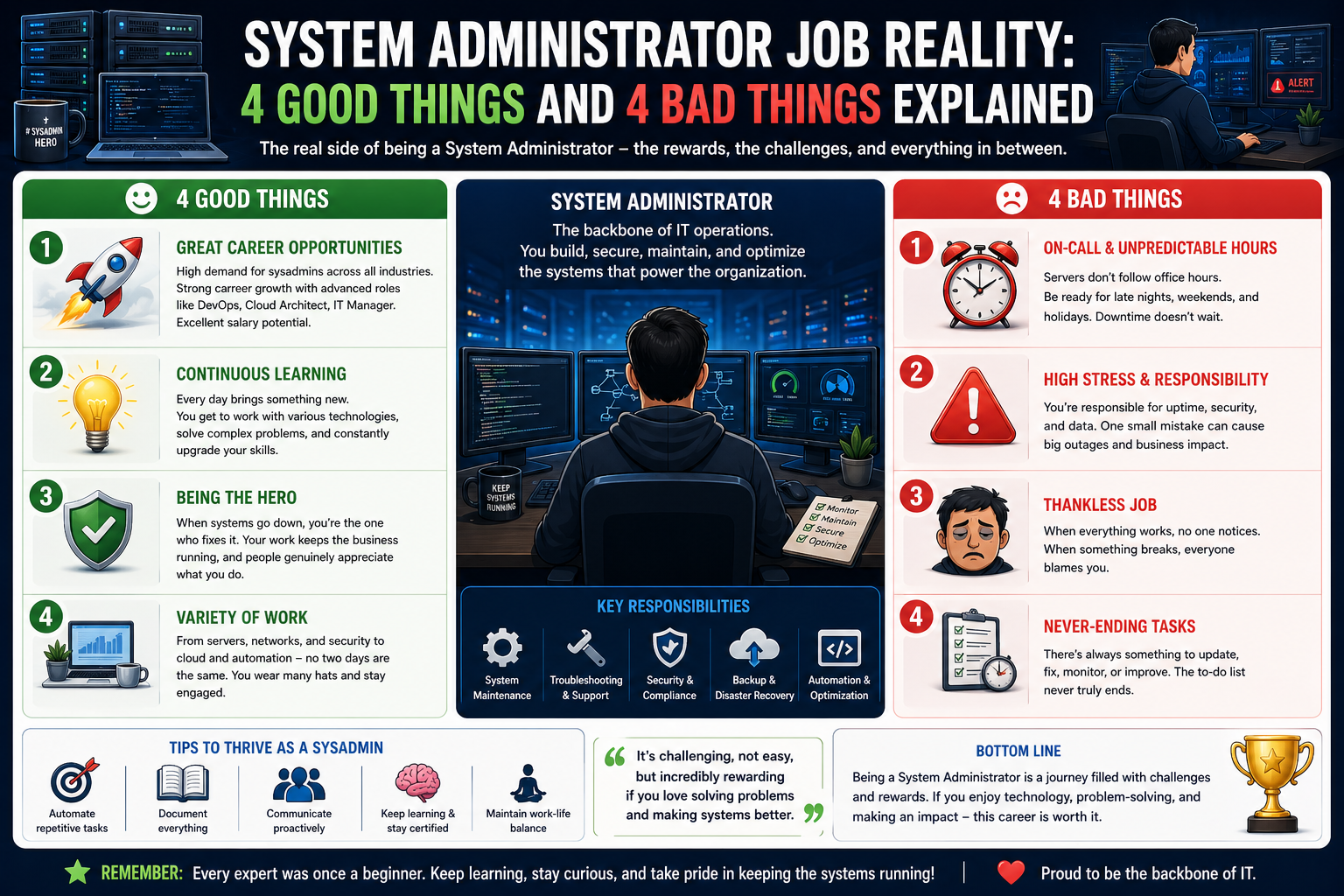
A system administrator, often shortened to sysadmin, plays a central role in keeping an organization’s digital infrastructure stable, secure, and functional. Although the job title might sound purely technical, the reality is that sysadmins operate at the intersection of technology, business continuity, and problem-solving under pressure.
In modern organizations, almost every workflow depends on servers, networks, cloud systems, authentication services, and internal applications. When any of these components fail, the sysadmin is typically among the first responders. This responsibility makes the role both highly respected and, at times, highly stressful.
What makes the sysadmin position particularly unique is its dual nature. On one hand, it is deeply technical, requiring knowledge of operating systems, virtualization, networking, storage, and security. On the other hand, it is highly reactive, requiring fast decision-making, communication with multiple teams, and prioritization of business-critical issues.
Because of this combination, sysadmins often describe their work as unpredictable. No two days are the same, and even routine days can shift instantly when an unexpected system issue arises.
Constant System Reliability Expectations and Invisible Responsibility
One of the defining realities of being a sysadmin is the expectation of constant uptime. In many organizations, users assume that systems should simply work at all times. When everything is functioning properly, the sysadmin’s work becomes invisible. When something breaks, however, the role immediately becomes the center of attention.
This creates a unique professional dynamic. The success of sysadmins is often measured by the absence of problems rather than visible accomplishments. If systems run smoothly for weeks or months, it is easy for management and users to overlook the effort required to maintain that stability.
Behind the scenes, sysadmins perform continuous tasks that are not always visible. These include monitoring server health, applying security patches, managing backups, reviewing logs, optimizing performance, and ensuring that storage and network resources remain sufficient.
Even when no incidents are reported, sysadmins are actively working to prevent future failures. This preventative work is one of the most critical yet least recognized parts of the job.
The paradox is that the better a sysadmin performs, the less noticeable their work becomes. Stability can sometimes lead to underappreciation, even though maintaining that stability requires constant attention and expertise.
High Pressure During System Failures and Downtime Events
When systems fail, the environment changes immediately. What was previously a quiet and stable infrastructure becomes a high-priority emergency. Downtime affects productivity, customer experience, financial operations, and, in some cases, brand reputation.
During these moments, sysadmins must act quickly to identify the root cause, mitigate the issue, and restore services as fast as possible. The pressure is intensified by the fact that multiple stakeholders may be waiting for updates, including managers, executives, and end users.
Unlike routine tasks, system outages require rapid thinking and structured troubleshooting under time constraints. A misstep can extend downtime or create additional complications, so decisions must be both fast and accurate.
In many cases, sysadmins rely on disaster recovery plans, backup systems, redundancy setups, and documented procedures. However, not every scenario can be fully anticipated, which means adaptability is equally important.
The emotional pressure during outages is significant. Even experienced professionals can feel the weight of responsibility when critical services are affected. The urgency is not just technical—it is tied directly to business continuity.
Once systems are restored, there is often a follow-up phase that involves analyzing what went wrong, documenting the incident, and implementing improvements to prevent recurrence. This cycle of reaction and improvement is a core part of sysadmin life.
Limited Recognition Despite High Responsibility
A recurring theme among system administrators is the lack of visible recognition. Because their work is primarily behind the scenes, achievements are not always obvious to non-technical stakeholders.
When systems function well, it is often perceived as the natural state of things rather than the result of careful maintenance. This can create a disconnect between effort and acknowledgment.
Sysadmins frequently handle complex tasks such as configuring secure networks, managing identity systems, ensuring data protection, and maintaining uptime across distributed environments. Yet these contributions are often only noticed when something goes wrong.
This lack of recognition can affect morale over time. Even though sysadmins understand the importance of preventative work, the absence of feedback or appreciation can make the role feel undervalued in certain environments.
However, in more mature IT cultures, there is a growing awareness of the importance of infrastructure teams. Organizations that understand the value of reliability tend to recognize sysadmins more consistently, especially after major incidents highlight how critical their role truly is.
The Challenge of Continuous Learning Without Structured Support
Technology evolves rapidly, and system administrators are expected to keep up with constant changes. New operating systems, cloud platforms, cybersecurity threats, automation tools, and infrastructure models appear regularly, reshaping how IT environments are managed.
Despite this, many sysadmins face limited access to structured training. In some organizations, training budgets are minimal or not prioritized, leaving professionals responsible for self-directed learning.
This creates a challenge: sysadmins must stay current to remain effective, but often must do so outside of working hours or through personal effort.
Self-learning becomes a key part of career development. Many sysadmins rely on hands-on experience, documentation, lab environments, and experimentation to build new skills. While this approach can be effective, it also requires significant time and motivation.
The gap between expected knowledge and available training can lead to frustration. Organizations may expect expertise in multiple domains without investing in formal development pathways.
At the same time, this environment also rewards initiative. Sysadmins who actively pursue certifications, practice new technologies, and expand their skill sets often find themselves more competitive in the job market and better equipped to handle complex systems.
The Impact of Non-Technical Decision Making
Another challenge sysadmins frequently encounter is working under non-technical decision-makers. In some organizations, strategic or operational decisions affecting IT infrastructure are made without sufficient technical consultation.
This can lead to situations where systems are designed, modified, or scaled in ways that are not optimal from an engineering perspective. For example, decisions may prioritize short-term cost savings or organizational convenience over long-term stability and scalability.
When sysadmins are not included in early planning stages, they may be tasked with implementing solutions that are technically inefficient or difficult to maintain. This can increase workload and introduce avoidable risks.
The impact becomes more visible during implementation or after deployment, when limitations emerge. At that point, adjusting the system can require additional effort, time, and resources.
In well-structured environments, sysadmins collaborate closely with management and architects to ensure that technical constraints are considered during planning. In less integrated environments, however, communication gaps can lead to friction between teams.
This dynamic highlights the importance of aligning technical expertise with business decision-making to avoid unnecessary complexity and operational challenges.
Balancing Stability with Rapid Technological Change
Sysadmins often find themselves balancing two competing forces: maintaining stable legacy systems while adapting to new technologies. Many organizations rely on long-standing systems that are critical to operations but may not be modern or easily replaceable.
At the same time, businesses frequently adopt new tools and platforms to improve efficiency, security, or scalability. Sysadmins must integrate these changes without disrupting existing services.
This balancing act can be challenging. Legacy systems may require specialized knowledge, while new technologies demand continuous learning and adaptation. Managing both simultaneously requires flexibility and strong prioritization skills.
In some environments, sysadmins may also face resistance to change. Older systems may remain in place due to cost concerns or operational dependencies, even when modernization would improve performance or security.
Conversely, some organizations adopt new technologies too quickly without sufficient planning, creating additional complexity and workload for IT teams.
The sysadmin’s role becomes one of stabilization—ensuring that innovation does not compromise reliability and that existing systems remain functional while transitions occur gradually.
Communication Demands Across Technical and Non-Technical Teams
System administrators do not work in isolation. They interact with multiple teams, including developers, security personnel, management, and end users. This makes communication an essential part of the role.
One of the challenges is translating technical issues into language that non-technical stakeholders can understand. During incidents or planning discussions, sysadmins must explain problems, risks, and solutions clearly without relying heavily on technical jargon.
Effective communication is especially important during outages or system changes. Stakeholders need clear updates on status, expected resolution times, and potential impacts.
Miscommunication can lead to confusion, unrealistic expectations, or unnecessary pressure. Therefore, sysadmins must develop not only technical expertise but also interpersonal skills.
In many cases, sysadmins act as a bridge between technical infrastructure and business operations. Their ability to communicate effectively directly influences how smoothly projects are executed and how incidents are managed.
Growing Dependence on Infrastructure and Its Implications
As organizations continue to digitize their operations, dependence on IT infrastructure increases significantly. Cloud services, remote work systems, automation platforms, and interconnected applications all rely on stable backend systems.
This growing dependence elevates the importance of sysadmins even further. A small configuration error, hardware failure, or security vulnerability can have widespread effects across the organization.
With this increased reliance comes greater responsibility. Sysadmins are expected not only to maintain systems but also to anticipate risks, implement security measures, and ensure scalability for future growth.
The complexity of modern IT environments means that sysadmins must manage a wide range of technologies simultaneously. This includes hybrid cloud environments, virtualized infrastructure, containerized applications, and distributed networks.
Each layer adds additional responsibility and requires continuous monitoring and adjustment. As systems become more complex, the sysadmin’s role becomes more strategic as well as operational.
The Reality of Being the First Line of Technical Defense
In many organizations, sysadmins serve as the first line of defense when technical issues arise. Whether it is a server outage, a network disruption, or a security alert, they are often responsible for initial diagnosis and response.
This role requires both technical knowledge and calm decision-making. Initial assessments are critical because they determine how quickly and effectively an issue can be resolved.
Sysadmins often rely on monitoring tools, logs, alerts, and diagnostic utilities to identify problems. However, not all issues present clear symptoms, which means experience and intuition also play important roles.
Being the first responder means handling uncertainty while maintaining control of the situation. It is a responsibility that demands resilience, focus, and structured thinking, especially under pressure.
Even outside of emergencies, sysadmins remain responsible for maintaining system integrity and ensuring that potential issues are detected early before they escalate.
Real-World Complexity of Daily System Administration Work
System administration is often described as a behind-the-scenes profession, but in reality, it is one of the most operationally intense roles in modern IT environments. Every day brings a mix of planned maintenance, unexpected incidents, user support requests, and infrastructure monitoring tasks that require constant attention.
Unlike roles that follow a predictable workflow, sysadmins operate in an environment where priorities can change instantly. A quiet morning dedicated to routine updates can quickly shift into an urgent response to a server outage or network failure. This unpredictability is one of the defining characteristics of the profession.
Much of the daily work revolves around maintaining system health. This includes checking server logs, reviewing performance metrics, ensuring backup processes are functioning correctly, and verifying that security patches are up to date. While these tasks may seem repetitive, they are essential for preventing larger failures.
Even small misconfigurations can escalate into significant problems if not detected early. As a result, sysadmins develop a habit of continuous observation, constantly scanning for irregularities that may indicate deeper issues.
In many organizations, sysadmins also handle user support tickets. These can range from simple password resets to complex application issues that require deep troubleshooting. The variety of tasks requires adaptability and patience, especially when balancing user expectations with technical limitations.
The Pressure of Maintaining Uptime in Modern Infrastructure
Uptime is one of the most critical metrics in system administration. Businesses rely on continuous access to applications, databases, and services to operate efficiently. Even short periods of downtime can result in financial loss, reduced productivity, or customer dissatisfaction.
Sysadmins are responsible for ensuring that systems remain available as close to 100 percent of the time as possible. Achieving this requires a combination of redundancy, monitoring, proactive maintenance, and disaster recovery planning.
However, maintaining uptime is not simply a technical challenge—it is also a strategic one. Sysadmins must anticipate potential points of failure and design systems that can tolerate disruptions without affecting end users.
High availability environments often involve load balancing, failover systems, replicated databases, and geographically distributed infrastructure. Managing these systems adds complexity to daily operations but significantly improves reliability.
Despite best efforts, failures still occur. Hardware can degrade unexpectedly, software updates can introduce bugs, and external factors such as power outages or network disruptions can impact availability. When this happens, sysadmins must act quickly to restore services.
The pressure during these moments is intense because every minute of downtime matters. Communication becomes just as important as technical action, as stakeholders expect regular updates while the issue is being resolved.
Incident Response and High-Stress Problem Solving
Incident response is one of the most demanding aspects of system administration. When a critical system fails, sysadmins must transition immediately from routine operations to emergency troubleshooting mode.
The first step is usually identification. Determining what is broken, how widespread the issue is, and what systems are affected requires careful analysis of logs, monitoring dashboards, and system alerts.
Once the scope of the issue is understood, sysadmins begin isolating the root cause. This process may involve checking recent changes, reviewing configuration files, testing connectivity, or rolling back updates.
Time pressure plays a significant role during incidents. The longer a system remains down, the greater the impact on the organization. This urgency can make decision-making more challenging, especially in complex environments where multiple systems are interconnected.
Effective incident response requires structured thinking. Many sysadmins rely on established methodologies such as prioritization frameworks and escalation procedures to guide their actions during emergencies.
After the incident is resolved, a post-incident review is typically conducted. This analysis helps identify what went wrong, how the issue was resolved, and what can be improved to prevent similar problems in the future.
Hidden Complexity of Infrastructure Management
Modern IT infrastructure is far more complex than it appears on the surface. What users experience as simple applications or services is often supported by multiple layers of systems working together behind the scenes.
Sysadmins manage operating systems, virtualization platforms, network configurations, storage systems, authentication services, and application environments. Each of these components has its own dependencies and potential failure points.
In cloud-based environments, complexity increases further. Sysadmins must manage virtual machines, containers, managed services, and distributed architectures that span multiple regions or providers.
One of the challenges of infrastructure management is ensuring consistency across environments. Configuration drift can occur when systems are modified over time without proper synchronization, leading to inconsistencies that may cause unpredictable behavior.
Automation tools are often used to reduce manual configuration and improve consistency. However, automation itself introduces new responsibilities, as scripts and configurations must be maintained and updated regularly.
The complexity of modern infrastructure means that sysadmins must have a broad skill set. They are expected to understand networking, security, storage, virtualization, and increasingly, cloud technologies.
Security Responsibilities and Constant Threat Awareness
Security has become one of the most important aspects of system administration. Sysadmins are responsible for protecting organizational systems from unauthorized access, data breaches, and cyberattacks.
This responsibility involves implementing firewalls, managing access controls, monitoring logs for suspicious activity, and ensuring that systems are regularly patched against known vulnerabilities.
Security threats are constantly evolving. New vulnerabilities are discovered regularly, and attackers continuously develop new methods to exploit systems. Sysadmins must stay informed about emerging threats and apply updates promptly to reduce risk.
One of the challenges in security management is balancing protection with usability. Strict security controls can sometimes interfere with user productivity, while overly relaxed controls can increase vulnerability.
Sysadmins must find the right balance based on organizational needs and risk tolerance. This often involves collaboration with security teams and management to establish appropriate policies.
In addition to external threats, internal risks must also be managed. Misconfigured permissions, accidental data exposure, or unauthorized changes can also lead to security incidents.
Security responsibilities add another layer of pressure to the sysadmin role, as failures in this area can have serious consequences for the entire organization.
Managing Legacy Systems and Technical Debt
Many organizations rely on legacy systems that have been in use for years or even decades. These systems often continue to function because they are critical to business operations, even if they are outdated or difficult to maintain.
Sysadmins are responsible for keeping these systems operational while also managing the risks associated with aging technology. This can be challenging because documentation may be incomplete, original developers may no longer be available, and compatibility with modern systems may be limited.
Technical debt accumulates over time when systems are not updated or redesigned. This can make maintenance more difficult and increase the likelihood of failures.
Despite these challenges, replacing legacy systems is not always straightforward. Migration projects can be expensive, time-consuming, and risky, especially if the system is deeply integrated into business processes.
As a result, sysadmins often find themselves maintaining a balance between keeping legacy systems running and supporting newer technologies. This dual responsibility requires both technical expertise and careful planning.
Communication Under Pressure in Technical Environments
Communication is a critical skill for system administrators, especially during high-pressure situations. When systems fail or performance issues arise, sysadmins must communicate clearly with multiple stakeholders.
This includes explaining technical issues to non-technical users, providing status updates to management, and coordinating with other IT teams to resolve problems.
One of the challenges is translating complex technical concepts into simple, understandable language. Stakeholders often want quick answers, but the underlying issues may require detailed investigation.
During incidents, communication must be frequent and transparent. Users want to know what is happening, how long it will take to resolve, and what impact the issue may have.
Poor communication can increase frustration and reduce confidence in IT systems. On the other hand, clear and consistent updates can help manage expectations even when problems take time to resolve.
Sysadmins often act as intermediaries between technical systems and business operations, making communication an essential part of their role.
Evolving Role of Automation in System Administration
Automation has significantly changed the nature of system administration. Many repetitive tasks that were once performed manually are now handled by scripts, configuration management tools, and orchestration systems.
This shift allows sysadmins to focus more on higher-level responsibilities such as system design, optimization, and strategic planning.
However, automation also introduces new challenges. Automated systems must be carefully designed, tested, and maintained. A small error in an automated script can potentially affect multiple systems at once.
Sysadmins must therefore understand not only how to use automation tools but also how to troubleshoot them when issues arise.
In many environments, automation is used for tasks such as software deployment, system provisioning, configuration management, and monitoring. These tools improve efficiency but also require ongoing oversight.
The increasing reliance on automation means that sysadmins are gradually shifting from manual operators to infrastructure engineers responsible for managing complex automated environments.
Career Progression and Expanding Responsibilities
As sysadmins gain experience, their responsibilities often expand beyond day-to-day operations. Many transition into more specialized roles such as systems engineer, cloud architect, security administrator, or infrastructure manager.
Career progression in system administration is closely tied to skill development. Professionals who continuously learn new technologies and adapt to industry changes are more likely to advance into senior positions.
Experience in troubleshooting, system design, and infrastructure management provides a strong foundation for higher-level roles.
In many cases, senior sysadmins are also involved in strategic planning. This includes designing infrastructure upgrades, evaluating new technologies, and contributing to long-term IT strategy.
The progression from operational tasks to strategic responsibilities reflects the growing importance of IT infrastructure in modern organizations.
Emotional Resilience and Long-Term Sustainability in the Role
System administration requires not only technical skills but also emotional resilience. The pressure of maintaining uptime, responding to incidents, and managing expectations can be demanding over time.
Sysadmins must be able to handle stress, remain focused during emergencies, and recover quickly after high-pressure situations.
The unpredictable nature of the job means that work-life balance can sometimes be challenging. Unexpected incidents may require attention outside of normal working hours, especially in environments that require high availability.
Despite these challenges, many sysadmins find the role rewarding due to its variety, complexity, and impact on organizational success.
Long-term sustainability in the profession often depends on continuous learning, strong support structures, and effective workload management.
The Shift from Traditional Infrastructure to Cloud-Centric Systems
The role of a system administrator has changed dramatically over the past decade due to the widespread adoption of cloud computing. Traditional on-premises environments, where sysadmins managed physical servers and local data centers, are increasingly being replaced or supplemented by cloud-based infrastructure.
This shift has transformed not only the tools sysadmins use but also the way they think about systems. Instead of managing physical hardware directly, they now work with virtualized resources, distributed services, and scalable cloud platforms that can expand or shrink based on demand.
In cloud-centric environments, sysadmins are expected to manage infrastructure as code, automate deployments, and ensure that services remain highly available across multiple regions. This introduces new layers of abstraction that require different skill sets compared to traditional system administration.
While cloud platforms simplify certain tasks, they also introduce complexity in other areas. Sysadmins must now understand billing models, resource optimization, identity management across distributed systems, and security configurations that span multiple environments.
The transition to cloud systems has also changed the way failures are handled. Instead of dealing with a single physical server failure, sysadmins must manage distributed failures across services that may be interconnected in complex ways.
Infrastructure as Code and the Rise of Automation-First Thinking
One of the most significant developments in modern system administration is the concept of infrastructure as code. This approach allows sysadmins to define and manage infrastructure using code-based configurations rather than manual setup processes.
Infrastructure as code enables consistency, repeatability, and scalability. Instead of configuring systems individually, sysadmins can deploy entire environments using predefined templates or scripts.
This shift reduces human error and makes it easier to replicate environments across development, testing, and production systems. However, it also requires sysadmins to develop skills in scripting, version control, and configuration management.
Automation-first thinking has become essential in modern IT environments. Repetitive tasks such as provisioning servers, deploying applications, and configuring networks are increasingly handled by automated systems.
While this improves efficiency, it also changes the nature of sysadmin work. The focus shifts from manual execution to design, orchestration, and troubleshooting of automated processes.
Sysadmins must now ensure that automation scripts are reliable, secure, and maintainable. A single error in automation can impact multiple systems simultaneously, making careful design and testing essential.
Advanced Monitoring and Observability in Complex Systems
As IT environments become more complex, traditional monitoring approaches are no longer sufficient. Modern system administration relies heavily on observability, which goes beyond simple uptime checks and performance metrics.
Observability includes logs, metrics, and traces that provide deep insight into system behavior. Sysadmins use these tools to understand how different components interact and where potential issues may arise.
In distributed systems, problems are not always immediately visible. A failure in one service may only appear as a slowdown or error in another part of the system. Observability tools help sysadmins trace these issues across multiple layers.
Advanced monitoring systems also use alerting mechanisms to notify sysadmins when anomalies are detected. However, managing alerts effectively is a challenge in itself, as too many alerts can lead to alert fatigue.
Sysadmins must fine-tune monitoring systems to ensure that alerts are meaningful and actionable. This requires a deep understanding of system behavior and normal operating patterns.
The goal of observability is not just to detect failures but to understand why they occur. This deeper insight allows sysadmins to prevent future issues and improve overall system reliability.
Real-World Complexity of Hybrid IT Environments
Many organizations do not operate entirely in the cloud or entirely on-premises. Instead, they use hybrid environments that combine both traditional infrastructure and modern cloud systems.
Managing hybrid environments is one of the most complex aspects of system administration today. Sysadmins must ensure seamless integration between local servers and cloud services while maintaining security, performance, and consistency.
Data synchronization between environments can be particularly challenging. Ensuring that information remains consistent across systems requires careful planning and reliable synchronization mechanisms.
Network connectivity also plays a critical role. Hybrid environments depend on secure and stable connections between on-premises infrastructure and cloud platforms.
Sysadmins must also manage identity and access control across multiple environments. Users may need access to both local systems and cloud applications, requiring unified authentication systems.
The complexity of hybrid IT environments demands a high level of coordination and technical expertise. Sysadmins must understand both legacy systems and modern cloud technologies to manage these environments effectively.
Security Challenges in a Highly Connected World
As systems become more interconnected, security challenges increase significantly. Sysadmins are responsible for protecting not only individual systems but entire ecosystems of connected services.
Cybersecurity threats have evolved to target complex infrastructures. Attackers may exploit vulnerabilities in cloud configurations, network interfaces, or user authentication systems.
One of the key challenges is maintaining consistent security policies across different environments. In hybrid systems, security configurations must be aligned between on-premises and cloud platforms.
Identity management has become a central focus of modern security. Sysadmins must ensure that only authorized users have access to sensitive systems and data.
Multi-factor authentication, role-based access control, and encryption are commonly used to enhance security. However, implementing these measures correctly requires careful planning and ongoing maintenance.
Another challenge is detecting and responding to security incidents. Sysadmins must monitor systems for unusual activity and respond quickly to potential threats.
Security is no longer a separate function in IT environments. It is integrated into every aspect of system administration, making it a continuous responsibility rather than a one-time task.
Performance Optimization in Large-Scale Systems
Performance optimization is a critical responsibility for sysadmins managing large-scale systems. As user demand increases, systems must be able to handle higher loads without degrading performance.
Optimization involves analyzing system behavior, identifying bottlenecks, and making adjustments to improve efficiency. This can include tuning databases, optimizing network configurations, or scaling resources dynamically.
In cloud environments, performance optimization often involves balancing cost and efficiency. Over-provisioning resources can be expensive, while under-provisioning can lead to performance issues.
Sysadmins must continuously monitor system performance and adjust configurations based on usage patterns. This requires both technical knowledge and analytical thinking.
Caching mechanisms, load balancing, and distributed architectures are commonly used to improve performance in modern systems.
Performance optimization is not a one-time task but an ongoing process. As systems evolve and usage patterns change, sysadmins must continuously refine configurations to maintain optimal performance.
Disaster Recovery and Business Continuity Planning
Disaster recovery is one of the most important aspects of system administration. It ensures that organizations can restore operations after unexpected failures or catastrophic events.
Sysadmins are responsible for designing and maintaining backup systems, replication strategies, and recovery procedures. These systems must be reliable and regularly tested to ensure they work when needed.
Business continuity planning goes beyond technical recovery. It involves ensuring that critical business functions can continue even during system disruptions.
This may include redundant systems, failover environments, and alternative workflows that allow operations to continue with minimal interruption.
One of the key challenges in disaster recovery is balancing cost and resilience. Highly redundant systems provide better protection but are more expensive to maintain.
Sysadmins must work with management to design recovery strategies that meet both technical and business requirements.
Regular testing is essential to ensure that disaster recovery plans are effective. Without testing, there is no guarantee that systems will function correctly during an actual failure.
Scaling Infrastructure to Meet Growing Demands
As organizations grow, their IT infrastructure must scale accordingly. Sysadmins are responsible for ensuring that systems can handle increased workloads without performance degradation.
Scaling can be vertical, involving upgrading existing systems, or horizontal, involving adding more systems to distribute the load.
Modern architectures often rely on horizontal scaling, especially in cloud environments. This allows systems to expand dynamically based on demand.
Sysadmins must design systems that can scale efficiently while maintaining stability and performance.
Load balancing plays a key role in distributing traffic across multiple systems. This helps prevent overload and ensures consistent performance.
Scalability is not only about handling more users but also about maintaining reliability under varying conditions.
Proper scaling requires careful planning and continuous monitoring to ensure that systems remain responsive and efficient.
The Human Side of System Administration Work
While system administration is highly technical, it also has a significant human component. Sysadmins interact with users, developers, managers, and other IT professionals daily.
These interactions require communication skills, patience, and the ability to explain technical concepts clearly.
User support is often part of the role, especially in smaller organizations. Sysadmins must help users resolve technical issues, which can range from simple to complex.
Managing expectations is an important aspect of the job. Users may not always understand technical limitations, so sysadmins must communicate constraints clearly and professionally.
Team collaboration is also essential. Sysadmins often work closely with other IT teams to implement solutions, troubleshoot issues, and plan infrastructure changes.
The human side of system administration adds complexity to the role but also makes it more dynamic and engaging.
Evolving Career Paths and Specialization Opportunities
System administration is no longer a single, uniform career path. It has evolved into multiple specialized roles that focus on different aspects of IT infrastructure.
Some sysadmins transition into cloud engineering, focusing on managing distributed cloud environments. Others move into cybersecurity, focusing on protecting systems from threats.
Network administration, database administration, and DevOps engineering are other common career paths that build on sysadmin experience.
Specialization allows professionals to deepen their expertise in specific areas while contributing to larger organizational goals.
Career progression often depends on experience, continuous learning, and adaptability to new technologies.
As IT environments continue to evolve, sysadmins have increasing opportunities to move into strategic and leadership roles.
The Future Direction of System Administration Work
The future of system administration is closely tied to automation, cloud computing, and artificial intelligence. Many traditional tasks are becoming automated, allowing sysadmins to focus on higher-level responsibilities.
Artificial intelligence is increasingly being used for monitoring, anomaly detection, and predictive maintenance. This helps identify potential issues before they become critical.
Despite automation, human oversight remains essential. Sysadmins are still needed to design systems, interpret data, and make strategic decisions.
The role is shifting from manual execution to orchestration, analysis, and system design.
As technology continues to evolve, system administration will remain a critical function, but its responsibilities will continue to expand and transform.
Sysadmins will increasingly act as infrastructure architects, security coordinators, and automation specialists rather than purely operational technicians.
Their role will continue to be central to ensuring that digital systems remain reliable, secure, and scalable in an increasingly complex technological landscape.
Conclusion
The role of a system administrator has always been essential to how modern organizations function, but its importance has grown even more as businesses become increasingly dependent on digital infrastructure. From small internal networks to complex global cloud systems, sysadmins sit at the core of operational stability, ensuring that technology continues to support business goals without interruption.
What makes this role particularly unique is its dual nature. On one side, it is deeply technical, requiring knowledge of operating systems, networks, security frameworks, cloud platforms, and automation tools. On the other side, it is highly operational and reactive, demanding quick decision-making, problem-solving under pressure, and constant adaptability to unexpected situations. Few roles in IT combine such a wide range of responsibilities into a single position.
One of the most defining realities of system administration is that success is often invisible. When systems are running smoothly, users rarely think about the infrastructure behind them. This can create the impression that sysadmins are not actively working, even though they are continuously monitoring systems, applying updates, managing backups, and preventing failures behind the scenes. Stability is not accidental; it is the result of constant effort, planning, and vigilance.
However, the moment something goes wrong, the importance of the sysadmin becomes immediately visible. System outages, security incidents, or performance failures quickly shift attention toward IT teams. During these moments, sysadmins must act quickly and efficiently to diagnose problems, restore services, and minimize business impact. The pressure during such events can be intense, as every minute of downtime can affect productivity, revenue, and customer trust.
Another major aspect of the role is the constant need for learning and adaptation. Technology evolves rapidly, and sysadmins must continuously update their knowledge to stay relevant. Whether it is new cloud services, evolving cybersecurity threats, or emerging automation tools, the learning curve never truly flattens. In many cases, professionals are expected to acquire new skills without formal training, relying instead on self-study, experimentation, and real-world experience.
This creates both opportunity and challenge. On one hand, sysadmins who invest in continuous learning can significantly advance their careers and expand into specialized roles such as cloud engineering, cybersecurity, or infrastructure architecture. On the other hand, the lack of structured training in some environments can lead to frustration and uneven skill development across teams.
The job also requires balancing stability with change. Many organizations still rely on legacy systems that are critical to daily operations, while simultaneously adopting new technologies to stay competitive. Sysadmins must manage both worlds at the same time, ensuring that older systems remain functional while integrating newer solutions. This balancing act requires careful planning, technical creativity, and a deep understanding of system dependencies.
Security responsibilities have also become a central part of the sysadmin role. With cyber threats increasing in frequency and complexity, protecting systems is no longer optional—it is fundamental. Sysadmins must implement security controls, monitor for suspicious activity, manage access permissions, and ensure systems are patched and hardened against vulnerabilities. This responsibility adds another layer of pressure, as security failures can have serious consequences for organizations.
Communication is another often underestimated aspect of system administration. Sysadmins must regularly interact with non-technical users, managers, developers, and executives. They must explain technical issues in clear, simple terms while also coordinating responses during incidents. Strong communication skills are essential for managing expectations and ensuring that technical decisions are understood across the organization.
Despite its challenges, system administration remains a highly rewarding career for many professionals. It offers strong job stability, broad industry applicability, and opportunities for continuous growth. Almost every industry relies on IT infrastructure in some form, meaning sysadmins can find opportunities in healthcare, finance, education, government, manufacturing, and countless other sectors.
The career also offers strong earning potential relative to its entry requirements. While the role demands a broad skill set and continuous learning, it does not always require highly specialized academic pathways. Instead, practical experience, certifications, and hands-on expertise often play a more significant role in career advancement.
Another important aspect of the sysadmin profession is its impact. Although the work is often invisible, it directly supports the functioning of entire organizations. Every email sent, every application used, every database queried, and every secure login depends on systems maintained by IT infrastructure teams. Sysadmins play a foundational role in ensuring that digital operations remain reliable and efficient.
As technology continues to evolve, the role of system administrators is also changing. Automation, cloud computing, and artificial intelligence are transforming many traditional tasks, reducing manual workloads while increasing the complexity of system design and oversight. Instead of simply maintaining systems, sysadmins are increasingly responsible for architecting, optimizing, and orchestrating large-scale environments.
This evolution does not diminish the importance of the role—it enhances it. While automation handles repetitive tasks, human expertise is still required to design systems, interpret data, respond to unexpected failures, and make strategic infrastructure decisions. The sysadmin of the future is less of a manual operator and more of a systems strategist.