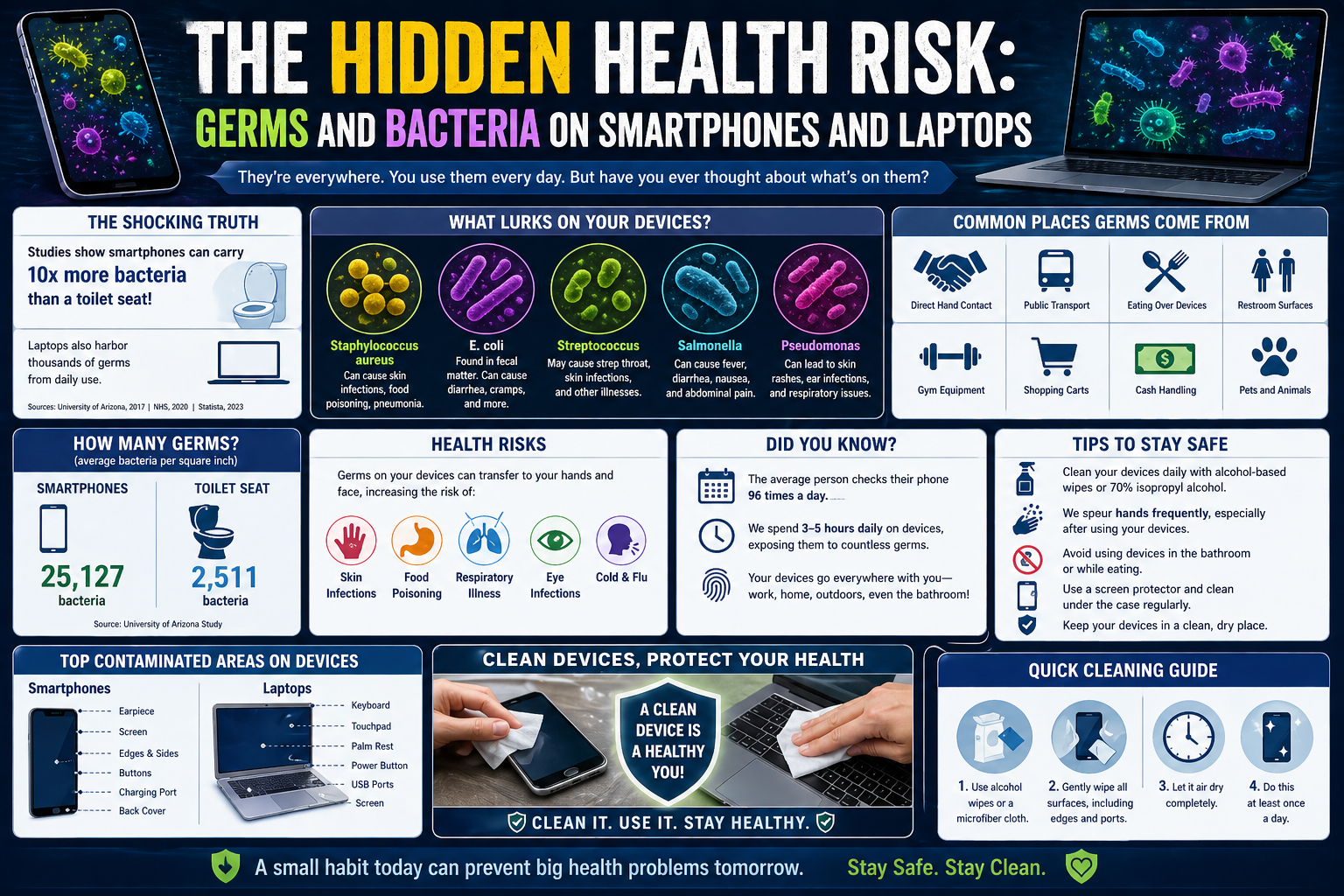
Most people interact with technology as if it exists in a separate category from physical cleanliness. A desk might be wiped down, floors may be cleaned, and hands are washed throughout the day, yet the devices that mediate nearly every task are often overlooked. Phones, keyboards, mice, laptops, and access badges are handled constantly, moved between environments, and exposed to countless surfaces without much thought about what accumulates on them over time.
This disconnect exists because technology appears visually clean even when it is not. Unlike dirt or spills that are immediately noticeable on a table or clothing, microbial buildup is invisible to the naked eye. A smartphone screen can look spotless while still carrying thousands of microscopic organisms. A keyboard can appear neat and organized while harboring residues from food, skin contact, and airborne particles that settle between and beneath the keys.
Human behavior plays a central role in this silent accumulation. Devices are carried everywhere, from office environments to public transport, cafeterias, and restrooms. Each location introduces new microbial exposure. The repeated cycle of contact and reuse turns everyday tools into long-term reservoirs for bacterial growth. Unlike surfaces that are cleaned routinely, technology often remains in constant use, reducing opportunities for thorough sanitation.
Another important factor is frequency of contact. A person may touch their phone hundreds of times per day, often without washing their hands in between activities. Each interaction transfers oils, particles, and microorganisms from skin to surface and back again. Over time, this exchange creates a stable environment for microbial communities to persist and multiply.
Understanding this hidden reality is not about fear but awareness. Technology is deeply integrated into modern life, and its cleanliness is directly tied to everyday habits. Recognizing how easily unseen buildup occurs is the first step toward understanding why devices behave as they do when examined from a microbiological perspective.
How Microorganisms Travel Through Daily Digital Habits
The movement of microorganisms in a digital environment is closely linked to human behavior patterns. Every interaction with a device creates a transfer point, allowing bacteria to move from hands, clothing, and surrounding surfaces onto technology. This process is continuous and often unnoticed because it blends seamlessly into routine tasks such as typing, scrolling, or unlocking a screen.
Hands act as the primary carriers in this transfer system. Throughout the day, they come into contact with door handles, desks, food items, and shared equipment. Without consistent cleaning, they become vectors that carry microscopic organisms between environments. When these hands interact with technology, microbes settle onto surfaces and begin to adapt to their new surroundings.
Phones are particularly susceptible due to their constant proximity to the user. They are held close to the face during calls, placed on various surfaces throughout the day, and frequently used in environments where cleanliness is not guaranteed. This combination of exposure and frequent handling creates ideal conditions for microbial persistence.
Keyboards and input devices function differently but are equally vulnerable. They are often stationary, allowing particles from the environment to settle over time. Food crumbs, dust, and skin flakes can accumulate in small spaces between keys or buttons. These organic materials provide a foundation that supports microbial survival.
Another often overlooked factor is environmental airflow. Indoor air carries microscopic particles that gradually settle on exposed surfaces. In office settings, ventilation systems distribute air that may contain dust and other particles, contributing to gradual accumulation on technology. Over time, these particles combine with contact-based contamination to create a layered microbial environment.
Understanding these pathways highlights how interconnected daily routines are with microbial movement. Technology does not become contaminated in isolation; it reflects the habits and environments of its users.
Why Technology Becomes a Stable Surface for Bacterial Growth
Not all surfaces are equally suitable for microbial survival, but many technological devices unintentionally create ideal conditions for bacteria. Unlike surfaces that are frequently washed with disinfectants or exposed to sunlight, electronic devices are typically kept indoors, handled gently, and rarely exposed to thorough cleaning processes.
One contributing factor is temperature stability. Most devices operate at or near room temperature, which falls within a range that supports microbial survival. While they do not provide the moisture required for rapid bacterial reproduction in the same way organic materials do, they still offer enough stability for microorganisms to persist for extended periods.
Another factor is surface texture. Many devices contain small grooves, seams, and textured areas that are difficult to clean thoroughly. These micro-environments protect microorganisms from removal and create pockets where debris can accumulate. Even smooth glass surfaces are not immune, as oils and residues from human skin create thin layers that support microbial adherence.
Moisture also plays an indirect role. While devices are not inherently wet, they are frequently exposed to humidity from hands, breath, and environmental conditions. This minimal moisture, combined with organic residue, is enough to support microbial survival even without visible dampness.
Organic material is another key contributor. Skin oils, sweat, and microscopic food particles provide nutrients that bacteria can utilize. Over time, repeated contact builds up layers of organic matter that are not visible but still biologically active. These layers form a foundation for microbial communities that persist as long as the surface remains undisturbed.
The combination of stable temperature, protective surface structures, intermittent moisture, and organic residues makes technology an unexpectedly suitable environment for microbial presence. This does not mean devices are inherently dangerous, but it does explain why they consistently show measurable levels of bacterial activity when examined.
The Hidden Ecology on Smartphones and Personal Devices
Smartphones represent one of the most frequently handled objects in modern life, making them central to microbial accumulation. Unlike stationary objects, they move continuously between environments, gathering microorganisms from every location they enter. This mobility creates a unique ecological pattern on their surfaces.
The front screen is the most commonly touched area, but it is not the only zone of microbial activity. The back of the device, edges, buttons, and camera area all contribute to a complex distribution of organisms. Each surface experiences different levels of contact and exposure, leading to uneven microbial patterns.
One of the most significant factors influencing smartphone contamination is behavioral repetition. Users instinctively reach for their phones after touching other surfaces, often without pausing to clean their hands. This repeated cycle amplifies microbial transfer and reinforces accumulation over time.
Phones are also frequently used in environments that are not traditionally associated with cleanliness concerns. They are placed on tables in restaurants, carried into bathrooms, and held during commutes. Each setting introduces new microbial exposure, creating a layered history of contact that is difficult to reverse without intentional cleaning.
The heat generated by devices during use can also contribute indirectly to microbial persistence. While not high enough to eliminate bacteria, warmth can influence the stability of residues on the surface, allowing them to remain intact for longer periods.
Despite these factors, smartphones are rarely included in routine cleaning habits. Unlike clothing or kitchen surfaces, they do not have obvious indicators of dirt. This invisibility contributes to their role as long-term carriers of microbial communities.
Understanding smartphones as dynamic microbial environments helps explain why they consistently rank among the most frequently contaminated personal items in everyday life.
Keyboards and Workstations as Microbial Collection Points
Workstations, particularly keyboards, function as long-term collection points for microbial material. Unlike handheld devices, keyboards are stationary, which allows particles to settle over time without being regularly disturbed or removed.
Typing behavior plays a central role in this accumulation. Fingers repeatedly contact keys throughout the day, transferring oils and microorganisms from skin to surface. Because typing is continuous during work tasks, this transfer happens frequently and consistently.
Food consumption near keyboards is another major contributing factor. Small crumbs and particles from snacks or meals often fall between keys. These organic remnants create micro-environments that support microbial persistence. Even when visible debris is removed, microscopic residues often remain.
Dust from the surrounding environment also settles on keyboards. In indoor office spaces, airflow circulates fine particles that gradually accumulate on exposed surfaces. Keyboards, with their multiple crevices, are particularly effective at trapping these particles.
Another important aspect is shared usage. In some environments, multiple individuals may use the same workstation or keyboard over time. Each user introduces their own microbial profile, contributing to a more diverse and layered microbial environment.
Unlike devices that are frequently carried or visually inspected, keyboards are often overlooked during cleaning routines. This allows microbial communities to remain undisturbed for extended periods, increasing their stability and persistence.
The combination of repeated hand contact, environmental exposure, food particles, and limited cleaning makes keyboards one of the most consistent microbial reservoirs in everyday digital environments.
Access Badges and Frequently Touched Surfaces
Access badges and similar identification tools represent another significant point of microbial transfer in professional environments. These items are handled repeatedly throughout the day, often touched after interacting with various surfaces such as doors, elevators, and shared equipment.
Because badges are frequently attached to clothing or lanyards, they remain in proximity to the body and are exposed to both environmental particles and direct hand contact. This positioning creates a continuous cycle of exposure and handling.
Unlike devices that are occasionally placed on desks or surfaces, badges are rarely set down in controlled environments. Instead, they are constantly in motion, increasing their likelihood of encountering diverse microbial sources.
The surfaces of these items are often made of plastic or laminated materials, which can retain oils and residues from repeated contact. Over time, this buildup creates a stable surface where microorganisms can persist.
Another factor is the lack of routine cleaning. While personal devices like phones may occasionally be wiped, access badges are rarely considered part of cleaning habits. This omission allows microbial accumulation to continue uninterrupted.
In environments where security protocols require frequent badge use, the level of contact increases even further. Each scan or entry involves direct handling, reinforcing microbial transfer patterns.
Understanding access badges as high-contact items helps illustrate how even small objects contribute significantly to overall microbial distribution in daily environments.
The Role of Environment in Shaping Device Contamination
The surrounding environment plays a major role in determining the level and type of microbial presence on technology. Indoor spaces, particularly offices, contain a mixture of airborne particles, human activity residues, and shared surfaces that collectively influence contamination levels.
Air circulation systems distribute particles throughout enclosed spaces. While designed for ventilation, these systems also move microscopic debris that eventually settles on surfaces, including electronic devices. Over time, this creates a continuous cycle of deposition.
Human density is another contributing factor. In shared environments, multiple individuals interact with the same space, increasing the diversity of microbial sources. Each person introduces their own microbial profile, which spreads through touch and air movement.
Surface sharing also plays a role. Desks, conference tables, and communal equipment are often used by multiple individuals. Devices placed on these surfaces are indirectly exposed to whatever microbial material has accumulated there.
Humidity and temperature variations within indoor environments can influence microbial stability. While not directly causing growth, these conditions affect how long microorganisms can persist on surfaces without significant decline.
The cleaning frequency of the environment itself also impacts device contamination. Even if devices are not cleaned regularly, a well-maintained environment can reduce overall microbial exposure. Conversely, environments that are rarely sanitized contribute to faster accumulation.
The interaction between environment and device use creates a continuous feedback loop where both influence each other. Technology reflects the conditions of its surroundings, making environmental hygiene a key factor in understanding microbial presence on digital tools.
Human Behavior and the Normalization of Device Contact
One of the most significant factors contributing to microbial accumulation on technology is behavioral normalization. People interact with devices so frequently that the idea of contamination rarely enters conscious thought. This familiarity reduces awareness of how often surfaces are touched without cleaning.
Multitasking behavior reinforces this pattern. Devices are used while eating, commuting, working, and relaxing. Each activity introduces different exposure risks, yet the focus remains on the task rather than the cleanliness of the object being used.
Another behavioral aspect is convenience. Cleaning devices require intentional effort, while using them does not. As a result, maintenance is often postponed or forgotten altogether.
There is also a psychological component. Because microbial contamination is invisible, it does not trigger immediate concern. Unlike visible dirt, which prompts action, unseen buildup remains unaddressed until external reminders or habits are introduced.
Over time, this creates a cycle where devices are continuously used but rarely cleaned. The longer this cycle persists, the more stable microbial communities become on surfaces.
Understanding this behavioral dimension is essential to explaining why technology, despite being constantly handled, is often overlooked in hygiene practices.
The Science Behind Microbial Survival on Everyday Technology
Microorganisms do not survive randomly on surfaces; their presence depends on specific environmental conditions that either support or limit their longevity. Technology provides a unique combination of factors that allow many bacteria to persist longer than people typically expect. While devices are not natural habitats like soil or water, they still offer enough stability for microbes to remain active in a dormant or semi-active state.
One of the key reasons bacteria survive on devices is surface compatibility. Many electronic devices are made from materials such as glass, plastic, and metal coatings. These materials do not actively kill microorganisms. Instead, they allow organisms to adhere and remain stable for extended periods without significant disruption. Once bacteria attach to a surface, they can form thin layers that protect them from environmental stress.
Another important factor is the absence of strong environmental forces. In natural ecosystems, microorganisms face sunlight, rain, wind, and temperature fluctuations. On technology surfaces, these forces are minimal or completely absent. Indoor environments, where most devices are used, provide consistent conditions that are neither too harsh nor too variable. This stability helps microbes survive longer than they might in outdoor environments.
Moisture availability also plays a subtle but important role. Although devices appear dry, they often retain microscopic traces of moisture from hands, breath, and humidity in the air. These minimal moisture levels are enough to support bacterial survival even if they are not sufficient for rapid reproduction. Over time, this creates a steady but low-level microbial presence.
Temperature consistency further supports microbial endurance. Most devices remain within a range that is comfortable for human use, which coincidentally overlaps with conditions that allow bacteria to persist. While extreme heat or cold would disrupt microbial activity, typical indoor conditions do not create such stress.
The combination of stable materials, limited environmental stress, trace moisture, and moderate temperatures creates a setting where microorganisms can persist quietly. This does not necessarily mean they grow rapidly, but it does mean they remain present and viable for longer than expected.
How Biofilms Develop on Frequently Used Devices
One of the most important yet least visible microbial processes on technology surfaces is biofilm formation. A biofilm is a thin layer of microorganisms that attaches to a surface and begins producing a protective matrix that allows them to survive in a more stable community structure.
This process begins when individual bacteria settle on a surface and attach themselves using natural adhesion properties. Once attached, they begin to secrete substances that form a protective layer around the group. Over time, more microorganisms join this structure, creating a layered community that becomes increasingly resistant to removal.
On technology surfaces, biofilms can form in areas that are not regularly cleaned or disturbed. Keyboard crevices, phone edges, and mouse buttons are particularly vulnerable because they provide small protected spaces where microbes can accumulate without being wiped away during routine handling.
The presence of organic material significantly supports biofilm formation. Oils from skin, dust particles, and microscopic food residues act as nutrients that help bacteria sustain themselves during early development. Once a biofilm begins forming, it becomes more resistant to drying and environmental fluctuations.
Another important factor is repeated contact. Every time a device is touched, new microorganisms are introduced. This constant input helps sustain and expand the microbial community. Unlike surfaces that are cleaned and reset regularly, devices often experience continuous layering without interruption.
Biofilms are not easily visible, which makes them particularly relevant in the context of technology hygiene. A device may appear clean while still hosting microscopic communities that are firmly attached to its surface.
The Role of Human Touch in Microbial Distribution
Human hands are the primary mechanism through which microorganisms spread across technology. Every touch transfers a small number of microbes, but repeated interactions throughout the day result in significant cumulative exposure.
Hands come into contact with a wide variety of surfaces, including shared objects, personal belongings, and environmental fixtures. Each interaction introduces new microbial elements that are carried forward to the next surface. When these hands interact with technology, they transfer a portion of this microbial load.
The frequency of touch is a critical factor. Devices such as smartphones are often handled dozens or even hundreds of times per day. Each interaction adds a new layer of microbial material. Even brief contact is enough to transfer microorganisms from skin to the surface.
Skin itself naturally hosts a diverse microbial community. This community is not inherently harmful, but it contributes to the overall microbial profile found on devices. When combined with environmental exposure, this creates a complex mixture of microorganisms on technology surfaces.
Another factor is unconscious behavior. People often touch devices without realizing how often they do so. This includes unlocking screens, adjusting positions, or simply resting hands on surfaces. These repeated micro-interactions increase microbial transfer without conscious awareness.
Hand hygiene plays an important role in influencing this process. When hands are clean, the amount of microbial transfer is reduced. However, even clean hands are not sterile, meaning some level of transfer always occurs.
The combination of frequency, diversity of contact, and unconscious behavior makes human touch the most significant driver of microbial distribution on technology.
Why Smartphones Accumulate Microbes Faster Than Other Devices
Among all technological devices, smartphones tend to accumulate microbial material at a faster rate due to their constant proximity and multifunctional use. Unlike stationary devices, phones are carried everywhere and used in nearly every environment throughout the day.
One of the main reasons for this rapid accumulation is environmental exposure. Smartphones are used in public spaces, workplaces, transportation systems, and private environments. Each location introduces new microbial elements, resulting in a constantly changing surface composition.
Another contributing factor is facial contact. Phones are frequently held close to the face during calls, allowing microorganisms from skin and breath to transfer directly onto the device. This adds another layer of biological material that is not typically present on other devices.
Behavioral patterns also contribute significantly. Phones are often used immediately after touching other objects, such as doors, money, or shared equipment. Without hand cleaning in between, microorganisms are transferred directly from one surface to another through the phone.
The design of smartphones also plays a role. Large smooth screens encourage frequent touch interactions, while edges, buttons, and cases provide additional areas for microbial accumulation. Protective cases, while useful for physical protection, can also create small spaces where debris and microorganisms collect.
Unlike devices that remain in fixed locations, smartphones are rarely left untouched for long periods. This constant interaction prevents any natural reduction in microbial presence through inactivity or environmental exposure.
The combination of mobility, frequent handling, environmental diversity, and design features makes smartphones one of the most microbially active personal items in daily life.
Keyboards as Long-Term Microbial Reservoirs
Keyboards function differently from smartphones, but are equally important in understanding microbial persistence. Because they are stationary, keyboards accumulate microorganisms over long periods without being reset by movement or environmental change.
Each key represents a contact point that receives repeated touch from users. Over time, these repeated interactions create localized areas of microbial concentration. Some keys may experience more frequent use than others, leading to uneven distribution across the surface.
The structure of keyboards also contributes to accumulation. Small gaps between keys allow particles to fall beneath the surface, where they are less likely to be removed during regular cleaning. These spaces provide protected environments where microorganisms can persist undisturbed.
Food consumption near workstations significantly increases microbial presence on keyboards. Crumbs and residues provide nutrients that support microbial survival. Even small particles that are not visible can contribute to microbial stability.
Dust accumulation is another contributing factor. Indoor environments naturally produce dust from textiles, paper, and human activity. This dust settles on keyboards and combines with other residues to create a layered microbial environment.
Because keyboards are rarely replaced or deeply cleaned, they act as long-term reservoirs where microbial communities can persist for extended periods. Unlike handheld devices, they do not undergo frequent environmental resetting, which allows accumulation to continue uninterrupted.
The Interaction Between Environmental Air and Device Surfaces
Air quality and circulation play a subtle but important role in microbial distribution on technology. Indoor air contains microscopic particles that include dust, skin cells, and other biological material. These particles gradually settle on exposed surfaces, including electronic devices.
Ventilation systems in enclosed spaces distribute air continuously. While this helps regulate temperature and comfort, it also contributes to the movement of particles throughout the environment. Devices placed on desks or tables are exposed to these airborne materials over time.
Human activity increases the amount of airborne particles. Movement, walking, and interaction with objects cause microscopic debris to become suspended in the air before eventually settling again. This cycle contributes to ongoing exposure of devices even when they are not being directly touched.
Environmental airflow does not introduce large amounts of visible contamination, but it contributes to the baseline level of microbial presence on surfaces. When combined with direct contact, it reinforces accumulation patterns.
The interaction between air and surfaces creates a continuous loop where particles are constantly redistributed. Devices act as collection points within this system, gradually accumulating materials from both direct and indirect exposure.
The Persistence of Microbial Communities in Indoor Workspaces
Indoor work environments provide a stable setting where microbial communities can persist for extended periods. Unlike outdoor environments that experience constant changes, indoor spaces maintain relatively consistent temperature, humidity, and lighting conditions.
This stability allows microorganisms to survive longer on surfaces without being disrupted by environmental stress. Devices placed in these environments become part of this stable ecosystem, reflecting the conditions of the space they inhabit.
Shared workspaces increase microbial diversity. When multiple individuals use the same environment, they contribute different microbial profiles. These profiles combine over time, creating a complex mixture of organisms across surfaces.
Cleaning frequency within the environment also plays a role. While some areas may be cleaned regularly, others may receive less attention, allowing microbial buildup to occur unevenly. Devices often fall outside routine cleaning processes, making them more susceptible to accumulation.
The interaction between human activity and environmental stability creates a consistent pattern of microbial presence. Devices become long-term participants in this ecosystem, continuously collecting and retaining microbial material from their surroundings.
The Role of Repetition in Microbial Accumulation
Repetition is one of the most important drivers of microbial buildup on technology. Every repeated action—typing, scrolling, tapping, or holding—contributes incrementally to surface contamination.
Unlike isolated interactions, repetitive behavior creates layering effects. Each touch adds a small amount of microbial material that builds over time. This layering is gradual but continuous, resulting in significant accumulation over long periods.
Repetition also reduces the likelihood of surface reset. When a device is used constantly, there is little opportunity for natural reduction of microbial presence. This allows communities to stabilize and persist.
Daily routines reinforce this pattern. Devices are used in predictable cycles throughout the day, ensuring consistent microbial input. Morning use, workplace interaction, and evening engagement all contribute to continuous exposure.
The cumulative effect of repetition is one of the primary reasons why devices become persistent microbial reservoirs in everyday environments.
The Relationship Between Human Behavior and Digital Cleanliness
The state of technology surfaces reflects more about human behavior than it does about the devices themselves. Every smartphone, keyboard, or workstation carries a silent record of daily routines, repeated actions, and environmental exposure. These patterns accumulate gradually, forming a physical trace of how people interact with their surroundings.
One of the most influential behavioral factors is convenience-driven usage. Technology is designed for constant accessibility, which encourages frequent interaction without interruption. This ease of access reduces the likelihood that users pause to consider cleanliness between interactions. Devices become extensions of the hand, used instinctively throughout the day.
Another behavioral influence is multitasking. People often switch between activities without breaking physical contact with their devices. A phone might be used while eating, commuting, or working. A keyboard might be used continuously during long work sessions without cleaning breaks. These overlapping actions increase the frequency of contact and reduce opportunities for hygiene awareness.
There is also a strong psychological normalization of device touch. Because technology is so integrated into daily life, constant handling feels natural and unremarkable. Unlike visibly dirty objects, devices rarely show signs of contamination, which reinforces the perception that they are clean enough for continued use.
This perception gap is central to understanding modern hygiene behavior. Cleanliness is often judged by appearance rather than microbial reality. If a device looks clean, it is assumed to be clean, even though microbial presence is not visible. This disconnect allows accumulation to continue without interruption.
Behavioral habits also vary depending on context. In professional environments, users may be more conscious of cleanliness in visible spaces like desks or meeting rooms. However, personal devices often fall outside these structured habits, even though they are touched more frequently than any other object.
The combination of convenience, repetition, and visual misjudgment creates a behavioral framework where technology is constantly used but rarely cleaned. This framework explains why microbial accumulation is not an exception but a consistent outcome of modern digital behavior.
How Shared Environments Amplify Surface Contamination
Shared environments play a significant role in shaping the microbial landscape of technology. Offices, classrooms, and public workspaces bring together multiple individuals who interact with the same physical space, each contributing their own microbial profile.
When people share environments, they also indirectly share surfaces. Even when devices are personally owned, they are often placed on shared desks, tables, or counters. These surfaces act as intermediaries, transferring microbial material between objects and users.
The movement of people within shared spaces also contributes to redistribution. As individuals move through rooms, sit at different desks, or interact with communal equipment, they introduce and collect microorganisms from multiple points. This creates a continuous cycle of exchange.
Air circulation in shared environments further amplifies this effect. Movement, conversation, and general activity cause particles to become airborne before eventually settling on surfaces. Technology placed in these environments becomes part of this circulation system.
Cleaning practices within shared spaces vary widely. Some areas may be cleaned regularly, while others receive less attention. Devices, particularly personal ones, are often excluded from routine cleaning protocols, allowing them to accumulate material independently of environmental maintenance.
Another important factor is the duration of exposure. Devices left in shared environments for long periods accumulate more material simply due to time. Even without direct handling, airborne particles and environmental contact contribute to a gradual buildup.
The result of these combined factors is a layered microbial environment where individual devices reflect the collective behavior of the space they occupy. Shared environments do not just increase exposure; they diversify it.
The Invisible Layering Effect on Technology Surfaces
One of the most overlooked aspects of device contamination is the layering process that occurs over time. Each interaction adds a thin layer of material that does not replace previous layers but instead builds upon them.
This layering includes skin oils, dust particles, environmental residues, and microscopic organic matter. Over time, these materials form a complex surface structure that is not visible to the naked eye but is physically present on the device.
Unlike surfaces that are washed or exposed to water, technology is rarely subjected to deep cleaning. This allows layers to remain intact and accumulate over extended periods. Even occasional wiping may remove surface-level material while leaving deeper layers undisturbed.
The layering effect is especially pronounced on high-touch areas such as screens, keyboards, and mouse buttons. These areas receive repeated contact throughout the day, ensuring continuous deposition of material.
Environmental dust also contributes to layering. Dust particles settle on devices and combine with oils from skin contact, creating a sticky surface that captures additional particles more easily. This increases the rate of accumulation over time.
Another factor is pressure-based transfer. When fingers press against surfaces, microscopic amounts of material are transferred more effectively than with light contact. Repeated pressure interactions reinforce layering in specific zones.
Over time, this process creates a stable surface ecosystem where multiple layers of material coexist. Each layer reflects a different period of use, creating a cumulative history of interaction.
Why Cleaning Habits Often Fail to Match Exposure Levels
Despite high levels of exposure, cleaning habits for technology often remain inconsistent or minimal. This mismatch between exposure and maintenance is a key reason why devices accumulate microbial material over time.
One reason for this gap is prioritization. People tend to focus on cleaning objects that visibly appear dirty or are traditionally associated with hygiene, such as kitchen surfaces or clothing. Devices, which rarely show visible signs of contamination, are often deprioritized.
Another reason is convenience. Cleaning a device requires deliberate effort, including selecting appropriate materials and taking time away from usage. In contrast, using a device requires no additional steps, making it the default behavior.
There is also uncertainty about cleaning methods. Some users avoid cleaning devices due to concerns about damaging screens or internal components. This hesitation reduces cleaning frequency even further.
Time perception also plays a role. Devices are used constantly throughout the day, but cleaning is perceived as an occasional task. This creates an imbalance where exposure is continuous, but maintenance is intermittent.
Another contributing factor is habit formation. Cleaning routines are often tied to specific contexts, such as household chores, but devices exist outside these structured routines. Without integration into daily habits, cleaning is easily overlooked.
The result is a consistent gap between how often devices are used and how often they are cleaned. This gap allows microbial accumulation to continue without interruption.
The Role of Repeated Contact Patterns in Long-Term Accumulation
Repeated contact is one of the strongest drivers of long-term microbial buildup on technology. Unlike single interactions, repeated use creates a compounding effect where each touch reinforces previous accumulation.
Daily routines are highly structured around device use. Morning interactions, work-related tasks, and evening engagement all involve repeated handling of the same devices. This consistency ensures continuous microbial transfer throughout the day.
Certain actions are performed hundreds of times daily, such as unlocking screens, typing messages, or navigating applications. Each action contributes a small amount of material that accumulates over time.
Repetition also reduces surface variability. When the same areas of a device are touched repeatedly, those zones become concentrated points of microbial presence. This uneven distribution reflects behavioral patterns of use.
Another aspect of repetition is unconscious behavior. Many interactions with devices are automatic, requiring little conscious attention. This increases frequency without increasing awareness, further contributing to accumulation.
Over long periods, repeated contact transforms devices into stable repositories of microbial material. The accumulation is not sudden but gradual, building layer by layer through routine behavior.
Hygiene Awareness in the Context of Digital Dependence
Modern dependence on technology has changed how people think about hygiene in relation to everyday objects. Devices are no longer separate tools but integrated extensions of daily activity, making traditional hygiene boundaries less distinct.
This integration reduces the perceived need for cleaning. When an object is used continuously throughout the day, it becomes part of normal interaction rather than something requiring maintenance. This perception shift affects how often cleaning is considered necessary.
Digital dependence also increases exposure frequency. Because devices are used for communication, work, entertainment, and navigation, they remain in constant contact with the user. This level of exposure is far higher than most traditional objects.
Despite this, hygiene awareness does not always increase proportionally. People may become more aware of cleaning visible environments, but overlook the continuous contact with devices.
Another factor is habituation. As people become accustomed to constant device use, they adapt their behavior without adjusting their hygiene practices. This creates a mismatch between exposure intensity and cleaning frequency.
The result is a modern hygiene landscape where the most frequently used objects are often the least frequently cleaned. This reflects not neglect but adaptation to convenience-driven lifestyles.
The Biological Significance of Surface Diversity on Devices
The microbial composition on technology surfaces is not uniform. Different devices and different areas of the same device host varying types of microorganisms based on usage patterns and environmental exposure.
High-touch areas tend to have more diverse microbial populations due to frequent contact. Low-touch areas accumulate material more slowly but may retain it for longer periods due to a lack of disturbance.
Environmental exposure also influences diversity. Devices used in different settings—such as homes, offices, or public spaces—reflect the microbial characteristics of those environments.
Skin-derived microorganisms are consistently present due to direct contact. However, environmental microbes from air, surfaces, and shared objects also contribute to overall diversity.
This diversity is not static. It changes over time as devices move between environments and as usage patterns evolve. Each interaction introduces new elements into the existing microbial structure.
The result is a dynamic biological surface that reflects both human behavior and environmental conditions. Devices act as recorders of interaction rather than isolated objects.
Long-Term Implications of Continuous Microbial Exposure
Continuous exposure to microbial material on devices does not necessarily lead to immediate or visible effects, but it does reflect long-term patterns of interaction between humans and their environment.
Over time, repeated exposure creates stable microbial communities on frequently used surfaces. These communities are maintained through continuous contact and environmental input.
The significance of this lies in understanding how modern lifestyles shape everyday microbial exposure. Devices act as constant intermediaries between humans and their surroundings, making them central points in daily microbial exchange.
This continuous interaction highlights the importance of awareness rather than alarm. Technology is not inherently dangerous, but it is consistently involved in processes that influence microbial distribution.
Understanding these long-term patterns helps explain why devices behave as they do in microbial studies and why they consistently show measurable levels of biological material.
The relationship between humans and technology is therefore not only digital but also biological, shaped by repeated contact, environmental exposure, and behavioral habits that operate continuously over time.
The relationship between technology and microbial presence also reflects how modern lifestyles prioritize speed and convenience over routine maintenance. As devices continue to serve as constant companions in work, communication, and entertainment, they naturally become extensions of personal space that carry traces of daily activity. This makes hygiene awareness even more important, especially in shared or high-contact environments where contamination can transfer quickly between users and surfaces. Developing simple habits, such as occasional wiping of devices and mindful hand hygiene, can significantly reduce buildup over time. Ultimately, understanding this invisible layer of life on our technology encourages a healthier balance between digital dependence and everyday cleanliness practices.
Conclusion
The presence of bacteria on everyday technology highlights an often-overlooked aspect of modern life: the constant interaction between human behavior, shared environments, and digital devices. Smartphones, keyboards, mice, and access badges are not just tools for communication and productivity—they are also surfaces that reflect daily habits and patterns of contact. While these devices may appear clean, they quietly accumulate microbial material through repeated handling, environmental exposure, and indirect transfer from surrounding spaces.
This accumulation does not necessarily indicate immediate danger, but it does reveal how seamlessly technology has become integrated into every aspect of daily routines. Devices travel with us across multiple environments, are used during various activities, and are rarely given the same level of cleaning attention as other frequently touched objects. Over time, this creates stable conditions where microorganisms can persist and layer upon one another.
Understanding this connection encourages a more mindful approach to digital hygiene. Simple awareness of how often devices are handled and how easily microbes transfer between surfaces can help bridge the gap between usage and cleanliness habits. In a world where technology is always within reach, maintaining cleaner devices is not about eliminating microbes, but about recognizing their presence and managing everyday exposure more thoughtfully.