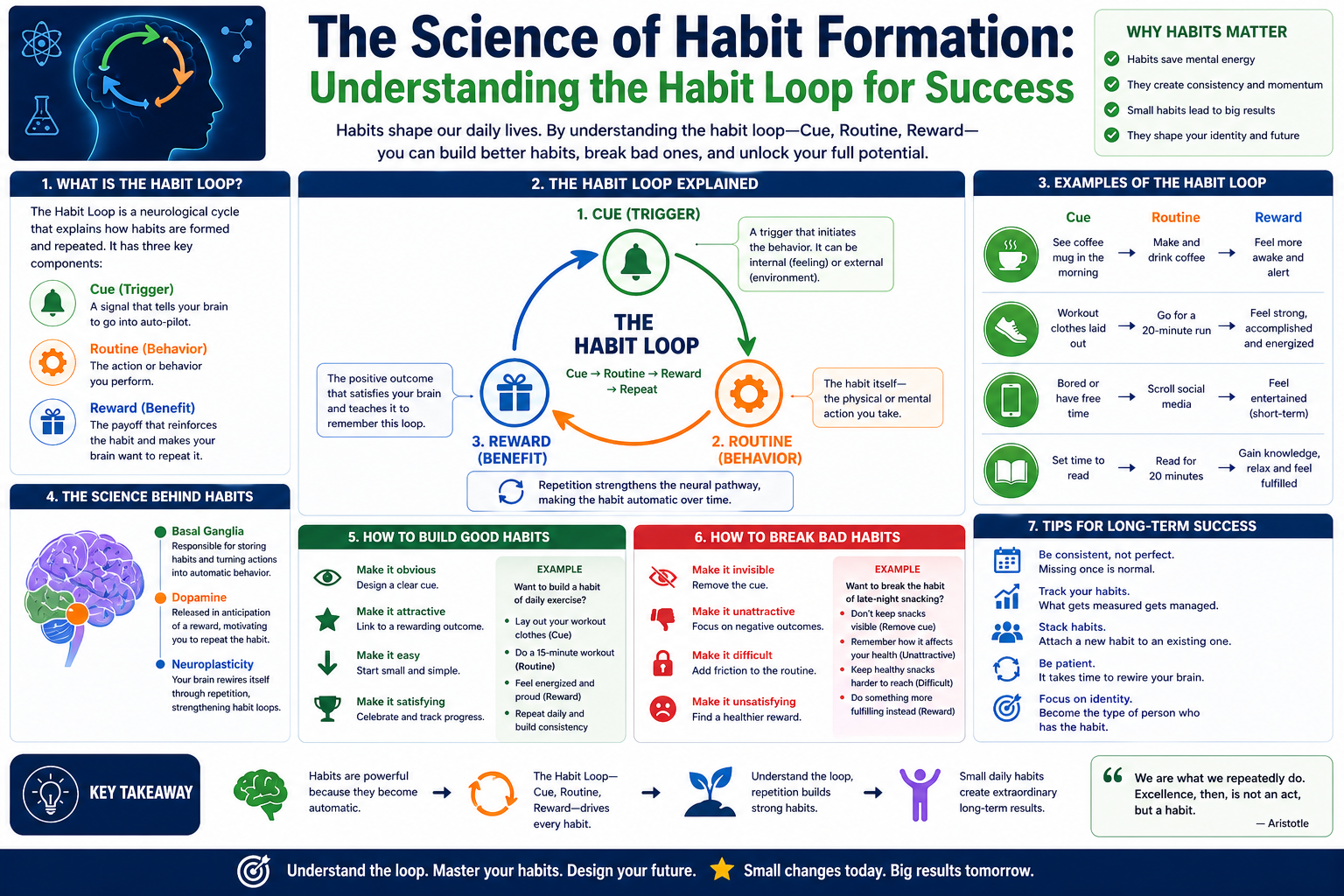
Habits are deeply rooted in how the human brain learns, adapts, and conserves energy. At a biological level, the brain is constantly looking for ways to make life more efficient. Instead of treating every action as a new decision, it gradually automates repeated behaviors so that less mental effort is required over time. This process is not random; it is shaped by specific neurological systems that strengthen certain pathways every time a behavior is repeated in a similar context.
When a person acts repeatedly, the brain begins to recognize patterns. These patterns are stored through connections between neurons that become stronger with repetition. The more frequently a behavior is repeated in the same situation, the more efficient these neural connections become. Eventually, the brain stops treating the action as something new and begins to classify it as familiar. This is where habits begin to form.
A significant part of this process involves the brain’s reward system, which plays a crucial role in reinforcing behavior. When an action leads to a positive outcome, the brain releases chemicals that create a sense of satisfaction. This internal feedback encourages repetition of the same action in the future. Over time, the brain starts to anticipate the reward even before the behavior is completed, which increases motivation to repeat it.
This system is not limited to positive habits alone. It applies equally to unhelpful or negative behaviors. If a repeated action consistently provides relief, comfort, or pleasure, even temporarily, the brain strengthens that behavior in the same way it would for a beneficial habit. This is why habits can be difficult to change once they are established, as the brain does not automatically distinguish between helpful and harmful routines.
Another important aspect of habit formation is the brain’s tendency to reduce cognitive load. Thinking requires energy, and the brain naturally seeks to minimize unnecessary effort. When a behavior becomes predictable, the brain shifts responsibility for it from conscious decision-making areas to more automatic regions. This transition allows individuals to perform complex tasks while conserving mental energy for new challenges.
In everyday life, this process happens continuously without awareness. Simple actions such as walking familiar routes, using a phone, or following morning routines all become automated through repetition. Each of these behaviors was once a conscious decision, but gradually became effortless due to repeated exposure and reinforcement.
The brain’s ability to form habits is not only a mechanism for efficiency but also a survival tool. In earlier human environments, quick decision-making and predictable responses increased the chances of survival. By automating useful behaviors, the brain ensured that attention could be reserved for unexpected or urgent situations. This evolutionary advantage continues to shape modern behavior, even in environments very different from those of early humans.
Understanding the scientific foundation of habit formation provides insight into why certain behaviors persist and why change often requires consistent effort over time. It also highlights that habits are not simply matters of discipline or motivation, but structured neurological processes that evolve gradually through repetition and reinforcement.
Understanding Automatic Behavior and Neural Pathways
Automatic behavior develops when the brain reduces the need for conscious thought in repeated actions. This shift happens as neural pathways become more efficient through consistent use. Every time a behavior is repeated, the brain strengthens the connection between the neurons involved in that specific action. Over time, these connections form a reliable pathway that can be activated quickly and with minimal effort.
Once a neural pathway becomes strong enough, the behavior it supports no longer requires active decision-making. Instead, it is triggered almost automatically when similar conditions arise. This is why certain actions can feel natural or instinctive, even though they were originally learned through deliberate effort. The brain essentially stores a shortcut for that behavior, allowing it to be executed without extensive thinking.
This automation process is particularly important in managing the brain’s limited capacity for attention. Since humans encounter numerous stimuli every day, the brain must prioritize which actions require focus and which can be handled automatically. Habits serve as a way to free cognitive resources, allowing individuals to concentrate on more complex or unfamiliar tasks.
As neural pathways strengthen, they also become more resistant to change. This explains why established habits can feel difficult to break. The brain continues to favor familiar pathways because they require less energy to activate. Even when a person consciously decides to change a behavior, the underlying neural structure may still default to the established pattern unless new pathways are consistently reinforced.
Automatic behavior is not limited to simple actions. It can also include emotional responses, decision patterns, and reactions to specific situations. For example, a person may automatically respond to stress in a particular way because the brain has learned to associate that emotional state with a specific behavior. Over time, these responses become deeply embedded and are triggered without deliberate thought.
The strength of a neural pathway is influenced by repetition, consistency, and context. When a behavior is repeated in the same environment or under similar conditions, the brain is more likely to reinforce that pathway. This is because the brain associates environmental cues with specific actions, making the behavior easier to recall and execute in the future.
Another important factor in automatic behavior is timing. Behaviors that are repeated at consistent times are more likely to become habitual because the brain begins to anticipate the action. This anticipation further strengthens the neural connection, making the behavior feel even more natural over time.
The development of automatic behavior demonstrates how the brain prioritizes efficiency and predictability. Instead of treating every action as new, it builds a structured system of responses that can operate with minimal conscious input. This system allows individuals to navigate daily life more smoothly, but it also means that changing established behaviors requires intentional effort to reshape those neural pathways.
The Role of Cues in Shaping Daily Actions
Cues play a fundamental role in initiating habitual behavior. A cue is any signal that prompts the brain to begin a specific action. These signals can come from the environment, internal states, or patterns in time and routine. The brain is highly sensitive to cues because they act as triggers that activate stored behavioral responses.
Environmental cues are among the most powerful influences on behavior. These include physical locations, objects, sounds, or even smells that are consistently associated with certain actions. When the brain repeatedly experiences a behavior in connection with a specific cue, it begins to link the two together. Eventually, the presence of the cue alone can trigger the behavior without conscious thought.
Time-based cues are equally important. The brain often associates certain actions with specific times of day. When a behavior is consistently performed at the same time, the body and mind begin to anticipate it. This anticipation can create a sense of readiness that makes the behavior easier to initiate. Over time, the clock itself becomes a cue that activates the routine.
Emotional cues also influence behavior. Feelings such as stress, excitement, boredom, or fatigue can trigger habitual responses. In many cases, individuals develop habits as a way to manage emotional states. For example, a person may automatically engage in a particular activity when feeling anxious, not because of external signals, but because of an internal emotional trigger.
Social cues are another important factor. The presence of other people, group dynamics, or social expectations can all serve as triggers for behavior. Humans are naturally influenced by social environments, and repeated interactions within these environments can lead to the formation of shared or individual habits.
Cues are powerful because they operate at a subconscious level. Once a cue is established, the brain begins to respond automatically without requiring deliberate decision-making. This is why habits can feel triggered almost instantly when certain conditions are met.
The relationship between cues and behavior is strengthened through repetition. Each time a cue is followed by a specific action, the connection becomes more defined. Over time, the brain learns to rely on this pattern as a shortcut for decision-making. This reduces uncertainty and increases efficiency in daily life.
However, not all cues are obvious. Some are subtle and may go unnoticed until they consistently influence behavior. Small environmental details, habitual surroundings, or routine patterns can all serve as hidden triggers. Recognizing these cues requires attention to patterns rather than isolated actions.
The role of cues highlights how behavior is often shaped more by context than by intention alone. While individuals may believe they are making conscious choices, many actions are actually responses to cues that have been reinforced over time. Understanding this influence is essential for recognizing how habits begin and how they continue to operate in everyday life.
How Routines Become Repeated Behavioral Patterns
Routines are the central actions within the habit process. They represent the actual behavior that follows a cue and leads toward a reward. At first, routines require conscious effort and attention, as the brain has not yet automated the behavior. Each step must be deliberately executed, and mistakes or inconsistencies are common during this stage.
As repetition continues, the routine becomes more familiar. The brain begins to recognize the sequence of actions and reduces the need for active decision-making. This shift marks the beginning of automation, where the routine starts to transition from a conscious effort into a more natural response.
Consistency plays a crucial role in this transformation. When a routine is performed in the same way under similar conditions, the brain strengthens the associated neural pathways. This repetition helps stabilize the behavior and reduce variability. Over time, the routine becomes smoother and more efficient, requiring less mental effort to complete.
The environment in which a routine is performed also influences its development. When the surroundings remain stable, the brain can more easily associate the routine with specific cues. This strengthens the connection between context and behavior, making the routine more likely to occur automatically when the cue appears.
Routines often begin as intentional actions driven by motivation or external goals. However, motivation alone is not enough to sustain long-term behavior. As the initial motivation fades, repetition becomes the primary driver of habit formation. The routine gradually shifts from being something that is consciously chosen to something that is expected or automatic.
Another important factor in the development of routines is emotional association. When a routine consistently leads to a positive emotional experience, the brain reinforces the behavior. This emotional feedback helps sustain repetition even when motivation is low. Conversely, if a routine is associated with discomfort or frustration, it may be more difficult to maintain.
Over time, routines become integrated into daily life in a way that feels natural and predictable. They no longer require planning or deliberation, as the brain has stored them as efficient behavioral scripts. These scripts allow individuals to perform complex sequences of actions with minimal conscious effort.
The transformation of routines into habits demonstrates the brain’s ability to optimize behavior through repetition and reinforcement. What begins as a deliberate action gradually becomes an automatic process shaped by cues, context, and experience.
The Psychology of Reward and Reinforcement
Reward is a central component of habit formation because it provides the brain with feedback about the value of a behavior. When an action results in a positive outcome, the brain reinforces the connection between the cue and the routine. This reinforcement increases the likelihood that the behavior will be repeated in the future.
The psychological impact of reward is closely linked to motivation. Rewards create a sense of satisfaction or relief that encourages repetition of the behavior. This does not always require large or significant outcomes; even small or immediate rewards can strongly influence habit formation.
The timing of the reward is also important. Immediate rewards are more effective in reinforcing behavior than delayed ones because the brain connects the action directly with the outcome. When there is a clear and immediate link between behavior and reward, the habit loop becomes stronger.
Rewards can take many forms, including physical sensations, emotional responses, or psychological satisfaction. Each of these forms of reward activates the brain’s reinforcement system, strengthening the association between cue, routine, and outcome.
The brain does not evaluate rewards purely on logic. Instead, it responds to perceived value, which can vary depending on context and individual experience. This means that behaviors associated with comfort, pleasure, or relief are often reinforced even if they are not objectively beneficial in the long term.
Reinforcement also plays a role in shaping expectations. Once a reward is consistently linked to a behavior, the brain begins to anticipate it. This anticipation can become a motivating factor in itself, driving the individual to repeat the behavior even before the reward is received.
Over time, the reward system helps stabilize habits by creating emotional and psychological reinforcement loops. These loops strengthen the connection between actions and outcomes, making behaviors more likely to persist without external encouragement.
The psychology of reward highlights how deeply behavior is influenced by feedback mechanisms. Habits are not simply actions performed repeatedly, but structured patterns shaped by the brain’s response to reinforcement and satisfaction.
How the Brain Encodes Habit Strength Over Time
Habit strength is not created instantly; it develops gradually as the brain repeatedly encounters the same behavior under similar conditions. Each repetition strengthens the neural representation of that behavior, making it more stable and easier to activate in the future. The brain essentially records frequency and consistency, using these patterns to decide how strongly a habit should be encoded.
When a behavior is first learned, the brain treats it as a new and uncertain action. It requires attention, conscious control, and deliberate effort. At this stage, the neural connections involved are relatively weak and flexible. With each repetition, however, those connections become more efficient. The brain begins to streamline the process, reducing the amount of mental energy required to act.
As repetition continues, the brain starts to prioritize the behavior as part of a predictable sequence. This is where habit strength begins to increase significantly. The action no longer feels unfamiliar; instead, it becomes part of a recognized pattern. The brain starts to rely on this pattern because it reduces uncertainty and simplifies decision-making.
Consistency plays a major role in determining how quickly a habit becomes strong. A behavior performed at irregular intervals takes longer to encode because the brain cannot reliably predict when it will occur again. In contrast, a behavior repeated under stable conditions is more quickly recognized as a dependable pattern. The brain values predictability because it allows it to conserve resources.
Habit strength is also influenced by context stability. When the same environment repeatedly triggers the same behavior, the brain forms a strong association between the two. This association helps solidify the habit because the environment itself becomes part of the behavioral memory. Over time, simply being in a familiar setting can trigger the behavior automatically.
As habits strengthen, they become less sensitive to conscious interruption. Early-stage behaviors can be changed relatively easily because they have not yet been deeply encoded. However, once a habit becomes strong, it operates more independently of conscious thought. This does not mean it cannot be changed, but it does require more deliberate restructuring of the underlying patterns.
The process of encoding habit strength reflects the brain’s broader goal of efficiency. Rather than treating every repeated action as separate, it compresses experiences into reliable behavioral scripts. These scripts allow individuals to function smoothly in familiar environments without constant decision-making. Over time, this compression of behavior becomes a defining feature of how habits are stored and executed.
Dopamine Signals and the Anticipation of Reward
Dopamine plays a central role in how habits are formed and maintained, but its function is often misunderstood. It is not simply a chemical linked to pleasure; it is more accurately associated with motivation and anticipation. The brain uses dopamine signals to indicate that a reward is likely, which encourages the repetition of behaviors that lead to that outcome.
When a behavior is first associated with a reward, dopamine is released after the reward is received. This reinforces the connection between the action and the positive result. However, as the habit becomes more established, dopamine release shifts. Instead of occurring after the reward, it begins to occur before the behavior is completed, triggered by cues that predict the reward.
This shift is important because it transforms behavior from reaction-based to anticipation-based. The brain begins to expect the reward when it detects familiar cues. This expectation creates motivation to act, even before the reward is experienced. The anticipation itself becomes a driving force behind the habit loop.
Dopamine signals also help the brain prioritize certain behaviors over others. Actions that consistently lead to rewarding outcomes receive stronger reinforcement signals, making them more likely to be repeated. This prioritization helps the brain manage competing behaviors and focus energy on actions that have proven value.
Interestingly, dopamine is not solely dependent on positive outcomes. It is strongly influenced by prediction errors, which occur when the outcome is better or worse than expected. When a reward is greater than anticipated, dopamine levels increase significantly, strengthening the associated behavior. When a reward is less than expected, dopamine activity decreases, weakening the connection.
Over time, this system allows the brain to refine its understanding of which behaviors are most effective. It learns not only from outcomes but also from expectations and discrepancies between prediction and reality. This continuous feedback loop helps shape habits with increasing precision.
The anticipation of reward is often more powerful than the reward itself in sustaining behavior. Once a habit is established, the brain becomes more engaged by the expectation of reward than by the reward experience. This is why cues alone can trigger strong motivational responses, even before any action is taken.
Dopamine-driven anticipation explains why habits can feel automatic yet still motivating. The brain is not passively repeating behavior; it is actively predicting outcomes and encouraging action based on learned associations. This predictive system is a core part of how habits remain stable over time.
Environmental Design and Habit Shaping
The environment plays a crucial role in shaping behavior because it determines which cues are most frequently encountered. Since habits are triggered by cues, controlling or adjusting environmental signals can significantly influence which behaviors are activated.
When an environment remains consistent, the brain forms strong associations between specific locations and specific actions. Over time, the environment itself becomes a behavioral trigger. This means that simply being in a particular space can activate certain routines without conscious intention.
Environmental design involves structuring surroundings in a way that supports desired behaviors and reduces exposure to unwanted cues. When beneficial actions are made more visible, accessible, or convenient, they are more likely to be repeated. Conversely, when undesirable cues are minimized or removed, the likelihood of engaging in unhelpful habits decreases.
Small changes in the environment can have a significant impact on behavior because the brain responds strongly to immediate physical context. Even minor adjustments, such as repositioning objects or altering routines within a space, can shift which behaviors are most likely to occur.
The stability of environmental cues also contributes to habit formation. When cues remain consistent over time, the brain becomes more efficient at responding to them. This consistency strengthens the connection between environment and action, making the habit more automatic.
Environmental influence is not limited to physical spaces. Digital environments, social settings, and time structures also serve as behavioral contexts. Each of these environments provides cues that shape daily actions in subtle but powerful ways.
Social environments are particularly influential because they introduce shared cues and expectations. When individuals are repeatedly exposed to group behaviors, those behaviors can become internalized and transformed into personal habits. The presence of others often acts as a reinforcing cue for action.
Time-based environments also shape behavior through routine structuring. When certain actions consistently occur at specific times, the brain begins to associate those time periods with expected behavior. This creates temporal cues that guide daily patterns.
By understanding environmental influence, it becomes clear that habits are not solely internal processes. They are deeply connected to external conditions that repeatedly signal the brain to act in specific ways. Adjusting these conditions can therefore be a powerful way to influence long-term behavioral patterns.
Breaking Unwanted Habits Through Cue Disruption
Unwanted habits persist largely because the cues that trigger them remain active and consistent. To change such habits, the connection between the cue and the behavior must be disrupted. This does not necessarily require eliminating the habit at once but instead involves weakening the automatic link that drives it.
Cue disruption begins with awareness of triggers. Many cues operate subtly and may not be immediately noticeable. They can include emotional states, environmental settings, or routine sequences that precede the behavior. Identifying these triggers is an essential step in altering the habit structure.
Once cues are recognized, the next step involves changing their influence. This can be done by altering the environment, modifying routines, or introducing variation into previously stable patterns. When the brain no longer encounters the same consistent signal, the automatic response begins to weaken.
Disruption also works through substitution. When an old cue appears, replacing the habitual response with a different action can gradually rewire the association. Over time, the brain begins to associate the cue with the new behavior instead of the old one.
Another important aspect of cue disruption is breaking predictability. Habits rely on stable repetition of cue-response patterns. When this predictability is interrupted, the strength of the habit decreases. The brain becomes less certain about the expected response, which reduces automatic activation.
Emotional cues can be particularly challenging to disrupt because they are internally generated. In such cases, changing the response to the emotional state becomes essential. By consistently choosing a different reaction to the same emotional cue, the brain can gradually weaken the original habit loop.
The process of disrupting cues requires consistency because the brain resists sudden changes to established patterns. Repetition of the new response in the presence of the old cue is necessary for rewiring to occur. Over time, this repetition reduces the strength of the original association.
Cue disruption does not erase habits instantly, but it gradually reduces their automatic power. As the connection weakens, conscious control becomes more effective in guiding behavior. This creates space for new behavioral patterns to form and stabilize.
Repetition Cycles and Behavioral Stability
Repetition is the foundation of behavioral stability. When a behavior is repeated consistently over time, it transitions from conscious effort to automatic response. This cycle of repetition is what transforms temporary actions into lasting habits.
Each repetition strengthens the brain’s expectation that the behavior will occur again under similar conditions. This expectation reduces uncertainty and increases efficiency. As a result, the behavior becomes more stable and less dependent on conscious motivation.
Behavioral stability is influenced by both frequency and context. Frequent repetition accelerates habit formation, while consistent context ensures that the behavior is reliably triggered. When both elements are present, the habit becomes deeply embedded in daily routines.
Over time, repetition creates a feedback loop in which behavior reinforces itself. Each successful execution of the habit strengthens the likelihood of future repetition. This self-reinforcing cycle is what allows habits to persist even in the absence of strong motivation.
Stability also increases as the brain reduces variability in execution. Early repetitions of a behavior may involve adjustments and conscious corrections. However, as the habit becomes stable, these variations decrease, and the behavior becomes more uniform and predictable.
The repetition cycle is not static; it evolves as habits become more integrated into daily life. Once a behavior is fully stabilized, it requires minimal cognitive involvement. At this stage, the habit operates as part of an automated system that supports routine functioning.
Even highly stable habits remain sensitive to disruption if repetition is significantly altered. Extended breaks or changes in context can weaken the established cycle. However, when repetition resumes under similar conditions, the habit can quickly regain its strength due to residual neural patterns.
Behavioral stability ultimately reflects the brain’s ability to optimize efficiency through repetition. By reinforcing repeated actions, the brain reduces uncertainty and creates reliable patterns that support daily functioning.
Identity-Based Habit Formation and Long-Term Behavioral Change
Long-term habits are more stable when they are connected to identity rather than isolated actions. Instead of focusing only on what a person wants to do, identity-based habits focus on what a person believes about themselves. The brain tends to align behavior with self-perception, meaning that repeated actions gradually shape how a person defines their identity, and that identity then reinforces those same actions.
When a behavior is repeated consistently, the brain not only stores it as an action pattern; it also begins to associate it with a sense of self. For example, if a person repeatedly engages in a learning activity, the brain begins to link that behavior with the idea of being someone who learns regularly. Over time, this association becomes stronger and more automatic.
This identity reinforcement works in both directions. Actions shape identity, and identity influences actions. Once a behavior becomes part of self-perception, it requires less external motivation to continue. The behavior is no longer seen as something optional or temporary, but as something aligned with who the person is.
This process is gradual and depends heavily on repetition and consistency. Occasional actions do not create strong identity links. Instead, repeated engagement in the same behavior under similar conditions is required for the brain to form stable identity associations.
Identity-based habits also help reduce internal resistance. When a behavior aligns with self-perception, the brain experiences less conflict in executing it. Instead of evaluating whether to act, the brain treats it as a natural expression of identity. This reduces hesitation and increases consistency.
Over time, identity becomes one of the strongest forces in habit maintenance. Even when external conditions change, identity-linked behaviors are more likely to persist because they are internally reinforced. This makes identity an important layer in long-term behavioral stability.
Implementation Intentions and Structured Behavioral Planning
Implementation intentions are structured mental plans that define exactly when and where a behavior will occur. Unlike general goals, which focus on outcomes, implementation intentions focus on specific situational triggers that guide action. This structure helps reduce decision-making at the moment of behavior, allowing the brain to respond more automatically.
When a behavior is tied to a clear situational statement, the brain forms a stronger connection between context and action. This reduces ambiguity and increases the likelihood that the behavior will be executed when the situation arises. The clarity of the plan plays a key role in strengthening this connection.
The effectiveness of implementation intentions comes from their ability to pre-load decisions. Instead of deciding in real time whether to act, the decision is already made in advance. This reduces cognitive load and prevents hesitation that might otherwise interrupt the behavior.
These structured intentions also work by increasing cue sensitivity. When a specific situation is defined as the trigger for action, the brain becomes more alert to that situation. Over time, this heightened awareness makes it easier to detect opportunities to perform the behavior.
Implementation intentions are particularly useful in environments with competing distractions. When multiple behaviors are possible, having a predefined plan helps the brain prioritize the intended action over alternatives. This reduces the influence of spontaneous decision-making.
The repetition of implementation-based actions strengthens neural pathways in the same way as traditional habits. Each time the planned behavior is executed in the defined context, the association between situation and action becomes more stable. Eventually, the behavior may become automatic even without conscious reference to the original plan.
Structured planning also helps bridge the gap between intention and execution. Many behaviors fail not due to lack of motivation, but due to lack of clarity at the moment of action. Implementation intentions remove this uncertainty by providing a clear behavioral script.
Friction, Resistance, and Behavioral Energy Costs
Every behavior requires a certain level of mental and physical effort, often referred to as friction. Friction represents the resistance that must be overcome before a behavior can be performed. The brain naturally prefers actions with lower friction because they require less energy.
High-friction behaviors are more difficult to sustain because they involve additional steps, decisions, or obstacles. Even small barriers can significantly reduce the likelihood of action when they accumulate. The brain tends to avoid unnecessary effort whenever possible.
Low-friction behaviors, on the other hand, are easier to repeat. When an action requires minimal effort to begin, the brain is more likely to initiate it without delay. This is why simplifying the process of starting a behavior is often more important than increasing motivation.
Friction can exist in multiple forms. Physical friction involves effort in the environment, such as distance, accessibility, or setup requirements. Cognitive friction involves mental effort, such as decision-making or planning. Emotional friction involves resistance caused by discomfort, uncertainty, or stress.
Reducing friction increases the probability that a habit will be repeated consistently. When the initial barrier is lowered, the brain is more likely to engage in the behavior before resistance can interfere. This allows repetition to occur more frequently, strengthening the habit loop.
Conversely, increasing friction can weaken unwanted behaviors. When an action requires more effort to begin, the brain is less likely to initiate it automatically. Over time, this reduces the strength of the associated habit.
The concept of friction highlights how behavior is shaped not only by motivation or reward, but also by the ease or difficulty of execution. Even highly rewarding behaviors can fail to form habits if the friction is too high at the point of action.
Habit Stacking and Sequential Behavior Building
Habit stacking is a method of linking a new behavior to an existing one. Instead of introducing a behavior in isolation, it is attached to a routine that is already established. This leverages existing neural pathways to support the formation of new ones.
The brain responds well to sequences because they reduce uncertainty about when actions should occur. When a behavior is consistently performed after another known behavior, the brain begins to treat the sequence as a single pattern rather than separate actions.
This sequential structure makes it easier to integrate new habits into daily life. The existing habit acts as a reliable cue for the new behavior, reducing the need for additional reminders or external prompts. Over time, the new behavior becomes embedded within the established routine.
Habit stacking works because it uses momentum from existing behaviors. Once a stable habit is completed, the brain is already in a pattern-oriented mode, making it easier to transition into another action. This reduces the cognitive cost of starting a new behavior.
The strength of habit stacking depends on the stability of the original habit. If the foundational behavior is consistent, the attached behavior is more likely to become stable as well. If the foundation is inconsistent, the new behavior may not form reliably.
This method also helps reduce decision fatigue. Instead of deciding when to perform a new behavior, the timing is automatically determined by the existing habit. This removes uncertainty and supports consistent repetition.
Over time, stacked habits can evolve into integrated routines where multiple behaviors occur in sequence without conscious separation. This creates efficient behavioral chains that require minimal mental effort to execute.
Feedback Loops and Behavioral Adjustment
Feedback loops are essential for maintaining and refining habits. A feedback loop occurs when a behavior produces an outcome that influences future behavior. This continuous cycle allows the brain to adjust actions based on results.
Positive feedback strengthens habits by reinforcing the connection between action and outcome. When a behavior consistently leads to a desirable result, the brain increases its likelihood of repetition. This reinforcement makes the habit more stable over time.
Negative feedback can weaken or modify habits by signaling that a behavior is less effective than expected. When outcomes do not match expectations, the brain adjusts its response patterns. This may lead to reduced repetition or changes in the behavior itself.
Feedback loops operate at both conscious and unconscious levels. Some feedback is directly observed and evaluated, while other forms are processed automatically by the brain without deliberate awareness. Both types influence habit strength and direction.
The timing of feedback is important. Immediate feedback has a stronger impact on behavior because it creates a direct link between action and outcome. Delayed feedback is less effective in shaping habits because the connection becomes less clear.
Feedback also supports behavioral refinement. As habits stabilize, the brain uses feedback to fine-tune execution. This leads to more efficient and consistent performance over time, reducing variability in the behavior.
In long-term habit development, feedback loops help maintain balance between stability and adaptability. They ensure that habits remain effective while still allowing for adjustments when necessary.
Cognitive Load Reduction and Mental Efficiency in Habits
One of the primary functions of habits is to reduce cognitive load. Cognitive load refers to the amount of mental effort required to process information and make decisions. The brain has a limited capacity for active thinking, so it prioritizes efficiency whenever possible.
Habits reduce cognitive load by automating frequently repeated behaviors. Once a behavior becomes habitual, it no longer requires conscious decision-making. This frees mental resources for more complex or unfamiliar tasks.
As habits develop, the brain shifts responsibility for execution from higher-level decision-making areas to more automatic processing systems. This shift allows behaviors to occur with minimal awareness, increasing overall efficiency.
Reduced cognitive load also improves consistency. When behavior does not depend on active decision-making, it is less affected by fluctuations in motivation or mental fatigue. This makes habits more reliable over time.
Mental efficiency is further enhanced when multiple habits are integrated into routines. Instead of managing each behavior individually, the brain organizes them into structured sequences. This reduces the need for separate decisions and streamlines daily functioning.
Cognitive load reduction is a key reason why habits feel effortless once established. What initially required attention and effort eventually becomes automatic, allowing the brain to operate more efficiently in other areas.
The process of reducing cognitive load through habit formation reflects the brain’s ongoing goal of optimizing energy use. By automating repeated behaviors, the brain ensures that limited cognitive resources are reserved for situations that truly require conscious thought.
Conclusion
The habit loop reveals how deeply structured human behavior really is, showing that much of what people do each day is not the result of constant conscious choice but the outcome of repeated neurological patterns. Through the interaction of cues, routines, and rewards, the brain builds automated systems that allow actions to become more efficient, predictable, and less mentally demanding over time. This system is not accidental; it is a core feature of how the brain manages energy, attention, and decision-making.
Understanding this process makes it clear why habits are so powerful in shaping long-term behavior. Once a cue is consistently linked to a routine and reinforced through a reward, the brain begins to treat that pattern as a default response. Over time, repetition strengthens these connections, turning deliberate actions into automatic behaviors that require minimal conscious effort. This shift is what allows individuals to function efficiently in daily life while reserving mental capacity for new and complex challenges.
At the same time, the habit loop explains why change can feel difficult. Established habits are not just preferences; they are reinforced neural pathways that the brain relies on for efficiency. Breaking or replacing them requires more than motivation alone. It involves reshaping cues, adjusting routines, and redefining rewards so that new patterns can gradually replace old ones.
The broader insight is that habits are not fixed traits but adaptable systems. They are built through repetition and can be reshaped through consistent, intentional effort. By understanding how cues trigger behavior and how rewards reinforce it, individuals gain greater awareness of the forces that shape their daily actions.
Ultimately, the habit loop highlights that small, repeated choices carry long-term influence. Over time, these choices accumulate into structured patterns that define productivity, discipline, and personal growth.