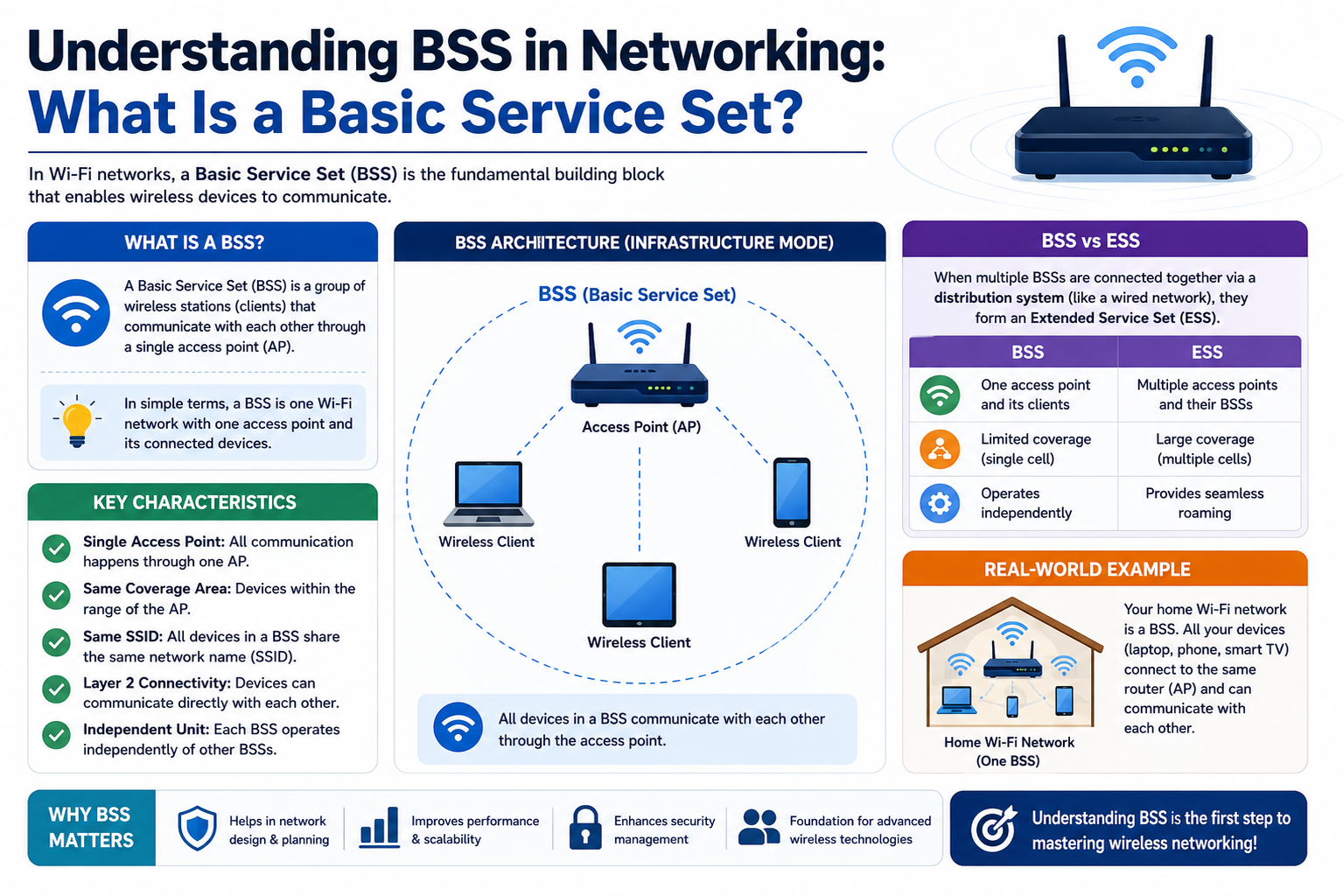
Wireless communication has become one of the most important technological foundations of the modern world, shaping how people connect, work, communicate, and access information. Behind every Wi-Fi connection lies a carefully structured system that organizes how devices interact with each other. One of the most essential building blocks of this system is the Basic Service Set, commonly referred to as BSS. Although users rarely notice it directly, this concept plays a central role in making wireless communication stable, organized, and efficient.
A Basic Service Set can be understood as a defined grouping of wireless devices that operate together within a specific communication boundary. This boundary is not physical in nature but is instead defined by radio coverage and network configuration. Within this group, devices are able to communicate through a structured system that ensures coordination and prevents chaos in signal transmission. The importance of this structure becomes clear when considering how many wireless devices exist in a typical environment today.
In any given space such as a home, office, or public area, multiple devices constantly attempt to connect to wireless networks. Without a structured system like a BSS, these devices would transmit signals freely without coordination, leading to interference, confusion, and unreliable communication. The Basic Service Set solves this problem by organizing devices into manageable groups that share a common communication framework.
At the center of most Basic Service Sets is a device known as an access point. This access point acts as the controlling hub for communication within the network. It is responsible for managing how data is transmitted between devices, ensuring that signals are properly organized, and maintaining overall network stability. Instead of allowing devices to communicate randomly, the access point coordinates all communication activities within the group.
Devices that connect to a Basic Service Set are commonly referred to as stations. These include a wide variety of wireless-enabled equipment such as smartphones, laptops, tablets, smart home devices, and other connected technologies. Each station depends on the access point to participate in the network. When a device connects, it becomes part of the structured group defined by the BSS, allowing it to send and receive data through a controlled system.
The concept of grouping devices in this way is essential for maintaining order in wireless environments. Radio signals do not have physical boundaries, which means they can overlap and interfere with one another if not properly managed. By organizing communication into Basic Service Sets, wireless systems are able to define clear boundaries of interaction. Each group operates independently, even if multiple groups exist within the same physical space.
Another important aspect of the Basic Service Set is that it defines not only how devices connect, but also how they identify each other. Each group is associated with a unique identity that distinguishes it from other nearby networks. This allows devices to recognize which network they are joining and ensures that communication remains within the correct boundary.
The structure of a BSS is designed to support both simplicity and scalability. On a small scale, it can function within a single room or building. On a larger scale, multiple Basic Service Sets can exist within a broader environment, working together to provide wider wireless coverage. This flexibility makes the concept suitable for a wide range of applications, from small home networks to large enterprise systems.
One of the key strengths of this structure is its ability to manage communication efficiently. Within a Basic Service Set, devices do not transmit data randomly or independently. Instead, communication is scheduled and coordinated to prevent overlap. This ensures that data is transmitted smoothly and reduces the likelihood of signal collisions, which can disrupt communication.
The importance of this coordination becomes more evident in environments with high device density. In places where many devices are connected simultaneously, such as offices or public venues, unmanaged communication would lead to severe performance issues. The BSS framework prevents this by controlling how and when devices communicate, ensuring that network resources are shared fairly and efficiently.
The Basic Service Set also plays a role in maintaining consistency in wireless connectivity. When a device moves within range of the network, it can connect seamlessly without requiring manual configuration. This automatic behavior is made possible by the structured design of the BSS, which continuously manages how devices join and participate in the network.
Another important characteristic of a Basic Service Set is its adaptability. Wireless environments are constantly changing due to movement of devices, variation in signal strength, and interference from external sources. The BSS framework is designed to handle these changes dynamically, allowing networks to remain stable even under fluctuating conditions.
In addition to managing communication, the Basic Service Set also contributes to defining how wireless coverage is shaped. The range of an access point determines the physical area covered by a BSS, and this range can be influenced by environmental factors such as walls, materials, and electronic interference. As a result, each Basic Service Set forms a unique coverage zone based on its surroundings.
This structured approach to wireless communication represents a major advancement compared to earlier forms of unorganized wireless transmission. By introducing order into how devices interact, the BSS framework enables reliable connectivity even in complex environments.
Communication Behavior and Internal Processes Within a Basic Service Set
Once a Basic Service Set is established, the focus shifts from structure to behavior. Understanding how devices communicate within this system reveals how wireless networks maintain stability and efficiency in real time. Communication inside a BSS follows a carefully coordinated process that governs how devices discover networks, establish connections, exchange data, and maintain synchronization.
When a wireless device enters an area where a network is available, it begins by scanning for signals. This scanning process involves detecting nearby wireless transmissions that indicate the presence of an access point. These signals contain essential information that helps the device determine whether the network is available for connection. This discovery phase is critical because it initiates the entire communication process.
After identifying a suitable network, the device proceeds to request access. This involves sending a connection request to the access point, which evaluates whether the device is allowed to join the Basic Service Set. This evaluation may depend on network capacity, configuration rules, or authentication requirements. Only after approval does the device become part of the network.
Once the connection is accepted, the device enters a synchronization phase. During this stage, it aligns itself with the timing and communication structure of the network. This ensures that it can properly participate in data transmission without disrupting other devices. Synchronization is essential for maintaining orderly communication, especially in environments where multiple devices are active simultaneously.
Within the Basic Service Set, communication is highly structured. Devices do not transmit data freely at any time. Instead, they follow coordinated timing rules that determine when communication can occur. This prevents overlapping transmissions, which could otherwise lead to interference and data loss. The access point plays a central role in managing this coordination.
All data exchanged within the network is typically routed through the access point. Even when two devices are located close to each other, their communication is usually handled through this central point. This ensures that all network traffic remains organized and controlled, rather than allowing direct uncontrolled exchanges between devices.
Another important aspect of communication within a BSS is the use of periodic signaling. The access point continuously broadcasts signals that help devices remain aware of the network’s presence. These signals also assist new devices in discovering the network and provide synchronization information to connected devices. This constant signaling helps maintain network stability over time.
Mobility is another key factor in wireless communication behavior. Devices are not fixed in place and can move while maintaining connectivity. As long as they remain within the coverage area of the access point, they continue to function within the same Basic Service Set. This allows users to move freely without losing connection.
However, if a device moves beyond the coverage area, it may lose connection temporarily. In such cases, it must reconnect when it re-enters range or find another available network. This dynamic behavior is an essential part of wireless communication and is supported by the structured design of the BSS.
In environments where multiple Basic Service Sets exist, devices must distinguish between different networks. This is achieved through unique identifiers that separate one group from another. These identifiers ensure that devices connect to the correct network and do not accidentally join unrelated systems in the same physical space.
Communication within a BSS also involves constant exchange of status information. Devices and the access point regularly share updates about connectivity, signal strength, and network conditions. This allows the system to adjust its behavior in real time, improving efficiency and maintaining stability.
The structured communication system within a Basic Service Set also supports recovery from disruptions. If interference or signal loss occurs, devices can quickly attempt to reconnect once conditions improve. This resilience is a key feature that ensures wireless networks remain usable even in unstable environments.
As communication continues within the network, the system continuously manages load distribution. When many devices are active at once, the network adjusts transmission timing to balance usage. This prevents congestion and ensures that all devices receive fair access to network resources.
The behavior of a Basic Service Set reflects a carefully designed balance between control and flexibility. While communication is strictly organized, the system is also capable of adapting to changing conditions such as movement, interference, and varying traffic levels. This adaptability is what makes wireless communication reliable in real-world scenarios.
Engineering Design, Performance Factors, and Real-World Network Operation
Designing a functional Basic Service Set requires careful engineering considerations that go far beyond simple device connectivity. Real-world wireless environments are influenced by physical structures, user behavior, device density, and environmental interference. All of these factors must be taken into account to ensure that a network performs reliably under varying conditions.
One of the most significant challenges in wireless network design is signal interference. Wireless signals travel through open space, which means they can be affected by obstacles such as walls, furniture, and electronic equipment. These obstacles can weaken or distort signals, leading to reduced performance. Engineers must carefully evaluate environments to minimize these effects.
The placement of access points plays a critical role in determining network quality. If an access point is positioned poorly, it may create areas with weak or inconsistent coverage. Proper placement ensures that signals are distributed evenly, reducing dead zones and improving overall connectivity. This is especially important in large or complex environments.
Another major consideration is network capacity. Each access point can only handle a certain number of connected devices effectively. When too many devices attempt to use the network simultaneously, performance can degrade. To prevent this, network design includes planning for expected device loads and ensuring that infrastructure can support future growth.
Channel management is also essential for maintaining network performance. Wireless communication operates across different frequency channels, and selecting the appropriate channel helps reduce interference from nearby networks. In dense environments, careful channel distribution ensures that multiple networks can coexist without disrupting each other.
Security is another critical aspect of Basic Service Set design. Since wireless networks are accessible through open air signals, they require protection against unauthorized access. Strong authentication systems and encryption methods help ensure that only legitimate devices can join the network and that transmitted data remains secure.
Scalability is also an important factor in modern wireless systems. Networks must be able to grow as the number of connected devices increases. A well-designed Basic Service Set can adapt to changing demands without requiring complete redesign, making it suitable for long-term use in evolving environments.
Monitoring and maintenance are ongoing processes that help ensure network stability. Wireless environments can change over time due to interference, physical changes, or increased usage. Continuous monitoring allows network administrators to identify issues early and make necessary adjustments before they impact performance.
Troubleshooting within a Basic Service Set involves analyzing how devices interact with the access point and identifying potential sources of disruption. This may include examining signal quality, checking for interference, or adjusting configuration settings to improve performance. Effective troubleshooting ensures that networks remain stable even under challenging conditions.
In larger deployments, multiple Basic Service Sets may work together to provide extended coverage. These interconnected systems allow devices to move across different areas while maintaining connectivity. Although each group operates independently, they collectively form a larger wireless infrastructure that supports seamless communication.
Environmental conditions also have a significant impact on network behavior. Temperature changes, building materials, and electromagnetic interference can all affect signal propagation. Engineers must account for these variables when designing and maintaining wireless systems to ensure consistent performance.
As wireless technology continues to evolve, the complexity of managing Basic Service Sets increases. Modern environments often contain large numbers of connected devices, each requiring reliable communication. This makes careful planning, optimization, and continuous monitoring essential for maintaining network quality.
The real-world operation of a Basic Service Set demonstrates how structured communication systems can support complex wireless environments. Through careful coordination, adaptive behavior, and engineered design principles, these systems provide the foundation for reliable wireless connectivity across a wide range of applications.
Advanced Behavior, Network Scaling, and Real-World Evolution of a Basic Service Set
As wireless networking continues to expand into nearly every aspect of modern life, the Basic Service Set has evolved from a simple conceptual grouping into a highly adaptive and scalable foundation for complex connectivity systems. While earlier understanding focuses on structure and communication, the deeper significance of a BSS becomes clearer when examining how it behaves in large-scale environments, how it interacts with multiple overlapping networks, and how it supports modern digital demands that require both stability and flexibility at the same time.
A Basic Service Set does not operate in isolation in most real-world scenarios. Instead, it exists alongside many other wireless groups within the same physical space. This creates a layered environment where multiple communication systems overlap, interact, and sometimes compete for limited wireless resources. Despite this complexity, each BSS maintains its own logical identity, allowing devices to remain organized within their designated communication space.
One of the most important developments in wireless networking is the ability of multiple Basic Service Sets to work together under a broader structure. When several BSS units are connected in a coordinated system, they form a larger network environment that allows seamless movement of devices between coverage areas. This means a user can move across a building or campus without losing connectivity, even though the underlying access points may change. This transition happens smoothly because each BSS is part of a larger coordinated system that shares configuration rules and network identity.
This scalability is essential in modern environments where mobility is constant. Devices are no longer stationary tools but mobile companions that require uninterrupted connectivity. Whether a person is walking through a workplace, traveling through public spaces, or moving between rooms in a home, the underlying network must adjust in real time to maintain service continuity. The Basic Service Set plays a key role in enabling this adaptability by serving as the smallest operational unit of wireless communication.
As the number of devices connected to wireless networks continues to grow, the demands placed on each Basic Service Set have increased significantly. Modern networks must support not only traditional devices such as laptops and smartphones but also a wide range of connected systems including sensors, appliances, wearable technology, and automated machines. This expansion of device types introduces new challenges in coordination, bandwidth management, and signal distribution.
Within a densely populated wireless environment, multiple BSS units often operate within overlapping coverage zones. This overlap creates a situation where devices may detect several networks simultaneously. In such cases, the system must determine the most appropriate network for connection based on signal strength, configuration rules, and network availability. This decision-making process ensures that devices connect to the most suitable Basic Service Set rather than randomly selecting one.
The presence of overlapping networks also increases the importance of efficient signal management. When multiple access points operate in close proximity, they must be carefully configured to minimize interference. Without proper management, signals from different BSS units could collide, leading to reduced performance or unstable connectivity. To prevent this, wireless systems distribute communication channels in a way that reduces overlap and ensures smoother operation across multiple networks.
Another critical aspect of modern Basic Service Set behavior is load balancing. In environments where many devices are connected, a single access point may become overloaded if too many devices attempt to communicate through it at once. To address this issue, networks distribute connected devices across multiple access points, each representing its own BSS. This distribution helps maintain performance by preventing any single point in the network from becoming overwhelmed.
The dynamic nature of wireless environments also means that Basic Service Sets must constantly adapt to changing conditions. Devices frequently join and leave networks, signal strength fluctuates due to physical movement or environmental changes, and interference levels vary throughout the day. The system continuously responds to these changes by adjusting communication timing, redistributing network load, and recalibrating signal behavior to maintain stability.
In more advanced implementations, Basic Service Sets are designed to support intelligent behavior. This includes the ability to automatically optimize performance based on usage patterns. For example, if a particular area experiences high device activity, the system may adjust its configuration to improve efficiency in that region. Similarly, if certain channels become congested, the system may shift communication to less crowded frequencies.
The evolution of wireless networking has also introduced a higher level of abstraction in how Basic Service Sets are managed. Instead of being treated as isolated units, they are now part of larger network ecosystems that function cohesively. These ecosystems allow centralized coordination of multiple BSS units, making it possible to manage complex wireless environments with greater efficiency and consistency.
Another important aspect of modern BSS behavior is roaming. Roaming refers to the ability of a device to move between different access points without losing connection. This process relies heavily on the coordination between multiple Basic Service Sets. As a device moves, it continuously evaluates signal quality and determines when it should switch from one access point to another. This transition is designed to be seamless, ensuring that communication remains uninterrupted even during movement.
The success of roaming depends on how well the underlying BSS units are synchronized. If the network is properly configured, devices can move freely without experiencing noticeable disruption. However, if coordination is weak or poorly managed, users may experience delays or brief disconnections during transitions. This highlights the importance of careful planning and configuration in large-scale wireless environments.
Energy efficiency has also become an important consideration in modern Basic Service Set design. As more devices rely on wireless connectivity, reducing unnecessary energy consumption has become a priority. Networks now incorporate mechanisms that allow devices to enter low-power states when not actively transmitting data. This helps extend battery life for mobile devices and reduces overall energy usage across the network.
In addition to energy management, modern BSS systems also focus on improving responsiveness. Low latency communication is essential for applications that require real-time interaction, such as video streaming, online collaboration, and automated control systems. To support these requirements, wireless networks prioritize certain types of traffic and optimize communication pathways within the Basic Service Set structure.
Security considerations also play an increasingly important role in the evolution of Basic Service Sets. As wireless networks expand, they become more exposed to potential security risks. Modern systems incorporate stronger authentication methods, improved encryption techniques, and continuous monitoring to detect unauthorized access attempts. These security measures are integrated into the BSS structure to ensure that protection is maintained at every level of communication.
Another emerging aspect of wireless network behavior is the integration of automated management systems. These systems are capable of analyzing network performance in real time and making adjustments without human intervention. They can detect congestion, optimize channel usage, and redistribute device connections across multiple Basic Service Sets to maintain balanced performance.
The interaction between multiple BSS units in modern environments also enables more advanced network architectures. These architectures support large-scale deployments such as enterprise networks, public connectivity systems, and smart infrastructure environments. In these systems, the Basic Service Set serves as a foundational building block that supports more complex organizational structures.
As wireless technology continues to develop, the role of the Basic Service Set is expected to become even more central. Future networks will likely involve even greater levels of automation, intelligence, and integration across multiple communication layers. Despite these advancements, the fundamental principle of organizing devices into structured communication groups will remain unchanged.
The Basic Service Set represents more than just a technical concept; it is a foundational mechanism that enables modern wireless communication to function at scale. Through structured organization, adaptive behavior, and coordinated communication, it provides the stability required for increasingly complex digital environments.
Deep Technical Behavior, Modern Wi-Fi Evolution, and the Future Role of the Basic Service Set
As wireless networking moves into more advanced generations of connectivity, the Basic Service Set continues to remain one of the most important underlying structures, even as technologies become faster, denser, and more intelligent. What has changed is not the existence of the BSS itself, but the complexity of the environments in which it operates. Modern wireless systems are no longer limited to simple home or office setups. Instead, they now function in highly dynamic ecosystems where thousands of devices, overlapping networks, and real-time applications coexist in the same radio space.
To understand the deeper behavior of a Basic Service Set in these environments, it is necessary to move beyond surface-level definitions and look at how it behaves under high load, how it adapts to modern wireless standards, and how it interacts with increasingly intelligent network systems.
At its core, a Basic Service Set still represents a single coordinated wireless environment controlled by an access point. However, in modern deployments, that simple structure becomes part of a much larger and more complex system. The access point is no longer just a basic controller; it is now a highly capable device that manages scheduling, prioritization, interference reduction, and dynamic optimization of wireless resources.
One of the most significant changes in modern wireless environments is the increase in device density. A single Basic Service Set may now need to support dozens, hundreds, or even thousands of devices depending on the environment. This introduces challenges that were not as prominent in earlier wireless systems. When too many devices attempt to communicate simultaneously, the shared wireless medium becomes congested. To manage this, modern systems rely heavily on advanced scheduling techniques that carefully control when each device is allowed to transmit data.
Instead of devices transmitting freely whenever they have data, they now operate within structured time-based coordination systems. These systems divide communication opportunities into small intervals, ensuring that devices take turns accessing the wireless medium. This reduces collisions and improves overall efficiency, especially in high-density environments.
As part of this evolution, the Basic Service Set has become more adaptive in how it handles traffic. Not all data is treated equally. Time-sensitive communication such as voice or video is prioritized differently compared to background tasks like file downloads or software updates. This prioritization ensures that important real-time communication remains stable even when the network is under heavy load.
Another important aspect of modern BSS behavior is airtime fairness. In older wireless systems, slower devices could significantly reduce the overall performance of the network because they required more time to transmit the same amount of data. Modern systems address this issue by ensuring that each device receives a fair share of transmission time regardless of its speed. This helps maintain balance within the Basic Service Set and prevents weaker devices from negatively impacting the entire network.
The introduction of newer wireless standards has also significantly influenced how Basic Service Sets operate. As transmission speeds increase, the system must manage more data in shorter time intervals. This requires more precise coordination between devices and access points. The access point must constantly evaluate network conditions and adjust communication parameters in real time to maintain efficiency.
In highly optimized environments, the Basic Service Set is no longer a static structure but a dynamic system that continuously adjusts itself based on demand. For example, when network usage increases during peak hours, the system may redistribute traffic or adjust transmission behavior to reduce congestion. When usage decreases, it may relax certain constraints to improve efficiency.
Another major advancement in modern wireless ecosystems is the integration of multiple overlapping Basic Service Sets into unified systems. In large environments such as campuses, industrial facilities, or public spaces, multiple access points operate simultaneously to provide continuous coverage. These access points are configured in such a way that devices can move between them seamlessly without experiencing noticeable interruption.
This seamless movement depends on how well the underlying BSS units are coordinated. When a device moves from one coverage area to another, it must transition between different access points while maintaining its active connections. This process requires precise synchronization between networks so that the transition appears smooth from the user’s perspective.
The ability of devices to move between different Basic Service Sets without disruption is one of the key achievements of modern wireless engineering. It allows users to remain connected while moving freely across large physical spaces. This behavior is especially important in environments where mobility is constant, such as workplaces, educational institutions, and public venues.
As wireless environments become more complex, interference management has also become increasingly important. Interference can occur not only from other Wi-Fi networks but also from a wide range of electronic devices and environmental factors. Modern Basic Service Sets use advanced techniques to minimize interference by dynamically selecting communication channels and adjusting transmission power based on current conditions.
This dynamic adjustment allows networks to avoid crowded frequency spaces and maintain more stable performance. In dense environments where many networks coexist, this adaptability is essential for maintaining usable wireless communication.
Another important development in the behavior of Basic Service Sets is the use of centralized and distributed management systems. In smaller environments, a single access point may manage all network activity. However, in larger systems, multiple access points may be controlled through a centralized coordination system that ensures consistency across the entire network.
This centralized coordination allows administrators to manage multiple Basic Service Sets as part of a unified system rather than as isolated units. It also enables more advanced features such as automatic load balancing, where devices are distributed across different access points based on current network conditions.
In addition to centralized systems, modern wireless networks also incorporate distributed intelligence. This means that access points themselves are capable of making local decisions based on real-time conditions. Instead of relying entirely on a central controller, each Basic Service Set can independently adjust its behavior to optimize performance in its immediate environment.
This combination of centralized oversight and distributed intelligence creates a highly flexible system that can respond quickly to changing conditions while maintaining overall consistency across the network.
Security has also evolved significantly in modern Basic Service Set environments. As wireless networks have become more widespread, they have also become more exposed to potential security risks. Modern systems therefore incorporate multiple layers of protection to ensure that only authorized devices can participate in the network.
These security mechanisms are integrated directly into the structure of the BSS, ensuring that protection is enforced at every stage of communication. This includes securing the process of device connection, protecting data during transmission, and continuously monitoring for suspicious activity within the network.
Another emerging aspect of Basic Service Set behavior is its interaction with intelligent automation systems. These systems analyze network performance continuously and make adjustments without requiring manual intervention. They can detect congestion, predict traffic patterns, and optimize resource allocation automatically.
This level of automation allows wireless networks to maintain high performance even in complex and unpredictable environments. It also reduces the need for constant manual configuration, making large-scale network management more efficient.
The evolution of the Basic Service Set is also closely linked to the increasing use of machine learning techniques in network optimization. By analyzing large amounts of performance data, systems can identify patterns in network usage and make predictive adjustments. This allows networks to anticipate congestion before it occurs and adjust behavior proactively.
For example, if a system detects that certain areas consistently experience high traffic at specific times, it can preemptively allocate additional resources to those areas. This predictive behavior improves overall network efficiency and reduces the likelihood of performance degradation.
Another important development is the growing integration of wireless networks with broader digital ecosystems. Modern Basic Service Sets are no longer isolated communication units but are instead part of interconnected systems that include cloud services, edge computing, and distributed applications. This integration allows data to flow more efficiently between devices and external systems.
As wireless technology continues to evolve, the role of the Basic Service Set will continue to expand. Future networks are expected to become even more adaptive, intelligent, and interconnected. Despite these advancements, the fundamental concept of organizing devices into structured communication groups will remain central.
The Basic Service Set continues to serve as the foundation upon which all wireless communication is built. Its ability to organize, coordinate, and manage wireless devices ensures that even the most complex modern networks remain functional and efficient.
Real-World Applications, Dense Environments, and the Expanding Role of the Basic Service Set
As wireless connectivity becomes deeply embedded in nearly every aspect of modern life, the Basic Service Set continues to operate quietly in the background as a foundational structure. While earlier discussions focus on how it is formed and how it behaves, its true importance becomes most visible when examined through real-world usage at scale. In practical environments, a Basic Service Set is not an isolated concept but a constantly active system that adapts to human behavior, physical environments, and rapidly changing digital demands.
In everyday settings such as homes, offices, and public areas, a Basic Service Set is responsible for maintaining order in wireless communication. Even a simple environment today may contain dozens of connected devices operating simultaneously. These devices include phones, laptops, televisions, security systems, wearable technology, and various smart appliances. Without a structured system like the BSS, managing this level of connectivity would be nearly impossible.
One of the most important real-world functions of a Basic Service Set is maintaining stability in environments where user behavior is unpredictable. People do not use networks in a uniform way. Some devices may stream high-quality video continuously, while others may only send occasional messages or background updates. The BSS must handle all of these behaviors simultaneously while ensuring that no single device disrupts the overall system.
In residential environments, the Basic Service Set often operates with a relatively small number of devices, but even here the complexity can be significant. Modern homes frequently include smart lighting systems, voice-controlled assistants, security cameras, gaming consoles, and streaming devices. Each of these devices places different demands on the network, requiring the BSS to continuously manage communication priorities and bandwidth distribution.
In office environments, the complexity increases significantly. A single Basic Service Set may support employees working on cloud applications, video conferencing systems, internal communication platforms, and data-heavy tasks such as file transfers and software development workflows. In such environments, network performance is critical to productivity, and even minor disruptions can have noticeable effects.
To handle these demands, the BSS must continuously balance competing requirements. It must ensure that high-priority communication, such as video calls or real-time collaboration, remains stable while still allowing background processes to function efficiently. This balancing act is performed automatically through internal coordination mechanisms that manage how devices access the wireless medium.
In public environments such as airports, shopping centers, and transportation hubs, the complexity of Basic Service Set operation increases even further. These environments often contain a very high density of devices, many of which connect and disconnect frequently as people move through the space. The BSS must adapt rapidly to these constant changes, maintaining stability despite unpredictable traffic patterns.
One of the most challenging aspects of dense environments is managing interference. When many devices operate within a limited physical area, wireless signals naturally overlap. This can lead to congestion and reduced performance if not properly managed. The Basic Service Set addresses this by coordinating communication in a way that reduces simultaneous transmission attempts and distributes network usage more evenly over time.
Another important real-world factor is physical movement. Unlike wired networks, wireless systems must support continuous mobility. Devices may move between rooms, floors, or entire buildings while remaining connected. The Basic Service Set supports this behavior by maintaining continuous communication as long as devices remain within range of the access point. When a device moves closer to the edge of coverage, the system prepares for a potential transition to another network without abrupt interruption.
In large-scale deployments, multiple Basic Service Sets work together to form a continuous coverage environment. This is common in environments such as universities, corporate campuses, hospitals, and large commercial complexes. In these settings, each access point manages its own BSS, but all units are configured to work in coordination. This allows devices to move seamlessly between coverage zones without manual reconnection.
This seamless movement relies on carefully managed coordination between overlapping service areas. When a device transitions from one area to another, it must disconnect from one Basic Service Set and connect to another without noticeable delay. The system ensures that this process happens smoothly by continuously monitoring signal quality and preparing alternative connections in advance.
In industrial environments, the role of the Basic Service Set becomes even more critical. Factories, warehouses, and automated systems rely heavily on wireless communication to control machinery, track inventory, and monitor processes in real time. In these environments, reliability is more important than speed alone. A disruption in communication can have serious operational consequences, so the BSS must prioritize stability and consistency above all else.
Industrial networks often involve a mix of human-operated devices and automated systems. These systems may include sensors, robotic equipment, and monitoring systems that continuously transmit data. The Basic Service Set must ensure that this data flows reliably without interruption, even in environments with high levels of physical interference such as metal structures, machinery, and electromagnetic noise.
Another important real-world application of the Basic Service Set is in transportation systems. Modern vehicles, trains, and airports increasingly rely on wireless communication for navigation, coordination, and passenger connectivity. In these environments, the BSS must support high mobility and rapidly changing signal conditions. Devices may move at high speeds while maintaining continuous connectivity, requiring the system to adapt in real time.
Conclusion
The Basic Service Set remains one of the most fundamental building blocks of modern wireless networking, even though it often operates behind the scenes without drawing attention. At its core, it provides structure to what would otherwise be an unorganized flow of wireless signals. By grouping devices into a coordinated communication environment, it ensures that wireless networks function in a stable, efficient, and predictable way.
Across all types of environments—whether homes, offices, industrial systems, or large public spaces—the BSS plays a consistent role in managing how devices connect and communicate. It defines the relationship between a central access point and the devices that rely on it, allowing communication to be organized rather than chaotic. This structure is what enables Wi-Fi to support everything from simple browsing to complex real-time applications without constant disruption.
As wireless technology has evolved, the importance of the Basic Service Set has only increased. Modern networks must handle far more devices, higher data demands, and more complex usage patterns than ever before. Despite this growing complexity, the BSS continues to provide the foundational framework that allows networks to adapt and scale. It supports mobility, manages interference, and helps maintain fairness among connected devices, all while adjusting dynamically to changing conditions.
In larger systems, multiple BSS units work together to create seamless coverage across wide areas, enabling users to move freely without losing connectivity. This interconnected behavior highlights how essential the concept is to modern networking design. Even as advanced technologies introduce automation, intelligence, and predictive optimization, they still rely on the same underlying principle of structured wireless grouping.
Ultimately, the Basic Service Set represents more than just a technical term—it is the foundation of how wireless communication is organized in practice. Its ability to bring order to complex environments ensures that modern digital life remains connected, responsive, and efficient across countless devices and applications.