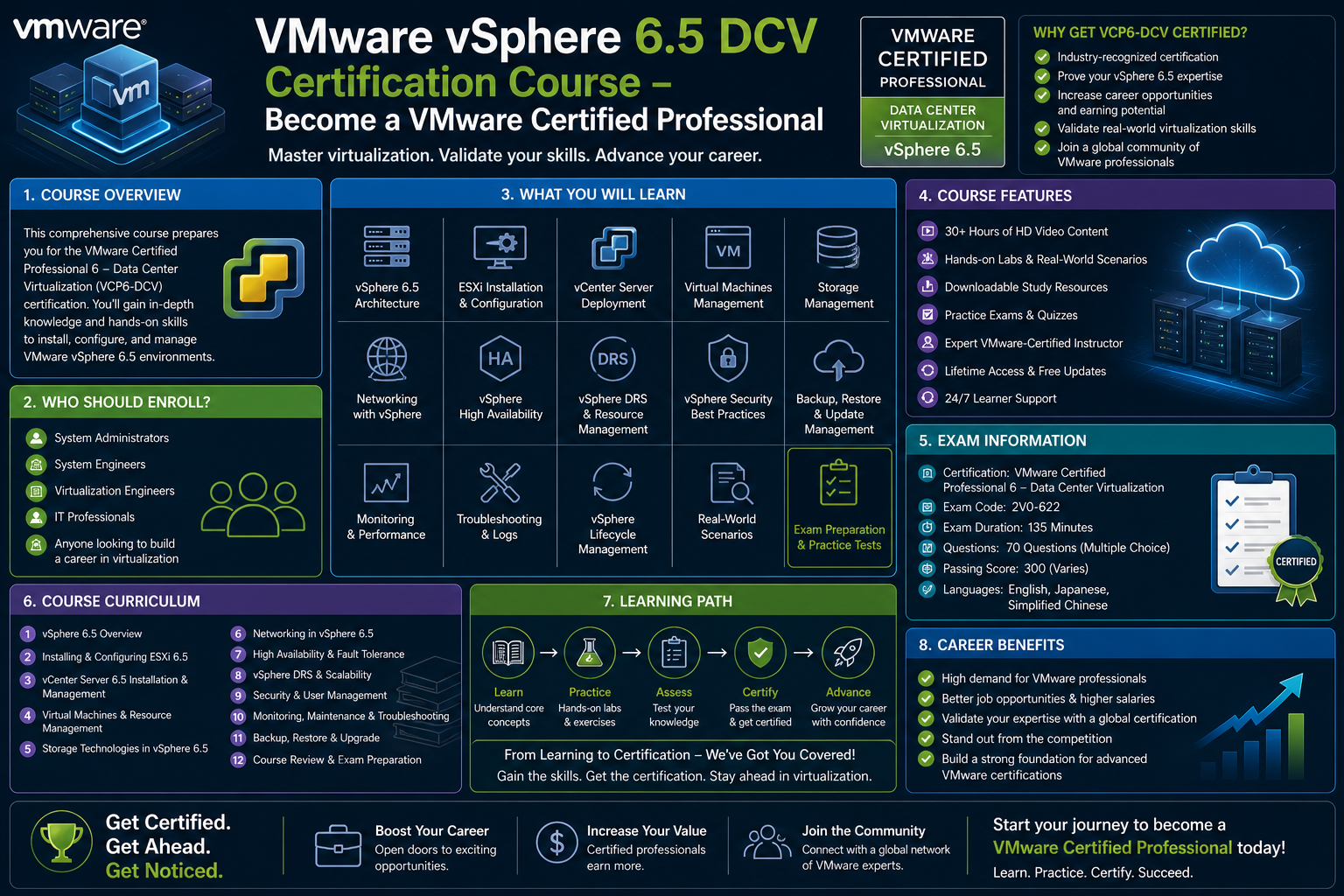
Virtualization has become one of the most influential technologies shaping modern IT infrastructure. It fundamentally changed how organizations design, deploy, and manage computing resources. Instead of relying on a one-to-one relationship between physical hardware and operating systems, virtualization allows multiple virtual machines to run on a single physical host. This shift improves efficiency, reduces costs, and enables far greater flexibility in how computing environments are built and scaled.
Within this landscape, VMware’s virtualization platform has played a central role for many years. The vSphere ecosystem, in particular, has been widely adopted in enterprise environments due to its reliability, scalability, and robust feature set. By the time version 6.5 was introduced, virtualization had already matured significantly, and organizations were increasingly dependent on virtual infrastructure to support critical workloads.
At its core, vSphere 6.5 represents a comprehensive virtualization platform designed to manage large-scale data center environments. It brings together several components that work in harmony to provide compute virtualization, centralized management, high availability, and advanced operational control. For IT professionals, understanding this ecosystem is not just about learning a tool—it is about understanding how modern digital infrastructure is built and maintained.
One of the most important aspects of vSphere 6.5 is its focus on operational stability. Enterprises rely on continuous uptime, and even small disruptions can have significant consequences. As a result, virtualization platforms must not only provide performance but also ensure resilience, fault tolerance, and rapid recovery capabilities. vSphere addresses these needs through a combination of architectural design and integrated services.
Another defining characteristic of this platform is its abstraction layer. Physical hardware is abstracted into logical resources that can be allocated dynamically. This allows administrators to treat compute, storage, and networking as flexible pools rather than fixed assets. In practice, this means workloads can be moved, scaled, or replicated without the constraints of underlying hardware limitations.
For professionals entering the virtualization field, vSphere 6.5 serves as both a practical toolset and a conceptual foundation. It introduces key ideas such as hypervisors, virtual machines, resource scheduling, and cluster management. These concepts are not only relevant within VMware environments but also extend to broader cloud computing and infrastructure design principles.
As organizations continue to adopt hybrid and cloud-based architectures, the principles learned through vSphere remain highly relevant. Even as technologies evolve, the underlying ideas of virtualization—abstraction, pooling, automation, and scalability—remain consistent. This makes vSphere 6.5 an important reference point in understanding how modern infrastructure has developed.
The Architecture Behind VMware vSphere 6.5
To fully appreciate how vSphere 6.5 functions, it is necessary to understand its architectural structure. The platform is built around a layered model that separates compute resources, management services, and user interaction components. This separation allows for greater flexibility, scalability, and maintainability in large environments.
At the foundation of the architecture is the hypervisor layer, known as ESXi. This is a bare-metal hypervisor, meaning it runs directly on physical hardware without requiring a traditional operating system underneath. This design improves performance and reduces overhead, allowing more resources to be allocated to virtual machines rather than host-level processes.
ESXi is responsible for creating and managing virtual machines. Each virtual machine behaves like an independent system with its own operating system, applications, and allocated resources. However, all of these virtual machines share the same underlying physical hardware, which is managed and distributed by the hypervisor.
Above the ESXi layer sits the centralized management system. This is typically handled through vCenter Server, which provides a unified interface for managing multiple ESXi hosts. Without centralized management, administrators would need to configure each host individually, which would be inefficient and error-prone in larger environments. vCenter resolves this by enabling centralized control, automation, and monitoring.
One of the most important functions of vCenter Server is cluster management. A cluster is a group of ESXi hosts that work together to pool resources and provide high availability. Within a cluster, workloads can be distributed dynamically based on resource demand, ensuring optimal performance and utilization.
The architecture also includes storage abstraction mechanisms. Virtual machines require storage for operating systems, applications, and data. In a virtualized environment, storage can come from local disks, network-attached storage, or storage area networks. vSphere abstracts these storage resources so that they can be managed consistently regardless of underlying hardware differences.
Networking is another critical layer in the architecture. Virtual networking allows virtual machines to communicate with each other and with external systems. This is achieved through virtual switches, which function similarly to physical network switches but exist within the hypervisor environment. These virtual switches enable complex network configurations without requiring changes to physical infrastructure.
A key strength of this architecture is its modularity. Each layer operates independently but integrates tightly with the others. This means that changes in one area, such as adding new hosts or adjusting storage configurations, do not require redesigning the entire system. Instead, resources can be adjusted dynamically as business needs evolve.
The separation of responsibilities also improves security. By isolating virtual machines from the underlying hardware and from each other, vSphere reduces the risk of system-wide failures or breaches. Each virtual machine operates in a controlled environment, with defined access to resources and network pathways.
High Availability and Fault Tolerance in Virtual Environments
One of the primary reasons organizations adopt virtualization platforms like vSphere is the ability to improve system availability. In traditional physical environments, hardware failures often result in downtime, which can be costly and disruptive. Virtualization addresses this challenge by introducing mechanisms that ensure workloads remain operational even in the event of infrastructure issues.
High availability is a core feature of vSphere 6.5. It ensures that virtual machines are automatically restarted on alternative hosts if a failure occurs. This process is managed at the cluster level, where multiple ESXi hosts share responsibility for running workloads. If one host fails, the system detects the failure and initiates recovery actions without requiring manual intervention.
The high availability system relies on continuous monitoring between hosts. Each host communicates its status to others in the cluster, ensuring that failures are quickly detected. When a failure is identified, affected virtual machines are restarted on healthy hosts using available resources.
This approach significantly reduces downtime, but it is important to understand that high availability does not prevent failures—it mitigates their impact. The system is designed to recover quickly rather than avoid failure entirely. This distinction is critical in understanding how resilient infrastructure is built.
In addition to high availability, vSphere introduces fault tolerance for more critical workloads. Fault tolerance provides continuous availability by maintaining a live shadow instance of a virtual machine on another host. Both instances run simultaneously, with the secondary instance mirroring the primary in real time.
If the primary virtual machine fails, the secondary instance immediately takes over without interruption. This creates a seamless experience where users do not experience downtime or data loss. Fault tolerance is particularly useful for applications that require continuous operation, such as financial systems or real-time services.
However, fault tolerance comes with additional resource requirements. Running duplicate instances consumes more compute capacity, which means it must be used selectively for workloads that truly require continuous availability.
Another important aspect of resilience is storage redundancy. Virtual machines depend on underlying storage systems, and vSphere integrates with storage technologies that provide replication and redundancy. This ensures that data remains accessible even if individual storage components fail.
Together, high availability, fault tolerance, and storage redundancy create a layered approach to system reliability. Each mechanism addresses different types of failure scenarios, ensuring that virtual environments remain stable under a wide range of conditions.
Performance Optimization and Resource Management Strategies
Efficient resource management is one of the defining strengths of virtualization platforms. In traditional physical environments, hardware resources are often underutilized or unevenly distributed. Virtualization changes this by allowing resources to be allocated dynamically based on demand.
In vSphere 6.5, resource management is handled through a combination of scheduling algorithms and policy-based controls. These systems ensure that virtual machines receive appropriate levels of CPU, memory, and storage resources based on their requirements and priorities.
One of the key mechanisms involved is resource scheduling. The hypervisor continuously evaluates the demand of virtual machines and distributes resources accordingly. If one virtual machine requires more processing power, it can temporarily receive additional CPU allocation, provided resources are available.
Memory management is another critical area. Since memory is a limited resource, vSphere uses techniques such as memory ballooning and compression to optimize usage. These methods allow the system to reclaim unused memory from virtual machines and redistribute it where needed.
Storage performance is also optimized through caching and tiering strategies. Frequently accessed data can be stored in faster storage layers, while less frequently used data is moved to slower, more cost-effective storage. This improves overall system responsiveness without increasing hardware costs significantly.
Network optimization is achieved through virtual switching and traffic management. Virtual switches allow administrators to define traffic rules, prioritize certain types of communication, and isolate network segments for security or performance reasons.
Another important aspect of performance management is load balancing across hosts. In a cluster environment, workloads can be distributed dynamically to prevent any single host from becoming overloaded. This ensures consistent performance across the entire infrastructure.
These optimization strategies are not static; they adapt in real time based on changing workload demands. This dynamic behavior is what allows virtual environments to support large-scale enterprise applications efficiently.
Security Principles in Virtualized Infrastructure
Security is a fundamental concern in any IT environment, and virtualization introduces both new opportunities and new challenges in this area. While virtualization can improve security through isolation and segmentation, it also increases the complexity of managing access and protecting workloads.
In vSphere 6.5, security begins at the hypervisor level. The ESXi hypervisor is designed to be minimal and secure, reducing the number of components that could be targeted by attackers. Its small footprint reduces the attack surface and helps ensure system stability.
Virtual machine isolation is another key security feature. Each virtual machine operates independently, with no direct access to other virtual machines unless explicitly configured. This prevents lateral movement between workloads and reduces the risk of widespread compromise.
Access control is managed through centralized authentication and role-based permissions. Administrators can define specific roles with limited access rights, ensuring that users only interact with the parts of the system relevant to their responsibilities.
Network security is enforced through virtual network segmentation. By separating traffic into different virtual networks, organizations can isolate sensitive workloads and control communication paths. This reduces exposure to unauthorized access or internal threats.
Encryption also plays an important role in protecting data. Both data at rest and data in transit can be encrypted to ensure that sensitive information remains secure even if underlying infrastructure is compromised.
Monitoring and logging provide additional layers of security. By tracking system activity, administrators can detect unusual behavior, identify potential threats, and respond quickly to incidents.
Security in virtual environments is not a single feature but a combination of layered protections. Each layer contributes to an overall security posture that is designed to protect both infrastructure and workloads.
The Evolving Role of Virtualization in Enterprise IT
As enterprise IT continues to evolve, virtualization remains a foundational technology that supports modern infrastructure design. While cloud computing has expanded the way resources are delivered, virtualization continues to serve as the underlying mechanism that enables these environments.
Virtualization allows organizations to transition from static infrastructure models to dynamic, scalable systems. This shift is essential for supporting modern applications, which often require rapid scaling, high availability, and flexible deployment models.
In many environments, virtualization also serves as a bridge between traditional data centers and cloud platforms. Organizations can maintain on-premises virtual infrastructure while extending workloads into cloud environments as needed. This hybrid approach provides flexibility while maintaining control over critical systems.
The continued relevance of virtualization is also tied to its adaptability. As new technologies emerge, virtualization platforms evolve to support them. This includes integration with automation tools, orchestration systems, and cloud-native technologies.
Even as infrastructure becomes more distributed and abstracted, the core principles introduced by virtualization remain unchanged. Concepts such as resource pooling, isolation, and dynamic allocation continue to define how modern computing systems operate.
Virtualization has also influenced how IT professionals approach system design. Rather than focusing solely on physical hardware, engineers now think in terms of virtual resources and software-defined infrastructure. This shift in mindset has had a lasting impact on the field of information technology.
In large-scale environments, virtualization continues to provide the foundation for innovation. It enables organizations to experiment, deploy, and scale applications in ways that would be difficult or impossible using traditional infrastructure models.
Virtualization Lifecycle Management and Infrastructure Evolution
The evolution of virtualization environments is closely tied to how efficiently organizations manage the lifecycle of their infrastructure. In platforms like VMware vSphere 6.5, lifecycle management is not limited to installing and maintaining virtual machines. It extends to planning, deployment, updates, optimization, and eventual retirement of workloads in a controlled and predictable manner.
At a foundational level, infrastructure lifecycle management begins with provisioning. This process involves allocating compute, storage, and networking resources to create a functional virtual machine. In modern virtualized environments, provisioning is no longer a manual or repetitive task. Instead, it is often automated through templates and standardized configurations that ensure consistency across deployments.
Templates play an important role in maintaining uniformity. A virtual machine template is essentially a pre-configured image that includes an operating system, base settings, and sometimes application frameworks. By using templates, administrators eliminate variability and reduce the likelihood of configuration errors. This consistency becomes especially important in large environments where hundreds or thousands of virtual machines may be deployed.
Once virtual machines are deployed, the focus shifts to operational management. This stage involves monitoring performance, adjusting resource allocations, and ensuring that workloads continue to meet organizational requirements. In virtual environments, workloads are dynamic, meaning their resource needs can change frequently based on demand. Effective lifecycle management ensures that these changes are handled smoothly without disrupting services.
Another important aspect of lifecycle management is patching and updating. Virtual machines, just like physical systems, require regular updates to maintain security and performance. However, virtualization introduces additional flexibility in how updates are applied. Administrators can migrate workloads between hosts before applying updates, reducing or eliminating downtime during maintenance.
The underlying infrastructure also requires updates. ESXi hosts and centralized management components must be maintained to ensure compatibility and stability. In a well-managed environment, updates are planned in stages, often using maintenance modes that temporarily shift workloads away from affected systems.
As virtual environments grow, lifecycle management becomes increasingly dependent on automation. Manual processes are no longer practical at scale. Automation tools help orchestrate repetitive tasks such as provisioning, configuration, monitoring, and scaling. This reduces administrative overhead while improving accuracy and response times.
Over time, virtual machines may also be decommissioned. This stage of the lifecycle is often overlooked, but it is essential for maintaining an efficient environment. Unused or outdated virtual machines consume resources and increase complexity. Proper decommissioning ensures that resources are reclaimed and that the environment remains organized and efficient.
Lifecycle management is not a static process. It evolves alongside infrastructure needs. As organizations adopt new technologies and workloads become more complex, lifecycle strategies must adapt accordingly. This adaptability is one of the key strengths of virtualization platforms like vSphere 6.5.
Advanced Cluster Design and Resource Distribution Models
Cluster design is one of the most critical aspects of virtualization infrastructure. A cluster is a collection of physical hosts that work together to provide shared resources for virtual machines. In vSphere 6.5, clusters form the backbone of scalable and resilient environments.
The primary purpose of clustering is resource pooling. Instead of treating each physical host as an isolated system, clustering allows resources such as CPU, memory, and storage to be aggregated. This pooled resource model enables more efficient utilization and provides flexibility in workload distribution.
Within a cluster, workloads are not tied permanently to a specific host. Instead, they can move dynamically based on resource availability. This mobility is one of the defining features of virtualization and plays a key role in maintaining performance and availability.
Resource distribution within a cluster is managed by sophisticated scheduling systems. These systems continuously evaluate the demands of virtual machines and assign resources accordingly. If one host becomes heavily loaded, workloads can be redistributed to other hosts to balance the load.
Clusters also enable advanced availability features. When multiple hosts operate as part of a cluster, the system can tolerate individual host failures without impacting overall service availability. This resilience is achieved by distributing workloads across multiple systems and maintaining redundancy.
Another important aspect of cluster design is scalability. As demand increases, new hosts can be added to the cluster without disrupting existing workloads. This modular approach allows organizations to expand infrastructure incrementally rather than investing in large-scale hardware upgrades all at once.
Effective cluster design requires careful planning. Factors such as workload type, resource requirements, and redundancy levels must be considered. Poorly designed clusters can lead to resource bottlenecks or inefficient utilization, while well-designed clusters provide a stable and scalable foundation for virtual environments.
Load balancing is a key function within clusters. By distributing workloads evenly, the system ensures that no single host becomes a performance bottleneck. This is particularly important in environments with variable or unpredictable workloads.
Clusters also support policy-based management. Administrators can define rules that determine how resources are allocated under different conditions. These policies help enforce organizational priorities, ensuring that critical workloads receive sufficient resources even during periods of high demand.
Storage Virtualization and Data Abstraction Techniques
Storage is one of the most important components in any IT infrastructure, and virtualization has significantly transformed how storage systems are managed. In traditional environments, storage is tightly coupled with physical hardware, making it difficult to scale or reconfigure. Virtualization introduces abstraction, allowing storage resources to be managed more flexibly.
In vSphere 6.5, storage virtualization enables multiple types of storage to be presented as a unified resource pool. These storage types may include local disks, network-attached storage, and storage area networks. Regardless of the underlying hardware, virtual machines interact with storage in a consistent and standardized way.
This abstraction simplifies management significantly. Administrators no longer need to worry about the specific characteristics of individual storage devices when provisioning virtual machines. Instead, they can allocate storage from a shared pool based on performance and capacity requirements.
One of the key advantages of storage virtualization is flexibility. Storage resources can be added, removed, or reconfigured without impacting running workloads. This allows organizations to adapt quickly to changing requirements without significant downtime.
Another important feature is storage mobility. Virtual machines can be moved between different storage systems without disruption. This is particularly useful in environments where storage performance needs to be optimized or where maintenance activities are required.
Storage performance optimization is achieved through techniques such as caching and tiering. Frequently accessed data is stored on high-performance storage media, while less frequently used data is moved to slower, more cost-effective storage. This ensures that performance is maintained while controlling costs.
Data protection is also a critical aspect of storage virtualization. Redundancy mechanisms ensure that data remains available even in the event of hardware failure. This is often achieved through replication or distributed storage architectures.
Snapshots are another important feature. A snapshot captures the state of a virtual machine at a specific point in time. This allows administrators to roll back changes if necessary, providing a safety net for updates or configuration changes.
Storage policies play a key role in managing virtualized environments. These policies define how storage resources should be allocated based on workload requirements. By applying policies consistently, organizations can ensure that storage performance and reliability align with business needs.
Virtual Networking Architecture and Communication Flows
Networking is a fundamental component of any IT infrastructure, and virtualization introduces a new layer of abstraction that significantly changes how networks are designed and managed. In vSphere 6.5, virtual networking enables communication between virtual machines, physical systems, and external networks through software-defined components.
At the core of virtual networking is the virtual switch. A virtual switch functions similarly to a physical network switch but operates within the hypervisor environment. It connects virtual machines to each other and to external networks through physical network interfaces.
Virtual switches allow administrators to create complex network configurations without modifying physical infrastructure. This flexibility enables segmentation, isolation, and customization of network traffic based on organizational requirements.
Port groups are another important concept in virtual networking. A port group defines a set of network policies and configurations that apply to virtual machine connections. By assigning virtual machines to specific port groups, administrators can control how they communicate with other systems.
Network segmentation is a key benefit of virtual networking. By separating traffic into different virtual networks, organizations can improve security and performance. For example, production workloads can be isolated from development or testing environments.
Traffic management is also an important aspect of virtual networking. Bandwidth allocation, traffic shaping, and prioritization rules can be applied to ensure that critical applications receive sufficient network resources.
Monitoring and troubleshooting are simplified through centralized network visibility. Administrators can observe traffic flows, identify bottlenecks, and diagnose issues without needing to access physical network devices directly.
Virtual networking also supports advanced features such as distributed switching. In this model, network configurations are applied consistently across multiple hosts, ensuring uniform behavior throughout the environment.
Security is deeply integrated into virtual networking. Firewalls, access controls, and segmentation policies help protect workloads from unauthorized access and internal threats.
As network demands continue to grow, virtual networking provides the flexibility needed to support modern applications. It enables dynamic scaling, rapid reconfiguration, and integration with broader infrastructure components.
Automation, Orchestration, and Intelligent Infrastructure Operations
As virtual environments become more complex, manual management becomes increasingly impractical. Automation and orchestration play a critical role in ensuring that infrastructure remains efficient, consistent, and scalable.
Automation refers to the execution of repetitive tasks without human intervention. In virtualization environments, this can include provisioning virtual machines, configuring networks, applying updates, and monitoring performance.
Orchestration goes a step further by coordinating multiple automated tasks into workflows. These workflows ensure that complex processes are executed in a specific order and under defined conditions.
Together, automation and orchestration reduce operational overhead and improve consistency. They eliminate human error and allow administrators to focus on higher-level strategic tasks.
In modern environments, automation is often driven by policies. These policies define how systems should behave under different conditions. For example, a policy might specify that additional virtual machines should be automatically deployed when demand exceeds a certain threshold.
Intelligent infrastructure operations involve using monitoring data to make real-time decisions. By analyzing performance metrics, systems can adjust resource allocations dynamically to maintain optimal performance.
This level of intelligence is made possible through integration between monitoring tools and management systems. Data collected from virtual machines and hosts is continuously analyzed to identify patterns and predict potential issues.
Predictive analysis is becoming increasingly important in virtual environments. By identifying trends early, systems can take proactive actions to prevent performance degradation or failures.
Automation also plays a key role in disaster recovery. In the event of a failure, predefined workflows can automatically restore services in alternative environments. This reduces downtime and improves resilience.
As infrastructure continues to evolve, automation and orchestration are becoming essential components of modern IT operations. They enable organizations to manage complexity at scale while maintaining efficiency and reliability.
Security Architecture and Trust Boundaries in Virtualized Data Centers
Security in virtualized environments is no longer just about protecting individual servers. It is about protecting an entire ecosystem where compute, storage, and networking are abstracted, shared, and dynamically allocated. In a platform like VMware vSphere 6.5, security must operate across multiple layers, from the hypervisor up to the application workload, while maintaining strict isolation between tenants, systems, and administrative roles.
At the foundation of this model is the hypervisor itself. The ESXi hypervisor is designed with a minimal footprint, which reduces the number of components exposed to potential attack. By eliminating unnecessary services and keeping the system lean, the attack surface is significantly reduced compared to traditional operating systems. This design philosophy is critical because the hypervisor sits at the lowest level of the virtualized stack, controlling access to all virtual machines running on a host.
Above the hypervisor layer, isolation becomes a primary security principle. Each virtual machine operates in its own encapsulated environment, with dedicated virtual hardware. This isolation ensures that processes inside one virtual machine cannot directly interfere with another. Even if multiple virtual machines share the same physical hardware, they remain logically separated.
This separation is enforced through strict resource control mechanisms. CPU scheduling, memory allocation, and I/O access are all governed by the hypervisor. These controls prevent one workload from monopolizing system resources or interfering with the performance of others. In secure environments, this isolation is essential for maintaining trust boundaries between workloads with different sensitivity levels.
Access control is another critical pillar of security architecture. In a virtualized data center, multiple administrators may manage different parts of the infrastructure. Without proper controls, this could lead to unauthorized changes or accidental misconfigurations. Role-based access control ensures that each user has only the permissions required for their responsibilities.
Authentication systems integrate with centralized identity services, allowing organizations to enforce consistent login policies across the environment. This reduces the risk of weak credentials or inconsistent access rules. Multi-layer authentication strategies further enhance protection by requiring additional verification steps before granting access to critical systems.
Network security in virtualized environments is enforced through segmentation and policy-driven controls. Virtual networks allow administrators to isolate traffic between different workloads, ensuring that sensitive systems are not exposed to unnecessary communication paths. This segmentation is particularly important in environments where production, development, and testing workloads coexist.
Firewalls at both the virtual and physical levels help enforce security boundaries. These controls regulate traffic flows between virtual machines, between hosts, and between internal and external networks. By combining distributed firewalling with centralized policies, organizations gain fine-grained control over network behavior.
Encryption is another essential component of modern virtualization security. Data can be encrypted both at rest and in transit, ensuring that sensitive information remains protected even if storage media or network traffic is intercepted. Encryption mechanisms are integrated into the virtualization layer, allowing protection to be applied consistently without requiring application-level changes.
Monitoring and auditing complete the security framework. Every significant action within a virtualized environment can be logged and analyzed. This includes configuration changes, access attempts, resource modifications, and system events. By maintaining detailed logs, organizations can detect suspicious activity and respond to incidents more effectively.
Security in virtual environments is not static. It evolves continuously as new threats emerge and infrastructure changes. This dynamic nature requires ongoing attention to policy updates, system hardening, and compliance enforcement.
Performance Engineering and Deep Resource Optimization Strategies
Performance in virtualized environments is not simply about maximizing hardware usage. It is about balancing efficiency, predictability, and responsiveness across diverse workloads. In vSphere 6.5, performance engineering involves careful tuning of compute, memory, storage, and network resources to ensure optimal system behavior under varying conditions.
At the compute level, the hypervisor uses advanced scheduling algorithms to distribute CPU resources across virtual machines. These schedulers take into account workload priority, resource reservations, and current demand. The goal is to ensure that critical workloads receive sufficient processing power while maintaining fairness across the system.
Memory management is particularly complex in virtual environments because physical memory is a limited and highly contended resource. Techniques such as transparent page sharing allow identical memory pages across virtual machines to be consolidated, reducing overall memory consumption. This optimization is especially effective in environments where multiple virtual machines run similar operating systems or applications.
Memory ballooning is another mechanism used to manage memory pressure. When a host experiences high memory demand, the hypervisor can reclaim unused memory from virtual machines, allowing it to be redistributed where needed. This ensures that active workloads continue to function without interruption.
Storage performance optimization involves multiple layers of caching and prioritization. Frequently accessed data is stored in faster storage tiers, while less critical data is moved to slower storage systems. This tiered approach balances performance and cost efficiency.
Input/output operations are carefully managed to prevent bottlenecks. Storage queues are monitored and adjusted dynamically based on workload demand. This helps maintain consistent performance even during periods of heavy disk activity.
Network performance is optimized through traffic shaping and load balancing techniques. Virtual switches distribute network traffic efficiently across physical interfaces, preventing congestion and ensuring consistent throughput for virtual machines.
Another important aspect of performance engineering is workload placement. Not all virtual machines have the same resource requirements, and placing workloads intelligently across hosts can significantly improve overall efficiency. Resource-intensive applications may be distributed across multiple hosts, while lighter workloads can be consolidated to reduce overhead.
Performance tuning is not a one-time activity. It requires continuous monitoring and adjustment. As workloads evolve, resource demands change, and the infrastructure must adapt accordingly. This dynamic optimization is a key strength of virtualized environments.
Data Resilience, Backup Strategies, and Recovery Models
In modern IT environments, data resilience is as important as system performance. Virtualized infrastructures must be designed to withstand hardware failures, software errors, and even large-scale disruptions without significant data loss or downtime.
One of the core mechanisms supporting resilience is redundancy. By maintaining multiple copies of data across different storage systems or locations, organizations can ensure that information remains available even if one component fails. This redundancy can be implemented at both the storage and system levels.
Snapshots provide a powerful tool for short-term recovery. A snapshot captures the exact state of a virtual machine at a specific point in time. If a configuration change or update causes issues, the system can be quickly restored to a previous state. This capability reduces risk during maintenance and development activities.
Backup systems extend this concept by providing long-term data protection. Backups are typically stored separately from the primary infrastructure, ensuring that data can be recovered even in the event of catastrophic failure. These backups can include full system images or incremental changes, depending on the recovery strategy.
Replication adds another layer of resilience by continuously copying data to secondary locations. In the event of a primary system failure, workloads can be switched to replicated environments with minimal disruption. This approach is commonly used in disaster recovery planning.
Disaster recovery strategies define how systems are restored after major outages. These strategies vary depending on organizational requirements, but they typically include predefined recovery objectives that specify acceptable levels of downtime and data loss.
Failover mechanisms are a critical component of recovery models. When a system failure is detected, workloads are automatically transferred to healthy hosts or environments. This process is designed to be as seamless as possible, minimizing the impact on users and applications.
Testing and validation are essential parts of any recovery strategy. Without regular testing, organizations cannot be confident that their recovery systems will function correctly when needed. Virtualized environments make testing easier by allowing isolated environments to be created for simulation purposes.
Data resilience is not only about recovery but also about prevention. Monitoring systems continuously track the health of infrastructure components, allowing potential issues to be identified before they result in failure.
Virtualization and the Shift Toward Software-Defined Infrastructure
One of the most significant transformations driven by virtualization is the shift toward software-defined infrastructure. In traditional IT environments, hardware components such as servers, storage arrays, and networking devices are manually configured and managed. This approach is rigid and difficult to scale.
Virtualization changes this model by abstracting physical resources into software-defined components. Compute, storage, and networking are no longer tied directly to physical hardware. Instead, they are managed through software layers that provide flexibility and automation.
In a software-defined model, infrastructure becomes programmable. Administrators can define policies that automatically control how resources are allocated and managed. This reduces manual intervention and increases consistency across environments.
This shift also enables greater agility. New environments can be deployed quickly using predefined templates and configurations. Resources can be scaled up or down dynamically based on demand, without requiring physical changes to the infrastructure.
Software-defined infrastructure also improves portability. Workloads are no longer tied to specific hardware configurations. They can be moved between environments, data centers, or even cloud platforms with minimal changes.
This flexibility is particularly important in hybrid environments, where organizations combine on-premises infrastructure with cloud services. Virtualization provides the foundation for this integration, allowing workloads to operate seamlessly across different environments.
Automation is a key enabler of software-defined infrastructure. By automating configuration and management tasks, organizations can reduce operational complexity and improve reliability.
Operational Intelligence and Continuous Infrastructure Adaptation
Modern virtualized environments are increasingly driven by operational intelligence. This refers to the ability of systems to analyze data, detect patterns, and make decisions based on real-time conditions.
Monitoring tools collect vast amounts of data from virtual machines, hosts, storage systems, and networks. This data is analyzed to identify trends, detect anomalies, and optimize performance.
Predictive analytics plays a growing role in infrastructure management. By analyzing historical data, systems can predict future resource demands and potential failures. This allows administrators to take proactive action before issues occur.
Dynamic resource adjustment is another aspect of operational intelligence. Instead of relying on static configurations, systems can adjust resource allocations in real time based on workload behavior.
This continuous adaptation ensures that infrastructure remains efficient and responsive even under changing conditions. It also reduces the need for manual tuning and intervention.
Operational intelligence also enhances incident response. When issues are detected, systems can automatically trigger corrective actions or alert administrators. This reduces response times and improves overall system reliability.
As infrastructure becomes more complex, operational intelligence becomes essential for maintaining control and visibility. It enables organizations to manage large-scale environments without overwhelming administrative overhead.
Long-Term Impact of Virtualization on IT Architecture
Virtualization has fundamentally reshaped how IT systems are designed, deployed, and managed. Its impact extends far beyond data centers, influencing cloud computing, application development, and enterprise architecture as a whole.
One of the most significant long-term effects is the decoupling of software from hardware. Applications are no longer tightly bound to specific physical systems. Instead, they run in virtual environments that can be moved, scaled, and managed independently.
This decoupling has enabled new models of infrastructure design, including cloud computing and containerization. These technologies build on the principles introduced by virtualization, extending them into more flexible and distributed architectures.
Virtualization has also changed how organizations approach scalability. Instead of purchasing and configuring new hardware for each increase in demand, resources can be scaled dynamically within existing infrastructure.
Another important impact is the rise of automation-driven operations. Traditional manual management practices are increasingly being replaced by automated systems that handle provisioning, monitoring, and optimization.
This shift has also influenced the role of IT professionals. Instead of focusing primarily on hardware management, professionals now work more with software-defined systems, automation tools, and orchestration platforms.
Virtualization continues to serve as a foundational layer for modern IT ecosystems. Even as new technologies emerge, the core principles of abstraction, isolation, and resource pooling remain central to how systems are built and operated.
Its long-term influence is evident in nearly every aspect of modern computing infrastructure, from enterprise data centers to global cloud platforms, shaping the way digital systems evolve and operate over time.
Conclusion
Virtualization has reshaped the foundations of modern IT, and VMware vSphere 6.5 stands as a clear example of how far this technology has evolved in enterprise environments. By abstracting physical hardware into flexible, software-defined resources, it enables organizations to build infrastructures that are more efficient, scalable, and resilient than traditional systems. This shift is not only technical but also strategic, influencing how businesses plan capacity, manage risk, and deliver digital services.
Across its architecture, vSphere integrates critical capabilities such as high availability, centralized management, resource optimization, and strong security controls. These elements work together to ensure that workloads remain stable, performant, and protected even under changing or high-demand conditions. The platform’s ability to support dynamic workloads while maintaining operational consistency has made it a cornerstone in data center design.
Equally important is the way virtualization has transformed IT roles and practices. Professionals now focus more on orchestration, automation, and policy-driven management rather than manual configuration of hardware. This evolution reflects a broader industry shift toward intelligent, adaptive infrastructure.
Ultimately, vSphere 6.5 demonstrates how virtualization is not just a technology layer but a fundamental enabler of modern computing, supporting the ongoing transition toward more agile, cloud-integrated, and software-defined environments.