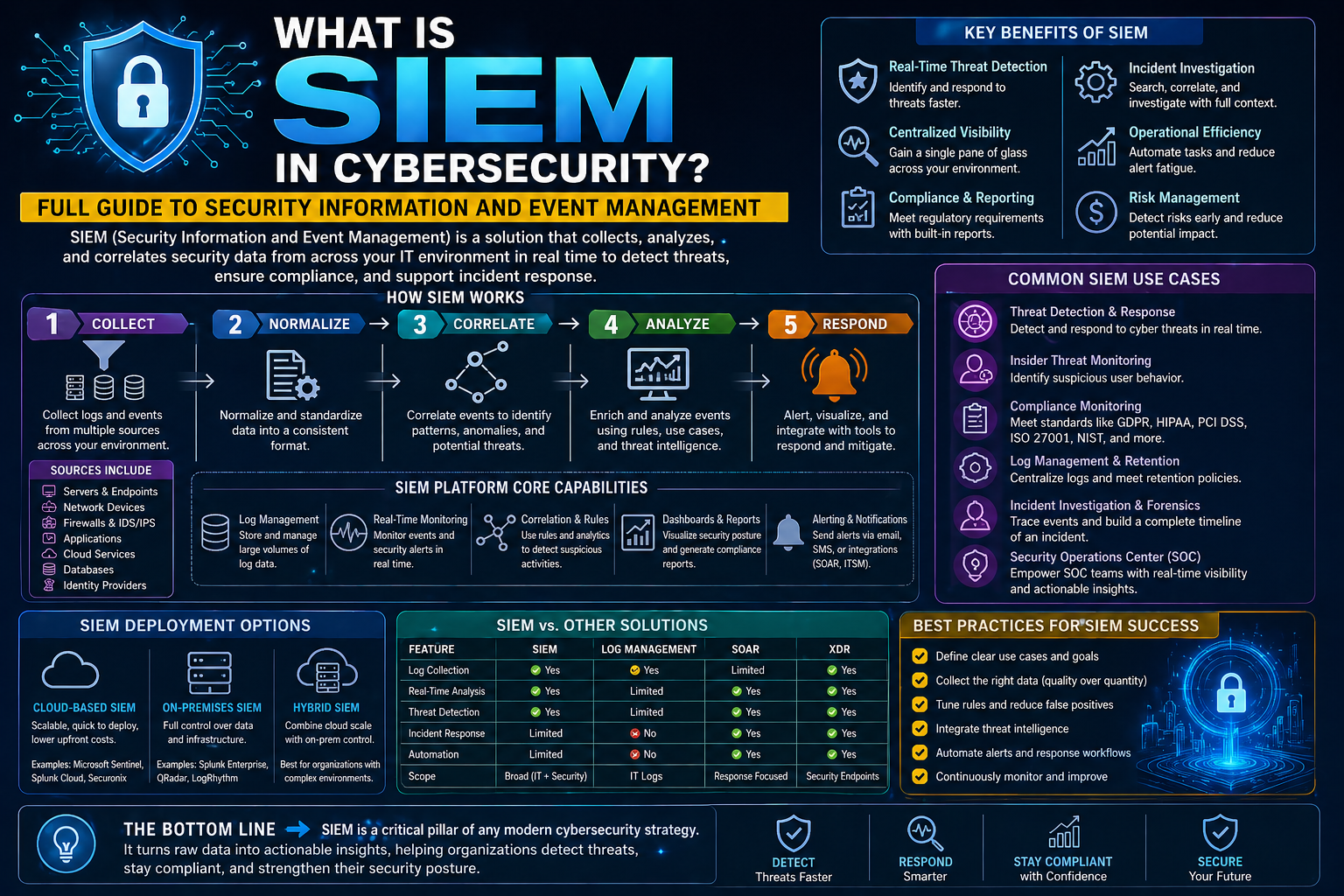
Security Information and Event Management (SIEM) refers to a category of cybersecurity technology designed to collect, analyze, and manage security-related data from across an entire IT environment. At its core, a SIEM system brings together two important capabilities that were once handled separately: security information management, which focuses on long-term storage and analysis of logs, and security event management, which deals with real-time monitoring and alerting.
In modern digital environments, organizations generate massive amounts of data every second. Every login attempt, file access, network connection, system error, and application activity produces a record. Individually, these records might not seem significant. However, when analyzed collectively, they can reveal patterns that indicate malicious behavior, system misconfigurations, or policy violations. SIEM technology exists to make sense of this overwhelming flow of data.
Rather than relying on isolated tools that only monitor specific systems, SIEM platforms unify security visibility across the entire infrastructure. This includes servers, cloud environments, endpoint devices, network hardware, applications, and security tools. By consolidating this information into a centralized system, organizations gain the ability to detect threats that would otherwise remain hidden.
A SIEM is not just a monitoring tool. It functions as an analytical engine that continuously evaluates system behavior, looking for anomalies and suspicious activity. It provides security teams with context, allowing them to understand not just what happened, but how, when, and why it happened.
The Evolution of SIEM in Cybersecurity
The development of SIEM systems is closely tied to the evolution of cybersecurity itself. In the early days of computing, security monitoring was relatively simple. Systems were smaller, networks were isolated, and threats were less sophisticated. Administrators often relied on basic log files stored locally on individual machines.
As organizations began expanding their digital infrastructure, the limitations of this approach became clear. Logs were scattered across different systems, making it difficult to investigate incidents. Security teams had to manually collect data from multiple sources, which was time-consuming and prone to error.
The rise of networked computing introduced new challenges. Attackers began exploiting interconnected systems, moving laterally across networks to gain unauthorized access. Traditional monitoring tools were not designed to detect these complex attack patterns.
This gap led to the development of centralized log management systems. These early systems allowed organizations to aggregate logs into a single location, improving visibility. However, they still lacked advanced analytics and real-time detection capabilities.
The modern SIEM emerged as an evolution of these earlier systems. It combined centralized logging with advanced correlation engines, behavioral analysis, and automated alerting. Over time, SIEM platforms have continued to evolve, incorporating machine learning, cloud integration, and advanced threat intelligence.
Today, SIEM systems are considered a foundational component of enterprise cybersecurity strategies. They are widely used in industries that require strict compliance, high security standards, and continuous monitoring of sensitive data.
Why SIEM Is Essential in Today’s Threat Landscape
Cybersecurity threats have grown significantly in both scale and sophistication. Attackers no longer rely on simple methods such as brute-force attacks or basic malware. Instead, they use advanced techniques like phishing campaigns, ransomware, zero-day exploits, and multi-stage attacks that unfold over time.
One of the biggest challenges in modern cybersecurity is visibility. Organizations often operate complex environments that include on-premises infrastructure, cloud platforms, remote endpoints, and third-party integrations. Without a centralized system, it becomes extremely difficult to detect suspicious activity across all these layers.
SIEM addresses this challenge by providing a unified view of security events. It allows organizations to detect subtle patterns that may indicate a larger attack in progress. For example, a single failed login attempt might not be significant. However, if that attempt is followed by multiple failed logins from different locations and unusual access requests, it could indicate a coordinated attack.
Another critical aspect of SIEM is its ability to reduce response time. In cybersecurity, speed is essential. The longer an attacker remains undetected within a system, the greater the potential damage. SIEM systems help security teams identify threats quickly and respond before they escalate.
In addition to threat detection, SIEM plays an important role in compliance. Many regulatory frameworks require organizations to maintain detailed logs of system activity, monitor access to sensitive data, and generate audit reports. SIEM systems automate much of this process, ensuring that organizations can meet compliance requirements more efficiently.
Core Architecture of a SIEM System
A SIEM system is built on several interconnected components that work together to collect, process, analyze, and respond to security data. While implementations may vary across vendors, the fundamental architecture typically includes data collection mechanisms, normalization processes, correlation engines, storage systems, and reporting interfaces.
At the foundation is data collection. SIEM platforms gather logs and event data from a wide variety of sources. These sources include network devices such as routers and firewalls, operating systems, application servers, cloud services, and endpoint security tools. Each of these systems generates logs in different formats, which must be collected in a consistent manner.
Once data is collected, it is normalized. Normalization is the process of converting diverse log formats into a standardized structure. This step is essential because it allows the SIEM system to analyze data from different sources in a unified way. Without normalization, comparing events across systems would be extremely difficult.
After normalization, the data is processed by a correlation engine. This is one of the most important components of a SIEM system. The correlation engine analyzes events in real time, looking for relationships between different activities. It uses predefined rules, behavioral models, and sometimes machine learning algorithms to identify patterns that may indicate security threats.
For example, the system might correlate a series of failed login attempts with a successful login from a different geographic location. On its own, each event might seem harmless. However, when combined, they could indicate a compromised account.
The processed data is then stored in a centralized repository. This storage system allows organizations to retain historical data for long-term analysis, forensic investigations, and compliance reporting. Depending on the configuration, data may be stored on-premises or in cloud-based environments.
Finally, SIEM systems provide dashboards, reports, and alerting mechanisms. These interfaces allow security teams to monitor system activity, investigate incidents, and respond to threats. Alerts are typically generated when the system detects suspicious behavior that matches predefined rules or anomaly thresholds.
The Role of Logs in Security Intelligence
Logs are the foundation of any SIEM system. Every action that occurs within a digital environment generates a log entry. These entries include details such as timestamps, user identities, IP addresses, system processes, and event descriptions.
On their own, logs are simply records of activity. However, when analyzed collectively, they become a powerful source of security intelligence. SIEM systems rely on logs to reconstruct events, identify anomalies, and detect potential threats.
Different types of logs provide different insights. System logs track operating system activity, including startup events, process execution, and system errors. Application logs provide information about software behavior, including user interactions and application performance. Network logs capture traffic data, including connection attempts, data transfers, and protocol usage.
Security logs are particularly important because they focus on authentication and access control. These logs record login attempts, privilege changes, and access to sensitive resources. By analyzing security logs, SIEM systems can detect unauthorized access attempts and compromised accounts.
The challenge with logs is not just collecting them, but making sense of them. Large organizations can generate millions of log entries per day. Without automation, it would be impossible for human analysts to review this volume of data manually. SIEM systems solve this problem by filtering, categorizing, and prioritizing log data based on relevance and risk.
Event Correlation and Pattern Recognition
One of the most powerful capabilities of SIEM systems is event correlation. This process involves linking together multiple events to identify patterns that indicate potential security incidents.
Cyberattacks often occur in stages rather than as single events. An attacker might begin with reconnaissance, followed by credential harvesting, lateral movement, and finally data exfiltration. Each stage may appear harmless when viewed in isolation, but together they form a clear attack pattern.
SIEM systems use correlation rules to identify these patterns. These rules define relationships between different types of events. For example, a rule might trigger an alert if multiple failed login attempts are followed by a successful login from an unusual location.
More advanced systems use behavioral analytics to detect deviations from normal activity. Instead of relying solely on predefined rules, they learn what typical behavior looks like within an organization. Any deviation from this baseline may be flagged as suspicious.
Pattern recognition is essential for detecting advanced persistent threats. These threats are designed to remain undetected for long periods of time by avoiding obvious indicators. SIEM systems help uncover these hidden activities by analyzing subtle relationships between events.
Real-Time Monitoring and Security Visibility
Real-time monitoring is one of the defining features of SIEM technology. It allows organizations to observe system activity as it happens, rather than relying on post-incident analysis.
This capability is crucial because cyber threats often require immediate response. Delays in detection can lead to data breaches, financial loss, and operational disruption. SIEM systems continuously process incoming data, ensuring that suspicious activity is identified as quickly as possible.
Real-time monitoring also improves situational awareness. Security teams can view dashboards that display the current state of the network, including active alerts, system health, and ongoing incidents. This visibility allows them to make informed decisions and prioritize responses effectively.
In addition, real-time monitoring supports proactive security strategies. Instead of reacting to incidents after they occur, organizations can identify and mitigate threats before they cause significant damage.
SIEM and the Growing Importance of Centralized Security
Modern IT environments are highly distributed. Organizations rely on cloud platforms, remote work infrastructure, third-party services, and hybrid systems. This complexity makes centralized security management more important than ever.
SIEM systems serve as a central hub for security operations. By aggregating data from multiple sources, they eliminate blind spots and provide a unified view of the entire environment. This centralization is essential for maintaining consistent security policies and ensuring comprehensive threat detection.
Without centralized monitoring, security teams would need to manage multiple tools independently. This approach increases complexity and reduces efficiency. SIEM simplifies this process by integrating all security data into a single platform.
Centralization also improves collaboration between teams. Security analysts, system administrators, and compliance officers can all access the same data, ensuring that decisions are based on consistent information.
Relationship Between SIEM and Security Operations Centers
In many organizations, SIEM systems are closely integrated with Security Operations Centers. These centers serve as command hubs for monitoring, analyzing, and responding to security incidents.
SIEM provides the data and alerts that SOC teams rely on to perform their duties. Analysts use SIEM dashboards to investigate suspicious activity, track threats, and coordinate responses.
This relationship is essential for effective cybersecurity operations. SIEM provides the technological foundation, while SOC teams provide the human expertise needed to interpret and act on the data.
Together, they form a layered defense strategy that enhances an organization’s ability to detect and respond to threats in real time.
How SIEM Systems Ingest Massive Volumes of Security Data
At the heart of every SIEM platform lies a powerful data ingestion layer designed to handle enormous volumes of security-related information coming from across an organization’s digital ecosystem. This layer is responsible for collecting logs and event data continuously, often in real time, from hundreds or even thousands of sources.
Modern IT environments generate data from an extremely wide range of systems. Servers record system-level activity, applications log user interactions, databases track queries and transactions, and network devices capture traffic flows. In addition to these traditional sources, cloud services, identity providers, container platforms, and endpoint security agents also generate continuous streams of telemetry.
The SIEM ingestion process must handle all of this data without delay or loss. To achieve this, SIEM platforms use agents, APIs, syslog collectors, and cloud connectors. These mechanisms ensure that data flows into the system reliably, regardless of where it originates.
A critical challenge in ingestion is data diversity. Every system produces logs in a different format. Some logs are structured, while others are unstructured text. SIEM platforms must be able to accept all formats without requiring manual conversion at the source. This flexibility is what allows SIEM systems to function as centralized security hubs in complex environments.
The Importance of Data Parsing and Structuring
Once data is ingested, it must be parsed into a consistent structure. Parsing is the process of breaking down raw log entries into meaningful fields such as timestamps, event types, user identifiers, IP addresses, and action descriptions.
Without parsing, logs would remain difficult to analyze because each system uses its own format. For example, one firewall might label an IP address as “src_ip,” while another uses “sourceAddress.” Parsing normalizes these differences so that the SIEM can treat them consistently.
This step is essential because structured data enables advanced analysis. Once logs are parsed, they can be filtered, searched, and correlated with other events. This transformation turns raw data into actionable intelligence.
In more advanced SIEM systems, parsing is dynamic. Machine learning models can identify patterns in previously unseen log formats and automatically extract relevant fields. This reduces the need for manual configuration and allows the system to adapt to new technologies more quickly.
Data Normalization and the Creation of a Unified Security Model
After parsing, SIEM systems perform normalization, which ensures that all data follows a standardized schema. Normalization is crucial because it allows events from different systems to be compared directly.
For example, a login event from a Windows server and a login event from a Linux system must be represented in a consistent format. Without normalization, the correlation between these events would be unreliable or impossible.
Normalization typically involves mapping raw log fields to a common event model. This model defines standard categories such as user activity, system events, network activity, and application behavior. By aligning all data to this model, SIEM systems create a unified view of security activity across the entire infrastructure.
This unified structure is what enables advanced analytics. Once data is normalized, it can be aggregated, filtered, and analyzed at scale without being constrained by differences in underlying systems.
Event Correlation Engines and Relationship Mapping
One of the most powerful components of a SIEM system is the correlation engine. This engine is responsible for identifying relationships between seemingly unrelated events. It works by analyzing patterns across time, systems, and user behavior.
Cyberattacks rarely occur as single isolated events. Instead, they unfold in sequences. An attacker may begin by scanning a network, then attempt credential access, followed by privilege escalation, and finally data extraction. Each of these steps generates separate logs.
Individually, these events may not appear suspicious. However, when analyzed together, they reveal a coordinated attack pattern. The correlation engine is designed to detect such sequences.
Correlation rules define how events are linked. These rules can be simple or complex. A simple rule might trigger an alert when multiple failed login attempts occur within a short time. A more complex rule might correlate unusual login behavior with data access from sensitive systems.
Advanced SIEM platforms also use statistical analysis to detect correlations that are not explicitly defined. This allows them to identify unknown attack patterns and emerging threats.
Behavioral Analytics and Anomaly Detection
Beyond rule-based correlation, modern SIEM systems increasingly rely on behavioral analytics. This approach focuses on understanding what normal activity looks like within an organization and identifying deviations from that baseline.
Every organization has unique patterns of behavior. Employees access systems at certain times, use specific applications, and interact with defined resources. Behavioral analytics systems learn these patterns over time.
Once a baseline is established, any deviation from normal behavior can be flagged as potentially suspicious. For example, if a user typically logs in from one geographic location but suddenly attempts access from another country, the system may generate an alert.
This approach is particularly effective against advanced threats that do not match known attack signatures. Instead of relying solely on predefined rules, behavioral analytics allows SIEM systems to adapt to new and evolving threats.
Machine learning plays a significant role in this process. Algorithms continuously analyze incoming data to refine behavioral models. Over time, the system becomes more accurate at distinguishing between legitimate anomalies and malicious activity.
Real-Time Event Processing and Streaming Analysis
SIEM systems are designed to process data in real time, which means they analyze events as soon as they are generated. This capability is critical for detecting fast-moving cyber threats.
Real-time processing is achieved through streaming architectures. Instead of storing data first and analyzing it later, SIEM systems evaluate events immediately as they enter the pipeline.
This approach allows security teams to respond to incidents as they unfold. For example, if a ransomware attack begins encrypting files across multiple systems, the SIEM can detect the unusual file activity and trigger an immediate alert.
Streaming analysis also reduces the delay between detection and response. In cybersecurity, even a few minutes of delay can significantly increase the impact of an attack. Real-time processing helps minimize this risk.
To handle large volumes of data efficiently, SIEM platforms often use distributed processing systems. These systems spread workloads across multiple servers, ensuring that performance remains consistent even during peak activity.
Threat Intelligence Integration in SIEM Platforms
Threat intelligence is a key component of modern SIEM systems. It refers to external data about known threats, such as malicious IP addresses, domain names, file hashes, and attack patterns.
By integrating threat intelligence feeds, SIEM systems can enhance their detection capabilities. When incoming data matches known indicators of compromise, the system can immediately flag the event as high risk.
This integration allows organizations to benefit from global cybersecurity knowledge. Threat intelligence sources are constantly updated based on real-world attack data collected from around the world.
For example, if a particular IP address is known to be associated with ransomware campaigns, any attempt to communicate with that address can be automatically flagged.
Threat intelligence also helps prioritize alerts. Not all suspicious activity carries the same level of risk. By enriching events with external intelligence, SIEM systems can assign severity levels more accurately.
Alert Management and Prioritization Strategies
SIEM systems generate alerts when they detect suspicious activity. However, not all alerts are equally important. One of the biggest challenges in security operations is managing alert volume.
Without proper prioritization, security teams can become overwhelmed by false positives and low-risk events. This phenomenon is often referred to as alert fatigue.
To address this issue, SIEM platforms use prioritization mechanisms that assign severity levels to each alert. These levels are based on factors such as event type, correlation strength, asset criticality, and threat intelligence context.
High-priority alerts typically require immediate attention, while low-priority alerts may be logged for later review. This structured approach helps security teams focus on the most critical threats first.
Some SIEM systems also support alert grouping. Instead of generating multiple alerts for related events, the system can consolidate them into a single incident. This reduces noise and improves clarity.
SIEM Deployment Models and Infrastructure Considerations
SIEM systems can be deployed in different ways depending on organizational needs. The three primary deployment models are on-premises, cloud-based, and hybrid.
On-premises deployments involve hosting the SIEM infrastructure within the organization’s own data centers. This model provides maximum control over data and system configuration. However, it also requires significant hardware resources and maintenance efforts.
Cloud-based SIEM solutions operate in external environments managed by service providers. These systems offer scalability and reduce the need for internal infrastructure management. They are particularly useful for organizations with distributed or cloud-heavy environments.
Hybrid deployments combine both approaches. Some data is processed on-premises, while other data is analyzed in the cloud. This model provides flexibility and allows organizations to balance control with scalability.
Each deployment model has trade-offs in terms of cost, performance, security, and operational complexity. The choice depends on organizational priorities and regulatory requirements.
The Role of Machine Learning in Modern SIEM Systems
Machine learning has become increasingly important in SIEM technology. It enhances traditional rule-based detection by enabling systems to learn from data and improve over time.
Machine learning models can identify patterns that are too complex for manual rule creation. They can also adapt to changing environments without requiring constant updates.
In SIEM systems, machine learning is used for anomaly detection, event classification, and predictive analysis. For example, it can help identify unusual login behavior or detect subtle changes in network traffic patterns.
One of the key advantages of machine learning is its ability to reduce false positives. By learning what normal behavior looks like, the system can more accurately distinguish between legitimate and suspicious activity.
However, machine learning is not a replacement for traditional security methods. It works best when combined with rule-based detection and human analysis.
Challenges in Managing SIEM Complexity
Despite their power, SIEM systems come with significant challenges. One of the most common issues is complexity. SIEM platforms require careful configuration, ongoing tuning, and continuous maintenance.
If not properly managed, SIEM systems can generate excessive alerts, many of which may be irrelevant. This creates noise that makes it harder for security teams to identify real threats.
Another challenge is scalability. As organizations grow, the volume of log data increases significantly. SIEM systems must be able to handle this growth without performance degradation.
Storage management is also a concern. Retaining large volumes of log data for long periods can be expensive and resource-intensive.
Finally, skill requirements can be high. Effective SIEM operation requires specialized knowledge in cybersecurity, networking, and data analysis.
SIEM as the Operational Core of Modern Security Teams
In modern cybersecurity environments, SIEM systems are no longer just passive monitoring tools. They function as the operational core of security teams, shaping how incidents are detected, investigated, and resolved. Nearly every action taken by a security analyst in a mature environment is influenced by SIEM-generated insights.
Security operations centers rely heavily on SIEM dashboards to maintain situational awareness. These dashboards provide a constantly updating view of system activity, highlighting anomalies, active threats, and potential vulnerabilities. Instead of manually reviewing logs across multiple systems, analysts interact with a centralized interface that aggregates all relevant information.
This centralized visibility fundamentally changes how security operations function. Rather than reacting to isolated alerts from individual tools, teams can analyze interconnected events across the entire infrastructure. This holistic perspective allows for more accurate decision-making and faster incident resolution.
SIEM also acts as a coordination layer between different security tools. Endpoint detection systems, firewalls, intrusion prevention systems, and identity management platforms all feed into the SIEM, creating a unified operational environment.
Incident Detection and the Lifecycle of Security Events
One of the most important roles of SIEM is supporting the full lifecycle of security incidents. This lifecycle begins with detection and continues through investigation, containment, eradication, and recovery.
Detection is driven by continuous monitoring and correlation of events. When suspicious activity is identified, the SIEM generates an alert. However, alerts are only the starting point. Each alert must be evaluated in context to determine whether it represents a genuine threat.
Once an alert is triggered, analysts begin an investigation. They use SIEM tools to trace the origin of the event, examine related logs, and reconstruct the sequence of actions that led to the alert. This process often involves correlating data from multiple systems to build a complete timeline.
Containment involves limiting the impact of the incident. Depending on the severity, this may include isolating affected systems, disabling compromised accounts, or blocking malicious network traffic. SIEM systems can support containment by integrating with other security tools to automate response actions.
Eradication focuses on removing the root cause of the incident. This may involve deleting malware, patching vulnerabilities, or revoking unauthorized access. SIEM data helps identify exactly what needs to be removed or corrected.
Recovery involves restoring systems to normal operation while ensuring that vulnerabilities have been addressed. SIEM systems continue to monitor activity during this phase to ensure that no residual threats remain.
Throughout this entire lifecycle, SIEM acts as both an information source and a coordination platform.
SIEM and Advanced Persistent Threat Detection
Advanced persistent threats represent some of the most complex challenges in cybersecurity. These attacks are characterized by stealth, persistence, and long-term infiltration of target systems. Unlike traditional attacks, they are designed to remain undetected for extended periods.
SIEM systems play a critical role in detecting these threats by analyzing subtle patterns of behavior over time. Instead of relying on single indicators, they look for sequences of events that suggest long-term compromise.
For example, an attacker might gain initial access through phishing, escalate privileges over time, and gradually move through the network while avoiding detection. Each step may appear harmless, but when viewed collectively, they form a recognizable pattern.
SIEM systems track these sequences by maintaining historical context. They can analyze weeks or even months of activity to identify slow-moving attacks. This long-term visibility is essential for detecting threats that are designed to blend into normal operations.
Behavioral anomalies are also important in detecting advanced threats. Even if attackers attempt to mimic legitimate users, small inconsistencies in behavior often emerge. SIEM systems can detect these inconsistencies and flag them for investigation.
Integration with Endpoint and Network Security Systems
Modern SIEM platforms do not operate in isolation. They are deeply integrated with other security technologies that provide specialized protection across different layers of the IT environment.
Endpoint security systems monitor individual devices such as laptops, servers, and mobile devices. These systems detect malware, unauthorized access, and suspicious behavior at the device level. When integrated with SIEM, endpoint alerts become part of a larger security picture.
Network security tools, such as intrusion detection and prevention systems, monitor traffic flowing across the organization’s infrastructure. These tools detect anomalies in communication patterns, unauthorized connections, and potential data exfiltration attempts.
When SIEM integrates with these systems, it can correlate endpoint and network events to identify coordinated attacks. For example, unusual network traffic combined with suspicious endpoint activity may indicate a compromised device being used for lateral movement.
This integration creates a layered defense model. Each system provides specialized visibility, while SIEM brings all of this information together for comprehensive analysis.
Identity and Access Monitoring Through SIEM
Identity and access management is one of the most critical areas of cybersecurity. Many attacks begin with compromised credentials, making user authentication data a key focus for SIEM systems.
SIEM platforms continuously monitor login attempts, authentication failures, privilege changes, and access to sensitive resources. By analyzing this data, they can detect suspicious identity-related activity.
For example, multiple failed login attempts followed by a successful login from an unusual location may indicate a brute-force attack. Similarly, sudden privilege escalation by a user account may suggest account compromise.
SIEM systems also track user behavior over time. They build profiles of normal access patterns for each user, including typical login times, devices, and locations. Any deviation from these patterns can trigger alerts.
This level of monitoring is essential for detecting insider threats as well as external attacks that use stolen credentials.
SIEM in Cloud and Hybrid Environments
As organizations increasingly adopt cloud technologies, SIEM systems have evolved to support distributed and hybrid environments. Traditional on-premises monitoring is no longer sufficient for modern infrastructure.
Cloud environments generate their own logs and telemetry data, including API calls, identity events, storage access, and configuration changes. SIEM systems must be able to ingest and analyze this data alongside traditional on-premises logs.
Hybrid environments present additional complexity because data flows across multiple platforms. A single application may interact with on-premises servers, cloud databases, and third-party services.
SIEM systems address this complexity by integrating with cloud service providers through APIs. This allows them to collect data directly from cloud platforms and maintain consistent visibility across environments.
The ability to unify cloud and on-premises monitoring is essential for organizations with distributed architectures. Without this integration, security visibility would be fragmented and incomplete.
Compliance Monitoring and Regulatory Alignment
Compliance is one of the most important drivers of SIEM adoption. Many industries are required to adhere to strict regulatory standards that govern how data is collected, stored, and protected.
SIEM systems help organizations meet these requirements by providing detailed audit trails, automated reporting, and continuous monitoring of security controls.
Regulations often require organizations to track user access to sensitive data, maintain logs of system activity, and demonstrate that security controls are functioning correctly. SIEM systems automate much of this process by collecting and organizing relevant data.
Audit logs generated by SIEM platforms provide a clear record of all system activity. These logs can be used during compliance audits to demonstrate adherence to regulatory requirements.
In addition to logging, SIEM systems also support alerting for compliance violations. For example, if unauthorized access to sensitive data occurs, the system can generate an immediate alert.
Data Retention and Long-Term Security Analysis
One of the key capabilities of SIEM systems is long-term data retention. Security incidents are not always detected immediately. In some cases, attackers may remain undetected for months before being discovered.
Having access to historical data is essential for investigating such incidents. SIEM systems store logs over extended periods, allowing analysts to reconstruct events that occurred in the past.
Long-term data also support trend analysis. Organizations can identify recurring security issues, monitor changes in attack patterns, and evaluate the effectiveness of security controls over time.
However, storing large volumes of data presents challenges. Organizations must balance the need for retention with storage costs and performance considerations. Many SIEM systems address this by offering tiered storage options, where older data is archived in lower-cost storage systems.
Automation in Security Response Workflows
Automation has become an increasingly important feature in SIEM systems. As the volume of security alerts continues to grow, manual response processes are no longer sufficient.
Automated workflows allow SIEM systems to take predefined actions when certain conditions are met. These actions may include blocking IP addresses, disabling user accounts, or isolating affected systems.
Automation helps reduce response time and minimize the impact of security incidents. It also allows security teams to focus on more complex tasks that require human judgment.
However, automation must be carefully configured to avoid unintended consequences. Overly aggressive automated responses can disrupt legitimate business operations.
SIEM Performance Tuning and Optimization Strategies
To operate effectively, SIEM systems require continuous tuning and optimization. As environments change, correlation rules, alert thresholds, and data sources must be adjusted.
Without proper tuning, SIEM systems can generate excessive false positives. This creates noise that makes it difficult for analysts to identify real threats.
Performance optimization also involves ensuring that the system can handle increasing data volumes. As organizations grow, SIEM infrastructure must scale accordingly.
Indexing strategies, data filtering, and rule refinement all play a role in maintaining performance. Regular review of system behavior helps ensure that SIEM continues to operate efficiently.
The Human Role in SIEM-Driven Security Environments
Despite advances in automation and machine learning, human expertise remains essential in SIEM environments. Security analysts are responsible for interpreting alerts, investigating incidents, and making final decisions about response actions.
SIEM systems provide data and context, but human judgment is required to understand intent and impact. Analysts must evaluate whether an alert represents a genuine threat or a false positive.
Training and experience are critical in this role. Analysts must understand both technical systems and attacker behavior to effectively interpret SIEM data.
Collaboration between human analysts and automated systems creates a balanced security model. SIEM handles large-scale data processing, while humans provide critical thinking and decision-making.
SIEM in the Future of Cybersecurity Infrastructure
As cybersecurity threats continue to evolve, SIEM systems are expected to become even more intelligent and autonomous. Future developments are likely to focus on deeper integration with artificial intelligence, improved predictive capabilities, and more adaptive security models.
Security environments will continue to grow in complexity, with increasing reliance on cloud services, distributed systems, and edge computing. SIEM systems will need to adapt to these changes by providing more scalable and flexible architectures.
The role of SIEM will likely expand beyond detection and monitoring to include more proactive defense mechanisms. Instead of simply identifying threats, future systems may be able to anticipate and prevent attacks before they occur.
As this evolution continues, SIEM will remain a central component of enterprise cybersecurity strategies, shaping how organizations defend against increasingly sophisticated threats.
Evolving Role of SIEM in Security Orchestration and Extended Detection
As cybersecurity environments become more interconnected, SIEM systems are increasingly being used as a foundation for broader security orchestration strategies. Instead of functioning only as monitoring tools, they now serve as central intelligence hubs that coordinate actions across multiple security technologies. This shift allows organizations to respond to threats in a more unified and automated way.
Modern SIEM platforms are often integrated with extended detection and response capabilities, enabling them to share data with endpoint protection tools, threat intelligence systems, and network security solutions. This integration helps create a more complete defense ecosystem where each component contributes to a shared understanding of risk. When a threat is detected in one area, SIEM can immediately correlate it with activity across other systems, helping security teams understand the full scope of an incident.
This interconnected approach is particularly valuable in large enterprises where security tools operate independently. Without SIEM acting as a central coordination layer, critical signals may remain isolated within separate systems, delaying detection and response. By consolidating these signals, SIEM enhances both speed and accuracy in identifying real threats.
Further Extension on SIEM Adaptability and Future Resilience
SIEM systems are also becoming more adaptive to changing threat environments and organizational structures. As businesses adopt remote work models and distributed cloud infrastructures, SIEM platforms must adjust to monitor highly dynamic environments where users, devices, and applications constantly change locations and configurations. This adaptability ensures continuous visibility even when traditional network boundaries no longer exist.
In addition, modern SIEM solutions are being designed with resilience in mind, allowing them to maintain performance under heavy data loads and during large-scale security incidents. This ensures that critical monitoring and alerting functions remain operational even when systems are under attack. As a result, SIEM continues to evolve from a static monitoring tool into a highly flexible, intelligence-driven security backbone capable of supporting future cybersecurity demands.
Conclusion
Security Information and Event Management (SIEM) has become one of the most important pillars of modern cybersecurity because it brings structure, visibility, and intelligence to environments that are otherwise highly fragmented. In today’s digital landscape, organizations operate across on-premises systems, cloud platforms, remote endpoints, and third-party services, all of which generate continuous streams of security data. Without a centralized system to collect and interpret this information, detecting threats in real time would be extremely difficult.
The value of SIEM lies in its ability to transform raw log data into meaningful security insights. By collecting events from multiple sources, normalizing them into a consistent format, and analyzing them through correlation and behavioral models, SIEM platforms help security teams understand not just what is happening, but why it is happening. This contextual understanding is essential for identifying advanced threats that are designed to remain hidden within normal system activity.
Another key strength of SIEM is its role in accelerating incident response. Cyberattacks today move quickly, often progressing through multiple stages before detection. SIEM systems reduce the time between detection and response by generating real-time alerts and providing analysts with detailed investigative context. This speed is critical in minimizing damage, especially in cases involving ransomware, data breaches, or credential compromise.
SIEM also plays a central role in regulatory compliance. Many industries are required to maintain detailed logs, monitor user activity, and produce audit-ready reports. SIEM platforms automate much of this work, ensuring that organizations can meet compliance requirements more efficiently and consistently. This makes SIEM not only a security tool but also an operational necessity for regulated environments.
At the same time, SIEM is not without challenges. It requires careful configuration, ongoing tuning, and skilled personnel to manage effectively. Large volumes of data can create noise if not properly filtered, and poorly configured systems may overwhelm teams with false alerts. Despite these challenges, the benefits far outweigh the complexity when SIEM is implemented correctly.
Ultimately, SIEM represents the shift from reactive security to proactive and intelligence-driven defense. It enables organizations to move beyond isolated monitoring tools and adopt a unified approach to threat detection and response. As cyber threats continue to evolve in scale and sophistication, SIEM will remain a foundational technology that helps organizations maintain visibility, resilience, and control over their digital environments.