Digital forensics is a discipline that sits at the intersection of technology, investigation, and legal procedure. It focuses on uncovering information from digital devices in a way that is structured, reliable, and legally defensible. In practical terms, it is the process of finding, preserving, examining, and interpreting data from computers, mobile phones, cloud systems, and networks to understand what happened during a cyber incident or criminal activity.
Unlike general IT work, digital forensics is not about fixing systems or improving performance. Instead, it is about reconstructing events after something has gone wrong. That might involve a cyberattack, fraud, data theft, unauthorized access, or even internal misuse of company systems. Every action taken by a digital forensic professional must be carefully documented because the findings may be used in legal proceedings where accuracy is critical.
The field has grown rapidly as more of human activity has moved online. Almost every modern investigation now includes some digital component. Messages, emails, browser activity, file transfers, cloud storage logs, and even deleted data can become crucial pieces of evidence. Digital forensics professionals are responsible for making sense of this digital footprint in a structured and reliable way.
The Role of Digital Evidence in Modern Investigations
Digital evidence is any information stored or transmitted in electronic form that can be used in an investigation. This includes obvious sources like hard drives and smartphones, but also less visible ones such as metadata, system logs, application histories, and network traffic records.
One of the most important aspects of digital evidence is that it is fragile in a legal sense. Unlike physical evidence, digital data can be easily altered, copied, or destroyed without leaving visible traces. Because of this, investigators must follow strict procedures to ensure that evidence remains unchanged from the moment it is collected to the time it is presented in court.
Digital evidence can help answer questions such as who accessed a system, when a file was modified, what data was transferred, and whether any unauthorized actions took place. Even deleted files are not always truly gone. In many cases, forensic tools can recover fragments of data that reveal important details about user behavior or system activity.
The Core Principles That Guide Digital Forensics Work
Digital forensics is built on a set of principles that ensure investigations remain trustworthy and legally valid. One of the most important principles is preservation. This means that evidence must be protected from any alteration during the investigation process. Investigators often create exact copies of storage devices, known as forensic images, so that analysis can be performed without touching the original data.
Another key principle is integrity. Every step taken during an investigation must maintain the original condition of the evidence. This is why hashing techniques are used. A hash is a unique digital fingerprint of a file or dataset. If even a single character changes, the hash value changes completely, allowing investigators to verify whether data has been altered.
Documentation is also a central part of the process. Every action, from the moment evidence is collected to the final report, must be recorded in detail. This ensures transparency and allows others to review the investigation if necessary. In legal contexts, this documentation is often just as important as the evidence itself.
Finally, there is the principle of repeatability. Another investigator should be able to follow the same process and reach the same conclusions. This ensures that forensic findings are not based on subjective interpretation but on verifiable methods.
The Digital Forensic Investigation Process Explained
Digital forensic investigations typically follow a structured process that helps maintain consistency and reliability. While different organizations may use slightly different models, the core stages are generally the same.
The first stage is identification. This involves determining what devices, systems, or data sources may contain relevant evidence. Investigators must understand the scope of the incident and decide where to focus their efforts.
The next stage is preservation. Once potential evidence is identified, it must be secured immediately to prevent tampering or loss. This often involves isolating devices or creating forensic copies.
After preservation comes acquisition. This is the process of extracting data in a forensically sound manner. Investigators use specialized tools to copy data without altering it. This ensures that the original evidence remains untouched.
The analysis stage is where investigators examine the acquired data. They look for patterns, anomalies, deleted files, communication records, or any other information that could help explain what happened. This is often the most time-consuming part of the process.
Finally, there is reporting. Findings must be clearly documented and explained in a way that both technical and non-technical audiences can understand. Reports may be used in court, internal investigations, or cybersecurity assessments.
Types of Digital Evidence Found in Investigations
Digital evidence comes in many forms, and understanding these categories is essential for anyone entering the field. One major category is file-based evidence, which includes documents, images, videos, and software files stored on devices.
Another important category is system data. This includes operating system logs, registry entries, and configuration files that can reveal user activity and system behavior over time.
Network-based evidence is also critical. This includes information about data transmitted between devices, such as IP addresses, connection logs, and traffic patterns. Network evidence is especially useful in identifying external attacks or unauthorized access.
Mobile device data is increasingly important as smartphones contain large amounts of personal and professional information. Text messages, app data, location history, and call logs can all provide valuable insights during investigations.
Cloud-based evidence has become a major focus in recent years. Many individuals and organizations store data in cloud platforms, which means investigators often need to work with remote servers and distributed systems rather than physical devices.
Tools and Technologies Used in Digital Forensics
Digital forensics relies heavily on specialized tools designed to extract and analyze data without compromising its integrity. These tools vary depending on the type of investigation and the systems involved.
Disk analysis tools are used to examine storage devices at a low level. They can recover deleted files, analyze file structures, and inspect hidden data. These tools are essential for investigating computer systems and external drives.
Memory analysis tools focus on volatile data stored in RAM. This type of data disappears when a device is turned off, so it must be captured quickly. Memory analysis can reveal running processes, active connections, and malicious activity that may not exist on disk.
Network analysis tools help investigators examine traffic flows and detect suspicious communication patterns. These tools are commonly used in cybersecurity investigations involving hacking or data breaches.
Mobile forensic tools are designed specifically for smartphones and tablets. They can extract messages, app data, photos, and system information even from locked or damaged devices.
Each tool must be used carefully and in accordance with forensic principles to ensure that the evidence remains admissible in legal proceedings.
Legal and Ethical Responsibilities in Digital Forensics
One of the most important aspects of digital forensics is its legal foundation. Investigators must always operate within the boundaries of the law. Unauthorized access to data, improper handling of evidence, or failure to follow procedures can invalidate an entire investigation.
Chain of custody is a key legal concept. It refers to the documented history of evidence from the moment it is collected to its presentation in court. Every transfer, examination, or storage action must be recorded to prove that the evidence has not been tampered with.
Ethical responsibility is equally important. Digital forensic professionals often have access to sensitive personal and corporate data. This means they must handle information with confidentiality and professionalism at all times.
In many cases, investigators must also consider privacy laws and regulations. These rules vary depending on the country or organization, but they generally aim to protect individuals from unnecessary intrusion while still allowing legitimate investigations to proceed.
Skills Required to Work in Digital Forensics
A career in digital forensics requires a combination of technical and analytical skills. Technical knowledge includes understanding operating systems, file systems, networking, and cybersecurity fundamentals. Without this foundation, it is difficult to interpret digital evidence accurately.
Analytical thinking is equally important. Investigators must be able to connect small pieces of information to form a larger picture. This often involves identifying patterns, recognizing anomalies, and reconstructing timelines of events.
Attention to detail is a critical trait in this field. Even small oversights can lead to incorrect conclusions or missed evidence. Forensic work demands patience and precision.
Communication skills are also essential. Investigators must often explain complex technical findings to legal teams, managers, or law enforcement officers who may not have technical backgrounds. Clear reporting ensures that findings are understood and can be acted upon effectively.
Educational Pathways into Digital Forensics
There is no single path into digital forensics, but most professionals begin with a background in computer science, cybersecurity, or information technology. These fields provide the foundational knowledge needed to understand systems and networks.
Some individuals enter the field through law enforcement or criminal justice studies, later gaining technical skills through specialized training. This combination of legal and technical understanding is especially valuable in investigative roles.
Hands-on experience is highly important. Working with systems, experimenting with forensic tools, and understanding how data is stored and retrieved all contribute to practical knowledge that cannot be gained through theory alone.
Over time, professionals often specialize in specific areas such as network forensics, mobile forensics, or incident response, depending on their interests and career goals.
The Evolving Nature of Digital Forensics Work
Digital forensics is not a static field. It evolves constantly as technology changes. New devices, platforms, and communication methods introduce new challenges for investigators. Cloud computing, encrypted messaging apps, and artificial intelligence systems have all added complexity to modern investigations.
At the same time, forensic tools and techniques continue to improve. Automation and advanced analytics are making it possible to process large volumes of data more efficiently. However, human judgment remains essential because not all evidence can be interpreted by machines alone.
As digital environments become more complex, the need for skilled forensic professionals continues to grow. The field now extends far beyond traditional computer investigations and includes areas such as mobile ecosystems, cloud infrastructures, and even Internet of Things devices.
The Mindset Required for Effective Digital Investigation Work
Beyond technical ability, digital forensics requires a particular mindset. Investigators must be curious, patient, and methodical. They must be willing to follow leads that may not immediately appear significant and revisit evidence multiple times to ensure accuracy.
Objectivity is also crucial. Investigators must avoid assumptions and base conclusions strictly on evidence. Personal bias can distort interpretation and lead to incorrect findings.
Persistence is another key trait. Digital investigations can be complex and time-consuming, often involving large datasets and incomplete information. The ability to remain focused and thorough is essential for success in this field.
This combination of mindset, technical skill, and procedural discipline forms the foundation of effective digital forensic practice.
How Digital Forensics Careers Expand Beyond a Single Job Role
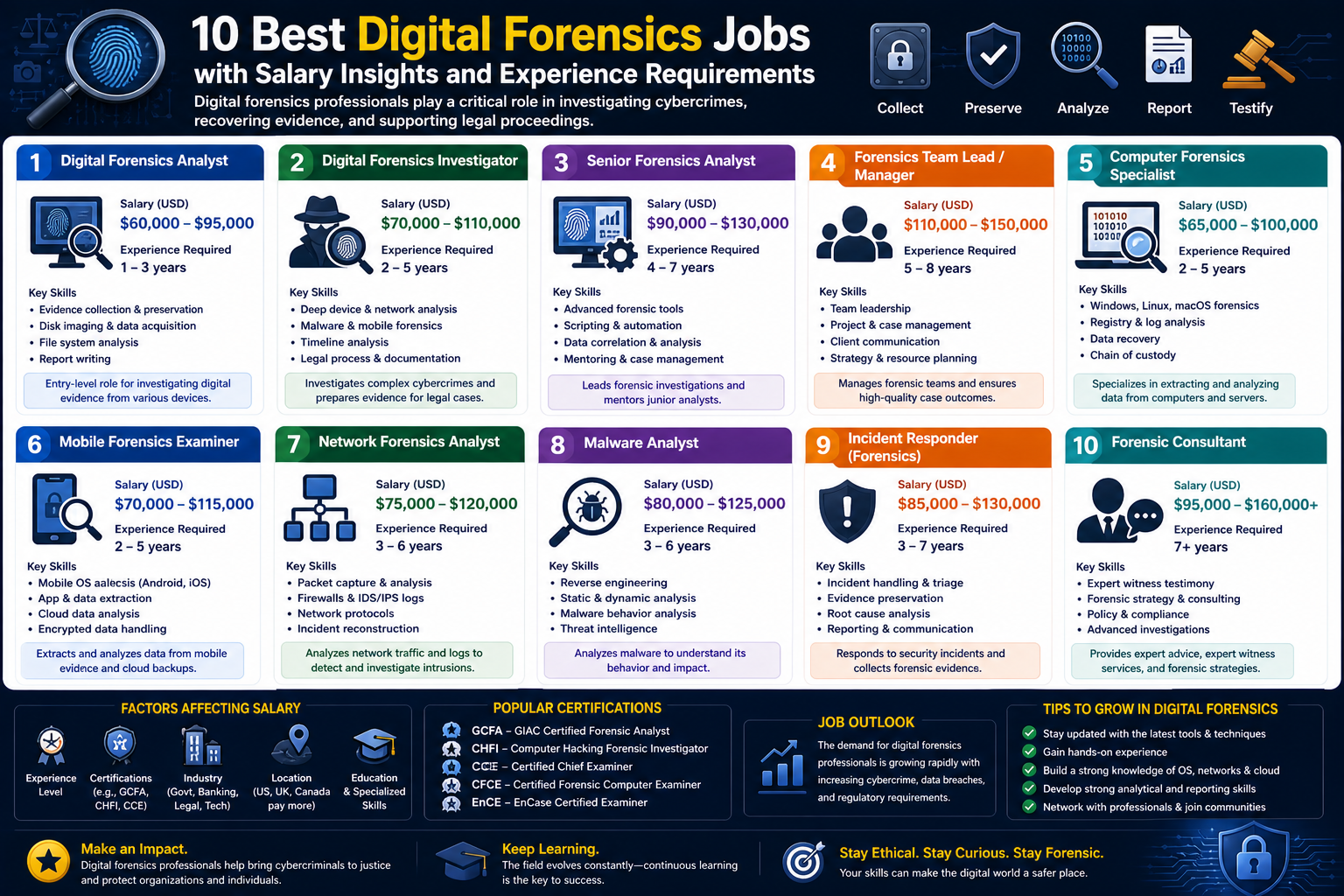
Digital forensics is not a single career path but a wide professional ecosystem made up of many specialized roles. As organizations grow more dependent on digital systems, the need for professionals who can investigate digital activity has expanded into multiple industries. These roles are not limited to law enforcement or government agencies. They also exist in corporate security teams, consulting firms, financial institutions, healthcare organizations, and technology companies.
Each role in digital forensics focuses on a different aspect of investigation, analysis, or incident response. Some professionals work directly with evidence recovery, while others focus on interpreting data patterns, supporting legal teams, or responding to cyber incidents in real time. The variety of roles makes this field flexible for people with different interests, whether they lean more toward technical analysis, investigative work, or legal support.
What connects all these roles is the requirement to handle digital evidence responsibly and to extract meaningful insights from complex data environments. While the tools and environments may differ, the core objective remains the same: understanding what happened in a digital system and proving it through reliable evidence.
Entry-Level Roles and How They Shape Early Experience
Most professionals begin their journey in entry-level positions where they gain hands-on exposure to forensic tools and investigative workflows. These roles are designed to build foundational experience rather than handle complex or high-stakes investigations independently.
At this stage, professionals typically assist senior investigators in collecting data, creating forensic images, and organizing evidence. They may also help maintain documentation and prepare reports that summarize technical findings. Although entry-level roles are supervised, they are critical for learning how real investigations operate in practice.
Early-career professionals often work with pre-established procedures that guide every step of the investigation. This includes how devices are handled, how data is extracted, and how findings are recorded. By following these structured processes, newcomers learn the importance of consistency and accuracy in forensic work.
Over time, individuals in these roles develop familiarity with different operating systems, file structures, and data recovery techniques. They also begin to understand how digital evidence behaves in different environments, which becomes essential for more advanced work later in their careers.
Mid-Level Roles and the Shift Toward Independent Investigations
As professionals gain experience, they often transition into mid-level roles where they are expected to handle investigations with greater independence. At this stage, the complexity of cases increases, and investigators are trusted to analyze evidence without constant supervision.
Mid-level professionals may be responsible for conducting full forensic examinations, identifying suspicious activity, and preparing detailed reports that summarize findings. They are also more likely to interact with other departments, such as cybersecurity teams, legal advisors, or law enforcement officers.
One important aspect of mid-level roles is the ability to interpret data rather than just collect it. Investigators must begin connecting multiple pieces of evidence to build a timeline of events. This requires not only technical knowledge but also strong analytical thinking.
Professionals at this level also start encountering more specialized cases, such as malware infections, insider threats, or complex fraud investigations. These cases often require deeper technical understanding and the ability to work across multiple systems simultaneously.
Advanced Roles in High-Stakes Investigations
Advanced digital forensics roles involve complex investigations that often have significant legal, financial, or security implications. Professionals in these positions are expected to lead investigations, make critical decisions, and ensure that all findings are defensible in legal or regulatory contexts.
At this level, investigators may work on large-scale cyberattacks, corporate data breaches, or national security incidents. These cases often involve multiple systems, large volumes of data, and sophisticated attackers who attempt to conceal their actions.
Advanced investigators must be able to reconstruct events across different environments, including cloud systems, physical devices, and network infrastructure. This requires a deep understanding of how data flows across systems and how different technologies interact.
They are also responsible for validating the work of junior investigators, ensuring that all procedures have been followed correctly and that evidence remains reliable. Their role is both technical and supervisory, requiring strong leadership and communication skills.
Corporate Digital Forensics and Internal Investigations
In corporate environments, digital forensics plays a crucial role in protecting business assets and maintaining trust. Companies often employ forensic specialists to investigate internal threats such as data leaks, employee misconduct, or intellectual property theft.
Corporate investigations are often sensitive because they involve confidential business information. Unlike law enforcement cases, these investigations are usually conducted internally or by private security teams. The goal is to identify risks and prevent further damage rather than pursue criminal charges directly.
One of the most common scenarios in corporate forensics is insider threat investigation. This involves analyzing employee activity to determine whether sensitive data has been accessed or transferred without authorization. Investigators may examine email logs, file access records, and network activity to identify unusual behavior patterns.
Another important area is data breach response. When a company’s systems are compromised, forensic professionals are brought in to determine how the breach occurred, what data was affected, and whether the attacker is still present in the system.
Corporate digital forensics requires a strong understanding of business operations because investigators must interpret technical findings in the context of organizational processes. This helps ensure that recommendations are practical and aligned with business needs.
Law Enforcement and Public Sector Forensics Work
Digital forensics in law enforcement involves supporting criminal investigations by analyzing digital evidence related to crimes. This can include anything from fraud and harassment cases to organized cybercrime and terrorism investigations.
Law enforcement investigators often work closely with detectives and prosecutors to provide technical evidence that supports legal cases. Their findings must be clearly documented and presented in a way that can be understood in court.
One of the key challenges in this environment is ensuring that evidence meets strict legal standards. Every step of the investigation must follow established procedures to ensure admissibility in court. This includes proper handling of devices, secure storage of evidence, and accurate reporting of findings.
Public sector forensic teams also deal with a wide variety of cases, which means they must be adaptable. One day they may be working on a financial fraud case, and the next they may be analyzing digital evidence from a violent crime investigation.
These roles often require collaboration with multiple agencies, especially when cases cross jurisdictional boundaries. This adds complexity to investigations but also provides opportunities to work on high-impact cases.
Cybersecurity Incident Response and Forensic Integration
Incident response and digital forensics are closely connected disciplines. When a cybersecurity incident occurs, such as a data breach or ransomware attack, forensic professionals are often brought in to investigate what happened while incident response teams work to contain the damage.
Incident response focuses on immediate action, such as isolating affected systems, stopping ongoing attacks, and restoring normal operations. Digital forensics, on the other hand, focuses on understanding the cause and scope of the incident.
In many modern organizations, these roles overlap significantly. Professionals may be required to both respond to incidents and perform forensic analysis simultaneously. This requires the ability to work under pressure while maintaining accuracy and attention to detail.
Forensic analysis during incident response often involves examining system logs, memory data, and network traffic in real time. This helps organizations understand how attackers gained access and what actions they took within the system.
The insights gained from forensic investigations are also used to improve security measures and prevent future incidents. This makes digital forensics an essential part of long-term cybersecurity strategy.
Specialized Roles in Cyber Threat Intelligence
Cyber threat intelligence focuses on understanding and tracking cyber threats before they cause harm. Professionals in this area analyze data from multiple sources to identify patterns of malicious activity and predict future attacks.
Unlike traditional forensic work, which focuses on past events, threat intelligence is forward-looking. Investigators attempt to understand the behavior of threat actors, including their tools, techniques, and motivations.
This role requires strong analytical skills and the ability to work with large datasets. Investigators often combine forensic data with external intelligence sources to build a complete picture of threat activity.
Threat intelligence specialists also work closely with forensic teams during investigations. For example, if a breach occurs, threat intelligence professionals may help identify whether the attack is part of a larger campaign targeting multiple organizations.
The insights generated in this field are used to strengthen security defenses and improve organizational awareness of emerging threats.
Digital Forensics in Legal and Litigation Support Environments
Digital forensics also plays an important role in legal proceedings. In litigation support environments, forensic professionals assist lawyers by collecting and analyzing electronic evidence that can be used in court cases.
This may involve retrieving emails, documents, or communication records that are relevant to a legal dispute. The goal is to ensure that digital evidence is accurate, properly preserved, and presented in a way that supports legal arguments.
Forensic professionals in this area must have a strong understanding of legal procedures and evidence standards. They must also be able to explain technical findings in clear and simple language so that judges and juries can understand them.
In some cases, forensic experts may be required to testify in court. This requires not only technical knowledge but also the ability to communicate findings confidently and clearly under cross-examination.
The Importance of Cross-Disciplinary Knowledge in Forensic Careers
Digital forensics is inherently interdisciplinary. Professionals in this field must understand not only technology but also law, psychology, and organizational behavior.
Understanding legal principles helps ensure that investigations are conducted in a way that supports legal outcomes. Knowledge of psychology can help investigators interpret user behavior and identify patterns of malicious activity. Awareness of organizational systems helps forensic professionals understand how data flows within companies and institutions.
This combination of disciplines allows forensic professionals to approach investigations from multiple perspectives. It also improves their ability to interpret complex evidence and draw accurate conclusions.
As the field continues to evolve, cross-disciplinary knowledge becomes even more important. Modern investigations often involve multiple technologies and legal frameworks, requiring professionals to adapt quickly to new challenges.
Work Environments and Operational Conditions in Digital Forensics
Digital forensics professionals work in a variety of environments depending on their role. Some work in controlled laboratory settings where they analyze evidence in secure conditions. Others work in offices, corporate environments, or even field locations where evidence is collected.
In laboratory environments, strict protocols are followed to maintain the integrity of evidence. These labs are often access-controlled and designed to prevent contamination or unauthorized access.
Field investigators may need to collect evidence from crime scenes, offices, or data centers. This requires careful handling of devices to ensure that data is not altered during collection.
Remote work is also becoming more common, especially in corporate and consulting roles. Investigators may analyze data from secure systems without physically accessing devices.
Regardless of the environment, the core principles of forensic work remain the same: accuracy, integrity, and documentation.
The Growing Complexity of Digital Investigation Work
As technology evolves, digital forensics continues to become more complex. Modern systems generate vast amounts of data, much of which is encrypted, distributed, or stored in cloud environments.
This complexity requires forensic professionals to continuously adapt their skills and approaches. Investigations now often involve multiple platforms, including mobile devices, cloud services, and virtual environments.
At the same time, attackers are becoming more sophisticated in how they hide or manipulate digital evidence. This increases the difficulty of investigations and requires more advanced techniques for data recovery and analysis.
Despite these challenges, the demand for skilled forensic professionals continues to grow as organizations recognize the importance of understanding digital activity in both security and legal contexts.
How Digital Forensics Expands Into High-Impact Global Investigations
Digital forensics today extends far beyond basic data recovery or internal company investigations. It has become a critical discipline in solving complex, large-scale incidents that can affect governments, global corporations, and entire digital ecosystems. As technology becomes deeply embedded in everyday life, digital evidence is now central to almost every serious investigation.
Modern forensic professionals are no longer limited to examining a single device or system. Instead, they may analyze interconnected networks, cloud infrastructures, mobile ecosystems, and even Internet of Things devices simultaneously. This expansion has significantly increased the complexity of investigations, requiring professionals to think across systems rather than within isolated environments.
Large-scale investigations often involve coordinated efforts between multiple agencies or organizations. For example, a cyberattack affecting financial institutions across several countries may require forensic experts to collaborate internationally. In such cases, digital forensics becomes not just a technical discipline but also a form of global coordination.
The ability to reconstruct events across distributed systems is now one of the most valuable skills in the field. Investigators must understand how data moves across networks, how cloud systems store and replicate information, and how attackers exploit system interconnections.
The Role of Digital Forensics in Cybercrime Investigations
Cybercrime has become one of the most significant drivers of digital forensics demand. Criminal activity now frequently takes place in digital environments, including identity theft, ransomware attacks, phishing schemes, financial fraud, and corporate espionage.
Digital forensic professionals play a central role in identifying how these crimes occur and who is responsible. They analyze compromised systems to determine entry points, trace attacker activity, and recover evidence that can be used in legal proceedings.
One of the most challenging aspects of cybercrime investigations is attribution. Attackers often use techniques to hide their identity, such as anonymization tools, proxy networks, and encrypted communication channels. Forensic investigators must carefully analyze indirect evidence to build a reliable picture of attacker behavior.
Cybercrime investigations often require collaboration with cybersecurity analysts, law enforcement agencies, and intelligence organizations. This multidisciplinary approach ensures that both technical evidence and contextual intelligence are used to understand the full scope of an attack.
In many cases, forensic findings not only support criminal prosecution but also help organizations strengthen their defenses. By understanding how attackers gained access, security teams can close vulnerabilities and reduce future risk.
Advanced Digital Forensics in National Security and Intelligence Operations
At the highest level of digital forensics, investigations support national security operations. These cases often involve threats from organized cybercriminal groups, nation-state actors, or terrorism-related activities.
In these environments, forensic professionals work with highly sensitive and classified information. Their investigations may involve analyzing communications between threat actors, identifying infiltration of government systems, or examining cyber espionage activities.
These roles require a deep understanding of advanced technologies and sophisticated attack methods. Investigators must be familiar with encryption systems, advanced malware behavior, and stealth techniques used by highly skilled adversaries.
Security clearance is often required for these positions because of the sensitive nature of the data involved. This adds an additional layer of trust and responsibility to the role.
Digital forensics in national security contexts is often time-sensitive. Investigators may need to work quickly to identify threats and prevent further damage. At the same time, accuracy cannot be compromised because findings may have serious political or legal implications.
The Integration of Artificial Intelligence in Digital Forensics
Artificial intelligence is increasingly influencing the field of digital forensics. As the volume of digital data grows exponentially, manual analysis alone is no longer sufficient for many types of investigations.
AI tools can help identify patterns in large datasets, detect anomalies in system behavior, and prioritize relevant evidence for human analysis. This allows investigators to focus on higher-level interpretation rather than raw data processing.
Machine learning models can also assist in identifying malware behavior, predicting attack patterns, and classifying types of digital evidence. These capabilities are particularly useful in large-scale investigations where time is a critical factor.
However, AI does not replace human investigators. Instead, it enhances their capabilities. Human judgment is still essential for interpreting context, validating findings, and ensuring that conclusions are legally and ethically sound.
One of the emerging challenges in this area is ensuring transparency in AI-assisted investigations. Forensic professionals must be able to explain how conclusions were reached, even when automated systems are involved.
Cloud Computing and Its Impact on Forensic Investigations
Cloud computing has fundamentally changed how digital evidence is stored and accessed. Instead of being confined to physical devices, data is now distributed across remote servers managed by third-party providers.
This shift introduces new challenges for forensic investigators. Accessing cloud-based evidence often requires cooperation from service providers and adherence to strict legal frameworks.
Investigators must also understand how cloud systems handle data replication, synchronization, and storage redundancy. Unlike traditional systems, cloud environments may store copies of data across multiple geographic locations.
Another challenge is volatility. Cloud data can change rapidly, and logs may be overwritten or deleted within short timeframes. This makes timely evidence collection critical.
Despite these challenges, cloud environments also provide new opportunities for forensic analysis. Centralized logging systems, for example, can provide detailed records of user activity across multiple devices and locations.
As organizations continue to migrate to cloud-based infrastructure, cloud forensics is becoming one of the fastest-growing areas within the field.
Mobile Device Forensics in a Connected World
Mobile devices have become one of the most important sources of digital evidence in modern investigations. Smartphones and tablets contain vast amounts of personal and professional information, including messages, emails, photos, app data, and location history.
Mobile forensics involves extracting and analyzing this data in a way that preserves its integrity. Investigators must deal with a wide range of operating systems, device models, and security features.
One of the biggest challenges in mobile forensics is encryption. Many modern devices use strong encryption to protect user data, making unauthorized access extremely difficult.
Despite these challenges, mobile devices often contain critical evidence that can help reconstruct events, verify timelines, and identify communication patterns.
Location data is particularly valuable in many investigations. It can help determine where a device was at a specific time, which may be crucial in criminal or fraud cases.
As mobile technology continues to evolve, forensic professionals must constantly adapt to new device architectures and security mechanisms.
Internet of Things (IoT) and Emerging Forensic Challenges
The rise of Internet of Things devices has introduced a new frontier in digital forensics. IoT devices include smart home systems, wearable technology, connected vehicles, and industrial sensors.
These devices generate continuous streams of data, much of which can be relevant in investigations. However, IoT environments are highly diverse and often lack standardized data storage formats.
One of the challenges in IoT forensics is identifying where data is stored and how it can be extracted. Unlike traditional computers or smartphones, IoT devices may have limited storage capacity or rely heavily on cloud integration.
Another challenge is data interpretation. IoT devices often record sensor data rather than traditional files, requiring investigators to interpret numerical or environmental data in context.
Despite these challenges, IoT forensics is becoming increasingly important as connected devices become more integrated into daily life. From smart appliances to vehicle systems, these devices can provide valuable insights during investigations.
The Role of Digital Forensics in Financial and Fraud Investigations
Financial fraud is another major area where digital forensics plays a critical role. Investigators analyze transaction records, communication logs, and system activity to identify fraudulent behavior.
In corporate environments, forensic professionals may investigate embezzlement, insider trading, or accounting manipulation. These cases often involve large volumes of financial data that must be carefully analyzed.
Digital evidence can reveal patterns such as unauthorized transactions, altered records, or hidden accounts. Investigators must often reconstruct financial activity over long periods to identify irregularities.
Fraud investigations require strong attention to detail and a deep understanding of financial systems. Even small discrepancies can be significant when analyzed in context.
In many cases, forensic findings are used in legal proceedings, making accuracy and documentation essential.
The Expanding Role of Digital Forensics in Private Sector Security
While law enforcement and government agencies remain major employers of forensic professionals, the private sector has become equally important. Businesses across industries now rely on digital forensics to protect assets and manage cyber risks.
Corporate forensic teams are often involved in incident response, internal investigations, and compliance monitoring. They help organizations understand security incidents and ensure that data handling practices meet regulatory requirements.
In financial institutions, for example, forensic professionals may monitor transactions for signs of fraud or suspicious activity. In healthcare organizations, they may investigate unauthorized access to patient data.
Technology companies also rely heavily on forensic expertise to analyze system failures, investigate breaches, and improve product security.
The private sector offers diverse opportunities for forensic professionals, often combining technical analysis with business-focused decision-making.
Skill Evolution and Continuous Learning in Digital Forensics
One of the defining characteristics of a digital forensics career is the need for continuous learning. Because technology evolves rapidly, professionals must constantly update their skills to remain effective.
New operating systems, applications, and security technologies introduce new types of data and new challenges for investigators. This means that techniques used a few years ago may no longer be sufficient for modern investigations.
Professionals must also stay informed about changes in legal standards and privacy regulations. These changes can affect how evidence is collected, stored, and presented.
Practical experience remains one of the most important ways to develop expertise. Working on real cases, analyzing complex systems, and using forensic tools in varied environments all contribute to professional growth.
As careers progress, many professionals choose to specialize in specific areas such as network forensics, malware analysis, or cloud investigations. Specialization allows them to develop deeper expertise in a particular domain.
The Future Direction of Digital Forensics Careers
The future of digital forensics is closely tied to the evolution of technology. As digital environments become more complex, forensic investigations will also become more sophisticated.
Automation and artificial intelligence will continue to play a larger role, helping professionals manage large datasets and identify patterns more efficiently. However, human expertise will remain essential for interpretation and decision-making.
New technologies such as quantum computing, advanced encryption systems, and decentralized networks will introduce new challenges for forensic professionals. These developments will require innovative approaches and advanced technical understanding.
At the same time, the demand for digital forensics expertise is expected to grow across industries. As cyber threats increase and digital dependency expands, organizations will continue to rely on forensic professionals to investigate incidents and protect critical systems.
The field is also likely to become more interdisciplinary, combining elements of cybersecurity, data science, law, and behavioral analysis. This integration will create new opportunities for professionals with diverse skill sets.
Digital forensics is no longer a niche discipline. It has become a foundational component of modern security, legal systems, and digital trust frameworks across the world.
Conclusion
Digital forensics has evolved into one of the most essential disciplines in today’s technology-driven world. As society becomes increasingly dependent on digital systems for communication, finance, governance, healthcare, and personal activity, the need to understand and investigate digital behavior has grown significantly. What once began as a specialized support function for computer-related investigations is now a core component of cybersecurity, law enforcement, corporate governance, and national security operations.
Across all the roles explored in this discussion—from entry-level forensic lab positions to advanced intelligence and incident response careers—one consistent theme emerges: digital forensics is built on precision, accountability, and analytical reasoning. Every investigation relies on the ability to preserve digital evidence in a reliable way, analyze complex systems accurately, and present findings that can withstand scrutiny in legal or organizational settings. This combination of technical skill and investigative discipline makes the field both challenging and highly impactful.
Another key takeaway is the diversity of career opportunities within digital forensics. Professionals are not limited to a single path. Some focus on corporate investigations, helping organizations detect internal threats and prevent data breaches. Others work in law enforcement, where their findings directly contribute to solving criminal cases. There are also roles in cyber threat intelligence, where analysts track evolving attacker behavior, and in legal support environments, where digital evidence is translated into courtroom-ready material. This variety allows individuals to align their careers with their interests, whether they are drawn to technical analysis, investigative work, or legal applications.
The field also stands out because of its constant evolution. Technology does not remain static, and neither does digital forensics. The rise of cloud computing, mobile devices, artificial intelligence, and interconnected IoT systems has dramatically expanded the scope of investigations. At the same time, cybercriminals have become more sophisticated, using advanced methods to hide their activity and evade detection. This ongoing competition between defensive investigation and offensive evasion ensures that digital forensics remains a dynamic and ever-changing profession.
Despite the technical nature of the work, success in digital forensics is not determined by technology alone. It also depends heavily on mindset and discipline. Professionals must be patient, detail-oriented, and committed to following strict procedures. They must be able to remain objective, even when dealing with complex or high-pressure investigations. Strong communication skills are equally important, as forensic findings often need to be explained to non-technical stakeholders, including legal teams, executives, or juries.
Perhaps most importantly, digital forensics plays a crucial role in maintaining trust in the digital world. Every day, individuals and organizations rely on digital systems to store sensitive information and conduct critical operations. When incidents occur—whether through cyberattacks, fraud, or internal misconduct—digital forensics provides the means to uncover the truth, assign responsibility, and prevent future harm. Without this discipline, many digital crimes would remain unsolved, and many security vulnerabilities would go unaddressed.
As the digital landscape continues to expand, the demand for skilled forensic professionals will only increase. The field offers long-term career stability, intellectual challenge, and the opportunity to contribute meaningfully to both security and justice systems. For those willing to develop the required technical expertise and investigative mindset, digital forensics provides a career path that is both intellectually rewarding and socially significant.