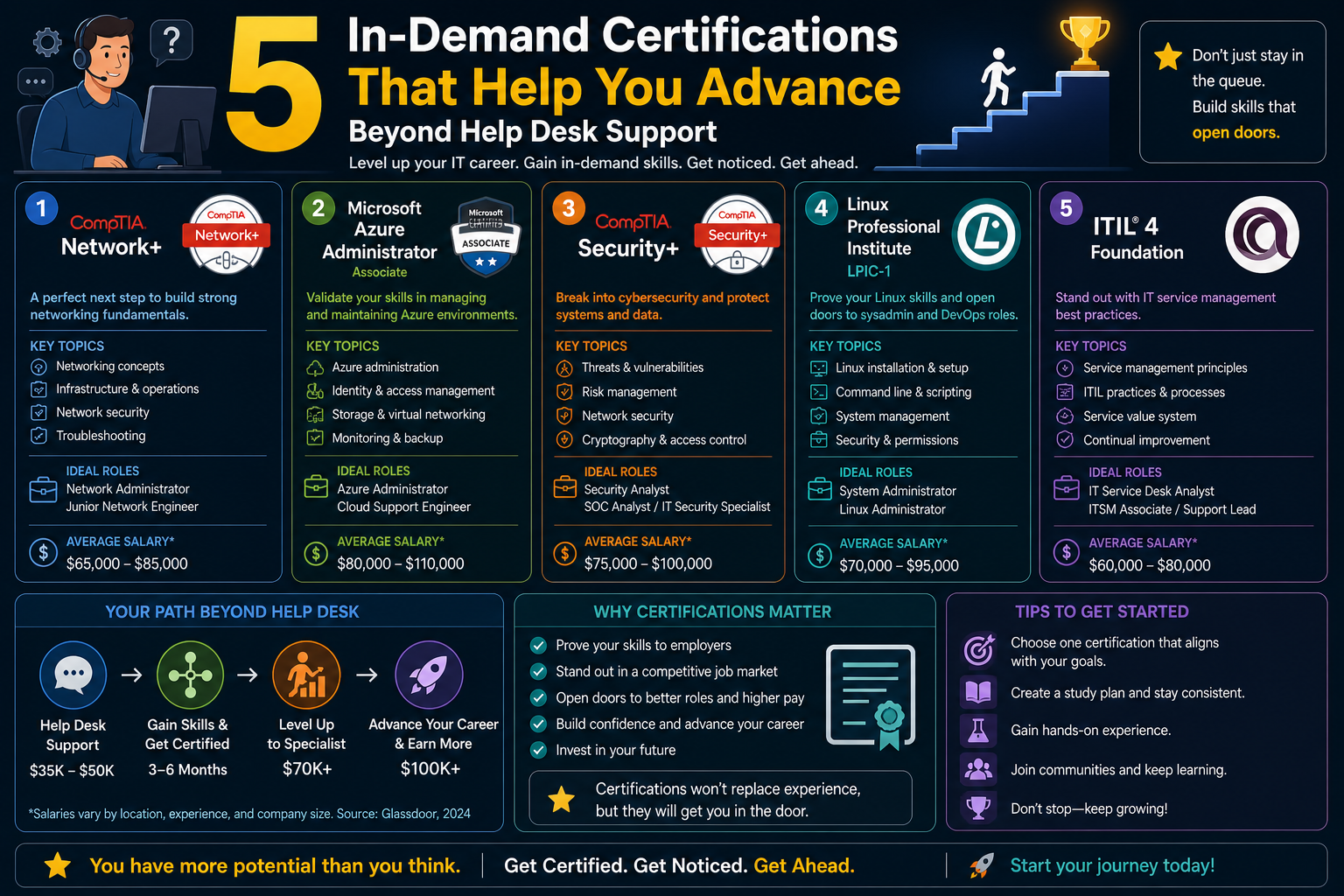
Working in an IT help desk role is often the first real exposure many professionals get to the technology industry. It is where foundational skills are built, where exposure to real-world systems begins, and where problem-solving under pressure becomes routine. However, after a certain point, many professionals begin to notice a pattern: the work becomes repetitive, the challenges start to feel familiar, and the growth opportunities appear limited.
This is not because help desk roles lack value. On the contrary, they are essential to every organization that relies on technology. The limitation comes from perception. Employers often categorize help desk experience as entry-level support, which means candidates can struggle to demonstrate readiness for more advanced roles such as systems administration, network engineering, cloud operations, or cybersecurity.
Another challenge is the nature of the work itself. Help desk tasks are often reactive rather than proactive. You respond to issues, troubleshoot symptoms, reset configurations, and escalate complex problems to higher-level teams. While this builds troubleshooting ability and communication skills, it may not always provide deep exposure to infrastructure design, architecture, or advanced system management.
Over time, this creates a gap between experience and ambition. Many professionals know they are capable of more, but their resumes do not yet reflect the depth required for higher-level positions. This is where structured skill validation becomes important.
How Certifications Shift Employer Perception
Certifications play a critical role in transforming how employers evaluate candidates who primarily come from help desk backgrounds. In many hiring decisions, recruiters and managers look for signals that go beyond job titles. They want proof of technical capability, structured learning, and commitment to career growth.
A certification acts as a standardized benchmark. Unlike job experience, which varies widely from company to company, certifications validate that an individual has met a defined set of knowledge and skill requirements. This reduces uncertainty for employers.
It is also important to understand how hiring psychology works in IT. When two candidates have similar experience levels, the one with certifications often appears more prepared for advancement. This is especially true in cases where the certification aligns directly with the job role being applied for.
For help desk professionals, this shift is significant. Certifications help bridge the gap between foundational support work and specialized technical roles. They demonstrate initiative, discipline, and the willingness to invest in professional development.
They also help restructure a resume narrative. Instead of appearing limited to password resets and ticket resolution, a candidate can demonstrate structured learning in networking, cloud systems, virtualization, or enterprise infrastructure.
Choosing a Direction Before Choosing a Certification
One of the most common mistakes professionals make when trying to move out of help desk roles is pursuing certifications without a clear direction. While any learning is valuable, career advancement becomes more efficient when there is a defined path.
IT is a broad field with multiple branches. Some of the most common directions include networking, systems administration, cloud computing, cybersecurity, and infrastructure virtualization. Each of these paths requires different skills and leads to different job roles.
For example, someone interested in networking will focus on routers, switches, IP addressing, traffic flow, and infrastructure design. Someone interested in cloud computing will focus on scalable systems, virtual environments, deployment models, and cloud services. Systems administration, on the other hand, involves managing servers, operating systems, user environments, and internal enterprise tools.
Help desk experience naturally touches all of these areas at a surface level. However, certifications help deepen knowledge in a specific direction. Choosing a direction early helps avoid scattered learning and increases the likelihood of career progression.
Among all these paths, networking is often the most common first step for help desk professionals transitioning into more technical roles. It builds foundational understanding of how systems communicate, which supports nearly every other IT discipline.
Networking as a Natural Progression Path
Networking is one of the most logical next steps after help desk experience because it builds directly on what many support technicians already encounter daily. Issues such as slow internet, server connectivity failures, VPN problems, and routing errors are common tickets in support environments.
While help desk roles involve troubleshooting these issues, networking roles involve understanding why they happen at a structural level and how to design systems to prevent or optimize them.
Networking knowledge is also foundational for nearly every advanced IT discipline. Cloud computing relies heavily on virtual networks. Cybersecurity depends on understanding network vulnerabilities. Systems administration requires stable connectivity and proper routing between environments.
Because of this, networking certifications often serve as a gateway to multiple career paths rather than just one.
CompTIA Network+ — Building Vendor-Neutral Networking Foundations
While CCNA focuses on Cisco systems and technologies, CompTIA Network+ offers a broader, vendor-neutral approach to networking fundamentals. This makes it particularly useful for individuals who want a wide foundational understanding before specializing.
Network+ is designed to validate core networking knowledge that applies across different environments and technologies. This includes concepts such as network design, troubleshooting methodology, infrastructure components, and security principles.
One of the key advantages of a vendor-neutral certification is flexibility. Instead of focusing on a single technology ecosystem, learners gain a broader understanding of how networks function regardless of the equipment or software being used.
This is especially useful in environments where organizations use mixed technologies. Many companies do not rely solely on one vendor, so professionals who understand general networking principles can adapt more easily.
For help desk professionals, Network+ aligns closely with common support scenarios. Issues involving connectivity, DNS failures, IP conflicts, and wireless performance are all part of the certification’s conceptual scope.
Another important aspect of Network+ is structured problem-solving. The certification emphasizes identifying, diagnosing, and resolving network issues using a consistent methodology. This helps professionals transition from reactive troubleshooting to more analytical thinking.
Network+ also introduces security fundamentals within networking contexts. This includes understanding how data is protected during transmission, how access is controlled, and how vulnerabilities can affect communication between systems.
From a career perspective, Network+ can serve as a stepping stone toward both networking and cybersecurity roles. It helps establish credibility while preparing individuals for more specialized certifications later in their careers.
How Help Desk Experience Becomes an Advantage Instead of a Limitation
Although help desk roles are often viewed as entry-level, they provide a strong foundation for technical growth when combined with structured learning.
One of the most important skills developed in help desk environments is communication. Explaining technical issues to non-technical users is a skill that becomes increasingly valuable in advanced IT roles. Whether working in networking, cloud computing, or systems administration, the ability to translate technical concepts into understandable language remains essential.
Another advantage is exposure to diverse systems. Help desk professionals often interact with operating systems, applications, networks, and hardware components daily. This exposure builds familiarity with how different technologies interact in real environments.
Time management and prioritization are also developed under pressure. Handling multiple tickets, prioritizing urgent issues, and maintaining service levels are all transferable skills that remain relevant in higher-level positions.
When combined with certifications, this experience becomes even more powerful. Certifications provide technical depth, while help desk experience provides practical context. Together, they create a more complete professional profile.
Building Early Momentum Toward Advanced IT Roles
The transition from help desk to more advanced IT roles does not happen instantly. It requires consistent skill development, strategic learning choices, and gradual exposure to more complex systems.
Certifications such as CCNA and Network+ represent the early stages of this transition. They help establish direction and validate readiness for more specialized responsibilities.
However, what truly matters is how these certifications are applied. Understanding concepts is important, but being able to connect them to real-world troubleshooting scenarios is what ultimately builds confidence and capability.
As professionals progress through these learning stages, they begin to shift from reactive problem-solving to proactive system understanding. This shift is what separates entry-level support roles from infrastructure and engineering roles.
The next stages of career growth often involve expanding into virtualization, cloud platforms, and enterprise systems, where concepts introduced in networking become even more critical.
Moving From Foundational Skills to Specialized IT Roles
Once a help desk professional builds a solid foundation in IT support and begins developing structured knowledge through certifications, the next stage of career growth involves specialization. This is the point where the learning journey becomes more focused, and career direction starts to define itself more clearly.
Specialization is important because modern IT environments are no longer generalized. Organizations rely on highly specific skill sets such as cloud engineering, virtualization management, network architecture, cybersecurity operations, and systems engineering. Each of these areas requires deeper knowledge than what is typically gained in support roles.
At the help desk level, professionals interact with these systems indirectly. They may reset virtual machines, troubleshoot cloud access issues, or escalate network problems. However, they are not always responsible for designing or managing the underlying infrastructure.
Specialization bridges this gap. It allows professionals to move from understanding how to fix problems to understanding how systems are built, optimized, and secured. This shift changes both responsibility and career potential.
Why Virtualization Became a Core Skill in Modern IT Environments
Virtualization is one of the most transformative technologies in modern computing. It allows multiple virtual systems to run on a single physical machine, improving efficiency, scalability, and resource utilization.
In traditional IT environments, each application or service often required dedicated hardware. This approach was expensive and difficult to scale. Virtualization changed that model by introducing abstraction between hardware and software.
For help desk professionals, virtualization often appears in the form of virtual desktops, remote servers, or cloud-hosted environments. However, understanding how these systems work internally is a different level of expertise.
Virtualization is now central to enterprise IT operations because it supports cloud computing, disaster recovery, testing environments, and scalable infrastructure deployment. Almost every modern organization relies on virtualization in some form.
This makes virtualization knowledge highly valuable for career advancement. It serves as a bridge between networking, systems administration, and cloud computing.
VMware Certified Professional — Understanding Enterprise Virtual Environments
One of the most recognized certifications in virtualization is the VMware Certified Professional. This certification focuses on understanding and managing virtualized environments at an enterprise level.
Virtualization is not just about running virtual machines. It involves understanding how resources such as CPU, memory, storage, and networking are allocated and optimized across multiple virtual systems.
The VMware ecosystem is widely used in corporate environments, making this certification highly relevant for IT professionals aiming to move beyond support roles.
A key aspect of VMware-based environments is resource management. Unlike physical systems where resources are fixed, virtual environments require dynamic allocation. This means administrators must understand how workloads impact performance and how to balance resources across multiple systems.
Another important concept is virtualization architecture. This includes hypervisors, virtual switches, storage systems, and network configurations that allow virtual machines to operate efficiently.
For someone transitioning from help desk work, this represents a shift from reactive troubleshooting to infrastructure management. Instead of fixing individual issues, professionals begin to understand how entire systems operate together.
Virtualization also plays a critical role in system recovery and backup strategies. Virtual machines can be cloned, restored, or migrated between physical hosts with minimal downtime. This capability is essential for business continuity and operational stability.
How Virtualization Connects to Real IT Job Roles
Virtualization knowledge opens the door to several important job roles. These include systems administrator, virtualization engineer, infrastructure support specialist, and cloud operations technician.
Systems administrators, in particular, rely heavily on virtualization to manage servers and internal services. They are responsible for ensuring that systems run efficiently and securely across both physical and virtual environments.
Virtualization engineers take this further by designing and optimizing virtual infrastructure. They plan resource allocation, manage performance, and ensure scalability for growing organizations.
Even cloud computing relies heavily on virtualization principles. Cloud platforms are essentially large-scale virtualized environments that allow organizations to deploy resources on demand.
This means that learning virtualization is not limited to one career path. Instead, it supports multiple directions in IT, making it one of the most flexible specialization areas.
Cloud Computing as the Next Major Career Shift
Cloud computing has become one of the most dominant forces in modern IT. It has changed how organizations store data, deploy applications, and manage infrastructure.
Instead of maintaining physical servers in internal data centers, companies now use cloud platforms to access computing resources over the internet. This shift has created new job roles and increased demand for cloud-skilled professionals.
For help desk professionals, cloud computing often begins with user support tasks such as resetting access permissions, troubleshooting login issues, or assisting with cloud-based applications.
However, cloud engineering goes far beyond this. It involves understanding infrastructure as a service, platform as a service, and software as a service models. It also requires knowledge of scalability, security, automation, and system architecture.
Cloud environments are highly dynamic. Resources can be created, modified, or removed in minutes. This flexibility requires a strong understanding of how systems interact in real time.
AWS Cloud Practitioner — Building Cloud Awareness
One of the entry points into cloud computing is the AWS Cloud Practitioner certification. This certification is designed to introduce fundamental cloud concepts and provide a broad understanding of how cloud environments operate.
Rather than focusing on deep technical implementation, this certification emphasizes awareness and conceptual understanding. It covers cloud architecture basics, security principles, billing models, and service categories.
A key concept in cloud computing is elasticity. This refers to the ability of systems to scale resources up or down based on demand. Unlike traditional infrastructure, cloud systems are designed to respond automatically to workload changes.
Another important concept is shared responsibility. In cloud environments, security and management responsibilities are divided between the provider and the customer. Understanding this division is essential for proper system management.
Cloud computing also introduces a new way of thinking about cost. Instead of purchasing hardware upfront, organizations pay for resources based on usage. This changes how IT decisions are made and requires professionals to understand cost optimization.
For help desk professionals, this certification provides a structured introduction to cloud environments. It helps bridge the gap between traditional IT support and modern cloud-based infrastructure.
How Cloud Skills Change Career Opportunities
Cloud skills are increasingly in demand across all industries. Almost every organization is either migrating to the cloud or already operating within a cloud-based environment.
This creates opportunities in roles such as cloud support associate, cloud operations technician, junior cloud engineer, and infrastructure analyst.
These roles involve managing virtual environments, monitoring system performance, troubleshooting cloud services, and ensuring security compliance.
One of the most important advantages of cloud computing careers is scalability of opportunity. Cloud systems are used globally, meaning professionals with cloud skills can work across industries such as finance, healthcare, education, and technology.
Another advantage is career progression. Cloud roles often lead to higher-level positions such as cloud architect or cloud solutions engineer, where professionals design large-scale systems and infrastructure strategies.
How Systems Thinking Becomes Essential in Advanced IT Roles
As professionals move beyond help desk roles, the nature of problem-solving changes significantly. Instead of focusing on individual issues, they begin to think in terms of systems.
Systems thinking involves understanding how different components interact within an IT environment. This includes networks, servers, applications, storage, and security layers.
For example, a slow application is not just an application issue. It could be related to network congestion, server load, storage performance, or misconfigured virtualization resources.
Understanding these relationships is what separates entry-level support from advanced IT roles.
Certifications in networking, virtualization, and cloud computing all contribute to building this systems-level understanding. Each certification adds a layer of depth that helps professionals see the bigger picture.
The Role of Structured Learning in Career Progression
Structured learning is essential for transitioning from help desk roles into specialized IT careers. Without structure, learning can become fragmented and inconsistent.
Certifications provide that structure by defining what needs to be learned, how knowledge is evaluated, and what skills are expected.
However, structured learning is not just about passing exams. It is about building mental models that reflect how real systems operate.
For example, networking certifications teach how data flows across systems. Virtualization teaches how resources are shared. Cloud computing teaches how systems scale dynamically.
Together, these areas form a complete understanding of modern IT infrastructure.
Building Confidence Through Technical Depth
One of the most important outcomes of specialization is confidence. Many help desk professionals feel limited not because they lack ability, but because they have not yet been exposed to deeper technical concepts.
As knowledge increases, confidence grows naturally. Understanding how systems work internally reduces uncertainty when troubleshooting complex issues.
It also improves communication with senior engineers and architects. Instead of escalating issues without context, professionals can describe problems in technical terms, which improves collaboration and efficiency.
This confidence becomes a key factor in career advancement. Employers are more likely to promote individuals who demonstrate both knowledge and analytical thinking.
Preparing for More Advanced Infrastructure Roles
Specialization is not the final stage of career development, but it is a critical transition point. Once professionals gain experience in networking, virtualization, or cloud environments, they become eligible for more advanced infrastructure roles.
These roles involve designing systems, managing enterprise environments, and optimizing performance at scale.
At this stage, IT professionals are no longer just solving problems. They are actively shaping how systems operate within organizations.
The knowledge gained from certifications in networking, virtualization, and cloud computing forms the foundation for these advanced responsibilities.
Why Security Skills Have Become Essential in Modern IT Careers
As IT environments continue to expand across cloud platforms, virtual infrastructure, and interconnected systems, security has become one of the most critical areas of focus. Every organization now depends on protecting data, managing access, and preventing unauthorized activity across complex digital ecosystems.
For professionals coming from help desk roles, cybersecurity often appears first in the form of password resets, account lockouts, and basic access issues. While these tasks seem simple, they represent entry points into a much larger discipline. Each access request, permission change, or security incident is part of a broader security framework that governs how systems are protected.
Security is no longer a separate function within IT. It is embedded into every layer of infrastructure, from networks to cloud platforms to virtualization systems. This makes security knowledge valuable across all IT career paths.
The shift toward security-focused thinking also reflects how organizations operate today. Cyber threats are more frequent, more advanced, and more damaging than ever before. As a result, companies need professionals who understand not only how systems work but also how they can be protected.
For help desk professionals, this creates a natural opportunity for career advancement. Security skills build directly on existing experience with user access, system troubleshooting, and incident response.
Understanding the Role of Security in IT Infrastructure
Security in IT is not limited to firewalls or antivirus software. It is a layered system that includes identity management, network protection, endpoint security, data encryption, and monitoring systems.
At a foundational level, security revolves around three core principles: confidentiality, integrity, and availability. These principles define how information is protected, how it is maintained, and how it remains accessible to authorized users.
In practical terms, this means ensuring that only the right people can access systems, that data is not altered improperly, and that services remain available when needed.
Help desk professionals often interact with these principles without realizing it. For example, resetting passwords supports confidentiality. Troubleshooting system errors supports availability. Verifying account permissions supports integrity.
As professionals move beyond support roles, they begin to understand how these individual tasks connect to larger security systems.
CompTIA Security+ — Building a Foundation in Cybersecurity
One of the most widely recognized entry-level cybersecurity certifications is CompTIA Security+. This certification introduces core security concepts and prepares professionals to understand threats, vulnerabilities, and defensive strategies.
Security+ focuses on developing awareness of how cyberattacks occur and how organizations defend against them. It covers topics such as network security, identity and access management, risk management, cryptography basics, and security operations.
Unlike general IT certifications, Security+ places a strong emphasis on thinking like a security professional. This means understanding not only how systems function but also how they can be exploited or compromised.
One of the most important areas covered is threat identification. This includes recognizing different types of attacks such as phishing, malware infections, denial-of-service attacks, and unauthorized access attempts.
Another key area is risk management. Security professionals must evaluate potential threats and determine how likely they are to occur and what impact they may have. This allows organizations to prioritize security efforts effectively.
Identity and access management is another core topic. This involves controlling who has access to systems and ensuring that permissions are assigned correctly. It also includes authentication methods such as multi-factor authentication and role-based access control.
For help desk professionals, these concepts often feel familiar but are now viewed from a more strategic perspective. Instead of simply resolving access issues, professionals begin to understand why those systems exist and how they contribute to overall security.
Security+ also introduces incident response concepts. This includes how organizations detect, respond to, and recover from security breaches. Understanding these processes is essential for anyone moving into cybersecurity roles.
How Security Skills Expand Career Opportunities
Cybersecurity skills open doors to a wide range of IT roles that go beyond traditional support work. These include security analyst, SOC (Security Operations Center) technician, incident response specialist, and junior penetration tester.
Security analysts are responsible for monitoring systems for suspicious activity and investigating potential threats. They work closely with security tools and logs to identify anomalies.
SOC technicians focus on real-time monitoring and response. They are often the first line of defense when security alerts are triggered.
Incident response specialists handle active security breaches and coordinate recovery efforts. This requires both technical knowledge and the ability to remain calm under pressure.
Even entry-level cybersecurity roles often require a strong understanding of networking and systems, which makes help desk experience valuable when combined with security certifications.
As professionals gain experience in security, they may eventually progress into advanced roles such as security engineer or cybersecurity architect, where they design and implement enterprise-level security systems.
Microsoft Ecosystem and Enterprise IT Environments
Alongside networking, cloud, and security, Microsoft technologies play a central role in enterprise IT environments. Many organizations rely heavily on Microsoft systems for identity management, cloud services, collaboration tools, and operating systems.
This makes Microsoft-related skills highly valuable for career advancement. Understanding how Microsoft environments function allows IT professionals to work more effectively in corporate settings.
Microsoft systems are often the backbone of internal IT infrastructure. This includes user management, server administration, cloud integration, and productivity platforms.
For help desk professionals, Microsoft environments are often the first point of contact. Password resets, account management, and software troubleshooting are commonly handled within Microsoft-based systems.
As careers progress, professionals move from user-level support into administrative and engineering roles within Microsoft ecosystems.
Microsoft Azure Fundamentals — Introduction to Cloud Integration
Microsoft Azure is one of the leading cloud platforms used by organizations worldwide. It provides a wide range of services, including virtual machines, databases, networking, and identity management.
The Azure Fundamentals certification introduces core cloud concepts within the Microsoft ecosystem. It focuses on understanding how cloud services are structured and how they integrate with on-premises systems.
One of the key areas of Azure knowledge is identity and access management. Microsoft systems often rely on centralized identity services that control user authentication across multiple platforms.
Another important concept is hybrid cloud architecture. Many organizations do not fully migrate to the cloud. Instead, they use a combination of on-premises systems and cloud services. Understanding how these environments interact is essential for IT professionals.
Azure also emphasizes scalability and automation. Resources can be deployed dynamically based on demand, and services can be managed through centralized dashboards.
For professionals transitioning from help desk roles, Azure Fundamentals provides a structured introduction to cloud computing within a familiar enterprise environment.
Building a Strategic Certification Path Instead of Random Learning
One of the biggest challenges for professionals trying to move beyond help desk roles is choosing certifications without a clear strategy. While learning anything technical is valuable, structured progression leads to faster career advancement.
A strategic approach involves layering certifications in a way that builds upon previous knowledge. Instead of jumping between unrelated topics, professionals can follow a logical progression.
For example, networking certifications build foundational understanding of connectivity. Virtualization introduces infrastructure abstraction. Cloud certifications expand into scalable environments. Security certifications add protection and risk management.
Microsoft certifications integrate these concepts within enterprise environments.
When combined properly, these areas create a complete IT skill profile that aligns with real-world job requirements.
The Importance of Scripting and Automation Skills
As IT environments become more complex, automation has become increasingly important. Many routine tasks that were once performed manually are now handled through scripts and automated workflows.
For professionals transitioning from help desk roles, scripting represents a significant shift in skill level. It moves them from reactive problem-solving to proactive system management.
Scripting allows IT professionals to automate repetitive tasks such as user account creation, system monitoring, and configuration management. This increases efficiency and reduces the likelihood of human error.
While scripting may seem technical at first, it is becoming an essential skill in almost every IT role. Whether working in networking, cloud computing, or cybersecurity, automation plays a critical role in modern infrastructure management.
Understanding scripting also improves problem-solving ability. It encourages logical thinking, structured workflows, and a deeper understanding of how systems behave.
How Career Progression Becomes More Structured Over Time
As professionals move beyond help desk roles, career progression becomes less about general exposure and more about specialization and expertise.
At the entry level, IT work often involves responding to a wide range of issues without deep specialization. However, as professionals gain certifications and experience, their roles become more focused.
For example, a professional who starts in help desk may transition into networking support, then into network engineering. Another may move into cloud support and eventually into cloud architecture. Others may specialize in cybersecurity operations or systems administration.
Each of these paths requires increasingly specialized knowledge, but they all build on foundational IT support experience.
This structured progression is what allows IT professionals to move from entry-level roles into high-responsibility positions.
Soft Skills That Influence Technical Career Growth
While technical certifications are essential, soft skills play an equally important role in career advancement. Communication, problem-solving, teamwork, and adaptability are critical in every IT role.
Help desk professionals often develop strong communication skills early in their careers. They regularly interact with non-technical users and must explain technical issues in simple terms.
As careers progress, communication becomes more strategic. Professionals must collaborate with engineers, managers, and stakeholders across different departments.
Problem-solving also evolves over time. Instead of resolving individual user issues, professionals begin to analyze system-wide problems and design long-term solutions.
Adaptability is another key skill. IT environments change rapidly, and professionals must continuously learn new technologies and methodologies.
These soft skills often determine how quickly someone progresses in their career, especially when combined with technical certifications.
Building Practical Experience Alongside Certifications
Certifications provide knowledge, but practical experience reinforces it. One of the most effective ways to grow in IT is to combine structured learning with hands-on practice.
Practical experience can come from many sources. This includes lab environments, simulation tools, personal projects, and real workplace exposure.
For example, setting up a virtual network environment helps reinforce networking concepts. Configuring virtual machines strengthens understanding of virtualization. Working with cloud environments builds familiarity with scalable infrastructure.
These experiences help bridge the gap between theoretical knowledge and real-world application.
Employers often look for candidates who can demonstrate both certification-based knowledge and practical understanding of systems.
Developing a Long-Term IT Career Strategy
Career growth in IT is not linear. It involves multiple stages of learning, specialization, and adaptation. Professionals who move beyond help desk roles successfully often follow a long-term strategy that combines technical depth with continuous learning.
This strategy involves identifying areas of interest, building foundational knowledge, gaining certifications, and applying skills in real environments.
Over time, professionals develop a clear identity within the IT field, whether in networking, cloud computing, security, or systems engineering.
Each stage builds upon the previous one, creating a structured path from entry-level support to advanced technical roles.
As expertise grows, professionals become more valuable to organizations not only for their technical skills but also for their ability to design, manage, and secure complex systems across enterprise environments.
Deepening Technical Identity Through Real-World Problem Solving
One of the most important shifts that happens as IT professionals move beyond help desk work is the development of a technical identity. At the help desk level, work is often defined by external input: tickets arrive, issues are described by users, and solutions are applied based on known procedures. As professionals progress into specialized roles, the nature of work becomes more self-directed and analytical.
Instead of simply reacting to problems, advanced IT roles require professionals to interpret system behavior, identify patterns, and anticipate failures before they occur. This shift is subtle but significant. It changes how individuals think about technology itself.
For example, a networking issue at the help desk might appear as a simple “no internet connection” ticket. In a more advanced role, that same issue becomes a multi-layered investigation involving DNS resolution, routing tables, firewall rules, and physical connectivity. The problem is no longer isolated; it becomes part of a broader system interaction.
This is where structured certifications and specialization paths begin to show their real value. They provide the conceptual framework needed to understand systems at a deeper level, allowing professionals to move beyond surface-level troubleshooting.
Over time, repeated exposure to complex issues builds intuition. Professionals begin to recognize recurring patterns in system behavior. They start predicting outcomes based on configuration changes or network modifications. This kind of intuition is not innate; it is developed through structured learning and practical exposure.
The Growing Importance of Cross-Domain Knowledge
Modern IT environments are no longer isolated domains. Networking, cloud computing, virtualization, and security are deeply interconnected. A change in one area often impacts all others.
For instance, a cloud deployment may depend on virtual networking configurations, which in turn rely on underlying routing and security policies. A misconfiguration in identity management can affect access across multiple platforms simultaneously.
Because of this interconnectedness, professionals who understand multiple domains have a significant advantage. They are able to see how systems interact rather than focusing on isolated components.
This cross-domain awareness becomes increasingly important in mid-level IT roles. Employers value professionals who can communicate across teams, troubleshoot multi-layered issues, and understand the broader impact of technical decisions.
Certifications play a key role in developing this awareness. Networking certifications introduce system communication. Virtualization introduces infrastructure abstraction. Cloud certifications introduce scalability and distributed systems. Security certifications introduce risk and protection layers. Microsoft ecosystem knowledge ties these elements together within enterprise environments.
When combined, these areas create a holistic understanding of IT infrastructure.
The Shift From Execution to Design Thinking
Another major transition in IT careers is the move from execution-based work to design-based thinking. In help desk roles, professionals typically execute predefined procedures. These procedures are designed by senior engineers or system architects.
As professionals advance, they begin to participate in the design process itself. Instead of following instructions, they contribute to creating systems, workflows, and architectures.
Design thinking in IT involves understanding requirements, evaluating constraints, and building scalable solutions. It requires balancing performance, cost, security, and usability.
For example, designing a cloud-based system is not just about deploying servers. It involves selecting appropriate services, configuring redundancy, ensuring security compliance, and optimizing cost efficiency.
Similarly, designing a network involves planning traffic flow, segmenting systems, implementing redundancy, and ensuring fault tolerance.
This level of thinking requires both technical knowledge and strategic awareness. Certifications help develop the technical foundation, while experience builds the decision-making ability needed for design roles.
The Role of Continuous Learning in Long-Term Career Growth
IT is one of the few industries where continuous learning is not optional. Technologies evolve rapidly, and systems that are standard today may become outdated within a few years.
For professionals transitioning out of help desk roles, this means that certification is not a one-time effort. It is part of an ongoing learning process.
New cloud services, updated security frameworks, and evolving networking protocols require constant adaptation. Professionals who remain static in their knowledge often find it difficult to progress beyond entry-level roles.
Continuous learning also helps professionals stay relevant in a competitive job market. Employers are more likely to invest in individuals who demonstrate a commitment to keeping their skills up to date.
This does not necessarily mean constantly chasing new certifications. It also involves staying engaged with evolving technologies, practicing hands-on skills, and applying knowledge in real environments.
Over time, this habit of continuous learning becomes a defining characteristic of successful IT professionals.
Building Professional Confidence Through Structured Progression
Confidence in IT careers does not come from titles alone. It comes from understanding systems deeply enough to handle uncertainty.
Help desk professionals often experience uncertainty when dealing with unfamiliar issues. As knowledge expands through certifications and specialization, this uncertainty decreases.
Each new skill learned adds a layer of confidence. Networking knowledge makes connectivity issues easier to interpret. Virtualization knowledge makes infrastructure behavior more predictable. Cloud knowledge makes system scaling more understandable. Security knowledge makes risk assessment more structured.
This growing confidence changes how professionals interact with their work environment. They become more proactive, more analytical, and more willing to take ownership of complex problems.
Employers often recognize this shift. Professionals who demonstrate confidence in technical decision-making are more likely to be considered for promotions and advanced roles.
Transitioning Into Mid-Level and Advanced IT Roles
As professionals accumulate experience and certifications, they begin transitioning into mid-level IT roles. These roles include systems administrator, network engineer, cloud technician, security analyst, and infrastructure specialist.
At this stage, responsibilities shift from individual issue resolution to system management. Professionals are expected to maintain stability, optimize performance, and ensure security across entire environments.
Mid-level roles also involve more collaboration. Professionals work closely with other technical teams, project managers, and sometimes business stakeholders. Communication becomes more structured and strategic.
Advanced roles go even further, involving architecture design, system planning, and organizational technology strategy. These roles require a combination of deep technical knowledge and broad systems understanding.
The progression from help desk to advanced IT roles is not immediate, but it is highly achievable with structured learning and consistent skill development.
Conclusion
Moving beyond a help desk role in IT is less about a single leap and more about a steady, structured progression of skills, experience, and mindset. The help desk provides the starting point where professionals build communication ability, troubleshooting discipline, and exposure to real-world systems. However, long-term career growth depends on how effectively that foundation is expanded through specialization and continuous learning.
Certifications act as a bridge between entry-level support work and more advanced technical roles. They provide structure to learning, validate knowledge in a standardized way, and help employers recognize readiness for greater responsibility. Whether it is networking through CCNA-level knowledge, infrastructure understanding through Network+, cloud fundamentals through AWS or Azure concepts, virtualization through VMware, or security foundations through CompTIA Security+, each certification contributes to a larger technical picture.
What makes this progression powerful is not just individual certifications, but how they connect. Networking supports cloud systems, virtualization enables scalable infrastructure, security protects every layer, and enterprise ecosystems like Microsoft integrate these domains into real organizational environments. Together, they create a complete understanding of modern IT operations.
At the same time, career growth in IT is not driven by technical knowledge alone. Problem-solving ability, communication skills, adaptability, and the willingness to continuously learn all play equally important roles. Professionals who combine technical depth with strong soft skills are better positioned to move into mid-level and advanced roles.
Ultimately, leaving the help desk is not about abandoning its value but building on it. Every ticket resolved, every user assisted, and every system issue handled contributes to the foundation needed for future success. With the right direction and consistent effort, help desk experience becomes the starting point of a much larger journey into networking, cloud engineering, cybersecurity, or systems architecture.
The path forward is not defined by speed, but by clarity, consistency, and intentional skill development.