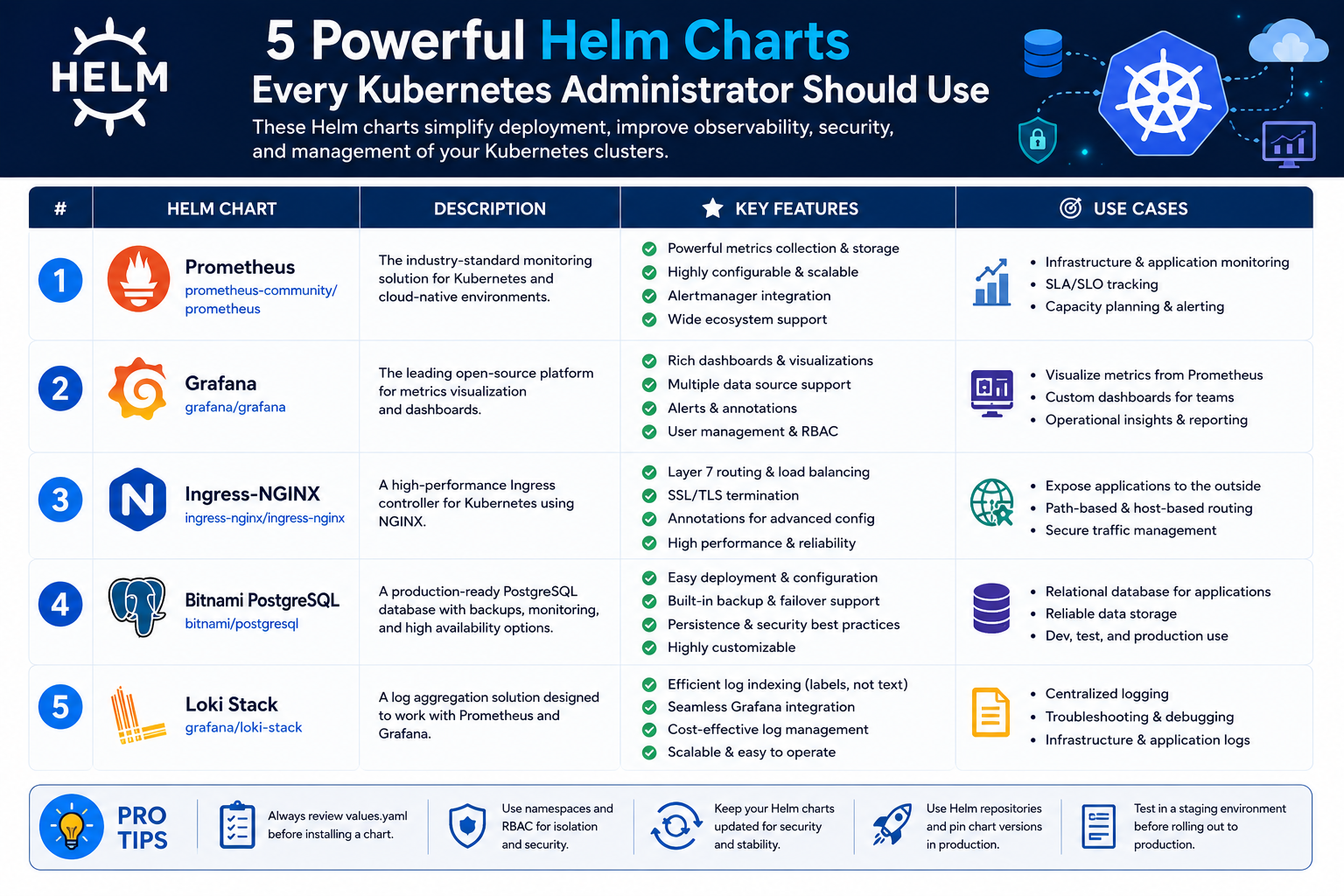
Running a Kubernetes cluster for the first time often feels like stepping into a powerful but highly complex system. At its core, Kubernetes is designed to orchestrate containerized applications at scale, but the flexibility it provides also introduces a steep learning curve. Even basic infrastructure concepts such as networking, storage, access control, and service exposure require multiple interconnected components. Without a structured approach, managing these components manually can quickly become overwhelming.
This is where Helm charts become extremely valuable. Helm acts as a package manager for Kubernetes, offering a standardized way to deploy applications and services. Instead of manually writing and maintaining large sets of YAML configurations, Helm packages these resources into reusable charts. Each chart represents a complete application stack or service configuration that can be deployed with customizable parameters. This approach significantly reduces complexity and improves consistency across environments.
A key advantage of Helm charts is their ability to abstract Kubernetes complexity. Rather than worrying about how deployments, services, ingress rules, or config maps are structured internally, users can focus on defining values that tailor the deployment to their needs. This separation between configuration and implementation makes Helm especially powerful for both beginners and experienced Kubernetes administrators.
Modern Kubernetes environments often include a combination of different workloads, each requiring specialized configurations. Applications may need secure ingress routing, real-time monitoring, automated deployment pipelines, and continuous security validation. Managing all of this from scratch would require deep expertise in Kubernetes primitives. Helm charts simplify this by providing pre-built, community-maintained solutions that follow best practices.
As organizations scale their containerized infrastructure, consistency becomes critical. Helm ensures that deployments remain reproducible across development, staging, and production environments. The same chart can be deployed multiple times with different values, ensuring predictable behavior regardless of environment differences. This is particularly important in distributed systems where configuration drift can lead to unpredictable failures.
Another important aspect of Helm charts is their community-driven ecosystem. Many widely used open-source projects maintain official Helm charts that encapsulate years of operational knowledge. These charts are designed to work out of the box while still allowing customization for advanced use cases. This reduces the need for organizations to reinvent infrastructure components and instead allows them to focus on application logic.
When evaluating which Helm charts to use, it is important to think in terms of core infrastructure needs. Every Kubernetes cluster typically requires solutions for continuous integration, observability, traffic management, and security enforcement. Without these foundational components, managing workloads at scale becomes inefficient and error-prone.
The following sections explore five essential open-source Helm charts that address these foundational needs. Each one plays a critical role in building a stable, observable, and secure Kubernetes ecosystem. While these tools are not mandatory for every environment, they represent widely adopted patterns that significantly improve operational maturity.
One of the most important aspects of modern infrastructure is automation. Kubernetes itself encourages automation at every level, from scaling workloads to managing deployments. However, automation does not stop at container orchestration. It extends into software delivery pipelines, system monitoring, and infrastructure synchronization.
Jenkins for Continuous Integration and Deployment
In many Kubernetes environments, Jenkins serves as a central automation engine. It is widely recognized for its ability to orchestrate continuous integration and continuous deployment workflows. By integrating Jenkins into a Kubernetes cluster, organizations can standardize how code is built, tested, and deployed.
Jenkins becomes even more powerful when deployed through Helm because it removes much of the manual configuration traditionally required. Instead of setting up complex infrastructure from scratch, Helm provides a pre-defined structure that includes deployment configurations, service definitions, and scheduling capabilities. This allows teams to focus on pipeline logic rather than infrastructure setup.
A particularly useful feature of Jenkins in a Kubernetes context is its ability to run jobs as containers. This means each build or test process can execute in an isolated environment, ensuring consistency and reducing dependency conflicts. Additionally, automated backup mechanisms help preserve pipeline configurations and job histories, making recovery easier in case of failures.
Flux for Git-Driven Cluster Management
As Kubernetes environments scale, maintaining consistency between configuration files and live cluster state becomes increasingly difficult. Flux addresses this challenge by introducing a Git-driven approach to cluster management. Instead of manually applying changes, Flux continuously synchronizes cluster state with a version-controlled repository.
This model introduces a powerful concept: infrastructure as code enforcement at the cluster level. Any change made in the repository is automatically reflected in the Kubernetes environment. This ensures that the cluster always matches the desired state defined in version control.
Flux also supports automated rollback capabilities. If a change introduces instability, reverting to a previous commit automatically restores the cluster to a stable state. This reduces downtime and improves system reliability. Additionally, it allows teams to audit changes more effectively, since every modification is tracked in version control.
Prometheus for Monitoring and Metrics Collection
While automation improves efficiency, observability ensures reliability. Prometheus plays a central role in monitoring Kubernetes clusters by collecting and storing time-series metrics. It gathers data from various components, including nodes, pods, and services, allowing administrators to gain deep insight into system performance.
Prometheus uses a powerful query language that enables flexible data analysis. This allows teams to detect anomalies, monitor resource consumption, and set up alerting rules based on specific thresholds. When integrated with visualization tools, Prometheus data can be transformed into meaningful dashboards that highlight system behavior in real time.
One of the strengths of Prometheus is its ability to integrate with multiple data sources. In hybrid environments where cloud services and on-premises systems coexist, Prometheus can aggregate metrics into a unified monitoring layer. This makes it easier to identify bottlenecks and performance issues across the entire infrastructure.
As Kubernetes clusters grow in complexity, two critical areas become increasingly important: managing external traffic and ensuring security. Without proper control over these areas, even well-designed systems can become unstable or vulnerable.
Ingress-NGINX for Traffic Routing and Load Distribution
Ingress-NGINX is one of the most widely used solutions for managing external access to services running inside Kubernetes clusters. It acts as a gateway that directs incoming traffic to the appropriate internal services based on defined rules.
In a typical Kubernetes setup, multiple services may run simultaneously, each responsible for different parts of an application. Without a centralized routing mechanism, exposing these services individually would be inefficient and difficult to manage. Ingress-NGINX solves this problem by providing a unified entry point for external users.
What makes Ingress-NGINX particularly powerful is its flexibility. It supports advanced routing logic, including path-based routing, host-based routing, and traffic splitting. This allows administrators to design highly customized traffic flows that match application requirements.
Additionally, Ingress-NGINX can handle important networking concerns such as load balancing and session persistence. These features ensure that traffic is distributed evenly across pods and that user sessions remain stable even during scaling events. This is essential for maintaining a smooth user experience in production environments.
Another advantage is its ability to integrate with security mechanisms. Authentication layers, TLS termination, and request filtering can all be managed at the ingress level. This reduces the complexity of individual services and centralizes security enforcement.
Anchore for Container Image Security
Security is a critical concern in any containerized environment. Since Kubernetes relies heavily on container images, ensuring that these images are safe and trustworthy is essential. Anchore provides a security-focused solution that analyzes container images before they are deployed.
Anchore scans images for vulnerabilities, misconfigurations, and malicious components. It verifies that images originate from trusted sources and checks for known security issues. This helps prevent compromised containers from entering the production environment.
One of the key benefits of Anchore is its integration into CI/CD pipelines. By analyzing images during the build process, security issues can be detected early, before they reach deployment stages. This shift-left approach reduces the risk of vulnerabilities making their way into live systems.
Anchore also supports policy enforcement. Organizations can define rules that determine whether an image is acceptable for deployment. For example, images with critical vulnerabilities can be automatically rejected, ensuring compliance with security standards.
In addition to vulnerability scanning, Anchore provides detailed reports that help teams understand security risks. These insights are valuable for maintaining long-term system integrity and improving development practices.
Conclusion
Helm charts play a crucial role in simplifying Kubernetes operations by packaging complex infrastructure configurations into reusable components. Instead of manually managing multiple Kubernetes resources, administrators can rely on structured charts to deploy consistent, production-ready services across environments. This not only reduces operational overhead but also improves reliability and scalability.
Tools like Jenkins, Flux, Prometheus, Ingress-NGINX, and Anchore represent foundational building blocks in modern Kubernetes ecosystems. Jenkins streamlines automation and CI/CD workflows, ensuring rapid and consistent software delivery. Flux introduces a Git-driven approach to cluster management, enabling real-time synchronization between version control and live infrastructure. Prometheus enhances observability by providing deep insights into system performance and resource usage.
On the networking side, Ingress-NGINX simplifies traffic routing and ensures stable external access to services, while Anchore strengthens security by analyzing container images and preventing vulnerabilities from reaching production environments. Together, these tools address key operational challenges in Kubernetes environments, including automation, observability, networking, and security.
By leveraging well-designed Helm charts for these tools, organizations can significantly improve their Kubernetes maturity. Instead of building everything from scratch, teams can adopt proven open-source solutions and focus on optimizing application performance and business logic.