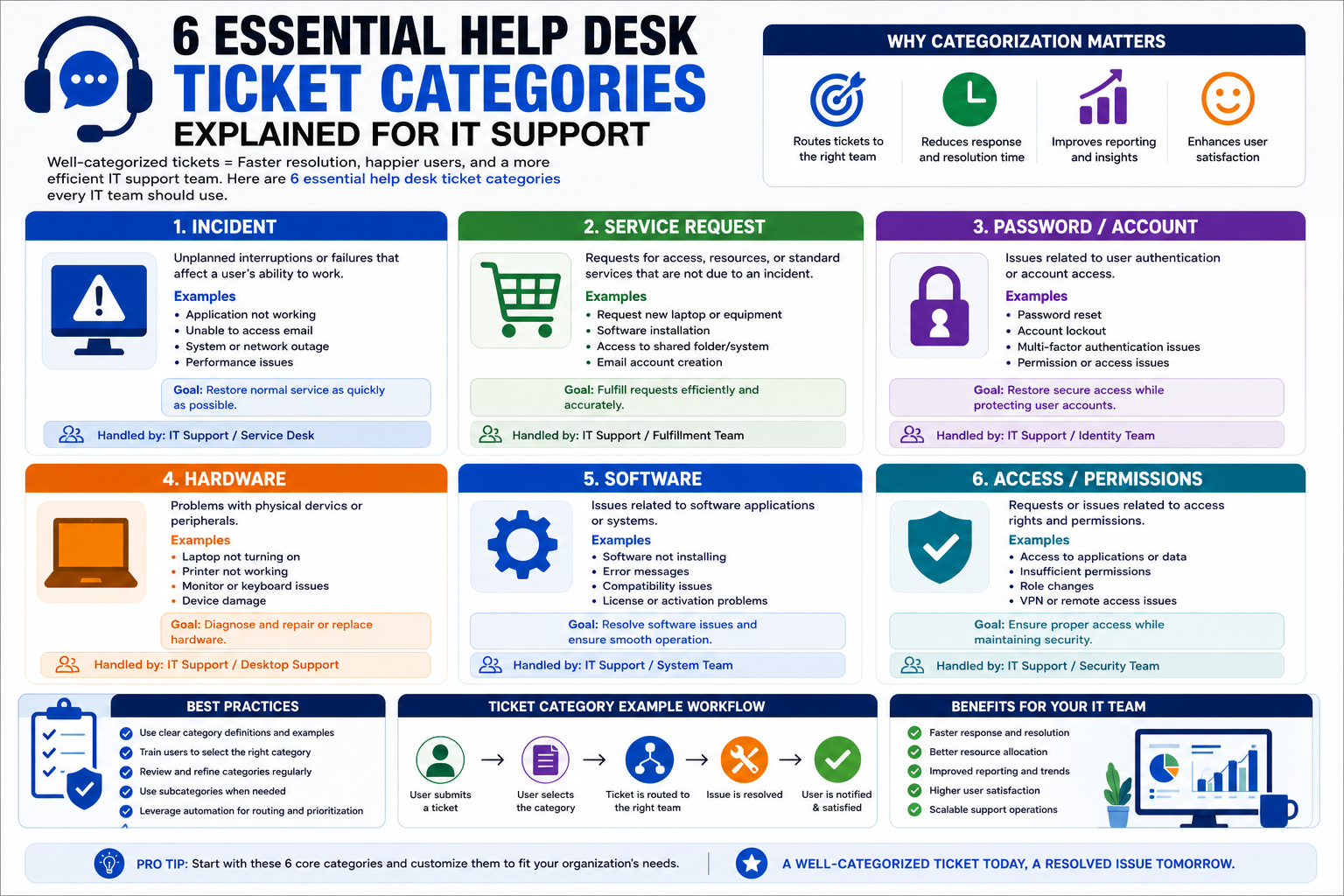
In any organization that relies on technology, the help desk becomes one of the most active nerve centers of daily operations. It is where problems surface first, where confusion gets translated into actionable tasks, and where the messy reality of human interaction meets structured technical systems. On the surface, a support ticket might seem like a simple record: a user reports an issue, an IT team responds, and the problem gets resolved. In practice, however, tickets are far more diverse, unpredictable, and revealing than that simple workflow suggests.
Every ticket carries its own personality. Some arrive neatly packaged with precise technical details, logs, timestamps, and reproduction steps that make resolution almost effortless. Others arrive as fragmented emotional messages, urgent demands without context, or long narratives that resemble personal diaries more than technical reports. Between these extremes lies an entire ecosystem of communication styles, problem types, and human behaviors that define how support teams operate on a daily basis.
Over time, help desk professionals begin to recognize patterns. Not just patterns in systems or errors, but patterns in people. The way users describe issues, the urgency they attach to problems, and the expectations they bring to the support process all shape the nature of the ticket itself. This is where the idea of a “bestiary” of tickets becomes useful. Like mythical creatures in a catalog, each ticket type represents a recognizable archetype that appears repeatedly in different environments, regardless of industry or tooling.
Understanding these archetypes is more than an academic exercise. It directly influences how effectively support teams can diagnose issues, prioritize work, communicate with users, and maintain sanity in high-pressure environments. The more familiar one becomes with these patterns, the easier it becomes to navigate the complexity of the queue and extract meaning from even the most chaotic submissions.
Among the many forms that support tickets take, a few stand out as especially memorable. These are the ones that define the daily rhythm of help desk life: the long-winded narratives that hide critical clues, the ultra-minimal reports that require careful interrogation, and the seemingly impossible tasks wrapped in urgency and expectation. Each of these categories reveals something important about both systems and people.
DEV-618: The Novelist
One of the most distinctive types of support tickets is what can be described as the Novelist. These tickets are immediately recognizable by their length, tone, and structure—or rather, their lack of structure. Instead of presenting a straightforward problem statement, the Novelist ticket unfolds like a piece of literary writing. It may contain metaphors, emotional reflections, unrelated observations, and a timeline of events that stretches far beyond what is necessary to diagnose the issue.
At first glance, these tickets can feel overwhelming. The core problem is often buried beneath layers of narrative detail. A simple authentication failure might be described through a story about the user’s morning routine, their environment, their emotional state, and even philosophical reflections triggered by the moment of failure. The challenge for the support engineer is not just technical—it is interpretive. One must sift through the language to extract the essential facts.
What makes the Novelist ticket particularly interesting is that it is not created out of malice or confusion. In many cases, the user genuinely believes they are providing helpful context. They assume that more detail equates to better understanding. From their perspective, every observation may feel relevant. The moment of failure is not just a system error—it is an experience, and they are documenting it as such.
For example, a user attempting to log into a corporate VPN might describe not only the error message but also the atmosphere of the room, their expectations for the day, the emotional weight of the task they were about to begin, and even unrelated memories triggered by the failure. While this narrative may seem excessive, it often contains hidden clues. A timestamp buried in the story might reveal a session timeout. A mention of location might explain network instability. A casual reference to switching networks might point to a routing issue.
Working with Novelist tickets requires a specific kind of patience and analytical discipline. The support engineer must learn to read selectively, identifying relevant technical signals while filtering out narrative noise. This is not unlike forensic analysis, where the important evidence is scattered within a larger context that may or may not be meaningful.
Another important aspect of Novelist tickets is the communication opportunity they present. Because these users are already expressive, they are often receptive to guidance on how to structure future reports more effectively. Over time, gentle coaching can transform a Novelist into a more structured reporter, improving the quality of future tickets and reducing resolution time.
However, even when well-managed, Novelist tickets remain a recurring presence in help desk environments. They reflect a fundamental truth about human communication: people do not naturally think in structured problem statements. They think in experiences, and it is the job of the support system to translate those experiences into actionable data.
DEVOPS-5537: The Minimalist
At the opposite end of the spectrum lies the Minimalist. If the Novelist overwhelms with detail, the Minimalist provides almost none. These tickets are short, blunt, and often cryptic. A typical Minimalist ticket might consist of a single sentence such as “System broken” or “Dashboard not working.” Occasionally, it may include emotionally charged language but very little technical context.
On the surface, Minimalist tickets appear frustrating. They lack reproduction steps, error messages, timestamps, or any of the standard information needed for troubleshooting. However, they often come from highly experienced users who are deeply familiar with the system and assume that the problem is already known or self-evident. In other cases, the user may simply be overwhelmed or pressed for time, prioritizing speed over detail.
The challenge with Minimalist tickets is not interpreting excess information, but rather extracting missing information. This requires a conversational approach. Support engineers must act as investigators, asking targeted questions designed to gradually reveal the underlying issue. Instead of asking broad questions like “What happened?”, effective follow-ups are precise: “What action triggered the issue?”, “Is this affecting all users or just your account?”, or “When did you first notice the problem?”
Interestingly, Minimalist tickets often contain hidden precision beneath their brevity. A user who writes “monitoring crashed after deployment” may be summarizing a highly specific sequence of events in their mind. They may assume that the deployment itself is the key variable, or that the system state change is obvious. The support engineer must bridge the gap between assumed knowledge and explicit description.
There is also an emotional dimension to Minimalist tickets. The brevity is sometimes a reflection of frustration. Users may feel that systems should “just work” and that additional explanation is unnecessary. In such cases, the tone of the response becomes as important as the content. A calm, structured, and non-confrontational approach encourages cooperation rather than resistance.
Over time, experienced support teams learn to appreciate Minimalist tickets for what they are: concentrated signals. While they require more effort upfront, they often lead to efficient resolutions once the missing pieces are filled in. In some ways, they represent the opposite challenge of the Novelist—where the task is not filtering noise, but generating structure from silence.
IT-1966: The Mission Impossible
Between expressive narratives and cryptic brevity lies another category entirely: the Mission Impossible ticket. These tickets are defined not by how information is presented, but by the scope and feasibility of the request itself. They often describe tasks that involve multiple systems, unclear ownership boundaries, outdated infrastructure, or unrealistic timelines.
A Mission Impossible ticket typically begins with a reasonable-sounding request. However, as the details unfold, the complexity becomes apparent. The task might involve analyzing dozens of legacy systems, some of which are no longer maintained or documented. It might require coordination across departments that do not share priorities or even communication channels. In some cases, it demands access to resources that are restricted, unavailable, or lost to time.
What makes these tickets particularly challenging is that they are often rooted in real business pressure. A deadline may have been set externally, and the help desk is brought in as the last link in a chain of escalating urgency. The expectation is not just resolution, but rapid resolution under constraints that may not be technically or organizationally realistic.
Handling Mission Impossible tickets requires more than technical expertise. It demands negotiation, prioritization, and a clear understanding of system boundaries. The first step is often not solving the problem, but reframing it. What exactly is being asked? What is the minimum viable outcome? Which parts of the request are essential, and which are assumptions?
For example, a request to identify a race condition across dozens of products might initially appear to require exhaustive analysis. However, upon closer inspection, it may be possible to narrow the scope based on system architecture, recent changes, or known risk areas. The key is to transform an overwhelming problem into a series of manageable investigations.
Communication plays a critical role here. Mission Impossible tickets often involve multiple stakeholders with different expectations. The support engineer must act as a translator between technical reality and business urgency, ensuring that limitations are understood without undermining trust. This requires clarity, transparency, and sometimes difficult conversations about feasibility.
Despite their difficulty, these tickets can also be opportunities. They often highlight systemic weaknesses, outdated processes, or gaps in documentation. Addressing them—even partially—can lead to long-term improvements in infrastructure and workflow design.
Mission Impossible tickets are rarely resolved in a single step. Instead, they evolve through cycles of clarification, negotiation, and incremental progress. They represent the intersection of technical limits and organizational ambition, where the role of support extends beyond troubleshooting into problem shaping.
REN-0911: The Most Important Ticket in the Entire World
Another recurring archetype is the hyper-prioritized ticket. These arrive with urgent labels, multiple follow-ups, and escalating communication channels. They are often described as blocking critical releases, impacting executives, or requiring immediate attention.
While some of these tickets are genuinely urgent, others reflect perception rather than objective severity. The challenge for support teams is to assess urgency without being influenced by pressure alone. This requires balancing responsiveness with structured prioritization frameworks.
These tickets often test communication skills more than technical ability. Users expect immediate acknowledgment, even if resolution takes time. A calm, structured response that outlines next steps can significantly reduce tension and prevent escalation spirals.
HELPDESK-008: The Mystery Ticket
Not all tickets are immediately understandable. Some arrive fragmented, inconsistent, or constantly changing. These are the Mystery Tickets—cases where the problem definition itself evolves over time. They may originate from unstable environments, language barriers, or rapidly changing user expectations.
Mystery Tickets require persistence. The support engineer must reconstruct context through iterative communication, testing assumptions and validating interpretations. They often involve trial-and-error investigation, where each new piece of information reshapes the understanding of the issue.
PERF-707: The Unicorn
Occasionally, a perfect ticket appears. It is complete, precise, reproducible, and aligned with system understanding. It contains all necessary information and leads directly to resolution. These rare cases are highly valued because they eliminate ambiguity and allow efficient problem-solving.
Such tickets are not just convenient—they represent an ideal standard of communication between users and support systems.
The Hidden Structure Behind Support Ticket Behavior
While support tickets often appear as isolated requests, they are actually part of a deeper system shaped by human behavior, organizational structure, and technical complexity. Once a help desk team moves beyond recognizing surface-level archetypes like long narratives or minimal reports, a more subtle layer emerges: the underlying patterns that determine why tickets are written the way they are in the first place.
At this level, tickets are no longer just communication artifacts. They become indicators of system maturity, user understanding, training effectiveness, and even organizational stress. The same technical issue can produce completely different ticket styles depending on who reports it, how urgently they perceive it, and what prior experience they bring into the situation.
One of the most important realizations for support teams is that ticket quality is not a fixed trait. It fluctuates depending on context. A user who submits a perfect ticket one day may submit a vague or emotional one the next, not because their skill has changed, but because their environment has changed. Time pressure, system instability, organizational urgency, and even fatigue all influence how people communicate problems.
This means that help desk work is not only reactive troubleshooting. It is also interpretive work—decoding intent, reconstructing missing context, and aligning different mental models of the same system. The ticket becomes a bridge between two realities: the user’s experience and the system’s actual behavior.
Understanding this hidden structure helps explain why certain ticket types repeat so consistently across industries. It is not random. It is shaped by predictable human responses to complexity, stress, and uncertainty.
The Anatomy of Ambiguous Incidents
One of the most challenging categories of support tickets is the ambiguous incident. These tickets do not clearly fall into any single problem category. Instead, they describe symptoms that shift depending on timing, environment, or user perspective.
An ambiguous incident might begin with a complaint about a system being “slow,” but further investigation reveals that the slowness only occurs under specific conditions. It might involve certain users, certain regions, or certain times of day. What initially appears to be a single issue often expands into a network of related behaviors.
The difficulty with ambiguous incidents is that they resist immediate classification. Traditional troubleshooting workflows depend on categorization: authentication issue, network failure, application bug, and so on. But ambiguous tickets sit between these categories, often touching multiple systems without fully belonging to any one of them.
Support engineers dealing with these tickets must adopt a hypothesis-driven approach. Instead of assuming a fixed problem definition, they generate possible explanations and test them against observed behavior. Each interaction with the user becomes an opportunity to refine the understanding of the issue.
A key characteristic of ambiguous incidents is inconsistency in reproduction. The issue may appear once and then disappear completely. This leads to uncertainty both for users and support teams. Users may begin to doubt their own observations, while engineers may struggle to determine whether the problem is still active.
In such cases, time becomes an important factor. Collecting logs, monitoring system behavior, and correlating events across different layers of infrastructure becomes essential. The goal is not just to fix the issue, but to capture enough evidence to understand its conditions of existence.
Ambiguous incidents often reveal deeper architectural weaknesses. They expose hidden dependencies between systems or unexpected interactions between components that were assumed to be independent. In this sense, they are less like isolated failures and more like stress signals from a complex ecosystem.
The Rise of Duplicate Storms in Ticket Systems
Another often overlooked phenomenon in help desk environments is the duplicate storm. This occurs when a single underlying issue triggers a flood of similar tickets from multiple users at once. On the surface, it may appear as a sudden spike in unrelated problems, but in reality, it is usually a single systemic failure propagating across the user base.
Duplicate storms are particularly challenging because they distort prioritization systems. When hundreds of users report the same issue independently, it creates the illusion of multiple distinct problems, when in fact there is only one root cause.
The first step in managing a duplicate storm is recognition. Support teams must quickly identify patterns in incoming tickets, looking for similarities in symptoms, timestamps, and affected systems. Once a common thread is found, individual tickets can be grouped under a single incident.
However, even after grouping, communication remains critical. Users who submitted tickets still expect responses, updates, and acknowledgment. Simply closing duplicates without explanation can lead to frustration and repeated submissions.
The emotional dimension of duplicate storms should not be underestimated. When users see their systems fail simultaneously, it creates a sense of instability and loss of control. Even if the technical issue is resolved quickly, the perception of system reliability may be affected long-term.
From an operational perspective, duplicate storms also highlight the importance of monitoring and alerting systems. Ideally, internal detection should identify the issue before it reaches users. When this fails, the help desk becomes the first line of detection, effectively acting as a real-time sensor network for system health.
Change Requests Disguised as Incidents
A subtle but common pattern in support environments is the disguised change request. These tickets appear to be reporting a problem, but in reality, they are requests for new features, configuration changes, or workflow adjustments.
For example, a user might report that a system “is not working” when what they actually mean is that it no longer behaves in the way they prefer. A button may have moved, a process may have been updated, or a feature may have been intentionally removed as part of a redesign.
These tickets create tension because they sit at the boundary between support and development. Support teams are typically responsible for fixing broken systems, not modifying intended behavior. However, users often perceive any deviation from expectation as a failure.
Identifying disguised change requests requires careful listening. The key is to separate factual system behavior from user expectation. Once the distinction is clear, the ticket can be redirected appropriately—either as a training issue, a documentation gap, or a formal feature request.
The challenge lies in communication. Users rarely frame their requests in technical terms. Instead, they express dissatisfaction, confusion, or urgency. Translating this emotional input into structured categorization is a core skill in help desk operations.
Over time, patterns emerge. Certain workflows generate more disguised change requests than others, often indicating usability issues or misalignment between system design and user needs. In this way, these tickets become valuable feedback signals for product improvement.
The Psychology of Escalation Behavior
Escalation is a natural part of support systems, but it is also deeply influenced by psychology. Users escalate tickets not only based on severity, but also based on perception of progress, communication quality, and emotional state.
A ticket that receives no response within a perceived reasonable timeframe is more likely to be escalated, even if work is actively underway. Similarly, unclear communication can trigger escalation even when resolution is close.
Understanding escalation behavior requires recognizing that users do not see the internal structure of support workflows. They do not know queue positions, assignment rules, or backend prioritization logic. They only see silence or communication.
This creates a gap between internal efficiency and external perception. A system may be operating optimally from a technical standpoint, but still generate dissatisfaction if communication is insufficient.
Effective support teams manage this gap by maintaining visible progress. Even simple updates can significantly reduce escalation likelihood. Acknowledging receipt, confirming investigation, and providing estimated timelines all contribute to reducing uncertainty.
Escalation is not always negative. In some cases, it is necessary to bring additional expertise or authority into a complex issue. However, uncontrolled escalation chains can overwhelm teams and distort priorities.
The goal is not to eliminate escalation, but to make it intentional rather than reactive. This requires both process design and communication discipline.
The Complexity of Multi-System Failures
Some of the most difficult support scenarios involve multi-system failures. These occur when a single user-facing issue is caused by a chain of failures across multiple interconnected systems.
For example, a login failure might involve authentication services, network routing, database availability, and session management layers. Each component may appear healthy in isolation, yet the combined behavior results in failure.
Multi-system failures are particularly difficult because they require cross-domain knowledge. No single team may have full visibility into the entire chain of dependencies. As a result, collaboration becomes essential.
Diagnosing these issues often involves reconstructing the sequence of events across systems. Logs from different services must be correlated to identify where the failure originated. This requires not only technical skill but also coordination across teams.
One of the most challenging aspects is avoiding premature conclusions. It is easy to assume that the first visible symptom is the root cause, but in distributed systems, the true origin may be several layers removed.
Multi-system failures often reveal hidden architectural complexity. Systems that were assumed to be loosely connected may in fact have tight dependencies that were not fully documented. In this sense, incidents become a form of system discovery.
Ghost Tickets and Vanishing Problems
Ghost tickets describe issues that appear once and then disappear without resolution. A user reports a problem, but by the time support investigates, the issue is no longer reproducible.
These tickets are frustrating because they resist confirmation. Without reproducibility, it becomes difficult to determine whether the issue was real, temporary, or misinterpreted.
However, ghost tickets are not always meaningless. They often indicate intermittent issues that are difficult to capture in real time. Timing, load conditions, or external dependencies may all contribute to their sporadic nature.
Handling ghost tickets requires persistence and careful observation. Even if the issue cannot be reproduced immediately, collecting context such as environment details, timestamps, and system logs can help identify patterns over time.
In some cases, ghost tickets are early warnings of larger systemic problems. A rare failure may eventually become more frequent as system load increases or configurations change.
Intermittent Failures and Timing Dependencies
Closely related to ghost tickets are intermittent failures that depend on timing or load conditions. These issues are among the most difficult to diagnose because they do not follow consistent patterns.
An issue may only occur during peak traffic, during specific scheduled jobs, or under rare race conditions. Outside of those conditions, the system appears perfectly stable.
Diagnosing intermittent failures requires long-term observation and data collection. It often involves analyzing trends rather than individual incidents.
Support engineers must think statistically rather than deterministically. Instead of asking “what caused the failure?”, the question becomes “under what conditions does the failure emerge?”
This shift in thinking is crucial for resolving complex system behavior that cannot be replicated on demand.
The Role of Communication in Ticket Resolution
Across all ticket types, communication remains the central factor that determines resolution efficiency. Technical skill alone is not sufficient. The ability to extract, clarify, and structure information defines the effectiveness of support operations.
Clear communication reduces ambiguity, accelerates diagnosis, and improves user satisfaction. Poor communication amplifies uncertainty, increases escalation, and prolongs resolution time.
In many cases, the difference between a resolved and unresolved ticket is not technical complexity, but the quality of interaction between user and support engineer.
This is why help desk work is as much about language as it is about systems.
Evolving Patterns in Help Desk Ecosystems
As organizations scale, the help desk environment stops being a simple queue of issues and starts behaving more like an ecosystem. Tickets are no longer isolated events; they begin to interact with each other, reflect system architecture, and reveal organizational habits in ways that are not immediately obvious.
At this stage, support work shifts from reactive troubleshooting into pattern recognition at scale. Individual tickets still matter, but their true value emerges when viewed collectively. The help desk becomes a lens through which the health of systems, processes, and communication channels can be evaluated in real time.
One of the most important changes in mature support environments is the emergence of predictable “behavioral clusters” in tickets. These clusters are not defined by software categories alone but by how users interact with systems under certain conditions. For example, a poorly documented feature may consistently generate Novelist-style tickets, while a fragile authentication system may repeatedly produce Minimalist reports followed by escalation bursts.
Over time, these clusters become diagnostic tools. They help teams identify not just what is broken, but how users are struggling to adapt to system behavior. In this sense, tickets become more than problem reports—they become feedback loops that shape system evolution.
Ticket Fatigue and Cognitive Load in Support Teams
One of the most underestimated challenges in help desk environments is cognitive fatigue. As ticket volume increases, support engineers are not only processing more work—they are also continuously switching between different mental models, communication styles, and problem domains.
A single morning might involve interpreting a highly emotional narrative, followed by a cryptic one-line error report, followed by a complex infrastructure failure involving multiple systems. Each shift requires mental recalibration.
This constant context switching creates cognitive load that accumulates over time. Even experienced engineers begin to feel the effects: slower interpretation, reduced patience for ambiguous reports, and increased reliance on shortcuts or assumptions.
Ticket fatigue does not just affect individuals—it affects system quality. When cognitive load is high, subtle signals in tickets may be missed. Important details buried in Novelist-style descriptions may be overlooked. Minimalist tickets may be prematurely categorized without sufficient investigation.
To manage this, mature support organizations often introduce structural buffers: ticket triaging layers, categorization automation, and workload balancing systems. However, no amount of tooling fully eliminates cognitive load. The human element remains central.
Understanding ticket fatigue also explains why communication quality matters so much. Well-structured tickets reduce cognitive overhead. Poorly structured ones increase it exponentially.
The Lifecycle of a Support Ticket
While tickets may appear static once submitted, they actually move through a lifecycle that reflects both technical resolution and human interaction.
The lifecycle typically begins with submission, but this is only the surface. Behind the scenes, multiple processes begin immediately: categorization, prioritization, routing, and initial interpretation. Each of these steps shapes how the ticket will evolve.
In early stages, ambiguity is highest. The system does not yet fully understand the problem, and neither does the support team. This is where communication with the user is most critical. Clarifying questions act as a bridge between uncertainty and structured understanding.
As the ticket progresses, it enters a diagnostic phase. Evidence is gathered, hypotheses are tested, and system behavior is observed. In complex cases, this phase may loop multiple times as new information changes the understanding of the issue.
Eventually, the ticket reaches resolution—or at least stabilization. However, resolution is not always a single event. Sometimes it is a workaround, sometimes a partial fix, and sometimes a deferred action pending system changes.
Finally, there is closure, which includes not only technical resolution but also documentation and feedback. This final stage is often underestimated but is crucial for improving future support quality.
Understanding this lifecycle helps explain why tickets sometimes feel slow or fragmented from the user perspective. What appears to be delay is often structured progression through multiple necessary stages.
Communication Styles as Diagnostic Signals
One of the most subtle insights in help desk operations is that communication style itself can serve as a diagnostic signal. The way a user describes a problem often reveals more about the issue than the technical details they provide.
For example, a user who writes in highly emotional language may be experiencing intermittent or high-impact failures. A user who provides structured logs may be dealing with a reproducible system bug. A user who shifts descriptions over time may be encountering an evolving or poorly understood system behavior.
Even punctuation, urgency markers, and repetition patterns can indicate different underlying conditions. Multiple repeated messages often suggest service disruption or high urgency perception. Carefully structured descriptions suggest familiarity with system behavior.
This does not mean communication style replaces technical analysis, but it complements it. It helps prioritize investigation paths and tailor follow-up questions.
In advanced support environments, engineers learn to read between the lines—not to assume accuracy, but to identify signals that guide deeper investigation.
Organizational Friction Reflected in Tickets
Help desk tickets often reflect organizational structure more than technical issues. When systems are unclear, ownership is fragmented, or processes are poorly defined, this ambiguity shows up directly in ticket behavior.
For instance, repeated Mission Impossible-style tickets may indicate unclear system ownership boundaries. Duplicate storms may suggest lack of centralized monitoring. Frequent disguised change requests may reveal misalignment between product design and user expectations.
In this way, tickets become a mirror of organizational friction. They expose gaps between teams, unclear responsibilities, and inefficiencies in communication pathways.
Support teams that recognize these patterns can provide valuable feedback to engineering and product leadership. They are often the first to detect systemic issues because they sit at the intersection of users and infrastructure.
However, translating ticket patterns into organizational change requires careful framing. It is not about blaming teams, but about identifying structural improvements.
The Emotional Economy of Support Work
Beyond systems and processes, help desk environments operate within an emotional economy. Every ticket carries emotional weight—frustration, urgency, confusion, or relief.
Support engineers constantly navigate this emotional landscape. They must remain calm in the face of urgency, patient in the face of ambiguity, and precise in the face of confusion.
Users, on the other hand, often experience stress when systems fail. Their emotional response influences how they communicate, which in turn affects how effectively their issue is resolved.
This emotional exchange shapes the overall efficiency of support systems. Calm communication tends to produce faster resolution. Escalation-driven communication often introduces delays due to increased coordination requirements.
Understanding this dynamic is essential for maintaining balance. Support is not just technical problem-solving—it is also emotional regulation at scale.
Edge Cases That Break Standard Models
Every help desk system eventually encounters edge cases—tickets that do not fit any predefined category or workflow. These cases are important because they test the limits of assumptions embedded in the support structure.
An edge case might involve a system interaction that was never anticipated, a user behavior that falls outside expected patterns, or a combination of factors that produces unexpected results.
These tickets are often the hardest to resolve because they cannot be handled through standard procedures. They require improvisation, experimentation, and sometimes collaboration across multiple teams.
However, edge cases are also valuable. They reveal blind spots in system design and often lead to long-term improvements when properly analyzed.
In mature environments, edge cases are tracked carefully, not dismissed. They become input for redesign, documentation updates, and system hardening.
The Feedback Loop Between Users and Systems
Support tickets are not just one-way communications. They form part of a feedback loop between users and systems. Every reported issue influences future development, documentation, and system behavior.
When a ticket is resolved, the outcome often leads to changes beyond the immediate fix. Documentation may be updated. Interfaces may be adjusted. Error messages may be improved to reduce ambiguity.
Over time, this feedback loop shapes system evolution. Frequently reported issues tend to receive design attention. Confusing workflows get simplified. Recurring failures get engineered out.
In this sense, help desk data becomes a form of informal product intelligence. It reflects real-world usage patterns more accurately than controlled testing environments.
Scaling Support Systems Without Losing Context
As organizations grow, maintaining context becomes increasingly difficult. Tickets multiply, systems expand, and communication pathways become more complex.
Scaling support systems requires balancing automation with human interpretation. Automation can handle categorization, routing, and basic detection, but it cannot fully replace contextual understanding.
The risk in scaling is loss of nuance. When systems become too automated, Novelist tickets may be misclassified, Minimalist tickets may be under-prioritized, and subtle patterns may be overlooked.
To counter this, many organizations introduce layered support structures. First-line teams handle triage, while specialized teams handle deeper investigation. This preserves context while managing volume.
However, structure alone is not enough. Continuous feedback between layers is essential to maintain alignment.
The Quiet Value of Well-Resolved Tickets
Among all ticket types, well-resolved tickets often go unnoticed. These are the cases where communication is clear, diagnosis is efficient, and resolution is smooth.
They do not generate attention because they do not create friction. Yet they are the foundation of stable support systems.
Well-resolved tickets are often the result of invisible work: good documentation, clear system design, and effective communication habits. They represent the ideal state where complexity is managed without disruption.
While dramatic tickets—Novelist, Minimalist, Mission Impossible—tend to dominate attention, it is the consistent resolution of ordinary tickets that defines system reliability.
Patterns That Repeat Across Time
One of the most striking observations in help desk environments is that ticket archetypes remain stable over time. Despite changes in technology, systems, and tooling, the same patterns continue to appear.
People will always write long narratives when confused. They will always be brief when frustrated or rushed. Systems will always fail in unexpected combinations. And occasionally, perfect tickets will still appear.
This stability suggests that ticket behavior is driven more by human psychology than by technology itself. Tools may change, but communication patterns remain deeply rooted in how people process uncertainty.
Recognizing this continuity helps support teams develop long-term strategies rather than reactive solutions.
The Invisible Skill of Interpretation
At the core of all support work lies a skill that is rarely explicitly taught: interpretation. It is the ability to extract meaning from incomplete, inconsistent, or ambiguous information.
Interpretation is not just technical analysis. It is pattern recognition, empathy, and structured reasoning combined. It is what allows engineers to turn Novelist narratives into actionable steps, Minimalist reports into investigations, and Mission Impossible requests into feasible plans.
This skill develops over time, through exposure to diverse ticket types and repeated engagement with uncertainty.
It is also what transforms help desk work from reactive problem-solving into a form of systems thinking.
Where Support Work Ultimately Leads
As support systems mature, their role expands beyond fixing issues. They become central to understanding how systems are actually used in the real world. Tickets become data, communication becomes signal, and resolution becomes design input.
In this way, help desks evolve from reactive queues into observational systems—quietly mapping the gap between intended design and lived experience.
Conclusion
Support tickets may look like simple records of technical problems, but when examined closely, they reveal something much larger: the way people interact with complex systems under pressure, uncertainty, and expectation. Across every help desk environment, whether small or enterprise-scale, the same recurring patterns emerge in different forms. Some users write detailed narratives that mix emotion, context, and scattered clues. Others submit brief, almost cryptic messages that require careful questioning to decode. Some requests stretch into seemingly impossible tasks shaped by organizational pressure rather than technical reality. And occasionally, a perfectly structured ticket appears, almost elegant in its clarity, making resolution straightforward and efficient.
What makes these patterns so persistent is not the tools or platforms themselves, but human behavior. People naturally communicate based on urgency, familiarity, stress, and understanding of the system in front of them. A confusing interface produces fragmented tickets. A critical failure produces emotional urgency. A well-designed workflow often produces clear and structured reports. In this sense, support tickets act like a mirror reflecting both system health and user experience at the same time.
For support teams, recognizing these archetypes is not just about classification. It is about interpretation. Every ticket requires reading between the lines, identifying what is explicitly stated and what is implied. The Novelist-style ticket demands filtering and extraction of key facts hidden inside long narratives. The Minimalist ticket demands probing and structured questioning to uncover missing context. The Mission Impossible ticket demands negotiation and reframing of expectations. Even the Mystery Ticket requires patience, experimentation, and iterative clarification.
As systems grow more complex, the importance of this interpretive skill increases. Automation can assist with routing, prioritization, and detection, but it cannot fully replace human understanding of context and intent. Tickets often contain subtle signals that machines may miss but experienced engineers recognize instinctively: shifts in tone, inconsistencies in description, or repeated patterns across different users that hint at systemic issues.
Over time, help desk work becomes less about isolated problem-solving and more about understanding ecosystems. Each ticket contributes to a larger picture of how technology is actually experienced in real environments. This feedback loop helps organizations refine their systems, improve documentation, and adjust design decisions based on real-world usage rather than assumptions.
In the end, support tickets are not just requests for fixes. They are stories of interaction between humans and systems, shaped by urgency, confusion, expertise, and expectation. Learning to read them well means learning to understand both technology and people at the same time.