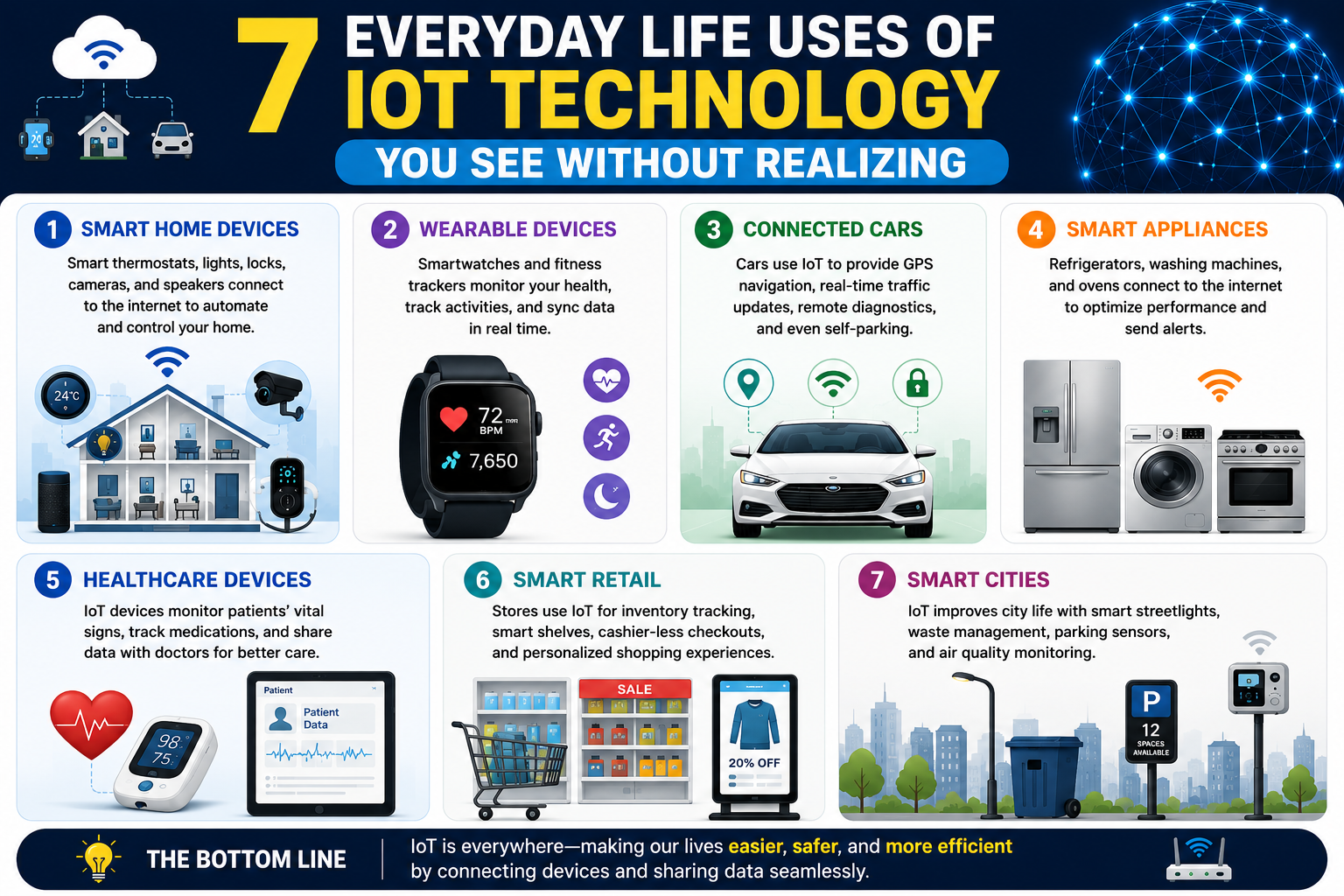
The Internet of Things (IoT) refers to the growing network of physical objects that are connected to the internet and capable of collecting, sharing, and acting on data. These “things” range from simple household appliances to complex industrial systems, all embedded with sensors, software, and connectivity features that allow them to communicate with other devices and centralized platforms.
Although IoT feels like a modern innovation, its foundations go back decades. Early experiments in connected devices demonstrated how everyday objects could be enhanced with computing power and remote communication. Over time, advances in microprocessors, wireless networking, and cloud computing transformed these early ideas into a global technological ecosystem that now supports billions of devices.
Today, IoT is no longer limited to research labs or experimental setups. It has become deeply embedded in daily life, influencing how we live, travel, work, and manage health. From smart homes that respond to voice commands to vehicles that communicate with traffic systems, IoT is quietly reshaping the world around us.
The Evolution of Connected Devices
The concept of connected machines can be traced back to early computing experiments where researchers explored how devices could exchange information over networks. One of the earliest examples involved simple machines that could report their status remotely, such as vending machines capable of signaling inventory levels.
As computing technology advanced, the idea of embedding intelligence into physical objects became more practical. The introduction of compact microprocessors made it possible to add “brains” to everyday devices. These small chips allowed objects to collect data from their surroundings, process basic information, and communicate with external systems.
The expansion of the internet played a crucial role in accelerating IoT development. Once global connectivity became widely accessible, devices could transmit data across long distances in real time. This enabled the shift from isolated smart devices to fully interconnected ecosystems.
Cloud computing further strengthened this transformation by offering scalable storage and processing power. Instead of relying on local systems, IoT devices could send data to cloud platforms where it could be analyzed, stored, and used to generate insights. This combination of connectivity, processing power, and data intelligence laid the foundation for modern IoT applications.
Smart Homes and Everyday Automation
One of the most visible applications of IoT is in smart home technology. Modern homes are increasingly equipped with connected devices that improve convenience, safety, and energy efficiency. These systems allow homeowners to control various aspects of their living environment through smartphones or voice commands.
Smart security systems are among the most widely used applications. Door sensors, motion detectors, surveillance cameras, and smart locks work together to monitor activity in and around the home. These devices can send real-time alerts when unusual movement is detected, allowing homeowners to respond quickly even when they are away.
Climate control systems have also become more intelligent. Smart thermostats learn user preferences and adjust temperature settings automatically based on time of day, occupancy, and weather conditions. This not only enhances comfort but also helps optimize energy usage.
In kitchens, IoT-enabled appliances such as refrigerators, ovens, and coffee makers bring added convenience. These devices can provide notifications, suggest recipes, track inventory, and even be controlled remotely. As a result, household management becomes more efficient and less time-consuming.
Lighting systems, irrigation controls, and entertainment devices are also part of the smart home ecosystem. Together, these connected systems create a seamless living environment where multiple functions operate in coordination.
IoT in Transportation and Mobility
Transportation has undergone significant transformation through IoT integration. Modern vehicles are no longer standalone machines; they are connected systems capable of interacting with external networks, infrastructure, and other vehicles.
Navigation systems are one of the most common IoT applications in transportation. Real-time traffic data collected from millions of users helps optimize routes, reduce congestion, and improve travel efficiency. These systems continuously analyze road conditions and provide alternative paths when delays occur.
Connected cars are equipped with sensors that monitor engine performance, fuel efficiency, and safety conditions. In some cases, vehicles can automatically alert service providers when maintenance is required or when an accident has occurred. This enables faster emergency response and proactive vehicle care.
Electronic toll systems are another example of IoT in action. Vehicles equipped with identification devices can pass through toll points without stopping, as sensors automatically detect and process payment information. Camera-based systems further enhance accuracy by recognizing license plates when necessary.
Public transportation systems also benefit from IoT integration. Buses, trains, and taxis can be tracked in real time, allowing passengers to access accurate arrival information and optimize their travel schedules.
Smart Retail, Industry, and Agriculture
IoT has significantly improved efficiency across industries such as retail, manufacturing, and agriculture. In retail environments, connected systems are used to monitor inventory levels, track product movement, and analyze customer behavior. This helps businesses manage stock more effectively and improve supply chain operations.
In manufacturing, IoT plays a crucial role in automation and predictive maintenance. Machines equipped with sensors can detect early signs of wear or malfunction, allowing companies to address issues before they result in costly breakdowns. Production lines can also be optimized in real time based on data collected from different stages of manufacturing.
Agriculture has also benefited from IoT innovations. Smart farming systems use sensors to monitor soil conditions, weather patterns, and crop health. Automated irrigation systems can adjust water usage based on real-time environmental data, improving efficiency and reducing waste. Livestock monitoring systems help farmers track animal health and behavior, ensuring better management of agricultural resources.
These applications demonstrate how IoT extends far beyond consumer convenience and plays a critical role in global economic systems.
Wearable Technology and Personal Data
Wearable devices represent one of the most personal forms of IoT technology. Smartwatches, fitness trackers, and health monitoring devices collect continuous data about the human body, including heart rate, physical activity, sleep patterns, and more.
This data helps individuals better understand their health and make informed lifestyle choices. For example, fitness trackers can monitor daily activity levels and encourage users to maintain healthier habits. Sleep tracking features provide insights into sleep quality and duration, helping users improve rest patterns.
Some wearable devices also include advanced health monitoring capabilities. They can detect irregular heart rhythms, measure blood oxygen levels, and monitor stress indicators. In certain cases, these devices can even alert users to potential health risks before symptoms become noticeable.
Beyond health, wearable IoT devices enhance convenience in daily life. They can be used for contactless payments, navigation assistance, and communication. As technology continues to evolve, wearables are becoming more integrated into everyday routines.
IoT in Healthcare Systems
Healthcare is one of the most impactful areas of IoT application. Connected medical devices and remote monitoring systems have transformed how healthcare services are delivered.
Patient monitoring systems allow doctors to track vital signs such as blood pressure, heart rate, and glucose levels in real time. This enables continuous care without requiring patients to remain in medical facilities. It is especially beneficial for individuals with chronic conditions who need ongoing observation.
Smart medical devices can also remind patients to take medication, track dosage schedules, and alert healthcare providers if doses are missed. This improves treatment adherence and reduces the risk of complications.
In hospitals, IoT systems help manage equipment, monitor patient flow, and optimize resource allocation. Connected devices can automatically update medical records, reducing administrative workload and improving accuracy.
Some advanced applications include implanted medical devices that communicate with external systems. These devices can transmit health data directly to healthcare professionals, enabling faster diagnosis and treatment decisions.
Conclusion
The Internet of Things has become a fundamental part of modern life, quietly influencing nearly every aspect of daily activity. From the moment we wake up in a smart home to the time we travel, work, or monitor our health, connected devices are constantly collecting and exchanging information to improve convenience, safety, and efficiency.
What makes IoT especially powerful is its ability to connect physical objects with digital intelligence. This connection allows systems to respond automatically to real-world conditions, reducing the need for manual intervention and creating more efficient environments. As technology continues to evolve, IoT will become even more deeply integrated into infrastructure, industries, and personal lifestyles.
However, the growth of IoT also brings new challenges, particularly in areas such as data privacy, security, and system reliability. As more devices become connected, ensuring safe and responsible use of data will be essential for maintaining trust and functionality.
Despite these challenges, the trajectory of IoT points toward an increasingly connected future. Homes, cities, transportation systems, and healthcare networks will continue to evolve into smarter, more responsive ecosystems. This transformation will not only change how we interact with technology but also how we experience the world around us, making everyday life more efficient, adaptive, and intelligent. As connectivity improves and devices become more capable of real-time decision-making, IoT will further blur the line between physical and digital environments. This shift will enable faster responses to everyday needs, better resource management, and more personalized services that adapt seamlessly to human behavior and environmental conditions.