Ethernet wiring standards exist to ensure that network cables are built and terminated in a consistent and reliable way. These standards define how the eight individual wires inside an Ethernet cable are arranged when connected to an RJ45 connector. Without such standards, network communication would become unpredictable, as devices might interpret signals differently depending on how cables are assembled.
The idea behind wiring standards is not just about organization, but about ensuring that electrical signals travel correctly between devices such as computers, switches, routers, and access points. Since Ethernet relies on precise signal transmission over twisted pairs of copper wires, even small inconsistencies in wiring can lead to reduced performance or complete communication failure.
Over time, structured standards were introduced to unify how network cables are installed across different environments. This allowed technicians, engineers, and organizations to follow the same guidelines regardless of location or equipment type. Among these standards, T568A and T568B became the most widely recognized configurations used in modern networking.
Although both standards serve the same functional purpose, they differ in how certain wire pairs are positioned. Understanding these differences is important for anyone involved in building or maintaining wired networks, especially in environments where reliability and consistency are critical.
The Role of Structured Cabling in Networks
Structured cabling refers to a standardized approach to designing and installing a network infrastructure. Instead of treating each cable installation as a separate task, structured cabling ensures that every component follows a consistent system. This includes cables, connectors, patch panels, and termination methods.
The importance of structured cabling lies in its ability to simplify maintenance and troubleshooting. When all cables follow the same standard, it becomes easier to identify issues, replace components, and expand the network without introducing errors. This consistency also reduces downtime and improves long-term scalability.
Ethernet wiring standards like T568A and T568B are a fundamental part of this structure. They ensure that every cable terminated in a network behaves predictably. Without such standards, even simple tasks like replacing a cable could introduce mismatches that disrupt communication between devices.
In large-scale environments such as offices, data centers, or institutional networks, structured cabling becomes even more important. It allows multiple technicians to work on the same system without confusion, since everyone follows the same wiring logic. This shared understanding reduces human error and improves the overall stability of the network infrastructure.
Overview of T568A Wiring Standard
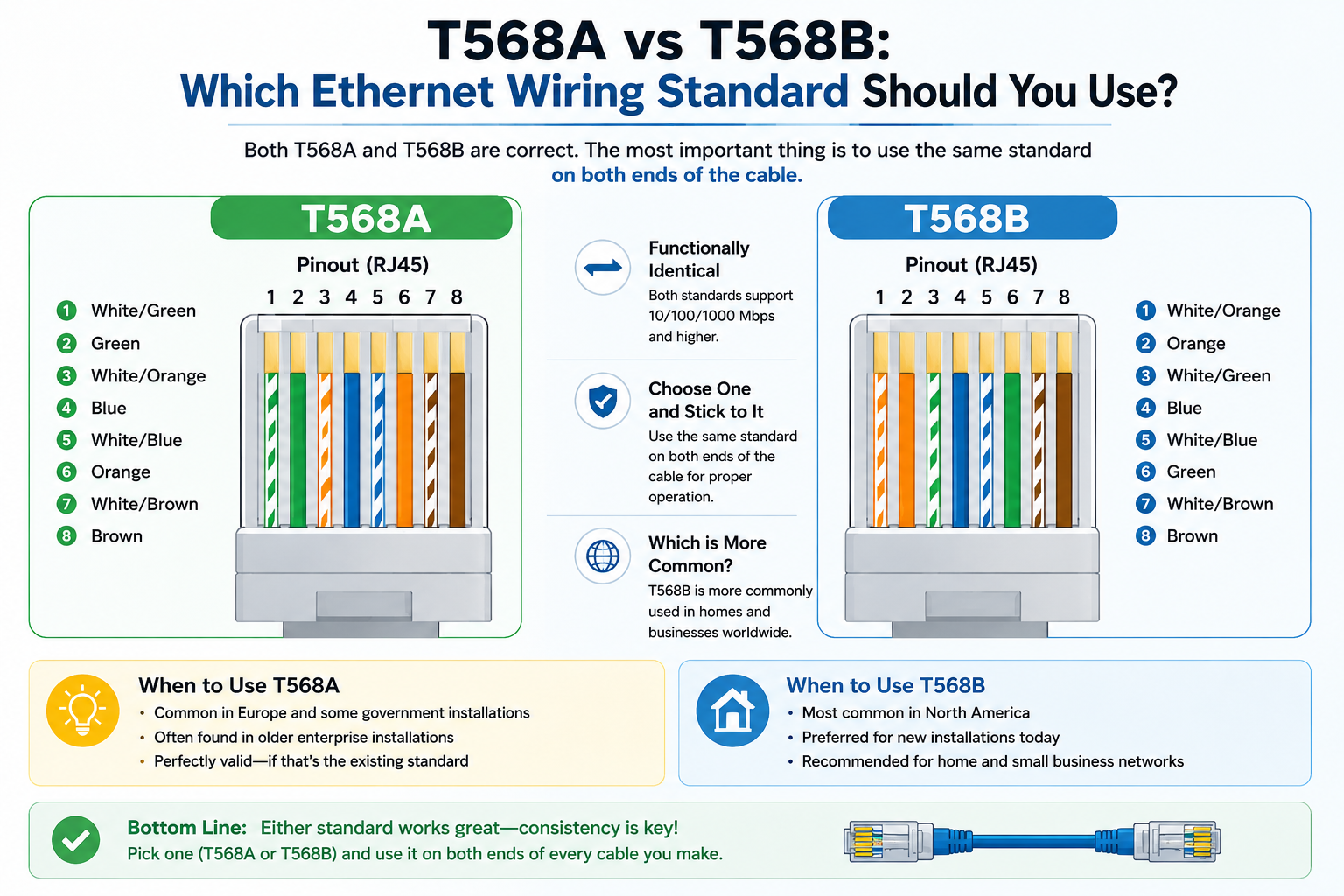
T568A is one of the two primary Ethernet wiring configurations used for terminating twisted pair cables. It defines the specific order in which the colored wires inside a cable are connected to the pins of an RJ45 connector. The arrangement is designed to maintain proper signal transmission across Ethernet connections.
In this standard, the green wire pair is placed first, followed by the orange pair in a different position compared to its counterpart standard. This specific arrangement was developed earlier and has historical significance in telecommunications, especially in environments where older voice systems were integrated with data networks.
One of the key characteristics of T568A is its compatibility with legacy telephone systems. Because of its wiring arrangement, it can support certain older communication infrastructures more naturally than other configurations. This made it particularly useful in environments where both voice and data systems were used together.
T568A is also recognized for its official preference in certain regulated environments. Its structured alignment ensures uniformity across installations that require strict compliance standards. This consistency helps maintain predictable network behavior across large installations where uniform wiring is essential.
Despite being an older configuration, T568A remains fully functional for modern Ethernet networks. It supports the same data speeds and performance levels as other standards when implemented correctly. Its continued use is primarily based on compatibility requirements and institutional guidelines rather than technical superiority.
Overview of T568B Wiring Standard
T568B is another widely used Ethernet wiring standard that defines a different arrangement of the same eight wires found in twisted pair cables. While it uses the same color-coded wires as T568A, the order of the green and orange pairs is swapped, resulting in a distinct configuration.
This standard became more popular in newer network installations, especially in commercial and private networking environments. Its adoption increased as modern Ethernet systems evolved and older telephone-based requirements became less relevant in many infrastructures.
T568B is often seen as the default choice in many networking projects due to its widespread use. Many existing networks have been built using this configuration, making it a familiar standard for technicians and engineers. This familiarity helps reduce installation errors and simplifies network expansion when maintaining consistency.
Although it differs from T568A in wire arrangement, T568B performs identically in terms of data transmission. Both standards support the same speeds and bandwidth capabilities when used with compatible Ethernet cables and devices. The difference lies purely in the physical wiring layout rather than performance.
In practice, T568B has become a common choice for new installations because it aligns with established industry trends. However, its effectiveness still depends on consistent application throughout the entire network. Mixing standards within the same system can lead to communication issues and signal mismatches.
Core Differences Between T568A and T568B
The primary difference between T568A and T568B lies in the arrangement of two wire pairs within the Ethernet cable. Specifically, the green and orange pairs are swapped between the two standards. This change affects how the signal pins are assigned within the RJ45 connector.
Despite this difference, both standards use the same set of colored wires and follow the same general structure. This means that from a physical standpoint, the cables look nearly identical once terminated, making it easy to confuse them if not properly labeled.
Functionally, both standards deliver the same network performance. There is no difference in speed, bandwidth, or signal quality when cables are correctly installed. The distinction exists only in wiring order, not in electrical capability.
However, the choice of standard becomes important when connecting different network devices. If one end of a cable uses T568A and the other uses T568B, the result is a crossover configuration, which can be useful in specific networking scenarios but problematic if used unintentionally.
This subtle difference highlights the importance of consistency in network design. A network that mixes both standards without planning can experience connectivity issues that are difficult to diagnose, even though the physical cables appear correct.
Compatibility and Interoperability in Networks
Both T568A and T568B are compatible with modern Ethernet equipment, which means that devices such as switches, routers, and computers can function with either standard. The key requirement is that the wiring remains consistent throughout the network.
When both ends of a cable follow the same standard, the connection is known as a straight-through cable, which is the most common type used in everyday networking. This ensures that transmit and receive signals align correctly between devices.
When different standards are used on each end, the cable becomes a crossover type. While this can be useful in certain direct device-to-device connections, it is generally unnecessary in modern networks due to automatic signal detection in many devices.
Interoperability between the two standards is therefore possible, but only when used intentionally. Mixing them without understanding their function can lead to communication errors, reduced connectivity, or complete signal failure in some cases.
Because of this, network design emphasizes the importance of choosing one standard and applying it consistently across all installations. This ensures that all components communicate effectively without unexpected mismatches.
Choosing the Right Standard in Practice
Selecting between T568A and T568B is less about technical performance and more about environmental requirements and consistency. In most modern network installations, either standard can be used effectively as long as it is applied uniformly.
In some cases, organizational guidelines or regulatory requirements may influence the choice. Certain environments may prefer one standard to maintain alignment with existing infrastructure or compliance rules. In other cases, the decision is based on historical usage within a building or network system.
For new installations, consistency is the most important factor. Choosing one standard and applying it across all cables ensures predictable behavior and simplifies future maintenance. Mixing standards within the same network introduces unnecessary complexity and increases the risk of errors.
Conclusion
The distinction between T568A and T568B lies in a simple difference in wire arrangement, yet this small variation plays an important role in how Ethernet networks are structured. Both standards are fully capable of supporting modern network communication, and neither offers a performance advantage over the other when correctly implemented. Their value comes from providing a consistent framework that ensures reliable connections across all network devices.
In practical terms, the most important consideration is not which standard is chosen, but how consistently it is applied throughout a network. Mixing both standards without intention can create unnecessary connectivity problems that affect performance and reliability. By maintaining uniformity, networks become easier to design, expand, and troubleshoot over time.
Whether in small setups or large-scale infrastructures, the principles behind these standards remain the same. They exist to bring order to network cabling and ensure that communication between devices remains stable and predictable. Understanding and respecting this structure helps maintain efficient and dependable network systems in any environment.