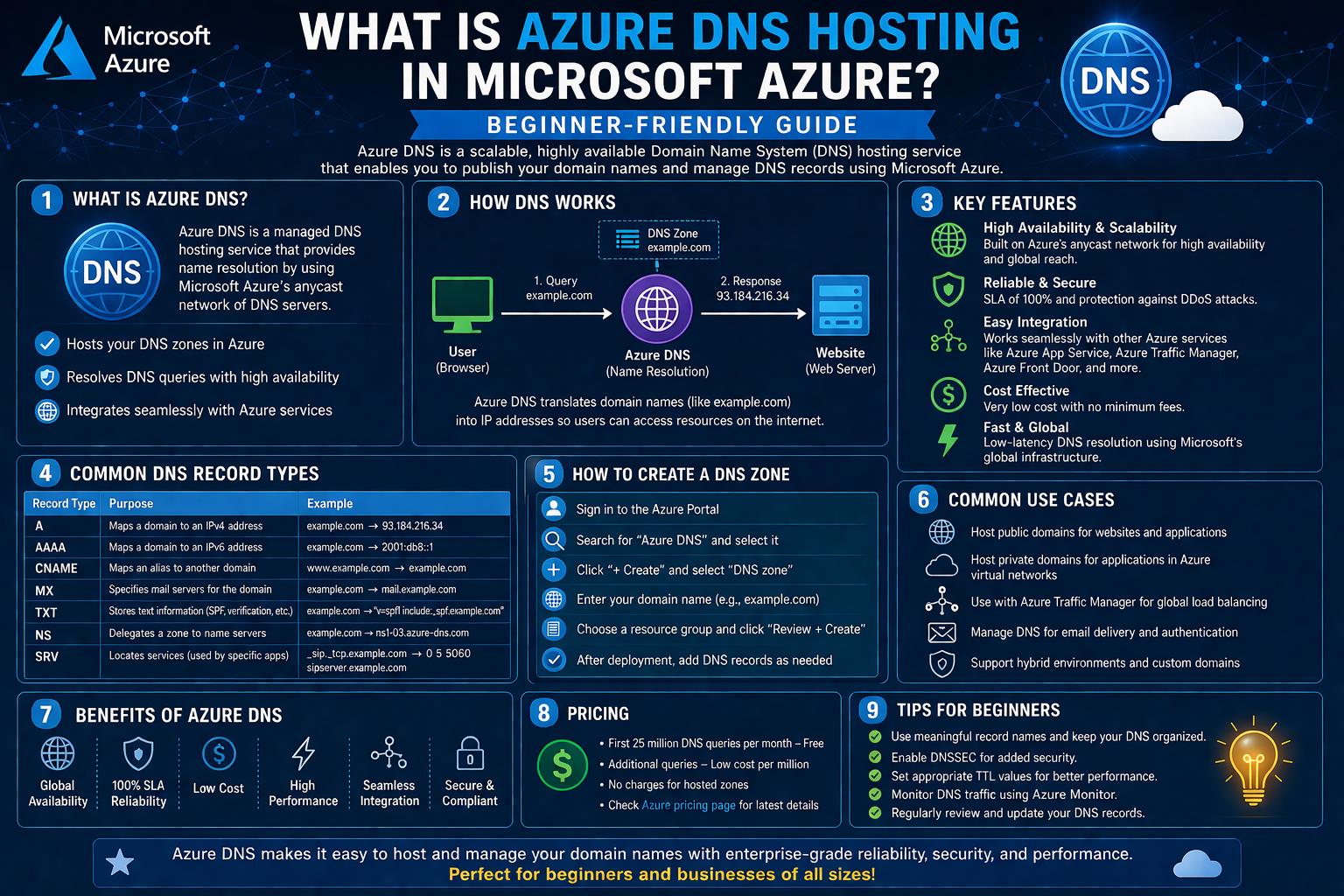
When a new service is created in a cloud environment, especially in Microsoft Azure, one of the first practical challenges is how that service will be accessed and communicated with by other systems. Unlike traditional on-premises environments, where servers are often placed in predictable network segments with manually assigned addresses, cloud infrastructure introduces a more dynamic model. Resources can be created, scaled, or removed within seconds, which changes how connectivity must be managed from the ground up.
In Azure, every newly provisioned resource exists within a defined networking boundary, typically a virtual network. This structure ensures that services are not just randomly exposed across the cloud but are instead organized into controlled communication zones. Within these zones, Azure handles a large portion of the connectivity configuration automatically, especially when it comes to name resolution and DNS behavior. This automation is a key part of why cloud deployments can scale efficiently without requiring constant manual network configuration.
Instead of relying solely on static IP addresses, Azure encourages a model where resources are accessed through domain names. This approach is more stable in a dynamic environment where IP addresses can change due to scaling, redeployment, or failover events. Domain-based communication allows systems to continue interacting without needing to track underlying network changes constantly.
Understanding this shift from static addressing to name-based resolution is essential for working effectively in Azure. It is the foundation of how services communicate after provisioning and leads directly into the concept of Azure-managed DNS behavior.
The Role of Virtual Networks in Azure Communication Structure
A core component of Azure networking is the virtual network, which acts as a logically isolated environment for deployed resources. Every virtual machine, database, or application service deployed into Azure is typically associated with a virtual network unless explicitly configured otherwise. This structure creates a controlled communication boundary where resources can interact securely and predictably.
Within this environment, services are not just placed into a flat network space. Instead, they are segmented into subnets, and each subnet operates as part of a larger virtual network design. This segmentation allows administrators to control traffic flow, define security boundaries, and manage connectivity patterns across workloads.
The virtual network is also the primary context in which DNS resolution occurs by default. When a resource is created inside a virtual network, Azure automatically ensures that it can be addressed using internal naming conventions. These names are not arbitrary; they are generated based on a structured pattern that ties the resource identity to its network location.
This is where Azure-hosted DNS begins to play a critical role. Rather than requiring administrators to manually configure DNS records for every new service, Azure handles this automatically within the virtual network boundary. This reduces operational overhead and ensures that new resources are immediately reachable by name from other services in the same network.
However, this convenience also introduces a specific behavior: name resolution is primarily scoped to the virtual network unless additional configuration is applied. This means that communication between services is straightforward within the same network but requires additional considerations when spanning multiple networks or hybrid environments.
What Azure-Hosted DNS Means in Practical Terms
Azure-hosted DNS refers to the built-in name resolution system that operates within Azure virtual networks. It is not a separate product that needs to be deployed manually, but rather an integrated service that automatically manages DNS records for resources inside a virtual network.
When a new resource is provisioned, Azure assigns it a fully qualified domain name. This name is automatically registered within the internal DNS system associated with that virtual network. As a result, other resources within the same network can resolve and communicate with the new service using its domain name instead of relying on direct IP addresses.
This system is particularly important because Azure resources often receive dynamically assigned private IP addresses. If communication depended solely on IP addresses, any change in network assignment could break connectivity. DNS abstraction solves this problem by decoupling identity from underlying addressing.
The Azure-hosted DNS system operates behind the scenes, ensuring that name resolution requests are handled seamlessly. When a service attempts to connect to another service using its domain name, the request is automatically routed through Azure’s internal DNS resolver, which maps the name to the correct IP address within the virtual network.
This process is designed to be transparent to the user. From an operational perspective, it feels similar to traditional DNS systems, but the management and automation layers are deeply integrated into Azure’s networking fabric. This integration is what allows cloud environments to maintain both flexibility and reliability at scale.
How Azure Generates Fully Qualified Domain Names for Resources
One of the most noticeable behaviors in Azure-hosted DNS is the automatic generation of fully qualified domain names for resources. These names follow a structured format that reflects both the resource identity and its network context.
A typical Azure-generated domain name includes the resource name, a unique virtual network identifier, and a standard domain suffix. This structure ensures that each resource has a globally unique identifier within the Azure environment while still being logically tied to its network boundary.
The resource name portion of the domain is usually derived from the name assigned during provisioning. This makes it easier for administrators to recognize the service being referenced. The network identifier portion ensures that even if multiple virtual networks contain resources with identical names, there is no conflict in resolution. Finally, the standardized suffix ensures consistency across all Azure-hosted DNS entries.
This naming structure is not just cosmetic; it plays a functional role in ensuring accurate routing of DNS queries. When a request is made, Azure uses the full domain name to determine exactly which virtual network and which resource the request is targeting.
Because these names are automatically generated, they also help enforce consistency across large environments. In complex deployments with dozens or hundreds of services, manual naming and DNS management would quickly become unmanageable. Azure’s automated approach ensures that every resource is immediately accessible using a predictable naming convention.
Internal DNS Resolution Process Within a Virtual Network
Once a resource has been assigned a fully qualified domain name, the next step is understanding how that name is resolved when communication occurs. Inside an Azure virtual network, DNS resolution follows a specific internal process that is optimized for speed and reliability.
When a service attempts to communicate with another service using its domain name, the request is first sent to the configured DNS resolver for that virtual network. By default, this resolver is provided by Azure and operates using a built-in IP address reserved for internal DNS handling.
The resolver checks the internal DNS records associated with the virtual network to determine the correct IP address for the requested domain name. If a match is found, the corresponding private IP address is returned to the requesting service. Communication then proceeds directly between the two resources using that IP address.
This entire process happens transparently and typically within milliseconds. From the perspective of the application or service making the request, the interaction feels like a standard DNS lookup, even though it is fully managed by Azure infrastructure.
One important aspect of this system is that it only applies within the boundaries of a single virtual network by default. DNS records created for resources in one virtual network are not automatically visible in another. This design reinforces network isolation and security, but also requires additional configuration when cross-network communication is needed.
The Default DNS Infrastructure Behind Azure-Hosted DNS
Azure provides a built-in DNS infrastructure that supports name resolution for virtual networks without requiring manual setup. This infrastructure includes a specialized DNS resolver that is automatically assigned to each virtual network unless overridden by custom configuration.
A key component of this system is the internal DNS IP address used for resolution. This address is reserved by Azure and is used by virtual machines and other services as the default DNS server. When a resource is created, it automatically receives DNS configuration pointing to this resolver, ensuring that name resolution works immediately without additional setup.
This default DNS infrastructure is designed to be highly available and integrated deeply into Azure’s networking layer. It understands the structure of virtual networks, subnets, and resource identities, allowing it to resolve names efficiently within the correct scope.
Because this system is built into Azure, administrators do not need to deploy or maintain traditional DNS servers for basic name resolution inside a virtual network. However, this does not prevent organizations from implementing their own DNS solutions if they require more advanced control or hybrid integration.
The presence of a default DNS infrastructure also ensures consistency across environments. Every virtual network behaves in a predictable way unless explicitly configured otherwise, which simplifies network design and troubleshooting.
How Virtual Network Scope Affects Name Resolution Behavior
One of the most important characteristics of Azure-hosted DNS is that name resolution is scoped to the virtual network in which resources are deployed. This means that each virtual network effectively operates as an independent DNS boundary unless additional configuration is applied.
Within a single virtual network, resources can resolve each other’s domain names without issue. However, when attempting to resolve names across different virtual networks, the default behavior does not allow direct resolution. This is a deliberate design choice that supports isolation and security.
This scoped behavior ensures that resources are not unintentionally exposed across network boundaries. It also allows organizations to design environments where different workloads remain separated even if they exist within the same subscription or region.
To enable cross-network name resolution, additional mechanisms such as custom DNS servers or network peering configurations must be introduced. These configurations extend the default behavior of Azure-hosted DNS and allow organizations to build more complex networking topologies.
Understanding this scope limitation is essential when designing cloud architectures. It influences how services communicate, not just within a single application environment but across larger enterprise systems deployed in Azure.
The Relationship Between DNS and Virtual Network Identity
Each virtual network in Azure has a unique identity that plays a role in DNS resolution. This identity is embedded in the fully qualified domain names assigned to resources within that network. As a result, DNS names are not just labels but also carry information about the network context in which a resource exists.
This relationship between DNS and virtual network identity ensures that name resolution remains unambiguous even in large environments. Multiple virtual networks can contain resources with identical names without causing conflicts, because the network identifier portion of the domain name distinguishes them.
This design also supports scalability. As organizations expand their cloud footprint, they can create new virtual networks without worrying about name collisions or DNS conflicts. Each network operates as its own self-contained namespace within the broader Azure environment.
By linking DNS structure to network identity, Azure ensures that communication remains both predictable and scalable, even as the number of deployed resources increases significantly.
Early Design Considerations for Azure-Based Name Resolution
When building systems in Azure, name resolution is not just a technical detail but a foundational design consideration. The way resources are named and how they are accessed directly influences application architecture and communication patterns.
Since Azure-hosted DNS automatically assigns domain names and manages internal resolution, designers must consider how these names will be used by applications and services. This includes understanding how services discover each other, how dependencies are managed, and how network boundaries affect communication.
In environments where multiple services interact frequently, relying on DNS-based communication becomes essential for stability. It ensures that services remain reachable even if the underlying infrastructure changes. At the same time, awareness of virtual network boundaries helps prevent unexpected connectivity issues.
These early considerations shape how cloud systems are structured and how they evolve. DNS is not just a background service in Azure; it is an integral part of how resources interact and function within the cloud environment.
Expanding Name Resolution Beyond a Single Virtual Network
As Azure environments grow, communication rarely stays confined to a single virtual network. Most real-world deployments involve multiple networks, multiple workloads, and services that must interact across boundaries. This is where the limitations of default Azure-hosted DNS become more visible and where additional name resolution strategies begin to matter.
While Azure-hosted DNS works seamlessly inside a single virtual network, it does not automatically extend name resolution across separate virtual networks. This means that when services are distributed across multiple networks, administrators must introduce additional mechanisms to ensure that resources can still be located and accessed reliably.
In larger environments, this requirement becomes central to architectural design. Communication is no longer just about whether a service exists but about how that service is discovered across segmented network boundaries. This leads to more advanced DNS planning that builds on top of the default Azure behavior.
The challenge is not only technical but structural. Each virtual network behaves as its own isolated naming domain unless explicitly connected through additional configuration. As a result, cross-network communication requires deliberate design choices rather than relying on automatic resolution.
Introducing Custom DNS Servers into Azure Environments
Although Azure provides built-in DNS resolution, organizations often require more control over how name resolution is handled. This is especially true in enterprise environments where naming conventions, internal domains, and hybrid connectivity must be aligned across multiple systems.
To address this need, Azure allows the use of custom DNS servers. Instead of relying solely on the default Azure resolver, a virtual network can be configured to forward DNS queries to externally managed DNS infrastructure. This can include traditional on-premises DNS servers or specialized cloud-based DNS systems.
When a custom DNS server is configured, virtual machines within the network will send their name resolution requests to that server instead of the default Azure resolver. The custom server then determines how to resolve the request, whether by using internal records, forwarding to Azure, or querying external DNS sources.
This flexibility allows organizations to maintain consistent naming strategies across hybrid environments. It also enables integration between cloud resources and legacy systems that rely on existing DNS structures.
However, introducing custom DNS also adds complexity. Misconfiguration can lead to resolution failures, latency issues, or inconsistent behavior between services. As a result, custom DNS must be carefully planned and aligned with the overall network architecture.
Hybrid Name Resolution Between Cloud and On-Premises Systems
In many enterprise environments, Azure is not used in isolation but as part of a hybrid infrastructure that includes on-premises data centers. In these scenarios, DNS becomes a critical bridge between cloud and local systems.
On-premises environments typically use established DNS hierarchies with internal domain names that are not publicly resolvable. When extending these environments into Azure, name resolution must be carefully integrated so that both sides can communicate seamlessly.
This is often achieved by configuring conditional forwarding between DNS systems. In this model, DNS queries originating in Azure can be forwarded to on-premises DNS servers when they match specific domain patterns. Similarly, on-premises systems can be configured to forward cloud-related queries to Azure-based resolvers.
This bidirectional relationship ensures that services deployed in different environments can still discover each other using consistent naming structures. Without this integration, hybrid applications would require manual IP management or fragmented naming strategies, both of which are inefficient and error-prone.
Hybrid DNS also introduces considerations around latency and dependency. Since name resolution may traverse network links between cloud and on-premises environments, performance and reliability become important factors in system design.
Virtual Network Peering and Its Impact on DNS Resolution
Virtual network peering allows multiple Azure virtual networks to connect directly with each other, enabling resources in different networks to communicate as if they were part of a single environment. However, while network traffic is enabled through peering, DNS behavior does not automatically follow the same rules.
By default, even when virtual networks are peered, Azure-hosted DNS does not automatically resolve names across those networks. This means that a service in one network may still be unable to resolve the domain name of a service in a peered network unless additional configuration is applied.
To address this limitation, administrators often implement shared DNS strategies or custom resolution rules that extend name visibility across peered networks. This can involve configuring centralized DNS servers or enabling DNS forwarding between environments.
The key concept here is that network connectivity and name resolution are separate layers. While peering enables traffic flow, DNS must be explicitly configured to support cross-network discovery. This separation allows for greater control but also requires more detailed planning in larger deployments.
Understanding DNS Behavior at the Network Interface Level
In Azure, DNS settings are not only defined at the virtual network level but can also be configured at the individual network interface level. This provides granular control over how specific virtual machines resolve domain names.
When DNS is configured at the virtual network level, all resources within that network inherit the same resolution settings. However, in some scenarios, a specific virtual machine may need to use a different DNS configuration due to application requirements or integration needs.
By modifying DNS settings at the network interface level, administrators can override default behavior for individual resources. This allows a single virtual network to support multiple DNS strategies simultaneously.
This flexibility is particularly useful in environments where different workloads have different naming dependencies. For example, some services may rely on Azure-hosted DNS, while others may need to resolve names through external or hybrid DNS systems.
However, this level of customization must be managed carefully. Inconsistent DNS configurations across resources can lead to unpredictable behavior and difficult troubleshooting scenarios.
Private Endpoints and Their Relationship with Name Resolution
As cloud security models evolve, private connectivity has become increasingly important. Azure private endpoints allow services such as databases and storage accounts to be accessed through private IP addresses within a virtual network rather than through public endpoints.
When private endpoints are used, DNS resolution becomes even more critical. Instead of resolving to a public address, the domain name of a service must resolve to a private IP address within the virtual network.
Azure handles this through DNS integration that maps service names to private endpoint addresses. This ensures that when a service is accessed using its domain name, traffic remains within the private network boundary.
This behavior significantly enhances security by preventing exposure of services to the public internet while still maintaining standard name-based communication patterns. From an application perspective, nothing changes in how services are accessed, but the underlying routing is fundamentally different.
Private endpoints also introduce additional DNS considerations in hybrid and multi-network environments. Ensuring that all relevant networks resolve service names to the correct private addresses requires careful DNS configuration.
The Role of DNS Forwarding in Complex Architectures
DNS forwarding is a mechanism that allows DNS queries to be passed from one DNS server to another based on specific rules. In Azure environments, forwarding is often used to bridge the gap between Azure-hosted DNS and external or on-premises DNS systems.
When a DNS query cannot be resolved locally within a virtual network, it can be forwarded to another DNS server that may have the required information. This enables layered resolution strategies where different DNS systems work together to resolve names.
Forwarding is particularly useful in hybrid environments where some resources exist in Azure, and others exist in traditional data centers. Instead of maintaining duplicate DNS records, forwarding allows each environment to remain authoritative for its own domain space.
However, forwarding also introduces dependency chains. If a downstream DNS server becomes unavailable, name resolution can fail even if the local environment is functioning correctly. This makes redundancy and failover design important considerations.
Caching Behavior and Its Effect on DNS Consistency
DNS resolution in Azure, as in other environments, relies heavily on caching to improve performance. Once a domain name is resolved, the result is temporarily stored so that subsequent requests can be answered more quickly without repeating the resolution process.
While caching improves efficiency, it can also introduce challenges in dynamic environments where resources are frequently created, modified, or deleted. If a DNS record changes, cached entries may temporarily point to outdated information.
In Azure-hosted DNS, caching behavior exists at multiple levels, including within virtual machines, DNS resolvers, and application layers. Each layer may retain cached results for different durations depending on configuration and system behavior.
This layered caching system helps reduce latency but requires awareness when troubleshooting connectivity issues. In some cases, resolving inconsistencies may involve clearing cached entries or waiting for cache expiration.
Understanding caching behavior is essential for ensuring predictable communication between services, especially in environments where resources are highly dynamic.
Security Implications of DNS Design in Azure
DNS is not only a communication tool but also a potential security boundary. In Azure environments, DNS design plays a role in controlling how and where services can be discovered.
By default, Azure-hosted DNS restricts name resolution to within the same virtual network. This isolation helps prevent unintended exposure of internal services to external systems. It also ensures that only authorized networks can resolve specific resource names.
When custom DNS or hybrid configurations are introduced, security considerations become more complex. Misconfigured forwarding rules or overly permissive resolution policies can unintentionally expose internal naming structures.
Private endpoints further strengthen security by ensuring that services are only accessible through private IP addresses. However, they also depend heavily on correct DNS configuration to function properly.
As a result, DNS in Azure must be treated as both a networking and security component. Its configuration directly influences how services are discovered and accessed across environments.
Troubleshooting Name Resolution Behavior in Azure Networks
When communication issues arise in Azure environments, DNS is often one of the first areas to investigate. Because name resolution sits at the foundation of service communication, any misconfiguration can prevent applications from connecting properly.
Troubleshooting typically begins by verifying whether a domain name resolves correctly within the virtual network. If resolution fails, the issue may lie in DNS configuration, network boundaries, or forwarding rules.
In some cases, resolution may succeed within one network but fail across another. This often indicates a boundary issue where the DNS scope has not been extended appropriately between environments.
Caching can also play a role in troubleshooting. Outdated cached entries may cause services to attempt communication with incorrect IP addresses even after changes have been made.
Understanding the layered nature of DNS resolution in Azure is essential for diagnosing these issues effectively. Each layer, from virtual network configuration to DNS forwarding, contributes to the final resolution outcome.
Evolving Patterns in Cloud-Based Service Discovery
As cloud architectures continue to evolve, DNS remains a central mechanism for service discovery. However, the way it is used has become more dynamic and distributed compared to traditional environments.
Modern Azure deployments often involve multiple services that are created, scaled, and removed automatically. In this environment, static configuration is no longer sufficient for maintaining reliable communication.
DNS-based service discovery allows systems to adapt to changing infrastructure without requiring manual intervention. As long as domain names remain consistent, underlying resources can change without disrupting connectivity.
This model supports highly dynamic architectures where services are loosely coupled and independently managed. DNS acts as the stable reference point that allows these services to locate and communicate with each other regardless of infrastructure changes.
Over time, this approach has become a foundational pattern in cloud architecture design, shaping how applications are structured and how services interact across distributed environments.
Extending Azure-Hosted DNS into Large-Scale Enterprise Architectures
As Azure environments evolve beyond simple deployments, DNS becomes less of a background service and more of a structural backbone for communication. In large-scale enterprise architectures, hundreds or even thousands of services may coexist across multiple subscriptions, regions, and virtual networks. At this scale, Azure-hosted DNS is no longer just about resolving names within a single network but about supporting a coordinated system of service discovery across an entire digital ecosystem.
The default behavior of Azure-hosted DNS still applies at the core level: resources within a virtual network receive automatically assigned fully qualified domain names, and those names are resolved internally. However, enterprise architectures introduce additional layers where multiple virtual networks, subscriptions, and identity boundaries interact. This creates a need for a structured DNS design that goes beyond default behavior.
In these environments, DNS is no longer simply reactive. It becomes a planned architecture component that determines how services are grouped, how they are discovered, and how they interact across organizational boundaries. The scale introduces complexity, but it also reinforces the importance of consistency in naming and resolution behavior.
Multi-Tier Network Design and Its Effect on DNS Flow
Enterprise Azure deployments often adopt multi-tier network designs where workloads are separated into functional layers. These layers may include application networks, data networks, security networks, and integration networks. Each layer may exist within its own virtual network or even across multiple regions.
In such a structure, DNS resolution must function across tiers without breaking isolation principles. Azure-hosted DNS, by default, operates within a single virtual network boundary, which means multi-tier communication requires deliberate DNS extension strategies.
When services in one tier need to communicate with services in another, DNS queries must be resolved either through shared DNS infrastructure or through controlled forwarding mechanisms. This ensures that name resolution remains consistent while preserving segmentation between tiers.
The challenge in multi-tier design is maintaining clarity in resolution paths. Without proper structure, DNS queries can become fragmented, leading to inconsistent behavior depending on where a request originates. This makes DNS planning a key part of network architecture rather than a secondary configuration detail.
Centralized DNS Models in Distributed Azure Environments
As Azure environments grow, many organizations adopt centralized DNS models to maintain consistency across multiple networks. Instead of allowing each virtual network to operate independently with its own DNS behavior, a centralized system is introduced to manage name resolution across the entire environment.
In this model, a dedicated DNS layer becomes responsible for resolving queries from multiple virtual networks. These DNS systems may run within Azure itself or exist in hybrid configurations that span on-premises infrastructure.
Centralized DNS provides a unified view of the environment, allowing services in different networks to resolve each other’s names without requiring duplicated records or isolated configurations. This simplifies management and reduces the risk of inconsistencies between networks.
However, centralized DNS also introduces dependencies. If the central resolver becomes unavailable or misconfigured, it can impact name resolution across multiple systems simultaneously. As a result, redundancy and fault tolerance become critical design considerations in centralized models.
The shift toward centralized DNS reflects a broader trend in cloud architecture: moving from isolated resource management to coordinated system-wide control.
DNS and Service Identity in Microservices Architectures
Modern cloud applications often adopt microservice architectures where applications are broken down into small, independently deployable components. In Azure, each microservice may be deployed as a separate resource or containerized workload within a virtual network.
In this context, DNS plays a critical role in service identity. Instead of relying on static IP addresses, microservices use domain names to locate and communicate with each other. This allows services to scale independently without disrupting communication patterns.
Azure-hosted DNS supports this model by automatically assigning domain names to resources and ensuring they remain resolvable within the network. As services are scaled or redeployed, their underlying IP addresses may change, but their DNS identity remains stable.
This separation between identity and infrastructure is what enables microservices to function effectively in dynamic environments. DNS becomes the stable reference point that allows services to evolve independently while maintaining connectivity.
However, as the number of services increases, DNS naming conventions become increasingly important. Without structured naming, service discovery can become confusing, especially in environments with hundreds of microservices interacting simultaneously.
Regional Distribution and DNS Consistency Challenges
Azure supports global deployment across multiple regions, allowing organizations to deploy services closer to users or distribute workloads for redundancy. While this improves performance and resilience, it introduces additional complexity for DNS resolution.
Each region may contain its own virtual networks and DNS configurations. As a result, name resolution behavior can differ depending on where a service is deployed. A service in one region may resolve a name differently from a service in another region unless DNS is carefully synchronized.
To maintain consistency, organizations often implement global DNS strategies that ensure uniform resolution behavior across regions. This may involve centralized DNS servers or replicated DNS configurations that mirror records across geographic boundaries.
The challenge lies in balancing latency, consistency, and redundancy. Centralized DNS may introduce cross-region dependencies, while decentralized DNS may lead to inconsistent resolution behavior.
In multi-region architectures, DNS becomes a coordination mechanism that ensures services remain discoverable regardless of physical location.
Private DNS Zones and Their Role in Controlled Resolution
In addition to Azure-hosted DNS, Azure provides support for private DNS zones, which allow organizations to define custom domain names that are only resolvable within specific virtual networks or linked environments.
Private DNS zones provide a way to override default resolution behavior and define more controlled naming structures. Instead of relying solely on automatically generated domain names, organizations can define their own internal naming schemes.
These zones can be linked to multiple virtual networks, allowing shared resolution across environments without exposing names publicly. This makes them particularly useful in enterprise scenarios where consistent internal naming is required across multiple workloads.
Private DNS zones also support hybrid scenarios where cloud and on-premises systems must resolve the same domain names. By centralizing name definitions, they reduce duplication and improve consistency across environments.
However, managing private DNS zones requires careful planning. Misalignment between private and public resolution can lead to conflicts or unexpected routing behavior.
DNS Resolution Priority and Conflict Handling
When multiple DNS sources are present in an Azure environment, resolution priority becomes an important factor. A single domain name may exist in multiple contexts, such as Azure-hosted DNS, private DNS zones, and external DNS systems.
Azure follows a structured resolution order to determine which source should be used when multiple records exist. This ensures predictable behavior but also requires awareness when designing DNS architectures.
Conflicts can occur when the same domain name is defined in multiple DNS systems with different targets. In such cases, resolution results may vary depending on configuration order and scope.
To avoid conflicts, DNS design in Azure often involves strict naming separation and clearly defined authority boundaries. Each DNS system is assigned responsibility for specific namespaces to prevent overlap.
This structured approach ensures that even in complex environments, DNS resolution remains predictable and manageable.
The Role of DNS in Application Resiliency and Failover
DNS is also closely tied to application resiliency in Azure environments. When services fail or become unavailable, DNS can be used as part of failover strategies to redirect traffic to alternative endpoints.
By updating DNS records or adjusting resolution paths, traffic can be rerouted without requiring changes to application logic. This makes DNS a powerful tool for maintaining availability during infrastructure disruptions.
In Azure-hosted DNS scenarios, failover is often handled through integration with other services that monitor resource health and adjust DNS mappings accordingly. This ensures that users and services are always directed to healthy endpoints.
However, DNS-based failover is not instantaneous due to caching and propagation delays. This means that resiliency planning must account for time-based factors in addition to configuration changes.
Despite these limitations, DNS remains one of the most widely used mechanisms for supporting high availability in distributed systems.
Security Boundaries Reinforced Through DNS Architecture
DNS architecture in Azure is closely aligned with security boundaries. By controlling how names are resolved, organizations can indirectly control how services are accessed.
Virtual networks act as primary security boundaries, and DNS resolution is typically restricted within these boundaries unless explicitly extended. This prevents unauthorized discovery of internal services.
Private DNS zones further reinforce these boundaries by ensuring that internal names are not exposed externally. This separation between internal and external resolution helps maintain secure communication patterns.
DNS also plays a role in preventing unintended exposure of services. Even if a service has network connectivity, it may not be discoverable without proper DNS configuration.
This layered approach to security ensures that DNS is not just a convenience feature but an integral part of the security model in Azure.
Operational Management of DNS at Scale
Managing DNS in small environments is relatively straightforward, but at scale, operational complexity increases significantly. Large Azure deployments may involve thousands of DNS records distributed across multiple systems.
Operational management includes maintaining naming consistency, ensuring resolution accuracy, and monitoring DNS performance. It also involves managing changes as services are added, removed, or modified.
Automation becomes essential at this scale. Manual DNS management is not feasible in dynamic cloud environments where services change frequently. Instead, DNS updates are often integrated into deployment pipelines and infrastructure automation systems.
Monitoring also plays a critical role. DNS resolution issues can be difficult to diagnose without visibility into query paths and resolution outcomes. As a result, observability becomes an important part of DNS operations.
Long-Term Evolution of DNS in Cloud Infrastructure
As cloud infrastructure continues to evolve, DNS remains one of the most stable and foundational components. While compute, storage, and networking technologies continue to change rapidly, DNS maintains a consistent role as the primary mechanism for service discovery.
However, its implementation continues to evolve. Modern cloud environments increasingly integrate DNS with identity systems, security frameworks, and automation platforms. This integration allows DNS to function not just as a resolution system but as part of a broader control plane for cloud infrastructure.
In Azure, this evolution is reflected in the increasing integration between DNS, virtual networks, and application services. DNS is no longer an isolated service but a deeply embedded component of the cloud architecture.
As environments become more distributed and dynamic, DNS will continue to serve as the stable layer that enables communication across changing infrastructure.
Conclusion
Azure-hosted DNS plays a foundational role in how communication is established and maintained across cloud-based services. Once resources are provisioned in Azure, they are no longer accessed primarily through static IP addresses but through dynamically managed domain names that are automatically assigned and resolved within the cloud environment. This shift represents a broader change in how modern infrastructure is designed, moving away from fixed, manually maintained configurations toward automated, identity-based connectivity.
At the core of this system is the virtual network, which defines the boundary within which DNS resolution occurs by default. Within that boundary, Azure-hosted DNS automatically assigns fully qualified domain names to resources and ensures that these names are resolvable without requiring manual intervention. This automation simplifies service discovery and reduces the operational burden traditionally associated with DNS management.
However, as environments scale, the simplicity of default DNS behavior gives way to more complex architectural requirements. Multi-network deployments, hybrid cloud integration, and multi-region architectures introduce scenarios where name resolution must extend beyond a single virtual network. In these cases, additional DNS strategies such as custom DNS servers, forwarding rules, and private DNS zones become essential for maintaining consistent communication across distributed systems.
Despite these complexities, the underlying principle remains consistent: DNS acts as the stable reference layer that allows services to communicate regardless of underlying infrastructure changes. Whether resources are scaled, moved, or replaced, their domain-based identity remains constant, ensuring continuity in communication.
Security also plays a significant role in Azure DNS design. By restricting resolution within defined network boundaries and enabling private DNS configurations, Azure ensures that service discovery remains controlled and aligned with organizational security policies. This helps prevent unintended exposure of internal systems while still supporting flexible connectivity where needed.
As cloud environments continue to evolve, DNS will remain a central component of system architecture. Its role is no longer limited to simple name resolution but extends into service discovery, hybrid connectivity, resiliency planning, and operational governance. Understanding how Azure-hosted DNS functions is therefore essential for designing reliable, scalable, and secure cloud systems.
Ultimately, effective use of Azure DNS is about more than just resolving names—it is about designing communication pathways that remain stable in an environment defined by constant change.