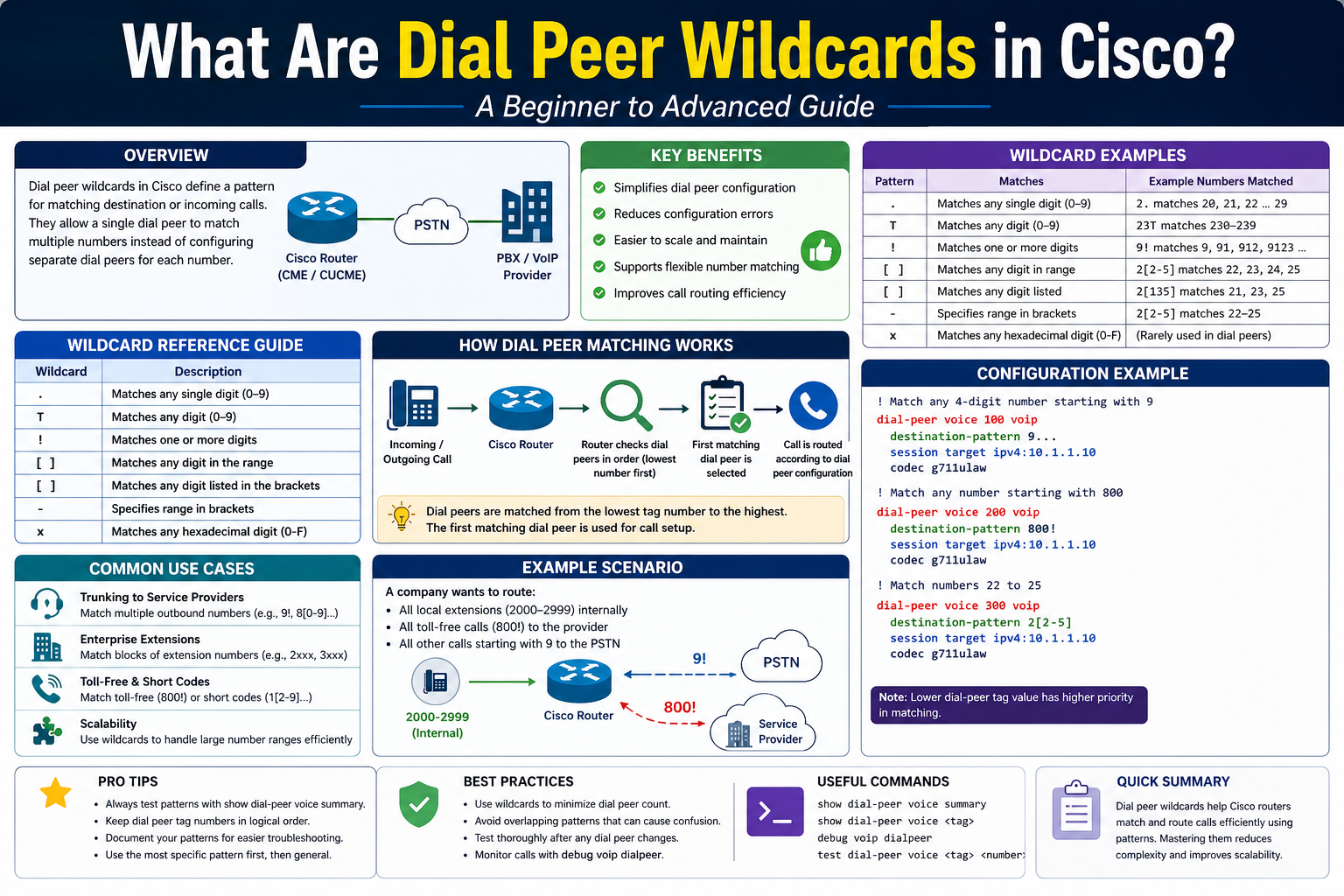
In Cisco Unified Border Element environments, dial peers form the foundation of call routing decisions. Every voice call passing through a Cisco CUBE device relies on dial peers to determine where the call should go, how it should be handled, and what rules should be applied before it is completed. These dial peers act as logical routing entries that match dialed numbers against predefined patterns.
In smaller environments, manually defining each destination number or route may be manageable. However, in real-world enterprise networks, the number of possible destinations grows rapidly. Organizations often deal with thousands of extensions, multiple geographic regions, overlapping numbering plans, and external carrier routes. In such environments, defining every single number individually becomes inefficient and difficult to maintain.
This is where wildcards become essential. Instead of explicitly writing every possible number, administrators can define patterns that represent entire ranges of numbers. These patterns allow Cisco CUBE to intelligently interpret dialed digits and match them against generalized rules. The result is a more scalable and flexible dial plan design that reduces administrative overhead while increasing routing efficiency.
Wildcards introduce abstraction into call routing logic. Rather than focusing on individual numbers, the system focuses on patterns, structures, and digit behavior. This shift in thinking is what makes large-scale voice deployments manageable.
Challenges of Managing Large Dial Plans Without Pattern Matching
Without wildcards, every single destination in a voice network would require its own dial peer entry. This creates several operational challenges that become more severe as the network grows.
One major challenge is configuration size. Large organizations may have thousands of extensions spread across multiple offices. If each extension requires a separate entry, the configuration quickly becomes massive and difficult to navigate. Even simple updates can take significant time because administrators must locate and modify multiple entries.
Another challenge is consistency. When entries are manually configured, small variations in formatting or logic can lead to routing inconsistencies. One dial peer might use a slightly different pattern than another, causing unexpected behavior in call routing decisions. Over time, these inconsistencies accumulate and create troubleshooting difficulties.
Maintenance is also a significant concern. As organizations expand, phone numbers are added, removed, or reassigned. Without wildcard-based patterns, every change requires manual updates across multiple dial peers. This increases the risk of human error and misconfiguration.
Scalability becomes the most limiting factor. A static dial plan does not adapt well to growth. Each expansion requires careful planning and configuration adjustments, often resulting in downtime or complex migration steps.
Wildcards solve these challenges by introducing flexible pattern-based rules that can automatically accommodate changes in numbering structures without requiring individual entries for every number.
Concept of Wildcards in Cisco CUBE Dial Peer Logic
Wildcards in Cisco CUBE function as symbolic representations of digits within a dialed number. Instead of matching a single exact number, a wildcard allows a dial peer to match multiple possible numbers that follow a defined structure.
At a conceptual level, wildcards transform dial peers from static entries into dynamic rules. These rules describe patterns rather than specific values. When a call is initiated, Cisco CUBE evaluates the dialed number against these patterns and determines the best match based on the configured logic.
This approach mirrors pattern recognition systems used in other technical domains. Instead of evaluating fixed values, the system evaluates structure, sequence, and constraints. Each wildcard type defines a different level of flexibility, ranging from broad matching rules to highly specific digit constraints.
The strength of wildcards lies in their ability to compress complexity. A single pattern can represent hundreds or thousands of possible numbers. This significantly reduces configuration size and improves readability of the dial plan.
Wildcards also introduce hierarchy into routing logic. More specific patterns can override broader ones, allowing administrators to define priority paths for certain types of calls while still maintaining general routing rules for everything else.
How Pattern Matching Works in Dial Peer Selection
When a call is placed through Cisco CUBE, the system evaluates the dialed digits against available dial peers. Each dial peer contains a destination pattern, and these patterns may include wildcards. The system compares the dialed number against each pattern to determine which dial peer is the best match.
The matching process is not random. It follows structured rules based on specificity. More specific patterns typically take precedence over broader patterns. This ensures that highly targeted routes are selected before general fallback routes.
Pattern matching occurs digit by digit. Each position in the dialed number is evaluated against the corresponding position in the wildcard pattern. Depending on the type of wildcard used, the system determines whether the digit is an exact match, falls within a range, or satisfies a structural rule.
This process allows Cisco CUBE to interpret flexible dialing formats while maintaining deterministic routing behavior. Even though patterns may appear broad, the matching logic remains precise and predictable.
The efficiency of this system is what enables large-scale voice networks to operate without requiring exhaustive manual configuration for every possible number.
Dot Notation and Its Role in Digit-Level Flexibility
One of the simplest wildcard mechanisms in Cisco CUBE is dot notation. A dot represents a single-digit placeholder that can match any number from 0 to 9. Each dot corresponds to exactly one digit position in the dialed number.
This makes dot notation useful when the structure of a number is known, but the exact digits are not. It provides positional flexibility while still enforcing a fixed length for the number.
For example, when a pattern uses multiple dots after a prefix, each dot represents one unknown digit. This allows a single dial peer to match a wide range of numbers that share the same starting sequence but differ in their final digits.
The key characteristic of dot notation is its strict one-to-one mapping. Each dot corresponds to exactly one digit, making it predictable and easy to reason about. It does not allow variable-length matching; instead, it maintains a consistent structure across all matched numbers.
This makes dot notation particularly useful in environments where numbering plans follow strict formatting rules, such as extension systems or region-based numbering schemes.
Understanding Plus Notation for Expanded Pattern Matching
Plus notation introduces a more flexible approach to digit repetition. Unlike dot notation, which represents a single digit position, plus notation allows repetition of a preceding digit pattern.
This means that a sequence can expand dynamically based on how many times the pattern is repeated. Instead of defining each repetition explicitly, the plus symbol instructs Cisco CUBE to treat the pattern as expandable.
This type of wildcard is useful in scenarios where number lengths vary significantly but still follow a predictable structure. It allows a compact representation of multiple possible dialing formats without needing separate entries.
Plus notation supports extended digit sequences, which can result in long number expansions. This flexibility makes it powerful, but it also requires careful design to avoid overly broad matching that could unintentionally capture unrelated numbers.
The main advantage of plus notation is its ability to reduce redundancy in dial plan definitions while supporting variable-length number structures within a single rule.
Introduction to Bracket Notation in Dial Peer Patterns
Bracket notation provides a more controlled way of defining acceptable digits in a specific position. Instead of allowing any digit, bracket notation restricts the possible values to a defined set or range.
This makes it significantly more precise than dot notation. While dot notation allows any digit, bracket notation allows only specific digits that are explicitly defined within the brackets.
This level of control is essential when dialing patterns must follow strict numbering rules. It ensures that only valid numbers within a defined structure are matched, reducing the risk of misrouting calls.
Bracket notation behaves like a filter. It evaluates each digit position against a predefined set of allowed values. If the digit does not match the allowed set, the pattern is rejected.
This mechanism introduces precision into dial peer design, enabling administrators to enforce structured dialing rules without sacrificing flexibility.
Range and List-Based Matching Within Bracket Structures
Bracket notation becomes more powerful when combined with ranges and lists. Instead of defining individual digits one by one, ranges allow continuous sequences of digits to be included in a single expression.
This means a pattern can define a starting and ending digit, and all digits within that range are automatically included. This simplifies configuration and reduces repetition.
Lists further extend this capability by allowing non-sequential digits to be grouped. This means multiple unrelated digits can be included in a single bracket expression, providing highly customized control over matching behavior.
Together, ranges and lists allow bracket notation to function as a highly flexible filtering system. It can be broad when needed or extremely specific when required.
This balance between flexibility and precision makes bracket notation one of the most powerful tools in dial peer configuration design.
Excluding Digits Using Negative Matching Logic
Bracket notation also supports exclusion logic, allowing certain digits to be explicitly removed from matching patterns. This is achieved through a negation mechanism that instructs Cisco CUBE to reject specific digit values.
This feature is useful when most digits are valid except for a few restricted values. Instead of listing all allowed digits, administrators can define what should be excluded, simplifying configuration.
Exclusion-based patterns are particularly useful in enterprise environments where certain number ranges are reserved for special services or internal routing rules.
By excluding these digits, the system ensures that only valid external or internal routes are matched, preventing unintended call routing behavior.
This approach improves control and reduces configuration complexity in scenarios where exceptions are more common than inclusions.
T Notation and Variable-Length Dialing Behavior
T notation introduces time-based evaluation into dial peer matching. Instead of immediately processing a dialed number, Cisco CUBE waits for a timeout period to determine whether additional digits will be entered.
This allows support for variable-length dialing plans where the system cannot determine the end of the number immediately. The T indicator signals that the system should wait for additional input before making a routing decision.
This is especially useful in environments where numbers do not follow a fixed-length structure. Instead of enforcing strict digit counts, the system relies on timing to determine completion of input.
The tradeoff with this approach is user experience. If the timeout is too long, callers may experience delays. If it is too short, longer numbers may be cut off prematurely.
Despite this, T notation remains a critical mechanism for supporting flexible numbering systems that cannot be defined using fixed-length patterns alone.
Inter-Digit Timing and Its Influence on Wildcard Processing
Inter-digit timing defines how long Cisco CUBE waits between digits before assuming that dialing is complete. This timing directly influences how wildcard patterns behave, especially those involving variable-length structures.
When a user is dialing a number, the system continuously evaluates input against configured patterns. If no additional digits are entered within the timeout period, the system assumes that the number is complete and proceeds with matching.
This timing mechanism is essential for T notation and other variable-length wildcard patterns. Without it, the system would not be able to determine when to finalize pattern matching.
Inter-digit timing must be carefully balanced. If configured too aggressively, it may interrupt valid dialing sequences. If configured too leniently, it may delay call setup unnecessarily.
This timing layer works in conjunction with wildcard logic to ensure both flexibility and responsiveness in call routing behavior.
Combining Multiple Wildcard Types in a Single Dial Peer
Cisco CUBE allows multiple wildcard types to be used together within a single dial peer pattern. This enables highly customized routing logic that can account for multiple conditions simultaneously.
By combining different wildcard mechanisms, administrators can define complex dialing rules that remain readable and maintainable. Each wildcard contributes a different layer of logic, allowing precise control over how numbers are matched.
This combination approach is especially useful in enterprise environments where dialing rules vary by region, service type, or network boundary. It allows a single dial peer to handle multiple scenarios without requiring separate entries for each case.
The ability to combine wildcards is what makes Cisco CUBE dial plans both powerful and scalable.
Designing Scalable Dial Plans with Wildcard Strategy Thinking
In large voice networks, dial plan design is not only about making calls work; it is about building a structure that can grow without constant redesign. Wildcards in Cisco CUBE become the foundation of this structural thinking because they allow patterns to represent entire categories of numbers rather than individual endpoints.
A scalable dial plan begins with understanding number behavior across the organization. Internal extensions, external PSTN numbers, service codes, and international formats all follow different structural rules. Instead of treating each category separately with isolated entries, wildcard design encourages grouping numbers based on shared patterns.
This approach reduces dependency on individual configuration entries and shifts the focus toward logical segmentation. For example, internal extensions might follow a consistent digit length, while external calls follow variable-length formats. Wildcards allow both behaviors to coexist within the same routing system without conflict.
Scalability is achieved when patterns remain stable even as numbers are added or removed. A well-designed wildcard structure does not need frequent updates because it is based on rules rather than static entries. This reduces operational overhead and ensures that growth does not require constant reconfiguration.
The key principle in scalable design is abstraction. Instead of thinking about individual numbers, the system is designed around ranges, behaviors, and routing intent.
Digit Analysis and Pattern Resolution Behavior in Cisco CUBE
When a call is processed, Cisco CUBE performs digit analysis to interpret the dialed number and match it against configured patterns. This process is dynamic and occurs in real time as digits are entered or completed.
Digit analysis does not simply compare full numbers after dialing is complete. Instead, it evaluates partial input continuously, narrowing down possible matches as more digits are received. Wildcards play a critical role in this process because they define how flexible each position in the number can be.
As digits are analyzed, the system eliminates non-matching patterns and prioritizes those that remain valid based on the current input state. This progressive narrowing ensures that routing decisions become more accurate as additional digits are provided.
Pattern resolution also depends on specificity. A pattern with more defined digits typically takes priority over a broader wildcard pattern. This ensures that precise routing rules are applied before generalized fallback rules.
The interaction between digit analysis and wildcard patterns allows Cisco CUBE to handle complex dialing environments where multiple routing possibilities exist simultaneously.
Hierarchical Routing Logic and Wildcard Precedence Structure
Cisco CUBE uses hierarchical logic when evaluating multiple dial peers that match a dialed number. This hierarchy is based on specificity, pattern structure, and rule strength.
More specific patterns are always evaluated before broader wildcard patterns. This ensures that precise routes are selected whenever possible. If multiple patterns match the same number, the system prioritizes the one with the highest level of specificity.
This hierarchy is essential for avoiding routing conflicts. Without it, multiple dial peers could compete unpredictably for the same call, leading to inconsistent behavior.
Wildcard-based patterns must therefore be designed with awareness of their position in the hierarchy. Broad patterns serve as fallback routes, while narrow patterns handle targeted routing cases.
This layered approach allows administrators to build both general and specialized routing logic within the same dial plan structure. It also ensures that changes in one part of the configuration do not unintentionally affect unrelated routing decisions.
Understanding this hierarchy is critical for designing stable voice networks that rely heavily on wildcard-driven routing.
Normalization Concepts in Dial Peer Wildcard Environments
Normalization refers to the process of transforming dialed numbers into a consistent format before routing decisions are made. In wildcard-based systems, normalization ensures that patterns match reliably regardless of how users enter numbers.
In real-world environments, users may dial numbers in different formats. Some may include country codes, others may use local formats, and some may include internal prefixes. Without normalization, these variations could lead to mismatched routing behavior.
Wildcards assist in normalization by allowing patterns to accommodate multiple input formats. Instead of requiring a single strict format, wildcard rules can recognize variations and still route calls correctly.
Normalization often works in combination with pattern grouping. Similar number formats are mapped to consistent routing behaviors, ensuring that the system interprets different inputs as logically equivalent destinations.
This reduces user dependency on strict dialing rules and improves overall usability of the voice system. It also reduces configuration complexity because fewer rigid transformations are required.
By combining normalization concepts with wildcard flexibility, Cisco CUBE can support diverse dialing behaviors without sacrificing routing accuracy.
Handling Overlapping Patterns and Conflict Resolution
In complex dial plans, it is common for multiple wildcard patterns to overlap. This means that a single dialed number may match more than one configured dial peer. When this happens, Cisco CUBE must determine which route to use.
Conflict resolution is based primarily on pattern specificity and matching strength. More restrictive patterns take priority over broader ones. This ensures that the most accurate routing rule is selected.
However, overlapping patterns can still introduce design challenges. If two patterns are too similar in structure, it may become difficult to predict which one will be selected. This can lead to inconsistent call routing behavior if not carefully managed.
To avoid conflicts, wildcard patterns should be designed with clear boundaries. Each pattern should serve a distinct purpose and should not unintentionally duplicate the behavior of another pattern.
Proper planning reduces ambiguity and ensures that routing decisions remain deterministic. In well-structured dial plans, overlaps are intentional rather than accidental, and they serve as controlled fallback mechanisms.
Conflict resolution is, therefore, not just a system function but also a design consideration that must be addressed during dial plan creation.
Real-World Application of Wildcards in Enterprise Voice Networks
In enterprise environments, wildcard-based dial plans are used to manage a wide range of communication scenarios. These include internal extension routing, branch office connectivity, external PSTN access, and service number handling.
Each of these scenarios has different numbering characteristics. Internal extensions are typically short and structured, while external numbers may vary in length and format depending on geographic location.
Wildcards allow all of these scenarios to be managed within a unified routing framework. Instead of creating separate static entries for every possible destination, administrators define patterns that represent entire categories of numbers.
This approach significantly reduces configuration complexity in large environments. It also improves consistency because routing rules are applied uniformly across similar number types.
Another advantage is adaptability. As organizations expand into new regions or add new services, wildcard patterns can accommodate new numbering structures without requiring a complete redesign.
This makes wildcard-driven dial plans particularly suitable for dynamic enterprise environments where change is frequent and scalability is essential.
Troubleshooting Wildcard-Based Dial Peer Issues
When issues arise in wildcard-based dial plans, troubleshooting requires a structured approach. Since patterns can match multiple numbers, identifying the exact cause of routing behavior requires careful analysis of pattern evaluation.
One common issue is unintended pattern matching. A broad wildcard may capture numbers that were intended for a more specific route. This can lead to calls being routed incorrectly.
Another issue involves missing matches. If a pattern is too restrictive, valid numbers may fail to match any dial peer, resulting in call failures.
Troubleshooting begins by analyzing the dialed number and comparing it against all potential matching patterns. Understanding how each wildcard behaves is essential for identifying why a specific route was selected or ignored.
Digit structure analysis is also important. Even small differences in pattern design can significantly affect routing outcomes.
Effective troubleshooting requires a clear understanding of wildcard behavior, pattern hierarchy, and digit evaluation logic. Without this understanding, resolving routing issues becomes significantly more difficult.
Designing Efficient Wildcard Boundaries for Large Networks
Boundary design refers to how wildcard patterns are structured to separate different categories of numbers within a dial plan. Proper boundary design ensures that patterns do not interfere with each other and that routing remains predictable.
In large networks, boundaries often represent organizational structure, geographic regions, or service types. Each boundary defines a set of numbers that share common routing behavior.
Wildcards are used to enforce these boundaries by defining acceptable digit structures within each category. This ensures that numbers outside the defined boundary do not accidentally match incorrect routing rules.
Effective boundary design reduces ambiguity and simplifies maintenance. When boundaries are clearly defined, administrators can quickly identify which patterns control which types of traffic.
Poor boundary design, on the other hand, leads to overlapping patterns, routing conflicts, and unpredictable behavior.
By carefully structuring wildcard boundaries, networks achieve a balance between flexibility and control.
Optimizing Dial Plan Efficiency Through Pattern Consolidation
As dial plans grow, redundancy can become a significant issue. Multiple dial peers may exist that serve similar or overlapping purposes. This increases configuration size and reduces clarity.
Pattern consolidation is the process of combining similar wildcard rules into fewer, more efficient entries. This reduces duplication and improves overall readability of the dial plan.
Instead of maintaining multiple narrow patterns, administrators can often design a single broader wildcard pattern that covers all required cases. This reduces maintenance effort and simplifies future updates.
However, consolidation must be done carefully. Overly broad patterns can introduce unintended matches, so balance is essential.
The goal of consolidation is not to reduce control but to improve structure. A well-consolidated dial plan remains precise while minimizing unnecessary complexity.
Efficient wildcard usage is central to achieving this balance, ensuring that routing logic remains both powerful and manageable over time.
Advanced Wildcard Behavior in Cisco CUBE Dial Peer Processing
As Cisco CUBE environments grow in complexity, wildcard usage moves beyond basic pattern matching and becomes part of a deeper routing intelligence system. At an advanced level, wildcards are not just shortcuts for digit matching; they become structured logic tools that define how call flows behave under multiple conditions.
In real deployments, dial peers rarely exist in isolation. They interact with codec rules, signaling behavior, class of service policies, and external network constraints. Wildcards sit at the center of this interaction because they determine which dial peer is selected before any other processing occurs.
Advanced wildcard behavior depends heavily on how patterns are interpreted under load conditions, overlapping configurations, and multiple route possibilities. Cisco CUBE evaluates these patterns dynamically, ensuring that even complex routing scenarios can be resolved in real time without manual intervention during call processing.
At this level, wildcard design is no longer about simple matching. It becomes about predicting how multiple patterns will behave when scaled across thousands of potential call paths.
Wildcard Interaction with Call Admission and Routing Policies
In enterprise voice systems, call routing is not only about matching numbers but also about enforcing network policies. Wildcards indirectly influence call admission decisions because they determine which dial peer is selected and therefore which policy is applied to the call.
Each dial peer may carry different constraints, such as bandwidth limitations, codec preferences, or session handling rules. When a wildcard pattern matches a call, it effectively activates a specific policy set associated with that dial peer.
This means that wildcard design has a direct impact on network behavior beyond routing. A poorly designed pattern may unintentionally route calls through a dial peer with stricter limitations, causing call failures or degraded quality.
Conversely, well-structured wildcard patterns ensure that calls are consistently routed through appropriate policy paths. This alignment between pattern logic and policy enforcement is critical in large-scale deployments.
Call admission control systems also interact indirectly with wildcard-based routing decisions. Since different dial peers may represent different network segments, wildcard matching influences which segment is used for the call, affecting resource availability and utilization.
Understanding this relationship is essential for designing voice networks that are both efficient and policy-compliant.
Timing Sensitivity and Dynamic Matching Adjustments
Wildcard-based routing is not static during call processing. It is influenced by timing behavior, especially in scenarios involving variable-length dialing. Cisco CUBE continuously evaluates digit input until a final decision is made based on configured patterns and timing rules.
Timing sensitivity becomes particularly important when using flexible wildcard constructs such as T notation. In these cases, the system must determine when dialing is complete before applying pattern-matching logic.
During this waiting period, the system maintains a dynamic evaluation state. As each digit is entered, potential matches are recalculated. This ensures that routing decisions are always based on the most complete and current input.
However, timing sensitivity introduces complexity. If timing thresholds are too aggressive, valid numbers may be prematurely evaluated, leading to incorrect routing. If thresholds are too lenient, call setup delays may increase.
Wildcard design must therefore account for timing behavior to ensure a smooth user experience and accurate routing decisions. This interaction between time-based evaluation and pattern matching is a key aspect of advanced dial plan engineering.
Multi-Region Dial Plan Design Using Wildcard Abstraction
In global enterprise environments, dial plans must support multiple geographic regions, each with its own numbering conventions. Wildcards provide the abstraction layer needed to manage this diversity without creating fragmented configurations.
Each region may have distinct number lengths, prefixes, and dialing rules. Instead of creating separate rigid configurations for each region, wildcard patterns can be designed to represent regional structures.
This allows a unified dial plan architecture that still respects regional differences. Patterns are grouped logically based on geographic or organizational boundaries, while still maintaining global consistency in routing logic.
This abstraction reduces complexity in multi-region deployments. It also simplifies expansion into new regions because new patterns can be added without restructuring existing configurations.
Wildcards make it possible to design hierarchical dial plans where global rules coexist with regional exceptions. This balance is essential in large distributed networks where consistency and flexibility must be maintained simultaneously.
Security Considerations in Wildcard-Based Dial Routing
Wildcard patterns can influence not only routing behavior but also security posture within a voice network. Since dial peers determine call destinations, overly broad wildcard patterns can unintentionally expose sensitive routes.
If a pattern is too permissive, it may allow calls to destinations that should be restricted. This creates potential security risks, especially in environments where internal and external numbering spaces overlap.
Security-conscious wildcard design involves carefully restricting pattern scope. Instead of allowing broad digit ranges, patterns should be designed to match only intended number structures.
This reduces the risk of unauthorized routing and ensures that calls are only directed through approved paths. It also helps enforce organizational dialing policies by preventing unintended access to restricted number ranges.
Another security aspect involves call interception prevention. Proper wildcard segmentation ensures that calls cannot be redirected through unintended dial peers that may alter signaling behavior.
Security and routing logic are therefore closely linked in wildcard-based designs, requiring careful planning to maintain both functionality and protection.
Wildcard Optimization for High-Volume Call Environments
In environments with high call volume, wildcard efficiency becomes critical for maintaining performance. Cisco CUBE must evaluate dial peers quickly to ensure minimal call setup delay.
Poorly optimized wildcard configurations can increase processing overhead because the system must evaluate multiple broad patterns before finding a match. This can slow down routing decisions in large-scale deployments.
Optimization involves reducing unnecessary pattern complexity and ensuring that frequently used routes are matched using highly specific patterns. This minimizes evaluation time and improves system responsiveness.
Another optimization strategy involves grouping similar patterns into shared structures. Instead of multiple overlapping wildcard entries, a single well-designed pattern can handle multiple scenarios efficiently.
High-volume environments benefit from predictable pattern structures. When wildcard logic is clean and consistent, the system can quickly eliminate invalid matches and focus on relevant routes.
This improves overall call handling capacity and reduces latency in voice communication systems.
Debugging Complex Wildcard Matching Scenarios
Troubleshooting wildcard-based dial plans becomes increasingly challenging as pattern complexity increases. When multiple overlapping patterns exist, identifying the exact match path requires detailed analysis of digit evaluation behavior.
Debugging begins by isolating the dialed number and tracing it through potential matching patterns. Each wildcard rule must be evaluated against the input to determine which conditions were satisfied.
In complex scenarios, multiple dial peers may appear valid at first glance. However, only one will be selected based on specificity rules and hierarchy precedence.
Understanding why a particular pattern was chosen requires analyzing not only the pattern itself but also its relationship to other patterns in the system.
Common debugging challenges include unexpected route selection, missing matches, and timing-related mismatches. Each of these issues requires careful examination of both wildcard logic and system evaluation behavior.
Effective debugging depends on a structured understanding of how Cisco CUBE processes patterns in sequence and resolves conflicts between overlapping entries.
Wildcard Evolution in Modern Voice Architectures
As voice architectures evolve, wildcard usage continues to play a central role in routing logic, but its implementation has become more sophisticated. Modern systems integrate wildcard-based dial plans with automation, policy engines, and dynamic routing frameworks.
Instead of static configurations, wildcard patterns are now often part of adaptive systems that adjust routing behavior based on network conditions, user behavior, and service requirements.
This evolution has expanded the role of wildcards from simple pattern-matching tools to foundational components of intelligent routing systems.
In modern architectures, wildcards are not only used for matching numbers but also for supporting flexible service delivery models. They help bridge traditional voice systems with more dynamic communication platforms.
This shift reflects the growing need for adaptable, scalable, and policy-driven voice infrastructures.
Best Practices for Long-Term Wildcard Management
Maintaining wildcard-based dial plans over time requires disciplined design and consistent structure. As systems grow, poorly managed patterns can become difficult to interpret and maintain.
One key practice is maintaining clear pattern boundaries. Each wildcard should represent a distinct logical group of numbers. This prevents overlap and reduces ambiguity.
Another important practice is documentation consistency. Even though configurations may be complex, their structure should remain understandable to administrators who may not have originally designed the system.
Regular review of wildcard patterns is also important. As organizational needs change, outdated patterns should be updated or removed to prevent unnecessary complexity.
Consistency in pattern design improves long-term maintainability. When wildcard usage follows predictable rules, future modifications become significantly easier.
The goal of long-term management is to ensure that wildcard-based dial plans remain scalable, understandable, and efficient even as network demands evolve.
Strategic Role of Wildcards in Voice Network Architecture
At a strategic level, wildcards represent more than just configuration tools. They form the foundation of routing logic in Cisco CUBE environments. Their design influences how calls flow, how policies are applied, and how scalable the network remains over time.
Wildcard strategy determines how well a voice network can adapt to growth, change, and complexity. Poorly designed patterns can lead to rigid systems that require constant maintenance, while well-designed patterns enable smooth expansion and minimal operational disruption.
In modern voice architecture, wildcards serve as a bridge between human-readable dialing logic and machine-level routing decisions. They translate organizational communication needs into structured, executable rules.
This makes them one of the most important components in Cisco CUBE design, influencing everything from call setup efficiency to long-term system stability.
Conclusion
Dial peer wildcards in Cisco CUBE are far more than a convenience feature for simplifying configuration. They represent a foundational design approach that transforms how voice routing systems are built, scaled, and maintained. Instead of treating each phone number as an isolated entry, wildcards allow administrators to define intelligent patterns that represent entire ranges, behaviors, and dialing structures. This shift from static configuration to pattern-based logic is what makes modern enterprise voice networks practical to operate at scale.
At the core, wildcards solve one of the most persistent challenges in voice engineering: complexity. As organizations grow, the number of reachable destinations expands exponentially. Without abstraction, this would require constant manual updates, creating a fragile and error-prone system. Wildcards eliminate this limitation by enabling a single rule to represent thousands of potential routing paths. This reduces administrative overhead while also improving consistency across the dial plan.
Another important takeaway is that wildcards introduce structure into what would otherwise be an unmanageable system of individual routes. Dot notation, bracket notation, plus notation, and T notation each serve a different purpose, but together they form a complete toolkit for expressing dialing logic in a flexible yet controlled way. Each type contributes a different layer of abstraction, allowing engineers to define patterns that are both broad enough to scale and precise enough to avoid routing conflicts.
However, the true power of wildcards is not just in their ability to match numbers—it is in how they influence the entire call routing lifecycle. Every dialed number passes through a structured evaluation process where patterns are matched, prioritized, and resolved. This means wildcard design directly impacts call behavior, network efficiency, and user experience. A well-designed pattern ensures that calls are routed quickly and accurately, while a poorly designed one can introduce delays, mismatches, or unintended routing paths.
Scalability is one of the most significant benefits of wildcard-driven dial plans. In large enterprise environments, growth is constant. New users are added, new branches are opened, and numbering plans evolve. Without wildcards, each of these changes would require extensive manual reconfiguration. With wildcards, many of these changes are absorbed naturally by existing patterns, allowing the system to adapt without major redesign. This adaptability is what makes wildcard-based systems suitable for long-term deployment in dynamic environments.
Equally important is the role wildcards play in maintaining operational consistency. In distributed networks, different regions or departments may follow slightly different numbering conventions. Wildcards allow these variations to coexist within a unified routing framework. Instead of fragmenting the dial plan into separate static rules, administrators can design patterns that account for structural differences while still maintaining centralized control. This ensures that routing behavior remains predictable across the entire organization.
From a troubleshooting perspective, wildcards introduce both power and complexity. While they simplify configuration, they also require a deeper understanding of how patterns interact with each other. Overlapping rules, unintended matches, and timing-based evaluation can all influence call routing outcomes. Effective management of wildcard-based systems, therefore, requires not only technical knowledge but also disciplined design practices. Engineers must carefully structure patterns, avoid unnecessary overlap, and ensure that routing logic remains transparent and traceable.
Security and control are also important considerations. Because wildcard patterns can match broad ranges of numbers, poorly designed rules can unintentionally expose sensitive routing paths. This makes careful boundary definition essential. Each wildcard must be designed with intent, ensuring that only appropriate numbers are matched and routed through specific dial peers. In this way, wildcards are not just a routing tool but also a mechanism for enforcing organizational dialing policies.
Performance optimization is another area where wildcard design plays a critical role. In high-volume environments, efficient pattern matching is essential to maintaining low call setup times. Overly complex or redundant patterns can slow down evaluation and increase processing overhead. By contrast, streamlined wildcard structures allow Cisco CUBE to quickly eliminate non-matching routes and select the correct dial peer with minimal delay. This directly impacts user experience, especially in environments where call speed and reliability are critical.
Over time, wildcard-based dial plans evolve into strategic architectural components rather than simple configuration elements. They become part of the underlying logic that defines how communication flows within an organization. When designed correctly, they provide a stable foundation that can support growth, policy enforcement, and technological change without requiring constant re-engineering.
Ultimately, dial peer wildcards represent a balance between flexibility and control. They give engineers the ability to define highly adaptable routing rules while still maintaining structure and predictability. This balance is what makes them indispensable in Cisco CUBE environments. They reduce complexity without sacrificing precision, and they enable scalability without introducing chaos.
In modern voice networks, success is not defined by how many individual routes are configured, but by how intelligently those routes are structured. Wildcards provide the mechanism to achieve that intelligence. They allow networks to think in patterns rather than isolated entries, transforming dial plan design from a manual task into a scalable engineering discipline.
As voice systems continue to evolve, the importance of wildcard-based design will only increase. Whether supporting traditional telephony, hybrid communication systems, or future unified communication platforms, the principles behind wildcard usage will remain central to efficient and reliable call routing.