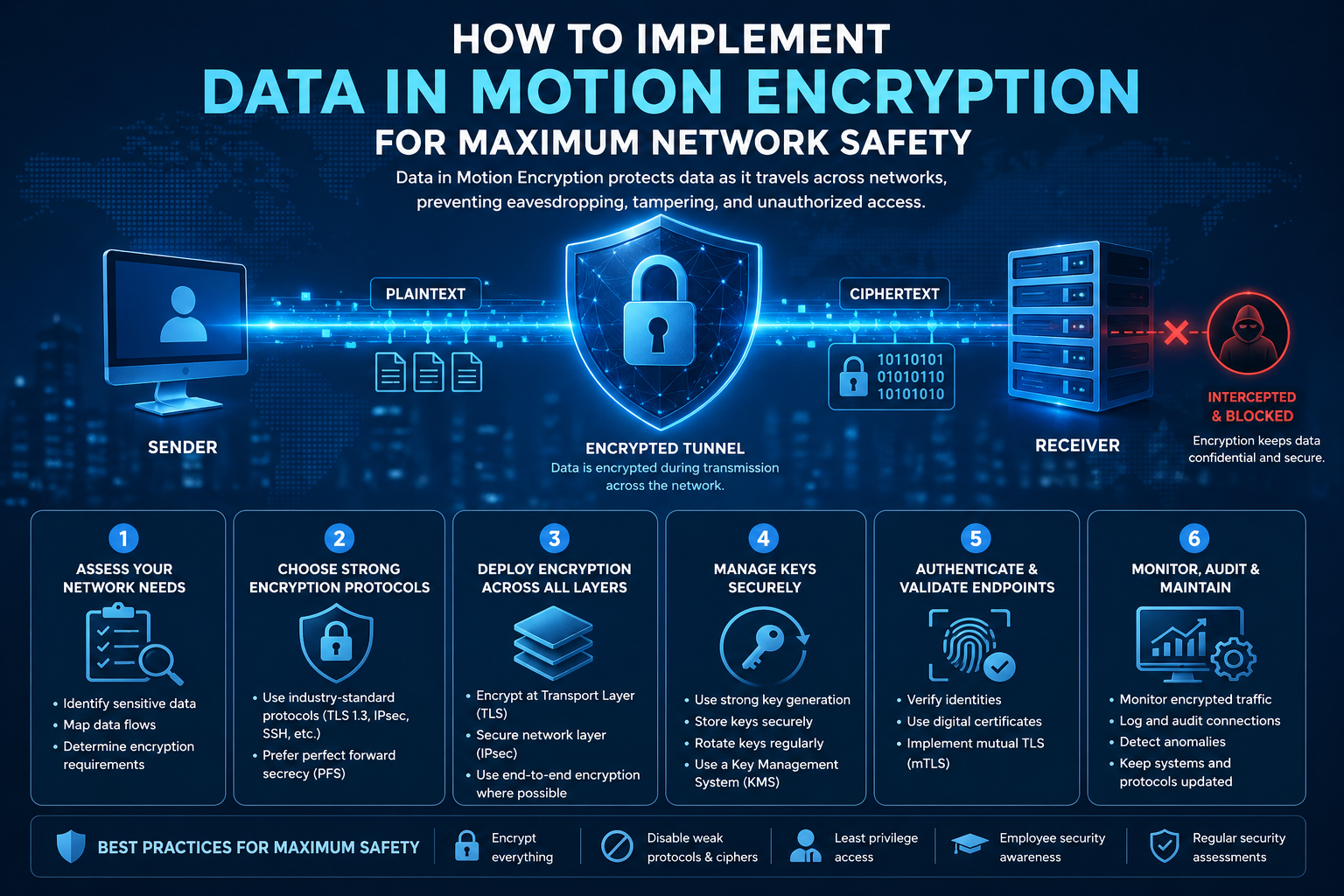
Data in motion refers to any information that is actively traveling between systems rather than sitting idle in a storage location. This movement can happen across local networks inside an organization or over global networks like the internet. Every time a user loads a webpage, sends a message, accesses cloud storage, or connects to a remote system, data is being transmitted from one point to another. During this journey, the information passes through multiple devices such as routers, switches, firewalls, and servers, all of which help guide it toward its destination.
In modern digital environments, almost every interaction involves data in motion. Unlike data at rest, which is stored on physical or virtual storage devices, data in motion is constantly exposed to potential interception. This makes it especially important to understand how it behaves during transmission. The moment data leaves its source, it enters a shared environment where multiple systems may handle it before it reaches the intended recipient.
The nature of network communication means that data does not always follow a single predictable path. Instead, it may be split into packets and routed through different pathways depending on network conditions. Each packet carries a portion of the original information, along with metadata that helps it reach its destination. While this system makes communication efficient and scalable, it also introduces opportunities for unauthorized access if proper protections are not in place.
Data in motion is not limited to internet browsing or email communication. It also includes background processes such as system updates, database synchronization, cloud backups, and application-to-application communication. Even devices within the same local network continuously exchange data in motion as they coordinate tasks and share resources. This constant flow of information creates a large surface area that must be protected against interception, manipulation, or unauthorized monitoring.
Understanding data in motion is essential because it highlights the difference between simply storing information securely and ensuring it remains protected while being transferred. A system may have strong storage security, but if data is exposed during transmission, the overall security posture is weakened. This is why modern networks rely heavily on encryption techniques designed specifically for protecting data while it is moving across systems.
The concept also extends into mobile and wireless environments where data travels through airwaves rather than physical cables. In such cases, the risk of interception can be even higher because wireless signals can be detected within range. As a result, encryption becomes a fundamental requirement rather than an optional enhancement in nearly all communication scenarios.
Why Encryption Becomes Necessary During Transmission
When data travels across networks, it passes through environments that cannot always be fully controlled. Even in secure infrastructures, there are multiple points where information could potentially be observed or captured. This is where encryption plays a critical role. Encryption transforms readable information into an unreadable format while it is being transmitted, ensuring that even if the data is intercepted, it cannot be understood without the correct decryption process.
The primary reason encryption is necessary during transmission is to protect confidentiality. Without encryption, any device or system positioned along the communication path could potentially view sensitive information. This includes personal details, login credentials, financial records, and internal organizational data. Encryption ensures that only the intended recipient can interpret the information, even if it passes through multiple intermediate systems.
Another important reason is integrity. Data in motion can be vulnerable not only to observation but also to modification. Without encryption or related security mechanisms, malicious actors could alter the information while it is traveling, leading to corrupted or misleading data being received. Encryption protocols often include methods to detect such changes, ensuring that any tampering is identified before the data is accepted.
Authentication is also closely connected to encryption during transmission. Secure communication requires both parties to confirm each other’s identity before exchanging sensitive information. Encryption protocols often include handshake mechanisms that verify identities and establish trust between systems. This helps prevent scenarios where attackers impersonate legitimate services to intercept or manipulate data.
Modern digital ecosystems rely heavily on distributed systems, cloud services, and remote access. In such environments, data frequently travels across public or semi-public infrastructure. Even when organizations use private networks, the interconnected nature of systems means that data often passes through shared components. Encryption ensures that this complexity does not become a vulnerability.
Another key reason encryption is essential is regulatory and compliance requirements. Many industries are required to protect data in motion to meet legal standards. These requirements exist because unprotected transmission can lead to severe consequences, including identity theft, financial loss, and exposure of sensitive organizational information. Encryption helps organizations meet these expectations while maintaining operational efficiency.
As communication technologies continue to evolve, the volume of data in motion continues to grow rapidly. With more devices connected to networks than ever before, the opportunities for interception also increase. Encryption serves as a foundational safeguard that ensures this growing flow of information remains protected regardless of scale or complexity.
How Secure Communication Channels Are Established
Secure communication does not happen automatically; it is the result of a carefully designed process that establishes trust and protection before any meaningful data is exchanged. When two systems begin communicating, they first engage in a negotiation phase where they agree on how to secure the connection. This process is essential because both systems must ensure that they are communicating with a legitimate counterpart and that the communication channel cannot be easily compromised.
During the initial stage, systems exchange information about the encryption methods they support. This includes details about cryptographic algorithms, key exchange mechanisms, and security protocols. The goal is to identify a common set of rules that both sides can use to secure the communication. Once this agreement is reached, the systems proceed to establish a secure channel.
A critical part of this process involves the creation of encryption keys. These keys are used to lock and unlock the data during transmission. Modern systems often use a combination of asymmetric and symmetric encryption techniques. Asymmetric encryption helps establish a secure exchange of keys, while symmetric encryption is used for efficiently protecting the actual data being transmitted.
Once keys are generated and exchanged securely, both systems use them to encrypt outgoing data and decrypt incoming data. This ensures that every piece of information sent between them is protected throughout its journey. The encryption process happens in real time, meaning that data is continuously secured as it moves across the network.
Another important aspect of secure communication channels is verification. Systems often rely on digital certificates or similar mechanisms to confirm identities. This step ensures that the system on the other end of the connection is who it claims to be. Without this verification, attackers could impersonate legitimate services and intercept sensitive data without detection.
Secure communication channels are designed to be dynamic and adaptive. They can adjust encryption strength, renegotiate keys, and respond to potential threats during an active session. This flexibility is important because network conditions and security requirements can change over time. By continuously maintaining security parameters, these channels ensure that data remains protected throughout the entire communication session.
The establishment of secure channels is invisible to most users. When someone accesses a website or connects to a remote system, the underlying security processes happen automatically in the background. However, this invisible layer is what ensures that everyday digital interactions remain safe and reliable.
Understanding SSL and TLS in Practical Terms
Secure communication on the internet is commonly associated with protocols designed to protect data in motion. Two of the most widely recognized technologies for this purpose are SSL and TLS. These protocols are responsible for securing web traffic and ensuring that data exchanged between browsers and servers remains encrypted during transmission.
SSL, which stands for Secure Sockets Layer, was one of the earliest widely adopted protocols for securing internet communication. It introduced the concept of encrypting data between clients and servers to prevent interception. Over time, however, improvements in cryptographic research and evolving security needs led to the development of TLS, or Transport Layer Security, which replaced SSL as the modern standard.
In practical terms, TLS functions in a similar way to SSL but with stronger security mechanisms and improved efficiency. When a user connects to a secure website, the browser and server begin a handshake process using TLS. During this handshake, they determine which encryption methods to use and establish shared keys for secure communication.
This process ensures that all data exchanged after the connection is established is encrypted. Whether it is login credentials, personal information, or browsing activity, everything is protected from external observation. This is why users often see a padlock icon in their browser when visiting secure websites, indicating that TLS encryption is active.
TLS also plays a role in verifying the authenticity of websites. The use of digital certificates, it helps ensure that users are connecting to legitimate servers rather than fraudulent ones. This verification process is essential in preventing phishing attacks and other forms of online deception.
While SSL laid the foundation for secure communication, modern systems rely almost entirely on TLS due to its enhanced security features. Older versions of SSL are no longer considered safe for use in modern networks because they contain vulnerabilities that can be exploited. As a result, TLS has become the standard protocol for encrypting data in motion across the internet.
Understanding SSL and TLS in practical terms means recognizing them as the invisible security layer that protects everyday online interactions. Whether users are shopping, banking, or simply browsing, these protocols ensure that sensitive information remains protected as it travels between systems.
How Modern Browsers and Servers Negotiate Security
When a user accesses a website, a complex but fast negotiation process takes place between the browser and the server. This process determines how the communication will be secured before any actual data exchange occurs. Although it happens in milliseconds, it is one of the most important steps in protecting data in motion.
The negotiation begins when the browser sends a request to the server indicating that it wants to establish a secure connection. The server responds by presenting its security credentials and supported encryption methods. These credentials include information that helps verify the identity of the server and ensure that it is legitimate.
Next, both sides compare their supported encryption options. Modern systems are designed to prioritize the most secure and efficient methods available. This ensures that the connection uses the strongest possible protection that both systems can support. If both sides agree on a common method, they proceed to establish encryption keys.
These keys are generated in a way that ensures they cannot be easily intercepted or reconstructed by unauthorized parties. Once the keys are securely established, all subsequent communication is encrypted using these keys. This means that even if data packets are intercepted during transmission, they cannot be understood without the correct decryption information.
The negotiation process also includes validation steps that confirm the authenticity of the server. This helps protect users from connecting to malicious or fake websites. If any part of the verification fails, the browser may display a warning or block the connection entirely to prevent potential security risks.
Modern browsers automate this entire process, making secure communication seamless for users. However, behind the scenes, multiple layers of cryptographic operations are working together to ensure that the connection is safe. This combination of negotiation, encryption, and authentication forms the backbone of secure web communication and plays a vital role in protecting data in motion across the internet.
The Role of Encryption Across Network Protocols Beyond Web Traffic
Encryption in motion is not limited to web browsing or secure websites. Many different network protocols are designed specifically to protect data while it moves between systems, especially in environments where administrative control or sensitive operations are involved. These protocols ensure that communication remains confidential and resistant to interception even outside typical browser-based interactions.
One of the most widely used encrypted protocols is SSH, which is designed for secure remote administration. It replaces older, insecure methods by encrypting the entire session between a client and a remote server. This means that every command entered and every response returned is protected from being read by unauthorized parties on the network. SSH is commonly used for managing servers, configuring network devices, and performing administrative tasks in environments where security is essential.
Another important protocol is RDP, which allows users to remotely access graphical desktops over a network. When properly configured, RDP encrypts the session so that screen data, keyboard inputs, and mouse movements are protected during transmission. This is particularly important in enterprise environments where employees access systems from remote locations.
VPN technology also plays a major role in encrypting data in motion. A VPN creates a secure tunnel between a user’s device and a remote network, ensuring that all traffic passing through it is encrypted. This tunnel protects data not only at the application level but across multiple applications simultaneously, making it a broader approach to securing communication.
Even within internal networks, encryption protocols are increasingly used to ensure that sensitive data remains protected between systems. This reflects a shift in modern security thinking, where trust is not assumed even inside organizational boundaries. Instead, encryption is applied consistently across different communication channels to reduce risk exposure.
Understanding Encryption Mechanisms at the Packet Level
When data moves across a network, it is broken down into smaller units known as packets. Each packet contains a portion of the original data along with routing information that helps it reach its destination. Encryption mechanisms operate at this packet level to ensure that the contents remain secure throughout the journey.
In encrypted communication, the payload of each packet is transformed using cryptographic algorithms before it is transmitted. This means that even if a packet is intercepted, its contents appear as unreadable data without the correct decryption key. The structure of the packet remains intact so that routing devices can still deliver it to the correct destination, but the sensitive information inside is protected.
Different layers of the network model can apply encryption. For example, encryption may occur at the transport layer, where protocols like TLS operate, or at the network layer, where VPNs function. Each approach provides a different level of protection and scope of coverage, depending on how broadly the encryption needs to be applied.
Packet-level encryption also includes mechanisms for ensuring data integrity. This means that each packet can be checked for tampering during transit. If even a small modification is detected, the receiving system can reject the packet or request retransmission. This helps maintain the reliability of communication even in potentially hostile network environments.
The distributed nature of packet transmission means that packets may take different routes to reach their destination. Encryption ensures that, regardless of the path taken, the data remains secure. This is especially important in large-scale networks like the internet, where packets may pass through multiple independent systems before arriving at their endpoint.
Threats That Target Data While It Is Moving
Data in motion is exposed to several types of threats that specifically target information during transmission. One of the most well-known threats is interception, where attackers capture data packets as they move across a network. Without encryption, intercepted data can be read directly, exposing sensitive information.
Another major threat is the man-in-the-middle attack, where an attacker positions themselves between two communicating systems. In this scenario, the attacker can potentially read, modify, or inject data into the communication stream without either party being immediately aware. Encryption helps mitigate this risk by ensuring that intercepted data cannot be understood or altered without detection.
Network sniffing is another technique used to monitor traffic on a network. While legitimate administrators may use sniffing tools for diagnostics, attackers can use the same tools to capture unencrypted data. This makes encryption essential in preventing unauthorized visibility into network traffic.
Session hijacking is also a concern in unsecured environments. In this type of attack, an attacker attempts to take over an active communication session by stealing session identifiers or authentication tokens. If encryption is not properly implemented, these tokens may be exposed during transmission.
Downgrade attacks specifically target encryption negotiation processes. In such attacks, an attacker attempts to force systems to use weaker encryption methods by interfering with the initial handshake. This allows them to exploit known vulnerabilities in older protocols. Proper configuration of modern encryption systems helps prevent this by refusing insecure fallback options.
These threats highlight why encryption is not optional in modern communication systems. As networks become more interconnected, the opportunities for exploitation increase, making secure transmission a critical requirement.
Key Exchange Methods and Their Importance in Secure Communication
Before encrypted communication can begin, systems must agree on shared cryptographic keys. These keys are essential for both encrypting and decrypting data during transmission. The process of establishing these keys securely is known as key exchange, and it is one of the most important components of data in motion security.
Key exchange methods are designed to ensure that even if the communication channel is being observed, the keys themselves cannot be easily discovered. This is typically achieved through mathematical techniques that allow two systems to generate shared secrets without directly transmitting them over the network.
Once the key exchange is complete, both systems possess the same cryptographic key, which is then used to encrypt and decrypt data. This key is typically valid only for the duration of the session, adding a layer of security. If a session is compromised, future sessions will not be affected because new keys are generated each time.
Modern encryption systems often use a combination of key exchange and authentication. This ensures not only that keys are securely established but also that both parties are verified before communication begins. Without this dual protection, attackers could potentially intercept or impersonate legitimate systems during the key exchange process.
Key exchange mechanisms are designed to be resistant to interception. Even if an attacker captures the exchange process, they should not be able to reconstruct the key from the observed data. This property is fundamental to maintaining secure communication over untrusted networks.
The strength of encryption in motion depends heavily on the security of the key exchange process. If this stage is compromised, the entire communication session becomes vulnerable. For this reason, modern systems invest significant effort into ensuring that key exchange methods remain robust and resistant to attack.
Encryption Behavior in Wireless and Mobile Networks
Wireless and mobile networks introduce additional complexity to data in motion security because data is transmitted through the open air rather than physical cables. This makes it easier for unauthorized devices within range to potentially intercept signals if they are not properly encrypted.
In wireless environments, encryption is applied at multiple layers to protect data from being captured. This includes securing the connection between devices and access points as well as encrypting application-level communication. Without these protections, wireless transmissions would be highly vulnerable to passive monitoring.
Mobile networks also rely heavily on encryption to protect user data as it moves between devices and cellular infrastructure. Since mobile communication often travels through shared infrastructure, encryption ensures that individual user sessions remain isolated and secure.
One of the challenges in wireless encryption is maintaining strong security without significantly impacting performance or battery life. Mobile devices must balance encryption strength with resource efficiency, ensuring that users can maintain secure communication without excessive overhead.
Another important aspect of wireless encryption is handling roaming scenarios, where devices move between different network towers or access points. In such cases, encryption keys and secure sessions must be maintained or re-established without exposing data during the transition.
Despite these challenges, encryption remains a fundamental requirement for all wireless communication. Without it, the convenience of mobile connectivity would come at the cost of significant security risks, including unauthorized access to transmitted data.
Application Layer Encryption and End-to-End Protection
In addition to transport-level encryption, many systems implement encryption directly at the application layer. This approach ensures that data remains encrypted not only during transmission but also at the endpoints involved in communication. Application layer encryption is often referred to as end-to-end encryption because only the communicating users or systems can decrypt the data.
With end-to-end encryption, even intermediate servers or service providers cannot access the contents of the communication. This provides a higher level of privacy and security, especially in environments where data passes through multiple external systems.
Application layer encryption is commonly used in messaging systems, file sharing platforms, and secure communication tools. In these systems, data is encrypted before it leaves the sender’s device and only decrypted when it reaches the intended recipient.
This approach reduces reliance on intermediary systems for security, shifting the responsibility entirely to the endpoints. As a result, even if a server is compromised, the encrypted data remains protected.
However, application-layer encryption also introduces challenges in key management and synchronization. Since encryption and decryption occur at the endpoints, both sides must securely manage cryptographic keys and ensure they remain consistent throughout the communication session.
Despite these challenges, end-to-end encryption is considered one of the strongest methods for protecting data in motion. It ensures that sensitive information remains secure throughout its entire journey, regardless of the underlying network infrastructure.
The Interaction Between Encryption and Network Performance
While encryption is essential for protecting data in motion, it also introduces additional processing requirements that can impact network performance. Encryption and decryption operations require computational resources, which can affect speed and latency depending on the system’s capacity.
Modern encryption algorithms are designed to be efficient, but large volumes of data or high-frequency communication can still create noticeable overhead. This is especially relevant in environments where real-time communication is required, such as video streaming or remote system access.
To address performance concerns, systems often use optimized encryption techniques that balance security with efficiency. Hardware acceleration is also commonly used to offload cryptographic operations from the main processor, improving overall performance.
Another factor influencing performance is the size of encryption keys and the complexity of algorithms used. Stronger encryption typically requires more processing power, but it also provides higher levels of security. This creates a trade-off that system designers must carefully manage.
Despite these considerations, modern infrastructure is generally capable of handling encryption with minimal impact on user experience. Advances in hardware and protocol design have made encryption an integrated part of network communication rather than an optional overhead.
The relationship between encryption and performance continues to evolve as networks become faster and more complex. However, security remains the priority, and encryption is increasingly seen as a necessary component rather than a performance burden.
Evolution of Encryption Standards in Data in Motion
Encryption for data in motion has changed significantly over time, driven by both advances in computing power and the growing sophistication of cyber threats. Early network communication systems were built with performance in mind rather than security, which meant that much of the original traffic on the Internet was transmitted in plain text. As digital systems became more interconnected, the weaknesses of unencrypted communication became more obvious, leading to the development of structured encryption standards.
The transition from early insecure protocols to modern encryption frameworks did not happen overnight. It was a gradual shift influenced by repeated security incidents, academic research in cryptography, and the increasing need for trust in online communication. Over time, encryption moved from being an optional enhancement to a fundamental requirement for almost all network communication.
Modern encryption standards are designed with several goals in mind. They must provide strong protection against interception, ensure compatibility across a wide range of devices, and remain efficient enough to handle large-scale data transmission. These standards are regularly updated to address newly discovered vulnerabilities and to improve resistance against emerging attack techniques.
One of the most important developments in encryption evolution is the move toward stronger cryptographic algorithms and the retirement of outdated ones. Older encryption methods that were once considered secure have become vulnerable due to advances in computational capabilities. As a result, modern systems continuously phase out weaker protocols to maintain a secure communication environment.
This evolution reflects a broader shift in cybersecurity philosophy. Instead of relying on static defenses, encryption systems are now designed to adapt over time. This adaptability ensures that data in motion remains protected even as the threat landscape continues to change.
The Importance of Forward Secrecy in Secure Communication
One of the key advancements in modern encryption systems is the concept of forward secrecy. This principle ensures that even if encryption keys are compromised in the future, past communication sessions remain secure and cannot be decrypted retroactively.
Forward secrecy works by generating unique encryption keys for each session rather than relying on a single long-term key. These session-specific keys are used only for the duration of a single communication exchange and are discarded afterward. This means that even if an attacker gains access to long-term credentials, they cannot use them to decrypt previously recorded traffic.
This approach significantly improves the resilience of encrypted communication. Without forward secrecy, a compromised key could potentially expose large volumes of past data. With forward secrecy in place, the damage is limited to future sessions rather than historical communication.
Forward secrecy is particularly important in environments where long-term data confidentiality is critical. This includes financial transactions, private communications, and sensitive organizational data transfers. By ensuring that each session is independently secured, systems reduce the long-term impact of potential security breaches.
The implementation of forward secrecy requires careful coordination between encryption protocols and key exchange mechanisms. Systems must be able to generate secure temporary keys efficiently while maintaining performance and compatibility. Despite this complexity, forward secrecy has become a standard feature in modern encryption systems for data in motion.
Role of Certificates in Verifying Communication Endpoints
In secure communication systems, encryption alone is not enough. It is also necessary to verify that the systems exchanging data are legitimate. This is where digital certificates play a critical role in establishing trust between communicating endpoints.
A digital certificate acts as a form of identity verification for a server or system. It contains information about the entity it represents and is issued by a trusted authority that confirms its authenticity. When a client connects to a server, it checks the server’s certificate to ensure that it is communicating with the correct destination.
This verification process helps prevent impersonation attacks, where malicious actors attempt to disguise themselves as legitimate services. Without certificates, it would be much easier for attackers to intercept communication by pretending to be trusted systems.
Certificates are also used to establish encrypted connections. They contain public keys that are used during the initial stages of secure communication to negotiate encryption parameters. Once trust is established, these keys help facilitate the creation of secure session keys used for encrypting data in motion.
The trust model behind certificates relies on a chain of verification. Certificates are issued by trusted entities, which themselves are validated by higher-level authorities. This hierarchical structure ensures that trust can be established even across large and complex networks.
In practical terms, certificates are a foundational component of secure internet communication. They work alongside encryption protocols to ensure that both the identity of communication endpoints and the confidentiality of transmitted data are protected.
Encryption in Cloud-Based Data Transmission
Cloud computing has significantly changed the way data in motion is handled. Instead of relying on local infrastructure, many systems now transmit data between distributed cloud environments and user devices. This introduces new challenges for encryption because data often travels across multiple external networks and service layers.
In cloud-based systems, encryption is applied at multiple points to ensure end-to-end protection. Data may be encrypted before leaving a user’s device, during transit between cloud services, and even within internal cloud networks. This layered approach ensures that data remains secure regardless of where it is processed or stored temporarily.
One of the key challenges in cloud environments is maintaining consistent encryption policies across different services. Since cloud systems often involve multiple providers and platforms, ensuring uniform security standards requires careful coordination. Encryption protocols must be compatible across all systems involved in data transmission.
Cloud environments also rely heavily on automated encryption management. Large-scale systems handle massive volumes of data, making manual encryption management impractical. Automation ensures that encryption keys are generated, distributed, and rotated securely without human intervention.
Another important consideration is data segmentation. In cloud systems, data may be split across multiple locations for redundancy and performance reasons. Encryption ensures that even if individual segments are accessed independently, they remain unreadable without the appropriate keys.
The combination of scalability, automation, and strong encryption makes cloud-based systems capable of securely handling large volumes of data in motion. However, it also requires continuous monitoring and updates to ensure that encryption practices remain aligned with evolving security standards.
Impact of Encryption on Regulatory Compliance and Data Governance
Encryption plays a significant role in helping organizations meet regulatory and compliance requirements related to data protection. Many industries are governed by strict rules that require sensitive information to be protected during transmission. These regulations are designed to reduce the risk of data breaches and unauthorized access.
Compliance frameworks often specify minimum encryption standards that must be used when transmitting sensitive data. This includes requirements for strong encryption algorithms, secure key management practices, and proper authentication mechanisms. Organizations that fail to meet these standards may face legal consequences or financial penalties.
Data governance policies also rely heavily on encryption to enforce control over how information is handled during transmission. Encryption ensures that even if data is intercepted or accessed without authorization, it remains unreadable and unusable. This adds a layer of protection beyond access control systems.
In many cases, encryption is used to demonstrate accountability in data handling practices. Organizations must be able to show that they have taken appropriate steps to protect data in motion, especially when dealing with personal or confidential information. Encryption provides a clear and verifiable method of achieving this goal.
As regulatory environments continue to evolve, encryption standards are becoming more stringent. This reflects the growing importance of data protection in a digital economy where information is constantly moving across global networks.
Challenges in Managing Encryption at Scale
While encryption is essential for protecting data in motion, managing it at scale introduces several operational challenges. Large organizations often deal with thousands of systems, users, and communication channels, all of which require secure encryption configurations.
One of the primary challenges is key management. Encryption relies on cryptographic keys, and managing these keys securely becomes increasingly complex as the number of systems grows. Keys must be generated, stored, distributed, rotated, and eventually retired in a secure manner to prevent exposure.
Another challenge is maintaining consistency across different systems. In large environments, different platforms may support different encryption standards or configurations. Ensuring that all systems adhere to a unified security policy requires careful coordination and ongoing maintenance.
Performance is also a concern at scale. Encrypting large volumes of data across multiple systems can introduce processing overhead. Organizations must balance security requirements with performance expectations to ensure that systems remain efficient and responsive.
Additionally, monitoring encrypted traffic can be challenging. While encryption protects data from unauthorized access, it also makes it more difficult to inspect for malicious activity. Organizations must use specialized tools and techniques to maintain visibility without compromising security.
Despite these challenges, encryption remains a non-negotiable requirement for data in motion. The complexity of managing encryption at scale is outweighed by the risks associated with unprotected communication.
Future Directions of Data in Motion Encryption
The future of encryption for data in motion is shaped by ongoing advancements in computing, networking, and cybersecurity research. As systems become more interconnected and data volumes continue to grow, encryption methods must evolve to remain effective against increasingly sophisticated threats.
One emerging area of development is post-quantum cryptography. As quantum computing advances, traditional encryption algorithms may become vulnerable to new forms of computational attacks. Post-quantum encryption aims to develop methods that remain secure even in the presence of quantum computing capabilities.
Another direction is the increasing use of automated and adaptive encryption systems. These systems can dynamically adjust encryption strength and methods based on network conditions, threat levels, and system performance. This allows for more efficient and responsive security management.
There is also growing interest in integrating encryption more deeply into network infrastructure. Instead of treating encryption as a separate layer, future systems may embed it directly into hardware and communication protocols, making secure transmission a default behavior rather than an added feature.
Machine learning and artificial intelligence are also expected to play a role in future encryption systems. These technologies can help identify anomalies in encrypted traffic patterns and detect potential security threats without directly accessing the underlying data.
As digital communication continues to expand, encryption for data in motion will remain a foundational element of cybersecurity. Its future development will focus on maintaining strong security while adapting to new technological realities and increasing demands for efficiency and scalability.
Conclusion
Encryption for data in motion has become one of the most essential pillars of modern digital security. As information continuously moves across networks, devices, and cloud systems, it is constantly exposed to environments where interception, manipulation, or unauthorized access can occur. Without encryption, this movement of data would represent one of the weakest points in any communication system. Instead, encryption transforms data into a protected form that remains unreadable to anyone who does not possess the correct cryptographic keys.
The importance of securing data while it is being transmitted extends across nearly every aspect of digital life. Whether users are browsing websites, sending messages, accessing remote systems, or using cloud applications, they are relying on encryption in the background to maintain confidentiality and trust. This invisible layer of protection ensures that sensitive information, such as personal details, credentials, and financial data, cannot be easily exposed as it travels through complex network infrastructures.
Over time, encryption technologies have evolved from simple protective mechanisms into highly advanced systems designed to counter modern threats. Early communication systems lacked strong safeguards, making data transmission vulnerable to interception. Today, however, encryption standards such as TLS and secure protocols like SSH and VPN technologies provide strong, layered protection that secures information at multiple points during its journey. This evolution reflects the growing recognition that data in motion is just as important to protect as data stored on devices or servers.
One of the most significant aspects of encryption in motion is its ability to maintain trust in digital communication. Users may not see the complex processes happening behind the scenes, but encryption ensures that the systems they interact with are authentic and that the information exchanged remains private. Features such as secure handshakes, certificate validation, and key exchange mechanisms all work together to establish a trusted environment where communication can occur safely.
At the same time, encryption is not a static solution. It continues to evolve in response to new threats and technological advancements. Attackers constantly seek new ways to exploit weaknesses in communication systems, which drives continuous improvement in cryptographic methods. This ongoing cycle of adaptation ensures that encryption remains effective even as computing power increases and attack techniques become more sophisticated.
Another important dimension of encryption in motion is its role in supporting global digital infrastructure. Modern networks are highly distributed, often spanning multiple regions, service providers, and platforms. Encryption allows these complex systems to operate securely despite their scale and interconnected nature. It ensures that data can move freely across boundaries without compromising its confidentiality or integrity.
In addition, encryption supports regulatory compliance and data protection standards that govern how information must be handled. Many industries rely on strict security requirements that mandate encryption during transmission to prevent data exposure. This makes encryption not only a technical safeguard but also a critical component of legal and organizational responsibility.
Despite its importance, encryption also introduces challenges related to performance, key management, and system complexity. However, these challenges are outweighed by the necessity of protecting sensitive information in a constantly connected world. Advances in technology continue to reduce these challenges by improving efficiency and automating many aspects of encryption management.
Ultimately, encryption in motion represents the foundation of secure communication in the digital age. It enables individuals, businesses, and systems to exchange information confidently across networks that are inherently untrusted. As technology continues to advance, encryption will remain a central mechanism for ensuring that data remains protected throughout its entire journey, from the moment it leaves its source until it reaches its destination.