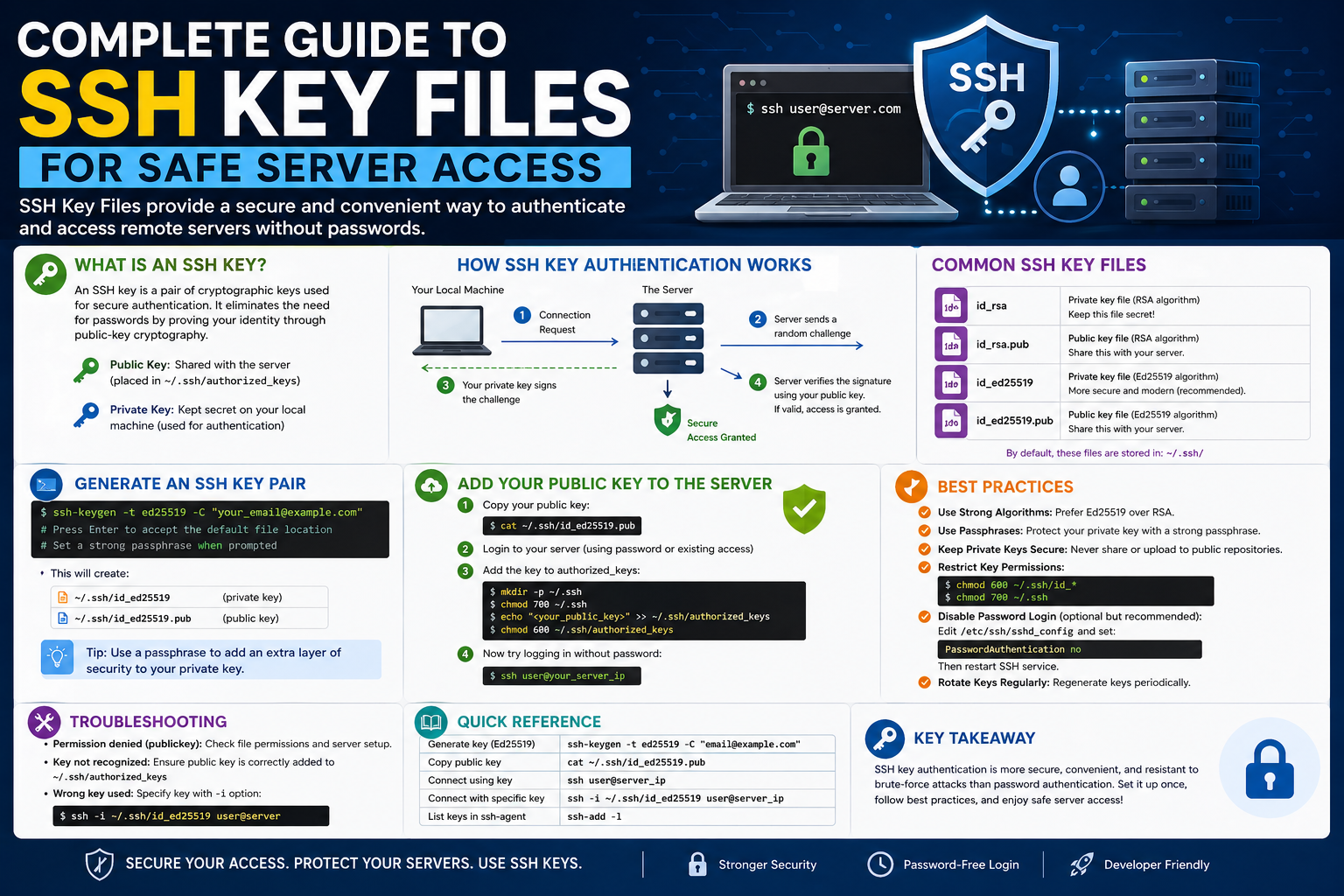
Secure Shell, commonly known as SSH, is one of the most important technologies in modern Linux administration. It serves as the primary method for securely accessing and managing remote systems over an unsecured network. At its core, SSH replaces older remote access tools that lacked proper security mechanisms, introducing encryption, authentication, and data integrity into remote sessions.
Before SSH became standard, system administrators relied heavily on tools that transmitted data in plain text. This meant that usernames, passwords, and even session commands could be intercepted by attackers using simple network monitoring techniques. SSH changed this landscape by encrypting all communication between client and server, ensuring that sensitive information could not be easily exposed.
In Linux environments today, SSH is not just a convenience but a foundational tool. It is used for system administration, file transfers, automation scripts, remote monitoring, and secure communication between systems. Nearly every Linux-based infrastructure depends on SSH in some capacity, making it a core skill for anyone working in system administration or cybersecurity.
The strength of SSH lies not only in encryption but also in its flexibility. It supports multiple authentication methods, configuration options, and operational modes. This allows organizations to tailor SSH behavior based on security policies, infrastructure complexity, and user requirements.
The Role of SSH in Secure Remote Access
SSH plays a central role in enabling secure remote access to Linux systems. When an administrator connects to a remote server using SSH, a secure tunnel is created between the local machine and the remote host. This tunnel ensures that all data exchanged during the session is encrypted and protected from interception.
One of the key advantages of SSH is that it operates over untrusted networks, such as the internet, without compromising security. Even if an attacker intercepts the traffic, the encrypted nature of SSH prevents meaningful data extraction.
SSH also supports authentication mechanisms that go beyond simple password verification. While passwords can still be used, SSH strongly encourages the use of cryptographic key pairs. These keys significantly reduce the risk of brute-force attacks and credential theft.
In addition to remote login capabilities, SSH can also be used to execute commands on remote systems without initiating a full interactive session. This makes it especially useful for automation, where scripts need to perform tasks across multiple servers without manual intervention.
The widespread adoption of SSH has made it a default tool in Linux distributions. It is typically installed and enabled by default, reflecting its importance in secure system communication.
Understanding SSH Architecture and Communication Flow
The architecture of SSH is built around a client-server model. The SSH client initiates a connection request, and the SSH server responds by establishing a secure session. This process involves several stages that ensure both security and authentication.
When a connection is initiated, the client and server first agree on encryption algorithms. This negotiation ensures that both sides use compatible cryptographic standards. Once the encryption method is selected, a secure channel is created using key exchange mechanisms.
After the secure channel is established, authentication takes place. This can involve passwords, public key authentication, or other supported methods. Only after successful authentication is the user granted access to the system.
The communication flow in SSH is designed to protect against multiple types of attacks. Encryption ensures confidentiality, while integrity checks prevent data tampering. Authentication ensures that only authorized users can access the system.
Another important aspect of SSH architecture is session management. Each SSH connection can support multiple channels within a single session. This allows users to run commands, transfer files, and forward ports simultaneously without creating separate connections.
SSH also includes support for compression, which can improve performance in low-bandwidth environments. Although not always enabled by default, compression can reduce data transfer time in specific use cases.
The Importance of System-Wide SSH Configuration
In Linux systems, SSH configuration is divided into system-wide and user-specific settings. The system-wide configuration controls how the SSH service behaves on a global level, affecting all users who connect to the system.
This configuration is typically stored in a central directory and is managed by system administrators. It defines security policies, connection rules, authentication methods, and server behavior. Because of its impact on the entire system, changes to system-wide SSH settings are usually made carefully.
System-wide configuration ensures consistency across all user sessions. It allows administrators to enforce security standards such as disabling weak authentication methods, restricting root login, and defining allowed encryption algorithms.
These settings also help maintain compliance with organizational security policies. In enterprise environments, SSH configurations are often standardized across all servers to reduce vulnerabilities and ensure predictable behavior.
Another important function of system-wide configuration is version management. As SSH evolves, newer versions may introduce updated security features or deprecate older ones. System-wide settings allow administrators to adapt to these changes without affecting individual user preferences.
Proper management of system-wide SSH configuration is essential for maintaining a secure and stable infrastructure. Misconfiguration at this level can expose entire systems to security risks.
SSH Client Configuration and User-Level Control
While system-wide settings define global behavior, SSH also provides user-level configuration that allows individuals to customize their connection experience. This configuration is stored within each user’s home directory and applies only to their sessions.
User-specific SSH settings often include connection shortcuts, authentication preferences, and identity files. This allows users to manage multiple remote systems efficiently without repeatedly entering complex connection details.
One of the key components of user-level SSH configuration is the management of trusted hosts. When a user connects to a remote system for the first time, SSH records the identity of that system. This record is used in future connections to verify that the server has not changed unexpectedly.
If the identity of a known host changes, SSH will issue a warning. This mechanism helps protect against man-in-the-middle attacks, where an attacker attempts to impersonate a legitimate server.
User-level configuration also supports multiple key pairs. This is useful for individuals who access different systems with different security requirements. Each key pair can be associated with a specific identity, allowing fine-grained control over authentication.
By separating user-level and system-level configurations, SSH provides both flexibility and security. Users can personalize their experience without compromising the integrity of the overall system.
SSH Authentication Mechanisms and Security Principles
Authentication is one of the most critical components of SSH security. It determines whether a user is allowed to access a system and under what conditions. SSH supports multiple authentication methods, each offering different levels of security.
The most basic method is password authentication. While easy to use, it is also the least secure, as passwords can be guessed, reused, or intercepted if improperly managed. For this reason, many organizations restrict or disable password authentication entirely.
A more secure method is public key authentication. This method uses a pair of cryptographic keys: a private key and a public key. The public key is placed on the remote server, while the private key remains securely stored on the client machine.
When a connection is attempted, the server verifies the client’s identity using cryptographic challenge-response mechanisms. Since the private key never leaves the client system, it is significantly more secure than traditional passwords.
SSH can also support additional authentication layers, such as passphrases for private keys. This adds another level of protection in case the key file is compromised.
Security principles in SSH authentication are designed to minimize trust assumptions. Instead of trusting a password alone, SSH relies on cryptographic validation, reducing the risk of unauthorized access.
Key-Based Authentication and Secure Identity Management
Key-based authentication is widely considered the most secure method for SSH access. It relies on asymmetric cryptography, where two mathematically linked keys are used for authentication.
The private key remains on the user’s system and must be protected at all times. If this key is exposed, an attacker could potentially gain unauthorized access to remote systems. To mitigate this risk, private keys are often encrypted with passphrases.
The public key, on the other hand, is shared with remote systems and stored in a dedicated authentication file. This file acts as a list of authorized identities allowed to access the system.
When a connection is initiated, the SSH server verifies whether the client’s private key corresponds to a valid public key stored in its configuration. If a match is found, access is granted without requiring a password.
Key-based authentication also supports automation. Since it does not require manual password entry, it is ideal for scripts, scheduled tasks, and system integrations.
Proper key management is essential for maintaining security. This includes generating strong keys, protecting private key files, and removing unused keys from authorized systems.
SSH Directory Structure and Configuration Hierarchy
SSH relies on a structured directory system to organize its configuration files and security components. These directories are divided based on their scope and purpose.
System-level directories contain configuration files that define global SSH behavior. These files control server settings, encryption standards, and connection rules. They are managed by administrators and apply to all users on the system.
User-level directories are stored within individual home directories. These contain personal SSH configurations, authentication keys, and trusted host records. Each user has full control over their own directory, allowing customization without affecting others.
The separation between system and user directories is a key design feature of SSH. It ensures that global security policies remain intact while still allowing flexibility for individual users.
Within these directories, various files serve specific functions. Some define connection behavior, while others store authentication credentials or security fingerprints.
This hierarchical structure makes SSH both powerful and scalable. It can be used in simple single-user environments as well as complex enterprise infrastructures with thousands of systems.
Security Considerations in SSH Implementation
SSH is inherently secure, but its effectiveness depends on proper configuration and management. Misconfigurations can introduce vulnerabilities even in otherwise secure systems.
One important security consideration is restricting user access. Limiting which users can connect via SSH reduces the attack surface and prevents unauthorized access attempts.
Another consideration is disabling weak authentication methods. Password-based authentication, if left enabled, can be exploited through brute-force attacks. Replacing it with key-based authentication significantly improves security.
Monitoring and logging are also essential. SSH systems can record connection attempts, authentication failures, and session activities. These logs help administrators detect suspicious behavior and respond to potential threats.
Network-level restrictions can further enhance SSH security. Limiting connections to specific IP ranges reduces exposure to external attacks.
Finally, regular updates are important. SSH implementations evolve, and updates often include security patches that address newly discovered vulnerabilities.
By combining proper configuration, strong authentication, and continuous monitoring, SSH can provide a highly secure communication channel for Linux systems.
SSH Server Behavior and Runtime Configuration Control
The SSH server is responsible for handling incoming connection requests and enforcing the rules that determine how users are allowed to access a system. Its behavior is defined through a structured configuration model that controls authentication methods, connection limits, encryption standards, and session handling rules.
When the SSH server starts, it loads its configuration and applies global policies that govern all future connections. These policies remain active until the service is restarted or reloaded. This makes SSH server behavior predictable, which is essential for maintaining secure environments where multiple users and systems interact.
A key aspect of SSH server control is its ability to manage both security and performance at the same time. Administrators can define limits on concurrent connections, restrict idle sessions, and enforce timeout values. These controls prevent system overload and reduce exposure to unused or forgotten sessions.
The SSH server also determines which features are available to connecting clients. This includes whether tunneling is allowed, whether X11 forwarding is permitted, and whether certain authentication mechanisms are enabled. By controlling these features, administrators can reduce the attack surface and enforce organizational policies.
Runtime behavior is also influenced by how the server processes authentication attempts. Each login request is evaluated against a set of rules, ensuring that only valid and authorized users are granted access. These rules may include group membership checks, user-specific restrictions, and network-based conditions.
Authentication Policies and Access Restriction Mechanisms
Authentication policies in SSH define how users prove their identity before being granted access. These policies are essential for controlling system entry points and ensuring that only trusted users can interact with sensitive systems.
One of the most important aspects of SSH authentication policy is flexibility. The system can support multiple authentication methods simultaneously, allowing organizations to choose the level of strictness required for different environments. Some systems may allow password authentication for simplicity, while others rely exclusively on cryptographic key verification.
Access restrictions can be applied at multiple levels. Administrators can define rules based on usernames, groups, or even network locations. This allows precise control over who can connect and from where those connections are permitted.
Another important concept in authentication policy is privilege separation. SSH ensures that authentication processes run independently from the main session process. This reduces the risk that a compromise during login could affect the entire system.
Authentication policies also define retry limits and failure handling behavior. After a certain number of failed attempts, SSH may delay further attempts or temporarily block access. This helps mitigate automated brute-force attacks.
By combining identity verification, access control rules, and failure handling mechanisms, SSH authentication policies form a layered defense system that protects against unauthorized access attempts.
SSH Key Lifecycle and Identity Management Practices
SSH keys are not static elements; they have a lifecycle that includes generation, distribution, usage, rotation, and eventual decommissioning. Proper management of this lifecycle is essential for maintaining secure environments.
The lifecycle begins with key generation. During this stage, cryptographic key pairs are created and associated with a specific user or system identity. These keys are then assigned roles based on their intended use, such as administrative access, automation tasks, or system integration.
Once generated, keys must be distributed securely. The public key is typically installed on remote systems, while the private key remains protected on the originating system. This separation is fundamental to SSH security design.
During active use, keys must be monitored for unusual activity. Repeated failed authentication attempts or unexpected usage patterns may indicate compromise. Monitoring helps identify issues before they escalate into security breaches.
Over time, keys may need to be rotated. Rotation involves replacing old keys with new ones to reduce the risk associated with long-term key exposure. This is especially important in environments where multiple administrators or automated systems rely on SSH access.
Finally, keys that are no longer needed must be revoked and removed from all systems. Leaving unused keys in place increases the risk of unauthorized access, especially if the private key has been lost or exposed.
Effective key lifecycle management ensures that SSH remains secure even in large and complex environments where many users and systems interact continuously.
SSH Connection Establishment and Cryptographic Negotiation
When an SSH connection is initiated, a structured process begins that establishes a secure communication channel between the client and server. This process involves multiple stages, each designed to ensure confidentiality, integrity, and authenticity.
The first stage is the initial handshake, where the client and server exchange information about supported encryption algorithms. This negotiation ensures that both sides agree on compatible cryptographic methods before any sensitive data is transmitted.
Once algorithms are agreed upon, a secure session key is generated using key exchange mechanisms. This session key is used to encrypt all subsequent communication between the client and server.
After encryption is established, the authentication phase begins. The client must prove its identity using one of the supported authentication methods. Only after successful authentication does the session become fully active.
Throughout the connection process, integrity checks ensure that data has not been altered during transmission. These checks protect against tampering and ensure that commands executed on remote systems are exactly what the client intended.
The connection establishment process is designed to be resistant to interception and manipulation. Even if an attacker can observe network traffic, the encrypted nature of SSH prevents meaningful interpretation of the data.
Secure Tunneling and Port Forwarding Concepts
SSH is not limited to remote shell access; it also supports secure tunneling, which allows network traffic to be forwarded through encrypted channels. This capability is widely used to protect data traveling between systems that may not be inherently secure.
Port forwarding is one of the most common tunneling techniques. It allows a connection to be redirected from a local system through an SSH tunnel to a remote destination. This ensures that data transmitted between endpoints remains encrypted even if the underlying service does not support encryption.
There are multiple types of port forwarding, each serving a different purpose. Local forwarding allows a client to access remote services securely. Remote forwarding allows external systems to access services on the client side through the SSH server. Dynamic forwarding creates a flexible tunnel that can route multiple types of traffic.
Secure tunneling is particularly useful in environments where direct access to services is restricted. It allows administrators to securely access internal systems without exposing them directly to external networks.
SSH tunneling also supports layered security architectures. By combining multiple tunnels, complex network paths can be securely traversed without compromising encryption or authentication standards.
SSH Agent and Credential Handling in Active Sessions
Managing authentication credentials during active SSH sessions can become repetitive and inefficient, especially when using key-based authentication with passphrases. To address this, SSH introduces an agent-based system that temporarily stores unlocked credentials.
The SSH agent acts as a background process that holds decrypted private keys in memory. Once a key is added to the agent, it can be used for multiple SSH connections without requiring repeated passphrase entry.
This approach improves usability while maintaining security. The private key itself is never exposed, and only the decrypted session representation exists temporarily in memory.
The agent can also enforce time-based restrictions. Keys can be configured to expire after a certain period, requiring re-authentication after expiration. This limits exposure in case the system is left unattended.
Credential forwarding is another related feature. It allows SSH authentication to be extended across multiple remote systems without transferring private keys. This enables secure multi-hop connections while maintaining centralized credential control.
Proper management of SSH agents is important because they represent a temporary but powerful access mechanism. If not properly secured, they can become a potential target for misuse.
Logging, Monitoring, and Audit Mechanisms in SSH Systems
SSH systems generate detailed logs that record authentication attempts, session activities, and system events. These logs are essential for monitoring system usage and identifying potential security incidents.
Authentication logs capture successful and failed login attempts. These records help detect suspicious behavior such as repeated failed logins or unusual access patterns.
Session logs record user activity during active connections. This includes command execution, session duration, and connection termination events. These logs provide visibility into how systems are being used.
Monitoring SSH activity allows administrators to identify anomalies early. For example, unexpected login times or unusual source locations may indicate compromised credentials.
Audit mechanisms also support compliance requirements in regulated environments. Organizations often need to demonstrate that access controls are enforced and that system usage is properly recorded.
By analyzing SSH logs, administrators can reconstruct events leading up to security incidents. This makes SSH logging a critical component of forensic investigation and incident response.
Performance Considerations in SSH Environments
Although SSH is primarily designed for security, performance is also an important consideration in large-scale environments. Efficient configuration can significantly improve responsiveness and reduce system overhead.
One performance factor is encryption overhead. Strong encryption algorithms provide better security but may require more processing power. Balancing security and performance is essential, especially in high-traffic systems.
Another factor is connection reuse. Establishing new SSH connections requires multiple negotiation steps. Reusing existing connections can reduce latency and improve efficiency in automated environments.
Network conditions also influence SSH performance. High latency or unstable connections can affect session responsiveness. SSH includes mechanisms to handle such conditions, including keepalive settings that maintain connection stability.
Compression is another optional feature that can improve performance in low-bandwidth environments. However, it must be carefully evaluated because in some cases it may increase CPU usage.
Proper tuning of SSH parameters ensures that systems remain both secure and responsive under varying workloads.
Operational Challenges and Diagnostic Thinking in SSH Environments
Managing SSH in real-world environments involves addressing operational challenges that arise from configuration complexity, user behavior, and network variability.
One common challenge is connection failure due to misconfiguration. This can result from incorrect permissions, invalid keys, or mismatched authentication settings. Diagnosing such issues requires understanding both client-side and server-side behavior.
Another challenge involves key mismatch situations, where a client attempts to authenticate using a key that is not recognized by the server. This often occurs when keys are rotated or not properly updated across systems.
Network-related issues can also affect SSH connectivity. Firewalls, routing changes, or packet loss may prevent successful connection establishment even when authentication is correct.
Administrative environments may also face scaling challenges. As the number of servers increases, managing SSH configurations and keys becomes more complex. Without proper structure, inconsistencies can lead to access problems.
Effective diagnostic thinking in SSH environments involves examining logs, verifying configuration consistency, and systematically isolating potential causes of failure.
Enterprise-Level SSH Security Hardening Practices
In larger environments, SSH must be hardened to meet strict security requirements. Hardening involves reducing vulnerabilities, limiting access, and enforcing strict authentication policies.
One key aspect of hardening is disabling unused authentication methods. By reducing available login options, the system minimizes potential entry points for attackers.
Another important practice is enforcing strict access controls. Limiting which users can access specific systems ensures that credentials are only valid where necessary.
Network-level restrictions further strengthen SSH security. By limiting access to trusted networks or specific IP ranges, exposure to external threats is reduced.
Encryption standards also play a role in hardening. Only strong, modern cryptographic algorithms should be permitted, while outdated methods must be disabled.
Regular auditing and configuration reviews ensure that SSH settings remain aligned with security policies over time. This prevents configuration drift and reduces the risk of unnoticed vulnerabilities.
Hardening SSH is an ongoing process rather than a one-time setup. It requires continuous attention to evolving threats and infrastructure changes.
Advanced SSH Configuration Patterns in Complex Linux Environments
As Linux infrastructures grow in size and complexity, SSH configuration evolves from a simple remote access setup into a structured system of policies, patterns, and layered controls. In advanced environments, SSH is no longer just a tool for logging into servers but a managed communication framework that must support scalability, security consistency, and operational efficiency across many systems.
One of the key aspects of advanced SSH configuration is standardization. When multiple administrators manage dozens or hundreds of servers, inconsistent settings can create unpredictable behavior. Standardized SSH configurations ensure that authentication rules, encryption settings, and access policies behave consistently across the entire environment.
Another important pattern is segmentation of access. Instead of granting broad SSH access across all systems, environments are often divided into zones based on function or sensitivity. For example, development systems, production systems, and administrative systems may each follow different SSH rules. This segmentation reduces risk and limits the impact of compromised credentials.
Advanced SSH configurations also rely heavily on centralized management strategies. Rather than manually configuring each system, administrators often apply consistent configuration templates. This ensures that updates to security policies can be rolled out uniformly without introducing configuration drift.
In complex systems, SSH is also integrated with identity management frameworks. This allows authentication policies to align with organizational roles rather than individual systems. As a result, access becomes more dynamic and easier to control at scale.
Multi-User Environments and SSH Access Coordination
In environments where multiple users interact with shared systems, SSH access must be carefully coordinated to prevent conflicts and security risks. Unlike single-user systems, multi-user environments require structured access control models that define who can access what resources and under which conditions.
One of the primary considerations in multi-user SSH environments is the separation of responsibilities. Different users may have different roles, such as system administration, application deployment, or monitoring. Each role requires a specific level of access, and SSH configurations must reflect these distinctions.
User grouping is a common approach used to manage access efficiently. Instead of assigning permissions individually, users are organized into groups, and SSH policies are applied at the group level. This simplifies management and ensures consistency.
Another important factor is concurrent session control. In multi-user environments, multiple SSH sessions may be active simultaneously. Proper configuration ensures that system resources are not overwhelmed and that sessions remain isolated from one another.
Auditability becomes especially important in shared environments. Each SSH session must be traceable to a specific user, ensuring accountability for actions performed on the system. This helps in both operational monitoring and security investigations.
Multi-user SSH coordination also involves managing conflicts between automation and human users. Automated systems may rely on SSH for scheduled tasks, while human users require interactive access. Proper separation ensures that automation does not interfere with manual operations.
SSH in Automated Infrastructure and System Orchestration
SSH plays a critical role in automated infrastructure management. Modern Linux environments often rely on automation tools to manage configuration, deploy applications, and maintain system consistency across multiple servers. SSH serves as the communication layer that enables these automated interactions.
In automated systems, SSH is typically used without manual intervention. This requires secure, non-interactive authentication methods that allow scripts and orchestration tools to execute commands remotely.
One of the key challenges in automation is ensuring secure authentication without exposing credentials. SSH key-based authentication addresses this by allowing systems to authenticate using pre-configured cryptographic identities instead of passwords.
Automation workflows often involve executing the same commands across multiple systems. SSH enables this by supporting batch execution and remote command invocation. This reduces manual workload and ensures consistency across environments.
Another important aspect of SSH in automation is error handling. Automated systems must be able to detect and respond to connection failures, authentication issues, or command execution errors. SSH provides return codes and output streams that can be used for this purpose.
Scalability is also a major consideration. As infrastructure grows, the number of SSH connections increases significantly. Efficient connection handling and reuse mechanisms help maintain performance in large-scale automation systems.
Security Boundaries and Isolation in SSH-Based Systems
Security boundaries are essential in SSH environments to prevent unauthorized access and limit the spread of potential compromises. SSH provides several mechanisms that help enforce isolation between users, systems, and network segments.
One of the key isolation strategies is restricting access based on user identity. Each user is granted only the minimum level of access required to perform their tasks. This principle reduces the risk of privilege escalation.
System isolation is another important concept. Different servers may serve different roles, and SSH access is configured accordingly. Critical systems often have stricter access controls compared to less sensitive environments.
Network-level isolation further strengthens SSH security. By limiting SSH access to specific network segments, organizations reduce exposure to external threats. This is particularly important in environments that span multiple geographic locations or cloud infrastructures.
Session isolation is also enforced within SSH itself. Each session operates independently, ensuring that activities performed in one session do not interfere with others. This helps maintain stability and security in multi-session environments.
Isolation also extends to authentication mechanisms. Different systems may require different authentication methods, ensuring that compromise in one area does not automatically grant access to all systems.
SSH in Cloud and Virtualized Infrastructure Environments
Modern infrastructure increasingly relies on cloud and virtualized environments, where systems are dynamically created, modified, and destroyed. SSH plays a crucial role in enabling secure access to these transient systems.
In cloud environments, SSH is often used to access virtual machines that are provisioned on demand. Since these systems may not exist permanently, SSH configuration must be flexible and adaptable.
One of the key challenges in cloud-based SSH usage is managing dynamic host identities. As systems are created and destroyed frequently, known host records must be updated regularly to avoid authentication conflicts.
SSH is also used extensively in containerized environments. Containers often require lightweight access mechanisms for debugging, configuration, and monitoring. SSH can be adapted to work within these environments, although alternative methods are sometimes used depending on the architecture design.
Another important aspect is integration with cloud identity services. SSH access may be linked to centralized authentication systems that manage user identities across multiple cloud platforms. This ensures consistent access control regardless of where systems are hosted.
Scalability is particularly important in cloud environments. SSH must be able to handle rapid scaling of systems without requiring manual reconfiguration for each new instance.
Troubleshooting SSH Connectivity and Authentication Failures
SSH connectivity issues are common in real-world environments and require systematic troubleshooting approaches. These issues can arise from configuration errors, network problems, authentication mismatches, or system restrictions.
One of the most common problems is authentication failure. This occurs when the client is unable to prove its identity to the server. Causes may include incorrect keys, missing public key entries, or mismatched authentication methods.
Another frequent issue is network connectivity failure. If the SSH server is unreachable due to firewall restrictions, routing problems, or service downtime, connections cannot be established even if authentication is correctly configured.
Permission-related issues also play a significant role in SSH failures. Incorrect file permissions on key files or configuration directories can prevent SSH from functioning properly. The system enforces strict permission requirements to maintain security.
Host key mismatches are another common problem. When a server’s identity changes unexpectedly, SSH will detect a mismatch and block the connection as a security precaution. This helps prevent man-in-the-middle attacks but can also occur during legitimate system changes.
Diagnosing SSH issues typically involves examining logs, verifying configuration settings, and testing connectivity at different stages of the connection process. A structured approach helps isolate the root cause more efficiently.
Performance Optimization Strategies for SSH Workloads
In high-performance environments, SSH must be optimized to handle large volumes of connections efficiently. Performance optimization focuses on reducing latency, minimizing resource consumption, and improving connection stability.
One important optimization strategy is connection reuse. Establishing a new SSH connection involves multiple cryptographic operations, which can introduce latency. Reusing existing connections reduces overhead and improves efficiency.
Another strategy is tuning encryption algorithms. While strong encryption is essential for security, some algorithms require more computational resources. Selecting appropriate algorithms can balance security and performance.
Session management also plays a role in optimization. Limiting idle sessions and properly closing unused connections helps free system resources and improve overall responsiveness.
Network optimization is another factor. SSH performance can be affected by latency, packet loss, and bandwidth limitations. Adjusting timeout settings and keepalive intervals can improve stability in unstable network conditions.
Compression can also be used selectively to improve performance in low-bandwidth environments. However, it must be evaluated carefully to avoid excessive CPU usage.
SSH Evolution and Its Role in Modern Security Architectures
SSH has evolved significantly since its introduction, adapting to new security challenges and infrastructure requirements. It remains a foundational component of modern Linux systems, but its role has expanded beyond simple remote login functionality.
In contemporary security architectures, SSH is integrated into broader identity and access management systems. It is no longer an isolated tool but part of a unified security framework that governs how users and systems interact.
SSH also plays a role in zero-trust security models. In such models, no connection is automatically trusted, and every access request must be verified. SSH’s strong authentication mechanisms align well with this approach.
Another area of evolution is automation integration. SSH is deeply embedded in infrastructure-as-code practices, where systems are managed through automated scripts and configuration templates. This allows large-scale environments to be managed efficiently and consistently.
Security expectations have also increased over time. Modern SSH implementations emphasize stronger encryption, improved key management, and better auditing capabilities. These improvements reflect the growing importance of secure remote access in distributed systems.
SSH continues to adapt to emerging technologies such as cloud computing, containerization, and distributed systems. Its flexibility ensures that it remains relevant even as infrastructure models evolve.
Operational Discipline and Long-Term SSH Management Practices
Managing SSH effectively over time requires operational discipline and consistent maintenance practices. Without proper oversight, SSH configurations can become outdated, inconsistent, or vulnerable to security risks.
One important practice is regular configuration review. SSH settings should be periodically evaluated to ensure they align with current security policies and operational requirements. This helps prevent outdated configurations from introducing vulnerabilities.
Another important aspect is key inventory management. Organizations must maintain visibility over all active SSH keys, ensuring that unused or orphaned keys are removed promptly.
User access reviews are also essential. Periodically reviewing which users have SSH access helps ensure that only authorized personnel retain system access.
Documentation plays a critical role in long-term SSH management. Clear records of configuration decisions, key distributions, and access policies help maintain consistency across teams.
Finally, continuous monitoring ensures that SSH systems remain secure and functional. By tracking usage patterns and system behavior, administrators can detect anomalies early and respond proactively.
Conclusion
SSH has become one of the most fundamental technologies in modern Linux administration, shaping the way systems are accessed, managed, and secured across both small-scale setups and large enterprise infrastructures. Its importance extends far beyond simple remote login functionality. It represents a complete security framework that combines encryption, authentication, access control, and operational flexibility into a single, cohesive system.
At its core, SSH solves a critical problem in computing: how to safely communicate with remote systems over networks that cannot be fully trusted. By encrypting all data exchanged between client and server, it ensures that sensitive information such as credentials, commands, and system outputs remains protected from interception. This alone makes SSH indispensable in environments where security is a priority.
Beyond encryption, SSH introduces strong authentication mechanisms that significantly reduce the risks associated with traditional login methods. Password-based authentication, while still supported in some environments, has largely been replaced by cryptographic key-based authentication due to its superior security. The use of private and public key pairs ensures that identity verification does not rely on easily compromised credentials, but instead on mathematical relationships that are extremely difficult to break.
SSH also plays a crucial role in system organization and access management. Through system-wide and user-specific configuration structures, administrators can enforce consistent security policies while still allowing flexibility for individual users. This separation of control ensures that global security standards are maintained without limiting user productivity.
In more advanced environments, SSH becomes even more powerful. It supports automation, orchestration, and large-scale infrastructure management, allowing administrators to control multiple systems efficiently. Automated processes rely heavily on SSH for secure command execution, configuration deployment, and system monitoring. This makes it a backbone technology in modern DevOps practices and cloud-based architectures.
Another important aspect of SSH is its adaptability. It continues to evolve alongside modern computing environments, including cloud platforms, virtualized systems, and container-based infrastructures. Its ability to function in dynamic environments where systems are frequently created and destroyed demonstrates its flexibility and long-term relevance.
Security hardening and operational discipline further enhance the effectiveness of SSH. Proper configuration, regular key management, access restriction policies, and continuous monitoring all contribute to maintaining a secure environment. Without these practices, even a strong protocol like SSH can become vulnerable due to misconfiguration or human error.
SSH also emphasizes accountability through logging and auditing. Every connection attempt, authentication event, and session activity can be recorded and analyzed. This level of visibility is essential for identifying suspicious behavior, investigating incidents, and ensuring compliance with organizational policies.
Despite its complexity, SSH remains highly reliable and widely adopted because it balances security with usability. It allows administrators to perform critical tasks remotely while maintaining strong protections against unauthorized access. This balance is one of the key reasons why SSH has remained a standard tool in Linux systems for so many years.
In modern IT ecosystems, where systems are distributed, interconnected, and constantly evolving, SSH continues to serve as a trusted communication layer. Its role is not diminishing but expanding, as more systems rely on secure remote access and automated management.
Ultimately, SSH is more than just a command-line tool. It is a foundational component of secure computing practices. Understanding its structure, behavior, and management principles is essential for anyone working in Linux administration or systems engineering. Its continued relevance reflects its strong design principles and its ability to adapt to the changing demands of modern technology environments.