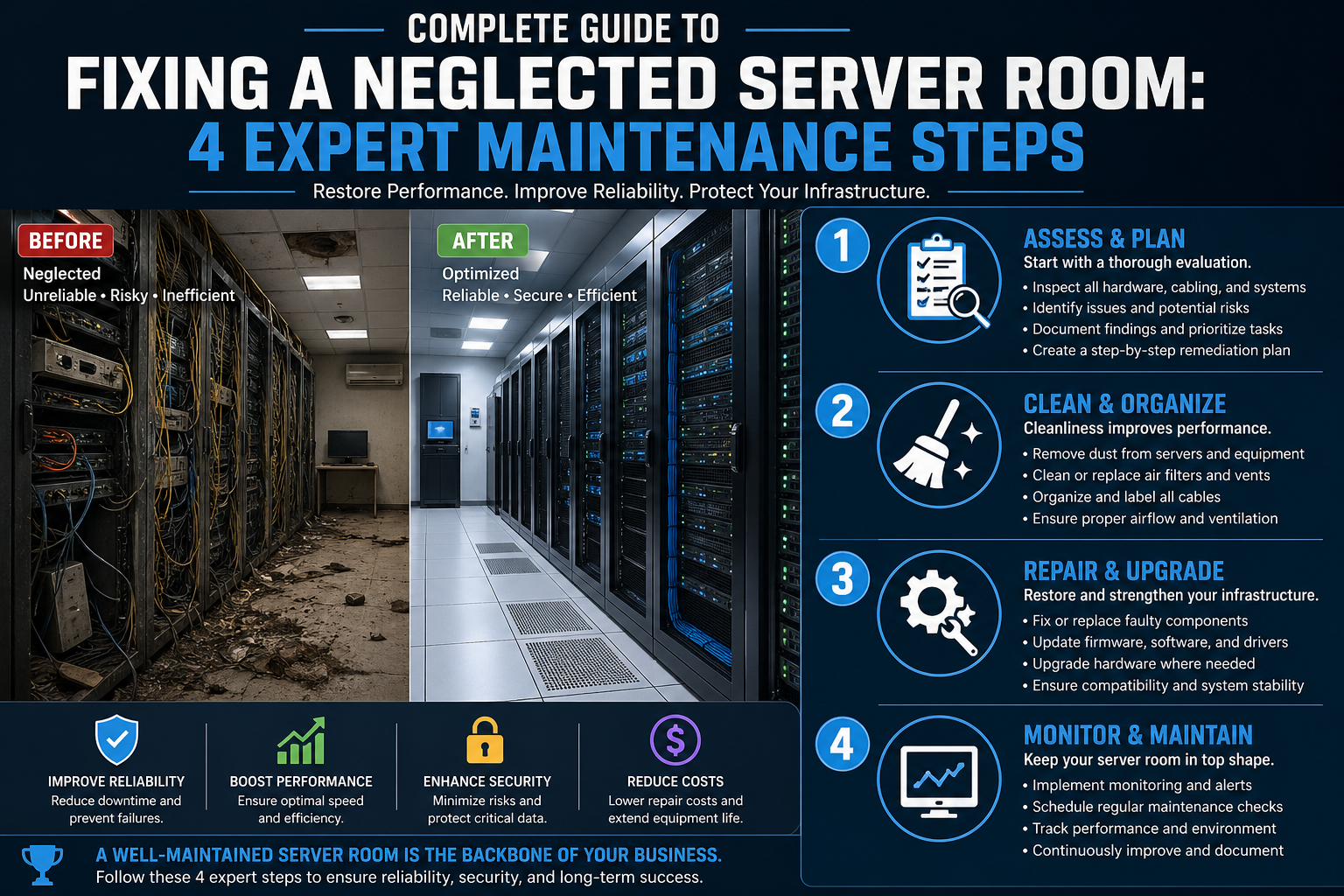
A neglected server room often tells its own story the moment you step inside it. The environment is usually filled with tightly packed racks, overlapping cable runs, and equipment that may have been added over time without a consistent physical structure. While the digital side of the network might still function as intended, the physical layer often reflects years of incremental changes, emergency fixes, and undocumented adjustments. This creates a situation where the infrastructure technically works but is increasingly fragile in practice.
In many real-world environments, server rooms evolve rather than being designed in a single controlled phase. Devices are added as business needs grow, connections are modified during urgent troubleshooting, and temporary solutions gradually become permanent. Over time, this leads to a physical layout that no longer reflects the logical network design. The result is a disconnect between what the network is supposed to look like and what the physical environment actually presents.
At first glance, this disorganization might seem like only a cosmetic issue, especially when services remain operational. However, the physical arrangement of cables and devices plays a significant role in how efficiently maintenance tasks can be performed. When a technician needs to trace a connection or replace a faulty line, the lack of structure transforms a simple task into a time-consuming and high-risk activity. Every movement inside such an environment requires caution, not because the network is unstable digitally, but because the physical handling of components becomes unpredictable.
The reality is that a server room is not just a storage space for equipment; it is a working environment that requires clarity and structure to support ongoing operations. When that structure is missing, even routine activities begin to carry unnecessary complexity. The physical mess does not immediately stop the network from functioning, but it steadily increases the difficulty of maintaining it.
Why Cable Chaos Becomes a Daily Operational Risk
Cable chaos is not just an inconvenience reserved for major maintenance days; it becomes a daily operational risk that quietly affects every interaction with the infrastructure. When cables are tangled, unlabeled, or routed without a clear system, even simple tasks require careful tracing and verification. This slows down response times and increases the chance of human error during routine work.
In a structured environment, identifying a connection is straightforward because each cable follows a predictable path. In a disorganized server room, however, cables often overlap, run in multiple directions, and blend visually into one another. This makes it difficult to distinguish one connection from another without physically disturbing the surrounding infrastructure. Each attempt to trace a cable introduces a level of disruption that could potentially affect other connections nearby.
The operational risk increases significantly when the environment is active, meaning systems are running and cannot be taken offline easily. In such cases, technicians must work around live systems, carefully avoiding accidental disconnections. A single mistake in a tangled setup can interrupt critical services, which is why physical cable management becomes directly tied to operational stability.
Beyond immediate risks, cable chaos also affects confidence during maintenance work. Technicians may need additional time to verify each connection, often retracing steps multiple times to ensure accuracy. This introduces delays that accumulate over time, especially in environments where frequent changes or troubleshooting tasks are required. What appears to be a simple patching job can quickly turn into a complex investigation simply due to poor physical organization.
The Hidden Cost of Disorganization in Network Infrastructure
The cost of disorganization in a server room is often underestimated because it does not appear as a direct financial expense on any invoice. Instead, it manifests through lost time, reduced efficiency, and increased operational stress. Every minute spent tracing cables or verifying connections is time not spent on productive network improvement or proactive maintenance.
One of the highest hidden costs is downtime risk. Even when systems remain operational, the likelihood of accidental disruption increases in a cluttered environment. A cable pulled slightly too hard or a connector mistakenly removed can cause unexpected outages. These incidents may be brief, but their impact on business operations can be substantial, especially when critical services are involved.
Another hidden cost lies in the cognitive load placed on technicians. Working in a disorganized environment requires constant attention to detail and heightened caution. Instead of focusing on problem-solving or optimization, a large portion of mental effort is spent simply navigating the physical layout. Over time, this reduces overall efficiency and increases fatigue during maintenance tasks.
There is also a long-term cost associated with scalability. As the network grows, a disorganized foundation makes future expansion more difficult. New cables must be added to an already congested environment, increasing complexity further. Without a clear physical structure, scaling the network becomes increasingly inefficient and risky.
Assessing the Existing Environment Before Making Changes
Before any physical changes are made in a neglected server room, it is essential to understand the existing environment in its current state. This assessment is not about immediately correcting problems but about developing a clear understanding of how the system is physically organized. Without this step, any attempt at improvement risks introducing new inconsistencies or disrupting existing functionality.
The assessment process involves observing how devices are currently connected and how cables are routed between them. In many cases, the physical layout will not match any available documentation, if documentation exists at all. This mismatch is common in environments that have evolved without strict physical standards. Understanding these discrepancies is critical before any restructuring begins.
During this stage, attention is often focused on identifying patterns within the chaos. Even in a disorganized setup, there are usually underlying structures that can be recognized. Certain racks may contain clusters of related equipment, or specific cable colors may indicate informal grouping systems used by previous technicians. Recognizing these informal patterns helps in building a foundation for future organization.
It is also important to observe potential points of risk during assessment. These include cables under tension, poorly supported connections, or areas where multiple cables converge without clear routing. Identifying these risks early allows for more informed decisions when changes are eventually introduced.
Building a Mental Model of the Network Layout
In environments where physical documentation is lacking or outdated, building a mental model of the network layout becomes a crucial step in understanding how everything is connected. This mental representation helps bridge the gap between what is physically visible and what the network is logically intended to achieve.
Creating this mental model requires careful observation of connection paths and device relationships. Each cable trace contributes to a broader understanding of how data flows through the physical environment. Over time, these individual observations form a structured internal map that guides future maintenance decisions.
The process is not instantaneous, as complex server rooms often contain layers of modifications accumulated over years. It requires repeated observation and verification to ensure accuracy. As more connections are understood, the mental model becomes increasingly reliable, allowing technicians to predict how changes in one area might affect another.
This internal mapping also plays an important role in reducing risk during intervention. When adjustments are made, having a clear understanding of the network’s physical structure helps prevent accidental disruption of unrelated systems. It provides a reference point that supports decision-making even in the absence of complete documentation.
The Role of Documentation in Untangling Complexity
Documentation serves as the bridge between physical infrastructure and operational understanding. In a neglected server room, the absence or inaccuracy of documentation is often one of the primary reasons why complexity has accumulated over time. Without a reliable reference, each change to the system risks becoming an isolated modification rather than part of a coherent structure.
Effective documentation does not simply record connections; it provides context for why those connections exist. This includes understanding the purpose of specific links, the role of devices within the network, and how different segments interact with one another. When this level of detail is missing, the physical environment becomes the only source of truth, which significantly increases the difficulty of maintenance.
Rebuilding documentation in such environments requires careful observation and verification. Each identified connection must be cross-checked against actual system behavior to ensure accuracy. This process can be time-intensive, but it is essential for establishing long-term stability. Without it, improvements made to physical organization may gradually degrade over time.
Once documentation begins to reflect reality more accurately, it becomes easier to introduce structured changes. Future maintenance tasks can be planned with greater confidence, and the risk of unintended consequences is significantly reduced. Documentation transforms the server room from a reactive environment into a manageable system.
Identifying Physical Risks in Cable-Dense Environments
Cable-dense environments present unique physical risks that are not always immediately visible. One of the most common issues is strain on connectors caused by improper cable tension. When cables are pulled tightly or lack proper support, the stress is transferred directly to connection points, increasing the likelihood of intermittent failures.
Another risk arises from restricted airflow. Dense cable arrangements can obstruct ventilation pathways within racks, leading to higher operating temperatures for equipment. Over time, this can reduce hardware lifespan and increase the probability of performance instability. Even if systems continue to function, they may operate under less-than-ideal conditions.
Physical accessibility is also a concern. In heavily congested server rooms, reaching a specific device or cable often requires moving or navigating around multiple obstacles. This increases the risk of accidental contact with unrelated components, especially during urgent maintenance tasks where speed is prioritized.
The accumulation of these risks does not always result in immediate failure, but it creates a fragile environment where small mistakes can have amplified consequences. Understanding these risks is essential before any restructuring or optimization work is undertaken.
Establishing a Baseline for Order Without Disruption
Before introducing major changes to a neglected server room, it is important to establish a baseline level of order that does not interfere with active systems. This baseline serves as a reference point for future improvements and ensures that essential services remain uninterrupted during the initial stages of organization.
Creating this baseline involves identifying which parts of the infrastructure are stable and should remain untouched during early restructuring efforts. It also includes recognizing areas where minor adjustments can be made safely without impacting system performance. This careful balance helps prevent unnecessary disruption while still moving toward improved organization.
The goal at this stage is not to achieve perfection but to introduce a minimal level of structure that supports further development. Even small improvements in cable alignment, labeling awareness, and routing clarity can significantly reduce operational difficulty. Once this baseline is in place, more comprehensive restructuring becomes safer and more manageable.
By focusing on controlled improvement rather than immediate overhaul, the environment begins to transition from chaotic to structured sustainably.
Designing a Practical Cable Management Strategy for Existing Infrastructure
A practical cable management strategy in an already active server room begins with acceptance of the current limitations of the environment. Unlike a new installation, where everything can be planned from the ground up, existing infrastructure requires careful integration of improvements without disrupting operational continuity. The strategy must focus on gradual correction rather than complete replacement of existing arrangements.
The first step in forming such a strategy is understanding that cable management is not only about physical tidiness but about creating a predictable structure. Predictability ensures that anyone interacting with the environment can anticipate where a cable originates, where it terminates, and how it is routed. Without this predictability, even small tasks become investigative exercises.
In a functioning but disorganized server room, the strategy must prioritize stabilizing critical pathways first. These are the connections that support core services and cannot tolerate interruption. Once stability is ensured in these areas, attention can shift toward less critical segments of the network.
A key principle in strategy development is minimizing unnecessary movement of existing cables. Each cable that is moved introduces potential risk, especially in environments where documentation is incomplete. Therefore, adjustments should be purposeful, small in scope, and fully understood before implementation.
Over time, this approach gradually transforms the environment into a more structured system without forcing large-scale disruption. The strategy evolves alongside the infrastructure, ensuring that improvements remain aligned with operational needs.
Establishing Structured Labeling Systems for Physical Clarity
Labeling is one of the most effective tools for bringing order to a complex server room, yet it is often inconsistently applied or entirely missing in neglected environments. A structured labeling system provides immediate clarity by assigning identifiable references to each cable, port, and device connection.
The effectiveness of labeling depends not only on its presence but on its consistency. Labels must follow a uniform pattern that applies across all parts of the infrastructure. When labeling varies from one area to another, confusion increases rather than decreases, defeating the purpose of the system.
In a disorganized environment, introducing labeling often requires a phased approach. It is not always possible to label everything at once, especially when cables are densely packed or difficult to access. Instead, labeling begins with the most critical or frequently accessed connections, gradually expanding outward.
Another important aspect of labeling is durability. Labels must remain readable over time despite environmental conditions such as heat, dust, and physical handling. If labels degrade quickly, the system loses its reliability, and the effort invested in creating it becomes less effective.
A well-structured labeling system also supports troubleshooting efficiency. When each connection can be identified without physical tracing, diagnostic processes become significantly faster and less disruptive. This reduces the need for unnecessary handling of cables, which in turn lowers operational risk.
Managing Cable Identification in Dense Environments
Dense cable environments present a unique challenge because visual distinction between cables becomes increasingly difficult. When multiple cables follow similar routes and share similar appearances, identifying individual connections requires more than visual inspection alone.
In such situations, identification relies heavily on systematic tracing combined with incremental verification. Each cable must be followed carefully from one endpoint to another, ensuring that its function and destination are correctly understood before any modifications are made.
A common difficulty in dense environments is the presence of overlapping cable layers. These layers can obscure underlying connections, making it difficult to determine the full path of a single cable without disturbing others. This requires a careful and methodical approach to avoid unnecessary disruption.
Another challenge is the presence of undocumented modifications made over time. These changes often create unexpected routing paths that do not align with existing assumptions about the layout. As a result, each cable must be treated as potentially unique until verified.
The goal of managing identification in such environments is not speed but accuracy. Misidentifying a single cable can lead to unintended service interruptions, making careful verification more important than rapid progress.
Working Safely in Live Server Environments
Working in a live server environment introduces constraints that significantly influence how physical changes can be made. Unlike inactive systems, where components can be freely adjusted, live environments require continuous awareness of operational impact.
One of the most important considerations is maintaining system stability during physical interaction. Any adjustment to cables or connections must be evaluated for potential impact before execution. This includes understanding not only the direct connection being modified but also any dependent systems.
Movement within the physical space must also be controlled. In tightly packed server rooms, accidental contact with unrelated cables is a real risk. Even slight disturbances can result in temporary connectivity issues or, in some cases, system interruptions.
Timing plays a crucial role in live environments. Certain maintenance activities may need to be performed during periods of lower system activity to reduce risk. This allows for more controlled adjustments without placing unnecessary strain on active services.
Communication is also essential when working in live environments. Coordinating with other personnel ensures that multiple changes are not made simultaneously in different areas of the system, which could lead to unintended interactions between modifications.
Creating a Step-by-Step Physical Cleanup Workflow
A structured cleanup workflow provides a controlled method for improving organization within a neglected server room. Without a defined workflow, cleanup efforts can become inconsistent, leading to partial improvements that do not address underlying structural issues.
The workflow begins with observation and mapping of existing conditions. This step focuses on understanding how cables are currently arranged without making immediate changes. The goal is to build a clear picture of the environment before intervention begins.
Once the environment is understood, the next step involves identifying priority areas. These are sections where disorganization has the greatest impact on functionality or maintenance difficulty. Addressing these areas first ensures that improvements deliver meaningful operational benefits.
Physical adjustments are then introduced gradually. Instead of attempting to reorganize large sections at once, changes are made in small, controlled increments. Each adjustment is verified before proceeding to the next, ensuring that no unintended disruptions occur.
The final stage of the workflow involves stabilization of the improved structure. This includes ensuring that cables remain secure, connections are properly supported, and no new tension points have been introduced during the cleanup process.
Organizing Rack Layouts for Functional Efficiency
Rack organization plays a central role in determining how efficiently a server room operates. When racks are arranged without clear logic, cable routing becomes unnecessarily complex, increasing both maintenance difficulty and risk.
A functional rack layout prioritizes logical grouping of related equipment. Devices that frequently interact with each other should be positioned in a way that minimizes cable distance and reduces unnecessary routing complexity. This helps create more direct and manageable connections.
Vertical and horizontal spacing within racks also influences cable behavior. Poor spacing can lead to congestion, where cables overlap excessively or become tightly compressed. Proper spacing allows for more natural cable routing and reduces physical strain on connectors.
Another important aspect of rack organization is accessibility. Equipment that requires frequent maintenance should be positioned in locations that allow easy access without disturbing surrounding components. This reduces the likelihood of accidental disruption during routine tasks.
Over time, improving rack organization contributes significantly to overall system maintainability. Even if underlying network complexity remains unchanged, improved physical structure reduces the effort required to manage it.
Standardizing Patch Panel Configurations Across Systems
Patch panels serve as central points of cable management within server rooms, and their configuration has a direct impact on overall organization. Without standardization, patch panels can become inconsistent, making it difficult to interpret connections across different sections of the infrastructure.
Standardization begins with establishing a uniform numbering or labeling system for ports. Each port should follow a predictable pattern that can be understood across the entire environment. This ensures that connections can be traced logically regardless of their location.
Consistency in cable routing within patch panels is equally important. Cables should follow structured paths that avoid unnecessary crossing or overlapping. This reduces visual confusion and makes it easier to identify individual connections.
When patch panels are standardized, troubleshooting becomes significantly more efficient. Technicians can quickly locate specific connections without needing to trace entire cable paths manually. This reduces downtime and improves response times during maintenance.
Standardization also supports scalability. As new equipment is added, it can be integrated into the existing system without disrupting established patterns. This ensures that the environment remains manageable even as it grows.
Separating Power and Data Pathways for Stability
Separation of power and data pathways is a critical principle in server room organization. When these two types of cabling are mixed or routed too closely together, it increases the risk of interference, accidental disconnection, and physical confusion during maintenance.
Power cables typically carry a higher physical risk due to their rigidity and electrical load. Keeping them separated from data cables reduces the chance of accidental disturbance during routine adjustments. It also helps prevent situations where data cables are mistakenly disconnected while working near power lines.
Routing power cables in dedicated pathways also improves airflow within racks. Data cables tend to be more flexible and can be arranged in tighter configurations, whereas power cables require more structured placement. Keeping them separate allows each type to be managed according to its physical characteristics.
Clear separation also improves visual clarity. When technicians enter a server room, being able to immediately distinguish between power and data lines reduces cognitive load and improves operational confidence.
This separation becomes even more important in dense environments where multiple systems are closely packed together. Without a clear distinction, the likelihood of confusion and error increases significantly.
Maintaining Real-Time Documentation During Adjustments
Real-time documentation is essential when making changes in a server room that lacks complete or accurate existing records. Instead of attempting to reconstruct all information after changes are made, documentation is updated continuously as adjustments occur.
This approach ensures that no detail is lost during the transition from a disorganized to a structured environment. Each modification is recorded at the moment it happens, including changes to cable routing, labeling, and device connections.
Real-time documentation also reduces the risk of inconsistencies. When information is recorded after the fact, details may be forgotten or misinterpreted. Capturing changes immediately helps maintain accuracy and reliability.
In complex environments, this documentation becomes a reference point for future maintenance. It allows technicians to understand not only the current state of the system but also the sequence of changes that led to that state.
Over time, continuous documentation transforms the server room into a well-understood system where physical structure aligns closely with recorded information, improving both stability and manageability.
Transitioning from Cleanup to Sustainable Operational Discipline
Once a server room has been physically reorganized and brought into a stable state, the challenge shifts from correction to consistency. Many environments fail not because they cannot be cleaned or structured, but because they gradually drift back into disorder after initial improvements. Sustainable operational discipline ensures that the improvements made during cleanup are preserved over time rather than eroding under day-to-day pressure.
At this stage, the focus is no longer on physical rearrangement but on behavior and process consistency. Every action that affects the physical network must follow a predictable pattern. This includes how new devices are introduced, how cables are routed during expansion, and how changes are verified before being finalized. Without this discipline, even a well-organized server room can slowly revert to its previous state.
Sustainability also depends on limiting informal or undocumented adjustments. In many environments, small “temporary” fixes are introduced under time pressure and later forgotten. These small deviations accumulate and gradually reintroduce the same problems that originally existed. Preventing this requires a mindset where even minor changes are treated as part of the formal system.
Another important aspect of operational discipline is consistency in physical handling. Cables, racks, and patch panels must always be treated with the same level of care regardless of urgency. When urgency overrides structure, physical integrity begins to degrade. Maintaining discipline during high-pressure situations is often what separates stable environments from unstable ones.
Over time, this disciplined approach creates a self-reinforcing structure where order becomes the default state rather than an exception. The server room begins to maintain its own stability through consistent behavior rather than periodic intervention.
Establishing Continuous Audit Routines for Physical Infrastructure
A structured server room requires ongoing verification to ensure that standards are being maintained. Continuous audit routines serve as a mechanism to regularly inspect and validate the physical state of the infrastructure. Without these routines, small deviations can go unnoticed until they accumulate into larger issues.
Audits are not intended to be disruptive events but rather systematic reviews of physical conditions. They focus on verifying that cables remain properly routed, labels are still legible, and connections continue to follow established conventions. This ongoing attention helps maintain alignment between the intended structure and the actual environment.
One of the key benefits of regular audits is early detection of drift. Drift refers to gradual deviation from established standards, often caused by small, uncoordinated changes over time. By identifying these deviations early, corrective action can be taken before they affect system stability.
Audits also help reinforce accountability within the environment. When physical infrastructure is regularly reviewed, there is a stronger incentive to maintain standards during daily operations. This reduces the likelihood of informal modifications that bypass established processes.
Another important aspect of audits is consistency in evaluation criteria. Without consistent standards, audits lose their effectiveness and become subjective. Clear criteria ensure that each review measures the same aspects of the environment, allowing for meaningful comparison over time.
Through continuous auditing, the server room remains aligned with its intended structure, reducing the risk of gradual degradation and supporting long-term operational reliability.
Managing Change Control for Physical Network Modifications
Change control is a critical discipline in environments where physical infrastructure supports active systems. Without structured control over modifications, even small changes can introduce unexpected consequences that affect stability and performance.
Effective change control begins with defining how modifications are requested, evaluated, and implemented. Each proposed change should be assessed not only for its immediate purpose but also for its impact on the surrounding infrastructure. This ensures that no adjustment is made in isolation.
In physical environments, change control must also consider spatial relationships. A modification in one rack or cable path may indirectly affect adjacent systems. Understanding these relationships is essential before any physical intervention is carried out.
Documentation plays a central role in change control. Every modification must be recorded in a way that clearly describes what was changed, why it was changed, and how it affects the overall structure. This record becomes essential for future troubleshooting and system understanding.
Another important element is approval discipline. Changes should not be executed informally, especially in critical environments. Even minor adjustments should follow a defined approval pathway to ensure consistency and traceability.
Over time, structured change control reduces uncertainty in the environment. It ensures that every modification contributes to system improvement rather than introducing hidden complexity.
Building Resilience Through Redundancy and Cable Path Diversification
Resilience in a server room is not only about digital redundancy but also about physical layout design. Cable path diversification is a key strategy that reduces dependency on single physical routes, ensuring that the failure of one path does not compromise the entire system.
When cables follow a single concentrated route, any disruption in that area can affect multiple systems simultaneously. Diversifying cable paths distributes risk and reduces the likelihood of large-scale impact from localized issues.
Redundancy also applies to physical accessibility. Critical connections should be arranged in a way that allows multiple access points, reducing dependency on a single physical entry path. This ensures that maintenance can continue even if one area becomes temporarily inaccessible.
However, resilience must be balanced with clarity. Excessive diversification without structure can reintroduce complexity. The goal is not randomness but controlled distribution that maintains order while reducing risk concentration.
Another aspect of physical resilience is minimizing single points of failure in cable management infrastructure itself. This includes ensuring that no single support structure or routing path becomes critical to multiple systems.
By incorporating redundancy into physical design, the server room becomes more tolerant of change, maintenance activity, and unexpected disruptions.
Environmental Factors: Airflow, Temperature, and Physical Layout Efficiency
The physical arrangement of a server room has a direct impact on environmental conditions such as airflow and temperature distribution. Poor cable management can obstruct airflow pathways, leading to uneven cooling and localized heat buildup around critical equipment.
When cables are densely packed or improperly routed, they can block ventilation channels within racks. This restricts the movement of cool air and reduces the efficiency of cooling systems. Over time, this can contribute to thermal stress on hardware components.
Temperature imbalance is not always immediately noticeable but can have long-term effects on system reliability. Equipment operating in consistently warmer conditions may experience reduced lifespan or intermittent performance issues.
Physical layout efficiency also influences how effectively cooling systems operate. When equipment is arranged in a structured manner, airflow can move predictably through the environment. This allows cooling systems to function more efficiently without compensating for obstructed pathways.
Cable routing should also consider vertical and horizontal airflow patterns. Proper spacing and alignment help maintain open channels that support consistent environmental conditions.
In well-structured environments, physical organization and environmental stability work together. When one is compromised, the other is affected, highlighting the importance of integrating environmental awareness into physical design decisions.
Lifecycle Management of Cables and Hardware Refresh Cycles
Cables and hardware components do not remain static indefinitely; they go through lifecycle stages that include installation, active use, wear, and eventual replacement. Without lifecycle management, outdated or degraded components remain in the system long after their optimal performance period.
Cable aging is often overlooked because cables do not typically fail abruptly. Instead, they degrade gradually through wear, bending stress, and environmental exposure. This can lead to intermittent connectivity issues that are difficult to diagnose.
Lifecycle management involves tracking when components were installed and evaluating their ongoing suitability for continued use. This ensures that aging infrastructure is replaced proactively rather than reactively after failure occurs.
Hardware refresh cycles also influence cable management indirectly. When equipment is replaced, associated cabling often requires reconfiguration. Without structured lifecycle planning, these transitions can introduce disorder into previously organized environments.
A disciplined approach to lifecycle management reduces the accumulation of outdated components. It ensures that the physical infrastructure evolves in a controlled manner rather than becoming a patchwork of different generations of equipment.
Over time, this approach contributes to a cleaner, more predictable environment that is easier to maintain and scale.
Incident Response Workflows in Structured Server Rooms
Even in well-organized server rooms, incidents can occur that require immediate physical intervention. A structured incident response workflow ensures that these situations are handled efficiently without compromising overall system stability.
The first element of effective response is situational awareness. Understanding the physical layout of the environment allows technicians to respond without causing unintended disruption to unrelated systems.
During incidents, structured environments provide a significant advantage because cables and connections are easier to identify. This reduces the time required to isolate problems and implement corrective actions.
However, incident response must still follow controlled procedures. Even under pressure, modifications should be made carefully to avoid introducing new issues. Structured workflows help maintain discipline during these high-stress situations.
Post-incident review is also an essential part of the workflow. After an issue is resolved, the physical cause must be documented and evaluated to prevent recurrence. This may involve adjusting cable routing, improving labeling, or modifying layout design.
Over time, structured incident response contributes to continuous improvement in physical infrastructure reliability.
Scaling Infrastructure Without Reintroducing Disorder
As networks grow, the risk of reintroducing disorder increases significantly. Scaling must therefore be approached as an extension of existing structure rather than a separate process. Without alignment, new additions can quickly disrupt established organization.
Scalability requires that new equipment integrates seamlessly into existing physical patterns. This includes following established routing conventions, labeling systems, and spatial organization principles.
One of the most common causes of disorder during scaling is inconsistent implementation. When new additions do not follow the same standards as existing infrastructure, fragmentation occurs.
Controlled scaling also requires anticipating future growth. Physical space, routing capacity, and structural flexibility must all be considered in advance to prevent congestion as the system expands.
By embedding scalability into the design of the environment, growth becomes a structured process rather than a disruptive one.
Human Factors: Training, Responsibility, and Access Discipline
The physical state of a server room is heavily influenced by human behavior. Even the most well-designed infrastructure can degrade if individuals interacting with it are not properly trained or guided.
Training ensures that everyone working in the environment understands the established standards and procedures. Without this understanding, inconsistency becomes inevitable.
Responsibility assignment is equally important. When ownership of specific areas or systems is unclear, accountability weakens, increasing the likelihood of uncoordinated changes.
Access discipline also plays a major role in maintaining order. Limiting physical access to authorized individuals reduces the frequency of uncontrolled modifications.
Together, these human factors create a controlled environment where physical structure is respected and maintained consistently over time.
Evolving the Server Room Into a Self-Maintaining System
Over time, a well-managed server room can evolve into a system that maintains its own structure with minimal intervention. This does not mean that maintenance becomes unnecessary, but rather that the environment naturally resists disorder due to embedded structure and discipline.
Self-maintenance emerges when physical organization, documentation, behavior, and process all align consistently. In such environments, deviations are easier to detect, changes are easier to control, and maintenance becomes more predictable.
This evolution is gradual and depends on sustained discipline across all aspects of infrastructure management. As structure becomes embedded into daily operations, the need for large corrective efforts decreases.
A self-maintaining environment is characterized by clarity, predictability, and resilience, where physical complexity is managed rather than accumulated, and where operational stability is supported by design rather than reaction.
Conclusion
A server room is often judged by whether systems are running, but true stability goes far beyond simple uptime. The physical environment behind those systems plays a defining role in how reliably, efficiently, and safely the network can be maintained over time. What begins as a tangled set of cables and undocumented connections is rarely just an aesthetic issue; it becomes a structural challenge that affects every future interaction with the infrastructure. Even when everything appears to function correctly on the surface, disorganization quietly increases operational risk in ways that only become visible during maintenance, troubleshooting, or expansion.
The transformation of a neglected server room is not achieved through a single effort but through a continuous process of understanding, structuring, and maintaining order. Early stages focus on observing and interpreting the existing environment without causing disruption. This phase is essential because it reveals the reality of the system as it exists, not as it was intended to be. From there, gradual improvements such as labeling, cable routing adjustments, and documentation rebuilding begin to introduce clarity into the physical layout.
However, physical cleanup alone is not enough to ensure long-term stability. Without consistent processes and disciplined behavior, even a well-organized environment will eventually drift back into disorder. This is why operational discipline becomes just as important as physical restructuring. Every change, no matter how small, contributes to the overall state of the system. When changes are made without structure, complexity accumulates again over time. When changes are controlled and documented, order is preserved and reinforced.
One of the most important outcomes of proper server room management is predictability. In a structured environment, technicians can anticipate how systems are connected, how cables are routed, and how changes will affect surrounding components. This predictability reduces risk during maintenance and allows work to be completed with greater confidence and efficiency. It also minimizes the likelihood of accidental disruptions, which are far more common in environments where physical structure is unclear.
Another key outcome is reduced cognitive load. In a disorganized server room, a significant amount of mental effort is spent simply navigating the physical environment. Technicians must constantly interpret cable paths, verify connections, and avoid unintended interference with other systems. In a structured environment, this burden is significantly reduced, allowing focus to shift toward problem-solving and system improvement rather than basic navigation.
Over time, structured cable management and disciplined operational practices also contribute to scalability. As systems grow, environments that already follow clear standards are able to integrate new equipment without introducing chaos. Expansion becomes a controlled extension of existing order rather than a disruptive event. This is one of the most valuable long-term benefits of investing effort into physical organization early and maintaining it consistently.
Equally important is the role of resilience. A well-structured server room is more tolerant of unexpected events because its physical organization reduces the likelihood of cascading failures. Clear separation of systems, predictable cable routing, and proper documentation all contribute to an environment where issues can be isolated and resolved more effectively. Even when problems occur, they are easier to diagnose and contain.
Ultimately, the condition of a server room reflects the discipline of the processes that govern it. Clean and structured environments are not the result of one-time effort but of ongoing commitment to clarity, consistency, and control. Every label placed, every cable routed correctly, and every documented change contributes to a system that becomes progressively easier to manage over time.
A neglected server room may still function, but it operates under hidden strain that grows with every unstructured change. A well-maintained one, on the other hand, supports efficiency, safety, and scalability in a way that makes daily operations smoother and less stressful. The difference is not only physical but operational, shaping how confidently and effectively the entire network can be managed in the long run.