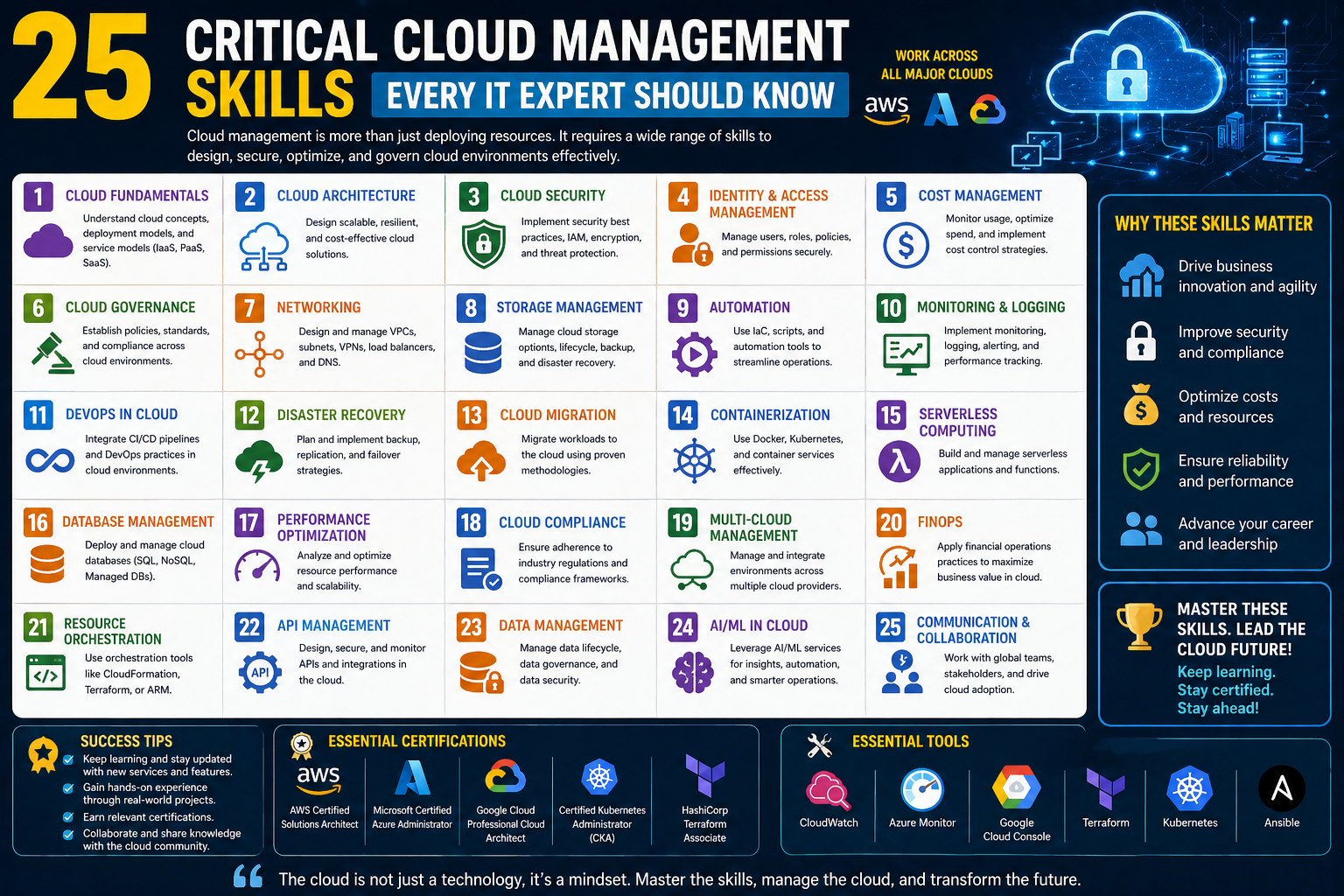
Businesses across the world are steadily shifting their operations toward cloud-based systems. This transition is not just a technical upgrade but a complete transformation in how IT services are designed, delivered, and maintained. As a result, cloud management skills have become essential for IT professionals who want to remain relevant in this evolving landscape. Understanding these skills provides a foundation for working effectively in cloud environments where traditional infrastructure thinking is no longer enough.
Linux as the Foundation of Cloud Infrastructure
Linux plays a central role in cloud computing environments because most cloud platforms rely heavily on Linux-based systems. Cloud servers, virtual machines, and containerized applications are frequently built on Linux due to its stability, flexibility, and efficiency. For IT professionals, understanding Linux is not limited to basic commands but extends to system configuration, user management, process control, and performance optimization.
In cloud environments, Linux is used to deploy applications, manage virtual machines, and support backend infrastructure. Engineers often work with command-line tools rather than graphical interfaces, making familiarity with terminal operations essential. File system navigation, permission structures, and system monitoring are part of everyday cloud operations.
Another important aspect of Linux in cloud computing is its role in automation and scripting. Many cloud tasks are performed using shell scripts that help reduce manual effort and improve efficiency. These scripts can manage deployments, monitor system health, and configure services automatically.
Since cloud platforms rely on scalability, Linux systems are often optimized to handle dynamic workloads. This requires understanding system resources such as CPU usage, memory allocation, and disk performance. A strong grasp of these areas helps ensure that cloud environments remain stable and responsive under varying loads.
Programming Skills for Cloud-Based Systems
Programming has become a core requirement in cloud management due to the increasing reliance on automation, integration, and custom application development. Unlike traditional IT environments, where coding may have been optional for some roles, cloud environments often require scripting and development skills across multiple functions.
Cloud platforms use application programming interfaces that allow different services to communicate with each other. Working with these interfaces requires an understanding of programming logic and data structures. IT professionals may need to write scripts to automate deployments, manage resources, or integrate services across platforms.
Programming in cloud environments is often focused on efficiency and scalability rather than building large applications from scratch. Scripts are commonly used to handle repetitive tasks such as provisioning servers, configuring networks, or managing storage resources. This reduces manual intervention and improves consistency across systems.
Different programming languages are used depending on the cloud task. Some languages are better suited for automation, while others are used for building cloud-native applications. The key is understanding how to apply programming logic to solve infrastructure problems rather than focusing solely on software development.
Debugging and troubleshooting are also important programming-related skills in cloud environments. Since systems are distributed across multiple services, identifying issues requires analyzing logs, tracing execution paths, and understanding how different components interact.
Database Management in Cloud Systems
Databases are a critical component of cloud infrastructure because they store and manage the data that applications rely on. In cloud environments, databases are no longer confined to a single physical location but are distributed across multiple servers and regions for performance and reliability.
Cloud database systems are designed to scale automatically based on demand. This means that database management involves understanding how data is distributed, replicated, and synchronized across environments. IT professionals must ensure that data remains consistent and accessible even during high traffic or system failures.
Traditional database concepts such as relational structures still apply, but cloud environments also introduce flexible data models that allow for more dynamic storage solutions. These systems are designed to handle large volumes of unstructured or semi-structured data, which is common in modern applications.
Performance optimization is another important aspect of cloud database management. This includes indexing strategies, query optimization, and resource allocation. Since cloud databases often operate on shared infrastructure, efficient resource usage is essential to maintain performance and control costs.
Security also plays a major role in cloud database management. Data must be protected both in transit and at rest. Access control mechanisms ensure that only authorized users and applications can interact with sensitive information. Encryption and authentication methods are commonly used to maintain data integrity.
Managing Multi-Cloud Environments
Many organizations now use more than one cloud provider to meet different operational needs. This approach is known as a multi-cloud strategy. While it offers flexibility and redundancy, it also introduces complexity in management and coordination.
In a multi-cloud environment, IT professionals must deal with different interfaces, tools, and service models. Each cloud provider may have its own way of handling storage, networking, and computing resources. Understanding these differences is essential for maintaining consistency across platforms.
One of the main challenges in multi-cloud management is visibility. IT teams need a unified view of all cloud resources to monitor performance, security, and usage. Without centralized oversight, managing multiple environments can become fragmented and inefficient.
Data transfer between cloud platforms is another important consideration. Moving workloads across different environments requires careful planning to avoid downtime or data loss. Compatibility between systems must also be evaluated to ensure smooth integration.
Multi-cloud strategies also require strong governance practices. Policies must be defined to manage access, security, and compliance across all platforms. This ensures that organizational standards are maintained regardless of where the data or applications are hosted.
Artificial Intelligence and Machine Learning in Cloud Systems
Artificial intelligence and machine learning are increasingly integrated into cloud environments to enhance automation, analytics, and decision-making. These technologies allow systems to learn from data and improve performance over time without direct human intervention.
In cloud management, artificial intelligence is used to optimize resource allocation, detect anomalies, and predict system behavior. This helps IT teams identify potential issues before they become critical problems. Machine learning models can analyze large volumes of data generated by cloud systems to provide insights into performance and usage patterns.
Cloud-based AI services are also used to support applications such as virtual assistants, recommendation systems, and predictive analytics tools. These applications rely on large-scale computing power that cloud platforms are well-suited to provide.
Understanding how artificial intelligence works at a conceptual level is important for cloud professionals. While they may not be responsible for building complex models, they need to understand how AI-driven systems interact with cloud infrastructure.
Data quality plays a significant role in the effectiveness of machine learning systems. Cloud engineers must ensure that data is properly collected, stored, and processed to support accurate model training and predictions.
Automation in Cloud Operations
Automation is a key element of modern cloud environments because it reduces manual effort and increases operational efficiency. In cloud systems, automation is used to manage deployments, monitor performance, and handle routine maintenance tasks.
Automated processes can respond to system events without human intervention. For example, if system demand increases, additional resources can be automatically allocated to maintain performance. Similarly, unused resources can be scaled down to reduce costs.
Cloud automation is closely linked with orchestration, which involves coordinating multiple automated tasks across different systems. While automation focuses on individual tasks, orchestration manages entire workflows that involve multiple components working together.
Scripts and configuration tools are commonly used to implement automation in cloud environments. These tools allow IT professionals to define rules and conditions that determine how systems should behave under different circumstances.
The main advantage of automation is consistency. Automated systems reduce the risk of human error and ensure that processes are executed in the same way every time. This improves reliability and stability across cloud environments.
Serverless Architecture in Cloud Computing
Serverless architecture represents a shift in how applications are built and deployed in cloud environments. In this model, developers focus on writing application logic without worrying about managing the underlying infrastructure.
In traditional systems, servers must be provisioned, configured, and maintained. Serverless architecture removes this responsibility by allowing cloud providers to handle infrastructure management automatically. This allows applications to scale dynamically based on demand.
Serverless systems are event-driven, meaning that functions are executed in response to specific triggers such as user actions or system events. This makes them highly efficient for workloads that are unpredictable or intermittent.
One of the key benefits of serverless architecture is cost efficiency. Since resources are only used when functions are executed, organizations only pay for actual usage rather than idle capacity.
From a management perspective, serverless systems require understanding how functions interact with other cloud services. This includes storage systems, databases, and external APIs.
DevOps Practices in Cloud Environments
DevOps is a collaborative approach that combines software development and IT operations into a unified process. In cloud environments, DevOps practices are essential for delivering applications quickly and reliably.
The main idea behind DevOps is to break down traditional barriers between development and operations teams. Instead of working separately, teams collaborate throughout the entire application lifecycle, from planning and development to deployment and maintenance.
Continuous integration and continuous delivery are key components of DevOps. These practices ensure that code changes are tested and deployed frequently, reducing the time between development and production.
Automation plays a major role in DevOps workflows. Build processes, testing, and deployment are often automated to improve speed and reduce errors.
Monitoring and feedback are also important aspects of DevOps. Performance data is continuously collected and analyzed to improve system reliability and application performance.
Cloud Security Fundamentals
Security is one of the most critical aspects of cloud management because cloud environments are exposed to a wide range of threats. Unlike traditional systems that operate within controlled environments, cloud systems are accessible over the internet, increasing their exposure to potential risks.
Cloud security involves protecting data, applications, and infrastructure from unauthorized access and attacks. This includes implementing access control mechanisms, encryption, and authentication systems.
Monitoring is a key component of cloud security. Continuous observation of system activity helps detect unusual behavior that may indicate security threats. Logging systems record events that can be analyzed for forensic purposes.
Another important aspect is compliance. Cloud environments must adhere to industry standards and regulatory requirements depending on the type of data being handled. This ensures that security practices meet legal and organizational expectations.
Security in cloud environments is an ongoing process that requires constant updates and improvements to address emerging threats.
Adaptability in Cloud Technology Roles
Adaptability is an essential skill for IT professionals working in cloud environments because technology in this field evolves rapidly. New tools, platforms, and methodologies are introduced frequently, requiring continuous learning and adjustment.
Cloud systems are dynamic by nature, meaning that configurations, workloads, and requirements can change quickly. Professionals must be able to respond to these changes effectively without disrupting operations.
Adaptability also involves problem-solving in unfamiliar situations. Since cloud environments can be complex and distributed, issues may not always have straightforward solutions. The ability to analyze situations and adjust approaches is essential.
Learning new technologies is a constant requirement in cloud computing. Professionals must stay updated with changes in platforms, tools, and best practices to remain effective in their roles.
Flexibility in thinking and working methods helps IT professionals handle the challenges of modern cloud environments where traditional fixed approaches are often not sufficient.
Managing Change in Cloud Migration Environments
Change management plays a central role in cloud migration because it governs how modifications are introduced into live systems without disrupting business operations. In cloud environments, where infrastructure is dynamic and distributed, even minor changes can have wide-ranging effects. This makes structured control over updates, configurations, and deployments essential.
In practical terms, change management ensures that every modification is planned, documented, and reviewed before implementation. This includes adjustments to applications, infrastructure components, security policies, and service configurations. The goal is to reduce uncertainty and prevent unexpected system failures during transitions.
Cloud-based systems require a more disciplined approach to change compared to traditional environments because resources are interconnected across multiple services and regions. A single update may impact databases, virtual machines, storage layers, and networking components simultaneously. Without proper coordination, these dependencies can lead to performance degradation or service outages.
A key element of change management in cloud environments is structured approval workflows. Changes are not implemented directly but move through defined stages of evaluation. This process ensures that technical and operational risks are assessed before deployment.
Another important aspect is rollback preparedness. Since cloud systems are highly dynamic, the ability to revert changes quickly is critical. Rollback mechanisms allow teams to restore previous system states in case an update introduces unexpected issues. This reduces downtime and protects service continuity.
Change tracking is also essential in cloud environments. Every modification must be recorded to maintain visibility into system evolution. This helps teams understand what changes were made, when they occurred, and who implemented them. Such transparency is important for troubleshooting and auditing purposes.
Effective change management also improves communication between teams. Developers, operations staff, and security teams must collaborate closely to ensure that changes align with business requirements and technical constraints. This coordination reduces the risk of conflicting updates and system instability.
Designing Hybrid Cloud Environments for Operational Balance
Hybrid cloud architecture is widely used by organizations that want to combine private infrastructure with public cloud services. This approach allows businesses to balance control, security, and scalability by distributing workloads across different environments based on their requirements.
In a hybrid model, sensitive data and critical systems are often kept in private infrastructure, while less sensitive workloads are deployed in public cloud environments. This separation allows organizations to maintain control over important assets while benefiting from the flexibility of cloud services.
One of the main challenges in hybrid cloud design is integration. Systems must communicate seamlessly across environments despite differences in platforms, configurations, and service models. This requires careful planning of networking, authentication, and data transfer mechanisms.
Data consistency is another important factor. Information must remain synchronized between private and public environments to ensure that applications function correctly. This often involves replication strategies and synchronization tools that maintain real-time or near-real-time data alignment.
Hybrid cloud environments also require a strong security design. Since data moves between different infrastructures, encryption and access control mechanisms must be consistently applied across all layers. This ensures that sensitive information remains protected regardless of where it is stored or processed.
Performance optimization is equally important in hybrid setups. Workloads must be distributed in a way that minimizes latency and maximizes efficiency. This often involves analyzing traffic patterns and determining the best location for each application component.
Hybrid cloud models also provide flexibility for scaling resources. Organizations can expand capacity into public cloud environments during peak demand periods while maintaining baseline operations in private infrastructure. This elasticity helps manage costs and performance effectively.
Selecting Cloud Service Providers in Complex Environments
Choosing a cloud service provider is a strategic decision that impacts performance, cost, security, and scalability. Organizations must evaluate providers based on their ability to meet technical requirements as well as long-term operational goals.
Different providers offer varying strengths in areas such as computing power, storage options, networking capabilities, and managed services. Understanding these differences is essential when aligning business needs with cloud capabilities.
One of the key considerations in provider selection is service reliability. Organizations must assess uptime guarantees, infrastructure redundancy, and disaster recovery capabilities. These factors determine how resilient a cloud platform is under failure conditions.
Security features are also a major evaluation criterion. Providers implement different models for data protection, identity management, and threat detection. IT professionals must understand how these security mechanisms align with organizational policies.
Cost structure is another important factor. Cloud pricing models vary based on resource usage, data transfer, storage consumption, and service tiers. Evaluating long-term cost implications is essential to avoid unexpected expenses.
Another consideration is ecosystem compatibility. Some providers offer stronger integration with specific tools, frameworks, or operating systems. This can influence development efficiency and system performance.
Support services also play a significant role in provider selection. The availability of technical assistance, documentation, and response times can affect operational stability during critical incidents.
Ultimately, selecting a provider involves balancing technical capabilities with business objectives. In many cases, organizations adopt multiple providers to reduce dependency and increase flexibility across their cloud strategy.
Collaboration with Cloud Service Partners
Cloud environments often rely on external partners to provide specialized expertise, tools, or services that are not available internally. These partners play a significant role in supporting the implementation, migration, and ongoing management of cloud systems.
Cloud partners may include consultants, managed service providers, or specialized vendors that contribute to different aspects of cloud operations. Their involvement allows organizations to access advanced skills without building all capabilities in-house.
Effective collaboration with cloud partners requires clear communication and well-defined responsibilities. Each party must understand its role in system design, deployment, and maintenance to avoid confusion and operational gaps.
Integration between internal teams and external partners is also important. Cloud systems are complex, and successful implementation depends on coordinated efforts across multiple stakeholders. Regular communication helps ensure alignment between technical execution and business objectives.
Security and access control are critical when working with external partners. Controlled access must be granted to cloud environments while maintaining strict governance over sensitive data and systems. This ensures that collaboration does not compromise security standards.
Cloud partners often bring specialized knowledge of specific platforms or technologies. This expertise can accelerate deployment processes and improve system efficiency. Their experience helps organizations avoid common mistakes during migration and optimization.
Another benefit of working with partners is the scalability of resources. Organizations can quickly expand their capabilities during large projects without hiring additional permanent staff. This flexibility is particularly useful during complex cloud transformations.
However, dependency on external partners must be carefully managed. Organizations should avoid over-reliance and ensure that internal teams retain sufficient knowledge to maintain systems independently.
Approaches to Application Transition in Cloud Systems
Application migration is one of the most critical aspects of cloud transformation because it involves moving software systems from traditional environments to cloud platforms. This process requires careful planning to ensure that applications continue to function correctly after migration.
Different applications require different migration approaches depending on their architecture, complexity, and business importance. Some applications can be moved with minimal changes, while others require significant redesign.
One approach involves directly moving applications to cloud infrastructure without modifying their core structure. This method is often used for legacy systems that need quick migration but may not fully utilize cloud-native capabilities.
Another approach involves modifying certain components of an application to improve compatibility with cloud environments. This allows organizations to gain better performance and scalability while maintaining much of the original structure.
In some cases, applications are completely redesigned to take full advantage of cloud architecture. This involves rethinking how the application is built, deployed, and managed to align with modern cloud capabilities.
Not all applications are suitable for migration. Some systems may be retired or replaced with alternative solutions that better fit cloud environments. This decision is typically based on cost, complexity, and business value.
Testing plays a critical role in application migration. Applications must be validated in cloud environments to ensure that functionality, performance, and security requirements are met before full deployment.
Data migration is also an important consideration. Applications often rely on large volumes of data that must be transferred accurately and securely to cloud storage systems.
Evaluating System Performance in Cloud Deployments
Performance testing is essential in cloud environments because it ensures that systems operate efficiently under varying workloads. Cloud systems must handle dynamic demand, making performance validation a continuous requirement.
Testing typically involves analyzing how applications respond under different levels of usage. This helps identify bottlenecks that may affect responsiveness or stability. Understanding system behavior under stress is particularly important in cloud environments where demand can fluctuate rapidly.
Resource utilization is another key focus of performance evaluation. This includes monitoring CPU usage, memory consumption, and storage efficiency. Proper analysis helps ensure that resources are allocated effectively.
Scalability testing is also important. Cloud systems are designed to scale based on demand, and performance testing helps verify that scaling mechanisms function correctly. This ensures that systems can handle increased traffic without degradation.
Latency measurement is another critical aspect. In distributed cloud environments, data may travel across multiple regions, affecting response times. Testing helps identify delays and optimize data flow.
Monitoring tools are often used to collect real-time performance data. This information is used to make adjustments and improve system efficiency over time.
Performance testing also supports cost management. By understanding resource usage patterns, organizations can optimize infrastructure to reduce unnecessary expenses while maintaining performance.
Cloud-First Strategy in Modern IT Planning
A cloud-first strategy prioritizes cloud-based solutions when designing or deploying new IT systems. This approach reflects the growing reliance on cloud infrastructure as the foundation for modern digital operations.
In a cloud-first model, organizations evaluate cloud options before considering traditional on-premises solutions. This ensures that cloud capabilities are fully considered during decision-making processes.
One of the main advantages of this strategy is scalability. Cloud systems can adjust resources dynamically based on demand, making them well-suited for variable workloads.
Another benefit is faster deployment. Cloud platforms allow applications and services to be launched more quickly compared to traditional infrastructure setups. This improves responsiveness to business needs.
Cost efficiency is also a key factor in cloud-first strategies. Instead of investing heavily in physical infrastructure, organizations can use cloud resources on demand, reducing upfront capital expenditure.
Cloud-first planning also supports innovation. Organizations can experiment with new technologies without significant infrastructure investment, allowing faster adoption of emerging solutions.
However, this approach requires careful governance. Not all workloads are suitable for cloud environments, and decisions must consider security, compliance, and performance requirements.
A cloud-first mindset also influences long-term IT architecture. Systems are designed with cloud compatibility in mind from the beginning, ensuring smoother integration and scalability as needs evolve.
Understanding Cost Centers in Cloud Environments
In cloud computing, cost management is no longer a secondary concern handled only by finance teams. Instead, it has become an essential responsibility for IT professionals working directly with infrastructure, applications, and services. Cloud resources are closely tied to usage-based pricing models, which means every decision made at the technical level can directly influence financial outcomes.
Cost centers in cloud environments typically refer to core resource categories such as computing power, storage systems, and networking usage. These categories help organizations break down and analyze where money is being spent. Unlike traditional IT setups, where costs were largely fixed and predictable, cloud environments introduce variable expenses that depend on demand and consumption.
Computing resources represent the processing power used by virtual machines, containers, and serverless functions. Costs in this category are influenced by factors such as CPU usage, memory allocation, and runtime duration. As workloads scale up or down, computing expenses change dynamically.
Storage costs are associated with how much data is stored and how frequently it is accessed. Cloud storage systems often include different tiers that vary in performance and price. Frequently accessed data may be stored in higher-cost, high-performance storage, while archived data may be moved to lower-cost options.
Networking costs are driven by data transfer between services, regions, and external users. In cloud environments, moving data across regions or out of the cloud provider’s infrastructure can significantly impact overall expenses. This makes data flow management an important part of cost optimization.
Understanding cost centers requires IT professionals to think beyond technical performance and consider financial efficiency. Every architecture decision, from system design to deployment strategy, can influence long-term operational costs.
Key Cost Factors in Cloud Infrastructure
Cloud computing costs are influenced by multiple factors that go beyond simple resource usage. These factors include configuration choices, workload behavior, service selection, and architectural design decisions.
One of the most important cost drivers is resource sizing. Selecting the appropriate computing power, memory allocation, and storage capacity is essential for balancing performance with cost efficiency. Over-provisioning leads to unnecessary expenses, while under-provisioning can result in performance issues.
Workload patterns also play a significant role in determining costs. Some applications run continuously, while others operate intermittently based on user demand. Continuous workloads generate predictable costs, whereas variable workloads require careful monitoring to avoid unexpected spikes in spending.
Geographical distribution of resources affects pricing as well. Cloud providers often charge different rates depending on the region where services are deployed. This means that hosting applications in multiple regions can impact overall cost structures.
Data transfer is another key factor. Internal data movement within cloud systems may have minimal cost, but transferring data between regions or outside the cloud environment can be significantly more expensive. Efficient data architecture design helps reduce unnecessary transfer costs.
Service selection also influences expenses. Managed services often reduce operational complexity but may come at a higher price compared to manually configured infrastructure. Choosing between convenience and cost efficiency is an important decision in cloud planning.
Cloud Cost Estimation and Planning Methods
Estimating cloud costs requires a structured approach that considers both technical requirements and usage expectations. Unlike traditional IT budgeting, where expenses are largely fixed, cloud cost estimation must account for dynamic and variable consumption patterns.
The first step in cost estimation involves identifying resource requirements. This includes determining the amount of computing power, storage capacity, and network bandwidth needed to support applications and services.
Once resource requirements are defined, usage patterns must be analyzed. Understanding whether workloads are constant, periodic, or unpredictable helps in selecting appropriate pricing models and resource configurations.
Cost estimation also involves selecting service tiers. Cloud providers offer different levels of performance and pricing for computing, storage, and networking services. Choosing the right combination of tiers is essential for balancing performance and cost.
Another important aspect is forecasting growth. Cloud environments are scalable, but increased usage leads to higher costs. Predicting future demand helps organizations prepare financially for scaling operations.
Cost modeling tools are often used to simulate different scenarios. These models help IT professionals understand how changes in architecture or usage patterns can affect overall expenses.
Accurate cost estimation is not a one-time activity but an ongoing process. As systems evolve and workloads change, cost models must be continuously updated to reflect current conditions.
Capital Expenditure and Operational Expenditure in Cloud Models
Cloud computing fundamentally changes how organizations manage IT spending by shifting costs from capital expenditure to operational expenditure. This transition has significant implications for budgeting, planning, and financial control.
Capital expenditure refers to upfront investments in physical infrastructure such as servers, networking equipment, and storage systems. In traditional IT environments, organizations had to purchase and maintain their own hardware, which required significant initial investment.
Operational expenditure, on the other hand, involves paying for resources based on usage. In cloud environments, organizations pay for computing power, storage, and services as they consume them. This eliminates the need for large upfront investments.
One of the main advantages of operational expenditure models is flexibility. Organizations can scale resources up or down based on demand without being locked into fixed infrastructure costs.
However, this flexibility also introduces variability in budgeting. Since costs are usage-based, monthly expenses can fluctuate depending on system activity. This requires careful monitoring and financial planning.
The shift from capital to operational expenditure also impacts organizational structure. Financial responsibility for IT resources becomes more distributed, involving both technical and business teams.
Total Cost of Ownership in Cloud Decision Making
Total cost of ownership is a comprehensive approach to evaluating cloud investments. It considers not only direct usage costs but also indirect expenses associated with deployment, maintenance, and operation.
In cloud environments, the total cost of ownership includes computing, storage, networking, and service fees. However, it also accounts for migration efforts, training requirements, and operational overhead.
One important component of the total cost of ownership is existing infrastructure. Organizations must consider how much value can be extracted from current systems before transitioning to the cloud.
Another factor is skill availability. Managing cloud systems requires specific expertise, and training or hiring costs must be included in overall calculations.
Service agreements and vendor contracts also influence total cost. These agreements define pricing structures, support levels, and usage limitations, all of which affect long-term expenses.
Application complexity is another consideration. Highly customized applications may require additional effort to migrate and maintain in cloud environments, increasing total cost.
Total cost of ownership analysis helps organizations make informed decisions by providing a complete view of financial impact over time rather than focusing only on short-term expenses.
Understanding Cloud Workload Economics
Cloud workloads refer to the amount of processing, storage, and network activity generated by applications running in cloud environments. These workloads directly influence cost, performance, and resource allocation.
Each workload consists of multiple components, including computing tasks, data processing operations, and communication between services. The complexity of these components determines overall resource consumption.
Workload costs are often calculated based on usage metrics such as processing time, memory consumption, and data transfer volumes. These metrics help organizations understand how resources are being utilized.
One important aspect of workload management is optimization. Efficient workloads reduce unnecessary resource consumption, leading to lower operational costs without compromising performance.
Scalability is another key factor in workload management. Cloud systems are designed to handle fluctuating demand, and workloads must be able to adjust dynamically to changing conditions.
Workload analysis also helps identify inefficiencies. By studying usage patterns, organizations can detect underutilized resources or overly complex processes that unnecessarily increase costs.
Migration Costs in Cloud Transformation Projects
Migrating systems to the cloud involves more than simply transferring data and applications. It includes a wide range of activities that contribute to overall migration costs.
One major cost factor is data transfer. Moving large volumes of data from on-premises systems to cloud environments requires bandwidth and time, both of which contribute to expense.
Another important factor is system modification. Applications may need to be adjusted or reconfigured to function properly in cloud environments, which requires development effort.
Testing is also a significant part of migration costs. Systems must be validated to ensure that they perform correctly after migration, which involves both time and resources.
Operational downtime can also contribute to migration costs. Even carefully planned migrations may result in temporary service interruptions that affect business operations.
Additional staffing requirements may be necessary during migration projects. Specialized expertise is often needed to manage complex transitions, increasing overall project costs.
Migration costs are often underestimated because they include both direct technical expenses and indirect operational impacts. Proper planning helps reduce unexpected financial burdens.
Expense Control and Budget Management in Cloud Systems
Controlling cloud expenses requires continuous monitoring and proactive management. Unlike fixed-cost environments, cloud systems require ongoing attention to ensure that spending remains within acceptable limits.
One approach to cost control is resource monitoring. Tracking usage of computing, storage, and networking resources helps identify areas where costs can be reduced.
Another important strategy is setting usage limits. Cloud platforms often allow organizations to define maximum spending thresholds to prevent unexpected cost increases.
Optimization of resource allocation also plays a key role. Adjusting system configurations to match actual demand helps eliminate waste and improve efficiency.
Automation can also support cost control by dynamically scaling resources based on demand. This ensures that systems only use the resources they need at any given time.
Cost visibility is essential for effective budget management. Organizations must have clear insights into how and where money is being spent across different cloud services.
Financial accountability is often distributed across teams in cloud environments. This encourages responsible usage of resources and better alignment between technical decisions and financial outcomes.
Strategic Financial Planning for Cloud Adoption
Cloud adoption requires careful financial planning to ensure that investments align with organizational goals. This involves balancing performance requirements, scalability needs, and cost constraints.
One of the main challenges in financial planning is unpredictability. Since cloud usage is dynamic, organizations must prepare for fluctuating expenses over time.
Long-term planning is essential for managing cloud costs effectively. This includes forecasting growth, evaluating service requirements, and anticipating changes in workload patterns.
Financial planning also involves evaluating trade-offs between performance and cost. Higher performance often comes at a higher price, requiring careful prioritization based on business needs.
Risk management is another important aspect of cloud financial planning. Organizations must consider potential cost overruns, service disruptions, and inefficiencies when designing budgets.
Strategic planning ensures that cloud investments support broader business objectives rather than focusing solely on technical implementation.
By integrating financial considerations into cloud architecture decisions, organizations can build more sustainable and efficient systems that align with long-term operational goals.
Cloud computing continues to reshape enterprise IT by enabling scalable, flexible, and cost-efficient infrastructure. Organizations increasingly rely on cloud platforms to support applications, data storage, and global operations. This shift demands professionals skilled in automation, security, and system optimization. Key areas such as DevOps, multi-cloud management, and serverless computing are becoming standard in modern architectures. At the same time, cost optimization and performance monitoring remain critical for sustainable operations. As cloud technologies evolve, adaptability and continuous learning are essential for IT professionals to stay effective and competitive in rapidly changing digital environments.
Conclusion
Cloud computing has reshaped the way modern IT systems are designed, deployed, and managed, shifting the focus from physical infrastructure to highly flexible, software-driven environments. Across all three parts of this discussion, one theme remains consistent: success in cloud environments depends on a combination of technical expertise, operational discipline, and financial awareness. The role of an IT professional is no longer limited to maintaining systems; it now extends into designing scalable architectures, automating operations, securing distributed environments, and making cost-conscious decisions that directly influence business outcomes.
The evolution of cloud management skills reflects this broader transformation. Foundational technologies such as Linux continue to provide the backbone for cloud infrastructure, while programming and scripting skills enable automation and integration across complex systems. At the same time, database management has expanded beyond traditional structures into distributed, scalable models that support global applications. These technical competencies are essential, but they are no longer sufficient on their own. Modern cloud environments demand professionals who can also work across multi-cloud systems, understand serverless architectures, and apply DevOps principles to streamline development and operations.
Equally important is the growing influence of automation and artificial intelligence in cloud ecosystems. Automation reduces manual intervention and ensures consistency, while AI-driven systems enhance decision-making through predictive analysis and intelligent resource management. These technologies are not replacing human expertise but rather amplifying it, allowing IT teams to focus on higher-level design and optimization tasks instead of repetitive operational work.
Security remains a foundational concern throughout all cloud operations. As systems become more distributed and interconnected, the potential attack surface expands significantly. This makes cloud security a continuous responsibility rather than a one-time implementation. Professionals must ensure that data protection, identity management, and monitoring systems are consistently applied across all layers of the infrastructure. Without strong security practices, even the most advanced cloud systems can become vulnerable.
The migration and operational strategies discussed in earlier sections highlight another critical reality: cloud transformation is not simply a technical shift but an organizational one. Change management, hybrid cloud design, application migration strategies, and performance testing all require structured planning and collaboration between multiple teams. Successful cloud adoption depends on aligning technical execution with business objectives while minimizing disruption and maintaining service continuity.
Cost management is perhaps one of the most defining aspects of cloud computing. Unlike traditional IT environments with predictable capital expenses, cloud systems operate on dynamic, usage-based pricing models. This introduces both opportunities and challenges. On one hand, organizations gain flexibility and scalability without large upfront investments. On the other hand, costs can escalate quickly if resources are not carefully monitored and optimized. Understanding cost centers, workload behavior, migration expenses, and total cost of ownership is essential for maintaining financial control in cloud environments.
Ultimately, cloud computing represents a shift toward a more adaptive, responsive, and efficiency-driven IT landscape. It requires professionals who can think beyond individual technologies and understand how systems, processes, and costs interact as part of a larger ecosystem. The ability to adapt, learn continuously, and respond to changing conditions is just as important as technical knowledge itself.
As cloud adoption continues to grow across industries, the demand for skilled professionals who can manage these complex environments will only increase. Those who develop a balanced skill set—combining technical expertise, strategic thinking, and financial awareness—will be best positioned to succeed in this evolving digital landscape.