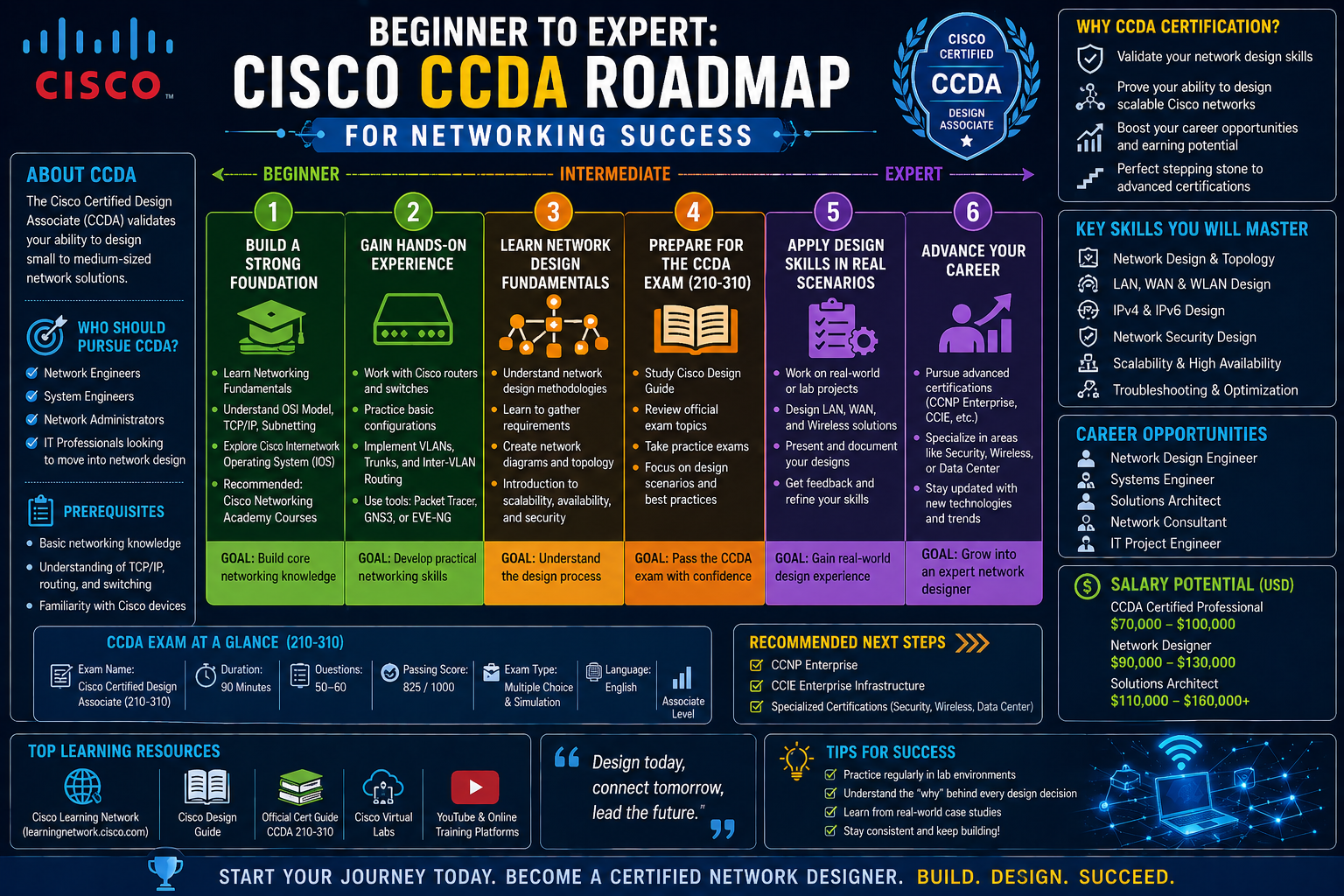
The Cisco Certified Design Associate certification represents an important step for learners who want to move beyond basic network operation and into the structured planning of enterprise-level network systems. Unlike certifications that focus primarily on configuration or troubleshooting, CCDA emphasizes how networks are designed from the ground up to meet business and technical requirements. This involves understanding how different components of a network interact, how data flows across systems, and how design choices influence long-term performance and reliability.
In modern IT environments, networks are no longer simple or isolated systems. They form the backbone of communication for businesses, supporting everything from internal applications to cloud services and remote connectivity. The CCDA framework helps learners develop the ability to think strategically about these systems rather than focusing only on isolated devices or protocols. It encourages a broader perspective where the network is treated as a unified structure designed to support business continuity and growth.
A key aspect of this certification is the transition from operational knowledge to architectural thinking. Many professionals begin their careers by managing routers, switches, and firewalls individually. CCDA shifts the focus toward understanding how these components fit together in a structured design. This includes evaluating how traffic moves between different layers of a network, how redundancy is built into systems, and how design decisions affect user experience across an organization.
This certification also introduces learners to structured design approaches used in enterprise environments. These approaches are not random or intuitive; they follow established principles that ensure consistency, scalability, and efficiency. By learning these principles, professionals are better equipped to contribute to large-scale network projects where coordination and planning are essential.
Another important dimension of CCDA is its emphasis on aligning technical design with organizational goals. A well-designed network is not just technically sound; it must also support business operations effectively. This requires understanding requirements such as application performance, security needs, and expected growth. CCDA helps learners connect these requirements with practical design decisions, ensuring that networks are not only functional but also adaptable.
Through this certification, learners begin to understand how design impacts every aspect of network performance. From latency and throughput to fault tolerance and scalability, each design choice has a direct effect on how the network behaves under different conditions. This awareness is essential for anyone aspiring to work in advanced network engineering or architecture roles.
Role of Network Design in Modern Enterprise Environments
Network design plays a critical role in shaping how modern organizations operate. As businesses become more dependent on digital systems, the underlying network infrastructure must be carefully planned to support increasing demands. This includes handling large volumes of data, supporting remote users, and ensuring uninterrupted access to applications and services.
In enterprise environments, networks are expected to deliver consistent performance regardless of workload or scale. This requires thoughtful design that anticipates future growth and avoids bottlenecks. Without proper design, networks can become inefficient, difficult to manage, and prone to outages. The CCDA framework helps learners understand how to prevent these issues through structured planning.
A well-designed enterprise network must also support multiple types of traffic simultaneously. For example, voice communication, video conferencing, and data transfer all have different performance requirements. Network design ensures that these diverse requirements are met without conflict. This involves segmenting traffic, prioritizing critical services, and ensuring that infrastructure can handle peak usage periods.
Security is another important consideration in network design. Modern networks are constantly exposed to internal and external threats, making it essential to incorporate security principles into the design process itself. Rather than treating security as an afterthought, CCDA encourages integrating protective measures directly into the network architecture. This includes controlling access, segmenting sensitive data, and ensuring secure communication paths.
Scalability is equally important in enterprise environments. Organizations grow over time, and their networks must grow with them. A poorly designed network may function well initially but struggle as demand increases. CCDA teaches how to build networks that can expand without requiring complete redesigns. This involves using modular design principles and planning for future expansion from the beginning.
Reliability is another core requirement in enterprise networks. Downtime can lead to significant operational and financial losses. Therefore, network design must include redundancy and failover mechanisms to ensure continuous availability. These design choices help maintain service continuity even when individual components fail.
Overall, network design is about creating systems that are efficient, resilient, and adaptable. It requires a deep understanding of both technical components and business requirements. CCDA provides the foundation for developing these skills, enabling professionals to contribute effectively to complex enterprise environments.
Core Networking Concepts Required Before CCDA
Before engaging with the CCDA certification, it is essential to have a strong understanding of fundamental networking concepts. These concepts form the basis for more advanced design principles and ensure that learners can follow complex architectural discussions with clarity.
One of the most important foundational areas is the structure of networks themselves. This includes understanding how devices communicate using layered models, how data is transmitted across networks, and how protocols govern communication. Without this knowledge, it becomes difficult to understand how design decisions impact overall network behavior.
Another essential concept is routing and switching. These are the core mechanisms that enable data to move between different parts of a network. Routing determines the path that data takes between networks, while switching manages communication within local segments. A solid grasp of these processes is necessary for understanding how large-scale networks are structured.
IP addressing is also a critical area of knowledge. Every device on a network requires a unique identifier, and proper addressing ensures that communication is accurate and efficient. Understanding how addresses are assigned, organized, and managed is important for designing scalable networks that avoid conflicts and inefficiencies.
Subnetting is closely related to addressing and plays a key role in network design. It allows networks to be divided into smaller segments, improving performance and security. Proper subnetting ensures that traffic is controlled and organized, reducing unnecessary congestion.
Another foundational concept is network protocols. These define the rules for communication between devices. Understanding how different protocols operate helps in designing networks that support various applications and services effectively.
Basic knowledge of network hardware is also important. Devices such as routers, switches, and access points each play specific roles in network communication. Understanding their functions helps in placing them correctly within a design structure.
These core concepts form the building blocks of network design knowledge. Without them, it would be difficult to understand more advanced topics such as scalability planning or enterprise architecture. CCDA builds on these fundamentals to introduce structured design thinking.
Evolution from Routing and Switching to Network Design Thinking
Many networking professionals begin their careers focusing on routing and switching. These areas involve configuring devices, managing connections, and ensuring that networks operate correctly on a technical level. While these skills are essential, they represent only one part of the broader networking landscape.
The transition to network design thinking involves moving from a device-centric mindset to a system-wide perspective. Instead of focusing on individual components, professionals begin to consider how entire networks function as interconnected systems. This shift is critical for understanding enterprise-level infrastructure.
In routing and switching roles, the primary goal is often to ensure that devices communicate effectively. However, in network design, the focus expands to include performance optimization, scalability planning, and long-term sustainability. This requires a deeper understanding of how different network elements interact over time.
Network design thinking also involves anticipating future needs. Rather than simply solving immediate problems, designers must consider how networks will evolve as organizations grow. This includes planning for increased traffic, new applications, and emerging technologies.
Another important aspect of this evolution is the ability to evaluate trade-offs. Every design decision has advantages and disadvantages. For example, increasing redundancy may improve reliability but also increase complexity and cost. Network designers must carefully balance these factors to create effective solutions.
This shift in thinking also requires a broader understanding of business requirements. Technical decisions are no longer made in isolation; they must align with organizational goals. This means considering factors such as budget constraints, operational efficiency, and user experience.
Ultimately, moving from routing and switching to network design represents a significant professional development step. It transforms technicians into architects who can shape the structure and behavior of entire networks.
Overview of Design Methodologies in Enterprise Networks
Design methodologies provide structured approaches to building enterprise networks. These methodologies ensure that networks are designed consistently, efficiently, and in alignment with organizational needs. They help eliminate guesswork and provide clear guidelines for decision-making.
One of the key aspects of design methodology is planning. Before any physical implementation begins, a thorough understanding of requirements is necessary. This includes identifying user needs, application demands, and performance expectations. Proper planning ensures that the resulting network meets both current and future requirements.
Another important element is modular design. This approach involves breaking the network into smaller, manageable components. Each component serves a specific function and can be independently scaled or modified. Modular design improves flexibility and makes networks easier to maintain.
Hierarchical design is another widely used methodology. It organizes networks into layers, each with specific responsibilities. This structure improves clarity and simplifies troubleshooting by separating functions across different levels of the network.
Redundancy planning is also a key part of design methodology. It ensures that networks remain operational even when individual components fail. This is achieved by incorporating backup paths and alternative systems into the design.
Design methodologies also emphasize documentation. Clear documentation ensures that network structures are understood by all stakeholders. It supports maintenance, troubleshooting, and future expansion.
By following structured methodologies, network designers can create systems that are efficient, reliable, and adaptable. CCDA introduces learners to these principles, helping them develop a disciplined approach to network architecture.
Understanding Campus Network Fundamentals for CCDA
Campus networks form a significant part of enterprise environments. These networks typically connect multiple buildings or departments within a single organization. Understanding how campus networks are structured is essential for effective design.
A campus network is usually divided into different layers, each serving a specific purpose. These layers help organize traffic and ensure efficient communication between devices. Proper layering improves performance and simplifies management.
One of the key considerations in campus network design is connectivity. Devices must be able to communicate seamlessly across different parts of the network. This requires careful planning of pathways and connections.
Another important factor is segmentation. By dividing the network into smaller sections, designers can improve performance and enhance security. Segmentation also helps control traffic flow and reduce congestion.
Campus networks must also support a wide range of applications. These include data transfer, voice communication, and video services. Each of these applications has different requirements, and the network must be designed to accommodate them effectively.
Reliability is particularly important in campus environments. Any disruption can affect a large number of users. Therefore, redundancy and failover mechanisms are essential components of the design.
Understanding campus networks provides a practical foundation for applying CCDA principles. It allows learners to see how theoretical design concepts are implemented in real-world environments.
Introduction to Scalability, Availability, and Performance
Scalability, availability, and performance are three fundamental principles in network design. Together, they determine how well a network can support organizational needs over time.
Scalability refers to the ability of a network to grow without losing efficiency. A scalable network can accommodate increasing numbers of users, devices, and applications. This requires careful planning and modular design structures.
Availability focuses on ensuring that network services remain accessible at all times. High availability is achieved through redundancy and fault-tolerant systems. This minimizes downtime and ensures continuous operation.
Performance relates to how efficiently a network handles traffic. High-performance networks deliver data quickly and reliably, even under heavy loads. This requires optimized routing, efficient bandwidth usage, and proper traffic management.
These three principles are interconnected. Improving one often impacts the others. For example, increasing redundancy may improve availability but could also affect performance if not designed properly.
Understanding how to balance these principles is a key part of network design. CCDA introduces learners to these concepts and helps them apply them in practical scenarios.
Addressing and Routing Considerations in Design Planning
Addressing and routing are fundamental components of network design. They determine how data is identified, organized, and transmitted across networks.
IP addressing ensures that every device in a network has a unique identifier. Proper address planning is essential for avoiding conflicts and ensuring smooth communication. In large networks, addressing must be structured and scalable.
Routing determines how data travels between different networks. Effective routing design ensures that data takes the most efficient path, reducing delays and improving performance.
Designers must consider how addressing schemes align with routing strategies. Poor alignment can lead to inefficiencies and increased complexity.
Subnetting plays an important role in this process. It allows networks to be divided into smaller segments, improving organization and control. Proper subnetting supports both addressing and routing efficiency.
These considerations form the backbone of network design planning. They ensure that data flows efficiently and that the network remains scalable and manageable.
Preparing the Mindset for Network Architecture Roles
Transitioning into network architecture roles requires more than technical knowledge. It requires a shift in mindset toward strategic thinking and long-term planning.
Network architects must think beyond immediate configurations and consider how systems will evolve. This involves anticipating challenges, evaluating risks, and designing flexible solutions.
Decision-making becomes more complex in architecture roles. Every choice has long-term implications for performance, scalability, and cost. Architects must weigh these factors carefully.
Collaboration is also an important aspect of this mindset. Network design often involves working with multiple teams and stakeholders. Clear communication and understanding of requirements are essential.
A strong architectural mindset also involves continuous learning. As technology evolves, network designs must adapt to new tools, protocols, and requirements.
Developing this mindset is a gradual process that builds on foundational knowledge and practical experience. CCDA serves as an important step in this transformation, preparing professionals for more advanced design responsibilities.
Enterprise Network Design Requirements and Business Alignment
Enterprise network design is fundamentally driven by business requirements rather than purely technical preferences. In modern organizations, networks are expected to support business operations in a way that is efficient, stable, and adaptable to change. This means that every design decision must be evaluated in terms of how it supports organizational goals such as productivity, communication, security, and growth.
One of the most important aspects of business-aligned network design is requirement gathering. Before any technical planning begins, designers must understand what the organization actually needs from its network. This includes identifying the types of applications being used, the number of users accessing the system, and the expected level of performance under normal and peak conditions. Without this understanding, even technically correct designs may fail to meet real-world expectations.
Business alignment also requires understanding operational priorities. Some organizations prioritize uptime above all else, while others may focus on cost efficiency or scalability. These priorities influence how network components are selected and arranged. For example, an organization that requires high availability may invest more in redundant systems, while another may prioritize simplified infrastructure.
Another key factor is adaptability. Businesses evolve, and their networks must evolve with them. This means that network design must anticipate future changes such as expansion into new locations, adoption of new technologies, or increased user demand. A rigid network structure can quickly become outdated, while a flexible design can accommodate growth with minimal disruption.
Communication between technical teams and business stakeholders is essential in this process. Designers must translate business needs into technical specifications that can be implemented effectively. This requires clarity, precision, and the ability to bridge the gap between non-technical requirements and technical solutions.
Ultimately, enterprise network design is not just about building systems that work; it is about building systems that support business success. CCDA helps learners develop this perspective by focusing on how design decisions align with organizational goals.
Structured Approach to Network Hierarchy Design
Hierarchical design is a foundational concept in enterprise networking that introduces structure and organization into complex systems. Instead of building flat and unorganized networks, hierarchical design divides the network into distinct layers, each with a specific role and responsibility.
This structured approach improves clarity and makes networks easier to manage. Each layer is designed to handle specific types of traffic or functions, reducing complexity and improving efficiency. By separating responsibilities, network designers can isolate issues more effectively and implement changes without affecting the entire system.
The hierarchical model also enhances scalability. As organizations grow, new components can be added to specific layers without requiring a complete redesign of the network. This modular approach supports long-term expansion and reduces operational disruption.
Another advantage of hierarchical design is improved performance management. By controlling how traffic moves between layers, designers can optimize data flow and reduce congestion. This ensures that critical applications receive the necessary bandwidth and resources.
Security is also strengthened through hierarchical structuring. Different layers can implement different security controls, limiting access and reducing exposure to threats. This layered defense approach makes it more difficult for vulnerabilities to spread across the entire network.
Troubleshooting becomes more efficient in a hierarchical model as well. When issues arise, they can often be isolated to a specific layer, reducing the time required for diagnosis and resolution.
Overall, hierarchical design provides a structured framework that supports scalability, performance, and manageability in enterprise networks. It is a key principle in CCDA-level network architecture thinking.
Campus Network Design, Architecture, and Segmentation Strategy
Campus networks are a major component of enterprise infrastructure, often connecting multiple departments, buildings, or organizational units within a single location. Designing these networks requires careful attention to structure, segmentation, and traffic flow.
A well-structured campus network is typically divided into functional areas that separate different types of network activity. This segmentation helps improve performance by preventing unnecessary traffic congestion and ensuring that critical services operate efficiently.
One of the primary goals in campus design is efficient communication between users and resources. This requires optimizing pathways so that data can travel quickly and reliably across different parts of the network. Poor design can result in delays, bottlenecks, and inconsistent performance.
Segmentation plays a crucial role in maintaining both performance and security. By dividing the network into smaller logical sections, designers can control how traffic moves and limit access between different areas. This reduces the risk of unauthorized access and helps contain potential issues.
Another important aspect is redundancy within campus networks. Since many users depend on these systems simultaneously, any disruption can have a significant impact. Redundant connections and backup paths ensure that communication continues even if a component fails.
Scalability is also a key consideration. Campus networks must be able to expand as organizations grow or restructure. A well-designed system allows new departments or buildings to be integrated without disrupting existing operations.
Wireless integration is increasingly important in campus environments. As mobile devices become more common, networks must support seamless wireless connectivity alongside traditional wired infrastructure. This adds another layer of complexity to the design process.
Campus network architecture requires balancing performance, security, and scalability while maintaining simplicity and manageability. CCDA provides a structured approach to achieving this balance.
Data Flow Optimization and Traffic Management Principles
Effective network design requires a deep understanding of how data flows through a system. In enterprise environments, large volumes of traffic move continuously between users, applications, and services. Without proper management, this can lead to congestion and performance degradation.
Traffic management involves controlling how data is prioritized and routed through the network. Not all traffic has the same importance. For example, real-time communication such as voice and video requires low latency, while file transfers may tolerate delays. Designing networks to accommodate these differences is essential for maintaining performance.
One approach to traffic management is prioritization, where critical data is given preference over less time-sensitive traffic. This ensures that essential services remain responsive even during peak usage periods.
Another important aspect is load distribution. By spreading traffic evenly across multiple paths or devices, designers can prevent bottlenecks and improve overall efficiency. This requires careful planning of routing paths and network capacity.
Congestion avoidance is also a key consideration. Networks must be designed to handle peak loads without becoming overwhelmed. This involves anticipating usage patterns and providing sufficient bandwidth and resources.
Data flow optimization also includes minimizing unnecessary hops between devices. Each additional step in a data path introduces potential delays, so efficient routing is essential for maintaining performance.
Monitoring and analysis play a role in understanding traffic behavior. By observing how data moves through the network, designers can identify inefficiencies and make improvements.
In CCDA-level design thinking, optimizing data flow is not just about speed but about ensuring consistent and reliable communication across the entire network.
Redundancy Planning and Fault Tolerance Design
Redundancy is a critical concept in network design that ensures continuous operation even when individual components fail. In enterprise environments, downtime can have significant operational and financial consequences, making fault tolerance a key design priority.
Redundancy involves creating backup systems that can take over when primary systems fail. These backups may include alternative network paths, duplicate devices, or secondary connections. The goal is to eliminate single points of failure.
One of the most common forms of redundancy is path redundancy, where multiple routes exist between network points. If one path becomes unavailable, traffic can automatically be redirected through another path.
Device redundancy is also important. Critical network devices such as routers and switches may be duplicated so that if one fails, another can immediately take its place. This ensures continuity of service without interruption.
Fault tolerance goes beyond redundancy by focusing on the network’s ability to continue functioning even under degraded conditions. A fault-tolerant network may not operate at full capacity during failures, but it continues to provide essential services.
Designing for redundancy requires careful balance. While redundancy improves reliability, it also increases complexity and cost. Designers must determine the appropriate level of redundancy based on business requirements.
Testing is an important part of redundancy planning. Networks must be evaluated under failure conditions to ensure that backup systems function correctly when needed.
In CCDA design principles, redundancy is not optional; it is an integral part of building reliable and resilient enterprise networks.
Address Planning Strategies for Scalable Networks
Address planning is a fundamental component of network design that ensures efficient organization and communication between devices. A well-structured addressing scheme supports scalability, simplifies management, and reduces the risk of conflicts.
In enterprise networks, addressing must be consistent and logical. Poorly planned addressing can lead to confusion, inefficiencies, and difficulty in troubleshooting. Therefore, designers must carefully structure how addresses are allocated across the network.
Hierarchical addressing is commonly used to organize large networks. This approach divides address space into structured segments that reflect organizational or functional divisions. It simplifies routing and improves clarity.
Subnetting is an essential tool in address planning. It allows large networks to be divided into smaller, more manageable segments. This improves performance by reducing broadcast traffic and enhances security by isolating different parts of the network.
Scalability is a major consideration in address planning. Networks must be able to accommodate growth without requiring complete restructuring. A flexible addressing scheme allows new devices and segments to be added easily.
Consistency is also important. A standardized approach to addressing makes it easier for administrators to understand and manage the network. It also reduces the likelihood of errors during configuration.
Address planning is closely linked to routing design. Proper alignment between addressing structures and routing protocols ensures efficient data flow across the network.
In CCDA-level design thinking, address planning is treated as a strategic component of overall network architecture.
Integration of Security Principles into Network Design
Security is no longer an optional layer added after network deployment; it is an integral part of the design process. Modern networks face constant threats, making it essential to incorporate security principles from the beginning.
One of the key aspects of secure design is segmentation. By dividing networks into smaller zones, designers can control access and limit the spread of potential threats. This reduces risk and improves overall security posture.
Access control is another important principle. Networks must be designed to restrict unauthorized access to sensitive resources. This involves defining clear boundaries and implementing appropriate authentication mechanisms.
Secure communication pathways are also essential. Data must be protected as it moves across the network, ensuring confidentiality and integrity. This requires careful planning of encryption and secure routing methods.
Monitoring and detection capabilities are often integrated into network design. These systems help identify unusual activity and potential threats before they cause significant damage.
Redundancy also contributes to security by ensuring that systems remain operational even under attack or failure conditions. This helps maintain service continuity during security incidents.
Security design must balance protection with usability. Overly restrictive systems can hinder productivity, while insufficient security exposes the network to risk.
In CCDA-level thinking, security is embedded into every aspect of network design rather than treated as a separate concern.
Design Documentation and Communication Standards in Networking Projects
Documentation is a critical part of network design that ensures clarity, consistency, and maintainability. Without proper documentation, even well-designed networks can become difficult to manage over time.
Design documentation provides a detailed record of network structure, configurations, and design decisions. This information is essential for troubleshooting, maintenance, and future upgrades.
Clear communication is equally important. Network design often involves multiple teams, including technical staff, management, and external stakeholders. Effective communication ensures that everyone understands the design objectives and implementation plans.
Standardized documentation practices help maintain consistency across projects. This makes it easier for teams to interpret and work with network designs, even if they were not involved in the original planning.
Documentation also supports scalability by providing a reference for future expansion. New components can be added more easily when existing structures are clearly defined.
Another important aspect is version control. As networks evolve, documentation must be updated to reflect changes accurately. This ensures that records remain relevant and useful.
In CCDA-level design environments, documentation is treated as an essential component of professional network architecture practice.
Transitioning from Technical Implementation to Design Leadership Thinking
Advancing into network design roles requires a shift from technical execution to strategic thinking. Instead of focusing solely on configuring devices or resolving issues, professionals must begin to think about how entire systems are structured and optimized.
Design leadership involves making decisions that affect long-term network performance and scalability. These decisions require a deep understanding of both technical principles and organizational needs.
One of the key aspects of this transition is perspective. Designers must view networks as dynamic systems rather than static configurations. This means considering how changes in one part of the network affect the entire structure.
Decision-making becomes more complex in design roles. Choices must account for performance, cost, security, and future growth simultaneously. This requires analytical thinking and careful evaluation of trade-offs.
Collaboration also becomes more important. Network designers often work with multiple teams, requiring strong communication and coordination skills.
This shift represents a significant step in professional development, moving from implementation-focused roles to architecture-focused responsibilities within enterprise networking environments.
Advanced Cisco CCDA Concepts in Enterprise Network Design
Enterprise network design at an advanced level requires a deeper understanding of how large-scale systems behave under real operational conditions. At this stage, design is no longer just about connecting devices or ensuring basic communication. It becomes a structured discipline focused on building resilient, scalable, and performance-optimized infrastructures that can support complex business environments.
One of the key advanced concepts is convergence. In modern enterprise networks, multiple services such as data, voice, and video often run over a single infrastructure. Designing for convergence requires careful planning to ensure that all types of traffic receive appropriate treatment. Voice and video traffic, for example, are sensitive to delays, while data traffic may tolerate some latency. A well-designed network must balance these requirements without compromising overall efficiency.
Another important concept is virtualization. Virtual networks allow multiple logical networks to operate over a single physical infrastructure. This improves resource utilization and simplifies management. In design terms, virtualization enables greater flexibility, allowing networks to be reconfigured without major physical changes. This is especially important in dynamic business environments where requirements frequently change.
Traffic engineering also plays a significant role in advanced design. This involves controlling how data flows through the network to optimize performance and avoid congestion. Instead of relying solely on default routing behavior, designers can influence paths taken by traffic based on performance needs, bandwidth availability, and application requirements. This ensures that critical services remain stable even under heavy load.
Quality of Service (QoS) is closely related to traffic engineering. It allows networks to prioritize certain types of traffic over others. In enterprise environments, this is essential for maintaining the performance of real-time applications such as voice calls and video conferencing. Without QoS, all traffic is treated equally, which can lead to delays and poor user experience during peak usage periods.
Another advanced area is hierarchical addressing refinement. While basic address planning focuses on structure, advanced design ensures that addressing schemes align closely with routing efficiency and organizational scalability. This reduces complexity in large networks and improves overall manageability.
Multi-Layer Design Optimization and Network Efficiency
Multi-layer design optimization is a core principle in enterprise architecture. It focuses on improving efficiency by distributing network functions across different layers, each optimized for specific roles. This structured approach helps reduce complexity while improving performance and scalability.
In an optimized multi-layer design, the core layer is responsible for high-speed transport across the network. It is designed for fast and reliable data movement with minimal processing delays. The focus here is stability and speed rather than policy enforcement or detailed control.
The distribution layer acts as an intermediary, handling routing decisions, policy enforcement, and traffic filtering. This layer plays a key role in controlling how data flows between different parts of the network. It also provides redundancy and ensures that failures in one part of the network do not disrupt overall communication.
The access layer connects end devices to the network. It is responsible for providing user connectivity and enforcing basic access policies. This layer must be flexible enough to support a large number of devices while maintaining consistent performance.
Optimizing these layers involves balancing load, minimizing latency, and ensuring redundancy. Each layer must be designed not in isolation but as part of a unified system. Changes in one layer often affect the behavior of others, making coordination essential.
Efficiency in multi-layer design also depends on minimizing unnecessary complexity. Overly complicated structures can lead to management difficulties and performance issues. Therefore, simplicity and clarity are important design goals.
By optimizing each layer appropriately, enterprise networks can achieve high levels of performance while remaining scalable and manageable.
Scalable Enterprise Architecture and Growth Planning
Scalability is one of the most critical aspects of enterprise network design. A scalable network can grow and adapt without requiring a complete redesign or causing performance degradation. This is essential in modern business environments where change is constant.
Scalable architecture begins with modular design principles. Networks are built with components that can be expanded independently. This allows organizations to add new users, locations, or services without disrupting existing operations.
Growth planning also involves anticipating future requirements. This includes estimating increases in traffic, identifying potential new services, and preparing for technological changes. While exact predictions are not always possible, design frameworks help ensure that networks remain flexible enough to accommodate change.
Another important aspect of scalability is efficient resource utilization. Networks must be designed so that resources such as bandwidth, processing power, and storage are used effectively. Poor utilization can lead to bottlenecks and unnecessary costs.
Hierarchical structuring also supports scalability by breaking large networks into manageable sections. This makes it easier to expand specific areas without affecting the entire system.
Automation is increasingly important in scalable design. As networks grow, manual management becomes difficult and error-prone. Automated systems help maintain consistency and reduce operational overhead.
A scalable enterprise architecture ensures that networks remain functional and efficient even as demands increase over time.
High Availability Design Strategies and System Resilience
High availability is a key requirement in enterprise network design. It ensures that systems remain operational even in the event of hardware failures, software issues, or external disruptions. Designing for high availability requires careful planning and the implementation of multiple protective mechanisms.
Redundancy is the foundation of high availability. By duplicating critical components and creating alternative pathways, networks can continue operating even if part of the system fails. This includes redundant routers, switches, and communication links.
Failover mechanisms are also essential. These systems automatically switch operations to backup components when a failure is detected. This minimizes downtime and ensures continuity of service without manual intervention.
Load balancing contributes to high availability by distributing traffic across multiple resources. This prevents any single component from becoming overwhelmed and reduces the risk of failure due to excessive load.
Monitoring systems play an important role in maintaining availability. Continuous monitoring allows administrators to detect potential issues before they become critical. Early detection enables proactive maintenance and reduces the likelihood of unexpected downtime.
Geographic redundancy is another advanced strategy. In large enterprises, critical systems may be duplicated across different physical locations. This protects against localized failures such as power outages or natural disasters.
High availability design requires balancing complexity and cost. While increased redundancy improves reliability, it also adds expense and operational overhead. Designers must carefully evaluate business requirements when determining the appropriate level of availability.
Integration of Design Principles Across Multiple Network Domains
Modern enterprise networks are not limited to a single functional area. They often include multiple domains such as data centers, campus networks, wireless systems, and cloud environments. Effective design requires integrating these domains into a cohesive structure.
Each domain has its own characteristics and requirements. For example, data centers focus on high-speed processing and storage, while campus networks prioritize user connectivity and access. Wireless networks must support mobility and flexibility, while cloud systems emphasize scalability and remote access.
Integration involves ensuring that these domains communicate effectively. This requires consistent addressing, routing strategies, and security policies across the entire network.
Interoperability is also important. Different systems and technologies must work together without conflicts or inefficiencies. This requires careful planning and standardization.
Unified management is another key aspect of integration. As networks become more complex, centralized monitoring and control become essential for maintaining consistency and efficiency.
Security integration ensures that protection mechanisms are applied consistently across all domains. This prevents vulnerabilities from emerging at domain boundaries.
Effective integration creates a seamless network environment where different systems work together as a unified whole.
Conclusion
The Cisco Certified Design Associate framework represents an important stage in the development of networking professionals who aim to move beyond operational tasks and into structured system design. It focuses on how networks are planned, organized, and optimized to support real-world business environments where reliability, scalability, and performance are essential.
Across enterprise infrastructures, network design plays a defining role in how effectively organizations can operate and grow. A well-designed network ensures that communication flows smoothly between users, applications, and services while maintaining stability under changing demands. This requires a combination of technical understanding and strategic thinking, where every design decision contributes to the overall efficiency of the system.
The progression from foundational networking knowledge to design-oriented thinking highlights a critical shift in professional growth. Instead of focusing solely on configuring devices or resolving issues, learners begin to evaluate how entire systems function as interconnected structures. This broader perspective allows for more effective planning, improved resource utilization, and stronger alignment with organizational objectives.
Concepts such as hierarchical design, scalability planning, redundancy, security integration, and performance optimization form the backbone of enterprise network architecture. These principles ensure that networks are not only functional but also adaptable to future requirements. As technology continues to evolve, the ability to design flexible and resilient infrastructures becomes increasingly valuable.
The CCDA approach also emphasizes the importance of aligning technical design with business needs. Networks are no longer isolated technical systems; they are essential business enablers that directly impact productivity and service delivery. Understanding this relationship is key to building systems that are both efficient and sustainable.
Overall, network design is a continuous discipline that evolves with technology, organizational needs, and user expectations. Developing strong design skills provides a solid foundation for advancing into more complex roles in network architecture and engineering, where strategic thinking and technical expertise come together to shape modern digital infrastructures.