In today’s digital environment, almost every application relies on some form of data storage system to function effectively. Whether it is a small mobile application, a large enterprise platform, or a real-time analytics system, the way data is stored, organized, and retrieved plays a central role in determining overall performance and usability. Databases are not just storage systems; they are structured environments that define how information flows within an application, how quickly it can be accessed, and how reliably it can be maintained under different workloads.
As applications continue to evolve and handle increasingly large and complex datasets, developers and organizations are often faced with critical decisions about which type of database system should be used. This decision is not only technical but also strategic, as it influences scalability, system design, and long-term maintenance requirements. Different database technologies are built with different design philosophies, which makes them suitable for specific types of workloads and application needs.
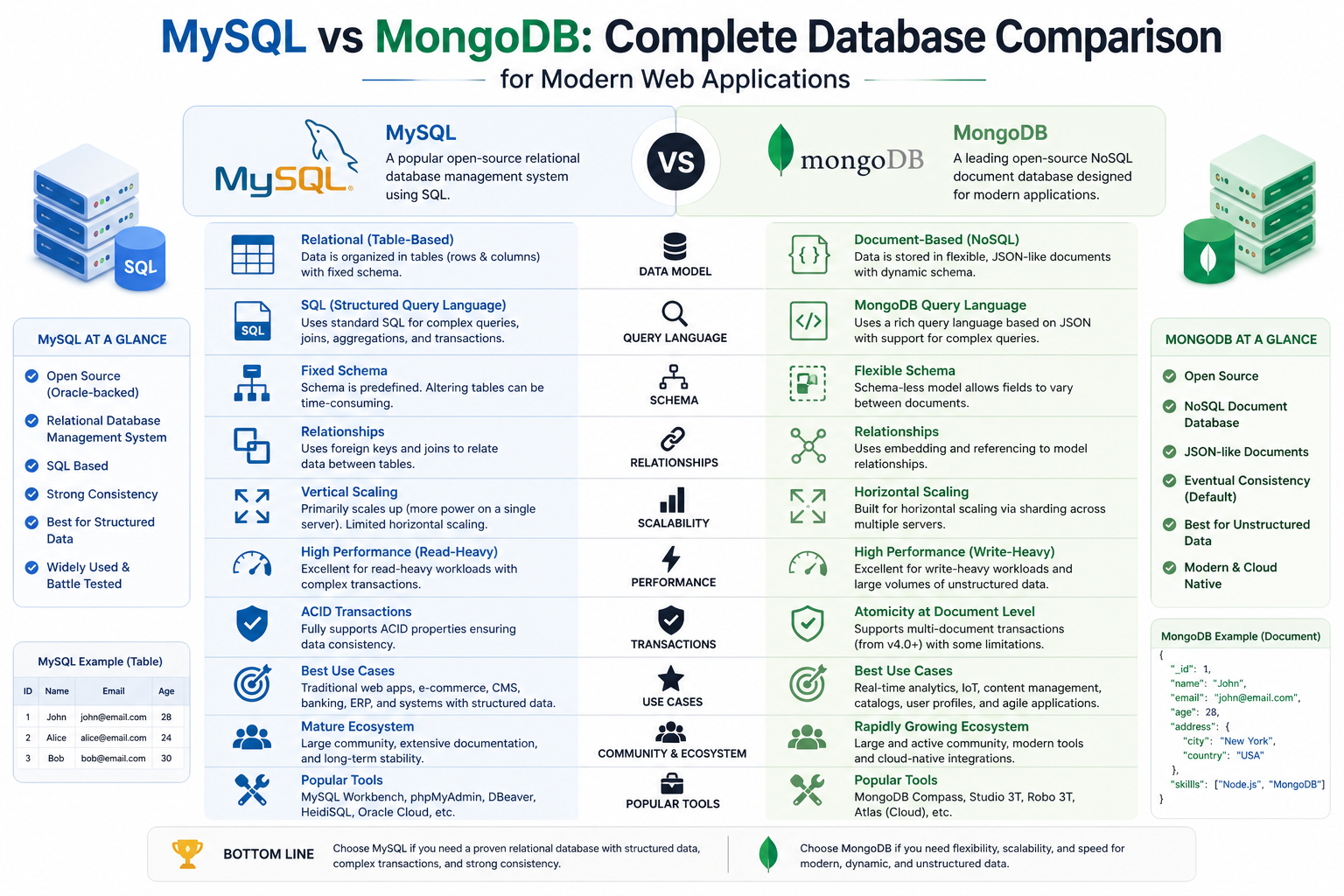
Among the most widely discussed database systems are relational databases and document-oriented NoSQL databases. MySQL represents the traditional relational approach, while MongoDB represents a modern, flexible NoSQL model. Understanding how these two systems operate provides a foundation for making informed architectural decisions in software development.
Importance of Database Selection in Software Architecture
Choosing a database system is not simply about picking a storage solution; it is about aligning data handling capabilities with application requirements. Every application has unique demands based on how it processes information, how frequently data is updated, and how it is accessed by users or services.
Performance is one of the primary considerations in database selection. Some applications require fast read and write operations, especially those dealing with real-time data or high user traffic. In such cases, the internal structure of the database and how it manages queries becomes extremely important. A database that is optimized for structured queries may perform differently compared to one that is optimized for flexible data formats.
Scalability is another critical factor. As applications grow, the amount of data they handle increases significantly. A database must be capable of handling this growth without requiring a complete redesign of the system. Some databases are designed to scale vertically by increasing hardware capacity, while others are designed to scale horizontally by distributing data across multiple servers.
Flexibility also plays an important role, especially in modern applications where data structures can change frequently. Applications that deal with dynamic or evolving datasets benefit from systems that do not require rigid schemas. On the other hand, applications that rely on structured and predictable data often benefit from systems that enforce strict data organization rules.
Security, maintainability, and consistency are additional factors that influence database choice. Each system offers different mechanisms for ensuring data integrity and protecting sensitive information. The right choice depends on balancing all these factors in a way that supports both current and future requirements of the application.
Understanding Relational Databases and the Role of MySQL
Relational databases are built on a structured model where data is stored in tables consisting of rows and columns. Each table represents a specific entity, and relationships between different entities are defined through keys. This structured approach allows for highly organized data management, where relationships between different data points are clearly defined and maintained.
MySQL is one of the most widely used relational database systems in the world. It is known for its stability, reliability, and ability to handle structured data efficiently. In a relational database like MySQL, data is organized in such a way that redundancy is minimized and consistency is maintained across different tables.
One of the core principles of relational databases is the use of structured query language, which allows users to define, manipulate, and retrieve data in a standardized way. This language provides powerful capabilities for filtering, sorting, joining, and aggregating data across multiple tables. The structured nature of queries ensures that data operations are predictable and consistent.
MySQL is designed to enforce data integrity through constraints and relationships. These constraints ensure that data remains accurate and consistent even when multiple operations are performed simultaneously. This makes relational databases particularly suitable for applications where accuracy and consistency are critical, such as financial systems or inventory management platforms.
The relational model also supports normalization, a process that organizes data in a way that reduces redundancy and improves efficiency. By breaking data into multiple related tables, MySQL ensures that updates and modifications do not lead to inconsistencies across the system.
MySQL Architecture and Core Working Principles
The architecture of MySQL is based on a layered design that separates different components responsible for query processing, storage management, and data retrieval. This separation allows the system to manage complex operations efficiently while maintaining stability and performance.
At the core of MySQL is its storage engine, which is responsible for how data is physically stored and retrieved from disk. Different storage engines can be used depending on application requirements, but the default engine is designed to balance performance and reliability. The storage engine determines how indexes are created, how transactions are handled, and how data is written or read.
Query processing in MySQL involves several stages. When a query is submitted, it is first parsed to check for syntax errors. It is then optimized to determine the most efficient way to execute the request. Finally, the execution engine processes the query and retrieves the required data from the storage layer. This multi-step process ensures that even complex queries are handled efficiently.
Indexes play an important role in improving query performance in MySQL. By creating structured references to specific columns, indexes allow the database to quickly locate relevant data without scanning entire tables. This significantly improves performance for read-heavy operations. However, maintaining indexes also introduces overhead during data modification operations, as the indexes must be updated whenever data changes.
Transactions are another important feature of MySQL. They ensure that multiple operations are treated as a single unit of work. If any part of a transaction fails, the entire operation can be rolled back to maintain data consistency. This ensures that the database remains in a valid state even in the event of errors or system failures.
Data Storage, Indexing, and Transaction Behavior in MySQL
The way MySQL stores and manages data is closely tied to its relational structure. Data is stored in tables, and each row represents a unique record. This structured format allows for efficient querying and relationship management between different data sets.
Indexing is one of the key mechanisms that enhances performance in MySQL. When data volumes increase, searching through entire tables becomes inefficient. Indexes solve this problem by creating a structured pathway to locate data quickly. However, indexes require additional storage and maintenance effort, which can affect performance during heavy write operations.
Transaction handling in MySQL ensures that data operations remain consistent and reliable. When multiple changes are made to the database, transactions ensure that either all changes are applied successfully or none of them are applied at all. This atomic behavior is essential for maintaining data integrity in systems where partial updates could lead to inconsistencies.
MySQL also supports different isolation levels for transactions, which determine how changes made by one transaction are visible to others. This allows developers to balance consistency and performance based on application needs.
Understanding NoSQL Databases and the Emergence of MongoDB
NoSQL databases were introduced to address limitations found in traditional relational systems, especially when dealing with large-scale, unstructured, or rapidly changing data. Unlike relational databases, NoSQL systems do not rely on fixed schemas or structured tables. Instead, they use flexible data models that can adapt to different types of information.
MongoDB is one of the most prominent NoSQL databases, designed to handle document-oriented data storage. Instead of tables and rows, MongoDB uses collections and documents. Each document is a self-contained unit of data that can store complex and nested information in a flexible format.
This document-based approach allows MongoDB to handle diverse data structures without requiring predefined schemas. This makes it particularly useful in applications where data formats evolve frequently or vary significantly between records.
MongoDB was designed with scalability and flexibility in mind. It supports horizontal scaling, allowing data to be distributed across multiple servers. This enables it to handle large datasets and high traffic loads more efficiently than traditional relational systems in certain scenarios.
MongoDB Architecture and Document-Based Data Model
The architecture of MongoDB is built around a distributed system that allows data to be stored across multiple nodes. This design supports high availability and fault tolerance, ensuring that data remains accessible even if part of the system fails.
At the core of MongoDB is the document model. Each document is stored in a format similar to structured data objects, allowing it to represent complex relationships and nested structures. This eliminates the need for multiple tables and joins, which are commonly used in relational databases.
The absence of strict schema requirements allows MongoDB to store different types of documents within the same collection. This flexibility is particularly useful in applications where data requirements are not fixed or may change over time.
MongoDB also uses internal mechanisms to manage data replication and distribution. Data can be replicated across multiple nodes to ensure availability and durability. This replication process ensures that even if one server fails, data can still be accessed from another location within the system.
Query processing in MongoDB is designed to work directly with documents. Instead of joining multiple tables, queries are executed on individual documents or collections. This simplifies data retrieval in many cases, especially when working with nested or hierarchical data structures.
Data Flexibility and Handling in MongoDB Systems
One of the most significant characteristics of MongoDB is its flexibility in handling data. Unlike structured systems that require predefined schemas, MongoDB allows data to be stored in a more dynamic format. This means that different documents within the same collection can have different structures.
This flexibility enables developers to adapt quickly to changing application requirements. As new features are added or data requirements evolve, the database structure can change without requiring major modifications to existing data.
MongoDB also handles large volumes of unstructured or semi-structured data efficiently. This makes it suitable for applications such as content management systems, real-time analytics platforms, and applications that process user-generated content.
The document-oriented approach also simplifies data modeling in many scenarios. Instead of breaking data into multiple related tables, related information can be stored together within a single document. This reduces the need for complex joins and can improve read performance in certain use cases.
However, this flexibility also introduces design considerations, particularly in maintaining consistency and avoiding data duplication. Since data is often stored in nested structures, careful planning is required to ensure that updates and modifications remain efficient and accurate across the system.
Conceptual Differences in Data Handling Approaches
The fundamental difference between relational and document-based systems lies in how they structure and manage data. Relational systems like MySQL focus on structured, normalized data organized into tables with strict relationships. Document-based systems like MongoDB prioritize flexibility and scalability, allowing data to exist in more fluid and dynamic forms.
In relational systems, relationships between data entities are explicitly defined and enforced through constraints. In document-based systems, relationships are often embedded within documents or handled at the application level. This difference affects how data is queried, updated, and maintained.
The choice between these approaches depends on the nature of the application and the type of data being managed. Structured data with well-defined relationships often benefits from relational models, while dynamic or rapidly evolving data often benefits from document-based models.
Each system represents a different philosophy in data management, and understanding these differences is essential for designing efficient and scalable applications.
Schema Design Strategies in Evolving Applications
Modern applications rarely remain static in terms of data requirements. As features expand and user expectations grow, the underlying data structure often needs to adapt. This is where schema design becomes a critical factor in determining how well a database can support long-term development.
In relational systems such as MySQL, schema design is typically defined in advance. Tables, columns, and relationships must be structured before data is inserted. This approach encourages careful planning and a disciplined understanding of how data will be used. Each table is designed to represent a specific entity, and relationships between entities are established using keys and constraints. This structure enforces consistency, but it also means that changes to the schema require deliberate modifications, often affecting multiple parts of the application.
When a schema evolves in a relational system, adjustments can involve restructuring tables, updating relationships, and migrating existing data. This process ensures data integrity but can introduce complexity in fast-moving development environments. As a result, schema planning in relational databases tends to prioritize long-term stability and predictable data patterns.
In contrast, document-based systems like MongoDB approach schema design with flexibility in mind. Instead of requiring a fixed structure, documents can evolve independently within the same collection. This allows different records to have different fields, which makes it easier to accommodate changing requirements without redesigning the entire database structure.
This flexibility supports rapid development cycles, where application features are frequently updated or expanded. New data fields can be introduced without modifying existing records, allowing the database to evolve alongside the application. However, this flexibility shifts responsibility to the application layer, which must handle variations in data structure and ensure consistency where needed.
Schema design in MongoDB often focuses on how data is accessed rather than how it is normalized. Developers frequently design documents based on usage patterns, grouping related information to optimize retrieval. This approach reduces the need for complex joins but requires careful consideration of data duplication and document size.
Query Processing and Data Retrieval Behavior Differences
The way databases process queries has a direct impact on performance and application responsiveness. In relational systems, query processing follows a structured pipeline that includes parsing, optimization, and execution. The query optimizer plays a crucial role in determining the most efficient way to retrieve data, especially when multiple tables and relationships are involved.
In MySQL, complex queries often involve joining multiple tables to reconstruct meaningful datasets. These joins allow data to remain normalized while still enabling comprehensive retrieval. The query engine evaluates different execution plans to minimize cost, considering factors such as indexes, table sizes, and join conditions.
This structured query process is highly efficient when dealing with well-defined relationships and predictable query patterns. However, as the complexity of joins increases, performance can be affected, especially when working with large datasets or poorly optimized queries.
MongoDB handles query processing differently by operating directly on documents. Since related data is often stored within a single document, many queries do not require joins. Instead, queries target specific fields or nested structures within documents.
This direct access model can significantly reduce query complexity and improve response times in scenarios where data is already grouped logically. However, when data is distributed across multiple collections, additional operations may be required at the application level to reconstruct relationships.
The absence of traditional joins in MongoDB changes how developers think about data retrieval. Instead of focusing on relational traversal, queries are designed around document structure and access patterns. This shift influences both performance optimization and data modeling strategies.
Scalability Approaches and Distributed Architectures
Scalability is one of the most important considerations in modern database systems. Applications must be able to handle increasing data volumes and user demands without degrading performance. MySQL and MongoDB approach scalability in fundamentally different ways, reflecting their underlying architectural philosophies.
MySQL traditionally scales vertically, meaning that performance improvements are achieved by increasing the resources of a single server. This can include adding more memory, faster processors, or improved storage systems. Vertical scaling is straightforward but has physical and financial limitations.
To support horizontal scaling, MySQL can be configured using replication techniques. In this setup, multiple copies of the database are maintained across different servers, allowing read operations to be distributed. However, write operations are typically managed by a primary server, which can become a bottleneck under heavy load.
This architecture works well for applications with balanced read-heavy workloads but may require additional complexity when scaling write-intensive systems. Managing consistency across replicas also introduces challenges that must be carefully handled.
MongoDB, on the other hand, is designed with horizontal scalability as a core feature. It supports sharding, a technique that distributes data across multiple servers based on defined partitioning rules. Each shard holds a portion of the dataset, allowing both read and write operations to be distributed across the cluster.
This distributed model allows MongoDB to handle large-scale datasets more efficiently by spreading the workload evenly across multiple nodes. As data grows, additional servers can be added to the cluster without significant restructuring.
The ability to scale horizontally makes MongoDB particularly suitable for applications with unpredictable growth patterns or large volumes of unstructured data. However, managing distributed systems introduces complexity in terms of coordination, balancing, and consistency management.
Consistency Models and Transaction Handling Comparison
Consistency is a fundamental concept in database systems, ensuring that data remains accurate and reliable across operations. MySQL and MongoDB handle consistency in different ways due to their architectural differences.
MySQL follows a strong consistency model, where transactions ensure that all operations within a unit either succeed or fail together. This guarantees that the database remains in a valid state at all times. The use of ACID principles ensures atomicity, consistency, isolation, and durability.
Transactions in MySQL are particularly important in applications where data accuracy is critical. Multi-step operations can be executed safely, knowing that partial failures will not corrupt the data. This makes MySQL suitable for systems where precision and reliability are essential.
MongoDB originally focused on single-document atomicity, meaning that operations on a single document were guaranteed to be consistent. Multi-document transactions were introduced later to support more complex operations, but the system still emphasizes document-level design to minimize the need for cross-document transactions.
In MongoDB, consistency is often achieved through careful data modeling rather than relying heavily on transactional logic. Since related data is frequently stored within the same document, many operations can be completed atomically without requiring multi-step coordination.
The trade-off between these approaches reflects different design philosophies. MySQL prioritizes strict consistency across structured data, while MongoDB prioritizes flexibility and performance with eventual consistency considerations in distributed environments.
Indexing Strategies Across Relational and Document Systems
Indexing plays a central role in database performance optimization. It determines how efficiently data can be retrieved from storage without scanning entire datasets.
In MySQL, indexes are tightly integrated with the relational structure. They are created on specific columns within tables and are used by the query optimizer to speed up data retrieval. Indexes can significantly improve read performance, especially in large datasets.
However, maintaining indexes introduces overhead during write operations. Every time data is inserted, updated, or deleted, associated indexes must also be updated. This creates a balance between read efficiency and write performance that must be carefully managed.
MySQL also supports composite indexes, which combine multiple columns into a single index structure. These are particularly useful for complex queries that involve multiple filtering conditions.
MongoDB uses a similar concept of indexing but applies it to document fields. Since documents can contain nested structures, indexes can be created on deeply embedded fields. This allows efficient querying even within complex document hierarchies.
The flexibility of MongoDB’s indexing system aligns with its document-based model, enabling efficient access to specific fields without requiring rigid table structures. However, as with relational systems, excessive indexing can impact write performance and storage usage.
Performance Behavior Under Different Workload Types
Performance in database systems is influenced by workload patterns, including read-heavy, write-heavy, and mixed operations. MySQL and MongoDB respond differently depending on the nature of the workload.
MySQL performs efficiently in structured, read-heavy environments where data relationships are well-defined. Its optimized query engine and indexing system allow it to handle complex queries effectively when data is properly normalized.
However, performance can degrade when dealing with highly dynamic or unstructured data, especially if queries involve multiple joins or poorly optimized indexes. Write-heavy workloads can also be affected by index maintenance overhead.
MongoDB performs well in scenarios involving large volumes of unstructured data and high write throughput. Its document-based design allows data to be written and retrieved quickly without requiring complex relational mapping.
In read-heavy scenarios where data is stored in well-structured documents, MongoDB can provide fast access times due to reduced need for joins. However, performance can vary depending on how data is modeled and whether queries align with document structure.
The performance differences between the two systems are often less about raw speed and more about workload suitability. Each system is optimized for different types of data access patterns.
Concurrency Control and Multi-User Environments
Concurrency refers to how multiple users or processes interact with the database at the same time. Effective concurrency control is essential for maintaining data integrity in multi-user environments.
MySQL uses locking mechanisms and transaction isolation levels to manage concurrent operations. These mechanisms ensure that multiple transactions do not interfere with each other in ways that could compromise data integrity.
Depending on the isolation level, MySQL can balance consistency with performance. Higher isolation levels provide stronger consistency but may reduce concurrency, while lower levels improve performance at the cost of potential anomalies.
MongoDB handles concurrency differently by using document-level locking. This means that multiple operations can occur simultaneously as long as they affect different documents. This fine-grained locking improves concurrency and reduces contention.
In distributed environments, MongoDB also manages concurrency across multiple nodes, ensuring that operations remain consistent even when data is distributed. This requires coordination between replica sets and shard clusters.
The differences in concurrency models reflect the underlying data structures of each system. Relational databases rely on structured locking, while document databases rely on more granular control mechanisms.
Data Modeling for Complex Applications
Data modeling determines how real-world entities are represented within a database system. In relational systems, modeling involves breaking data into normalized tables and defining relationships between them. This process ensures that data redundancy is minimized and consistency is maintained.
Complex applications often require multiple related tables to represent different aspects of the same entity. This leads to structured but interconnected models that rely heavily on joins for data retrieval.
In document-based systems, data modeling focuses on embedding related information within a single document. This approach simplifies data retrieval but can lead to duplication in certain scenarios.
Choosing between these modeling approaches depends on how the data is accessed and updated. Applications with stable relationships benefit from relational models, while applications with dynamic or hierarchical data benefit from document models.
Replication and Fault Tolerance Mechanisms
Replication ensures that data is duplicated across multiple systems to improve availability and reliability. MySQL uses replication setups where data from a primary server is copied to one or more secondary servers. This allows read operations to be distributed and provides backup in case of failure.
MongoDB uses replica sets, where multiple nodes maintain copies of the same data. One node acts as the primary, while others serve as secondary nodes. If the primary node fails, one of the secondary nodes can take over automatically.
This built-in fault tolerance makes MongoDB highly resilient in distributed environments. Data replication also supports high availability and disaster recovery scenarios.
Security Implementation Approaches
Security in both MySQL and MongoDB involves authentication, authorization, and encryption mechanisms. MySQL uses role-based access control to manage user permissions, ensuring that only authorized users can access or modify data.
MongoDB also implements role-based access control, along with encryption features for data at rest and in transit. These security mechanisms ensure that data remains protected across different environments.
Both systems support secure communication protocols to prevent unauthorized access during data transmission.
Choosing Between Structured and Flexible Data Models in Practice
The decision between MySQL and MongoDB often comes down to how structured or flexible the data needs to be. Structured systems are ideal for applications where relationships are well-defined and consistency is critical.
Flexible systems are better suited for applications where data evolves frequently or does not follow a strict structure. Each approach has strengths that align with different application requirements, and understanding these differences is essential for effective system design.
Advanced Query Optimization Techniques and Execution Strategies
As applications grow in complexity and data volume, the efficiency of query execution becomes a defining factor in overall system performance. Both MySQL and MongoDB employ different strategies to optimize how queries are processed, but their approaches reflect their underlying architectural philosophies.
In MySQL, query optimization is a structured and multi-stage process. When a query is submitted, the database first parses it to validate syntax and structure. Once validated, the query optimizer evaluates multiple execution paths to determine the most efficient way to retrieve data. This decision-making process is influenced by available indexes, table statistics, and join conditions.
The optimizer in MySQL plays a critical role in reducing resource consumption. It determines whether to use full table scans, index scans, or more complex join strategies. In large datasets, choosing the correct execution plan can significantly reduce response time and improve system efficiency.
Execution plans in relational systems are often predictable but highly dependent on schema design and indexing quality. Poorly designed queries or missing indexes can lead to performance bottlenecks, especially when dealing with large-scale joins or nested subqueries.
MongoDB approaches query optimization differently due to its document-based structure. Instead of relying heavily on joins, queries are executed directly against documents. This reduces the need for complex execution planning in many cases, especially when data is embedded within a single document.
MongoDB uses indexes to accelerate query performance, similar to relational systems, but its optimization is more closely tied to document structure. Queries that align well with the document schema perform efficiently, while poorly structured queries may require scanning multiple documents or collections.
The optimization strategy in MongoDB often depends on how well the data model aligns with application access patterns. When documents are designed with query efficiency in mind, performance can be highly optimized even at a large scale.
Handling Large-Scale Data Growth and System Expansion
As digital systems expand, data growth becomes one of the most significant challenges in database management. Both MySQL and MongoDB provide mechanisms to handle increasing data volumes, but their scalability strategies differ fundamentally.
MySQL typically scales vertically, meaning performance improvements are achieved by increasing hardware capacity. This includes adding more CPU power, memory, and storage resources to a single server. While this approach is straightforward, it has physical limitations, as hardware can only scale to a certain extent.
To extend scalability, MySQL can also use replication techniques. In this setup, data is copied from a primary server to multiple secondary servers. This allows read operations to be distributed across replicas, improving performance for read-heavy workloads. However, write operations are still typically handled by a single primary node, which can become a bottleneck under heavy load.
Some advanced MySQL architectures introduce clustering solutions that distribute workloads across multiple nodes, but these configurations require careful management to maintain consistency and avoid conflicts.
MongoDB, on the other hand, is designed for horizontal scalability from the ground up. It uses sharding, a method that distributes data across multiple servers based on a defined partitioning key. Each shard holds a portion of the dataset, allowing both read and write operations to be distributed across the system.
This distributed architecture enables MongoDB to handle very large datasets efficiently. As data grows, additional shards can be added without requiring major changes to application logic. This makes MongoDB particularly suitable for systems with unpredictable or rapidly increasing data requirements.
The ability to scale horizontally also supports high availability. If one node fails, other nodes in the cluster can continue serving requests, ensuring minimal disruption to application performance.
Data Distribution Models and System Architecture Implications
The way data is distributed across a system has a direct impact on performance, reliability, and scalability. MySQL and MongoDB adopt fundamentally different approaches to data distribution, which influence how applications are designed.
In MySQL, data is typically centralized within a single instance or distributed through replication. Centralized systems are easier to manage but can become performance bottlenecks as data volume increases. Replication improves availability and read performance but introduces complexity in maintaining synchronization between nodes.
Data consistency in replicated MySQL systems depends on how replication is configured. Asynchronous replication may lead to slight delays between primary and secondary nodes, while synchronous replication ensures stronger consistency at the cost of performance.
MongoDB uses a distributed model based on shards and replica sets. Sharding allows data to be partitioned across multiple nodes, while replica sets ensure redundancy and fault tolerance. This combination allows MongoDB to distribute both data and workload efficiently.
Each shard in MongoDB operates independently, handling a portion of the dataset. Queries are routed to the appropriate shard based on the shard key, reducing unnecessary data scanning and improving performance.
This distributed approach requires careful selection of shard keys to ensure even data distribution. Poor shard key selection can lead to uneven load distribution, which may affect system performance.
Consistency Trade-Offs in Distributed Systems
Consistency is one of the most important concepts in database design, especially in distributed systems where data is stored across multiple nodes. MySQL and MongoDB handle consistency in different ways based on their architectural priorities.
MySQL emphasizes strong consistency, ensuring that all users see the same data at the same time. This is achieved through transaction management and strict locking mechanisms. When a transaction is committed, changes are immediately visible across the system, ensuring data integrity.
This strong consistency model is ideal for applications where accuracy is critical, such as financial systems or inventory tracking platforms. However, maintaining strict consistency can impact performance, especially in distributed or high-concurrency environments.
MongoDB initially focused on eventual consistency in distributed setups, where updates may take time to propagate across all nodes. This allows for higher performance and availability, especially in large-scale systems.
With the introduction of multi-document transactions, MongoDB has improved its consistency guarantees, allowing developers to enforce stronger consistency when needed. However, its default design still prioritizes performance and scalability over strict synchronization.
The trade-off between consistency and performance is a key consideration when choosing between relational and document-based systems.
Transaction Processing and Operational Reliability
Transactions ensure that multiple operations within a database are executed reliably and consistently. In MySQL, transactions follow ACID principles, which guarantee atomicity, consistency, isolation, and durability.
Atomicity ensures that all operations within a transaction are treated as a single unit. If any part of the transaction fails, the entire operation is rolled back. This prevents partial updates that could lead to inconsistent data states.
Consistency ensures that the database remains in a valid state before and after a transaction. Isolation ensures that concurrent transactions do not interfere with each other. Durability ensures that once a transaction is committed, it remains permanent even in the event of system failure.
These properties make MySQL highly reliable for applications that require strict data integrity.
MongoDB originally supported atomic operations at the document level, meaning that changes to a single document were always consistent. This simplified transaction management for many use cases, as complex multi-step operations were often unnecessary.
Later versions introduced support for multi-document transactions, allowing more complex operations to be executed atomically. However, MongoDB still encourages data modeling practices that minimize the need for multi-document transactions.
This difference reflects a design philosophy where relational systems rely heavily on transactions for consistency, while document systems rely more on data structure design.
Storage Mechanisms and Internal Data Organization
Storage architecture plays a crucial role in determining how efficiently data can be written, retrieved, and maintained. MySQL uses a structured storage model where data is stored in tables, and each row represents a record. This row-based storage system is optimized for structured queries and relational operations.
The storage engine in MySQL determines how data is physically stored on disk. It also influences indexing, locking, and transaction behavior. Data is typically stored in contiguous blocks, allowing efficient sequential reads.
This structure is particularly effective for workloads where data relationships are well-defined and access patterns are predictable.
MongoDB uses a document-based storage model where each document is stored as a self-contained unit. This allows related data to be stored together, reducing the need for joins and improving read performance in certain scenarios.
Documents are stored in a binary format that preserves structure while allowing efficient access. This model is flexible and supports nested data structures, making it suitable for hierarchical or semi-structured data.
However, document storage can lead to data duplication if similar information is stored across multiple documents. This trade-off between flexibility and redundancy is an important consideration in system design.
Handling Unstructured and Semi-Structured Data Workloads
Modern applications often deal with unstructured or semi-structured data, such as logs, user-generated content, or multimedia metadata. These types of data do not fit neatly into traditional table-based structures.
MySQL can handle semi-structured data to some extent, but it requires careful schema design and often involves additional tables or columns to accommodate variability. This can increase complexity and reduce flexibility.
MongoDB is specifically designed to handle unstructured and semi-structured data. Its document model allows different records to have different structures, making it ideal for dynamic data environments.
This flexibility enables developers to store complex data without rigid schema constraints. However, it also requires careful planning to ensure that data remains consistent and manageable over time.
System Performance Under High Concurrency Conditions
High concurrency environments involve multiple users or processes accessing the database simultaneously. The ability of a database to handle concurrent operations efficiently is critical for maintaining performance.
MySQL uses locking mechanisms and transaction isolation levels to manage concurrency. These mechanisms ensure that data remains consistent, but they can also limit parallel execution in certain scenarios.
Row-level locking improves concurrency by allowing multiple operations to access different rows simultaneously. However, contention can still occur when multiple transactions attempt to modify the same data.
MongoDB uses a more granular locking model that operates at the document level. This allows multiple operations to occur simultaneously as long as they target different documents.
This fine-grained approach improves concurrency and reduces contention, making MongoDB well-suited for high-throughput applications.
System Maintenance and Operational Complexity
Maintaining a database system involves tasks such as backups, monitoring, indexing, and performance tuning. The complexity of these tasks varies depending on the database architecture.
MySQL requires careful management of schemas, indexes, and replication configurations. Performance tuning often involves analyzing query execution plans and adjusting indexes or schema design.
Backup and recovery processes are well-established in MySQL environments, but large datasets can make these operations time-consuming.
MongoDB simplifies some aspects of maintenance through automation features such as replica sets and automatic failover. However, managing sharded clusters introduces complexity in terms of balancing data distribution and monitoring cluster health.
Real-World Application Design Considerations
In practical application development, database choice is influenced by how data is accessed and manipulated. Systems with structured data and complex relationships often benefit from relational models.
Applications that require rapid development, flexible data structures, or large-scale distribution often benefit from document-based models.
Many modern systems use hybrid approaches, combining relational and document databases to leverage the strengths of both systems. This allows developers to optimize different parts of an application based on specific requirements.
Conclusion
Choosing between MySQL and MongoDB is not a matter of deciding which database is universally better, but rather understanding which system aligns more effectively with the requirements of a specific application. MySQL represents a structured, relational approach where data integrity, consistency, and well-defined relationships are central. It is well-suited for applications that rely on predictable data models, complex queries, and strict transactional accuracy. Its strength lies in its stability and structured organization, making it a reliable choice for systems where correctness and controlled data relationships are essential.
MongoDB, on the other hand, introduces flexibility through its document-oriented design. It allows data to evolve without rigid schema constraints and supports large-scale distributed systems with ease. This makes it particularly useful for applications dealing with dynamic, unstructured, or rapidly changing data. Its scalability and adaptability provide advantages in environments where speed of development and horizontal growth are priorities.
Ultimately, both systems serve important roles in modern application development. The decision depends on factors such as data structure, scalability needs, performance expectations, and long-term maintenance goals. Understanding their core differences allows developers and architects to build systems that are not only efficient but also future-ready in an increasingly data-driven world.