A help desk analyst plays a foundational role in the IT support structure of any organization. This position is often the first professional step for individuals entering the information technology field. The core purpose of a help desk analyst is to act as the initial point of contact for users experiencing technical issues. These issues may involve hardware malfunctions, software errors, login difficulties, network disruptions, or general system confusion. Rather than immediately escalating every problem to senior technicians, the help desk analyst evaluates the situation and determines the appropriate level of response.
In most organizations, the help desk analyst serves as a filter between end users and specialized IT teams. This filtering function is essential because it ensures that only complex or high-priority issues reach advanced engineers, while simpler problems are resolved quickly and efficiently. This structure helps organizations maintain productivity and reduce downtime, especially in environments where technology is deeply integrated into daily operations.
The role itself is designed to be accessible. Many employers consider help desk analyst positions as entry-level, meaning that candidates are not always required to have extensive experience or advanced technical qualifications. Instead, employers often prioritize problem-solving ability, communication skills, and a basic understanding of computer systems. This accessibility makes the role attractive to individuals who are transitioning into IT from other fields or starting their careers after education.
Despite being entry-level, the role is far from simple. Help desk analysts must be able to interpret technical symptoms described by non-technical users, translate those descriptions into meaningful diagnostic steps, and resolve issues efficiently. This requires a combination of technical understanding and human communication skills. Over time, professionals in this role develop a stronger understanding of systems, networks, and troubleshooting methodologies, which becomes the foundation for career growth into more advanced IT positions.
Another defining aspect of the help desk analyst role is adaptability. Technology environments vary widely between organizations, meaning that no two help desk positions are exactly alike. Some analysts may focus heavily on software support in corporate environments, while others may deal more with hardware troubleshooting or network connectivity issues. Regardless of the environment, the core responsibility remains consistent: ensuring that users can continue working with minimal disruption.
As organizations continue to expand their reliance on digital systems, the demand for help desk analysts remains steady. Every business that uses computers, networks, or cloud-based systems requires some level of technical support. This makes the role a critical component of modern IT infrastructure and a reliable entry point for long-term career development.
The Importance of Help Desk Support in Modern IT
Help desk support is often considered the backbone of IT operations within an organization. While higher-level engineers design systems, implement infrastructure, and manage complex networks, help desk analysts ensure that those systems remain usable on a day-to-day basis. Without effective help desk support, even the most advanced technology environments can become inefficient and frustrating for users.
One of the primary reasons help desk support is so important is its direct impact on productivity. When employees encounter technical issues, their ability to perform tasks is immediately reduced. A malfunctioning computer, a slow network connection, or a software error can halt work entirely. Help desk analysts reduce this downtime by providing fast and effective solutions. In many cases, resolving a simple issue quickly can save an organization significant time and resources.
Help desk teams also play a crucial role in maintaining user satisfaction. In modern workplaces, employees expect technology to function smoothly. When issues arise, users often turn to the help desk as their first point of contact. The quality of support they receive can influence their overall perception of the organization’s efficiency. A responsive and knowledgeable help desk team can improve morale and reduce frustration among employees.
In addition to internal support, help desk analysts may also assist external customers, depending on the organization. In customer-facing industries, technical support can directly affect customer retention and brand reputation. If users experience unresolved technical problems, they may choose to leave a service or product entirely. Help desk analysts help prevent this by resolving issues quickly and professionally.
Another important aspect of help desk support is its role in identifying recurring technical problems. Because analysts handle a wide variety of issues daily, they often notice patterns in system failures or user errors. These patterns can be reported to higher-level IT teams, leading to long-term improvements in system stability and design. In this way, help desk analysts contribute not only to immediate problem-solving but also to long-term system optimization.
Help desk support also serves as an early warning system for larger technical issues. A sudden increase in similar tickets may indicate a network failure, software bug, or security issue. By monitoring these trends, help desk teams can help organizations respond proactively before problems escalate into major disruptions.
As technology continues to evolve and become more complex, the importance of help desk support only increases. Organizations are adopting cloud services, remote work systems, and integrated digital platforms, all of which require ongoing technical assistance. This ensures that help desk analysts remain a vital part of IT ecosystems across industries.
Typical Responsibilities and Daily Workflow
The daily responsibilities of a help desk analyst revolve around managing and resolving technical support requests. These requests are usually submitted through various channels such as phone calls, emails, chat systems, or internal ticketing platforms. Each request represents a user experiencing a technical issue that needs attention.
A typical day begins with reviewing incoming support tickets. These tickets contain descriptions of issues reported by users. The analyst must quickly assess the urgency and complexity of each ticket to determine how it should be handled. Some issues are straightforward and can be resolved immediately, while others require investigation or escalation to more specialized teams.
Once a ticket is assigned, the help desk analyst begins troubleshooting. This process involves asking clarifying questions, gathering system information, and identifying potential causes of the issue. For example, if a user reports that they cannot access a shared network drive, the analyst might check network connectivity, user permissions, and system configurations to isolate the problem.
In many cases, help desk analysts are responsible for guiding users through step-by-step solutions. This may involve explaining technical procedures in simple language so that non-technical users can follow instructions accurately. Clear communication is essential during this process, as misunderstandings can delay resolution or worsen the issue.
Another key part of the workflow involves documentation. Every issue handled by a help desk analyst must be recorded in detail. This includes the nature of the problem, steps taken to resolve it, and the outcome. Proper documentation ensures that similar issues can be resolved more efficiently in the future and provides valuable data for IT teams analyzing system performance.
Help desk analysts also handle escalations. When an issue cannot be resolved at their level, it is forwarded to higher-level technicians or specialized departments. Even in these cases, the analyst remains involved by providing background information and tracking the progress of the issue.
In addition to reactive tasks, help desk analysts may also perform proactive maintenance activities. These can include updating software, monitoring system performance, or assisting with routine configuration tasks. While these responsibilities vary depending on the organization, they contribute to overall system stability.
The workflow of a help desk analyst is often fast-paced and dynamic. Multiple issues may need attention at the same time, requiring strong time management and prioritization skills. Analysts must balance urgency with accuracy, ensuring that problems are resolved correctly without unnecessary delay.
Communication and Customer Interaction Skills
Communication is one of the most critical skills for a help desk analyst. Unlike many technical roles that focus primarily on systems and infrastructure, help desk analysts interact directly with users throughout the day. These users may have little to no technical knowledge, making it essential for analysts to explain complex concepts in simple and understandable terms.
One of the main challenges in communication is translating technical language into everyday language. For example, instead of using technical jargon, a help desk analyst must describe issues in a way that makes sense to the user. This might involve explaining why a system is not working or what steps are being taken to fix it without overwhelming the user with unnecessary technical details.
Active listening is another important communication skill. Users often describe problems in non-specific or emotional terms, especially when they are frustrated. A skilled help desk analyst listens carefully to extract relevant details and identify the root of the issue. This helps reduce misunderstandings and speeds up the troubleshooting process.
Patience is also essential in customer interaction. Users may repeat questions, struggle to follow instructions, or become frustrated during the process. A professional help desk analyst remains calm and supportive, ensuring that the interaction remains productive and respectful.
Written communication plays a significant role as well. Many support interactions take place through emails or ticketing systems, where clarity and structure are important. Analysts must write clear, concise updates that accurately describe issues and solutions so that other IT staff or users can understand the situation.
Tone is equally important in communication. A respectful and reassuring tone helps build trust between the help desk analyst and the user. Even when dealing with repetitive or simple issues, maintaining professionalism ensures a positive support experience.
Effective communication also extends to teamwork. Help desk analysts often collaborate with other IT departments, sharing information about ongoing issues or escalating complex problems. Clear internal communication ensures that technical teams can resolve issues efficiently without confusion or duplication of effort.
Technical Skills Required for Entry-Level Analysts
Although the help desk analyst role is considered entry-level, it still requires a solid foundation of technical knowledge. Analysts must understand basic computer hardware, operating systems, and networking concepts to diagnose and resolve issues effectively.
A fundamental requirement is familiarity with operating systems commonly used in business environments. This includes understanding how to navigate system settings, manage user accounts, install or uninstall software, and troubleshoot common errors. Without this knowledge, resolving basic user issues becomes difficult.
Networking basics are also important. Help desk analysts frequently deal with connectivity issues such as slow internet, inability to access shared resources, or network authentication errors. Understanding concepts like IP addressing, DNS, and network configuration helps analysts identify and resolve these problems more efficiently.
Hardware knowledge is another key area. Analysts should be able to identify common hardware components such as hard drives, memory modules, monitors, and peripherals. They may need to assist users in diagnosing hardware failures or determining whether a device needs repair or replacement.
Software troubleshooting is a daily responsibility. This includes identifying application errors, resolving compatibility issues, and ensuring that software is properly installed and configured. Analysts often work with productivity tools, communication platforms, and specialized business applications.
Security awareness is also increasingly important. Help desk analysts often assist with password resets, account access issues, and basic security configurations. Understanding best practices for cybersecurity helps prevent accidental data breaches or system vulnerabilities.
While advanced technical expertise is not always required at this level, a strong willingness to learn is essential. Many of the skills used in help desk roles are developed on the job through hands-on experience and exposure to real-world issues.
How Help Desk Analysts Approach Problem Solving
Problem-solving is at the core of a help desk analyst’s responsibilities. Each support request represents a unique issue that must be analyzed and resolved efficiently. The process typically begins with gathering information from the user. This includes understanding the symptoms, identifying when the issue started, and determining what actions were taken before the problem occurred.
Once sufficient information is collected, the analyst begins the diagnostic process. This involves narrowing down potential causes based on available data. For example, if a user cannot connect to a network, the analyst may check physical connections, network settings, and system configurations to isolate the issue.
Testing is often part of the process. Analysts may ask users to perform specific actions to verify hypotheses about the problem. This step-by-step approach helps eliminate potential causes and leads to a more accurate diagnosis.
If the issue is simple, the analyst resolves it directly. If it is more complex, it may be escalated to specialized teams. However, even in escalations, the initial analysis performed by the help desk analyst provides valuable context that speeds up resolution.
Documentation is an important part of problem-solving. Recording each step ensures that future occurrences of similar issues can be resolved more quickly. It also helps organizations identify recurring problems and implement long-term fixes.
Entry-Level Expectations and Career Entry Pathways
Help desk analyst positions are widely recognized as entry points into the IT industry. Many professionals begin their careers in this role before moving into more specialized areas such as network administration, cybersecurity, or systems engineering.
Employers typically expect candidates to have basic computer literacy and strong communication skills. Formal education requirements vary, but many positions focus more on practical ability than academic background.
Because the role is entry-level, learning on the job is expected. New analysts are often trained internally and gradually exposed to more complex tasks as they gain experience. This structured learning environment helps individuals build confidence and technical competence over time.
Career entry into help desk roles can come from various backgrounds. Some individuals transition from unrelated fields, while others begin after completing technical studies. Regardless of the path, the help desk environment provides valuable hands-on experience that forms the foundation for future career growth.
Key Factors That Influence Help Desk Analyst Salaries
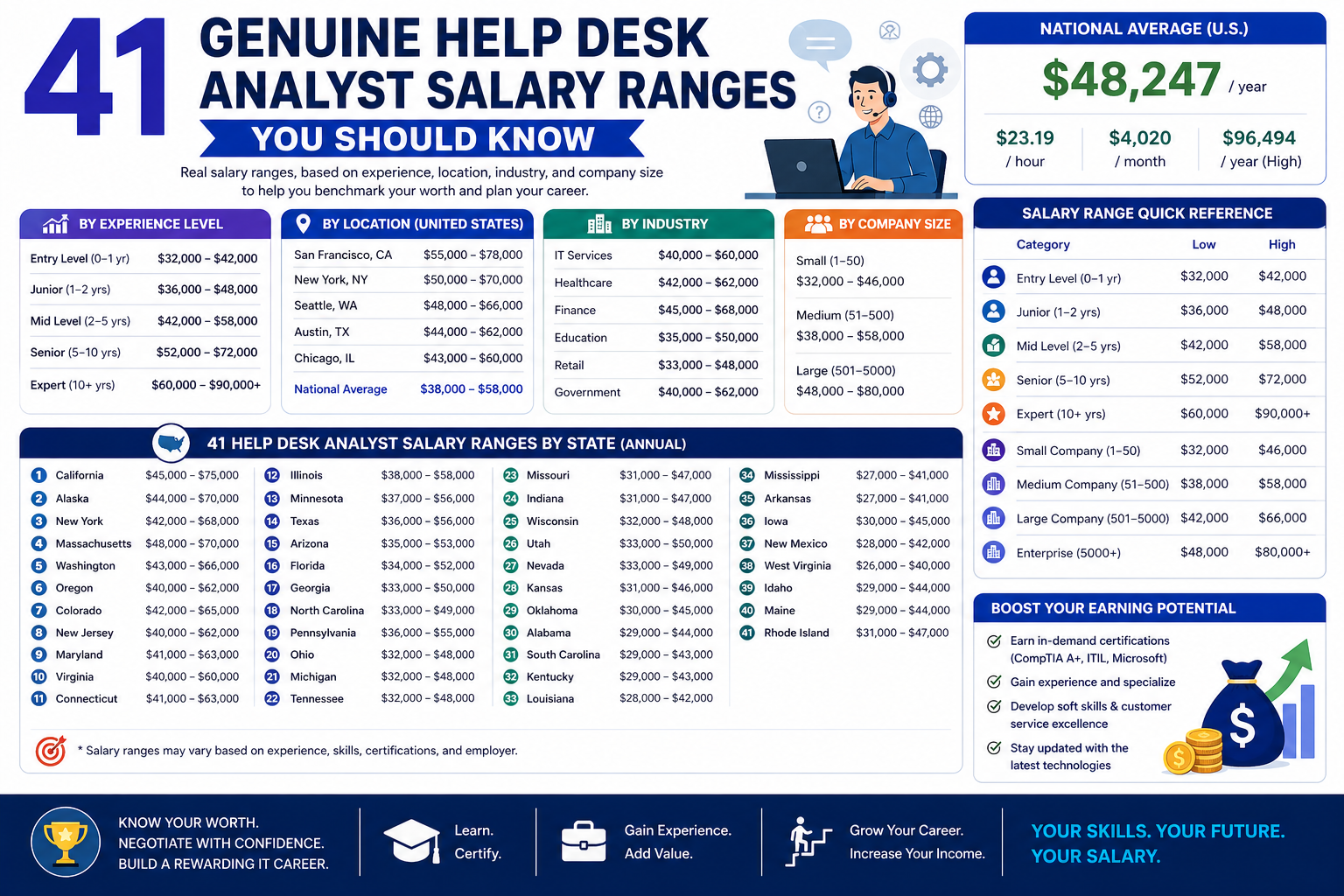
Several factors determine how much a help desk analyst earns. One of the most significant factors is location. Salaries vary widely depending on the cost of living and demand for IT professionals in a specific region. Urban areas with large technology industries tend to offer higher compensation compared to smaller towns or rural locations.
Experience also plays a major role. Entry-level analysts typically earn less than those with several years of experience. As professionals gain exposure to different systems and problem types, their ability to handle complex issues increases, which often leads to higher pay.
Education and certifications can also influence earning potential. While not always required, additional qualifications can demonstrate technical competence and commitment to professional development. Employers often reward these attributes with better compensation.
Industry type is another important factor. Organizations in sectors such as finance, healthcare, and technology may offer higher salaries due to the complexity and critical nature of their systems. In contrast, smaller organizations may offer lower pay but provide broader hands-on experience.
Company size and infrastructure also matter. Larger organizations with extensive IT systems often require more specialized support staff and may offer higher salaries to attract qualified candidates.
Compensation Structures in Help Desk Analyst Roles
Help desk analyst compensation is not limited to a single fixed salary figure. Instead, it is shaped by a combination of structured pay components that vary depending on the organization, industry, and geographic region. While base salary is the most visible part of earnings, it is only one element of a broader compensation structure that can include performance-based incentives, shift differentials, overtime pay, and internal progression adjustments.
Base salary is usually determined by job level and experience. Entry-level help desk analysts typically fall into the lower compensation band because they are still developing technical and troubleshooting skills. As analysts gain experience and demonstrate reliability in handling a wide range of support issues, their base salary tends to increase steadily. Organizations often use internal grading systems to classify help desk positions, and each grade corresponds to a defined salary range.
In some environments, especially larger corporations or managed service providers, additional compensation may be tied to performance metrics. These metrics can include ticket resolution speed, customer satisfaction scores, and adherence to service level agreements. When analysts consistently meet or exceed these benchmarks, they may become eligible for bonuses or salary adjustments.
Shift differentials also play a role in total earnings. Many help desk teams operate 24/7, particularly in global organizations. Analysts working night shifts, weekends, or holidays may receive additional pay to compensate for less desirable working hours. This can significantly increase overall income, especially in industries that require continuous support coverage.
Overtime is another important factor in compensation. During system outages, software deployments, or peak business periods, help desk analysts may be required to work beyond standard hours. Depending on company policy, this time may be compensated at an increased hourly rate or provided as additional time off.
Internal salary progression is often tied to tenure and demonstrated skill growth. Organizations typically review salaries annually or biannually, adjusting compensation based on performance evaluations. Analysts who consistently demonstrate strong technical ability and communication skills are more likely to receive higher increases.
Overall, compensation structures in help desk roles are designed to reward both technical competence and reliability. While entry-level pay may appear modest, the structure provides multiple pathways for incremental financial growth over time.
Geographic Influence on Earnings and Cost of Living Dynamics
Location plays one of the most significant roles in determining help desk analyst salaries. The same job title can result in vastly different compensation depending on whether the role is based in a major metropolitan area, a mid-sized city, or a smaller regional town. This variation is primarily driven by differences in cost of living, demand for IT professionals, and the concentration of technology-driven industries.
In large metropolitan areas with strong corporate presence, salaries tend to be higher. Cities with dense business ecosystems often require extensive IT infrastructure, which increases demand for skilled support personnel. Organizations in these regions must offer competitive salaries to attract and retain qualified candidates. However, these higher salaries are usually balanced by significantly higher living expenses, including housing, transportation, and general daily costs.
In contrast, smaller cities and rural areas typically offer lower salaries for help desk analysts. While the cost of living is also lower, the difference in compensation can still affect overall financial comfort. These regions may have fewer large corporations, resulting in reduced demand for IT support roles and less competitive salary structures.
Another important geographic factor is the presence of technology hubs. Regions with strong technology industries often offer higher-than-average salaries, even for entry-level positions. This is due to competition among employers and the need to maintain robust technical support teams. In such environments, help desk analysts may experience faster salary growth due to increased demand for skilled workers.
Remote work has introduced additional complexity into geographic salary differences. Some organizations now base compensation on the employee’s location rather than the company’s headquarters. Others maintain standardized pay regardless of location, especially if the role is fully remote. This creates new opportunities for analysts in lower-cost regions to access higher-paying roles traditionally reserved for larger cities.
Ultimately, geographic influence on salary reflects a balance between employer demand and regional economic conditions. While location can significantly affect earnings, it is only one of several factors that determine long-term financial growth in help desk roles.
Career Progression Pathways Beyond Help Desk Roles
The help desk analyst position is widely recognized as an entry point into the broader IT career landscape. It serves as a foundation for numerous advanced roles, allowing professionals to build technical expertise and transition into more specialized areas over time. Career progression is typically based on experience, skill development, and exposure to increasingly complex technical environments.
One of the most common progression paths is into system administration. As analysts gain familiarity with operating systems, network environments, and infrastructure management, they become well-positioned to take on responsibilities involving server maintenance, user account management, and system configuration. This transition often requires deeper technical knowledge and sometimes additional certifications.
Another possible pathway is network administration. Help desk analysts who develop strong networking skills may move into roles focused on managing and maintaining organizational networks. This includes monitoring network performance, configuring routers and switches, and ensuring secure connectivity across systems.
Cybersecurity is another growing field that attracts help desk professionals. Exposure to security-related incidents, such as unauthorized access attempts or malware infections, provides analysts with foundational knowledge of cybersecurity principles. Over time, this can lead to roles focused on protecting systems, monitoring threats, and implementing security protocols.
Some professionals transition into technical specialization roles. These positions focus on specific technologies such as cloud computing platforms, database management, or enterprise applications. Help desk experience provides a broad understanding of systems, which helps professionals identify areas of interest for specialization.
Others move into leadership roles within support environments. Senior help desk analysts, team leads, and support managers oversee teams of technicians, manage workflows, and ensure service quality standards are met. These roles require both technical knowledge and strong organizational skills.
Career progression is not always linear. Many professionals move between roles based on interest, opportunity, and organizational needs. The flexibility of the help desk experience allows individuals to explore different IT disciplines before committing to a specific specialization.
Service Desk Structures and Tiered Support Systems
Help desk environments are often organized into tiered support structures designed to improve efficiency and streamline issue resolution. These structures separate responsibilities based on complexity, ensuring that issues are handled by appropriately skilled personnel.
The first tier, often referred to as frontline support, is typically where help desk analysts operate. This tier is responsible for handling initial user inquiries and resolving basic technical issues. Analysts in this tier focus on password resets, software troubleshooting, connectivity problems, and general user assistance. The goal is to resolve as many issues as possible without escalation.
When issues cannot be resolved at the first level, they are escalated to second-tier support. This tier consists of more experienced technicians who handle more complex technical problems. These may include advanced system errors, deeper network issues, or application-specific malfunctions that require specialized knowledge.
In some organizations, there is also a third-tier or engineering-level support team. These professionals are responsible for resolving highly complex or system-wide issues. They may work directly with software developers, infrastructure engineers, or external vendors to identify and fix underlying problems.
The tiered structure ensures efficiency by preventing unnecessary escalation of simple issues while providing a clear pathway for handling complex problems. It also allows help desk analysts to focus on developing core troubleshooting skills before progressing to more advanced responsibilities.
Communication between tiers is essential for maintaining workflow efficiency. Detailed documentation from first-tier analysts helps higher-level teams understand the issue context and reduces resolution time. Without proper documentation, escalations can become delayed or misinterpreted.
Tiered support systems also contribute to career development. Help desk analysts gain exposure to a wide range of issues at the first level, which helps them build the foundational knowledge required for advancement into higher tiers.
Tools and Systems Used in Help Desk Environments
Help desk analysts rely on a variety of tools and systems to manage support requests and resolve technical issues. These tools are designed to streamline communication, track problems, and provide remote access to user systems when necessary.
Ticketing systems are central to help desk operations. These platforms allow users to submit support requests, which are then tracked through a structured workflow. Each ticket contains detailed information about the issue, including user descriptions, timestamps, and resolution steps. Analysts use these systems to prioritize tasks and ensure that no issue is overlooked.
Remote access tools are also commonly used. These tools allow help desk analysts to connect to user devices remotely and perform troubleshooting directly. This is especially useful for resolving software issues or configuring system settings without requiring physical access to the device.
Monitoring systems provide real-time insights into network and system performance. These tools help analysts identify issues such as server downtime, slow network performance, or application failures. By monitoring system health, help desk teams can proactively address problems before users are significantly affected.
Knowledge management systems are another important component. These systems store documentation, troubleshooting guides, and historical issue resolutions. Analysts use these resources to quickly find solutions to common problems, improving efficiency and consistency in support delivery.
Communication tools also play a critical role. Help desk analysts often use chat systems, email platforms, and internal messaging tools to communicate with users and team members. Clear and timely communication ensures smooth resolution of issues and reduces confusion.
While specific tools vary between organizations, the overall purpose remains consistent: to improve efficiency, enhance communication, and support effective problem resolution.
Performance Metrics and Evaluation Standards
Help desk analyst performance is often measured using specific metrics that reflect efficiency, accuracy, and customer satisfaction. These metrics help organizations evaluate the effectiveness of their support teams and identify areas for improvement.
One of the most common metrics is ticket resolution time. This measures how quickly an analyst is able to resolve a support request. Faster resolution times generally indicate higher efficiency, although accuracy must also be maintained.
First contact resolution rate is another important metric. This measures the percentage of issues resolved during the initial interaction without escalation. A high first contact resolution rate indicates strong technical knowledge and problem-solving ability.
Customer satisfaction scores are also widely used. After a support interaction, users may be asked to rate their experience. These ratings provide insight into communication quality, professionalism, and overall service effectiveness.
Ticket volume is another factor used in performance evaluation. Analysts who handle a higher number of tickets may be seen as more productive, although the quality of resolution is equally important.
Adherence to service level agreements is also critical. These agreements define expected response and resolution times for different types of issues. Meeting these standards ensures consistent service delivery and organizational reliability.
Performance metrics are not only used for evaluation but also for development. They help identify strengths and areas where additional training may be needed.
Work Environment and Daily Operational Challenges
The work environment for help desk analysts is typically fast-paced and structured around continuous interaction with users and systems. Analysts often manage multiple issues simultaneously, requiring strong organizational skills and the ability to prioritize effectively.
One of the primary challenges in this environment is workload variability. Some days may involve a steady flow of manageable issues, while others may include sudden spikes in support requests due to system outages or software updates.
Another challenge is dealing with frustrated users. Technical issues can be stressful for users, and help desk analysts must remain calm and professional while guiding them through solutions. Maintaining composure in these situations is essential for effective communication.
Time pressure is also a constant factor. Many organizations expect quick response and resolution times, which can create pressure to balance speed with accuracy. Analysts must ensure that issues are resolved correctly without rushing through important steps.
Repetitive tasks are another aspect of the job. Common issues, such as password resets or software troubleshooting, may occur frequently. While repetitive, these tasks are essential for maintaining system access and user productivity.
Despite these challenges, the environment also provides opportunities for continuous learning. Each issue presents a chance to develop new skills and gain a deeper understanding of IT systems.
Hiring Expectations and Interview Considerations
Hiring for help desk analyst positions typically focuses on a combination of technical aptitude and interpersonal skills. Employers look for candidates who can demonstrate problem-solving ability, clear communication, and basic technical knowledge.
During interviews, candidates are often evaluated on how they approach hypothetical technical scenarios. These scenarios test analytical thinking and the ability to logically break down problems.
Communication skills are also assessed through behavioral questions. Employers want to ensure that candidates can explain technical concepts clearly and interact professionally with users.
Basic technical questions may be included to evaluate understanding of operating systems, networking concepts, and troubleshooting methods. However, deep technical expertise is not always required for entry-level positions.
Some employers also assess adaptability and willingness to learn. Since help desk environments are dynamic, the ability to quickly learn new tools and systems is highly valued.
Work ethic and reliability are additional factors considered during hiring. Help desk roles often require consistent availability and responsiveness, especially in organizations with continuous support needs.
Overall, hiring expectations focus on potential rather than perfection, making the role accessible to individuals at the beginning of their IT careers.
Industry Demand and Employment Opportunities
Help desk analyst roles continue to remain in steady demand because almost every modern organization depends on technology to operate. Businesses across sectors such as healthcare, finance, education, retail, and telecommunications require reliable technical support to ensure that systems remain functional and users can continue their work without disruption. This widespread dependence on technology creates a consistent need for entry-level IT support professionals.
One of the strongest employment areas for help desk analysts is within large enterprises that manage complex internal systems. These organizations typically have hundreds or thousands of employees, each relying on computers, software platforms, and network access. When even minor technical issues occur, productivity can be significantly affected. Help desk analysts help reduce downtime by resolving these issues quickly and efficiently.
Another major source of employment is managed service providers. These companies offer outsourced IT support to multiple client organizations. Help desk analysts in these environments handle a wide range of technical issues across different industries and systems. This exposure can accelerate skill development because analysts are constantly dealing with varied technical environments.
Public sector organizations also provide stable employment opportunities. Government agencies, educational institutions, and public service departments often maintain internal IT support teams. These roles are valued for their job stability, structured environments, and long-term career growth potential.
The rise of remote work has also expanded opportunities for help desk analysts. Many organizations now hire remote support staff to handle user issues from different locations. This shift has made it easier for candidates to access jobs without needing to relocate, increasing overall employment accessibility.
Salary Growth Potential and Long-Term Earnings
While help desk analyst positions typically begin with entry-level salaries, long-term earning potential can increase significantly with experience and skill development. Salary growth is not immediate but follows a gradual progression as professionals move through different stages of their IT careers.
In the early stages, salary increases are usually modest and tied to performance evaluations. Analysts who consistently demonstrate efficiency in resolving tickets, strong communication skills, and technical improvement are more likely to receive incremental raises.
As professionals gain experience, they often transition into mid-level IT support roles. These positions involve handling more complex technical issues and may include mentoring newer analysts. Salary increases at this stage become more noticeable, reflecting expanded responsibilities.
Further progression into specialized IT roles leads to more substantial salary growth. Positions in network administration, systems engineering, cybersecurity, and cloud infrastructure typically offer significantly higher compensation compared to entry-level support roles. Help desk experience provides a strong foundation for these transitions.
Certifications and additional training also contribute to salary growth. While not always required for entry-level positions, recognized technical certifications can enhance credibility and open doors to higher-paying roles. Employers often reward certified professionals with increased compensation due to their validated skills.
Overall, salary progression in help desk careers is closely linked to continuous learning and professional development. Those who actively build technical expertise and pursue advancement opportunities tend to experience the strongest long-term financial growth.
Skill Development and Continuous Learning
Help desk analyst roles naturally encourage continuous skill development due to the wide variety of issues encountered on a daily basis. Each support request presents an opportunity to learn something new, whether it involves software behavior, hardware troubleshooting, or network configuration.
One of the most important areas of development is technical problem-solving. Analysts learn how to systematically approach issues, break them down into smaller components, and identify root causes. This structured thinking becomes increasingly valuable as professionals move into more advanced IT roles.
Communication skills also improve significantly over time. Regular interaction with users helps analysts refine their ability to explain technical concepts clearly and concisely. This skill is essential not only in support roles but also in leadership and technical consulting positions.
Time management is another critical skill developed in help desk environments. Analysts often handle multiple tickets simultaneously, requiring them to prioritize tasks based on urgency and impact. This ability to manage workload effectively becomes essential in more senior positions.
Exposure to different technologies also contributes to broader IT knowledge. Help desk analysts frequently interact with various operating systems, software applications, and network environments. This exposure helps them identify areas of interest for future specialization.
Continuous learning is often self-driven in this field. Many professionals take the initiative to explore new technologies, study documentation, and practice troubleshooting techniques outside of work. This proactive approach significantly enhances career development potential.
Common Challenges Faced by Help Desk Analysts
Despite being an entry-level role, help desk analyst positions come with several challenges that require resilience and adaptability. One of the most common challenges is handling high volumes of support requests. During peak periods or system outages, analysts may experience a sudden increase in workload, requiring them to remain organized under pressure.
Dealing with frustrated users is another frequent challenge. Technical issues can cause significant disruption to users’ work, leading to stress and impatience during support interactions. Analysts must maintain professionalism and patience while guiding users through solutions.
Repetitive tasks can also become challenging over time. Issues such as password resets, software installations, and basic troubleshooting occur frequently. While these tasks are essential, they can sometimes feel monotonous.
Another challenge is the need to constantly adapt to new technologies. As organizations update systems and adopt new software, help desk analysts must quickly learn how these changes affect user support processes. This requires ongoing learning and flexibility.
Balancing speed and accuracy is also important. Analysts are often expected to resolve issues quickly while ensuring that solutions are correct and complete. Rushing through tasks can lead to incomplete resolutions, while spending too much time on a single issue can affect overall performance metrics.
Future Outlook for Help Desk Analyst Careers
The future outlook for help desk analyst roles remains stable due to the continued reliance on technology in nearly every industry. As organizations expand their digital infrastructure, the need for technical support professionals continues to grow.
One major trend shaping the future of this role is automation. Many routine tasks, such as password resets and basic troubleshooting, are increasingly being automated through self-service systems and artificial intelligence tools. While this may reduce some traditional responsibilities, it also allows help desk analysts to focus on more complex issues.
Another important trend is the shift toward cloud-based systems. As organizations move their operations to cloud platforms, help desk analysts are required to understand new environments and support users across distributed systems. This increases the need for updated technical knowledge.
Remote support is also expected to remain a significant part of the industry. Many organizations continue to support hybrid or fully remote work environments, requiring help desk analysts to assist in different locations and on different devices.
Despite technological changes, the human element of support remains essential. Users still require clear communication, empathy, and guidance when dealing with technical issues. This ensures that help desk analysts will continue to play a critical role even as tools and systems evolve.
The long-term outlook suggests that help desk analyst positions will continue to serve as a strong entry point into IT careers. While the nature of the work may evolve, the foundational skills developed in this role will remain valuable across the entire technology industry.
Conclusion
Help desk analyst roles remain one of the most accessible and important entry points into the IT industry. They provide a practical starting foundation where individuals can build technical knowledge, communication ability, and real-world problem-solving experience. While the salary for entry-level positions may vary depending on location, experience, and industry, the role offers steady income and consistent opportunities for growth.
The true value of a help desk analyst position is not limited to its starting pay but lies in its long-term career potential. As professionals gain experience and expand their technical skill set, they can move into higher-paying roles such as system administration, network engineering, cybersecurity, and cloud computing. Each stage of development builds on the skills learned in help desk environments, making it a critical stepping stone in IT career progression.
Despite challenges such as workload pressure and repetitive tasks, the role continues to evolve with technology. Automation and modern tools are changing how support is delivered, but the need for skilled human analysts remains essential. Their ability to understand user problems, communicate clearly, and resolve technical issues ensures their continued relevance.
Overall, the help desk analyst position offers both stability and opportunity, making it a strong career starting point for anyone entering the IT field.