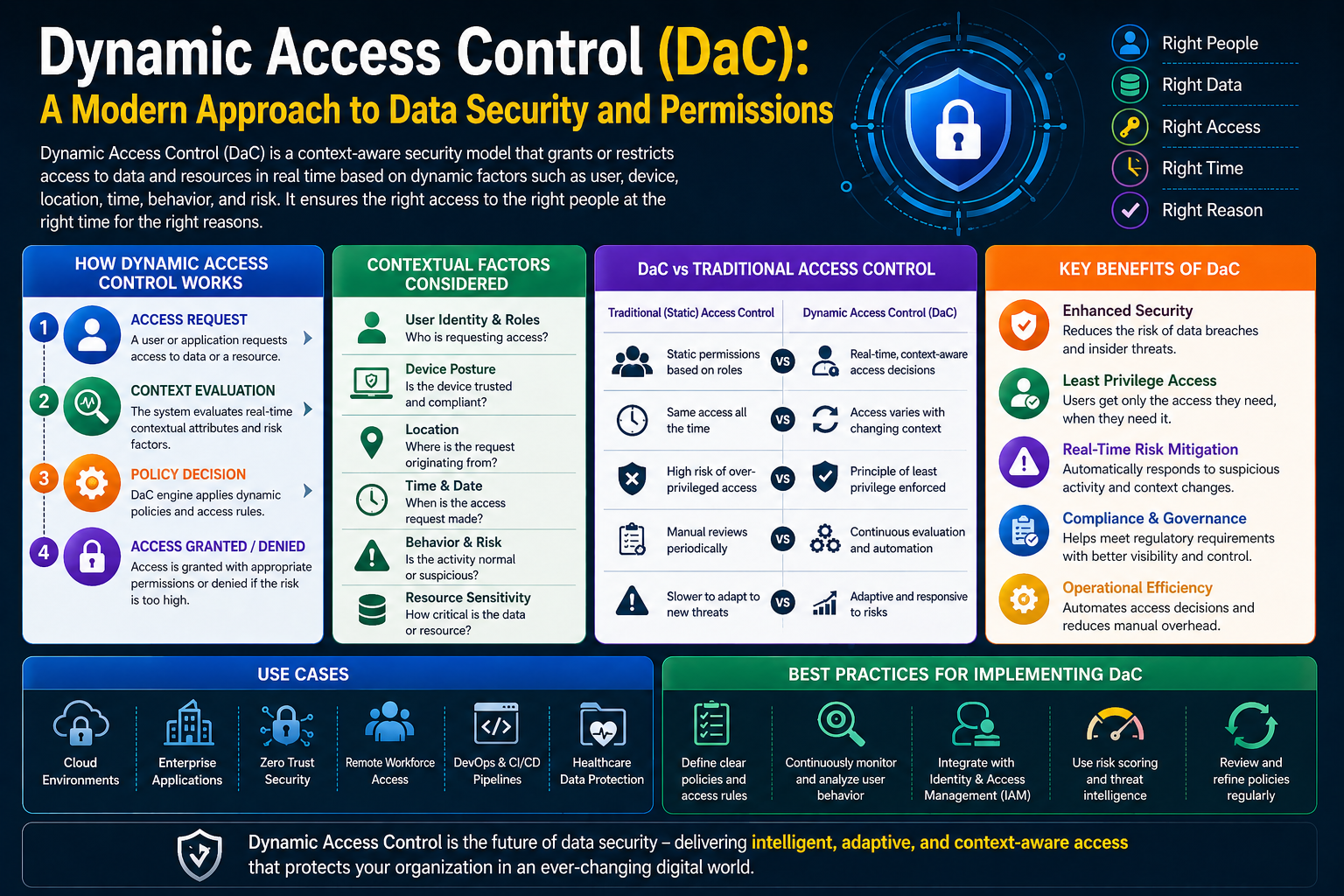
Dynamic Access Control, commonly referred to as DaC, is a security capability introduced in Windows Server 2012 that reshaped how organizations manage access to data across their network environments. Instead of relying only on fixed permissions tied to user accounts or groups, it introduces a more intelligent and flexible way of deciding who can access specific resources. This approach allows access decisions to be influenced by multiple real-time factors rather than static assignments that often become difficult to manage as environments grow.
In traditional file and resource security models, administrators typically assign permissions directly to users or groups, and those permissions remain unchanged unless manually updated. As organizations expand, this approach becomes increasingly complex because every change in job roles, departments, or compliance requirements requires manual adjustments across multiple systems. Dynamic Access Control was designed to reduce this administrative burden by introducing conditional logic into access control decisions.
At its core, DaC is built to improve governance over sensitive information by ensuring that access is not just based on identity, but also on contextual attributes such as user roles, device state, and resource classification. This shift allows enterprises to define more meaningful access rules that align closely with real business policies rather than static technical configurations.
The introduction of DaC also reflects a broader evolution in enterprise security thinking, where identity alone is no longer considered sufficient for making secure access decisions. Instead, security systems must evaluate a combination of attributes before granting or denying access, which makes security policies more adaptive and aligned with real-world scenarios.
Evolution from Traditional Access Control Models
Before the introduction of Dynamic Access Control, Windows-based environments primarily relied on two mechanisms for managing access: share permissions and NTFS permissions. These mechanisms worked together to control access to files and folders on network systems. Share permissions determined access at the network level, while NTFS permissions provided more granular control over files and directories stored on disk.
While this dual-layered approach provided a reasonable level of security, it also introduced complexity and limitations. Administrators had to carefully coordinate permissions between multiple layers, ensuring that conflicts did not unintentionally block or allow access. Over time, this method became increasingly difficult to manage, especially in large enterprises with thousands of users and rapidly changing organizational structures.
One of the major limitations of traditional access control models is their dependence on static group memberships. Users are placed into groups based on their roles, and those groups are then granted access to resources. However, as organizations evolve, users frequently move between departments, projects, or locations, requiring continuous updates to group memberships. This process is not only time-consuming but also prone to human error, which can lead to security gaps or unnecessary access privileges.
Another challenge with traditional models is the lack of contextual awareness. Permissions are generally unaware of factors such as where a user is logging in from, what device they are using, or whether the data being accessed has any sensitivity classification. As a result, access decisions are made in isolation from real-world conditions, which can increase security risks in modern distributed environments.
Dynamic Access Control was introduced to address these limitations by moving beyond static group-based permission models and introducing a system that can evaluate multiple attributes dynamically during access requests. This allows organizations to build more adaptive and context-aware security frameworks.
Core Objectives of Dynamic Access Control
The primary objective of Dynamic Access Control is to provide a more intelligent and flexible method for controlling access to resources in enterprise environments. Instead of relying solely on identity-based permissions, DaC enables administrators to define rules that take multiple factors into account before granting access.
One of the key objectives is to simplify access management in large-scale environments. As organizations grow, managing permissions through traditional methods becomes increasingly complex and difficult to maintain. DaC reduces this complexity by allowing centralized policies that automatically adjust access based on predefined conditions.
Another important objective is improving data security through classification. With DaC, data can be categorized based on sensitivity or business importance, allowing organizations to apply different access rules depending on the classification level. This ensures that sensitive data is protected more effectively without requiring manual intervention for each file or folder.
A further objective is to enhance compliance and auditing capabilities. Many industries are subject to strict regulatory requirements that demand detailed tracking of who accessed what data and under what conditions. DaC helps meet these requirements by providing structured and policy-based access control mechanisms that can be audited more easily.
Additionally, DaC aims to support the principle of least privilege more effectively. By using conditional logic, access can be granted only when specific conditions are met, ensuring that users receive only the permissions they need at any given time. This reduces the risk of excessive privileges and improves overall security posture.
Architecture Overview of Dynamic Access Control
The architecture of Dynamic Access Control is built around several interconnected components that work together to evaluate and enforce access policies. These components include claims-based identity, resource properties, and central access policies, all of which interact during an access request.
Claims-based identity plays a central role in DaC architecture. It allows user attributes from directory services to be included in access tokens. These attributes can represent information such as department, job title, location, or other organizational data. When a user attempts to access a resource, these claims are evaluated as part of the access decision process.
Resource properties represent metadata assigned to files and folders. These properties classify data based on organizational rules. For example, a document might be labeled as confidential, internal, or public. This classification helps define how sensitive the data is and what level of access should be allowed.
Central access policies act as the decision-making layer that combines claims and resource properties. These policies define the conditions under which access is granted or denied. Instead of applying permissions individually to each resource, administrators can define centralized rules that apply across multiple resources consistently.
The interaction between these components allows DaC to function as a dynamic system. When a user requests access to a file, the system evaluates the user’s claims, checks the resource classification, and then applies the relevant policy rules to determine whether access should be allowed.
This architecture ensures that access decisions are not static but instead are evaluated in real time based on current conditions and attributes. It also allows for greater scalability, as policies can be applied broadly without requiring individual configuration for every resource.
Role of Identity in Access Decisions
Identity remains a foundational element in Dynamic Access Control, but its role is expanded beyond simple authentication. In traditional systems, identity primarily determines whether a user is recognized and what group memberships they belong to. In DaC, identity becomes a richer source of contextual information through claims.
Claims are attributes associated with a user’s identity that provide additional information beyond basic login credentials. These attributes are extracted from directory services and can include organizational details such as department, employee type, or geographic location. These claims are then embedded into the user’s access token.
When an access request is made, these claims are evaluated against resource policies. This means that two users with the same basic identity level may receive different access outcomes depending on their associated claims. For example, a user in one department may have access to a document that is restricted for users in another department, even if both users belong to the same overall security group.
This approach allows identity to become more dynamic and context-aware. Instead of acting as a static identifier, identity becomes a flexible data source that helps determine access based on real-time conditions and organizational rules.
The use of claims also reduces reliance on complex group structures. In traditional systems, administrators often create multiple nested groups to manage access. With DaC, claims can replace many of these group-based rules, simplifying identity management while increasing flexibility.
Understanding Conditional Access Concept
Conditional access is one of the most important principles behind Dynamic Access Control. It refers to the ability to grant or deny access based on specific conditions rather than fixed rules. These conditions can involve user attributes, resource classifications, or environmental factors.
In a conditional access model, access is not simply granted because a user belongs to a particular group. Instead, access is evaluated based on whether certain criteria are met at the time of the request. This allows for more precise and context-sensitive security decisions.
Conditions can include factors such as the sensitivity of the data being accessed, the department of the user, or even the type of device being used. This level of granularity ensures that access decisions reflect real-world business requirements rather than static configurations.
Conditional access also improves security by reducing the risk of unauthorized access in changing environments. For example, a user may be allowed to access certain data while working within a corporate network, but restricted when accessing the same data from an external location. This dynamic adjustment helps protect sensitive information more effectively.
The flexibility of conditional access makes it particularly useful in modern IT environments where users frequently work remotely or across multiple devices. It allows organizations to maintain strong security controls without sacrificing usability or productivity.
Integration with Active Directory Infrastructure
Dynamic Access Control is closely integrated with Active Directory, which serves as the central identity management system in Windows-based environments. Active Directory provides the user attributes and organizational structure that DaC relies on to make access decisions.
Within this integration, Active Directory acts as the source of claims that are used in access evaluations. These claims are extracted from user attributes stored in the directory and are then included in access tokens during authentication processes.
The integration also extends to resource management, where file servers and storage systems use Active Directory information to apply classification and policy rules. This ensures that access control remains consistent across the entire infrastructure.
Active Directory also supports the management of central access policies, allowing administrators to define and deploy policies from a centralized location. These policies are then enforced across all connected systems, ensuring uniform security behavior throughout the environment.
This deep integration makes DaC a natural extension of existing Windows Server environments, allowing organizations to enhance their security models without replacing their entire identity infrastructure.
Security Context and Access Tokens in DaC
Access tokens play a critical role in how Dynamic Access Control evaluates permissions. When a user logs into the system, an access token is generated that contains information about the user’s identity, group memberships, and claims.
In DaC, this access token is extended to include additional attributes beyond traditional identity data. These attributes are used during the evaluation of access policies and help determine whether access should be granted under specific conditions.
The security context provided by the access token ensures that access decisions are made based on a complete view of the user’s identity and associated attributes. This context is evaluated each time a resource is accessed, allowing for dynamic and real-time decision-making.
The use of extended access tokens also enables more detailed auditing and tracking of access events. Since tokens include contextual information, it becomes easier to understand not just who accessed a resource, but also under what conditions the access occurred.
This enhanced security context contributes to a more robust and transparent access control system, where decisions are based on multiple layers of information rather than a single identity check.
Policy-Driven Security Approach in Enterprise Systems
Dynamic Access Control introduces a policy-driven approach to security that replaces many traditional manual configurations. Instead of assigning permissions directly to users or groups, administrators define policies that automatically govern access based on conditions and attributes.
These policies act as centralized rules that apply across multiple resources and users. This reduces administrative overhead and ensures consistency in how access decisions are enforced throughout the organization.
A policy-driven approach also allows for greater scalability. As organizations grow, new users and resources can automatically fall under existing policies without requiring individual configuration. This makes it easier to maintain security standards across large environments.
Another advantage of this approach is improved alignment with business requirements. Policies can be designed to reflect organizational rules, compliance requirements, and operational needs, ensuring that security controls are closely tied to real-world processes.
By shifting from manual permission management to policy-based control, Dynamic Access Control provides a more structured and efficient way to manage enterprise security.
Early Implementation Context in Windows Server 2012
The introduction of Dynamic Access Control in Windows Server 2012 marked a significant shift in how Microsoft approached enterprise security. It was designed to address growing challenges in data governance, compliance, and large-scale identity management.
During this period, organizations were increasingly dealing with complex IT environments that included distributed systems, remote users, and strict regulatory requirements. Traditional access control models were no longer sufficient to handle these evolving demands.
Windows Server 2012 introduced DaC as part of a broader effort to modernize identity and access management. It provided new tools and frameworks that allowed administrators to build more flexible and intelligent security models.
The early implementation of DaC focused on introducing key concepts such as claims-based identity, resource classification, and central access policies. These foundational elements laid the groundwork for more advanced security features in later systems.
By embedding DaC into Windows Server, Microsoft enabled organizations to begin transitioning toward more dynamic and context-aware security models without requiring a complete overhaul of existing infrastructure.
Data Classification as the Foundation of Dynamic Access Control
One of the most important building blocks of Dynamic Access Control is data classification, which allows organizations to assign meaning and sensitivity levels to information stored across file systems. Instead of treating all files equally, classification introduces structure by labeling data according to its business relevance, confidentiality, or regulatory requirements.
This classification process enables systems to understand what type of data is being handled, which is essential when making access decisions based on context. For example, a financial report may be classified differently from a general informational document, even if both reside on the same file server. This distinction ensures that sensitive information is handled with greater restrictions.
Classification in this context is not limited to manual tagging. It can also be automated through rule-based systems that analyze file content, location, or properties to determine appropriate labels. Once assigned, these classifications become part of the resource metadata and are used during access evaluations.
By introducing structured data classification, Dynamic Access Control transforms file systems into intelligent environments where access decisions are influenced by the nature of the data itself rather than just where it is stored or who owns it.
Resource Properties and Metadata Tagging Mechanisms
Resource properties play a central role in how Dynamic Access Control organizes and evaluates data. These properties act as metadata attributes that describe files and folders in terms of their business or security relevance.
Unlike traditional file systems, where metadata is limited to basic attributes such as size or modification date, resource properties allow administrators to define custom classifications. These may include labels such as “confidential,” “internal use,” or “regulated data,” depending on organizational needs.
Once defined, resource properties can be applied across multiple files and folders, creating a consistent classification structure throughout the environment. This consistency is critical because it ensures that access policies can rely on predictable data attributes when making decisions.
Resource properties are typically grouped into lists that define which classifications are available within the system. These lists help standardize how data is categorized and ensure that users and administrators apply labels consistently.
Through this mechanism, Dynamic Access Control extends file system capabilities beyond simple storage, turning data into structured and policy-aware entities that can participate in access control decisions.
Claims-Based Identity and Attribute Expansion
Claims-based identity is a key enhancement introduced by Dynamic Access Control that extends traditional identity models. Instead of relying solely on usernames and group memberships, claims introduce additional attributes that provide deeper insight into a user’s role and context.
These attributes are sourced from directory services and embedded into authentication tokens. They can include details such as department, job title, employee status, or geographical location. This enriched identity allows access decisions to be based on more than just static group assignments.
The inclusion of claims enables more granular control over access decisions. For instance, two users within the same organization may have different access rights depending on their department or project assignment, even if they share similar group memberships.
Claims also improve flexibility by reducing reliance on complex group hierarchies. Instead of creating multiple nested groups for every possible access scenario, administrators can define policies that evaluate claims dynamically at the time of access.
This approach makes identity management more scalable and reduces administrative overhead while increasing precision in access control decisions.
Central Access Rules and Policy Structure
Central access rules form the decision-making framework within Dynamic Access Control. These rules define the logical conditions under which access to resources is either granted or denied.
Unlike traditional permission models, where rules are applied directly to individual files or folders, central access rules operate at a higher level. They evaluate combinations of user claims, resource properties, and environmental conditions to determine access outcomes.
These rules are structured using conditional logic, allowing administrators to define complex relationships between identity attributes and data classifications. For example, a rule might allow access only if a user belongs to a specific department and the resource is classified below a certain sensitivity level.
Central access rules are grouped into policies that can be applied across multiple systems and resources. This centralized approach ensures consistency in access decisions and reduces the need for repetitive configuration.
By abstracting access logic into centralized policies, Dynamic Access Control simplifies administration while enabling highly detailed and context-aware security enforcement.
Policy Enforcement Across File Systems
Once central access policies are defined, they must be enforced consistently across file systems and network resources. Enforcement ensures that the rules established by administrators are actively applied during every access request.
In Dynamic Access Control, enforcement occurs at the file server level, where requests to access files or folders are evaluated against the relevant policies. The system checks user claims, resource properties, and defined rules before allowing or denying access.
This process happens dynamically, meaning that access decisions are made in real time based on current conditions. If any attribute changes—such as a user moving departments or a file being reclassified—the access decision automatically reflects those changes without requiring manual intervention.
Policy enforcement also integrates with auditing systems, allowing organizations to track how policies are applied in real-world scenarios. This helps ensure compliance with internal governance rules and external regulatory requirements.
Through consistent enforcement, Dynamic Access Control ensures that security policies are not just defined but actively maintained across the entire infrastructure.
Role of Kerberos in Claims Transmission
Kerberos authentication plays a supporting role in Dynamic Access Control by enabling the secure transmission of claims within access tokens. When a user authenticates, Kerberos issues a ticket that includes identity information and additional attributes required for access evaluation.
To support claims-based authentication, Kerberos must be extended to carry additional contextual data. This enhancement allows user attributes from directory services to be included in authentication tokens without compromising security.
The extended Kerberos mechanism ensures that claims are securely transmitted between client and server systems during authentication and authorization processes. This is essential for maintaining integrity in environments where access decisions depend on dynamic attributes.
Without this extension, claims-based access control would not function effectively, as the required contextual information would not be reliably available during access evaluations.
Kerberos integration ensures that Dynamic Access Control operates securely within existing authentication frameworks while enabling advanced identity-based decision-making.
Administrative Configuration Using Directory Tools
Managing Dynamic Access Control requires administrative tools that allow configuration of claims, resource properties, and policies. These tools provide a structured interface for defining how access control rules are applied across the environment.
Administrative interfaces within directory services enable administrators to define claim types based on user attributes. These claim types determine which pieces of identity information can be used in access decisions.
Resource properties are also configured through these tools, allowing administrators to define classification categories that can be applied to files and folders. These classifications form the basis for resource-aware access policies.
In addition, central access rules and policies are created and managed through administrative consoles that provide structured workflows for defining conditional logic. These tools help ensure that policies are consistent, accurate, and aligned with organizational requirements.
By centralizing configuration through directory-based tools, Dynamic Access Control reduces complexity and ensures that all policy components are managed in a unified manner.
File Server Integration and Resource Management
Dynamic Access Control is deeply integrated with file server infrastructure, allowing it to evaluate and enforce policies directly where data is stored. This integration ensures that access decisions are made at the point of resource interaction.
File servers use metadata associated with files and folders to determine their classification. This metadata is then evaluated against central access policies whenever a user attempts to access the resource.
Resource management systems also support automated classification processes, where files can be analyzed and tagged based on predefined rules. This reduces the need for manual classification and ensures consistency across large datasets.
Integration with file servers also enables real-time enforcement of access policies. As users interact with data, the system continuously evaluates whether access conditions are met, ensuring that security policies are always up to date.
This tight integration between Dynamic Access Control and file server infrastructure makes it possible to enforce sophisticated security models without requiring significant changes to existing storage systems.
Auditing and Compliance Tracking in Dynamic Access Control
Auditing is a critical component of Dynamic Access Control, especially in environments subject to regulatory oversight. The system provides detailed tracking of access events, including information about which users accessed which resources and under what conditions.
Unlike traditional auditing systems that focus primarily on identity-based logging, Dynamic Access Control adds contextual depth to audit records. This includes information about user claims, resource classifications, and policy evaluations.
This enriched auditing capability allows organizations to demonstrate compliance with regulatory requirements more effectively. It provides a clear record of how access decisions were made and ensures transparency in data handling processes.
Auditing also supports internal governance by helping administrators identify potential security risks or policy misconfigurations. By analyzing access patterns, organizations can refine their policies to improve both security and operational efficiency.
Through detailed auditing mechanisms, Dynamic Access Control strengthens accountability and enhances visibility into system activity.
Design Considerations for Scalable Deployment
Implementing Dynamic Access Control in large-scale environments requires careful design considerations to ensure scalability and maintainability. One of the primary considerations is how claims and resource properties are structured across the organization.
Poorly designed claim structures can lead to unnecessary complexity and reduced performance. It is important to define claims that are meaningful, consistent, and aligned with business requirements.
Another consideration is the design of resource classification systems. Overly granular classifications can make policy management difficult, while overly broad classifications may reduce security effectiveness. A balanced approach is required to maintain both usability and control.
Policy design also plays a critical role in scalability. Central access policies should be structured in a way that minimizes redundancy while covering a wide range of access scenarios.
In large environments, performance considerations must also be taken into account, as real-time evaluation of multiple attributes can introduce processing overhead. Efficient policy design helps mitigate this impact and ensures smooth system operation.
Real-World Usage Scenarios in Enterprise Environments
Dynamic Access Control is commonly used in enterprise environments where data sensitivity and regulatory compliance are critical concerns. One common scenario involves restricting access to sensitive financial or legal documents based on both user role and data classification.
In another scenario, organizations may use DaC to control access to data based on geographic location, ensuring that certain information can only be accessed from approved regions or offices.
It is also used in environments where employees frequently change roles or responsibilities. Instead of manually updating permissions each time a change occurs, access is automatically adjusted based on updated claims.
Another use case involves supporting compliance requirements by ensuring that access to regulated data is tightly controlled and fully auditable. This helps organizations meet industry standards without relying on manual oversight.
These scenarios demonstrate how Dynamic Access Control can be applied in practical environments to improve both security and operational efficiency.
Interaction Between Policy Layers and Decision Flow
The decision-making process in Dynamic Access Control involves multiple layers working together to evaluate access requests. When a user attempts to access a resource, the system first evaluates identity claims, then checks resource properties, and finally applies central access policies.
Each layer contributes specific information to the decision process. Claims provide user context, resource properties define data sensitivity, and policies define the rules that govern access behavior.
This layered approach ensures that access decisions are comprehensive and based on multiple factors rather than a single attribute. It also allows for flexible policy design, where different conditions can be combined to achieve specific security outcomes.
The interaction between these layers creates a structured and predictable decision flow that can adapt to changing organizational requirements while maintaining consistent enforcement across systems.
Advanced Policy Logic and Conditional Rule Design in Dynamic Access Control
Dynamic Access Control enables organizations to build access decisions using advanced conditional logic rather than relying on simple allow-or-deny permissions. This approach allows administrators to define rules that evaluate multiple attributes simultaneously, creating a more precise and context-aware security model.
At the core of this logic is the ability to combine user claims, resource properties, and environmental conditions into structured expressions. These expressions determine whether access should be granted based on whether all required conditions are satisfied. This makes access control highly flexible, as rules can be tailored to reflect real organizational policies.
For example, an access rule might require that a user belongs to a specific department and that the resource is labeled with a certain classification before access is allowed. Another rule might restrict access based on location or device type, ensuring that sensitive information is only accessible under approved conditions.
The strength of conditional logic lies in its ability to represent complex business requirements in a structured format. Instead of manually assigning permissions to individual users or groups, administrators define rules that automatically adapt to changes in user attributes or data classification.
This approach reduces administrative effort while increasing precision in access decisions. It also ensures that security policies remain consistent even as organizational structures evolve.
Context-Aware Access Decisions and Environmental Factors
One of the key advantages of Dynamic Access Control is its ability to incorporate contextual information into access decisions. This means that access is not only based on identity and resource classification but also on environmental factors that influence security conditions.
Environmental context can include factors such as network location, device compliance status, or authentication strength. By considering these variables, the system can make more informed decisions about whether access should be allowed.
For example, a user accessing sensitive data from a trusted corporate network may be granted full access, while the same user accessing from an external or untrusted network may be restricted or denied access entirely.
Similarly, device compliance can influence access decisions. If a device does not meet security requirements, such as encryption or updated antivirus protection, access to sensitive resources can be restricted even if the user has valid credentials.
This context-aware approach enhances security by ensuring that access decisions reflect real-world conditions rather than static identity information. It also reduces the risk of unauthorized access in scenarios where credentials alone are not sufficient to guarantee trust.
Relationship Between Least Privilege and Dynamic Access Control
The principle of least privilege is a foundational concept in cybersecurity that ensures users are granted only the minimum level of access necessary to perform their tasks. Dynamic Access Control strengthens this principle by enabling more precise and adaptive enforcement of access restrictions.
In traditional systems, implementing least privilege often requires complex group management and frequent updates to permissions. As organizations grow, maintaining strict adherence to this principle becomes increasingly difficult due to administrative overhead and human error.
Dynamic Access Control simplifies this process by allowing access to be determined dynamically based on user attributes and resource classifications. Instead of assigning fixed permissions, administrators define conditions under which access is granted.
This means that users automatically receive only the access they need at the time of request, and only when relevant conditions are met. If those conditions change, access is automatically adjusted without requiring manual intervention.
By integrating least privilege into policy-driven access control, organizations can significantly reduce the risk of excessive permissions while maintaining operational flexibility.
Scalability Challenges in Large Enterprise Deployments
While Dynamic Access Control provides significant benefits in terms of flexibility and security, deploying it in large enterprise environments introduces several scalability challenges that must be carefully managed.
One major challenge is the complexity of defining and maintaining claims across large user populations. As the number of attributes increases, it becomes more difficult to ensure consistency and avoid overlapping or conflicting definitions.
Another challenge involves managing resource classification at scale. Large organizations often have vast amounts of data spread across multiple systems, making it difficult to maintain consistent classification standards without automated tools.
Policy management can also become complex when dealing with a large number of conditional rules. Without careful design, policies may become difficult to understand, maintain, or troubleshoot.
Performance considerations are also important in large deployments. Since Dynamic Access Control evaluates multiple attributes during each access request, inefficient policy design can introduce delays or system overhead.
To address these challenges, organizations must adopt structured governance practices that ensure consistency in claim definitions, resource classifications, and policy design. This includes establishing clear standards and minimizing unnecessary complexity in access rules.
Automation and Classification Processes in Data Management
Automation plays an important role in Dynamic Access Control, particularly in the area of data classification. Manual classification of large datasets is not practical in most enterprise environments, so automated mechanisms are used to apply labels based on predefined rules.
These rules may evaluate file content, location, or metadata to determine appropriate classification levels. Once identified, the system automatically assigns resource properties that define the sensitivity or category of the data.
Automation ensures that classification remains consistent across large environments and reduces the risk of human error. It also allows organizations to scale their data governance strategies without requiring extensive manual effort.
In addition to classification, automation can also support policy enforcement by dynamically adjusting access rules based on changes in user attributes or organizational structure.
This level of automation enables Dynamic Access Control to function as a self-adjusting system that responds to changes in real time, ensuring that access decisions always reflect current conditions.
Security Boundaries and Trust Evaluation Models
Dynamic Access Control introduces a more sophisticated model for evaluating trust within enterprise environments. Instead of assuming that all authenticated users within a domain are equally trusted, the system evaluates trust based on multiple attributes.
These attributes may include user identity, device state, resource classification, and environmental context. By combining these factors, the system establishes a more nuanced understanding of trustworthiness.
Security boundaries are defined not just by network location but by policy conditions that determine when access is appropriate. This allows organizations to enforce stricter controls over sensitive data while maintaining flexibility for less critical resources.
Trust evaluation becomes a continuous process rather than a one-time decision at login. Each access request is evaluated independently based on current conditions, ensuring that trust is always assessed in real time.
This dynamic approach to trust helps reduce the risk of unauthorized access and strengthens overall security posture in distributed environments.
Integration with Enterprise Compliance Frameworks
Dynamic Access Control is particularly valuable in environments that must adhere to strict compliance requirements. Many regulatory frameworks require organizations to demonstrate control over sensitive data and provide detailed records of access activity.
DaC supports these requirements by enabling structured access control policies that align with compliance standards. Resource classification ensures that sensitive data is clearly identified and protected according to its classification level.
Central access policies provide a consistent framework for enforcing access rules across the organization, ensuring that compliance requirements are applied uniformly.
Auditing capabilities further support compliance by providing detailed records of access events, including contextual information about how decisions were made. This transparency is essential for demonstrating adherence to regulatory standards.
By integrating access control with compliance frameworks, Dynamic Access Control helps organizations meet regulatory obligations more efficiently while maintaining strong security controls.
Administrative Efficiency and Reduction of Manual Management
One of the most significant benefits of Dynamic Access Control is its ability to reduce the administrative burden associated with traditional permission management. In conventional systems, administrators must manually assign permissions to users and groups, often resulting in complex and time-consuming configurations.
DaC reduces this burden by replacing manual assignments with policy-driven rules. Once policies are defined, they automatically govern access decisions without requiring ongoing manual updates.
This reduces the likelihood of configuration errors and ensures that access control remains consistent across the organization. It also frees administrators to focus on higher-level security planning rather than routine permission management tasks.
Administrative efficiency is further improved through centralized policy management. Instead of configuring permissions on individual systems, administrators can define rules that apply across multiple resources simultaneously.
This centralized approach simplifies management and ensures that security policies remain consistent throughout the environment.
Risk Reduction Through Dynamic Enforcement Mechanisms
Dynamic Access Control helps reduce security risks by enforcing access decisions dynamically based on current conditions. This reduces the likelihood of unauthorized access caused by outdated permissions or misconfigurations.
Since access is evaluated in real time, changes in user roles or resource classification are immediately reflected in access decisions. This ensures that users do not retain access beyond what is appropriate for their current role or context.
Dynamic enforcement also reduces the risk of privilege escalation, as access is continuously evaluated against policy conditions rather than being permanently assigned.
This approach enhances security by ensuring that access is always aligned with current organizational requirements and environmental conditions.
Operational Challenges and Policy Optimization Needs
While Dynamic Access Control offers significant benefits, it also introduces operational challenges that must be carefully managed. One of the primary challenges is designing policies that are both effective and maintainable.
Overly complex policies can become difficult to understand and troubleshoot, leading to potential misconfigurations or unintended access behavior. It is important to strike a balance between flexibility and simplicity when designing access rules.
Another challenge is ensuring consistency across different parts of the organization. Without proper governance, different departments may define conflicting policies or classification standards, leading to inconsistencies in access control behavior.
Performance optimization is also an important consideration. Since access decisions involve evaluating multiple attributes, poorly designed policies can impact system performance if not properly optimized.
Addressing these challenges requires careful planning, clear governance structures, and ongoing monitoring of policy effectiveness.
Conclusion
Dynamic Access Control represents a major shift in how access to data is managed within Windows Server environments. Instead of relying on traditional static permissions based on users and groups, it introduces a flexible, policy-driven model that evaluates multiple factors before granting access. This includes user attributes, device context, and data classification, allowing organizations to enforce security more intelligently and adaptively.
By combining claims-based identity, resource properties, and central access policies, Dynamic Access Control creates a structured framework that aligns access decisions with real business requirements. It supports the principle of least privilege more effectively by ensuring users only access data when specific conditions are met, rather than relying on permanently assigned permissions.
It also strengthens compliance and auditing by providing clearer visibility into how and why access decisions are made. This is especially important for organizations operating under strict regulatory requirements, where detailed access tracking is essential.
Although its implementation can introduce complexity, the long-term benefits include improved security, reduced administrative overhead, and better scalability in large environments. Overall, Dynamic Access Control enhances traditional access management by making it more contextual, automated, and aligned with modern enterprise security needs.