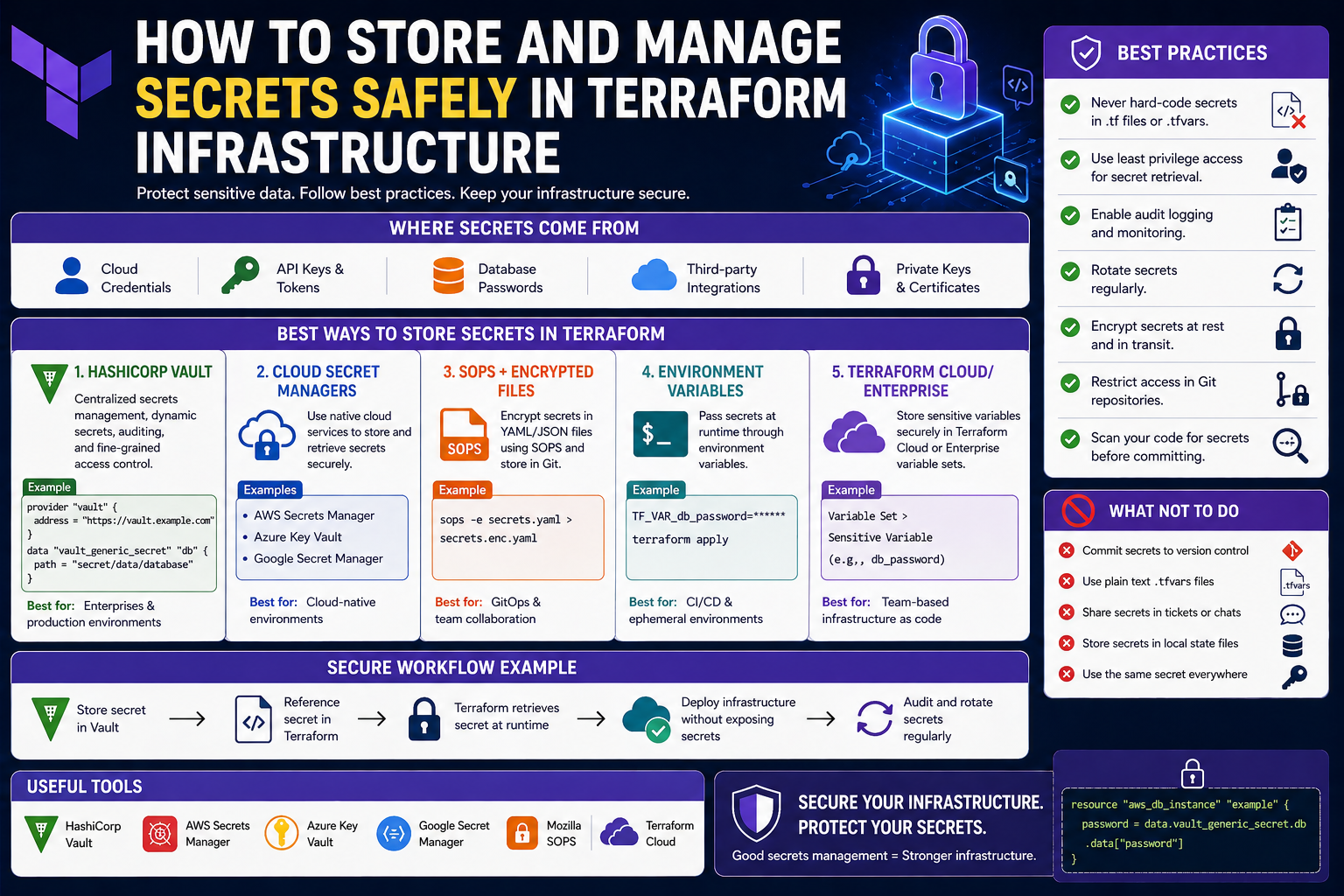
In modern cloud environments, infrastructure is no longer static or manually controlled. Systems are created, modified, and removed through automated processes that interact with multiple services at once. Within this dynamic environment, secrets play a central role in securing access to those services. A secret can be understood as any piece of sensitive information that verifies identity or enables authorized communication between systems. This includes items such as access keys, database credentials, authentication tokens, private certificates, and service passwords.
In cloud-based architectures, secrets are the foundation of trust between systems. When one service communicates with another, it must prove that it has permission to do so. This proof is often provided through a secret. Without proper handling of these sensitive elements, even the most advanced cloud infrastructure becomes vulnerable to unauthorized access.
Secrets differ from general configuration data because of their sensitivity and potential impact. While configuration values might define how a system behaves, secrets determine who can interact with that system. This distinction is important because secrets must be protected more strictly than in regular settings. In many cases, exposure of a single secret can lead to full access to cloud resources, data breaches, or unauthorized system modifications.
In infrastructure automation environments, secrets are often used in large volumes. A single application may require multiple secrets to connect with databases, storage systems, messaging services, and third-party APIs. Managing these secrets manually becomes impractical as systems scale, which is why automation tools like Terraform are widely used. However, automation introduces its own risks, especially when secrets are not handled correctly within configuration files or deployment pipelines.
Understanding secrets in this context requires recognizing their dual role. On the one hand, they enable seamless system communication. On the other hand, they represent one of the most sensitive components in any infrastructure design. This dual nature makes their management a critical responsibility in cloud engineering.
Why Terraform Needs Secure Secret Handling
Terraform is widely used for defining and managing infrastructure across multiple cloud providers. It allows users to describe infrastructure in a declarative way, meaning that desired system states are defined and then automatically applied. This approach simplifies infrastructure management but also introduces challenges when dealing with sensitive information.
Because Terraform configurations are designed to be reusable and shareable, they often exist in version-controlled environments. These environments make collaboration easier, but they also increase the risk of exposing secrets if they are not handled correctly. If sensitive data is accidentally included in configuration files, it may be stored in multiple locations, including logs, repositories, and deployment histories.
Terraform itself is not inherently unsafe. Instead, its flexibility requires careful handling of sensitive values. When properly managed, Terraform can interact with secrets securely without exposing them directly in configuration definitions. However, this depends entirely on how developers structure and manage their infrastructure definitions.
Another reason secure secret handling is essential in Terraform is its role in multi-cloud environments. Organizations often use multiple providers simultaneously, each with its own authentication requirements. Managing these credentials across different systems increases complexity and the chance of misconfiguration. Without a structured approach to secret handling, maintaining security consistency across environments becomes difficult.
Terraform also supports automated workflows where infrastructure changes are applied without manual intervention. While this improves efficiency, it also means that secrets may be accessed by automated systems rather than humans. Ensuring that these automated processes are secure is essential because any vulnerability in the workflow can expose sensitive data at scale.
The importance of secure secret handling in Terraform is therefore not only about protecting individual credentials but also about maintaining the integrity of the entire infrastructure lifecycle. When secrets are managed correctly, Terraform becomes a powerful and secure tool for infrastructure automation. When they are mismanaged, they can become a source of significant security risk.
Risks of Exposing Secrets in Infrastructure as Code
One of the most critical risks in infrastructure automation is the accidental exposure of secrets. Because Infrastructure as Code relies on text-based configuration files, it is easy for sensitive information to be included unintentionally. Once this happens, the exposure can spread quickly across multiple systems.
A common risk occurs when secrets are embedded directly into configuration definitions. When this happens, the secret becomes part of the infrastructure blueprint itself. If that blueprint is shared, backed up, or stored in multiple environments, the secret is replicated without restriction. This increases the likelihood of unauthorized access.
Another major risk is exposure through version control systems. Infrastructure code is often stored in repositories to enable collaboration and change tracking. However, if secrets are committed to these repositories, they can remain accessible even after being removed from active configurations. Historical records may still contain sensitive data, creating long-term security vulnerabilities.
Logs generated during infrastructure deployment can also expose secrets. When systems process configuration changes, they may produce detailed logs for debugging and monitoring purposes. If these logs include sensitive values, they can become another source of exposure.
In addition to internal risks, external threats also play a role. Attackers often target infrastructure repositories and deployment systems because they contain valuable information. A single exposed secret can provide access to cloud resources, leading to further compromise of systems and data.
The impact of secret exposure is not limited to immediate access. It can also lead to privilege escalation, where attackers use one compromised credential to gain access to additional systems. This chain reaction can significantly increase the scale of a security incident.
Because of these risks, secret management must be treated as a core part of infrastructure design rather than an afterthought. Every stage of the infrastructure lifecycle must consider how sensitive information is stored, accessed, and protected.
How Terraform Processes Configuration and Sensitive Values
Terraform operates by reading configuration definitions and translating them into infrastructure changes. These definitions describe resources, dependencies, and relationships between cloud components. Within this process, certain values may be marked as sensitive or handled in a way that prevents direct exposure during output operations.
When Terraform processes configurations, it builds an execution plan that outlines the changes required to reach the desired state. During this planning phase, sensitive values may be used to establish connections or authenticate services. However, the handling of these values depends on how they are defined and managed within the configuration structure.
Sensitive values are not inherently hidden from Terraform’s internal processes. Instead, they are protected from unnecessary display or logging. This means that while Terraform may use a secret to perform operations, it avoids displaying that secret in standard output or logs. This distinction is important because it allows automation to function without exposing sensitive information unnecessarily.
However, the responsibility for secure handling does not lie solely with Terraform. Users must ensure that sensitive values are not introduced into configurations in unsafe ways. Terraform provides mechanisms for handling sensitive data, but these mechanisms must be used correctly to be effective.
Another important aspect of Terraform’s processing model is state management. Terraform maintains a record of infrastructure resources in a state file, which is used to track changes over time. If sensitive values are stored in this state file without proper safeguards, they may become exposed. This makes state management one of the most critical areas in secret handling.
Terraform’s design allows it to integrate with external systems for managing sensitive data, but the effectiveness of these integrations depends on how they are implemented. Proper separation of configuration logic and sensitive information is essential for maintaining secure infrastructure workflows.
Common Mistakes in Secret Management with Terraform
One of the most common mistakes in managing secrets with Terraform is placing sensitive values directly into configuration files. This approach may seem convenient during initial development, but it creates long-term security risks. Once secrets are embedded in configuration files, they become difficult to remove completely from system history and backups.
Another frequent mistake is the inconsistent handling of secrets across environments. In many cases, development, testing, and production environments are managed differently, leading to variations in how secrets are stored and accessed. This inconsistency can create gaps in security coverage and increase the likelihood of exposure.
Improper state file management is another significant issue. When state files are stored without encryption or access control, they may expose sensitive information. Since state files contain detailed infrastructure information, including references to sensitive values, protecting them is essential.
A further mistake involves over-reliance on manual processes. When secrets are managed manually, there is a higher chance of human error. This includes copying secrets into incorrect locations, failing to rotate credentials, or sharing sensitive information through insecure channels.
Another issue arises when teams do not implement clear policies for secret rotation. Secrets that remain unchanged for long periods become more vulnerable over time. Without structured rotation practices, the risk of compromised credentials increases significantly.
In some cases, organizations also fail to separate access responsibilities. When too many individuals have access to secrets, the risk of accidental or intentional exposure increases. Proper role-based access control is essential to minimize this risk.
These mistakes highlight the importance of structured and disciplined secret management practices. Terraform provides the tools needed to handle secrets securely, but effectiveness depends on consistent and careful implementation.
Security Principles for Handling Secrets
Effective secret management is built on a foundation of core security principles that guide how sensitive information should be handled in any system. One of the most important principles is least privilege, which ensures that only the minimum level of access required is granted to any user or system component. This reduces the potential impact of a compromised credential.
Another key principle is the separation of concerns. Sensitive information should be stored separately from infrastructure definitions. This separation helps ensure that configuration files remain reusable and safe to share without exposing critical data.
Encryption is also a fundamental principle. Secrets should be protected both at rest and in transit. This ensures that even if data is intercepted or accessed without authorization, it remains unreadable without the appropriate decryption mechanism.
Access control is equally important. Systems managing secrets must enforce strict authentication and authorization rules. Only verified entities should be allowed to retrieve or modify sensitive information.
Auditability plays a significant role in maintaining security. Every access or modification of a secret should be recorded. This helps in identifying suspicious activity and maintaining accountability within infrastructure environments.
Another principle is lifecycle management. Secrets should not remain static indefinitely. Regular rotation and expiration policies help reduce the risk of long-term exposure.
Together, these principles form a structured approach to secret management. When applied consistently, they significantly reduce the risk of security breaches and improve the overall resilience of infrastructure systems.
Environment-Based Secret Injection Concept
One of the approaches used in infrastructure automation involves separating sensitive values from configuration definitions and injecting them at runtime. In this approach, secrets are stored outside the main infrastructure definitions and are made available only when required during execution.
This method ensures that sensitive information does not appear directly within configuration files. Instead, it is supplied dynamically by the environment in which the infrastructure process runs. This reduces the risk of accidental exposure through version control systems or shared configuration repositories.
Environment-based injection also allows for greater flexibility across different deployment stages. Development, testing, and production environments can each use different sets of secrets without requiring changes to the underlying infrastructure definitions. This separation improves both security and maintainability.
However, this approach requires careful control of the environment itself. If the environment is not properly secured, secrets may still be exposed. This includes protecting access to the system where the environment variables are defined and ensuring that unauthorized users cannot retrieve them.
Another important consideration is consistency. Managing secrets through environment-based methods requires standardized processes to ensure that values are correctly defined and updated across all environments. Without consistency, configuration drift may occur, leading to unexpected behavior or security gaps.
Despite these challenges, environment-based injection remains a widely used method for managing secrets due to its simplicity and compatibility with automation systems. It provides a balance between security and operational efficiency when implemented correctly.
Concept of External Secret Management Systems
External secret management systems are specialized tools designed to store, manage, and control access to sensitive information. These systems operate independently from infrastructure definitions, allowing secrets to be managed separately from application logic.
In this approach, secrets are stored in a centralized secure location rather than being embedded in configuration files or environment variables alone. Access to these secrets is controlled through strict authentication mechanisms, ensuring that only authorized systems or users can retrieve them.
One of the key advantages of external secret management systems is centralized control. Instead of managing secrets across multiple environments manually, organizations can maintain a single source of truth. This improves consistency and reduces the risk of duplication or misconfiguration.
These systems also support advanced features such as automatic rotation, access auditing, and fine-grained permission control. These features enhance security by ensuring that secrets are regularly updated and that all access is properly monitored.
Integration with infrastructure automation tools allows secrets to be retrieved dynamically during deployment processes. This ensures that sensitive information is never permanently stored within infrastructure definitions.
However, external secret management systems introduce additional complexity. They require proper setup, configuration, and ongoing maintenance. Ensuring secure integration between these systems and infrastructure tools is essential to avoid introducing new vulnerabilities.
Despite the complexity, external secret management systems are widely adopted in modern cloud environments because they provide a scalable and secure approach to handling sensitive information across large infrastructures.
Organizing Secret Lifecycle in Infrastructure Workflows
Managing secrets effectively requires attention not only to storage but also to their entire lifecycle. This includes creation, usage, rotation, and eventual removal. Each stage plays a role in maintaining the security of infrastructure systems.
During creation, secrets must be generated securely and unpredictably. Weak or predictable secrets increase the risk of unauthorized access. Proper generation processes ensure that secrets are strong and resistant to brute-force attacks.
Once created, secrets must be stored securely and accessed only by authorized systems. During usage, access should be limited to the specific context in which the secret is needed. Unnecessary exposure should always be avoided.
Rotation is another critical stage in the lifecycle. Regularly updating secrets reduces the risk associated with long-term exposure. Even if a secret is compromised, frequent rotation limits the window of opportunity for misuse.
Eventually, secrets may need to be retired. This occurs when they are no longer needed or when associated systems are decommissioned. Proper removal ensures that outdated credentials do not remain active in the environment.
Managing this lifecycle requires coordination between infrastructure tools, security systems, and operational processes. When done correctly, it ensures that secrets remain secure throughout their entire existence within the system.
Strengthening Terraform State Security for Sensitive Data
In infrastructure automation workflows, the state file plays a central role in tracking the current condition of managed resources. It acts as a bridge between the declared configuration and the actual deployed infrastructure. Because of this, it often becomes a repository of highly sensitive information, especially when secrets are involved in resource creation or configuration.
One of the most important aspects of securing Terraform state is ensuring controlled access. Only authorized systems and personnel should be able to read or modify state data. When access is overly broad, the risk of exposing sensitive information increases significantly, especially in collaborative environments where multiple teams interact with shared infrastructure.
Encryption is another essential element in protecting state data. Sensitive information stored within state files should always be encrypted at rest. This ensures that even if the file is accessed without permission, the contents remain unreadable. Encryption in transit is equally important, especially when state data is stored remotely or synchronized across systems.
Another key consideration is minimizing the presence of secrets within the state altogether. Whenever possible, sensitive values should be handled externally rather than embedded in state tracking. This reduces exposure and simplifies long-term maintenance.
Proper state segmentation also contributes to improved security. Large infrastructures benefit from being divided into smaller, isolated state units. This limits the scope of exposure if a single state file is compromised and allows for more granular access control across different infrastructure components.
Secure Secret Injection During CI/CD Workflows
Modern infrastructure deployment relies heavily on continuous integration and continuous delivery workflows. These automated pipelines are responsible for applying configuration changes consistently across environments. However, they also introduce unique challenges when handling sensitive information.
Within CI/CD systems, secrets are often required to authenticate cloud providers or access external services during deployment. If these secrets are not properly managed, they may become exposed through logs, environment variables, or misconfigured pipeline steps.
A secure approach involves injecting secrets only at runtime and limiting their availability to the specific stage where they are needed. This reduces the chance of persistent exposure throughout the pipeline lifecycle. Once the execution step is complete, sensitive values should no longer remain accessible within the system.
Another important aspect is pipeline isolation. Each deployment environment should operate with its own scoped credentials, ensuring that secrets used in one context cannot be reused in another. This separation reduces the impact of potential compromise and enhances operational control.
Logging practices must also be carefully designed. CI/CD systems often generate detailed logs for debugging and monitoring, but these logs must never contain sensitive values. Proper filtering mechanisms are essential to ensure that secrets are never written to persistent logs or output streams.
By designing CI/CD workflows with security-first principles, organizations can ensure that automation does not compromise the confidentiality of critical infrastructure credentials.
Using Identity-Based Access Instead of Static Credentials
One of the most effective ways to reduce secret-related risks is to move away from static credentials and adopt identity-based access mechanisms. Static credentials, such as long-lived API keys or passwords, present a significant security risk because they remain valid until manually rotated or revoked.
Identity-based access relies on dynamic authentication methods that verify the identity of a system or user at runtime. Instead of storing permanent secrets, systems request temporary authorization based on verified identity claims. This reduces the need for persistent credentials within infrastructure configurations.
In cloud environments, identity-based access is often implemented through workload identities or service roles. These mechanisms allow infrastructure tools to authenticate without embedding sensitive values directly into configuration files. This significantly reduces exposure risk and simplifies credential management.
Another advantage of identity-based systems is improved scalability. As infrastructure grows, managing static credentials becomes increasingly complex. Identity-based access eliminates the need to distribute and track multiple long-lived secrets across environments.
Security is also enhanced through automatic expiration. Temporary credentials reduce the window of opportunity for attackers, even if they are intercepted. Once expired, they cannot be reused, limiting potential damage.
Transitioning to identity-based access requires careful planning, but it represents a major improvement in modern infrastructure security practices.
Advanced Secret Stores Integration Strategies in Terraform
Secret stores play a central role in modern infrastructure security by providing centralized control over sensitive information. When integrated with infrastructure automation systems, they allow secrets to be retrieved dynamically without being permanently stored in configuration files.
A key strategy in integrating secret stores is ensuring that access is tightly controlled through authentication policies. Only authorized infrastructure components should be able to request sensitive values. This prevents unauthorized retrieval even if configuration access is compromised.
Another important consideration is minimizing direct exposure of secrets within infrastructure workflows. Instead of retrieving and storing secrets locally, systems should access them only when required for execution. This reduces the likelihood of accidental persistence in logs or state files.
Caching mechanisms must also be handled carefully. While caching can improve performance, it can also increase risk if sensitive data is stored for longer than necessary. Proper expiration rules ensure that cached secrets are invalidated quickly.
Consistency across environments is also essential. When multiple environments use the same secret management system, policies must be aligned to avoid discrepancies in access control or rotation behavior. Without consistency, security gaps may emerge.
Integrating secret stores effectively requires balancing convenience and strict control. When properly implemented, they significantly enhance the security posture of infrastructure automation systems.
Controlling Secret Exposure Through Outputs and Logging Behavior
Infrastructure automation tools often generate outputs that describe the results of applied configurations. These outputs can sometimes include sensitive information if not properly controlled. Managing what is displayed or recorded is essential for preventing accidental exposure.
One of the most important practices is explicitly marking sensitive values so that they are excluded from standard output displays. This ensures that secrets are not shown during execution summaries or debugging processes. However, marking values as sensitive does not eliminate their presence in underlying systems, so additional safeguards are necessary.
Logging behavior also requires careful configuration. Infrastructure systems often generate logs for auditing and troubleshooting purposes, but these logs must be filtered to prevent sensitive data from being recorded. Even temporary exposure in logs can lead to long-term security risks.
Another consideration is output sharing across systems. In automated workflows, outputs may be passed between different tools or stages. Ensuring that sensitive values are not unnecessarily propagated is critical to maintaining confidentiality.
Controlled visibility is a key principle in this area. Only the minimum necessary information should be exposed at each stage of execution. This reduces the attack surface and limits the potential for accidental leakage.
By carefully managing outputs and logs, infrastructure systems can maintain transparency without compromising security.
Role-Based Access Control in Infrastructure Automation Environments
Role-based access control is a foundational security mechanism that ensures users and systems only have access to the resources they need. In infrastructure automation environments, this principle is especially important due to the sensitivity of configuration and secret data.
Access roles define what actions a user or system can perform. By assigning roles based on responsibility rather than identity alone, organizations can enforce strict boundaries around sensitive operations. This reduces the risk of unauthorized access or accidental misconfiguration.
In environments where multiple teams collaborate, role separation becomes even more important. Developers, operators, and security teams often require different levels of access. Properly defining these roles ensures that no single entity has unnecessary control over sensitive infrastructure components.
Another important aspect is limiting access to secret retrieval operations. Only specific roles should be permitted to access sensitive values, and even then, access should be tightly scoped. This reduces the risk of widespread exposure in case of credential compromise.
Auditability is also a key benefit of role-based systems. Every access action can be tracked and reviewed, providing visibility into how secrets are being used within the system.
When properly implemented, role-based access control significantly strengthens the overall security structure of infrastructure automation environments.
Secret Rotation Strategies in Automated Infrastructure Systems
Secret rotation is a critical practice that involves periodically updating sensitive credentials to reduce the risk of long-term exposure. In automated infrastructure systems, rotation must be handled carefully to avoid service disruptions while maintaining security.
A structured rotation strategy ensures that secrets are updated at defined intervals. This reduces the likelihood that compromised credentials remain usable for extended periods. Frequent rotation limits the window of opportunity for unauthorized access.
Automation plays a key role in efficient rotation processes. Manual rotation is prone to delays and errors, making it less reliable in large-scale environments. Automated systems can ensure that updates occur consistently without human intervention.
Another important consideration is synchronization. When secrets are rotated, all dependent systems must be updated simultaneously to avoid authentication failures. Proper coordination ensures smooth transitions between old and new credentials.
Fallback mechanisms may also be necessary during rotation processes. These allow systems to continue functioning during transitional periods while new credentials are being propagated.
Effective rotation strategies balance security and operational stability. When implemented correctly, they significantly reduce the risk associated with credential compromise.
Multi-Environment and Multi-Cloud Secret Consistency
Modern infrastructure often spans multiple environments and cloud providers. This complexity introduces challenges in maintaining consistent secret management practices across different systems.
Each environment may have its own authentication requirements and security models. Without careful coordination, this can lead to inconsistencies in how secrets are stored, accessed, and rotated. These inconsistencies can create security gaps and operational inefficiencies.
A unified approach to secret management helps maintain consistency across environments. By applying standardized policies, organizations can ensure that secrets are handled uniformly regardless of underlying infrastructure differences.
Another important consideration is interoperability. Secret management systems must be able to integrate with multiple cloud platforms while maintaining consistent behavior. This ensures that infrastructure automation remains reliable across different environments.
Synchronization between environments is also essential. Changes made in one environment should be reflected appropriately in others when required. Without synchronization, outdated credentials may remain active in some systems while others are updated.
Maintaining consistency across multi-cloud environments requires careful planning and strong governance structures, but it is essential for scalable and secure infrastructure operations.
Handling Ephemeral Credentials for Short-Lived Access
Ephemeral credentials are temporary authentication tokens that exist only for a limited period. They are increasingly used in modern infrastructure systems to reduce the risks associated with long-lived secrets.
These credentials are generated dynamically when access is required and automatically expire after a short duration. This limits the potential impact of credential compromise because the window of usability is significantly reduced.
Ephemeral access is particularly useful in automated environments where systems require temporary permissions to perform specific tasks. Once the task is completed, the credentials become invalid, eliminating long-term exposure risk.
Another advantage is reduced secret storage requirements. Since credentials are short-lived, there is less need to store or manage them persistently across systems. This simplifies the overall secret management architecture.
However, proper implementation is essential. Systems must be able to reliably generate and validate ephemeral credentials without introducing delays or failures in automated workflows.
When used effectively, ephemeral credentials provide a strong balance between security and operational efficiency.
Reducing Secret Sprawl Through Modular Infrastructure Design
As infrastructure systems grow, secrets often become distributed across multiple configurations, environments, and tools. This distribution, known as secret sprawl, increases complexity and raises the risk of mismanagement.
Modular infrastructure design helps reduce this issue by organizing systems into reusable components with clearly defined boundaries. Each module is responsible for a specific function, and secret handling is centralized rather than duplicated across multiple locations.
This approach reduces redundancy and ensures that secrets are not unnecessarily replicated across configurations. Instead, sensitive values are managed through controlled interfaces that limit exposure.
Another benefit of modular design is improved maintainability. When secrets are centralized, updates and rotations can be applied more efficiently without requiring changes across multiple independent configurations.
It also enhances security visibility. With fewer distributed secrets, monitoring and auditing become more straightforward, allowing for better oversight of sensitive data usage.
By reducing secret sprawl through modular design, infrastructure systems become more secure, organized, and scalable.
Building a Secure Secret Management Architecture in Terraform
A strong secret management architecture in Terraform is not defined by a single tool or technique but by how multiple layers work together to protect sensitive data throughout the infrastructure lifecycle. At its core, the architecture must ensure that secrets are never treated as static or openly accessible values, but instead as controlled assets that move securely between systems only when required.
The foundation of this architecture is separation. Infrastructure definitions, secret storage, and execution environments must remain distinct. Terraform configurations should describe infrastructure behavior without embedding sensitive credentials directly. Instead, secrets are introduced dynamically through controlled mechanisms such as external secret systems or runtime injection processes. This separation reduces the risk of accidental exposure during development, review, or deployment.
Another key architectural principle is controlled access pathways. Secrets should never be broadly accessible across the entire system. Instead, each request for a secret should follow a defined path that includes authentication, authorization, and validation. This ensures that only legitimate infrastructure processes can retrieve sensitive values, reducing the potential for misuse.
Scalability is also an important factor in architectural design. As infrastructure grows, the number of secrets and their usage points increase significantly. A well-designed system must be able to handle this growth without requiring manual intervention for each new component. Centralized secret handling mechanisms help maintain consistency and reduce operational overhead.
Monitoring and visibility form another critical layer. A secure architecture must allow tracking of secret usage without exposing the secrets themselves. This includes logging access events, identifying unusual patterns, and maintaining audit trails for compliance and security analysis.
When these architectural principles are combined, Terraform environments become significantly more resilient against secret-related vulnerabilities, even in complex multi-cloud deployments.
Establishing Secure Workflow Boundaries in Infrastructure Automation
Infrastructure automation workflows often span multiple stages, including planning, validation, deployment, and post-deployment configuration. Each of these stages interacts with infrastructure state and, in some cases, sensitive credentials. Establishing clear boundaries between these stages is essential for maintaining security.
One important boundary is between planning and execution. During the planning stage, infrastructure tools analyze configuration definitions and determine what changes need to be made. Sensitive data should not be exposed during this stage, as it may be displayed in logs or intermediate outputs. Execution stages should handle secrets in a controlled runtime environment where exposure is minimized.
Another boundary exists between automation systems and external services. When Terraform interacts with cloud providers or third-party systems, authentication must occur securely without embedding long-lived credentials in workflow definitions. This separation ensures that external integrations do not become weak points in the security model.
Isolation between environments is also crucial. Development, testing, and production workflows should operate independently, with their own access controls and secret scopes. This prevents accidental cross-environment access, where credentials from one environment could be used in another without proper authorization.
Workflow boundaries also help reduce the risk of secret leakage through debugging processes. When issues arise, logs and diagnostic outputs are often examined closely. If boundaries are properly enforced, sensitive data remains protected even during troubleshooting activities.
By clearly defining and enforcing these workflow boundaries, infrastructure automation becomes more predictable, secure, and resistant to accidental secret exposure.
Designing Least-Privilege Secret Access Models
A least-privilege access model ensures that every system and user is granted only the minimum level of access necessary to perform their function. In the context of Terraform and secret management, this principle plays a critical role in reducing risk.
In a least-privilege model, secret access is tightly scoped. Instead of allowing broad access to all sensitive data, permissions are divided based on specific roles and responsibilities. For example, a deployment process may only have access to certain credentials required for provisioning resources, while monitoring systems may have no access to secrets at all.
This segmentation limits the impact of credential compromise. If one part of the system is exposed, the attacker cannot automatically gain access to all secrets. Instead, access remains restricted to a narrow set of permissions.
Another important aspect is time-bound access. Least-privilege models often incorporate temporary permissions that expire after a short duration. This ensures that access is not permanently granted, reducing long-term exposure risks.
Granular access control is also essential. Instead of granting access to entire secret stores, systems should be allowed to retrieve only specific secrets that are required for their tasks. This minimizes unnecessary exposure and improves security visibility.
Implementing least-privilege models requires careful planning, but it significantly strengthens the overall security posture of Terraform-based infrastructure systems.
Enhancing Secret Security Through Automation Governance
Automation governance refers to the rules, policies, and controls that define how automated infrastructure processes operate. In the context of secret management, governance ensures that automation systems handle sensitive data securely and consistently.
One key aspect of governance is defining clear policies for secret usage. These policies determine when secrets can be accessed, how they are retrieved, and under what conditions they must be rotated or invalidated. Without clear policies, automation systems may unintentionally misuse or expose sensitive data.
Another important element is enforcing compliance checks within automation pipelines. Before infrastructure changes are applied, systems should verify that secret handling practices align with established security rules. This helps prevent misconfigurations from reaching production environments.
Governance also includes monitoring automation behavior. By tracking how and when secrets are accessed, organizations can detect unusual patterns that may indicate misconfiguration or potential security issues.
Standardization is another important factor. When multiple teams work on infrastructure automation, consistent secret handling practices ensure that security is maintained across all workflows. This reduces fragmentation and minimizes the risk of inconsistent implementations.
Through effective governance, automation becomes not only efficient but also secure and predictable, ensuring that secret management practices remain aligned across the entire infrastructure ecosystem.
Protecting Secrets in Collaborative Infrastructure Environments
Infrastructure development is often a collaborative effort involving multiple teams, including developers, operators, and security engineers. While collaboration improves efficiency, it also increases the risk of secret exposure if not properly managed.
One of the primary challenges in collaborative environments is access control. Different team members require different levels of access to infrastructure components. Without proper segmentation, sensitive information may be exposed to individuals who do not need it for their tasks.
Another challenge is version control usage. Infrastructure code is often shared through collaborative platforms, which can unintentionally expose secrets if they are included in shared configurations. Strict separation between code and sensitive data is essential in these environments.
Communication channels also present risks. Secrets should never be shared through informal or insecure communication methods. Instead, secure retrieval mechanisms must be used to ensure that sensitive data remains protected.
Role clarity is another important factor. Each team should have clearly defined responsibilities regarding secret management. This prevents overlapping access and reduces the risk of accidental exposure.
Audit trails are particularly valuable in collaborative environments. They provide visibility into who accessed secrets, when access occurred, and what systems were involved. This transparency helps maintain accountability and supports security investigations if needed.
By carefully structuring collaboration around secure principles, organizations can maintain both productivity and strong security protection.
Managing Drift Between Secrets and Infrastructure State
In infrastructure automation, drift refers to the difference between the defined configuration and the actual state of deployed resources. When secrets are involved, drift can become a significant security concern.
Secret drift occurs when credentials used in infrastructure systems become outdated or inconsistent with their expected values. This can happen due to manual changes, incomplete rotations, or synchronization failures between systems.
One of the risks of secret drift is authentication failure. When systems attempt to use outdated credentials, they may lose access to required services, leading to operational disruptions.
Another risk is the unintended persistence of old secrets. If outdated credentials remain active in some parts of the system, they may become vulnerable to exploitation even after new secrets have been introduced.
Detecting drift requires continuous monitoring of infrastructure state and secret usage patterns. Systems must be able to identify inconsistencies and trigger corrective actions when necessary.
Correction mechanisms may include automated updates, forced rotation, or re-synchronization with secret management systems. These processes ensure that infrastructure remains aligned with expected security configurations.
Managing drift effectively is essential for maintaining both operational stability and security integrity in Terraform-managed environments.
Conclusion
Managing secrets in Terraform is a critical part of building secure and reliable cloud infrastructure. As organizations increasingly rely on automation to provision and manage complex environments, the way sensitive data such as API keys, passwords, and access tokens is handled becomes a key factor in overall system security. Poor secret management can quickly lead to serious vulnerabilities, including unauthorized access, data exposure, and infrastructure compromise.
A strong approach to secret management focuses on separation, control, and minimization. Secrets should never be embedded directly in configuration files, and access to them must always follow strict authorization rules. Using external secret stores, secure injection methods, and identity-based access significantly reduces risk while supporting scalable infrastructure workflows.
Equally important is the continuous lifecycle management of secrets. Regular rotation, monitoring, and auditing ensure that credentials remain valid only as long as necessary and that any unusual activity can be detected early. When combined with proper state security, role-based access control, and automation governance, these practices create a resilient security model.
Ultimately, Terraform itself is not the risk; mismanagement of secrets is. With disciplined practices and well-designed workflows, organizations can confidently automate infrastructure while keeping sensitive data fully protected across all environments.