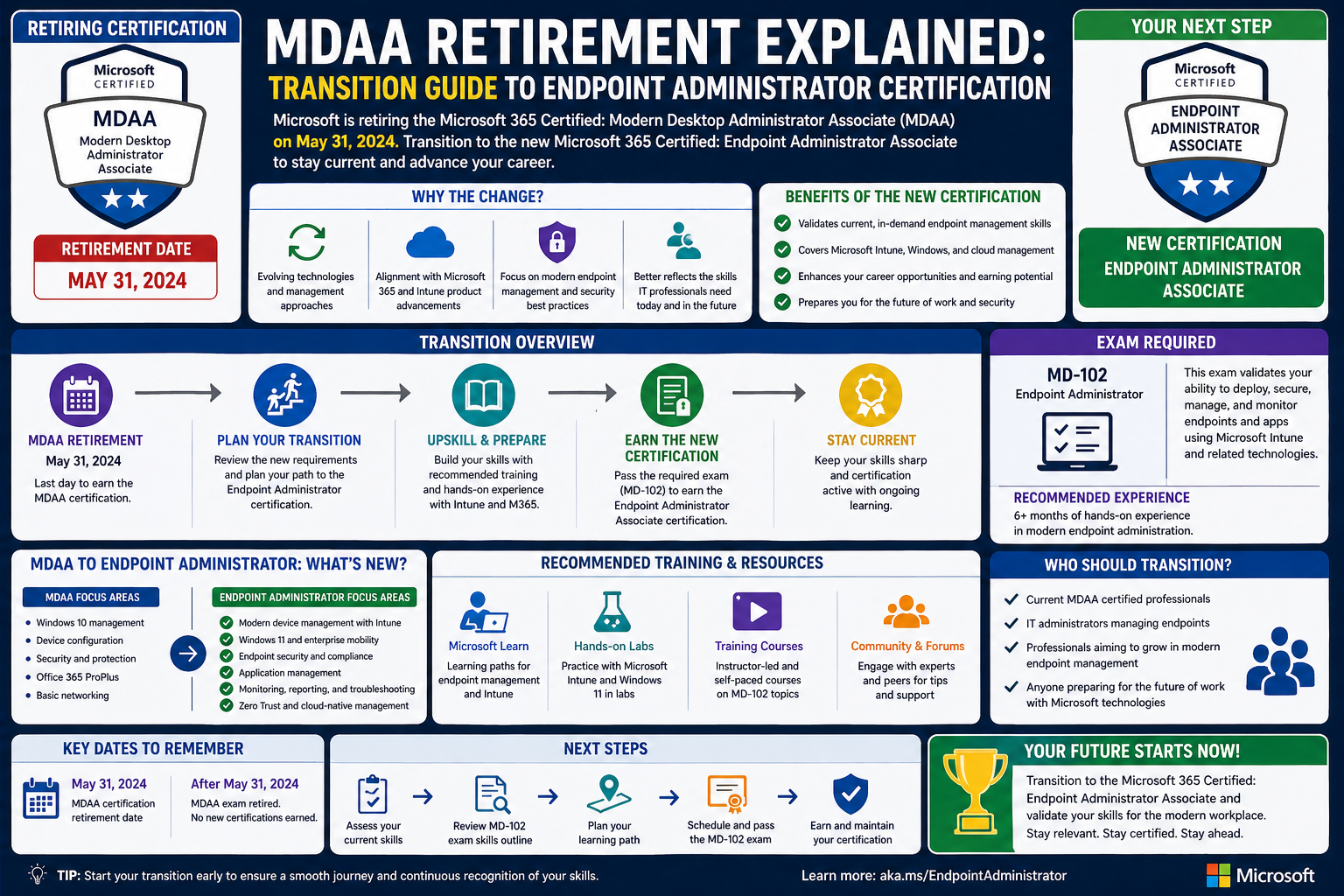
Microsoft has continuously reshaped its certification ecosystem to align with how enterprise IT environments evolve. Over the years, the focus has gradually moved from purely on-premises infrastructure management toward hybrid and cloud-first systems. This shift reflects broader changes in how organizations deploy, manage, and secure their digital workplaces.
Earlier certification paths in the Microsoft ecosystem were heavily centered on traditional desktop administration and server-based environments. IT professionals were expected to demonstrate skills in configuring local systems, maintaining domain-joined devices, and handling infrastructure that relied largely on internal networks. These skills were essential when organizations operated within more isolated and perimeter-based security models.
As cloud computing began to gain widespread adoption, the nature of enterprise IT started to change significantly. Organizations moved toward subscription-based services, centralized identity systems, and remotely managed devices. Employees were no longer confined to office networks, and devices became increasingly distributed across locations, time zones, and personal work environments.
This transformation created a need for new certification frameworks that could better reflect modern IT realities. Microsoft began updating its certification paths to emphasize cloud-based management tools and services. Instead of focusing exclusively on traditional desktop environments, certifications started incorporating identity management, cloud security controls, and remote device administration.
The transition from older certification tracks to the Endpoint Administrator-focused structure represents a continuation of this evolution. It reflects a broader industry recognition that managing devices today is no longer limited to physical desktops within corporate offices. Instead, IT professionals are expected to manage diverse device ecosystems that include laptops, mobile devices, virtual desktops, and cloud-connected endpoints.
This evolution also highlights the increasing complexity of IT environments. Modern organizations operate in hybrid infrastructures where cloud services and on-premises systems coexist. As a result, endpoint administration now requires a broader understanding of how devices interact with identity platforms, cloud security policies, and centralized management tools.
The certification landscape has adapted accordingly, placing greater emphasis on unified management strategies. Rather than treating devices as isolated systems, modern endpoint administration focuses on managing all endpoints through centralized platforms that enforce consistent policies, security standards, and compliance requirements.
Another important aspect of this evolution is the integration of automation and intelligence into endpoint management. Modern IT environments rely heavily on automated deployment processes, policy enforcement, and real-time monitoring. These capabilities reduce manual effort while improving consistency and security across large-scale device environments.
The shift in certification structure reflects these priorities by encouraging professionals to develop skills that align with automated and cloud-driven management systems. This ensures that certified individuals are better prepared to handle the operational demands of modern enterprises.
As organizations continue to adopt digital transformation strategies, endpoint management will remain a central component of IT operations. The certification changes are not isolated updates but part of a broader movement toward aligning professional skills with real-world enterprise requirements.
Why Microsoft Shifted from MD-100 and MD-101 to MD-102
The replacement of MD-100 and MD-101 with a unified certification model reflects a strategic simplification of the endpoint administration certification path. Previously, the certification structure was divided into separate exams that focused on different aspects of desktop and device management. This separation required learners to navigate multiple knowledge domains that were often interconnected in practical environments.
MD-100 primarily focused on fundamental desktop administration tasks, including operating system configuration, device setup, and basic system management. MD-101 expanded into more advanced topics such as modern management tools, application deployment, and enterprise-level configuration strategies. While both exams covered essential skills, the division sometimes created overlap and complexity for learners.
The introduction of a single, consolidated certification stream represents an effort to streamline this learning pathway. By combining core concepts into one structured exam, Microsoft reduced fragmentation in the certification journey. This allows IT professionals to focus on a more cohesive understanding of endpoint administration rather than splitting attention across multiple separate assessments.
Another key reason behind the shift is the increasing dominance of cloud-based device management. Traditional distinctions between desktop administration and enterprise management have become less relevant in modern environments. Devices are now managed through centralized platforms that integrate identity, security, compliance, and configuration into a unified system.
The new certification structure reflects this integration by aligning content with real-world management practices. Instead of separating foundational and advanced concepts into different exams, the unified approach ensures that candidates are evaluated on a complete set of skills relevant to modern IT environments.
The consolidation also addresses the need for updated skill validation in areas such as identity-driven security, remote device provisioning, and policy-based management. These areas have become central to endpoint administration as organizations adopt cloud-first strategies and reduce reliance on traditional infrastructure models.
In addition, the updated certification model reflects changes in workplace mobility. Employees now use multiple devices across different environments, requiring IT teams to manage endpoints that are no longer confined to corporate networks. This shift demands a more integrated understanding of device lifecycle management, security enforcement, and user access control.
By replacing MD-100 and MD-101 with a unified certification, Microsoft also simplified the certification maintenance process. IT professionals no longer need to manage multiple exam pathways to demonstrate their expertise in endpoint administration. Instead, they can focus on a single certification that encompasses the full range of required skills.
This change also aligns with industry expectations for role-based certifications. Modern IT roles are increasingly defined by practical responsibilities rather than isolated technical domains. Endpoint administrators are expected to manage entire device ecosystems, not just specific aspects of system configuration or deployment.
The transition to MD-102 reflects this shift by focusing on a broader and more integrated skill set. It emphasizes the importance of understanding how devices, identities, and security systems work together within a unified management framework.
Modern Workplace Transformation and Endpoint Administration Role
The modern workplace has undergone a profound transformation in recent years, reshaping how organizations approach IT management. Traditional office-based environments have evolved into flexible, distributed systems where employees work from multiple locations using a variety of devices. This shift has significantly impacted the role of endpoint administrators.
Endpoint administration is no longer limited to managing desktops within a corporate network. Instead, it involves overseeing a diverse ecosystem of devices that may include laptops, tablets, mobile phones, and virtual machines. These devices often operate outside traditional network boundaries, requiring new approaches to management and security.
One of the most significant changes in the modern workplace is the widespread adoption of remote work. Employees now expect seamless access to organizational resources regardless of location. This expectation has driven the need for centralized management systems that can support remote configuration, monitoring, and troubleshooting.
Endpoint administrators play a critical role in enabling this flexibility. They ensure that devices remain secure, compliant, and properly configured even when they are not physically connected to corporate infrastructure. This requires a deep understanding of cloud-based management tools and remote administration techniques.
Another key aspect of workplace transformation is the increasing reliance on mobile devices. Employees frequently use smartphones and tablets to access corporate resources, creating new challenges for IT teams. These devices must be managed in a way that balances security requirements with user accessibility.
Endpoint administrators are responsible for implementing policies that govern how devices interact with organizational data. This includes controlling application access, enforcing security configurations, and ensuring compliance with organizational standards.
The modern workplace also emphasizes user experience alongside security. Organizations aim to provide seamless access to tools and resources without introducing unnecessary complexity. Endpoint administrators must therefore design management strategies that support both operational efficiency and security enforcement.
This balance is achieved through centralized platforms that integrate identity management, device compliance, and application control. These platforms allow administrators to apply consistent policies across all endpoints, regardless of device type or location.
Another important development is the integration of analytics into endpoint management. Modern systems provide insights into device performance, user behavior, and security posture. Endpoint administrators use this data to make informed decisions about policy adjustments and system improvements.
The transformation of the workplace has also increased the importance of scalability. Organizations must manage thousands or even tens of thousands of devices simultaneously. Endpoint administration tools are designed to support this scale through automation and centralized control mechanisms.
As workplace environments continue to evolve, the role of endpoint administrators will remain essential in maintaining operational continuity and security across distributed systems. Their responsibilities now extend beyond traditional device management to include strategic oversight of entire digital work environments.
Cloud-First Management and Identity-Driven Security Model
Cloud-first management has become a defining characteristic of modern IT infrastructure. Instead of relying on locally hosted systems, organizations increasingly use cloud-based platforms to manage devices, users, and applications. This shift has fundamentally changed how endpoint administration is performed.
In a cloud-first model, devices are no longer managed individually or through isolated systems. Instead, they are connected to centralized platforms that provide unified control over configuration, updates, and security policies. This approach simplifies management while improving consistency across large device fleets.
Identity-driven security plays a central role in this model. Rather than relying solely on network-based access controls, modern systems use user identity as the primary factor for determining access permissions. This ensures that security policies are applied consistently regardless of device location or network environment.
Endpoint administrators are responsible for implementing and maintaining these identity-based systems. They configure access policies, manage authentication methods, and ensure that only authorized users can access organizational resources.
Cloud-first management also enables real-time policy enforcement. Changes made to security configurations or device settings can be applied instantly across all connected endpoints. This reduces delays and ensures that systems remain up to date with current organizational requirements.
Another important advantage of cloud-based management is scalability. Organizations can easily add or remove devices without significant infrastructure changes. Endpoint administrators can manage large-scale deployments efficiently using centralized tools that automate many routine tasks.
Security is deeply integrated into cloud-first systems. Endpoint administrators must ensure that devices comply with organizational security standards at all times. This includes enforcing encryption, managing software updates, and monitoring device health.
The identity-driven model also supports conditional access mechanisms. These mechanisms evaluate user identity, device status, and contextual factors before granting access to resources. This dynamic approach enhances security while maintaining user flexibility.
Cloud-first management further supports remote troubleshooting and support capabilities. Endpoint administrators can diagnose and resolve issues without requiring physical access to devices. This is particularly important in distributed work environments where devices may be located in different geographic regions.
The integration of cloud services into endpoint administration reflects a broader shift toward centralized IT governance. Instead of managing isolated systems, organizations now operate within unified ecosystems where identity, security, and device management are interconnected.
This transformation continues to shape the responsibilities of endpoint administrators, requiring them to develop expertise in cloud platforms, identity systems, and modern security frameworks.
Security-Centric Design in Modern Endpoint Administration
Security has become one of the most defining forces shaping modern endpoint administration. As organizations expand their digital footprint across cloud platforms, mobile devices, and remote work environments, the traditional perimeter-based security model has become less effective. Instead, security is now embedded directly into every layer of device and identity management.
Endpoint administration is no longer just about configuring devices or deploying software. It now requires a security-first mindset where every action is evaluated through the lens of risk reduction, compliance enforcement, and identity protection. This shift has significantly influenced how modern certification structures are designed and how IT professionals are expected to operate in real-world environments.
In cloud-connected ecosystems, devices are constantly interacting with organizational resources from multiple locations. This creates a dynamic threat surface where traditional assumptions about network safety no longer apply. As a result, endpoint administrators must ensure that every device is continuously validated and monitored, regardless of where it connects from.
One of the core principles driving this approach is the idea that no device or user should be trusted by default. Instead, access decisions are based on real-time verification of identity, device health, and compliance status. This approach reduces the risk of unauthorized access and limits potential exposure in case of compromised credentials or devices.
Endpoint administrators play a critical role in enforcing these security principles. They configure policies that determine how devices authenticate, what resources they can access, and under what conditions access is granted or denied. These policies are continuously updated to respond to evolving threats and organizational requirements.
Another important aspect of security-centric design is the integration of threat detection capabilities into endpoint management systems. Modern platforms are capable of identifying unusual behavior patterns, detecting vulnerabilities, and alerting administrators to potential risks. This allows organizations to respond to threats more quickly and effectively.
Security updates and patch management have also become more streamlined in modern environments. Instead of relying on manual processes, endpoint administrators can deploy updates across entire device fleets simultaneously. This ensures that vulnerabilities are addressed promptly and consistently across all endpoints.
The growing importance of data protection has further strengthened the role of endpoint administrators. They are responsible for ensuring that sensitive information remains secure both at rest and in transit. This includes implementing encryption standards, managing access controls, and monitoring data usage patterns.
As organizations adopt more sophisticated security frameworks, endpoint administrators must also understand how different security layers interact. Identity protection, device compliance, application security, and network controls all work together to create a comprehensive defense system.
This interconnected structure requires a holistic approach to endpoint management. Instead of focusing on isolated tasks, administrators must consider the broader security implications of every configuration and policy decision.
The emphasis on security also reflects changes in regulatory environments. Many industries now require strict compliance with data protection standards, which has increased the importance of auditability and traceability in endpoint management systems. Administrators must ensure that systems can demonstrate compliance through detailed reporting and monitoring capabilities.
Overall, security-centric design has transformed endpoint administration into a highly strategic function. It is no longer just a technical responsibility but a critical component of organizational risk management and digital resilience.
Role of Unified Device Management in Enterprise Environments
Unified device management has become a cornerstone of modern IT operations, enabling organizations to manage all endpoints through a single, centralized system. This approach replaces fragmented management tools with integrated platforms that provide consistent control over devices, applications, and security policies.
In traditional IT environments, different device types often require separate management solutions. Desktops, laptops, and mobile devices were managed using different tools, leading to inconsistencies in configuration and policy enforcement. Unified management eliminates these silos by bringing all devices under one administrative framework.
This consolidation simplifies the work of endpoint administrators by providing a single interface for managing diverse device ecosystems. Instead of switching between multiple tools, administrators can apply policies, monitor compliance, and deploy updates from a centralized platform.
One of the key advantages of unified management is consistency. When policies are applied uniformly across all devices, organizations can ensure that security standards and operational requirements are maintained without variation. This reduces the risk of misconfiguration and improves overall system reliability.
Unified management also improves operational efficiency. Automated processes allow administrators to deploy applications, configure settings, and enforce policies across thousands of devices simultaneously. This reduces manual workload and minimizes the potential for human error.
Another important benefit is improved visibility. Endpoint administrators can gain a comprehensive view of all devices within the organization, including their status, compliance level, and security posture. This visibility enables faster decision-making and more effective troubleshooting.
Unified systems also support lifecycle management for devices. From initial provisioning to retirement, every stage of a device’s lifecycle can be managed through the same platform. This ensures that devices remain compliant and secure throughout their operational lifespan.
The integration of cloud services into unified management platforms further enhances their capabilities. Devices can be enrolled and managed remotely without requiring physical access or complex configuration processes. This is particularly valuable in distributed work environments where employees operate from multiple locations.
Application management is another key component of unified systems. Endpoint administrators can control how applications are deployed, updated, and accessed across the organization. This ensures that users have access to the tools they need while maintaining security and compliance standards.
Unified device management also plays a critical role in supporting hybrid environments. Many organizations continue to operate a combination of on-premises and cloud-based systems. Unified platforms bridge these environments by providing consistent management capabilities across both infrastructures.
As enterprises continue to grow in complexity, unified device management has become essential for maintaining control and efficiency. It allows organizations to scale their IT operations without increasing administrative overhead or compromising security.
Identity Management and Access Control in Modern Systems
Identity management has become one of the most critical components of endpoint administration. In modern IT environments, identity serves as the foundation for controlling access to systems, applications, and data. Rather than relying on traditional network boundaries, organizations now use identity-based frameworks to determine who can access what resources.
This shift has fundamentally changed how endpoint administrators approach access control. Instead of focusing solely on device-based restrictions, they must now consider user identity as the primary factor in security decisions.
Identity management systems allow organizations to centralize user authentication and authorization processes. This ensures that access policies are applied consistently across all devices and applications. Endpoint administrators are responsible for configuring and maintaining these systems to ensure secure access control.
One of the key features of modern identity management is multi-factor authentication. This adds a layer of security by requiring users to verify their identity through multiple methods. Endpoint administrators configure these authentication mechanisms to reduce the risk of unauthorized access.
Access control policies are also becoming more dynamic. Instead of static permissions, modern systems evaluate multiple factors before granting access. These factors may include user identity, device compliance status, location, and risk level.
Endpoint administrators play a central role in defining these policies. They ensure that access rules align with organizational security requirements while maintaining usability for end users.
Identity management also supports role-based access control. This allows organizations to assign permissions based on job roles rather than individual users. This simplifies administration and ensures that users only have access to the resources necessary for their responsibilities.
Another important aspect of identity management is lifecycle control. Endpoint administrators manage user accounts from creation to deletion, ensuring that access is granted and revoked appropriately throughout the user’s tenure within the organization.
Modern identity systems also integrate with cloud services and applications. This allows users to access multiple resources using a single set of credentials. Endpoint administrators configure these integrations to ensure seamless and secure access across platforms.
Identity protection has become increasingly important due to the rise of cyber threats targeting user credentials. Endpoint administrators must monitor for suspicious login activity and respond to potential security incidents quickly.
Access control systems also support conditional policies that adapt based on real-time conditions. This allows organizations to enforce stricter security measures when risk levels are elevated while maintaining flexibility during normal operations.
The integration of identity management into endpoint administration reflects a broader shift toward centralized and intelligent security systems. Identity is no longer just an authentication mechanism but a core component of enterprise security architecture.
Operational Architecture of Modern Endpoint Management Platforms
Modern endpoint administration is built on a layered operational architecture that integrates device control, identity systems, security enforcement, and cloud services into a unified framework. This architecture is designed to support large-scale enterprise environments where thousands of devices must be managed simultaneously without sacrificing consistency or security.
At the core of this structure is a centralized management plane that communicates with endpoints across different operating systems and locations. Instead of relying on direct local administration, devices are enrolled into cloud-connected management systems that continuously synchronize configuration and policy data.
This architecture enables administrators to manage endpoints regardless of physical location. Devices only need an internet connection to receive policies, updates, and configuration changes. This removes dependency on traditional network-based management methods and allows IT teams to operate in highly distributed environments.
A key component of this architecture is device enrollment. Each endpoint must be registered within the management system before it can receive organizational policies. This enrollment process establishes a trust relationship between the device and the management platform, ensuring that only authorized devices can access corporate resources.
Once enrolled, devices are assigned configuration profiles that define how they should behave within the organization. These profiles include security settings, compliance rules, application access controls, and update policies. Endpoint administrators are responsible for designing and maintaining these profiles to ensure alignment with organizational requirements.
Communication between devices and the management platform is continuous but optimized to minimize network overhead. Devices periodically check in to receive updates and report their status. This ensures that administrators always have up-to-date visibility into device health and compliance.
The architecture also supports integration with identity systems, allowing access decisions to be made based on real-time identity verification. This integration ensures that device management and user authentication are tightly connected, reducing the risk of unauthorized access.
Another important aspect of operational architecture is policy distribution. Policies are not manually applied to each device but are instead assigned through dynamic targeting rules. These rules allow administrators to group devices based on attributes such as user role, device type, or location.
This abstraction layer significantly reduces administrative complexity. Instead of managing individual devices, endpoint administrators manage logical groups that automatically update as devices change state or location.
The architecture is also designed to support scalability. As organizations grow, new devices can be added without restructuring the entire management system. Cloud-based infrastructure ensures that performance remains stable even as the number of managed endpoints increases.
Security is embedded into every layer of this architecture. All communications between devices and the management system are encrypted, and access to administrative functions is tightly controlled through role-based permissions.
This operational model represents a shift away from traditional infrastructure management toward a more flexible, cloud-driven approach that supports modern enterprise requirements.
Device Lifecycle Management in Enterprise Environments
Device lifecycle management is a critical responsibility in endpoint administration, covering every stage of a device’s existence within an organization. This lifecycle begins with provisioning and continues through deployment, maintenance, and eventual retirement.
Provisioning involves preparing a device for organizational use. In modern environments, this process is largely automated. Devices are enrolled in management systems during initial setup, where they automatically receive configuration profiles and security policies.
This automated provisioning process reduces manual effort and ensures consistency across all devices. It also allows organizations to deploy large numbers of devices quickly without compromising configuration standards.
Once a device is provisioned, it enters the deployment phase. During this stage, applications and security settings are applied based on predefined policies. Endpoint administrators ensure that devices are fully configured before they are handed over to end users.
The operational phase is the longest stage of the device lifecycle. During this period, devices are actively used by employees and must be continuously monitored for performance, compliance, and security.
Endpoint administrators play a key role in maintaining device health during this phase. They ensure that devices receive regular updates, security patches, and configuration changes as needed.
Monitoring tools provide real-time insights into device status, allowing administrators to detect and resolve issues proactively. This reduces downtime and improves user productivity.
As devices age, they may require reconfiguration or upgrades to remain compatible with evolving organizational requirements. Endpoint administrators manage these changes to ensure that devices continue to function effectively within the IT environment.
Eventually, devices reach the end of their lifecycle. At this stage, they are decommissioned and removed from the management system. Data is securely wiped to prevent unauthorized access, and devices are either repurposed or disposed of according to organizational policies.
Lifecycle management also includes compliance tracking. Devices must continuously meet security and configuration standards throughout their lifecycle. If a device falls out of compliance, corrective actions are automatically triggered.
This structured lifecycle approach ensures that devices remain secure, functional, and aligned with organizational policies from deployment to retirement.
Policy Engineering and Compliance Frameworks
Policy engineering is a foundational aspect of endpoint administration, involving the creation and management of rules that govern device behavior across an organization. These policies define how devices are configured, how users interact with systems, and how security controls are enforced.
In modern environments, policies are centrally managed and automatically distributed to devices. This ensures that all endpoints adhere to consistent standards regardless of location or user behavior.
Endpoint administrators design policies based on organizational requirements, regulatory standards, and security best practices. These policies can control a wide range of device functions, including access permissions, application usage, and system configurations.
One of the key challenges in policy engineering is balancing security with usability. Overly restrictive policies can hinder productivity, while overly permissive policies can expose the organization to security risks. Endpoint administrators must carefully calibrate these settings to achieve an optimal balance.
Compliance frameworks are closely tied to policy engineering. Organizations must ensure that their device configurations meet industry regulations and internal governance standards.
Endpoint administrators define compliance rules that determine whether a device is considered secure and compliant. These rules may include requirements such as encryption status, operating system version, or security configuration settings.
Devices are continuously evaluated against these compliance rules. If a device fails to meet requirements, it may be restricted from accessing organizational resources until the issue is resolved.
This dynamic compliance enforcement ensures that security standards are maintained at all times. It also provides organizations with visibility into their overall security posture.
Policy updates are distributed in real time, allowing organizations to respond quickly to emerging threats or changing requirements. This flexibility is essential in modern IT environments where conditions can change rapidly.
Endpoint administrators also use policy segmentation to apply different rules to different groups of devices or users. This allows organizations to tailor configurations based on roles, departments, or security requirements.
Through structured policy engineering and compliance frameworks, organizations maintain control over their digital environments while supporting operational flexibility.
Application Deployment and Modern Software Management
Application deployment has evolved significantly in modern endpoint administration. Instead of manually installing software on individual devices, applications are now distributed through centralized management systems that automate installation and updates.
This approach ensures that all users have access to the correct versions of applications without requiring manual intervention. It also reduces the risk of configuration inconsistencies across devices.
Applications are typically packaged in standardized formats that allow them to be deployed across different device types and operating systems. Endpoint administrators manage these packages and assign them to device groups based on organizational requirements.
Deployment strategies can vary depending on the criticality of the application. Some applications are deployed automatically during device provisioning, while others are made available on demand through self-service portals.
Update management is another important aspect of application deployment. Applications must be kept up to date to ensure compatibility and security. Endpoint administrators configure update policies that determine how and when updates are applied.
Modern systems also support dependency management, ensuring that required components are installed before applications are deployed. This reduces installation failures and improves system stability.
Application lifecycle management includes tracking usage, performance, and compatibility. Endpoint administrators use this information to make decisions about application retention or replacement.
Security is also integrated into application deployment processes. Applications are evaluated for compliance with organizational security standards before being deployed.
This structured approach ensures that software environments remain consistent, secure, and efficient across the entire organization.
Remote Work Support and Distributed Troubleshooting Systems
Remote work has become a defining feature of modern enterprise environments, requiring endpoint administrators to support users across diverse locations and network conditions. This shift has significantly changed how troubleshooting and support operations are conducted.
In distributed environments, endpoint administrators rely on remote management tools to diagnose and resolve issues without requiring physical access to devices. These tools provide real-time access to system logs, configuration settings, and performance data.
Remote troubleshooting capabilities allow administrators to identify and resolve issues quickly, minimizing downtime for end users. This is especially important in organizations where employees rely heavily on continuous access to digital resources.
Support systems are also designed to be proactive rather than reactive. Monitoring tools continuously track device health and performance, allowing potential issues to be identified before they impact users.
Remote support includes capabilities such as configuration resets, application reinstallation, and policy reapplication. These actions can be performed without interrupting user activity.
Endpoint administrators also manage connectivity issues that arise in remote environments. Devices may operate on different networks with varying levels of reliability, requiring flexible support strategies.
Security remains a key concern in remote support scenarios. Administrators must ensure that remote access tools are secure and that only authorized personnel can perform administrative actions on devices.
The combination of remote management, monitoring, and automation ensures that organizations can maintain operational continuity even when employees are distributed across multiple locations.
Automation, Analytics, and Intelligent Endpoint Management
Automation has become a central component of modern endpoint administration. It reduces manual workload, improves consistency, and enables faster response to system changes.
Automated processes handle tasks such as device provisioning, policy enforcement, application deployment, and compliance monitoring. This allows endpoint administrators to focus on higher-level strategic responsibilities.
Analytics play a critical role in supporting automation. Modern systems collect large volumes of data from devices, including performance metrics, usage patterns, and security events.
This data is analyzed to identify trends, detect anomalies, and optimize system performance. Endpoint administrators use these insights to make informed decisions about policy adjustments and system improvements.
Intelligent systems can also trigger automated responses based on predefined conditions. For example, if a device becomes non-compliant, corrective actions can be initiated automatically without manual intervention.
Machine learning technologies are increasingly being integrated into endpoint management systems. These technologies help predict potential issues and recommend proactive solutions.
Automation and analytics together create a more efficient and responsive IT environment. They enable organizations to manage large-scale device ecosystems with reduced operational overhead.
Career Impact and Skill Development in Modern Endpoint Roles
The evolution of endpoint administration has significantly influenced career opportunities in the IT sector. Professionals in this field are now expected to possess a combination of traditional system administration skills and modern cloud-based expertise.
Technical knowledge alone is no longer sufficient. Endpoint administrators must also understand identity management, security frameworks, automation tools, and cloud platforms.
This expanded skill set reflects the complexity of modern IT environments. Organizations seek professionals who can manage integrated systems rather than isolated components.
Hands-on experience with real-world systems is highly valued. Practical understanding of device management, policy configuration, and troubleshooting is essential for success in endpoint administration roles.
Continuous learning is also important due to the rapid pace of technological change. Tools, platforms, and security requirements evolve regularly, requiring professionals to stay updated with new developments.
Endpoint administration roles are increasingly aligned with broader IT infrastructure and security responsibilities. This creates opportunities for career growth into specialized areas such as security analysis, cloud administration, and enterprise architecture.
The demand for skilled endpoint administrators continues to grow as organizations expand their reliance on digital infrastructure and distributed work environments.
Extended Governance Models and Centralized Control in Endpoint Ecosystems
Modern endpoint environments are increasingly governed through centralized control structures that extend beyond traditional IT administration boundaries. These governance models define how devices, identities, applications, and security policies are managed across an entire organization in a coordinated and standardized manner.
In large enterprises, governance is not just about technical configuration; it also involves defining operational rules that determine how IT systems behave under different conditions. Endpoint administrators operate within these governance frameworks to ensure that device management aligns with organizational objectives, risk tolerance, and regulatory obligations.
A key aspect of centralized governance is the ability to enforce consistency across diverse environments. Organizations often operate across multiple regions, departments, and business units, each with different operational needs. Despite this diversity, endpoint management systems ensure that core security and compliance standards remain uniform.
This is achieved through hierarchical policy structures that allow global rules to be defined at the top level while still permitting localized adjustments where necessary. Endpoint administrators manage these layers carefully to avoid conflicts and ensure predictable system behavior.
Another important element of governance is auditability. Modern endpoint systems maintain detailed logs of administrative actions, device changes, and policy updates. These logs are essential for compliance reporting, security investigations, and operational transparency.
Endpoint administrators must ensure that audit data is properly collected, stored, and protected. This enables organizations to demonstrate compliance with internal policies and external regulatory requirements.
Governance models also incorporate risk management principles. Devices are continuously evaluated based on their security posture, compliance status, and behavioral patterns. Based on this evaluation, systems can automatically adjust access permissions or trigger remediation workflows.
This dynamic governance approach reduces reliance on manual oversight and enables organizations to respond more quickly to emerging risks. Endpoint administrators play a supervisory role in refining these automated governance rules to ensure accuracy and effectiveness.
In addition, centralized control systems allow organizations to standardize operational procedures across global environments. Whether devices are located in different countries or operating under different network conditions, governance frameworks ensure consistent enforcement of policies and security requirements.
This level of control is essential for maintaining enterprise-wide security integrity, especially in industries that handle sensitive data or operate under strict compliance regulations.
Endpoint Security Intelligence and Adaptive Protection Mechanisms
Endpoint security has evolved into a highly intelligent system that continuously adapts to changing threat landscapes. Instead of relying on static defense mechanisms, modern systems use behavioral analysis and contextual evaluation to detect and respond to potential risks.
This adaptive approach allows endpoint systems to identify anomalies that may indicate malicious activity. For example, unusual login patterns, unexpected device behavior, or unauthorized access attempts can trigger automated security responses.
Endpoint administrators are responsible for configuring these adaptive protection mechanisms. They define thresholds, response actions, and escalation paths that determine how the system reacts to potential threats.
Security intelligence systems also aggregate data from multiple endpoints to identify broader attack patterns. This collective analysis helps organizations detect coordinated threats that may not be visible at the individual device level.
Another important capability of modern security systems is real-time risk scoring. Devices and users are assigned dynamic risk levels based on their activity and compliance status. These risk scores influence access decisions and security enforcement actions.
For example, a device with outdated security patches or unusual activity patterns may be restricted from accessing sensitive resources until the issue is resolved. This ensures that security decisions are continuously aligned with current conditions.
Endpoint administrators also work with automated remediation systems that can resolve certain security issues without manual intervention. These systems may apply patches, reset configurations, or isolate compromised devices to prevent further risk.
Adaptive protection mechanisms are closely integrated with identity systems, ensuring that both device and user behavior are considered when evaluating security posture. This dual-layer approach enhances overall protection effectiveness.
The growing sophistication of endpoint security intelligence reflects the increasing complexity of modern cyber threats. Organizations require systems that can respond dynamically rather than relying solely on predefined rules.
Endpoint administrators must therefore maintain a deep understanding of both security principles and system behavior to effectively manage these intelligent protection systems.
Conclusion
The evolution from MD-100 and MD-101 to MD-102 reflects a broader transformation in how Microsoft defines modern endpoint administration. Rather than separating desktop management and enterprise device administration into distinct learning paths, the updated structure brings these concepts together into a unified, cloud-centered approach. This shift mirrors the realities of today’s IT environments, where devices are no longer confined to office networks and must be managed across diverse, distributed settings.
Endpoint administration has become deeply integrated with identity management, security enforcement, and cloud-based governance. Professionals in this field are now expected to handle not only device configuration but also compliance, automation, and adaptive security controls. The emphasis on cloud-first architecture and zero-trust principles highlights how critical security has become in every layer of IT operations.
As organizations continue to expand their reliance on remote work and digital infrastructure, the role of endpoint administrators will remain essential. Their ability to manage complex device ecosystems, enforce consistent policies, and respond to evolving security threats ensures operational stability across modern enterprises.
The MD-102 certification framework represents this new reality, focusing on practical, integrated skills that align with current industry demands. It prepares IT professionals for environments where flexibility, scalability, and security must work together seamlessly to support business continuity and digital transformation.