ISACA has long been recognized as a global authority in IT governance, risk management, and cybersecurity certification standards. Over the years, its certifications have evolved in response to the shifting realities of digital infrastructure, emerging threats, and the growing integration of technology into every aspect of business operations. One of its most significant credentials, the Certified in Risk and Information Systems Control (CRISC), has recently undergone structural updates designed to better reflect modern enterprise risk environments.
The CRISC certification has always focused on preparing professionals to identify, evaluate, and manage IT and enterprise risk. However, as organizations increasingly rely on cloud computing, distributed systems, artificial intelligence, and global digital supply chains, the nature of risk itself has transformed. No longer limited to traditional IT failures or isolated security incidents, risk today spans regulatory compliance, third-party dependencies, data privacy obligations, and systemic vulnerabilities that can impact entire business ecosystems.
The updated CRISC exam structure reflects this broader understanding of risk. Rather than simply testing technical awareness, it now emphasizes strategic decision-making, governance alignment, and the ability to translate risk insights into actionable business decisions. This shift signals a move away from purely technical risk evaluation toward a more integrated, business-oriented approach.
In this context, understanding the updated CRISC exam domains is not just about exam preparation. It also provides insight into how the profession of risk management is evolving globally. The changes reveal what modern organizations expect from risk professionals and how the role is being reshaped in response to technological and operational complexity.
The Purpose Behind the CRISC Domain Updates
The primary motivation behind the CRISC updates is alignment with real-world enterprise challenges. Businesses today operate in environments where uncertainty is constant, and risk is not confined to IT departments. Instead, it is embedded across business units, third-party relationships, regulatory frameworks, and digital ecosystems.
Previously, CRISC emphasized a more balanced distribution between governance, technical security, and risk response activities. While these areas remain essential, the updated structure reallocates emphasis to reflect where professionals spend most of their time and where organizational risk exposure is most significant.
The updated weighting highlights a growing recognition that risk assessment and risk response activities are central to organizational resilience. Identifying risks is no longer enough; professionals must also understand their likelihood, potential impact, and cascading effects across interconnected systems. Similarly, responding to risk is not a reactive task but a continuous process involving monitoring, communication, and adaptation.
This shift is not arbitrary. It is based on global trends observed across industries, including increased cyberattacks, regulatory scrutiny, cloud adoption, and supply chain disruptions. These factors have made risk management a dynamic discipline rather than a static control function.
Overview of the Updated CRISC Exam Structure
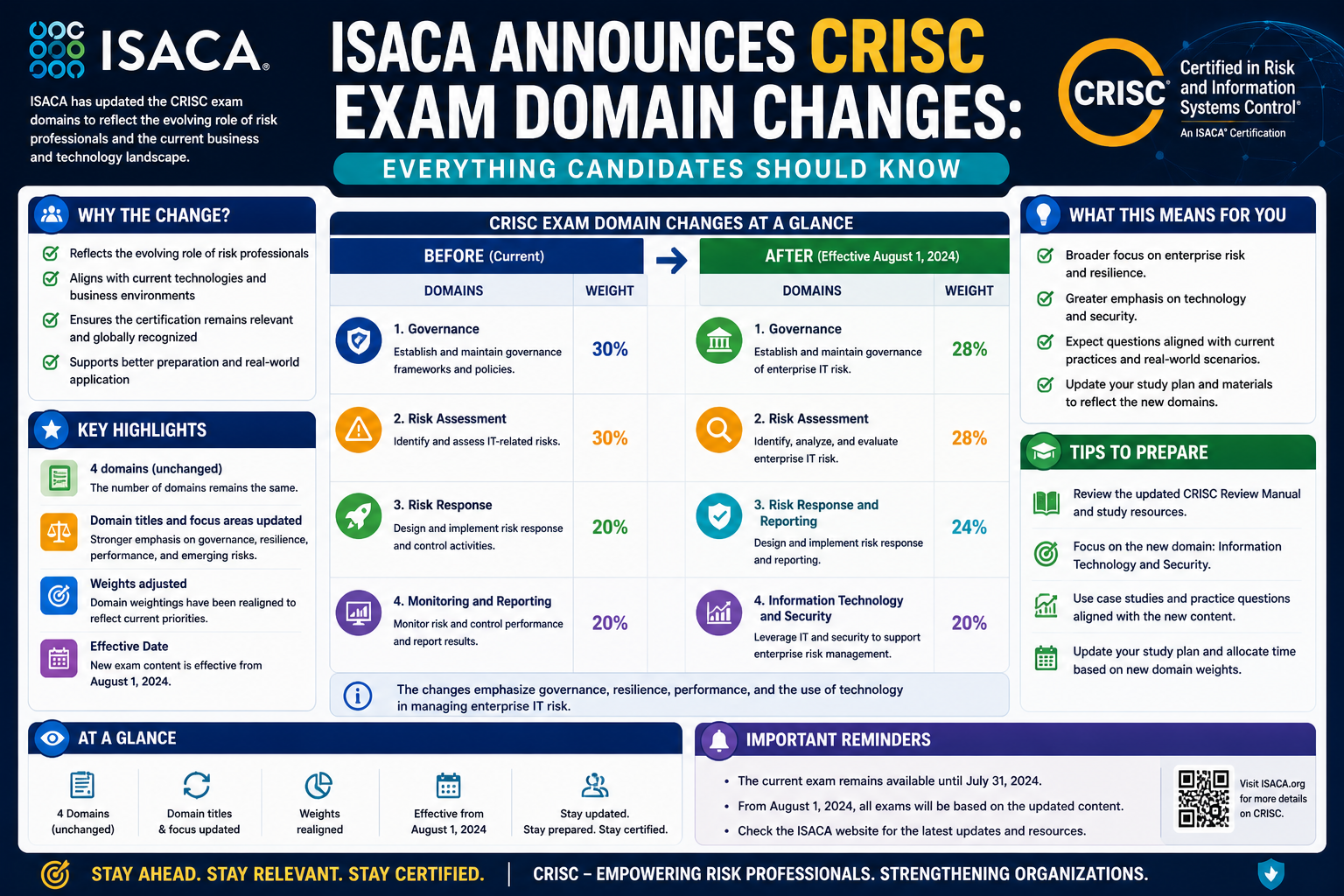
The CRISC exam continues to be organized into four core domains, but the percentage distribution of exam content has been revised to reflect current industry expectations.
The domains now include Governance, Risk Assessment, Risk Response and Reporting, and Technology and Security. While the structure remains familiar, the weighting changes significantly alter the focus areas for candidates.
Governance now accounts for 26 percent of the exam. This domain emphasizes organizational oversight, risk culture, and alignment between enterprise objectives and risk management strategies. It reflects the increasing importance of leadership involvement in risk decisions and the need for structured accountability frameworks.
Risk Assessment has been increased to 22 percent, signaling a stronger emphasis on the ability to identify and evaluate risks across complex environments. This includes qualitative and quantitative analysis, scenario evaluation, and understanding risk interdependencies.
Risk Response and Reporting remains the most heavily weighted domain at 32 percent. This consistency underscores its critical importance in translating risk analysis into practical actions. It involves selecting appropriate risk responses, monitoring effectiveness, and communicating risk information to stakeholders in a meaningful way.
Technology and Security have been adjusted to 20 percent. While still essential, this reduction reflects the understanding that technical security is now embedded within broader risk frameworks rather than treated as a standalone focus area.
These changes collectively represent a more holistic view of risk management, where strategic thinking and decision-making are prioritized over isolated technical controls.
Governance in Modern Risk Management
The Governance domain plays a crucial role in establishing how organizations define, oversee, and enforce risk management practices. With its increased weighting, it reflects the growing importance of leadership accountability and structured decision-making frameworks.
In modern enterprises, governance is no longer limited to policy creation or compliance oversight. It extends to shaping organizational culture, defining risk appetite, and ensuring that risk considerations are embedded in strategic planning processes.
This domain also emphasizes the role of senior leadership in risk management. Executives and boards are increasingly expected to understand risk exposure at a strategic level and to make informed decisions based on risk data. As a result, governance now includes communication between technical teams and business leadership, ensuring that risk information is both accessible and actionable.
Another important aspect of governance is the establishment of clear roles and responsibilities. In complex organizations, risk ownership is distributed across multiple teams. Governance frameworks ensure that accountability is clearly defined, reducing ambiguity and improving coordination during risk events.
The increased focus on governance in the CRISC exam reflects this reality. Professionals are expected not only to understand governance principles but also to apply them in dynamic and often unpredictable environments.
Expanding Importance of Risk Assessment
Risk Assessment has gained increased importance in the updated CRISC structure, reflecting its critical role in modern risk management practices. This domain focuses on identifying potential threats, analyzing vulnerabilities, and evaluating the potential impact on business operations.
In today’s digital environments, risk assessment is far more complex than it once was. Organizations must consider a wide range of factors, including cyber threats, system failures, regulatory changes, and third-party risks. Each of these elements can interact in unpredictable ways, creating compounded risks that are difficult to anticipate using traditional methods.
Modern risk assessment also relies heavily on data analysis. Professionals must be able to interpret large volumes of information, identify patterns, and assess probabilities. This often involves combining qualitative insights with quantitative models to create a more comprehensive view of risk exposure.
Another key aspect is scenario analysis. Instead of focusing solely on individual risks, professionals must evaluate how multiple risks might interact under different conditions. This helps organizations prepare for complex situations such as simultaneous system outages, supply chain disruptions, or coordinated cyberattacks.
The increased emphasis on risk assessment in the CRISC exam highlights its importance as a foundational skill. Without accurate and thorough risk evaluation, organizations cannot effectively prioritize resources or implement appropriate responses.
Risk Response and Reporting as the Core of Actionable Risk Management
Risk Response and Reporting remains the most heavily weighted domain in the updated CRISC exam, reinforcing its role as the practical application of risk management principles.
Risk response involves selecting and implementing strategies to address identified risks. These strategies may include risk avoidance, mitigation, transfer, or acceptance. Each approach requires careful consideration of cost, impact, and organizational priorities.
In modern environments, risk response is not a one-time decision but an ongoing process. Risks evolve, and response strategies must be continuously evaluated and adjusted. This requires strong monitoring capabilities and the ability to respond quickly to changing conditions.
Reporting is equally important, as it ensures that risk information is communicated effectively to stakeholders. This includes not only technical teams but also business leaders and decision-makers who may not have a technical background.
Effective risk reporting involves presenting information in a clear, concise, and actionable format. It must highlight key risks, potential impacts, and recommended actions without overwhelming stakeholders with unnecessary technical detail.
The emphasis on this domain reflects the reality that risk management is ultimately about decision-making. Identifying and analyzing risk is only valuable if it leads to informed and effective action.
Reduced Emphasis on Technology and Security
The Technology and Security domain has been adjusted to represent a smaller portion of the exam, reflecting its integration into broader risk management practices.
This does not mean that technology and security are less important. On the contrary, they remain fundamental to enterprise risk management. However, their role has evolved. Instead of being treated as separate disciplines, they are now viewed as components of a larger risk ecosystem.
Modern organizations rely heavily on integrated security frameworks that combine technical controls with governance, compliance, and risk management strategies. As a result, professionals are expected to understand technology and security in context rather than in isolation.
This shift acknowledges that technical security alone cannot address the full spectrum of enterprise risk. Issues such as human behavior, organizational structure, and regulatory compliance all play critical roles in determining overall risk exposure.
By reducing the emphasis on standalone technical content, the updated CRISC exam encourages a more balanced and strategic understanding of risk.
Industry Trends Driving the CRISC Changes
The updates to the CRISC exam are closely aligned with broader industry trends that are reshaping the way organizations approach risk management.
One of the most significant trends is the rapid adoption of cloud computing. As organizations migrate infrastructure and applications to cloud environments, traditional security boundaries become less relevant. This creates new challenges in visibility, control, and risk assessment.
Another major factor is the increasing complexity of global supply chains. Organizations now depend on multiple third-party vendors, each of which introduces additional risk exposure. Managing these dependencies requires sophisticated risk assessment and governance frameworks.
Regulatory requirements have also become more stringent. Data protection laws, cybersecurity regulations, and industry-specific compliance standards require organizations to maintain high levels of accountability and transparency.
In addition, the rise of advanced cyber threats has made risk management more urgent than ever. Attacks are becoming more sophisticated, targeted, and persistent, requiring continuous monitoring and adaptive response strategies.
Together, these trends explain why the CRISC certification is evolving. The role of risk professionals is no longer limited to identifying issues; it now involves strategic decision-making, cross-functional collaboration, and continuous adaptation to changing conditions.
The Expanding Role of Risk Professionals
The changes in the CRISC exam reflect a broader transformation in the role of risk professionals. They are no longer viewed as purely technical specialists but as strategic contributors to organizational decision-making.
Modern risk professionals are expected to bridge the gap between technical teams and business leadership. They must translate complex risk data into insights that can inform strategic planning and operational decisions.
This requires a combination of analytical skills, communication abilities, and business understanding. Professionals must be able to evaluate technical risks while also considering financial, operational, and regulatory implications.
The updated CRISC structure reinforces this expanded role by emphasizing governance, assessment, and response over isolated technical knowledge.
As organizations continue to evolve, the demand for professionals who can navigate this complexity will only increase.
Deep Dive into CRISC Domain Rebalancing and Its Strategic Impact on Modern Risk Practices
The recent updates introduced by ISACA to the Certified in Risk and Information Systems Control (CRISC) exam are not just structural adjustments—they reflect a deeper shift in how enterprises now understand and manage risk. In Part 2, the focus moves beyond the surface-level exam changes and into the reasoning, industry alignment, and real-world implications of the revised domain weighting.
The CRISC certification has always served as a bridge between technical risk understanding and business decision-making. However, with organizations becoming more digitally dependent, risk has expanded far beyond IT systems. It now includes operational resilience, third-party ecosystems, regulatory exposure, and even reputational consequences tied to digital events. The updated exam structure reflects this expanded scope and reinforces the idea that risk professionals must think in terms of business impact rather than isolated technical events.
The Shift from Technical Emphasis to Strategic Risk Thinking
One of the most important transformations in the updated CRISC structure is the gradual shift away from purely technical risk evaluation toward strategic risk interpretation. While technical knowledge remains essential, it is no longer the dominant focus.
This shift is driven by a simple reality: most modern organizational failures do not occur because of a lack of technical controls alone, but because of poor risk interpretation, delayed response, or misalignment between business priorities and technical decision-making.
For example, a cloud misconfiguration may be a technical issue, but its consequences—data exposure, regulatory penalties, and reputational damage—are business-level concerns. The updated CRISC framework encourages professionals to view risks through this broader lens.
In practice, this means risk professionals must now understand how technical vulnerabilities translate into financial, operational, and strategic consequences. They are expected to move beyond identifying what could go wrong and instead focus on what the impact would mean for the organization as a whole.
This evolution is reflected in the increased weighting of Risk Assessment and Risk Response domains, which emphasize interpretation, prioritization, and action rather than just detection.
Why Governance Has Gained Greater Importance
The Governance domain now holds a significantly larger portion of the CRISC exam content, reflecting its expanding role in enterprise risk management. Governance is no longer just about policies or compliance structures; it is about shaping how organizations think about and respond to risk at every level.
Modern governance frameworks define how risk appetite is established, how decisions are escalated, and how accountability is distributed. This ensures that risk is not handled in isolation by technical teams but is embedded across leadership structures.
In many organizations today, governance has become a strategic function rather than an administrative one. Boards and executive teams are increasingly required to interpret risk data and incorporate it into business planning. This has led to a demand for professionals who can translate complex risk information into meaningful insights for decision-makers.
Another important aspect of governance is cultural influence. Organizations with strong governance frameworks tend to have stronger risk awareness across all departments. Employees understand not only what the risks are but also how their actions contribute to risk exposure.
The updated CRISC structure reflects this broader interpretation of governance. Candidates are now expected to understand how governance frameworks operate in dynamic environments where risks evolve quickly, and decisions must be made under uncertainty.
Expanding Depth of Risk Assessment in Real-World Environments
Risk Assessment is one of the most significantly enhanced domains in the updated CRISC structure, and for good reason. It represents the analytical foundation upon which all other risk management activities are built.
In modern enterprises, risk assessment is no longer a periodic activity conducted during audits or reviews. Instead, it is a continuous process embedded into daily operations. Organizations must constantly evaluate new risks introduced by software updates, third-party integrations, system changes, and external threats.
The complexity of risk assessment has increased dramatically due to interconnected systems. A single change in one part of a digital ecosystem can create unintended consequences elsewhere. This interconnectedness requires professionals to think in systems rather than isolated components.
Another important development is the growing use of predictive analysis in risk assessment. Instead of simply reacting to known risks, organizations are increasingly trying to anticipate potential future scenarios. This includes modeling risk behavior based on historical data, system behavior, and external threat intelligence.
Risk professionals must also deal with uncertainty. Not all risks can be quantified precisely, and many require judgment-based evaluation. This introduces a layer of complexity that goes beyond traditional technical analysis.
The updated CRISC exam reflects this reality by placing greater emphasis on the ability to evaluate risk in uncertain, dynamic, and rapidly changing environments.
Risk Response as the Operational Core of Risk Management
Risk Response and Reporting remains the most heavily weighted domain in the updated CRISC exam, highlighting its importance as the operational heart of risk management.
Once risks are identified and assessed, organizations must decide how to respond. This decision-making process is often complex, involving trade-offs between cost, efficiency, operational impact, and strategic priorities.
There are several common risk response strategies, including avoidance, mitigation, transfer, and acceptance. Each strategy has its own implications and must be selected based on the organization’s risk appetite and operational constraints.
However, modern risk response is not static. It requires continuous monitoring and adjustment. As new information becomes available or conditions change, response strategies may need to be revised.
This dynamic nature of risk response is particularly important in cloud environments and digital ecosystems where changes occur rapidly and frequently.
Reporting is another critical aspect of this domain. Effective communication ensures that stakeholders at all levels understand the risks facing the organization. This includes translating technical risk data into business-relevant insights.
In many cases, poor risk communication leads to ineffective decision-making. Even when risks are properly identified and analyzed, failure to communicate them clearly can result in delayed or inappropriate responses.
The emphasis on this domain in the CRISC exam highlights the importance of execution. Risk management is not just about understanding risks; it is about acting on them effectively and consistently.
Technology and Security in an Integrated Risk Environment
The reduction in weighting for the Technology and Security domain does not indicate a decrease in its importance. Instead, it reflects its integration into broader risk management practices.
In earlier models of risk management, technology and security were often treated as separate disciplines. However, in modern enterprises, they are deeply embedded within every aspect of risk evaluation and response.
For example, cloud infrastructure security is not just a technical issue; it is a governance concern, a compliance requirement, and a business continuity issue. Similarly, cybersecurity incidents have financial, legal, and reputational implications that extend far beyond technical systems.
This integration means that risk professionals must understand technology and security in context. They do not need to be deep technical engineers, but they must understand how technology influences risk exposure and how security controls support risk mitigation strategies.
The updated CRISC structure reflects this integrated approach, ensuring that candidates can connect technical concepts to broader organizational risk frameworks.
Industry Forces Reshaping Risk Management Expectations
Several major industry trends are driving the evolution of the CRISC certification and the increased emphasis on certain domains.
One of the most influential trends is the widespread adoption of cloud computing. Cloud environments have fundamentally changed how organizations manage infrastructure, data, and applications. This shift has introduced new risks related to visibility, shared responsibility models, and vendor dependency.
Another major factor is the rise of digital transformation initiatives. Organizations are rapidly adopting new technologies such as artificial intelligence, machine learning, and automation. While these technologies offer significant benefits, they also introduce new types of risk that are not fully understood or easily controlled.
Global supply chain complexity has also increased significantly. Organizations now rely on multiple interconnected vendors and service providers. A disruption in one part of the chain can have cascading effects across multiple systems and industries.
Regulatory environments have become more demanding as well. Governments and industry bodies are introducing stricter requirements for data protection, cybersecurity, and operational transparency. This places additional pressure on organizations to maintain robust governance and reporting structures.
Finally, the frequency and sophistication of cyber threats continue to increase. Attackers are using advanced techniques to exploit vulnerabilities across systems, networks, and human behavior.
These combined forces explain why risk management is becoming more strategic and less technical in isolation.
The Changing Expectations of Risk Professionals
As the CRISC exam evolves, so too does the role of risk professionals in modern organizations. They are no longer confined to technical assessments or compliance monitoring. Instead, they are expected to play a central role in strategic decision-making.
Risk professionals must now operate at the intersection of technology, business strategy, and governance. They are expected to understand how risks affect organizational goals and how to prioritize responses based on business impact.
Communication skills have become just as important as analytical skills. Professionals must be able to explain complex risk scenarios in simple terms that executives and stakeholders can understand.
Another key expectation is adaptability. Because risk environments are constantly changing, professionals must be able to adjust their assessments and recommendations quickly.
The updated CRISC structure reinforces these expectations by emphasizing domains that require interpretation, judgment, and strategic thinking.
The Growing Importance of Risk Integration Across Business Functions
One of the most significant trends reflected in the updated CRISC exam is the integration of risk management across multiple business functions.
Risk is no longer confined to IT departments or compliance teams. It now spans finance, operations, human resources, legal, and external partnerships. Every department contributes to the organization’s overall risk profile.
This means that risk professionals must understand how different parts of the organization interact. A decision made in one department can have unintended consequences elsewhere.
For example, a procurement decision may introduce third-party risk, while a marketing initiative may introduce data privacy concerns. These interdependencies require a holistic approach to risk assessment and response.
The updated CRISC framework encourages this integrated thinking by emphasizing governance and response over isolated technical analysis.
The Role of Continuous Monitoring in Modern Risk Environments
Continuous monitoring has become a critical component of modern risk management. Unlike traditional models, where risk assessments were performed periodically, modern environments require constant observation and adjustment.
This is especially true in cloud-based systems where changes occur rapidly and continuously. Organizations must be able to detect anomalies, assess their impact, and respond in real time.
Continuous monitoring also supports proactive risk management. Instead of reacting to incidents after they occur, organizations can identify potential issues early and take preventive action.
This approach requires strong data collection and analysis capabilities, as well as well-defined response frameworks.
The emphasis on Risk Response in the CRISC exam reflects the importance of this continuous, adaptive approach to risk management.
Advanced Implications of CRISC Exam Updates in Modern Enterprise Risk Environments
The latest refinements to the Certified in Risk and Information Systems Control (CRISC) exam introduced by ISACA represent more than a simple redistribution of exam content. They signal a broader transformation in how organizations conceptualize, operationalize, and govern risk in increasingly complex digital ecosystems. Part 3 explores the deeper implications of these changes, focusing on how they reshape professional expectations, influence enterprise strategies, and redefine the skillsets required in modern risk management roles.
As businesses continue to evolve through digital transformation, risk is no longer an isolated function. It has become a continuous, organization-wide concern that influences every decision from strategic planning to operational execution. The updated CRISC structure mirrors this reality by emphasizing domains that reflect decision-making, adaptability, and integrated governance rather than isolated technical expertise.
Risk as a Strategic Business Function Rather Than a Technical Discipline
One of the most significant shifts reflected in the updated CRISC structure is the repositioning of risk management as a strategic business function. Traditionally, risk management was often viewed as a technical or compliance-oriented activity. However, in modern organizations, risk has become a core driver of strategic decision-making.
This shift is largely driven by the increasing complexity of business environments. Organizations today operate in interconnected digital ecosystems where decisions in one area can have cascading effects across multiple domains. A single technology deployment, vendor decision, or regulatory change can influence financial performance, customer trust, and operational stability.
As a result, risk professionals are now expected to operate at a strategic level. They must understand not only the technical nature of risks but also their business implications. This includes evaluating how risks impact organizational goals, competitive positioning, and long-term sustainability.
The updated CRISC exam reinforces this expectation by increasing emphasis on governance, risk assessment, and response functions. These domains require professionals to think beyond technical controls and focus on business outcomes.
The Evolving Nature of Enterprise Risk in Digital Ecosystems
Modern enterprise risk is fundamentally different from traditional risk models. In the past, risks were often contained within specific systems or departments. Today, however, risks are distributed across interconnected digital ecosystems that span cloud platforms, third-party vendors, remote infrastructures, and global operations.
This interconnectedness introduces a new level of complexity. A vulnerability in one system can quickly propagate across multiple environments, creating widespread impact. Similarly, dependencies on external service providers mean that organizations often have limited control over critical components of their infrastructure.
The rise of cloud computing has further amplified this complexity. While cloud platforms offer scalability and efficiency, they also introduce shared responsibility models that require organizations to clearly understand where their responsibilities begin and end.
In this environment, risk assessment becomes significantly more challenging. Professionals must evaluate not only internal systems but also external dependencies, integration points, and cross-organizational interactions.
The updated CRISC exam reflects this reality by emphasizing analytical thinking and system-level understanding. Candidates are expected to evaluate risk in dynamic environments where boundaries are not clearly defined, and conditions change rapidly.
Governance as the Foundation of Organizational Risk Maturity
Governance plays a central role in shaping how organizations manage risk, and its increased weighting in the CRISC structure reflects its foundational importance.
In mature organizations, governance is not limited to policy creation or compliance oversight. It defines how decisions are made, how accountability is assigned, and how risk appetite is established across the enterprise.
Effective governance ensures that risk management is aligned with organizational objectives. It creates a structured environment where risks are consistently evaluated, communicated, and addressed based on their strategic importance.
One of the most important aspects of modern governance is its role in enabling communication between technical and executive teams. Risk data must be translated into actionable insights that decision-makers can understand and use effectively.
Governance also plays a critical role in ensuring consistency. Without clear governance structures, risk decisions may vary across departments, leading to inconsistencies and inefficiencies.
The updated CRISC exam reflects this by requiring professionals to understand how governance frameworks operate in real-world environments where complexity and uncertainty are constant.
Risk Assessment in a Data-Driven Decision-Making Landscape
Risk Assessment has become significantly more sophisticated in modern enterprises due to the growing availability of data and analytical tools. Organizations now rely heavily on data-driven insights to evaluate risk exposure and predict potential outcomes.
However, the availability of data does not automatically translate into better risk decisions. The challenge lies in interpreting data correctly and applying it within the appropriate business context.
Modern risk assessment involves combining quantitative analysis with qualitative judgment. While data can provide insights into probabilities and trends, human interpretation is still required to understand context, implications, and uncertainty.
Another important development is the use of predictive modeling. Organizations are increasingly using historical data and behavioral patterns to anticipate future risks. This allows for more proactive risk management strategies rather than reactive responses.
However, predictive models are not perfect. They rely on assumptions and historical patterns that may not always reflect future conditions. This introduces a level of uncertainty that must be managed carefully.
The CRISC updates reflect this complexity by emphasizing analytical thinking, scenario evaluation, and adaptive reasoning within the Risk Assessment domain.
Risk Response as an Engine of Organizational Resilience
Risk Response and Reporting remains the most heavily weighted domain in the updated CRISC structure, highlighting its importance as the operational core of risk management.
Risk response is where theoretical risk analysis is transformed into practical action. It involves deciding how to address identified risks in a way that aligns with organizational priorities and resource constraints.
In modern enterprises, risk response is not a one-time activity but an ongoing process. As conditions change, response strategies must be continuously reviewed and adjusted.
This dynamic nature of risk response is particularly important in digital environments where systems are constantly evolving. A response strategy that is effective today may become obsolete tomorrow due to changes in infrastructure, threats, or business priorities.
Reporting is equally important in ensuring that risk information is effectively communicated across the organization. Clear and timely reporting enables stakeholders to make informed decisions and take appropriate actions.
In many cases, poor communication is one of the primary reasons risk management efforts fail. Even when risks are correctly identified and analyzed, failure to communicate them effectively can result in delayed or inappropriate responses.
The emphasis on this domain in the CRISC exam underscores the importance of execution and communication in successful risk management.
Technology and Security as Embedded Risk Components
The reduced emphasis on the Technology and Security domain reflects a broader shift in how organizations view technical risk. Rather than treating technology and security as separate disciplines, they are now integrated into all aspects of risk management.
This integration reflects the reality that technology is no longer a standalone function. It is embedded in every aspect of business operations, from customer interactions to supply chain management.
As a result, risk professionals are expected to understand how technology influences risk exposure rather than focusing solely on technical details.
For example, a security vulnerability in a cloud system is not just a technical issue. It is also a business continuity risk, a compliance risk, and potentially a reputational risk.
This interconnected perspective requires professionals to think holistically about risk rather than isolating technical components.
The CRISC updates reflect this integrated approach by reducing standalone emphasis on technology and encouraging broader contextual understanding.
The Influence of Global Digital Transformation on Risk Practices
Digital transformation is one of the most significant forces reshaping risk management practices across industries. Organizations are rapidly adopting technologies such as cloud computing, artificial intelligence, automation, and advanced analytics.
While these technologies provide significant benefits, they also introduce new risks that are often difficult to predict or control. For example, automation can improve efficiency but may also amplify errors if not properly monitored.
Similarly, artificial intelligence systems can introduce bias or unintended consequences if not carefully governed.
The rapid pace of digital transformation means that risk environments are constantly evolving. Traditional risk models, which rely on static assessments, are no longer sufficient.
Instead, organizations require dynamic, adaptive risk management approaches that can respond quickly to changing conditions.
The updated CRISC structure reflects this need by emphasizing flexibility, continuous assessment, and strategic response capabilities.
Third-Party and Supply Chain Risk Expansion
One of the most significant developments in modern risk management is the increasing importance of third-party and supply chain risk.
Organizations today rely heavily on external vendors, service providers, and partners to deliver critical services. This creates dependencies that extend beyond organizational boundaries.
A failure or security incident in a third-party system can have direct consequences for the organization, even if the internal systems are secure.
Managing these risks requires strong governance frameworks, continuous monitoring, and clear contractual agreements.
It also requires risk professionals to understand not only internal systems but also external ecosystems.
The CRISC updates reflect this reality by emphasizing risk assessment and governance in contexts that extend beyond organizational boundaries.
Continuous Adaptation as a Core Risk Competency
One of the most important skills for modern risk professionals is adaptability. In rapidly changing environments, risk conditions can shift quickly, requiring immediate reassessment and response.
This means that risk management is no longer a static process. It is continuous and iterative.
Professionals must be able to adjust their assessments based on new information, emerging threats, and changing business priorities.
This requires not only technical knowledge but also critical thinking and situational awareness.
The updated CRISC structure reinforces this expectation by emphasizing domains that require ongoing evaluation and adaptive decision-making.
Communication as a Critical Risk Management Skill
Effective communication has become one of the most important skills in modern risk management. Risk professionals must be able to translate complex technical information into clear, actionable insights for diverse audiences.
This includes executives, technical teams, regulatory bodies, and external stakeholders.
Poor communication can lead to misunderstandings, delayed responses, and ineffective decision-making.
In contrast, clear and structured communication enables faster and more accurate responses to risk situations.
The emphasis on Risk Response and Reporting in the CRISC exam reflects the importance of communication in successful risk management practices.
The Expanding Role of Risk Professionals in Organizational Strategy
The evolution of the CRISC certification reflects a broader transformation in the role of risk professionals. They are no longer confined to operational or technical functions. Instead, they are becoming integral contributors to organizational strategy.
Risk professionals are now expected to participate in strategic planning, evaluate business initiatives, and provide insights into potential risk implications.
This requires a deep understanding of both technical systems and business operations.
It also requires the ability to balance risk mitigation with business growth objectives.
The updated CRISC structure reflects this expanded role by emphasizing strategic domains that require judgment, analysis, and decision-making.
Future Direction of Risk Management in Digital Enterprises
As organizations continue to evolve, risk management will become even more integrated into business strategy. The boundaries between technical, operational, and strategic risk will continue to blur.
Future risk professionals will need to be even more adaptable, data-driven, and strategically oriented.
They will also need to work more closely with cross-functional teams to ensure that risk considerations are embedded into every decision-making process.
The CRISC updates are a reflection of this future direction, preparing professionals for roles that require both technical understanding and strategic insight.
Conclusion
The recent updates to the Certified in Risk and Information Systems Control (CRISC) certification by ISACA represent more than a simple exam restructuring. They reflect a broader and more fundamental shift in how organizations understand, manage, and prioritize risk in a rapidly changing digital world. Across all three parts of this discussion, one consistent theme emerges: risk management is no longer a supporting function—it has become a central pillar of modern business strategy.
The rebalanced CRISC domains highlight this transformation clearly. With greater emphasis placed on Governance, Risk Assessment, and Risk Response and Reporting, the certification now aligns more closely with the realities of enterprise environments. These are environments where uncertainty is constant, systems are interconnected, and decisions must often be made with incomplete information. In such conditions, the ability to interpret risk strategically is just as important as the ability to identify it technically.
One of the most significant insights from the updated structure is the increasing importance of governance. Governance is no longer simply about enforcing rules or maintaining compliance. It is about shaping how organizations think about risk at every level. It defines accountability, establishes risk tolerance, and ensures that decision-making processes are consistent and aligned with business objectives. In modern enterprises, strong governance acts as the foundation upon which all other risk activities are built.
Equally important is the elevated role of risk assessment. In today’s data-driven environments, organizations have access to more information than ever before. However, information alone does not guarantee better decisions. The challenge lies in interpreting data correctly, understanding context, and recognizing uncertainty. The updated CRISC framework emphasizes this analytical capability, reinforcing the idea that risk professionals must be able to evaluate complex scenarios and anticipate potential outcomes across interconnected systems.
Risk response and reporting, which remains the most heavily weighted domain, further underscores the practical nature of modern risk management. Identifying risks and analyzing them is only valuable if it leads to effective action. Organizations today expect risk professionals not only to assess threats but also to recommend and implement appropriate responses. Just as importantly, they must communicate these risks clearly to stakeholders who may not have technical expertise. This communication function is essential in ensuring that risk decisions are understood, accepted, and acted upon across all levels of the organization.
At the same time, the reduced emphasis on standalone technology and security reflects an important conceptual shift. Technology is no longer treated as a separate domain of risk; it is embedded within every aspect of business operations. Whether dealing with cloud infrastructure, data privacy, or system vulnerabilities, technical risks are now inseparable from business, financial, and operational considerations. This integration reinforces the need for risk professionals to adopt a holistic perspective rather than focusing narrowly on technical issues.
The broader context driving these changes cannot be ignored. Digital transformation, cloud adoption, global supply chain dependencies, regulatory expansion, and increasingly sophisticated cyber threats have fundamentally changed the risk landscape. Organizations are no longer dealing with isolated risks but with complex, interconnected systems where one issue can cascade into multiple areas of impact. This reality demands a new kind of risk professional—one who can think strategically, act decisively, and adapt continuously.
The CRISC updates also reflect a deeper evolution in professional expectations. Risk practitioners are now expected to serve as strategic advisors rather than operational support functions. They must be capable of bridging the gap between technical teams and executive leadership, translating complex risk data into actionable insights that inform business decisions. This requires not only technical understanding but also strong analytical thinking, communication skills, and business awareness.
Ultimately, the updated CRISC certification reflects a maturing discipline. Risk management is no longer reactive; it is proactive, continuous, and deeply integrated into organizational strategy. The ability to assess uncertainty, prioritize threats, and guide decision-making has become essential to organizational resilience and long-term success.
In this evolving landscape, the CRISC certification serves as a benchmark for modern risk expertise. It reflects the skills and knowledge required to navigate complexity, manage uncertainty, and support strategic growth in a world where risk is ever-present and constantly changing.