Starting a career in technology often feels overwhelming because of how wide the field is. There are network engineers, system administrators, cybersecurity specialists, cloud engineers, database administrators, and many more roles that all seem complex at first glance. For many people, the help desk becomes the entry point that connects theory with real-world practice.
A help desk role is more than just answering calls or replying to messages. It is the front line of IT support where users bring their problems, often without knowing exactly what is wrong. This means the person working at the help desk becomes a translator between technical systems and everyday users. They take vague descriptions like “my computer is slow” or “I cannot log in” and turn them into structured problems that can be solved.
This stage of a career is not just about fixing issues. It is about building awareness of how systems behave in real environments. Unlike controlled labs or simulations, real users create unpredictable situations. Learning how to handle this unpredictability is one of the most valuable parts of starting in a help desk position.
Why Help Desk Work Builds Strong Foundational Skills
One of the most important benefits of working in a help desk role is the wide range of skills developed in a relatively short time. These skills often become the foundation for future IT careers, regardless of specialization.
Communication is one of the strongest skills developed in this environment. Technical professionals often underestimate how important communication is until they are required to explain solutions to non-technical users. A help desk environment forces clarity. You learn how to avoid jargon, simplify explanations, and guide users step by step.
Another major skill developed is structured problem-solving. Every ticket or request becomes a small puzzle. You learn how to gather information, identify possible causes, test solutions, and document outcomes. Over time, this process becomes automatic, which is essential for advanced IT roles where problems are more complex and less predictable.
Time management is also heavily developed. Help desk environments often operate under strict performance expectations, where multiple issues must be handled within limited time frames. Learning how to prioritize urgent problems while managing routine requests builds discipline that carries into higher-level roles.
Exposure to Real-World Technical Environments
Unlike theoretical learning, help desk roles expose you directly to real systems used in organizations. This includes operating systems, software applications, networks, hardware, and user management systems.
You quickly become familiar with common operating system issues, such as login failures, software conflicts, update problems, and performance slowdowns. Repeated exposure helps you recognize patterns, which speeds up troubleshooting over time.
Networking concepts also become clearer in practice. Instead of just learning about IP addresses or connectivity in theory, you begin to see how network issues actually affect users. You may deal with problems like disconnected devices, DNS failures, or slow network performance. These experiences make abstract concepts more concrete and easier to understand.
Hardware troubleshooting is another area where practical exposure is valuable. You may work with printers, desktops, laptops, or peripheral devices. Over time, you start to recognize hardware failures quickly, which builds confidence and technical intuition.
The Human Side of Help Desk Work
A major part of help desk work that is often underestimated is the human interaction aspect. Many users contacting IT support are frustrated, stressed, or confused. They are not just looking for technical solutions but also reassurance that their issue will be resolved.
This environment naturally develops emotional intelligence. You learn how to remain calm under pressure, how to deal with frustrated users, and how to guide conversations in a productive direction. These are not just IT skills; they are professional skills that apply across many careers.
For individuals who may not initially be comfortable with communication, the help desk becomes a training ground for confidence. Regular interaction with users helps reduce hesitation and improve clarity in speech and writing. Over time, even introverted individuals often find themselves more comfortable handling conversations and explaining technical concepts.
Understanding Service Structures and IT Processes
Help desk roles also introduce professionals to structured IT processes. These include ticketing systems, escalation procedures, and service-level agreements (SLAs). While these terms may seem abstract at first, they become very practical in daily work.
Ticketing systems teach documentation discipline. Every issue must be recorded, tracked, and resolved properly. This builds accountability and ensures that no problem is lost or ignored. It also helps create a history of issues that can be useful for identifying recurring problems.
Escalation processes teach you how to recognize the limits of your role. Not every issue can be solved at the first level. Some require advanced technical knowledge or access to higher-level systems. Understanding when and how to escalate is a critical skill in IT operations.
Service-level agreements introduce you to performance expectations. These agreements define how quickly issues should be addressed and resolved. Working within these time constraints teaches efficiency and prioritization, which are essential in any technical environment.
How Help Desk Work Shapes Career Direction
One of the most important aspects of a help desk role is that it helps individuals understand what they enjoy and what they do not enjoy in IT. Some people discover that they enjoy troubleshooting and user interaction, while others realize they prefer deeper technical problem-solving or system design.
This self-awareness plays a major role in shaping career direction. Without real exposure, it is difficult to know whether you prefer networking, security, systems administration, or software-related work. Help desk experience provides a broad overview that helps narrow down future choices.
It also helps individuals understand workplace environments. Different companies operate differently, and help desk roles often give insight into organizational culture, workload expectations, and growth opportunities. This awareness is important when planning long-term career decisions.
The Learning Curve in Early IT Support Roles
The beginning phase of a help desk role often comes with a steep learning curve. Everything may feel fast-paced, and the number of systems and tools involved can seem overwhelming. However, this phase is temporary and typically becomes easier with consistent exposure.
During this period, learning happens through repetition. The same types of issues appear frequently, which helps build familiarity. Over time, what once felt complex becomes routine. This is one of the reasons help desk roles are considered effective entry-level positions.
As confidence increases, individuals begin to move from basic troubleshooting to more complex problem analysis. They start identifying root causes instead of just applying temporary fixes. This transition marks the beginning of deeper technical thinking.
The Importance of Documentation and Knowledge Building
Documentation is a core part of help desk responsibilities. Every issue solved contributes to a larger knowledge base. This includes recording symptoms, solutions, and steps taken during troubleshooting.
Good documentation skills become extremely valuable later in IT careers. In advanced roles, professionals often rely on records to solve recurring issues or improve system performance. The habits developed in help desk environments make this process easier.
Over time, individuals also begin building personal knowledge systems. They start recognizing patterns in issues and developing quick-reference mental notes. This internal knowledge becomes a powerful tool for faster problem-solving.
Early Signs of Technical Growth and Confidence
As experience builds, subtle signs of professional growth begin to appear. Tasks that once required step-by-step guidance become easier to handle independently. Problem-solving becomes faster, and confidence in decision-making increases.
One of the most noticeable changes is reduced dependency on scripts or predefined solutions. Instead of following instructions blindly, individuals start adapting solutions based on context. This flexibility is an important step toward more advanced IT roles.
Another sign of growth is improved communication efficiency. Explanations become clearer, shorter, and more effective. Users understand instructions more easily, reducing back-and-forth communication and improving overall support quality.
Balancing Repetition and Learning in Help Desk Work
Help desk environments often involve repetitive tasks, which can feel limiting at times. However, repetition is also what builds mastery. Each repeated task strengthens understanding and improves speed.
The key is how the repetition is used. Some individuals remain at the surface level, completing tasks without deeper learning. Others use repetition as an opportunity to analyze patterns and understand underlying systems more deeply.
This difference in approach often determines how quickly someone progresses in their IT career. Treating repetitive tasks as learning opportunities rather than routine obligations leads to faster skill development.
The Broader Role of Help Desk in IT Ecosystems
Help desk teams are not isolated from the rest of the IT structure. They act as the first layer of support and often interact with multiple departments. This gives a broad view of how IT systems are connected within an organization.
By working closely with other technical teams, help desk professionals gain exposure to different areas of IT. This includes networking teams, infrastructure teams, security teams, and application support teams. Each interaction provides insight into potential career paths.
This interconnected exposure is one of the most valuable aspects of help desk work. It helps individuals understand how different technical roles contribute to the overall functioning of an organization.
Understanding Why Time Spent in the Help Desk Matters
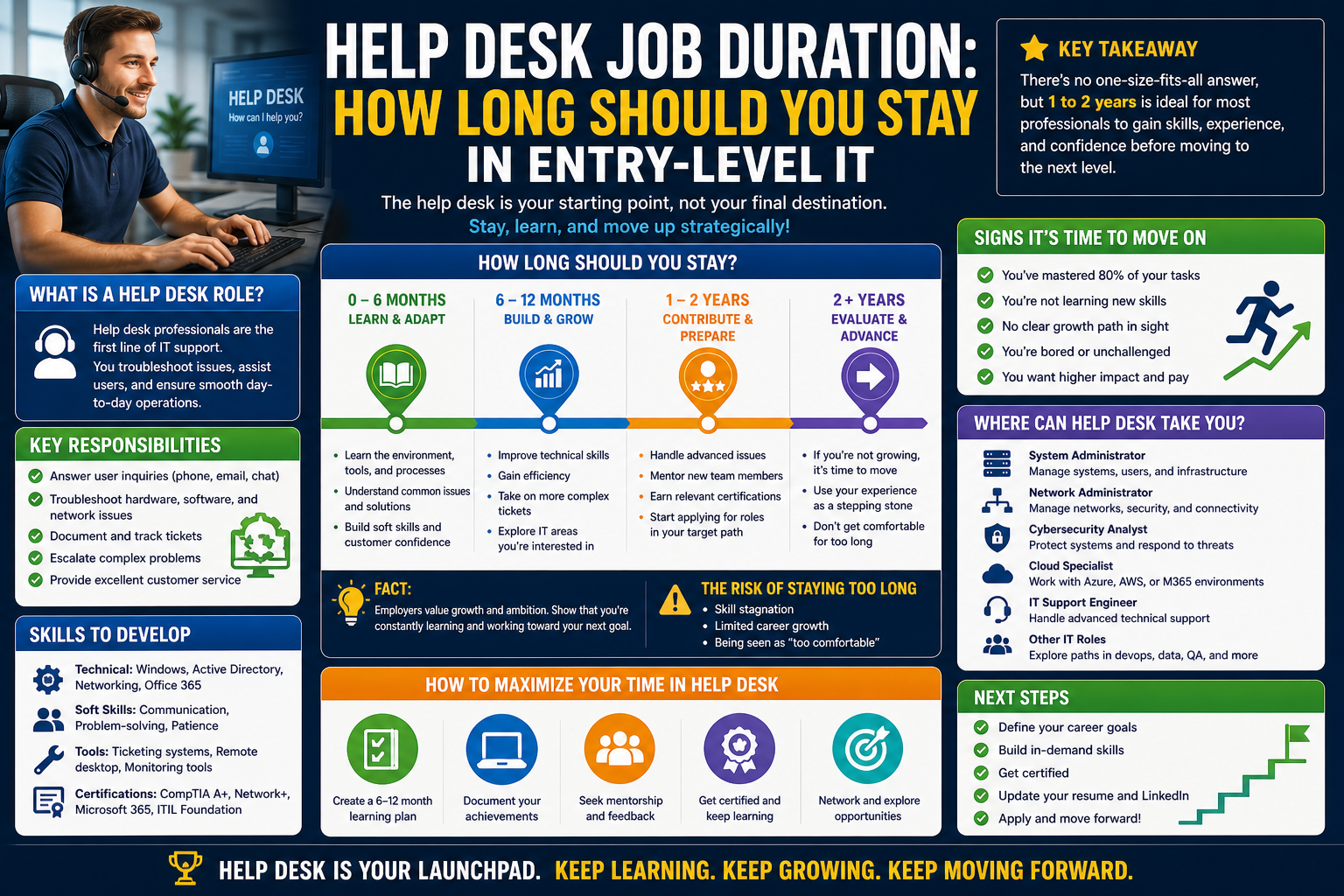
Time in a help desk role is not just a matter of employment duration; it is closely tied to how quickly an IT professional develops core competencies and direction. The early stage of an IT career is often defined by exposure, repetition, and gradual confidence building. However, staying too long without progression can limit long-term growth.
The idea of “how long is enough” is not fixed. It varies based on individual goals, company structure, and learning opportunities available in the workplace. Some environments encourage growth and provide internal pathways, while others are more static, keeping employees focused on repetitive support tasks.
What matters most is whether the time spent in a help desk role is actively contributing to skill development. If daily tasks continue to teach new troubleshooting techniques, expose you to different systems, or expand your understanding of IT infrastructure, then the experience remains valuable. If the work becomes predictable and no longer challenges your thinking, the value of additional time begins to decrease.
The Common 2 to 3 Year Development Window
In many IT career paths, a period of approximately two to three years in a help desk role is often seen as a natural development phase. This timeframe is not a strict rule but rather a general observation based on how quickly professionals typically build foundational skills.
During the first year, most individuals focus on learning systems, understanding workflows, and becoming comfortable with basic troubleshooting. This stage is heavily guided, and mistakes are part of the learning process.
The second year often brings increased independence. Individuals begin solving more complex issues, handling escalations with less supervision, and developing stronger pattern recognition. This is also the stage where confidence begins to grow significantly.
By the third year, many professionals reach a level where they can handle most routine and intermediate issues with ease. At this point, growth depends less on repetition and more on exposure to advanced tasks or new responsibilities. Without new challenges, learning can plateau.
This is why the two-to-three-year range is often viewed as a natural transition point rather than a strict limit.
Recognizing When Learning Begins to Slow Down
One of the most important factors in deciding how long to stay in a help desk role is the pace of learning. Early in a career, learning is constant. Every day introduces new problems, tools, or user behaviors. Over time, however, the rate of new learning may slow.
When tasks become repetitive and no longer require deeper investigation, it may indicate that growth is stabilizing. This does not mean the role has no value, but it does suggest that additional experience may not significantly expand technical ability.
Another sign of slowed learning is when troubleshooting becomes purely procedural rather than analytical. If problems are solved by following memorized steps without understanding underlying causes, technical development may stagnate.
At this stage, professionals often need to decide whether to seek new responsibilities, transition internally, or explore external opportunities that offer greater complexity.
The Role of Company Structure in Career Growth
Not all help desk environments offer the same growth opportunities. Some organizations view help desk teams as entry points into broader IT departments. These companies often encourage internal mobility, allowing employees to transition into specialized roles over time.
In such environments, help desk work becomes a stepping stone. Employees may move into system administration, network support, cybersecurity assistance, or other technical departments depending on performance and interest.
Other organizations, however, maintain a more rigid structure. In these cases, help desk roles remain separate from advanced technical teams, with limited internal movement. Employees may find themselves performing the same tasks for extended periods without clear progression pathways.
Understanding the structure of your workplace is essential when evaluating career timing. A supportive environment may justify a longer stay in a help desk role, while a limited-growth environment may require earlier transition planning.
When Repetition Becomes a Limiting Factor
Repetition is a natural part of help desk work, especially in environments with high user volume. Common issues often repeat, and over time, solutions become familiar. While repetition builds speed and efficiency, it can also reduce cognitive engagement.
When tasks become purely repetitive without introducing new challenges, professionals may stop actively learning. Instead of analyzing problems, they may rely on automatic responses. This shift can limit long-term technical development.
The challenge is to distinguish between productive repetition and limiting repetition. Productive repetition strengthens skills and builds mastery. Limiting repetition reduces engagement and slows professional growth.
Recognizing this difference helps individuals decide when it is time to seek new challenges or responsibilities.
Expanding Responsibilities Within the Help Desk Role
Before moving on from a help desk position, many professionals attempt to expand their responsibilities within the same role. This can involve taking on more complex issues, assisting with internal systems, or participating in backend support tasks.
Some individuals request exposure to higher-level troubleshooting or collaboration with specialized IT teams. These opportunities provide insight into advanced systems and processes, helping bridge the gap between entry-level support and technical specialization.
Others focus on improving efficiency within their current role by developing better workflows, contributing to documentation systems, or assisting in training newer team members. These activities help build leadership and organizational skills.
Expanding responsibilities within the same role can significantly extend the learning value of a help desk position without requiring immediate job changes.
The Importance of Self-Assessment in Career Timing
Deciding how long to stay in a help desk role requires honest self-assessment. This involves evaluating not just job satisfaction but also skill development, career direction, and long-term goals.
One key question is whether current work is still contributing to learning. If each month brings noticeable improvement in technical ability, staying longer may be beneficial. If progress feels minimal or stagnant, it may be time to consider next steps.
Another important factor is motivation. High engagement often indicates that challenges are still present. Low motivation, especially when tasks feel repetitive or unfulfilling, can signal the need for change.
Self-assessment also involves understanding career aspirations. Someone aiming for advanced technical roles may need to transition sooner, while someone focused on stability or customer interaction may find long-term satisfaction in support environments.
Internal Mobility and Career Path Exploration
In some organizations, help desk roles serve as gateways to multiple IT career paths. Internal mobility allows employees to move into different departments after gaining sufficient experience.
Common progression paths include technical support specialization, infrastructure roles, systems administration, network operations, and security-focused positions. Each path requires different skills, but help desk experience provides a strong foundation for all of them.
Transitioning internally often depends on performance, willingness to learn, and availability of roles. Employees who actively seek exposure to other departments increase their chances of moving beyond entry-level support.
However, internal mobility is not guaranteed in every organization. Understanding how your workplace handles career progression is an important part of planning your long-term direction.
The Risk of Staying Too Long Without Progression
While help desk experience is valuable, staying in the same role without progression for an extended period can have drawbacks. One of the main risks is skill plateauing, where technical development slows or stops entirely.
Another risk is reduced competitiveness in the job market. Employers often look for candidates who show progression in responsibilities or technical complexity over time. Long periods in the same role without advancement may raise questions during future job applications.
There is also a psychological impact to consider. Extended periods of repetitive work without growth can lead to reduced motivation, lower job satisfaction, and decreased engagement with learning.
These risks do not mean that help desk work is negative, but they highlight the importance of intentional career planning.
Building Direction Through Exposure and Experience
Help desk roles often expose individuals to multiple areas of IT simultaneously. This exposure can help clarify long-term interests and career direction.
Some professionals discover a strong interest in networking after repeatedly handling connectivity issues. Others become interested in cybersecurity after dealing with account security problems or suspicious activity. Some develop an interest in systems management through exposure to server-related support tasks.
This gradual discovery process is one of the most valuable aspects of the help desk experience. It allows individuals to explore different areas without committing immediately to a specialized path.
Over time, these experiences help shape clearer career goals, making future transitions more purposeful and informed.
When Help Desk Becomes a Launchpad Instead of a Destination
For many IT professionals, the help desk serves as a launchpad rather than a final destination. It provides initial exposure, builds confidence, and develops essential technical and interpersonal skills.
However, its true value lies in how it is used. When treated as a learning platform, it can accelerate career development. When treated as a long-term endpoint without growth, it can limit potential.
The difference often comes down to intentionality. Professionals who actively seek learning opportunities, request new responsibilities, and plan their next steps tend to progress more quickly. Those who remain passive may find themselves staying in the same position longer than intended.
Understanding this distinction is essential when evaluating how long to remain in a help desk role.
Moving from Support Roles to Specialized IT Careers
The transition from a help desk role into a more specialized IT position is one of the most important stages in a technology professional’s career. It represents a shift from reactive problem-solving to proactive system design, maintenance, and optimization. While help desk work focuses on resolving user issues, advanced roles focus on preventing those issues, improving systems, and building infrastructure that supports entire organizations.
This transition does not happen overnight. It is the result of accumulated experience, intentional skill development, and clear career planning. Many professionals reach a point where they begin to feel that they understand the basics of IT support deeply enough to move forward. At this stage, the focus shifts from “fixing issues” to “building systems” or “designing solutions.”
Moving beyond help desk work often requires a mindset shift. Instead of waiting for problems to appear, professionals begin to anticipate issues before they happen. Instead of focusing on individual users, they start thinking about entire networks, systems, or security frameworks. This change in thinking marks the beginning of specialization.
Identifying the Right Time to Transition
There is no single perfect moment to leave a help desk role, but there are clear indicators that suggest readiness for transition. One of the most important signs is consistent success with intermediate and complex technical issues. When troubleshooting becomes second nature, and most problems feel familiar, it often indicates that foundational learning is complete.
Another indicator is the ability to work independently without heavy reliance on scripts or step-by-step guidance. At the beginning of a help desk career, structured instructions are essential. However, as experience grows, professionals begin to develop their own problem-solving approaches. When this independence becomes natural, it often signals readiness for more advanced responsibilities.
A third sign is curiosity beyond the scope of daily tasks. If an individual finds themselves interested in how systems are built, how networks are designed, or how security is maintained at a deeper level, it often means their thinking is already shifting toward specialization.
Career readiness is not just about time spent in a role. It is about the depth of understanding gained during that time.
The Shift from Reactive to Proactive Thinking
Help desk roles are primarily reactive. Issues are reported by users, and support staff respond to those issues. This reactive environment is essential for learning how systems behave under real-world conditions, but it is only the first stage of IT thinking.
As professionals grow, they begin to transition from reactive problem-solving to proactive system management. Instead of waiting for issues to arise, they begin asking why those issues occur in the first place. This leads to a deeper analysis of system architecture, configuration, and user behavior.
For example, instead of repeatedly fixing the same login issue, a more advanced approach would involve investigating authentication systems, password policies, or directory services to prevent the issue from happening again.
This shift in thinking is what separates entry-level support roles from specialized IT positions. It is not just about solving problems faster, but about reducing the number of problems altogether.
Building Technical Depth Through Continuous Learning
Transitioning beyond help desk work requires continuous learning beyond daily job responsibilities. While help desk roles provide exposure to many systems, deeper expertise requires focused study and practical exploration of specific areas.
Technical depth is built gradually through repetition, experimentation, and exposure to more complex systems. For example, someone interested in networking might begin by understanding basic connectivity issues, then move on to studying routing, switching, and network security.
Similarly, someone interested in systems administration might start with user account management and gradually progress toward server configuration, virtualization, and infrastructure monitoring.
This progression requires patience and consistency. Technical depth cannot be rushed, but it can be accelerated through intentional practice and curiosity.
Developing a Specialization Direction
One of the most important steps after gaining help desk experience is choosing a direction for specialization. IT is a broad field, and help desk exposure often reveals multiple potential paths.
Some individuals are drawn toward networking due to frequent exposure to connectivity issues. Others become interested in cybersecurity after dealing with access control problems or security alerts. Some find system administration appealing because of their interaction with servers and infrastructure tools.
Choosing a specialization does not mean abandoning help desk experience. Instead, it means using that experience as a foundation for deeper exploration. The goal is to move from general support knowledge to focused expertise in a specific area.
Specialization helps professionals become more valuable in the job market and opens opportunities for higher-level roles with greater responsibility.
The Importance of Hands-On Practice Beyond the Workplace
While help desk roles provide valuable experience, they often do not offer enough depth in specialized areas. This is why hands-on practice outside of work becomes important for career growth.
Practical experimentation allows individuals to explore systems in controlled environments. This can include setting up virtual networks, configuring operating systems, or simulating infrastructure environments. These activities help bridge the gap between theoretical knowledge and real-world application.
Hands-on practice also builds confidence. When professionals understand how systems behave in different scenarios, they become more effective problem-solvers in advanced roles.
This type of learning is especially important for individuals preparing to transition into system administration, networking, or cybersecurity roles.
Overcoming the Comfort Zone of Help Desk Work
One of the biggest challenges in transitioning beyond help desk roles is comfort. Help desk environments become familiar over time. Tasks become predictable, workflows are understood, and confidence in daily responsibilities increases.
While comfort is positive in terms of job stability, it can also create resistance to change. Moving into a new role often involves uncertainty, new responsibilities, and a learning curve.
This discomfort is a natural part of career growth. Advanced roles require individuals to operate outside their comfort zones more frequently. Unlike help desk environments, where issues are often standardized, specialized roles involve more complex and less predictable challenges.
Recognizing that discomfort is part of growth helps professionals make more confident career decisions.
The Role of Certifications and Structured Learning
As professionals move beyond help desk roles, structured learning becomes increasingly important. Certifications and formal study paths help provide direction and ensure that knowledge is aligned with industry expectations.
These learning structures help fill gaps that may not be covered in day-to-day support work. For example, while help desk experience may provide exposure to networking issues, structured learning can provide a deeper understanding of network design, protocols, and infrastructure management.
Structured learning also helps validate skills in the job market. Employers often look for evidence of both experience and technical knowledge when hiring for specialized roles.
However, certifications alone are not enough. They must be combined with practical experience and real-world application to be truly effective.
Internal Promotion Versus External Transition
When moving beyond help desk roles, professionals often face two main paths: internal promotion within their current organization or transitioning to a new company.
Internal promotion is often smoother because it builds on existing relationships, systems knowledge, and organizational familiarity. Employees already understand the company’s infrastructure and processes, which reduces the learning curve.
However, internal opportunities may be limited depending on the organization’s structure and hiring practices. Not all companies prioritize internal development for technical roles.
External transition offers broader opportunities but comes with the challenge of adapting to new environments. It may require proving skills in interviews, adapting to different systems, and adjusting to new workflows.
Both paths are valid, and the best choice depends on individual goals and workplace opportunities.
Building a Professional Identity Beyond Support Roles
As professionals move beyond help desk work, they begin developing a stronger technical identity. Instead of being seen primarily as support staff, they start being recognized for specific technical skills or areas of expertise.
This identity shift is important for long-term career development. It helps define how professionals are perceived in the job market and influences the types of opportunities they receive.
Building a professional identity involves consistently developing skills in a chosen area, gaining practical experience, and demonstrating expertise through problem-solving and project work.
Over time, this identity becomes more important than initial job titles. What matters most is not where a career started, but how it has progressed.
Long-Term Career Development and IT Progression Paths
Beyond help desk roles, IT careers typically branch into several major pathways. Each path offers different types of challenges and responsibilities.
System administration focuses on managing and maintaining the IT infrastructure. Networking roles involve designing and maintaining communication systems. Cybersecurity focuses on protecting systems and data from threats. Cloud computing roles involve managing scalable infrastructure in virtual environments.
Each of these paths builds on foundational help desk experience but requires deeper specialization and technical expertise.
Choosing a long-term path does not need to happen immediately, but early exposure helps guide decisions. Help desk experience provides the initial understanding needed to make informed choices about these directions.
Continuous Growth as a Defining Career Principle
The most important principle in transitioning beyond help desk roles is continuous growth. IT is a constantly evolving field, and professionals must evolve with it.
Growth does not always mean changing jobs quickly. It can also mean taking on new responsibilities, learning new systems, or developing deeper expertise in a current role.
However, long-term success in IT often depends on avoiding stagnation. Staying in one role without growth for too long can limit opportunities and reduce long-term career potential.
Continuous growth ensures that skills remain relevant, adaptable, and valuable in a changing industry landscape.
Expanding Real-World Experience into Career Confidence
One of the most important but often overlooked aspects of moving beyond help desk work is the confidence built through accumulated real-world experience. Technical knowledge alone does not guarantee readiness for advancement. What truly prepares someone for higher-level IT roles is the ability to handle uncertainty with composure.
In help desk environments, professionals constantly face situations where complete information is not available. Users may provide unclear descriptions, systems may behave inconsistently, and documentation may not fully match real conditions. Over time, dealing with this uncertainty builds a kind of practical confidence that cannot be gained through theory alone.
As individuals progress, this confidence begins to influence decision-making. Instead of hesitating when faced with unfamiliar problems, they begin to rely on structured reasoning. They ask better questions, isolate variables more effectively, and test solutions systematically. This shift is subtle but significant because it reflects a transition from guided support work to independent technical thinking.
This confidence becomes especially important when entering specialized roles such as system administration or network engineering, where problems are often less standardized and require deeper analytical thinking.
Learning to Think Beyond Individual Tickets
Help desk work is structured around individual incidents. Each ticket represents a specific problem that must be resolved. While this approach is effective for support environments, it can sometimes limit broader system thinking if not consciously expanded.
As professionals mature, they begin to notice patterns across multiple tickets. Instead of viewing each issue as isolated, they start connecting recurring problems to underlying system behaviors. For example, repeated password reset requests may point to authentication policy issues, while frequent connectivity complaints may suggest network configuration weaknesses.
This pattern recognition is a critical step toward advanced IT thinking. It encourages professionals to move from symptom-based troubleshooting to root cause analysis. Rather than focusing solely on fixing immediate issues, they begin asking why those issues are happening repeatedly.
This type of thinking is essential for roles that involve system design, infrastructure planning, and long-term maintenance. It transforms the professional from a reactive responder into a proactive problem preventer.
The Importance of Technical Curiosity in Career Progression
Technical curiosity is one of the strongest indicators of long-term success in IT careers. It reflects a desire to understand systems beyond surface-level functionality. In help desk roles, curiosity often begins with simple questions such as why a problem occurs or how a system is structured behind the scenes.
Over time, this curiosity becomes more structured and focused. Instead of only solving issues, professionals begin exploring how systems interact with each other. They may start learning about network architecture, server roles, virtualization, or security principles simply to understand the environment they work in more deeply.
This curiosity is what drives self-improvement outside of work responsibilities. It leads individuals to explore new technologies, test configurations, and experiment with system setups in controlled environments. Without this curiosity, career growth often becomes dependent solely on workplace exposure, which can be limited.
Employers value this trait highly because it signals adaptability. In fast-changing IT environments, professionals who naturally seek to understand new systems tend to adjust more quickly to evolving technologies and responsibilities.
Preparing for the Transition Mindset
Transitioning beyond a help desk role is not only a technical decision but also a mental one. It requires a shift in how professionals view their responsibilities and potential. Instead of identifying primarily as support staff, they begin to see themselves as developing specialists.
This mindset shift involves accepting that growth may require discomfort. New roles often involve unfamiliar systems, higher expectations, and greater responsibility. Unlike help desk environments, where processes are often standardized, specialized roles demand adaptability and independent problem-solving.
Preparing for this transition also involves recognizing that mistakes are part of the learning process. In advanced roles, problems may be more complex, and solutions may not always be immediately obvious. Learning to navigate these challenges builds resilience and strengthens long-term capability.
The transition mindset is ultimately about embracing progression rather than stability. It involves viewing help desk experience as a foundation rather than a final destination, and actively preparing for the next stage of professional development.
Strengthening Long-Term Career Direction Through Reflection
As professionals gain experience, regular reflection becomes an important tool for career planning. Reflecting on past challenges, successful resolutions, and recurring tasks helps clarify strengths and interests.
This reflection often reveals patterns in what types of problems are most engaging or enjoyable to solve. Some individuals may find satisfaction in technical troubleshooting, while others may prefer system design, user interaction, or infrastructure management.
Understanding these preferences helps guide specialization decisions more effectively. Instead of choosing a career path based on external expectations, professionals can make decisions based on experience and personal interest.
Reflection also helps identify areas where growth is needed. Recognizing gaps in knowledge or recurring difficulties allows individuals to focus their learning efforts more effectively, making career progression more intentional and structured.
Over time, this reflective practice becomes a key part of long-term career development, ensuring that progression is aligned with both skill growth and personal motivation.
Conclusion
A help desk role is often the first meaningful step into the IT industry, and for many professionals, it becomes the foundation on which an entire career is built. It provides exposure to real users, real systems, and real problems that cannot be fully replicated in training environments. Through daily troubleshooting, communication with users, and interaction with technical systems, professionals develop a blend of technical and interpersonal skills that are essential in almost every area of IT.
What makes the help desk experience so valuable is not just the work itself, but the learning that happens through repetition and exposure. Over time, patterns become clearer, confidence grows, and problem-solving becomes more intuitive. These early experiences shape how professionals think about technology, users, and systems, often influencing their future career direction in significant ways.
However, the help desk is not intended to be a permanent destination for most individuals who want to advance into specialized IT roles. While some professionals may find long-term satisfaction in support-focused environments, many others reach a point where their growth begins to slow. Tasks that once felt challenging may become routine, and opportunities for deeper technical learning may become limited depending on the workplace structure.
Recognizing this stage is an important part of career development. It is not about leaving a role too quickly or staying too long, but about understanding when learning is still active and when it begins to plateau. For many, the commonly observed two to three-year period provides enough time to build a strong foundation while still maintaining momentum for future growth. Yet this timeline is flexible, shaped by individual goals, workplace opportunities, and personal ambition.
The decision to move beyond help desk work should always be guided by self-awareness. If curiosity is pushing toward deeper technical understanding, if repetitive tasks no longer provide challenge, or if career goals point toward specialized roles such as system administration, networking, cybersecurity, or cloud computing, then progression becomes a natural next step. On the other hand, if the environment continues to offer learning opportunities and internal growth, staying longer can still be valuable.
What ultimately matters is intentionality. Careers in IT are not defined by titles alone but by continuous development. Whether staying in a help desk role to strengthen foundational skills or moving forward into more complex technical positions, the focus should remain on growth, learning, and adaptability.
The help desk is best understood as a launch point rather than a limitation. It introduces professionals to the realities of IT work, builds resilience, and develops core competencies that remain useful throughout a career. From this starting point, every additional step—whether internal promotion or external transition—becomes part of a larger journey toward expertise.
In the end, success in IT is not determined by how long someone stays in an entry-level role, but by how effectively they use that time to grow. Those who actively learn, seek challenges, and prepare for the next stage of their careers are the ones who transition smoothly into specialized positions and continue progressing in an ever-evolving industry.
Ultimately, moving beyond help desk work is less about escaping a role and more about evolving within a career path. The experience gained at this stage continues to provide value long after transitioning into more advanced positions, because it builds the ability to understand users, troubleshoot under pressure, and think clearly through technical problems. These skills remain relevant across all areas of IT, regardless of specialization. With a clear sense of direction and a commitment to continuous learning, the help desk becomes not a limitation, but a strong launching point toward long-term professional growth and opportunity in the technology field.