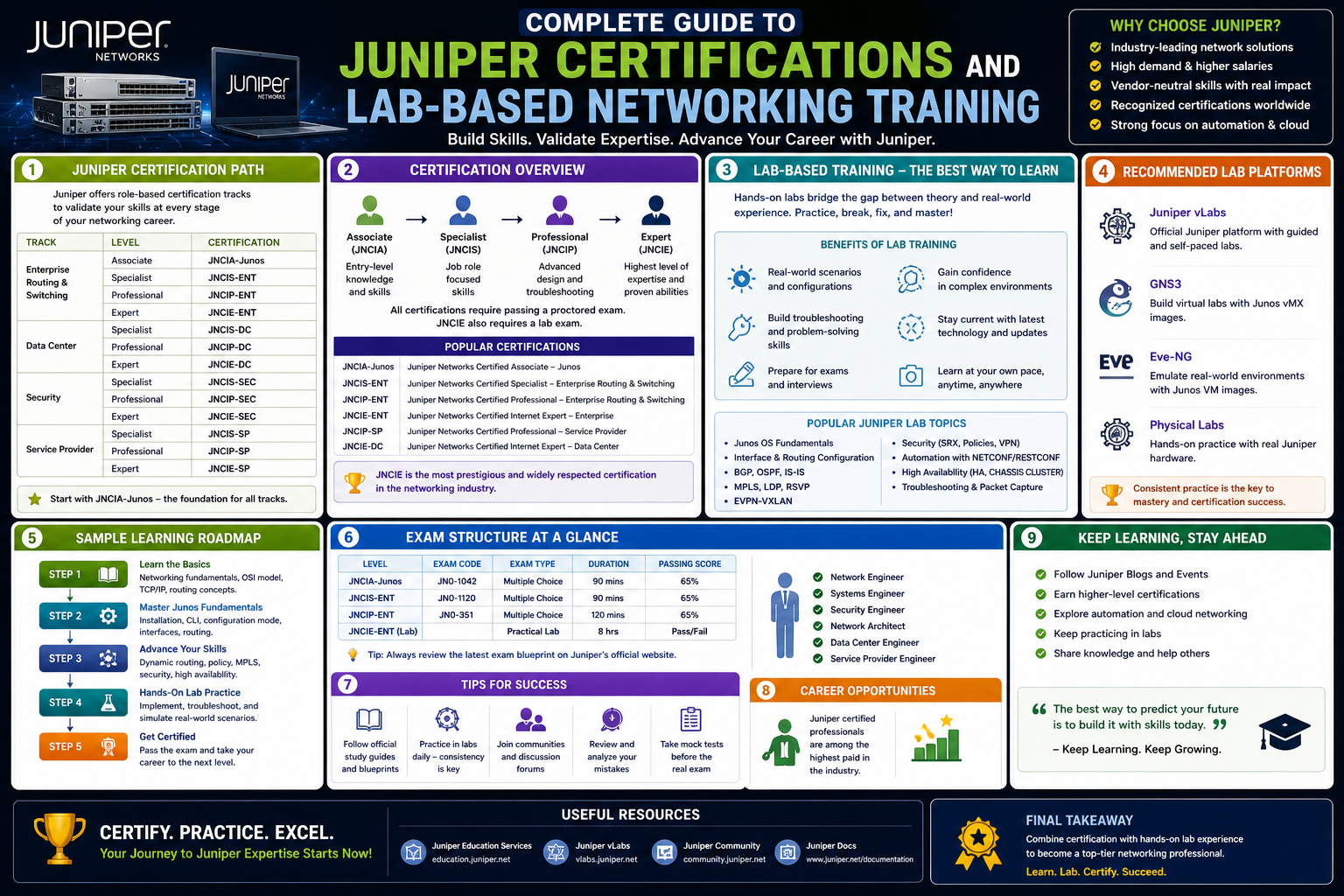
Juniper certification pathways are designed to validate practical networking knowledge and real-world operational skills across enterprise and service provider environments. Unlike purely theoretical learning approaches, these certifications emphasize how networking concepts translate into configuration, troubleshooting, and system design using Juniper technologies.
At the foundational level, the certification ecosystem begins with entry-level credentials that introduce networking principles through the lens of Juniper operating systems and device behavior. As learners progress, the certifications gradually shift toward more advanced topics such as routing policies, scalable architectures, automation, and network security implementation. This structured progression allows professionals to develop both depth and breadth in networking knowledge.
One of the most recognized starting points in this ecosystem is the associate-level certification focused on Juniper’s operating system. It is designed not only to test familiarity with concepts but also to ensure that candidates understand how those concepts behave in real environments. This is important because networking is not just about memorization; it is about understanding how systems react under different conditions.
Juniper’s certification approach is particularly aligned with operational readiness. Many organizations rely on stable and efficient network infrastructures, and professionals who understand how to manage Juniper devices are expected to work confidently with configurations, routing behaviors, and system outputs. As a result, certification preparation naturally includes hands-on experimentation and lab-based learning.
Another important aspect of these certification tracks is their alignment with real-world job roles. Instead of focusing solely on abstract concepts, the learning path reflects responsibilities commonly found in network administration, engineering, and operations roles. This ensures that certified individuals are not just exam-ready but also workplace-ready.
The certification structure also encourages continuous learning. As technology evolves, networking professionals are expected to keep pace with changes in protocols, automation tools, and cloud integration methods. Juniper certifications evolve accordingly, ensuring that the learning path remains relevant to modern infrastructure demands.
By establishing a structured journey from basic to advanced skills, Juniper certification tracks provide a clear roadmap for professionals aiming to build expertise in network engineering. This structured progression forms the foundation for understanding why hands-on practice environments are essential in the learning process.
Understanding the Foundation of JNCIA-Level Knowledge
The JNCIA-level certification represents the entry point into Juniper’s structured learning ecosystem. It focuses on foundational networking principles while introducing how these principles are implemented within Juniper environments. Rather than relying on theoretical definitions alone, it emphasizes operational understanding and system interaction.
At this level, learners are expected to become familiar with how networking devices communicate, how routing decisions are made, and how configurations influence network behavior. The focus is not just on knowing what a concept is, but understanding how it functions when applied to real systems.
A key characteristic of this certification level is its emphasis on Junos OS behavior. Junos OS is known for its structured architecture and consistency across devices, which makes it an important subject of study. Understanding its operational flow helps learners grasp how configuration changes propagate and how system processes interact.
The JNCIA-level approach also encourages learners to think in terms of network logic. Instead of viewing networks as isolated devices, candidates are guided to understand the relationships between routing tables, interfaces, and control mechanisms. This perspective is essential for building troubleshooting skills later in the learning journey.
Another important aspect is familiarity with basic routing concepts. These include understanding how traffic moves between networks, how routes are selected, and how network stability is maintained. These foundational concepts serve as building blocks for more advanced topics such as policy-based routing and traffic engineering.
Security awareness is also introduced at a basic level. While advanced security configurations are not the focus at this stage, learners begin to understand how network access, permissions, and control mechanisms are structured within Juniper environments. This helps build a security-conscious mindset early in the learning process.
The JNCIA-level knowledge framework also encourages learners to develop analytical thinking. Instead of memorizing commands or procedures, the focus is on understanding cause-and-effect relationships within network systems. This analytical approach becomes increasingly important as learners move into more complex certifications.
Ultimately, this foundation stage is designed to prepare individuals for hands-on experimentation. Without practical exposure, theoretical knowledge can remain abstract. That is why lab environments become an essential part of the learning experience.
The Importance of Hands-On Learning in Juniper Skill Development
Networking is inherently practical. While theoretical knowledge provides a necessary foundation, true understanding develops when learners interact with real or simulated network environments. This is especially true in Juniper-based systems, where configuration accuracy and system behavior play a critical role in network performance.
Hands-on learning allows individuals to observe how changes in configuration affect routing decisions, interface behavior, and system responses. This direct feedback loop is essential for building confidence and competence in network administration. It transforms abstract concepts into observable outcomes.
One of the biggest challenges in networking education is the gap between knowledge and application. A learner may understand routing theory, but without practical experience, it can be difficult to troubleshoot issues or design stable networks. Lab environments bridge this gap by providing a controlled space for experimentation.
Practical environments also help learners develop problem-solving skills. In real-world networks, issues rarely present themselves in predictable ways. By working in lab scenarios, individuals can simulate failures, misconfigurations, and network changes to understand how systems respond under different conditions.
Another important benefit of hands-on learning is familiarity with system interfaces and operational tools. Junos OS, for example, has a structured command-line interface that requires practice to navigate efficiently. Repeated exposure through lab exercises helps build speed and accuracy.
Lab-based learning also supports retention of knowledge. Studies in skill acquisition consistently show that active engagement leads to better long-term understanding than passive reading. When learners configure devices themselves, they are more likely to remember concepts and apply them effectively in real environments.
Additionally, hands-on practice encourages curiosity. Learners often begin to experiment beyond structured exercises, testing different configurations and observing system behavior. This exploratory learning approach deepens understanding and fosters innovation in problem-solving.
The importance of practical learning becomes even more evident when preparing for certification assessments. These assessments are designed to evaluate applied knowledge rather than memorized content. Therefore, individuals who have spent time working in lab environments are naturally better prepared.
Exploring Juniper Hardware-Based Learning Environments
Hardware-based learning environments represent one of the most traditional yet effective ways to gain networking experience. These environments involve physical networking devices such as routers and switches configured in a controlled setup for educational purposes.
Working with physical hardware provides a realistic understanding of network behavior. Learners can directly observe how cables, interfaces, and devices interact in real time. This tactile experience helps reinforce conceptual knowledge and builds confidence in handling real equipment.
One of the main advantages of hardware-based labs is exposure to real device constraints. Unlike virtual environments, physical devices may have limitations in processing power, interface availability, or configuration flexibility. These constraints help learners understand how real-world networks operate under practical limitations.
Hardware labs also provide a deeper understanding of physical connectivity. Concepts such as interface status, link negotiation, and signal behavior become more tangible when working with actual devices. This level of understanding is difficult to replicate in purely virtual environments.
However, building a hardware lab requires careful planning. Equipment selection, physical space, power requirements, and cost considerations all play a role. While this approach offers valuable experience, it may not always be accessible to everyone due to resource constraints.
Despite these challenges, hardware labs remain highly valuable for those who can access them. They provide an environment that closely mirrors enterprise network setups, allowing learners to experience realistic operational scenarios.
Another important benefit is exposure to troubleshooting at the physical layer. Issues such as faulty cables, interface mismatches, or hardware failures are part of real networking environments. Working with hardware helps learners develop diagnostic skills that go beyond software configuration.
Over time, individuals who practice in hardware-based environments tend to develop strong operational intuition. They become comfortable identifying problems quickly and understanding how different components of a network interact physically.
Understanding Software-Based Virtual Lab Environments
Software-based virtual labs have become an increasingly popular alternative to physical hardware setups. These environments simulate networking devices using virtualization technologies, allowing learners to build and configure networks without requiring physical equipment.
Virtual labs offer significant flexibility. They can be deployed on personal computers or cloud-based platforms, enabling learners to practice networking concepts from virtually anywhere. This accessibility makes them particularly valuable for individuals who cannot invest in physical hardware.
One of the key advantages of virtual environments is scalability. Multiple virtual devices can be created quickly, allowing learners to build complex network topologies without physical limitations. This makes it easier to simulate enterprise-level environments.
Virtual labs also provide safe experimentation spaces. Learners can test configurations, make mistakes, and reset environments without risk of damaging physical equipment. This encourages experimentation and accelerates the learning process.
Another benefit is repeatability. Configurations can be saved, cloned, and restored easily, allowing learners to revisit scenarios multiple times. This supports deeper understanding through repetition and variation.
Software-based labs also align well with modern networking trends. As cloud computing and virtualization become more prevalent, understanding virtual network environments is increasingly important for networking professionals.
These environments also support integration with automation tools. Learners can experiment with scripting and configuration automation, which are essential skills in modern network management.
Despite their advantages, virtual labs may not perfectly replicate hardware behavior in all cases. Certain performance characteristics or physical-layer behaviors may differ. However, they remain highly effective for conceptual learning and configuration practice.
Overall, software-based virtual labs provide a powerful and accessible way to gain practical networking experience, complementing traditional hardware-based approaches.
Deep Dive into Junos OS Architecture and Operational Philosophy
Junos OS is at the heart of Juniper networking environments and plays a defining role in how devices behave, process configurations, and handle network traffic. Unlike many traditional networking operating systems, Junos OS is built on a modular architecture that separates different system functions into distinct processes. This design improves stability, scalability, and predictability across network devices.
One of the most important characteristics of Junos OS is its separation of the control plane, forwarding plane, and management plane. This separation ensures that routing decisions, packet forwarding, and administrative tasks operate independently. As a result, issues in one area do not necessarily impact the entire system, which increases reliability in production environments.
The control plane is responsible for making decisions about how traffic should flow through the network. It runs routing protocols, builds routing tables, and determines optimal paths for data transmission. The forwarding plane, on the other hand, is responsible for actually moving packets based on decisions made by the control plane. This division of responsibility ensures high-speed packet processing without interrupting decision-making processes.
The management plane handles user interaction with the system. This includes configuration commands, monitoring tools, and administrative access. By isolating these functions, Junos OS ensures that management tasks do not interfere with critical forwarding operations.
Another defining feature of Junos OS is its hierarchical configuration structure. Instead of using flat configuration files, Junos organizes settings into a tree-like format. This structure makes it easier to understand relationships between different configuration elements and reduces the likelihood of errors.
Configuration changes in Junos OS follow a two-step process: candidate configuration and committed configuration. Users first make changes in a temporary candidate configuration space. Once verified, these changes are committed to become active. This approach adds a layer of safety by allowing validation before applying changes to live systems.
The rollback feature further enhances system reliability. It allows administrators to revert to previous configurations if issues arise after changes are implemented. This is particularly useful in complex network environments where configuration errors can have a widespread impact.
Understanding Junos OS behavior is essential for anyone pursuing Juniper certification because it directly influences how networks are designed, maintained, and troubleshooted. Without this understanding, even simple configuration tasks can become challenging.
Progression Through Juniper Certification Tracks
Juniper certification tracks are structured to guide learners through increasing levels of complexity and responsibility. Each stage builds on the previous one, ensuring that knowledge and skills develop in a logical and practical sequence.
At the foundational level, certifications focus on basic networking concepts and Junos OS familiarity. This stage ensures that learners understand how devices operate and how fundamental configurations are applied. It is designed for individuals who are new to Juniper technologies or networking in general.
As learners progress, intermediate certifications introduce more advanced topics such as routing policies, network security concepts, and scalable network design. At this level, individuals are expected to understand not only how to configure systems but also why certain configurations are used in specific scenarios.
Advanced certification levels focus on enterprise-scale networks, service provider environments, and automation strategies. These certifications require a deep understanding of network behavior under complex conditions and the ability to design resilient infrastructures.
One of the key strengths of this structured progression is its alignment with real-world job roles. Entry-level certifications correspond to junior network administrator responsibilities, while advanced certifications align with senior engineering and architectural roles.
Each certification stage also emphasizes problem-solving skills. Instead of focusing solely on theoretical knowledge, candidates are expected to demonstrate the ability to analyze network issues and implement effective solutions.
The progression through certification tracks also reinforces continuous learning. Networking technologies evolve rapidly, and professionals must stay updated with new protocols, tools, and methodologies. Certification paths are designed to reflect these evolving requirements.
By following a structured certification journey, learners gradually build the expertise needed to manage increasingly complex networking environments. This structured approach ensures long-term skill development rather than short-term memorization.
Understanding the Practical Mindset Behind Certification Preparation
Preparing for Juniper certifications requires more than studying documentation or memorizing commands. It involves developing a practical mindset focused on understanding how systems behave in real environments.
This mindset emphasizes experimentation and observation. Instead of simply reading about routing behavior, learners are encouraged to configure networks and observe how changes affect traffic flow. This hands-on approach leads to deeper understanding and stronger retention.
Another important aspect of this mindset is analytical thinking. Network issues rarely present themselves in straightforward ways. They often involve multiple layers of configuration and interaction between different systems. Developing the ability to break down problems into smaller components is essential.
Troubleshooting is a core skill in this process. Learners must be able to identify symptoms, analyze potential causes, and test hypotheses systematically. This structured approach helps in isolating issues efficiently.
The practical mindset also involves understanding cause-and-effect relationships. For example, a single configuration change can impact routing behavior, interface status, or security policies. Recognizing these relationships is critical for effective network management.
In addition, learners must develop patience and persistence. Networking environments can be complex, and solutions are not always immediately obvious. Repeated experimentation and gradual refinement of configurations are often required.
This mindset is reinforced through lab-based learning environments where learners can safely experiment without risk. These environments provide the freedom to make mistakes and learn from them, which is an essential part of skill development.
Building Effective Hardware Lab Environments for Skill Development
Hardware-based lab environments remain a valuable method for developing practical networking skills. These environments simulate real-world infrastructure using physical devices such as routers, switches, and connectivity hardware.
Designing an effective hardware lab requires careful planning. The first step is determining the learning objectives. Different goals may require different types of devices or configurations. For example, basic routing practice requires fewer devices than advanced network topology simulations.
Device selection is another important factor. Juniper hardware varies in capability and functionality, so choosing appropriate models ensures that learners gain relevant experience. Entry-level devices are often sufficient for foundational learning, while advanced setups may require more powerful equipment.
Physical connectivity plays a crucial role in hardware labs. Understanding how devices are physically connected helps learners develop a deeper awareness of network structure. This includes understanding cable types, interface configurations, and link behavior.
Power management and space considerations are also important. Hardware setups require physical space and stable power sources. Proper organization ensures that the lab environment remains manageable and efficient.
One of the key benefits of hardware labs is exposure to real-world constraints. Unlike virtual environments, physical devices have limitations in processing power, memory, and interface availability. These constraints help learners understand how networks operate under realistic conditions.
Hardware labs also provide valuable troubleshooting experience at the physical layer. Issues such as faulty cables, misconfigured interfaces, or hardware failures are common in real environments. Working with physical devices helps learners develop diagnostic skills that are essential in professional roles.
Despite their benefits, hardware labs require investment in time and resources. This makes them less accessible for some learners, which is why alternative methods such as virtual labs are often used alongside them.
Expanding Knowledge Through Virtual Lab Simulation Environments
Virtual lab environments offer a flexible and accessible alternative to physical hardware setups. These environments use software-based simulation to replicate network devices and their behavior.
One of the most significant advantages of virtual labs is scalability. Learners can quickly create multiple virtual devices and design complex network topologies without physical limitations. This allows for experimentation with large-scale network scenarios.
Virtual environments also provide flexibility in terms of configuration. Devices can be easily reset, duplicated, or modified, allowing learners to test multiple scenarios efficiently. This supports iterative learning and experimentation.
Another advantage is accessibility. Virtual labs can be run on standard computing systems or cloud-based platforms, making them widely available to learners regardless of physical location or resources.
Virtual environments also reduce risk. Since they are simulated, there is no risk of damaging physical equipment or disrupting real networks. This encourages learners to experiment more freely and confidently.
These environments are particularly useful for practicing configuration commands, testing routing protocols, and simulating network failures. They allow learners to observe system behavior in controlled conditions.
Virtual labs also support integration with modern networking practices such as automation and orchestration. Learners can experiment with scripted configurations and automated deployment processes.
However, virtual environments may not perfectly replicate all aspects of physical hardware behavior. Certain performance characteristics or hardware-specific behaviors may differ slightly. Despite this limitation, they remain highly effective for most learning purposes.
Exploring Juniper vLabs and Interactive Simulation Platforms
Juniper vLabs represent a structured approach to online networking simulation. These environments provide pre-configured or customizable network scenarios that allow learners to interact with Juniper systems in a controlled virtual space.
One of the key advantages of such platforms is accessibility. Users can access pre-built environments without needing to install complex software or maintain physical infrastructure. This simplifies the learning process and allows focus on configuration and analysis.
These environments often include a variety of scenarios that simulate real-world network challenges. Learners can explore routing configurations, connectivity issues, and system behaviors in a safe environment.
Another important feature is the ability to reset environments. This allows learners to retry exercises multiple times, reinforcing understanding through repetition and experimentation.
Interactive simulation platforms also help learners visualize network behavior. Configuration changes can be observed in real time, making it easier to understand cause-and-effect relationships.
These environments are particularly useful for beginners who are still developing confidence in network configuration. They provide structured guidance while still allowing room for exploration.
More advanced learners also benefit from these platforms by testing complex scenarios or validating configurations before applying them in real environments.
Understanding Cloud-Based Certification Lab Environments
Cloud-based certification lab environments provide another layer of flexibility for network learning. These platforms allow users to build and configure network environments in a cloud-hosted infrastructure.
Unlike traditional labs, cloud-based environments do not require physical hardware or local installation. Instead, they provide access to virtualized networking resources that can be configured on demand.
One of the key advantages of cloud-based labs is customization. Users can build environments from scratch, designing network topologies according to specific learning objectives or testing requirements.
These environments are particularly useful for advanced learners who want to simulate real-world enterprise scenarios. They allow for complex configurations involving multiple devices, routing protocols, and security policies.
Cloud-based labs also support scalability. Users can increase or decrease the size of their network environments depending on their needs. This flexibility is especially useful for testing large-scale architectures.
Another important feature is realism. Cloud-based environments are often designed to closely mimic production networks, providing a realistic testing ground for configurations and policies.
These platforms also support collaboration. Multiple users can interact with the same environment, making them useful for team-based learning or organizational training.
However, access to these environments may require structured permissions or subscriptions, which can limit availability for some users. Despite this, they remain a powerful tool for advanced network learning and testing.
Developing Troubleshooting Skills Through Controlled Practice
Troubleshooting is one of the most critical skills in networking. It involves identifying, analyzing, and resolving issues that affect network performance or connectivity.
Developing strong troubleshooting skills requires structured practice in controlled environments. Lab setups provide the ideal space for simulating network issues and testing solutions.
One effective approach is to introduce intentional misconfigurations. By observing how systems respond to incorrect settings, learners gain insight into how problems manifest in real environments.
Another important technique is step-by-step analysis. Instead of attempting to fix issues immediately, learners are encouraged to isolate variables and test hypotheses systematically.
Log analysis is also a key part of troubleshooting. Understanding system messages and logs helps identify the root cause of issues more effectively.
Over time, learners develop pattern recognition skills. They begin to recognize common symptoms and associate them with specific types of configuration errors or system behaviors.
Troubleshooting practice also reinforces conceptual understanding. By seeing how systems fail, learners gain a deeper appreciation of how they function correctly.
This skill becomes increasingly important in advanced certification stages, where network complexity increases, and issues become more difficult to isolate.
Integrating Juniper Knowledge Into Real-World Network Environments
Moving from structured learning environments into real-world networks is a major step in developing practical expertise with Juniper technologies. In production environments, networks are not isolated or simplified. They are dynamic systems where multiple devices, services, and users interact simultaneously, often under changing conditions.
One of the most important transitions at this stage is understanding how theoretical configurations behave when exposed to real traffic loads. In lab environments, networks are often predictable and controlled. In real environments, however, traffic patterns fluctuate, unexpected failures occur, and multiple systems compete for resources.
This shift requires a deeper understanding of how Junos OS handles operational workloads. Routing decisions, interface states, and system processes must be interpreted in context rather than in isolation. Professionals must learn to analyze not only what is happening, but why it is happening within the broader network ecosystem.
Another important aspect of real-world integration is scalability. Small lab topologies may include only a few devices, but enterprise environments can include hundreds or even thousands of interconnected systems. Understanding how configurations scale is essential for maintaining performance and stability.
In addition, real-world environments require awareness of redundancy and resilience. Network downtime can have a significant business impact, so systems are often designed with failover mechanisms, backup routes, and distributed architectures. Juniper configurations must be implemented with these requirements in mind.
Security also becomes more critical in production environments. Access controls, routing policies, and firewall configurations must be carefully designed to protect sensitive data and prevent unauthorized access. This adds another layer of complexity beyond basic connectivity.
Operational monitoring is another key area of focus. Real networks require continuous observation to ensure performance and stability. Professionals must be able to interpret system logs, monitor traffic patterns, and respond quickly to anomalies.
Ultimately, integrating Juniper knowledge into real-world environments is about applying structured learning to unpredictable conditions. It requires adaptability, analytical thinking, and a strong foundation built through hands-on practice.
Advancing Skills Through Complex Network Scenarios
As networking professionals progress in their learning journey, they must engage with increasingly complex scenarios that reflect real operational challenges. These scenarios often involve multiple interconnected systems, advanced routing protocols, and layered configurations.
One of the key challenges in complex environments is managing interdependencies. A change in one part of the network can have unintended consequences in another. Understanding these relationships is essential for maintaining system stability.
Advanced routing scenarios often involve dynamic protocols that adjust automatically based on network conditions. Professionals must understand how these protocols interact and how they influence traffic flow across different segments of the network.
Policy-based routing adds another layer of complexity. Instead of relying solely on default routing behavior, administrators can define rules that control how traffic is handled. This requires careful planning to avoid conflicts and ensure predictable outcomes.
Network segmentation is also commonly used in complex environments. By dividing networks into smaller segments, organizations can improve performance, enhance security, and simplify management. However, this also increases configuration complexity.
Another important aspect is high availability design. Networks must remain operational even in the event of hardware failures or link disruptions. This requires redundancy at multiple levels, including routing paths, interfaces, and system components.
Troubleshooting in complex environments becomes more challenging due to the number of variables involved. Professionals must develop structured diagnostic approaches to isolate issues efficiently. This often involves analyzing logs, testing connectivity, and verifying configuration consistency.
Automation also begins to play a significant role in complex environments. Manual configuration of large-scale networks is inefficient and prone to errors. Automation tools help streamline deployment, reduce inconsistencies, and improve operational efficiency.
By working through complex scenarios, professionals strengthen their ability to think critically and manage large-scale systems effectively. These skills are essential for advanced certification levels and real-world network engineering roles.
Developing Confidence Through Repeated Lab Experimentation
Confidence in networking is not built through theory alone. It is developed through repeated exposure to practical scenarios and consistent experimentation in controlled environments.
Each time a learner configures a network, tests a change, or resolves an issue, they reinforce their understanding of system behavior. This repetition helps transform knowledge into instinctive skill.
One of the most effective ways to build confidence is by recreating real-world scenarios in lab environments. This includes simulating routing changes, connectivity issues, and system failures. By repeatedly working through these situations, learners become more comfortable handling similar problems in production environments.
Experimentation also encourages curiosity. Instead of following fixed instructions, learners begin to explore different configuration possibilities and observe how systems respond. This exploratory approach deepens understanding and fosters problem-solving skills.
Another important factor in building confidence is error recovery. Mistakes are a natural part of learning, especially in complex technical environments. Learning how to identify and correct errors strengthens troubleshooting abilities and reduces hesitation in real situations.
Over time, repeated practice leads to faster decision-making. Tasks that once required careful analysis become more intuitive as learners recognize patterns and understand system behavior more deeply.
Confidence also improves communication skills within technical teams. Professionals who understand systems well are better able to explain issues, suggest solutions, and collaborate effectively with colleagues.
Ultimately, repeated lab experimentation transforms theoretical knowledge into practical expertise. It bridges the gap between learning and real-world application.
Understanding the Role of Automation in Juniper Networks
Automation has become a fundamental aspect of modern networking. As networks grow in size and complexity, manual configuration becomes inefficient and prone to error. Automation helps streamline operations and improve consistency across systems.
In Juniper environments, automation can be applied to configuration management, monitoring, and network provisioning. By using structured automation techniques, administrators can deploy changes across multiple devices simultaneously.
One of the key benefits of automation is consistency. Manual configuration can lead to small variations between devices, which may cause unexpected behavior. Automation ensures that configurations are applied uniformly.
Another advantage is efficiency. Tasks that would normally take hours can be completed in minutes using automated processes. This allows network teams to focus on higher-level planning and analysis.
Automation also reduces the risk of human error. Complex configurations can be difficult to apply manually without mistakes. Automated scripts help eliminate inconsistencies and ensure accuracy.
In addition, automation supports scalability. As networks expand, managing each device individually becomes impractical. Automation enables centralized control over large-scale environments.
Monitoring and alerting can also be automated. Systems can be configured to detect anomalies and trigger responses without manual intervention. This improves response times and reduces downtime.
However, automation requires careful planning. Poorly designed automation processes can introduce widespread issues if not properly tested. This is why lab environments are essential for safe experimentation.
By integrating automation into their skillset, networking professionals enhance their ability to manage modern infrastructure effectively.
Strengthening Troubleshooting Expertise in Advanced Environments
Troubleshooting in advanced networking environments requires a structured and methodical approach. As systems become more complex, identifying the root cause of issues becomes increasingly challenging.
One of the first steps in effective troubleshooting is problem identification. This involves recognizing symptoms such as connectivity loss, performance degradation, or routing inconsistencies.
Once a problem is identified, the next step is isolation. Professionals must determine which part of the network is responsible for the issue. This often involves testing different segments of the network systematically.
Log analysis plays a critical role in troubleshooting. System logs provide detailed information about device behavior, errors, and state changes. Understanding how to interpret these logs is essential for diagnosing issues accurately.
Another important technique is configuration comparison. By reviewing current configurations against expected behavior, discrepancies can be identified and corrected.
Connectivity testing is also commonly used. By verifying communication between devices, professionals can narrow down the source of a problem.
In advanced environments, troubleshooting often involves multiple layers of abstraction. Issues may originate from routing policies, interface configurations, or external dependencies. A structured approach helps manage this complexity.
Time management is also important during troubleshooting. In production environments, resolving issues quickly is critical to minimizing impact.
As professionals gain experience, they develop intuition for common issues. This allows them to identify problems more quickly and apply effective solutions with greater confidence.
Evolving Career Opportunities Through Juniper Expertise
Developing expertise in Juniper technologies opens a wide range of career opportunities in networking and infrastructure management. Organizations across industries rely on skilled professionals to design, implement, and maintain network systems.
Entry-level roles typically focus on basic configuration, monitoring, and support tasks. These roles provide hands-on experience with network devices and help build foundational skills.
As professionals gain experience, they can move into more advanced roles such as network engineering, where responsibilities include designing network architectures and implementing complex configurations.
Senior-level positions often involve strategic planning, infrastructure optimization, and leadership responsibilities. These roles require a deep understanding of networking principles and the ability to manage large-scale systems.
Specialized roles are also available in areas such as network security, automation engineering, and cloud networking. These positions focus on specific aspects of network infrastructure and require targeted expertise.
Certification plays an important role in career development. It validates skills and demonstrates technical proficiency to employers. However, practical experience remains equally important.
Continuous learning is essential in this field. Networking technologies evolve rapidly, and professionals must stay updated with new tools, protocols, and methodologies.
By combining certification knowledge with practical experience gained through labs and real-world exposure, professionals can build strong and sustainable careers in networking.
Transitioning from Learning Environments to Professional Practice
The transition from learning environments to professional practice represents the final stage in skill development. At this point, individuals are expected to apply their knowledge independently in real operational settings.
This transition requires confidence in decision-making. Professionals must be able to assess situations quickly and implement appropriate solutions without relying heavily on guidance.
Adaptability is also crucial. Real-world environments are unpredictable, and professionals must be prepared to handle unexpected challenges effectively.
Communication becomes increasingly important during this stage. Network professionals often work as part of larger teams, requiring clear and accurate communication of technical information.
Responsibility also increases significantly. Mistakes in production environments can have serious consequences, so attention to detail is essential.
Despite these challenges, this stage also offers the greatest opportunity for growth. Real-world experience provides insights that cannot be fully replicated in lab environments.
Over time, professionals develop a deeper understanding of network behavior, system interactions, and operational best practices. This knowledge forms the foundation for long-term success in the networking field.
Conclusion
The journey into Juniper networking knowledge, certification preparation, and hands-on lab experience represents far more than learning a single technology stack. It reflects a broader shift in how modern networking professionals are trained, evaluated, and prepared for real-world infrastructure challenges. Instead of relying purely on theory or memorization, the emphasis is placed on understanding system behavior, building operational confidence, and developing the ability to solve problems in dynamic environments.
Across the learning path, one of the most consistent themes is the importance of practical exposure. Networking is not a discipline that can be fully mastered through reading alone. Every concept—whether it involves routing decisions, interface behavior, system architecture, or configuration management—only becomes meaningful when applied in a functioning environment. This is why lab-based learning plays such a central role in Juniper skill development.
Whether using hardware-based setups or virtual environments, the goal remains the same: to simulate real-world conditions in a controlled and repeatable way. These environments allow learners to experiment freely, make mistakes safely, and observe outcomes without risk to production systems. Over time, this builds not only technical understanding but also professional confidence.
Another important takeaway is the structured nature of Juniper certification pathways. These certifications are not isolated achievements; they are part of a carefully designed progression that mirrors real career development in networking. Beginning with foundational concepts and gradually advancing toward complex architectures, automation, and enterprise-scale design, the path ensures that each stage builds logically on the previous one. This layered approach helps learners avoid gaps in knowledge and develop a well-rounded skill set.
The introduction of Junos OS as a core operating system further strengthens this learning experience. Its modular architecture, structured configuration model, and predictable behavior provide a stable foundation for understanding network operations. Concepts such as control plane separation, commit-based configuration, and rollback functionality are not just technical features—they are essential tools that shape how professionals think about network reliability and change management.
As learners progress, they begin to recognize that networking is not only about configuration but also about analysis. Understanding why a network behaves a certain way is often more important than simply knowing how to configure it. This analytical mindset becomes especially critical in troubleshooting scenarios, where multiple factors may contribute to a single issue. Developing the ability to isolate problems, test hypotheses, and interpret system feedback is one of the most valuable outcomes of hands-on practice.
Virtual lab environments and cloud-based simulation platforms further enhance this learning process by making advanced networking scenarios more accessible. These tools remove the limitations of physical infrastructure and allow learners to build complex topologies with ease. They also support repetition, which is essential for reinforcing concepts and improving retention. By repeatedly configuring, testing, and modifying network setups, learners gradually develop instinctive familiarity with system behavior.
At the same time, hardware-based labs continue to offer unique value by introducing physical-layer realities that cannot be fully replicated in virtual systems. Understanding how physical interfaces, cabling, and device limitations affect performance provides a deeper appreciation of real-world networking environments. Together, both hardware and software-based approaches create a balanced learning ecosystem.
Another significant aspect of this journey is the development of troubleshooting expertise. In real-world networks, issues rarely present themselves in simple or isolated ways. They often involve multiple layers of configuration, dependencies, and external influences. Through structured lab exercises and repeated experimentation, learners build the ability to approach problems methodically rather than reactively. This shift in thinking is essential for professional success.
Automation also emerges as a key theme in modern networking environments. As networks grow in scale and complexity, manual configuration becomes increasingly inefficient. Learning how automation can streamline operations, reduce errors, and improve consistency is an important part of advanced networking skill development. Even at a conceptual level, understanding the role of automation prepares professionals for future infrastructure demands.
Beyond technical skills, this entire learning journey also shapes professional behavior. Patience, attention to detail, persistence, and analytical thinking become second nature through repeated exposure to complex scenarios. These qualities are just as important as technical knowledge in real-world environments where decisions must often be made under pressure.
Ultimately, Juniper certification training and lab-based learning represent a comprehensive approach to building networking expertise. They combine theory with practice, structure with flexibility, and foundational knowledge with advanced application. This balanced approach ensures that learners are not only prepared for certification assessments but also equipped for real operational challenges.
As networking technologies continue to evolve, the ability to adapt becomes just as important as the knowledge itself. Professionals who invest time in understanding core principles, practicing in realistic environments, and developing problem-solving skills are better positioned to succeed in changing infrastructure landscapes. The combination of certification learning and hands-on experience creates a strong foundation that supports long-term growth in the networking field.