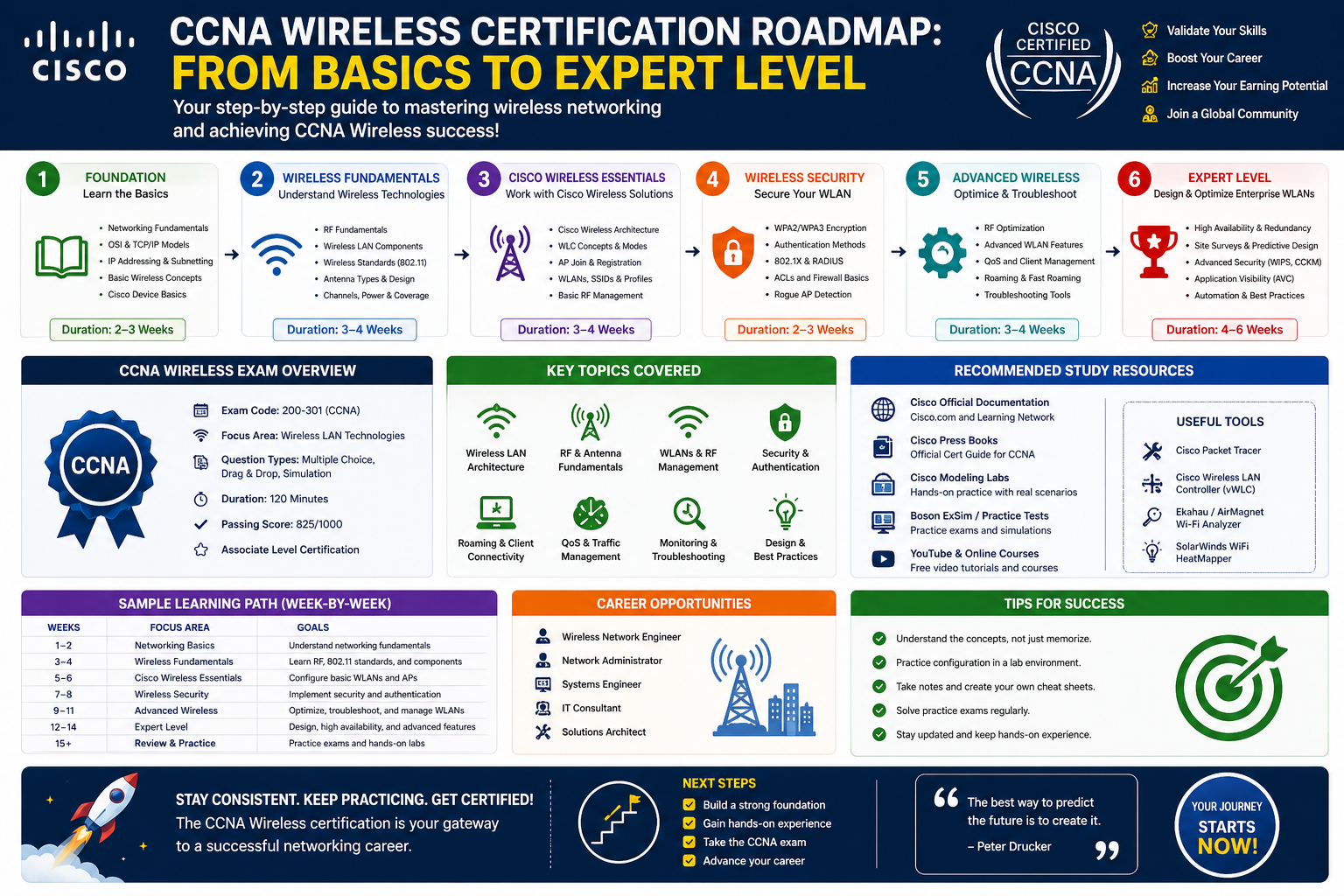
Wireless technology has become one of the most important pillars of modern networking. From small office environments to large enterprise systems, nearly every organization now depends on stable, secure, and efficient wireless connectivity. As devices continue to become more mobile and cloud-driven services dominate IT infrastructure, the demand for professionals who understand wireless systems has grown significantly. The CCNA Wireless certification sits at the entry level of this specialization and focuses on building strong foundational skills in wireless networking, configuration, monitoring, and troubleshooting.
This first part of the roadmap explores the foundational knowledge required to understand wireless networking and how it connects to professional growth in IT environments.
Understanding Wireless Networking in Modern IT Environments
Wireless networking is no longer just an optional convenience in IT systems; it has become a core requirement for almost every organization. Businesses rely on wireless infrastructure to support employees, customers, and connected devices without the limitations of physical cabling. This shift has transformed how networks are designed and managed.
Modern wireless environments support a wide variety of devices, including laptops, smartphones, tablets, IoT sensors, and industrial machines. Each of these devices depends on stable connectivity to function effectively. As a result, network performance, reliability, and scalability have become critical concerns for IT teams.
Unlike traditional wired networks, wireless systems operate through radio frequency signals, which introduces additional complexity. Factors such as signal interference, physical obstacles, and distance can affect performance. Understanding these challenges is essential for anyone working with wireless networks.
In addition, wireless networking must also address security concerns. Since wireless signals travel through open air, they are more vulnerable to unauthorized access. This makes encryption, authentication, and secure configuration essential components of any wireless infrastructure.
As organizations continue to expand remote work capabilities, wireless networks are also becoming more distributed. Employees often connect from different locations, requiring networks that can support flexibility without compromising performance or security. This shift has made wireless expertise a valuable skill in the IT industry.
The Role of CCNA Wireless in Professional Development
The CCNA Wireless certification plays an important role in building foundational knowledge for IT professionals who want to specialize in wireless networking. It is designed to validate an individual’s ability to understand wireless principles and apply them in real-world environments.
This certification introduces learners to essential wireless concepts, including how wireless networks are designed, how devices communicate over radio frequencies, and how wireless infrastructure is maintained. It helps bridge the gap between basic networking knowledge and more advanced wireless engineering skills.
For many IT professionals, CCNA Wireless serves as a stepping stone toward more advanced certifications and specialized roles. It provides a structured learning path that prepares individuals for responsibilities such as network support, system configuration, and basic troubleshooting.
Another important aspect of CCNA Wireless is its focus on practical understanding. Instead of purely theoretical knowledge, it emphasizes real-world application. This includes working with wireless access points, understanding network behavior, and identifying common connectivity issues.
Professionals who pursue this certification often aim to enhance their career opportunities in networking roles. It demonstrates that they have the technical foundation required to support wireless infrastructure in business environments.
Core Concepts of Radio Frequency (RF) in Networking
Radio Frequency (RF) technology is the foundation of all wireless communication systems. It is the method by which data is transmitted through the air without the use of physical cables. Understanding RF principles is essential for anyone working in wireless networking.
RF communication operates within specific frequency ranges. These frequencies determine how data travels between devices. Different frequency bands offer different advantages, such as range, speed, and resistance to interference. Understanding these trade-offs is important when designing wireless networks.
One of the key challenges in RF communication is signal interference. Many devices, including microwaves, Bluetooth devices, and other wireless networks, operate within similar frequency ranges. This can cause disruptions in signal quality if not properly managed.
Another important concept in RF networking is signal strength. Wireless signals weaken as distance increases or when obstacles such as walls or metal structures are present. This phenomenon affects network performance and must be considered during network planning.
RF behavior also includes concepts such as reflection, absorption, and scattering. These physical properties influence how signals move through different environments. For example, signals may bounce off surfaces or be absorbed by materials, affecting coverage and reliability.
A strong understanding of RF principles allows network professionals to design better wireless environments, reduce interference, and improve overall performance.
Fundamentals of IEEE 802.11 Wireless Standards
Wireless networking is governed by a set of technical standards that define how devices communicate. The IEEE 802.11 standard is one of the most widely used frameworks for wireless local area networks.
This standard defines how wireless devices establish connections, transmit data, and maintain communication within a network. It ensures compatibility between different manufacturers and devices, allowing seamless connectivity.
Over time, the 802.11 standard has evolved to include various versions that improve speed, range, and efficiency. Each version introduces enhancements that support modern networking demands, such as higher bandwidth and better performance in crowded environments.
These standards also define how wireless networks handle multiple users simultaneously. This is important in environments such as offices, schools, and public spaces where many devices connect to the same network.
Security is another important aspect of wireless standards. The 802.11 framework includes protocols that help protect data transmitted over wireless networks. These security mechanisms help prevent unauthorized access and ensure data integrity.
Understanding these standards is essential for configuring and maintaining wireless networks that are reliable and secure.
Wireless Network Architecture and Components
Wireless networks are built using several key components that work together to provide connectivity. Each component plays a specific role in ensuring that devices can communicate effectively.
One of the primary components is the wireless access point. This device acts as a bridge between wired networks and wireless devices, allowing users to connect without physical cables. Access points are strategically placed to provide coverage across different areas.
Another important component is the wireless client device. These include laptops, smartphones, and other devices that connect to the wireless network. Each device must be configured to communicate with the network securely and efficiently.
Network controllers are also used in larger environments to manage multiple access points. These controllers help ensure consistent performance and simplify network management.
Antennas play a critical role in transmitting and receiving wireless signals. Different types of antennas are used depending on the environment and coverage requirements.
Together, these components form the structure of a wireless network. Understanding how they interact is essential for designing and maintaining efficient systems.
Designing and Planning Wireless Networks for Organizations
Designing a wireless network requires careful planning to ensure coverage, performance, and reliability. Every environment has unique requirements based on size, structure, and user demand.
One of the first steps in planning a wireless network is understanding the physical layout of the environment. Walls, floors, and materials can affect signal propagation, so these factors must be considered during design.
Capacity planning is also important. A network must support the number of devices expected to connect simultaneously without performance degradation. This requires careful analysis of user demand and network usage patterns.
Placement of access points is another critical aspect of network design. Proper placement ensures that users receive strong and consistent signals throughout the coverage area. Poor placement can lead to dead zones or weak connectivity.
Interference management is also a key consideration. Wireless networks must be designed to minimize disruptions caused by overlapping signals or external devices.
Effective planning ensures that wireless networks are efficient, scalable, and capable of supporting organizational needs.
Installation and Configuration of Wireless Systems
Installing and configuring wireless systems involves setting up hardware and ensuring that devices communicate properly within the network. This process requires both technical knowledge and attention to detail.
The installation process typically begins with deploying access points in strategic locations. These devices must be positioned to maximize coverage and minimize interference.
Once hardware is installed, configuration begins. This includes setting up network names, security protocols, and access controls. Proper configuration ensures that only authorized users can access the network.
Wireless channels must also be configured to avoid interference. Selecting appropriate channels helps improve performance and stability.
Security configuration is another critical step. Encryption methods and authentication mechanisms are implemented to protect data and prevent unauthorized access.
After configuration, testing is performed to ensure that the network operates as expected. This includes checking connectivity, signal strength, and performance under load.
Monitoring Wireless Performance and Network Health
Monitoring wireless networks is essential for maintaining performance and identifying potential issues before they affect users. Continuous monitoring helps ensure that networks remain stable and efficient.
Network performance is measured using various indicators such as signal strength, data throughput, and connection stability. These metrics help identify areas where improvements may be needed.
Monitoring tools are used to track network activity and detect unusual behavior. This can include identifying devices that are consuming excessive bandwidth or detecting interference issues.
Network health monitoring also involves ensuring that access points are functioning properly. Faulty hardware or misconfigurations can lead to performance issues if not addressed promptly.
By regularly monitoring wireless systems, network administrators can maintain optimal performance and prevent disruptions.
Basics of Wireless Troubleshooting Techniques
Troubleshooting is an essential skill in wireless networking. When issues arise, professionals must be able to quickly identify and resolve them to minimize downtime.
Common wireless issues include weak signals, connectivity drops, and slow network speeds. Each of these problems can have multiple causes, ranging from hardware issues to environmental factors.
Troubleshooting begins with identifying the source of the problem. This may involve checking device settings, reviewing network configurations, or analyzing signal strength.
Interference is a common cause of wireless problems. Identifying and eliminating sources of interference can significantly improve network performance.
Hardware issues such as faulty access points or damaged antennas can also affect connectivity. Replacing or repairing equipment may be necessary in such cases.
Effective troubleshooting requires a systematic approach and a strong understanding of wireless principles.
Importance of Practical Skills in Wireless Networking
While theoretical knowledge is important, practical experience plays a crucial role in wireless networking. Real-world environments often present challenges that cannot be fully understood through theory alone.
Hands-on experience helps professionals understand how wireless systems behave under different conditions. This includes dealing with interference, adjusting configurations, and optimizing performance.
Practical skills also improve problem-solving abilities. By working directly with network equipment, professionals develop the ability to quickly diagnose and resolve issues.
Simulation and real-world practice help bridge the gap between learning and application. This prepares individuals for real job roles in networking environments.
Industry Expectations from Wireless Network Professionals
Organizations expect wireless network professionals to have a strong understanding of both technical concepts and practical applications. This includes the ability to design, configure, and maintain wireless systems.
Professionals are also expected to stay updated with evolving technologies. Wireless networking continues to change rapidly, and staying current is essential for long-term success.
In addition, communication skills and analytical thinking are important in professional environments. Network issues often require collaboration between teams and clear documentation.
Employers value individuals who can work independently while also contributing to team-based projects. Reliability and problem-solving ability are key traits in this field.
Building a Strong Foundation for Advanced Wireless Learning
A strong foundation in wireless networking is essential for progressing to more advanced topics. Understanding basic principles such as RF behavior, network design, and configuration provides the groundwork for future learning.
As professionals gain experience, they can move on to more complex areas such as advanced security, mobility solutions, and large-scale wireless deployments.
Continuous learning is an important part of career development in networking. Each new concept builds upon previous knowledge, creating a structured path of growth in the IT industry.
Wireless networking becomes significantly more powerful and complex once foundational concepts are understood. In this part of the roadmap, the focus shifts toward deeper technical structures, exam expectations, real-world deployment practices, and operational skills that define professional-level wireless networking environments. The CCNA Wireless certification requires not only conceptual understanding but also the ability to apply knowledge in structured and practical scenarios.
Understanding the CCNA Wireless Exam Structure in Depth
The CCNA Wireless certification assessment is designed to evaluate both theoretical knowledge and applied technical understanding of wireless systems. It is structured in a way that measures how well a candidate can interpret wireless behavior, configure systems, and troubleshoot issues under realistic conditions.
The exam is divided into different domains that collectively assess wireless fundamentals, implementation knowledge, and operational awareness. Each domain focuses on a specific area of wireless networking, ensuring that candidates are tested across a wide range of skills.
One major aspect of the exam structure is its focus on scenario-based questions. Instead of simply testing definitions, it often presents network situations where candidates must identify problems or select appropriate solutions. This approach ensures that learners are prepared for real-world environments where issues are rarely straightforward.
Another important element is time management. The exam requires candidates to analyze technical information and make decisions within a limited timeframe. This tests both technical accuracy and decision-making efficiency.
The exam also evaluates familiarity with wireless technologies at a functional level. This includes understanding how wireless components interact, how configurations affect performance, and how different design choices influence network stability.
Advanced Behavior of Wireless Communication Systems
Wireless communication systems operate using complex physical and digital principles that determine how data is transmitted across networks. Beyond basic connectivity, wireless systems rely on advanced behavior patterns that influence performance and reliability.
One of the most important aspects is modulation, which determines how data is encoded into radio signals. Different modulation techniques affect speed, range, and signal quality. Higher modulation levels can transmit more data but require stronger signal conditions.
Another key concept is channel utilization. Wireless networks operate on specific frequency channels, and efficient channel use helps reduce interference. In crowded environments, improper channel selection can significantly reduce performance.
Multiple-input and multiple-output technology plays a major role in modern wireless systems. It allows multiple signals to be transmitted and received simultaneously, improving throughput and efficiency. This is especially important in environments with many connected devices.
Signal reflection and multipath propagation also influence wireless behavior. Signals often bounce off surfaces and arrive at different times, which can either enhance or disrupt communication depending on the environment.
Understanding these advanced behaviors allows network professionals to design systems that maximize performance while minimizing interference and signal degradation.
Wireless Site Survey Principles and Environmental Analysis
A wireless site survey is a critical process used to design efficient wireless networks. It involves analyzing physical environments to determine optimal placement for wireless infrastructure.
The first step in a site survey is understanding the layout of the environment. Walls, ceilings, and building materials all affect how wireless signals travel. Thick materials can weaken signals, while open spaces allow for better coverage.
Signal measurement is another important part of the process. Engineers evaluate signal strength in different areas to identify coverage gaps and interference zones. This ensures that wireless access points are positioned effectively.
Capacity planning is also considered during site surveys. The number of users and devices expected in a location influences how many access points are needed. High-density environments require more careful planning to avoid congestion.
Environmental interference sources are also identified. These may include other wireless networks, electronic devices, or industrial equipment. Identifying these sources helps reduce performance issues later.
A properly conducted site survey ensures that wireless networks are both efficient and scalable, reducing the likelihood of future connectivity problems.
Cisco Wireless Architecture and Controller-Based Networks
Modern enterprise wireless networks often use controller-based architectures to manage access points and maintain consistent performance. This structure simplifies management and improves scalability.
In this architecture, wireless access points are typically lightweight devices that rely on a central controller for configuration and control. This allows administrators to manage multiple access points from a single interface.
The wireless controller handles tasks such as channel assignment, security enforcement, and load balancing. This centralized approach reduces configuration complexity and ensures uniform network behavior.
One advantage of this architecture is seamless roaming. As users move through different coverage areas, the controller ensures that their connection is maintained without interruption.
Another important feature is centralized security management. Security policies are applied across all access points, ensuring consistent protection throughout the network.
This architecture is widely used in enterprise environments because it simplifies large-scale wireless management while maintaining high performance and reliability.
WLAN Configuration and Network Segmentation Concepts
Wireless Local Area Network configuration involves setting up logical structures that define how devices connect and communicate within a network.
One of the primary configuration elements is the Service Set Identifier. This acts as the network name that users connect to. Multiple SSIDs can be created to separate different types of users or services.
Network segmentation is often achieved through VLAN mapping. This allows different user groups to be separated logically, even if they share the same physical infrastructure.
Each SSID can be associated with specific security settings and network policies. This ensures that different users have appropriate levels of access based on organizational requirements.
IP addressing and DHCP integration are also important parts of WLAN configuration. Devices must receive valid IP addresses to communicate effectively within the network.
Proper WLAN configuration ensures that wireless networks remain organized, secure, and efficient in handling multiple user groups.
Wireless Security Mechanisms and Protection Strategies
Security is one of the most critical aspects of wireless networking. Since wireless signals travel through open space, they are inherently more vulnerable to unauthorized access and interception.
Encryption plays a key role in protecting wireless data. Modern wireless networks use advanced encryption standards to ensure that transmitted data cannot be easily intercepted or decoded.
Authentication mechanisms are used to verify the identity of users before granting access to the network. This prevents unauthorized devices from connecting to secure systems.
Enterprise environments often use centralized authentication systems that validate user credentials before allowing network access. This provides an additional layer of protection.
Another important security aspect is intrusion prevention. Wireless networks are continuously monitored for suspicious activity, such as unauthorized access attempts or unusual traffic patterns.
Security configuration must be carefully managed to balance protection and usability. Overly restrictive settings may limit access, while weak security can expose networks to threats.
Mobility Management and Seamless Roaming in Wireless Networks
Mobility is a defining feature of wireless networks, allowing users to move freely while maintaining connectivity. This requires advanced coordination between access points and controllers.
Seamless roaming ensures that devices remain connected even when moving between different coverage areas. This is achieved by transferring user sessions between access points without interruption.
Roaming performance depends on signal overlap between access points. Proper planning ensures that coverage areas are designed to support smooth transitions.
Latency during roaming is minimized through optimized network protocols. This ensures that real-time applications such as voice and video continue functioning without disruption.
Mobility management is especially important in large environments such as campuses, hospitals, and corporate offices, where users are constantly moving.
Advanced Troubleshooting Methodologies in Wireless Environments
Troubleshooting wireless networks requires a structured approach to identifying and resolving issues efficiently. Problems may arise from configuration errors, environmental factors, or hardware failures.
The first step in troubleshooting is identifying symptoms. These may include weak signals, intermittent connectivity, or slow performance.
Once symptoms are identified, analysis begins to determine whether the issue is related to configuration, interference, or hardware malfunction.
Signal analysis tools are often used to measure performance and detect anomalies in wireless behavior. These tools help pinpoint areas of weakness or interference.
Configuration review is another important step. Incorrect settings, such as channel overlap or security mismatches, can cause connectivity problems.
Effective troubleshooting requires both analytical thinking and practical knowledge of wireless systems.
Practical Lab Environments and Hands-On Learning Approaches
Hands-on experience is essential for mastering wireless networking concepts. Practical environments allow learners to apply theoretical knowledge in controlled scenarios.
Lab environments typically simulate real-world wireless networks, allowing users to configure access points, controllers, and client devices.
These environments help learners understand how configuration changes affect network behavior. They also provide opportunities to practice troubleshooting techniques.
Simulation tools are often used to replicate wireless scenarios, including interference, roaming behavior, and security configurations.
Repeated practice in lab environments helps build confidence and improve technical decision-making skills.
Wireless Network Performance Optimization Techniques
Optimizing wireless performance involves adjusting network settings and infrastructure to achieve maximum efficiency.
One key optimization strategy is channel planning. Proper channel selection reduces interference and improves signal quality.
Access point placement also plays a critical role in performance. Strategic positioning ensures even coverage and reduces dead zones.
Load balancing is another important technique. It distributes user connections evenly across access points to prevent congestion.
Bandwidth management ensures that critical applications receive priority over less important traffic.
These optimization techniques help maintain consistent performance in both small and large wireless environments.
Monitoring Systems and Network Telemetry in Wireless Environments
Monitoring wireless networks is essential for maintaining stability and identifying performance issues. Telemetry systems collect data from network devices to provide real-time insights.
Performance metrics such as signal strength, latency, and throughput are continuously monitored to ensure optimal operation.
Alerts are generated when abnormal behavior is detected, allowing administrators to respond quickly to potential issues.
Historical data analysis helps identify long-term trends and recurring problems within the network.
Monitoring systems play a critical role in maintaining reliability and ensuring that wireless networks operate efficiently.
Professional Development Pathways in Wireless Networking
Wireless networking offers multiple career development pathways for IT professionals. As skills progress, individuals can move into more specialized and advanced roles.
Entry-level positions often focus on basic configuration and support tasks. As experience grows, professionals may transition into design, architecture, or security roles.
Specialization in wireless networking can lead to opportunities in enterprise infrastructure management and network engineering.
Continuous learning is essential, as wireless technologies continue to evolve rapidly. New standards and technologies regularly emerge, requiring professionals to stay updated.
This field rewards individuals who combine technical expertise with practical experience and problem-solving ability.
Wireless networking today sits at the center of modern IT infrastructure, supporting everything from enterprise operations to cloud applications and mobile workforces. In this final part of the roadmap, the focus shifts toward advanced operational thinking, enterprise-scale deployment concepts, long-term career development, and the broader wireless ecosystem that extends beyond foundational and intermediate knowledge.
Enterprise Wireless Deployment at Scale
Large organizations require wireless networks that go far beyond basic connectivity. Enterprise-scale deployments involve designing systems that can support thousands of users, multiple buildings, and highly dynamic traffic patterns without performance degradation.
In such environments, wireless networks must be designed with scalability in mind. This means the infrastructure should be capable of expanding without requiring a complete redesign. Access points, controllers, and network policies must work together to support growth seamlessly.
Redundancy becomes a critical requirement in enterprise wireless systems. If one component fails, another must take over immediately to prevent service disruption. This ensures high availability across the entire network.
Centralized management is commonly used in enterprise environments to simplify control. Administrators can configure, monitor, and troubleshoot large networks from a single system, reducing complexity and improving efficiency.
High-density environments, such as stadiums, airports, and corporate campuses, require careful planning to handle large numbers of simultaneous connections. These environments demand optimized channel usage and advanced load distribution techniques.
Wireless Roaming Behavior in Complex Environments
Roaming in wireless networks refers to the ability of a device to move between access points without losing connectivity. In enterprise environments, roaming must be seamless to support uninterrupted communication.
Roaming performance depends heavily on signal overlap between access points. If coverage areas are not properly designed, users may experience dropped connections or delays during transitions.
Fast roaming protocols help reduce delays when switching between access points. These protocols ensure that authentication and session information are transferred quickly.
Device behavior also plays a role in roaming efficiency. Some devices aggressively switch access points based on signal strength, while others remain connected until the signal becomes too weak.
Environmental factors such as building structure and interference can also affect roaming performance. Proper network design helps minimize these challenges.
Seamless roaming is especially important for applications such as voice over wireless, video conferencing, and real-time data systems.
Advanced Wireless Security Architecture in Enterprise Networks
Wireless security in enterprise environments involves multiple layers of protection designed to secure data, users, and infrastructure.
Authentication systems ensure that only authorized users can access the network. These systems often integrate with centralized identity management platforms.
Encryption protects data as it travels across wireless networks. Advanced encryption standards ensure that even if data is intercepted, it cannot be easily decoded.
Access control policies define what users can access once they are connected to the network. These policies can vary based on user roles, device types, or location.
Network segmentation is used to isolate different types of traffic. This prevents unauthorized access between departments or systems within an organization.
Intrusion detection systems monitor network activity for suspicious behavior. These systems help identify potential security threats before they cause damage.
Wireless security is continuously evolving to address new threats and vulnerabilities in modern IT environments.
RF Planning and Environmental Optimization Strategies
Radio Frequency planning is a critical component of wireless network design. It ensures that signals are distributed efficiently across an environment without unnecessary interference.
One of the primary goals of RF planning is to maximize coverage while minimizing overlap. Overlapping signals can cause interference and reduce network performance.
Signal propagation is influenced by environmental factors such as walls, furniture, and building materials. These factors must be analyzed during the planning stage.
Channel reuse strategies are used to improve network efficiency. By carefully assigning channels, networks can support more users without congestion.
Power adjustment is another important technique in RF planning. Adjusting the transmission power of access points helps control coverage areas and reduce interference.
Environmental optimization ensures that wireless networks perform consistently across different physical spaces.
Wireless Quality of Service and Traffic Prioritization
Quality of Service mechanisms are used to manage network traffic and ensure that important applications receive priority.
In wireless networks, not all traffic has the same importance. Real-time applications such as voice and video require higher priority than general data traffic.
Traffic classification helps identify different types of network usage. Once classified, traffic can be prioritized accordingly.
Bandwidth allocation ensures that critical applications receive sufficient resources even during periods of high network usage.
Latency management is essential for maintaining performance in real-time communication systems. High latency can negatively affect user experience in voice and video applications.
Quality of Service policies are particularly important in enterprise environments where multiple applications compete for limited wireless resources.
Wireless Mesh Networks and Distributed Connectivity Models
Wireless mesh networks provide an alternative approach to traditional wireless infrastructure. In these systems, multiple access points work together to create a distributed network.
Each node in a mesh network can communicate with multiple other nodes, allowing data to be routed dynamically through different paths.
This structure improves network resilience because if one node fails, data can still be transmitted through alternative routes.
Mesh networks are often used in environments where traditional cabling is difficult or impractical.
Self-healing capabilities allow mesh networks to automatically adjust when changes occur in the network topology.
These networks are highly scalable and can be expanded easily by adding more nodes.
Wireless Network Automation and Intelligent Management
Automation plays an increasingly important role in modern wireless networking. Intelligent systems can automatically adjust network settings based on real-time conditions.
Automated channel selection helps reduce interference by dynamically choosing the best available frequencies.
Load balancing systems automatically distribute traffic across multiple access points to optimize performance.
Self-optimizing networks use data analytics to continuously improve performance without manual intervention.
Predictive analysis helps identify potential network issues before they occur, allowing proactive maintenance.
Automation reduces the need for manual configuration and improves overall network efficiency.
Cloud-Based Wireless Network Management Systems
Cloud-based management systems allow administrators to control wireless networks from remote locations. This approach simplifies network administration and improves accessibility.
Centralized cloud dashboards provide real-time visibility into network performance and status.
Configuration changes can be applied across multiple locations simultaneously, reducing administrative overhead.
Cloud systems also enable better scalability, allowing organizations to expand their networks without significant infrastructure changes.
Data collected from wireless networks is stored and analyzed in the cloud, providing insights into usage patterns and performance trends.
Remote troubleshooting capabilities allow administrators to resolve issues without physically accessing network hardware.
Wireless Network Performance Analytics and Data Interpretation
Performance analytics is essential for understanding how wireless networks operate over time.
Data collection systems gather information on signal strength, user activity, bandwidth usage, and network latency.
This data is then analyzed to identify patterns and trends that can help improve network performance.
Anomaly detection systems identify unusual behavior that may indicate network issues or security threats.
Historical performance data helps organizations make informed decisions about network upgrades and expansions.
Visualization tools help translate complex data into understandable formats for network administrators.
Integration of Wireless Networks with Cloud and IoT Systems
Modern wireless networks are increasingly integrated with cloud services and Internet of Things systems.
Cloud integration allows wireless networks to support distributed applications and services hosted remotely.
IoT devices rely heavily on wireless connectivity to transmit data between sensors, controllers, and cloud platforms.
Wireless networks must be designed to support large numbers of low-power IoT devices efficiently.
Data collected from IoT devices is often processed in real time, requiring reliable and low-latency wireless connections.
Security becomes especially important in IoT environments due to the large number of connected devices.
Troubleshooting Complex Enterprise Wireless Failures
Enterprise wireless troubleshooting involves identifying and resolving issues that affect large-scale environments.
Problems may originate from multiple sources, including configuration errors, hardware failures, or environmental interference.
Network segmentation issues can cause communication breakdowns between different parts of the system.
Controller misconfigurations may lead to inconsistent behavior across access points.
High traffic loads can cause performance degradation if not properly managed.
Advanced diagnostic tools are used to analyze network behavior and identify root causes of issues.
Wireless Mobility Services and User Experience Optimization
Mobility services focus on improving user experience as devices move across wireless networks.
Seamless connectivity ensures that users do not experience interruptions during movement.
Session persistence allows applications to continue functioning even when switching between access points.
Performance optimization techniques ensure consistent connectivity across different environments.
User experience is influenced by factors such as latency, signal strength, and network stability.
Mobile optimization is particularly important in enterprise environments with high user mobility.
Long-Term Evolution of Wireless Technologies and Industry Trends
Wireless technology continues to evolve rapidly, driven by increasing demand for speed, reliability, and connectivity.
New wireless standards introduce improvements in bandwidth, efficiency, and device density support.
Emerging technologies focus on supporting smart environments, autonomous systems, and advanced communication networks.
Artificial intelligence is increasingly being integrated into wireless systems to improve automation and optimization.
The growth of connected devices continues to expand the role of wireless networking in everyday life.
Future developments will continue to focus on improving scalability, security, and performance in wireless environments.
Emerging Innovations and Real-World Wireless Challenges
Wireless networking is entering a phase where traditional design thinking is no longer sufficient on its own. Networks are expected to support more devices, more data, and more critical applications than ever before, often in highly unpredictable environments. This shift is pushing wireless professionals to think beyond configuration and troubleshooting and instead focus on adaptability, intelligence, and long-term resilience of network systems.
One of the most noticeable developments in modern wireless environments is the increasing reliance on adaptive networking behavior. Wireless systems are gradually becoming more responsive to environmental changes, automatically adjusting parameters such as channel selection, power levels, and load distribution based on real-time conditions. This reduces manual intervention and allows networks to remain stable even in fluctuating conditions such as sudden user spikes or physical obstructions affecting signal paths.
Another emerging challenge is the growing density of connected devices in shared environments. In places such as office complexes, educational institutions, and public venues, hundreds or even thousands of devices may compete for the same wireless resources. This creates complex performance dynamics where interference management and airtime fairness become more critical than simple coverage planning. Network efficiency in such scenarios depends heavily on how well traffic is distributed and how intelligently access points coordinate with each other.
Security expectations are also evolving alongside these technical demands. Wireless networks are now expected to defend against more sophisticated and persistent threats, including unauthorized access attempts that adapt to security configurations over time. This requires not only strong encryption methods but also continuous monitoring of behavioral patterns within the network. Unusual traffic flows, unexpected device activity, or repeated authentication failures often serve as early indicators of potential security risks.
In addition to technical complexity, user expectations have also changed significantly. End users now expect uninterrupted connectivity regardless of movement, device type, or application being used. This expectation places pressure on wireless systems to maintain consistency across diverse conditions. Even minor disruptions in connectivity can impact productivity, communication quality, and user satisfaction.
Another important aspect shaping modern wireless environments is the increasing integration of analytics-driven decision-making. Network behavior is no longer observed only for troubleshooting purposes but also for long-term optimization. Patterns in device usage, peak traffic periods, and coverage performance are analyzed to refine network design continuously. This creates a feedback loop where wireless systems gradually improve based on real operational data rather than static configurations.
As wireless environments continue to expand in scale and complexity, professionals in this field must develop a mindset that combines technical precision with strategic awareness. Understanding how systems behave under pressure, how they adapt to changing conditions, and how they interact with broader digital ecosystems is becoming just as important as knowing how to configure individual components.
Conclusion
Wireless networking has become one of the most essential components of modern IT infrastructure, shaping how organizations communicate, operate, and scale their digital environments. As devices continue to evolve and mobility becomes a standard expectation rather than an added benefit, the importance of skilled wireless professionals continues to rise steadily across industries. The CCNA Wireless certification represents a structured entry point into this growing field, offering learners a clear pathway to understand how wireless systems are designed, deployed, secured, and maintained.
Throughout this roadmap, the progression from foundational concepts to advanced enterprise-level thinking highlights how wireless networking is not just about connectivity, but about performance optimization, security enforcement, and intelligent design. From radio frequency behavior and signal propagation to enterprise controller-based architectures and mobility management, each layer builds upon the previous one to create a complete understanding of wireless environments.
One of the most significant takeaways from this journey is the importance of practical application. Wireless networking cannot be fully mastered through theory alone. Real-world environments introduce challenges such as interference, device density, environmental limitations, and evolving security threats. These factors require professionals to think critically and adapt quickly, using both analytical and hands-on skills to maintain stable and efficient networks.
The growing integration of wireless systems with cloud platforms, IoT devices, and automated management tools further expands the responsibilities of network professionals. Wireless networks are no longer isolated systems; they are deeply connected to broader digital ecosystems that demand reliability, scalability, and intelligent control. This shift makes wireless expertise not only relevant but essential in nearly every sector of the modern economy.
As organizations continue to adopt remote work models, mobile-first strategies, and distributed infrastructure, the demand for professionals who understand wireless technologies will continue to increase. The CCNA Wireless certification helps build the foundational mindset required to grow into these roles, preparing individuals for more advanced certifications and specialized career paths in networking.
Ultimately, success in wireless networking depends on continuous learning, adaptability, and a strong understanding of both technical principles and real-world applications. Those who invest time in developing these skills position themselves strongly for long-term growth in an industry that continues to evolve at a rapid pace.