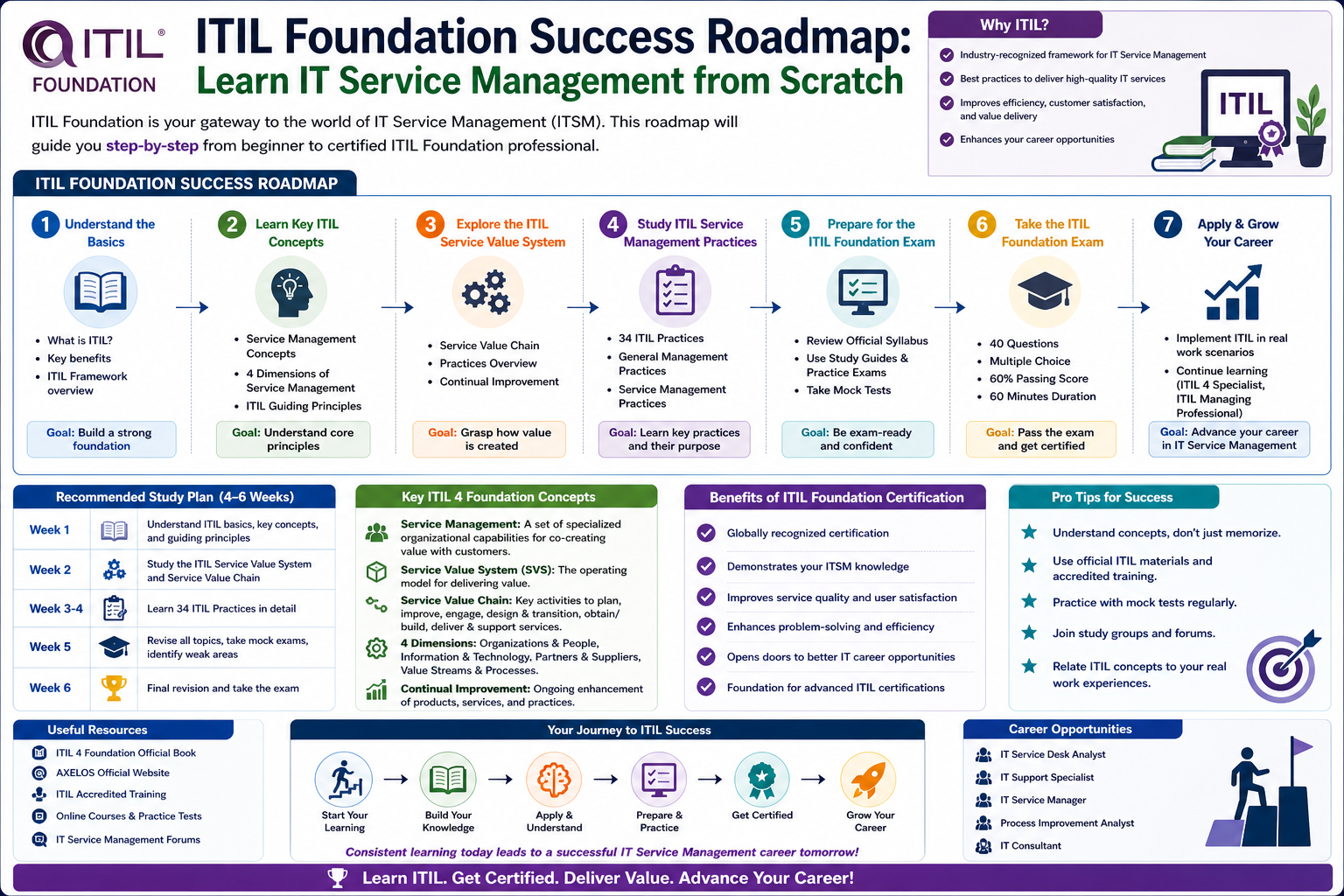
The modern business environment depends heavily on reliable, consistent, and well-structured IT services. Whether an organization operates in healthcare, finance, education, or technology, IT systems form the backbone of daily operations. When these systems fail or become inefficient, the entire organization feels the impact. This is where IT service management becomes essential, and ITIL plays a central role in shaping how organizations design, deliver, and improve IT services.
ITIL is widely recognized as a structured framework that guides organizations in aligning IT services with business needs. Instead of treating IT as a purely technical function, ITIL positions it as a service-driven discipline focused on delivering value to users and stakeholders. The ITIL Foundation level introduces learners to these core ideas, offering a structured entry point into service management concepts, terminology, and lifecycle thinking.
At its core, ITIL is not about tools or technologies. It is about processes, coordination, and continuous improvement. Organizations adopt ITIL to reduce service disruptions, improve communication between IT teams and business units, and create predictable service outcomes. The Foundation level is designed to build awareness of these principles and help learners understand how IT services are structured and managed in real-world environments.
The Evolution and Purpose of ITIL in IT Environments
ITIL has evolved over time in response to changing business needs and technological advancements. Early IT environments were often reactive, where IT teams responded to issues as they occurred. Over time, this approach proved inefficient and costly, especially as businesses became more dependent on digital systems. ITIL emerged as a way to introduce structure, consistency, and proactive management into IT operations.
The purpose of ITIL is not to enforce rigid rules but to provide a flexible framework that organizations can adapt to their needs. This adaptability is one of the reasons ITIL has become widely adopted across industries. Instead of prescribing exact steps, it offers guidance on best practices that organizations can tailor.
One of the key goals of ITIL is to ensure that IT services are aligned with business objectives. This means IT departments are not operating in isolation but are actively contributing to organizational success. For example, when a business launches a new digital service, ITIL principles help ensure that the service is designed, delivered, and maintained in a way that supports business goals while maintaining efficiency and reliability.
Another important aspect of ITIL is its focus on service quality. Quality in IT services is not only about technical performance but also about user experience, availability, and responsiveness. ITIL encourages organizations to define service expectations clearly and measure performance against those expectations.
Understanding the ITIL Service Lifecycle Approach
A central concept in ITIL is the service lifecycle. This lifecycle represents the stages through which an IT service moves from initial planning to eventual retirement. Understanding this lifecycle is essential for anyone studying ITIL Foundation because it forms the backbone of the framework.
The service lifecycle consists of several interconnected stages, each with its own purpose and processes. These stages are designed to work together rather than function independently. This interconnected structure ensures that IT services are consistently aligned with business needs throughout their existence.
At a high level, the lifecycle includes service strategy, service design, service transition, service operation, and continual service improvement. Each stage contributes to ensuring that IT services are not only created effectively but also maintained and improved over time.
Service strategy focuses on understanding business objectives and defining how IT services will support those objectives. Service design translates strategic goals into practical service solutions. Service transition ensures that new or changed services are introduced into the live environment in a controlled manner. Service operation focuses on delivering and supporting services on a day-to-day basis. Continual service improvement ensures that services evolve and improve over time based on feedback and performance data.
This lifecycle approach helps organizations avoid fragmented IT practices. Instead of treating each IT function separately, ITIL encourages a holistic view where all stages are connected and contribute to overall service value.
Key Concepts Introduced at the ITIL Foundation Level
The ITIL Foundation level introduces several essential concepts that form the building blocks of IT service management. These concepts help learners understand how IT services are structured and how different components interact within an organization.
One of the most important concepts is the idea of a service. In ITIL terms, a service is a means of delivering value to customers by facilitating desired outcomes without the customer needing to manage specific costs and risks. This definition shifts the focus from technology to value delivery.
Another key concept is the service provider and service consumer relationship. ITIL distinguishes between those who deliver services and those who use them. Understanding this relationship helps clarify responsibilities and expectations within IT environments.
Processes are also a major focus at the Foundation level. A process is a structured set of activities designed to achieve a specific objective. ITIL emphasizes that processes should be well-defined, measurable, and repeatable. This ensures consistency in service delivery and reduces variability in outcomes.
Functions are another important concept. Functions represent organizational units or teams that perform specific activities. Unlike processes, which focus on workflows, functions focus on roles and responsibilities.
ITIL also introduces the concept of roles. Roles define the responsibilities and accountabilities of individuals within processes and functions. Clear role definition helps prevent confusion and ensures that tasks are completed efficiently.
The Structure and Importance of the ITIL Service Lifecycle Stages
Each stage of the ITIL service lifecycle plays a distinct role in ensuring effective service management. Understanding these stages in detail helps learners see how IT services are developed and maintained in real-world environments.
Service strategy is the stage where organizations define their long-term objectives for IT services. This includes understanding customer needs, market demands, and organizational capabilities. Decisions made at this stage influence all other stages of the lifecycle.
Service design focuses on creating IT services that meet business requirements. This includes designing processes, architectures, and policies that ensure services are reliable and efficient. Service design also considers factors such as capacity, availability, and security.
Service transition is responsible for moving new or changed services into the live environment. This stage ensures that changes are introduced in a controlled manner, minimizing risk and disruption. Activities in this stage include testing, validation, and deployment planning.
Service operation deals with the day-to-day management of IT services. This includes handling incidents, managing service requests, and ensuring that services remain available and functional. Service operation is often the most visible part of ITIL because it directly affects end users.
Continual service improvement focuses on identifying opportunities to enhance service quality and efficiency. This stage uses data, feedback, and performance analysis to drive improvements across all other lifecycle stages.
The Role of Processes in ITIL Foundation Understanding
Processes are fundamental to ITIL because they provide structure and consistency. Without defined processes, IT service management would be chaotic and unpredictable. ITIL introduces a wide range of processes that support different aspects of the service lifecycle.
Each process has a specific purpose and set of activities. For example, incident management focuses on restoring normal service operations as quickly as possible after a disruption. Problem management focuses on identifying and eliminating the root causes of incidents. Change management ensures that modifications to IT services are handled in a controlled and systematic way.
Other important processes include service level management, which defines and monitors service expectations, and configuration management, which tracks and manages IT assets and relationships.
These processes are not isolated. They are interconnected and often depend on each other to function effectively. For example, incident management may rely on configuration management data to resolve issues quickly. Similarly, change management may depend on service level agreements to assess the impact of proposed changes.
Understanding these relationships is a key part of the ITIL Foundation learning experience.
ITIL Terminology and Its Importance in Professional Communication
One of the most important aspects of ITIL Foundation training is learning the terminology used within the framework. ITIL has a specific language that helps professionals communicate clearly and consistently.
This terminology includes concepts such as incidents, problems, changes, service requests, and service level agreements. Each term has a precise meaning within the ITIL context, and understanding these definitions is essential for effective communication.
For example, an incident refers to an unplanned interruption or reduction in the quality of an IT service. A problem refers to the underlying cause of one or more incidents. A change refers to the addition, modification, or removal of anything that could impact IT services.
Using consistent terminology helps reduce misunderstandings between IT teams and business stakeholders. It also ensures that processes are applied correctly and consistently across the organization.
How ITIL Foundation Fits into Organizational IT Practices
Organizations that adopt ITIL often do so to improve efficiency, reduce downtime, and enhance service quality. The Foundation level plays an important role in this adoption process by ensuring that IT staff have a common understanding of service management principles.
In practice, ITIL Foundation knowledge helps IT professionals contribute more effectively to their teams. It enables them to understand how their work fits into larger organizational goals and how different processes interact.
For example, a support technician who understands ITIL principles may be better equipped to handle incidents efficiently and escalate issues appropriately. Similarly, a system administrator with ITIL knowledge may design systems with better consideration for service continuity and change management.
ITIL Foundation also helps organizations standardize their IT practices. When all team members understand the same framework, it becomes easier to coordinate activities, measure performance, and implement improvements.
The Growing Relevance of ITIL in Modern IT Careers
As organizations continue to rely more heavily on digital systems, the demand for structured IT service management has increased. ITIL remains relevant because it provides a scalable and adaptable framework that can be applied across industries and technologies.
Modern IT environments are complex, often involving cloud computing, hybrid infrastructure, and distributed systems. In such environments, structured service management is essential to maintain stability and performance.
ITIL Foundation knowledge is often seen as a valuable starting point for IT professionals because it provides a broad understanding of how IT services operate. It does not focus on specific technologies but instead emphasizes principles that can be applied in many different contexts.
This makes ITIL Foundation useful for individuals in various roles, including support staff, system administrators, analysts, and IT managers. It also provides a foundation for further learning and specialization in advanced ITIL concepts and related frameworks.
The Importance of Continual Learning in ITIL Framework Understanding
One of the core principles of ITIL is continual improvement. This principle applies not only to IT services but also to the professionals who manage them. IT environments are constantly evolving, and IT professionals must continuously update their knowledge and skills.
The Foundation level introduces this mindset by encouraging learners to think beyond initial implementation and consider long-term service improvement. This includes analyzing performance data, gathering feedback, and identifying areas for enhancement.
Continual learning is essential because ITIL itself evolves over time. New practices and updates are introduced to reflect changes in technology and business needs. Professionals who understand this dynamic nature of ITIL are better prepared to adapt to future developments in IT service management.
Understanding How ITIL Connects IT Services with Business Goals
One of the most important ideas in ITIL is that IT services should not exist in isolation. Instead, they must be directly connected to business objectives. Organizations invest in IT systems not simply to run technology efficiently, but to support growth, reduce costs, improve customer experience, and enable innovation. ITIL provides a structured way to ensure that this alignment is not accidental but intentional and continuously maintained.
In many traditional IT environments, there is often a gap between business leaders and technical teams. Business stakeholders may focus on outcomes such as revenue growth or customer satisfaction, while IT teams focus on infrastructure stability or system performance. ITIL bridges this gap by introducing a shared language and structured processes that allow both sides to communicate effectively.
Service strategy plays a critical role in this alignment. It ensures that IT services are designed with clear business purpose in mind. Decisions about which services to develop, improve, or retire are based on business value rather than technical convenience. This approach helps organizations prioritize resources effectively and avoid investing in services that do not contribute meaningfully to business goals.
By linking IT performance to business outcomes, ITIL helps organizations measure success in more meaningful ways. Instead of focusing solely on technical metrics, such as server uptime or response time, organizations also evaluate how IT services contribute to customer satisfaction, operational efficiency, and strategic objectives.
Service Design as the Blueprint for Reliable IT Services
Service design is one of the most critical stages in the ITIL lifecycle because it transforms strategic ideas into practical, deliverable services. Without proper design, even the best strategic plans can fail during implementation.
At this stage, IT teams consider all aspects of a service before it is introduced into the live environment. This includes technical architecture, processes, policies, security requirements, and user experience. The goal is to ensure that the service is not only functional but also reliable, scalable, and aligned with business needs.
A key principle of service design is that services should be built with the entire lifecycle in mind. This means considering how the service will be supported, maintained, and eventually retired even before it is launched. By thinking ahead, organizations reduce the risk of service failures and operational inefficiencies.
Capacity planning is an important part of service design. It ensures that systems have enough resources to handle expected demand without performance degradation. Availability planning ensures that services remain accessible when users need them. Security design ensures that data and systems are protected from unauthorized access or threats.
Service design also involves defining service level agreements. These agreements set clear expectations between IT providers and business users regarding performance, availability, and response times. By formalizing these expectations, organizations reduce misunderstandings and improve accountability.
Another important aspect of service design is coordination between different IT functions. Services often depend on multiple systems and teams working together. Service design ensures that these dependencies are identified and managed effectively.
The Role of Service Transition in Managing Change Safely
Change is a constant in IT environments. Systems are updated, new features are introduced, and infrastructure is upgraded regularly. Without proper control, these changes can introduce risks, disruptions, and service failures. Service transition is the ITIL stage responsible for managing this process in a structured and controlled manner.
The main goal of service transition is to ensure that new or modified services are introduced into the live environment with minimal disruption. This involves careful planning, testing, validation, and communication.
One of the most important processes within service transition is change management. This process ensures that all changes are evaluated before implementation. Changes are assessed for potential risks, impacts, and benefits. Based on this evaluation, decisions are made about whether to approve, reject, or modify the change.
Another key process is release and deployment management. This process ensures that new services or updates are delivered into the production environment in a controlled manner. It focuses on ensuring that all components are properly tested and ready for use before deployment.
Knowledge management also plays a crucial role in service transition. It ensures that relevant information about services, systems, and processes is documented and shared across teams. This helps reduce errors and improves efficiency during transitions.
Service transition also emphasizes validation and testing. Before a service is introduced, it must be tested to ensure it meets design specifications and business requirements. This reduces the risk of failures once the service is live.
By managing change carefully, service transition helps organizations maintain stability while still allowing for innovation and improvement.
Service Operation and the Delivery of Daily IT Services
Service operation is the stage where IT services are delivered and supported on a day-to-day basis. It is the most visible part of ITIL because it directly affects users and customers. When systems are working well, users may not notice IT operations at all. However, when problems occur, service operation becomes highly visible and critical.
The primary goal of service operation is to ensure that IT services are delivered effectively and efficiently. This involves managing incidents, fulfilling service requests, resolving problems, and maintaining infrastructure.
Incident management is one of the most important processes in this stage. An incident refers to any unplanned interruption or reduction in service quality. The goal of incident management is to restore normal service operation as quickly as possible. This minimizes the impact on business operations.
Service request management handles routine user requests such as password resets, access requests, or software installations. These requests are usually less urgent than incidents but still require efficient handling to maintain user satisfaction.
Problem management focuses on identifying and eliminating the root causes of incidents. While incident management deals with immediate fixes, problem management aims to prevent recurring issues. This helps improve overall service stability.
Access management ensures that users have appropriate permissions to access systems and data. It balances security requirements with user needs, ensuring that access is granted appropriately and revoked when necessary.
Service operation also includes monitoring and event management. Systems are continuously monitored to detect potential issues before they become critical problems. Events are notifications that indicate changes in system status, which may or may not require action.
Together, these processes ensure that IT services remain stable, reliable, and responsive to user needs.
Continual Service Improvement as a Core ITIL Principle
Continual service improvement is a fundamental principle of ITIL that focuses on enhancing IT services over time. It recognizes that no service is ever perfect and that there is always room for improvement.
This stage is not limited to a specific phase of the lifecycle. Instead, it applies to all stages and processes. The goal is to identify opportunities for improvement and implement changes that increase efficiency, effectiveness, and value.
Improvement begins with measurement. Organizations collect data on service performance, user satisfaction, and process efficiency. This data is then analyzed to identify trends, patterns, and areas of concern.
Once improvement opportunities are identified, organizations prioritize them based on business impact and feasibility. Not all improvements can be implemented at once, so decisions must be made about what to address first.
Continual service improvement also involves setting clear objectives. These objectives define what improvement should achieve and how success will be measured. Without clear goals, improvement efforts can become unfocused and ineffective.
Another important aspect is feedback collection. User feedback provides valuable insights into how services are performing in real-world conditions. This feedback helps organizations identify issues that may not be visible through technical metrics alone.
Improvement is not a one-time activity but an ongoing cycle. As services evolve, new opportunities for improvement continue to emerge. This ensures that IT services remain aligned with changing business needs.
ITIL Processes and Their Interconnected Nature
ITIL processes are designed to work together rather than function independently. This interconnected structure is what makes ITIL effective in managing complex IT environments.
Each process has a specific role, but they often share information and depend on each other. For example, incident management may rely on configuration management data to identify affected systems. Similarly, change management depends on service level agreements to evaluate the impact of proposed changes.
Configuration management plays a key role in maintaining accurate information about IT assets and their relationships. This information is stored in a configuration management database, which serves as a central source of truth for IT operations.
Service level management ensures that IT services meet agreed performance standards. It involves defining service expectations, monitoring performance, and addressing gaps when service levels are not met.
Capacity management ensures that IT resources are sufficient to meet current and future demand. It helps prevent performance issues caused by resource shortages.
Availability management focuses on ensuring that services remain accessible when needed. It involves designing systems with redundancy and resilience to minimize downtime.
These processes work together to ensure that IT services are reliable, efficient, and aligned with business expectations.
The Importance of Roles and Responsibilities in ITIL Framework
Clear definition of roles and responsibilities is essential in ITIL because it ensures accountability and efficiency. Without clearly defined roles, tasks may be duplicated, overlooked, or misunderstood.
In ITIL, roles are not always tied to specific job titles. Instead, they represent sets of responsibilities that individuals or teams may perform. A single person may perform multiple roles depending on the organization’s size and structure.
For example, in smaller organizations, one person may handle incident management, problem management, and change management roles. In larger organizations, these roles are often distributed among specialized teams.
Defining roles helps ensure that each process has clear ownership. This improves accountability and makes it easier to measure performance. It also helps reduce confusion during complex service operations.
Roles are often associated with specific processes. For example, the change manager is responsible for overseeing the change management process, while the service desk agent handles incident management activities.
Understanding roles and responsibilities is important for effective collaboration. When everyone understands their role in the service lifecycle, coordination becomes smoother and more efficient.
How ITIL Supports Risk Management and Stability in IT Systems
Risk management is an essential part of IT service management. IT systems are inherently complex, and changes or failures can have significant impacts on business operations. ITIL provides a structured approach to identifying, assessing, and managing these risks.
One of the key ways ITIL supports risk management is through change control. Before any change is implemented, it is evaluated for potential risks and impacts. This ensures that only well-understood and approved changes are introduced into the environment.
Incident and problem management also contribute to risk reduction. By quickly resolving incidents and addressing root causes, organizations reduce the likelihood of recurring issues.
Service design includes risk assessment as part of its planning process. Services are designed with reliability, security, and resilience in mind. This proactive approach helps minimize risks before services are deployed.
ITIL also emphasizes the importance of monitoring and early detection. By continuously monitoring systems, organizations can identify potential issues before they escalate into major problems.
Risk management in ITIL is not about eliminating all risks but about managing them effectively. This means balancing risk with business needs and ensuring that decisions are made with a clear understanding of potential consequences.
Developing a Professional Mindset through ITIL Foundation Knowledge
ITIL Foundation training does more than introduce technical concepts. It also helps develop a professional mindset focused on structure, accountability, and continuous improvement.
This mindset is important because IT service management is not just about tools or systems. It is about how people work together to deliver value. ITIL encourages professionals to think in terms of processes, outcomes, and collaboration rather than isolated tasks.
By understanding ITIL principles, professionals become better equipped to work in structured environments. They learn how their actions affect broader service outcomes and how to contribute effectively to organizational goals.
This mindset also encourages proactive thinking. Instead of reacting to problems as they occur, ITIL-trained professionals are encouraged to anticipate issues, identify improvements, and support long-term service stability.
As IT environments continue to grow in complexity, this structured and proactive mindset becomes increasingly valuable in professional IT roles.
Moving from Foundation Knowledge to Practical ITIL Application
Understanding ITIL at a conceptual level is only the beginning. The real value of the framework emerges when its principles are applied in real operational environments. Organizations do not adopt ITIL simply to learn terminology or theory; they implement it to improve how IT services are delivered, supported, and continuously enhanced.
At the Foundation level, learners gain awareness of key concepts such as service lifecycle stages, processes, and roles. However, applying these ideas requires a shift in thinking from memorization to practical execution. In real-world environments, IT professionals must interpret ITIL principles within the context of their organization’s size, industry, and technical infrastructure.
For example, an IT support team working in a small organization may apply ITIL principles in a simplified manner, combining multiple roles and processes into a single workflow. In contrast, a large enterprise may implement highly structured processes with dedicated teams for incident management, change management, and service design. In both cases, the underlying ITIL principles remain the same, but their implementation differs based on organizational needs.
One of the most important aspects of applying ITIL is understanding that it is flexible. It is not a rigid rulebook but a framework that guides decision-making. This flexibility allows organizations to adopt only the parts of ITIL that are relevant to their goals while adapting processes to fit existing structures.
Practical application also requires strong communication between teams. ITIL emphasizes collaboration between technical staff, business stakeholders, and service users. Without effective communication, even well-designed processes can fail to deliver expected results.
How ITIL Supports Real-World Incident and Problem Resolution
In day-to-day IT operations, incidents and problems are inevitable. Systems fail, services degrade, and users encounter issues that disrupt productivity. ITIL provides structured processes to handle these situations efficiently and consistently.
Incident management focuses on restoring normal service operation as quickly as possible. In practice, this means identifying the issue, categorizing it based on severity, and resolving it within agreed timeframes. The goal is not necessarily to find the root cause immediately but to minimize disruption to business operations.
For example, if an email service becomes unavailable, the incident management team prioritizes restoring access quickly, even if the underlying cause is not immediately known. Once service is restored, further investigation may continue under problem management.
Problem management takes a deeper approach. It investigates the root causes of recurring incidents and aims to eliminate them permanently. This process often involves analyzing incident patterns, identifying system weaknesses, and implementing long-term fixes.
In real-world environments, incident and problem management are closely connected. Incident data feeds into problem analysis, while problem solutions reduce future incidents. This continuous feedback loop improves overall service stability over time.
Effective incident and problem management also depend on accurate documentation and knowledge sharing. When teams document solutions and known issues, they reduce resolution time for future incidents and improve consistency in service delivery.
Change Management in Complex IT Environments
Change is one of the most sensitive areas in IT service management. Even small modifications to systems can have unexpected consequences if not properly controlled. ITIL change management provides a structured approach to handling these changes safely.
In real-world organizations, change management is essential because IT systems are constantly evolving. Software updates, infrastructure upgrades, security patches, and configuration changes all need to be managed carefully.
The change management process begins with a formal request. This request includes details about the proposed change, its purpose, potential impact, and implementation plan. The change is then evaluated based on risk, urgency, and business value.
Not all changes carry the same level of risk. Some changes are routine and low-risk, such as updating a user password policy. Others are high-risk, such as migrating critical systems to a new platform. ITIL emphasizes that higher-risk changes require more thorough assessment and approval.
In many organizations, a change advisory board is responsible for reviewing and approving significant changes. This group includes representatives from technical teams, business units, and service management functions. Their role is to ensure that changes are aligned with business goals and do not introduce unnecessary risk.
Once approved, changes are implemented according to a structured plan. After implementation, they are reviewed to ensure they have achieved the desired outcome without causing unexpected issues.
In practice, effective change management reduces downtime, improves system stability, and ensures that IT environments remain aligned with business needs.
Service Desk as the Central Point of ITIL Operations
The service desk plays a central role in ITIL-based organizations. It acts as the primary point of contact between users and IT services. Whether users are reporting incidents, requesting services, or seeking information, the service desk is typically the first point of interaction.
In real-world environments, the service desk is often seen as the face of IT. Its effectiveness directly influences user satisfaction and perception of IT services. A well-functioning service desk can significantly improve the overall experience of IT service delivery.
The service desk handles a wide range of activities, including incident logging, categorization, prioritization, and initial troubleshooting. In many cases, service desk staff are able to resolve issues immediately without escalating them to specialized teams.
When issues cannot be resolved at the first level, they are escalated to higher support tiers. This structured escalation process ensures that complex problems are handled by appropriate experts while maintaining efficient resolution of simpler issues.
Beyond incident handling, the service desk also manages service requests. These are standard requests from users, such as access to applications, hardware setup, or software installation. Efficient handling of service requests improves productivity and reduces delays in business operations.
The service desk also plays an important role in communication. It keeps users informed about the status of incidents, planned maintenance, and service disruptions. Clear communication helps manage expectations and reduces frustration during service interruptions.
Configuration Management and Its Role in IT Visibility
Configuration management is a critical ITIL process that provides visibility into IT infrastructure. It involves tracking and managing configuration items such as servers, applications, network devices, and their relationships.
In real-world IT environments, complexity is a major challenge. Systems are interconnected, and changes in one area can affect multiple components. Configuration management helps organizations understand these relationships and manage dependencies effectively.
A configuration management database is often used to store information about configuration items. This database serves as a central repository that supports other ITIL processes such as incident management, change management, and problem management.
For example, when an incident occurs, service desk staff can use configuration data to quickly identify affected systems and users. Similarly, during change planning, configuration information helps assess the potential impact of proposed changes.
Accurate configuration data is essential for effective IT service management. Without it, organizations may struggle to understand their infrastructure, leading to delays in problem resolution and increased risk during changes.
Maintaining configuration data requires continuous updates. As systems change, new components are added, and old ones are removed, the configuration database must be kept current to remain useful.
Service Level Management and Performance Expectations
Service level management focuses on defining and maintaining service quality expectations. It ensures that IT services meet agreed standards for performance, availability, and reliability.
In practice, service level agreements are used to formalize these expectations. These agreements define what users can expect from IT services, including response times, resolution times, and system availability.
Service level management is not just about defining targets but also about monitoring performance and ensuring compliance. Regular reports are generated to compare actual performance against agreed targets.
When service levels are not met, service level management processes help identify the cause and implement corrective actions. This ensures continuous improvement in service quality.
Service level management also plays an important role in communication between IT and business teams. It provides a clear framework for discussing expectations, performance, and improvements.
Capacity and Availability Management in High-Demand Environments
Capacity management ensures that IT systems have enough resources to handle current and future demand. In modern IT environments, demand can fluctuate significantly, especially with cloud-based services and digital platforms.
In practice, capacity management involves monitoring system performance, analyzing usage trends, and planning resource upgrades. The goal is to prevent performance degradation caused by insufficient resources.
Availability management focuses on ensuring that IT services are accessible when users need them. This includes designing systems with redundancy, failover mechanisms, and backup strategies.
For example, critical applications may be hosted across multiple servers or data centers to ensure they remain available even if one component fails. Availability management ensures that these designs are effective and meet business requirements.
Both capacity and availability management are essential for maintaining service reliability. Without proper planning, systems may become overloaded or unavailable, leading to business disruption.
Security Considerations within ITIL Service Management
Security is an integral part of IT service management. ITIL incorporates security considerations across all stages of the service lifecycle.
In real-world environments, security management involves protecting systems, data, and users from threats such as unauthorized access, data breaches, and cyberattacks. ITIL ensures that security is not treated as a separate function but is integrated into all IT processes.
For example, during service design, security requirements are defined as part of system architecture. During service transition, security testing ensures that new services do not introduce vulnerabilities. During service operation, access management controls who can use systems and data.
Security incidents are also managed through structured processes. When security breaches occur, they are treated as high-priority incidents and are handled quickly to minimize damage.
By integrating security into IT service management, organizations reduce risk and improve overall system resilience.
Career Growth and Professional Development through ITIL Knowledge
ITIL Foundation knowledge provides a strong starting point for career development in IT service management. It equips professionals with a structured understanding of how IT services are delivered and managed.
In real-world careers, ITIL knowledge is valuable across multiple roles, including IT support, system administration, service management, and IT operations. It is also useful for managerial roles where understanding service processes is essential for decision-making.
As professionals gain experience, they can progress to more advanced levels of ITIL understanding. These advanced levels focus on deeper process knowledge, strategic management, and practical application of ITIL principles in complex environments.
ITIL knowledge also complements other IT disciplines such as project management, cybersecurity, and cloud computing. Professionals who combine ITIL with other skills often have stronger career prospects because they understand both technical and service management perspectives.
The Long-Term Value of ITIL in Evolving IT Landscapes
IT environments continue to evolve rapidly, with increasing adoption of cloud services, automation, artificial intelligence, and digital transformation initiatives. Despite these changes, the core principles of ITIL remain relevant.
The focus on structured processes, service alignment, and continual improvement continues to provide value in modern IT environments. Even as technologies change, organizations still need reliable ways to manage services, handle incidents, and deliver value to users.
ITIL’s adaptability allows it to remain useful across different technological eras. Whether in traditional data centers or cloud-native environments, its principles can be applied to improve service delivery and operational efficiency.
In this context, ITIL Foundation knowledge remains a valuable asset for IT professionals who want to build long-term careers in service management and IT operations.
Conclusion
The ITIL Foundation journey represents far more than an introduction to a certification framework; it reflects a structured way of thinking about how modern IT services are designed, delivered, and continuously improved. Across organizations of all sizes and industries, IT has become a critical enabler of business success, and frameworks like ITIL provide the discipline needed to manage this complexity effectively.
By understanding the service lifecycle, learners gain insight into how IT services move from strategic planning to real-world operation and eventual improvement. Each stage of this lifecycle contributes to ensuring that services remain aligned with business needs while maintaining stability, efficiency, and user satisfaction. This structured approach helps organizations reduce operational risks, improve communication between teams, and create a consistent service experience for users.
ITIL also introduces a shared language that allows IT professionals and business stakeholders to collaborate more effectively. Concepts such as incidents, problems, changes, and service levels provide clarity in environments that are often highly technical and complex. This clarity is essential for building trust and ensuring that IT services deliver real value.
From a career perspective, ITIL Foundation knowledge serves as a strong stepping stone into the broader field of IT service management. It equips professionals with a mindset focused on process thinking, accountability, and continuous improvement. These skills are highly transferable and valuable across roles such as IT support, operations, service delivery, and management.
As technology continues to evolve, the need for structured service management becomes even more important. Organizations must balance innovation with stability, and ITIL provides a framework to achieve that balance. Ultimately, ITIL Foundation is not just about passing an exam—it is about developing a professional approach to managing technology in a way that consistently supports business success and long-term growth.