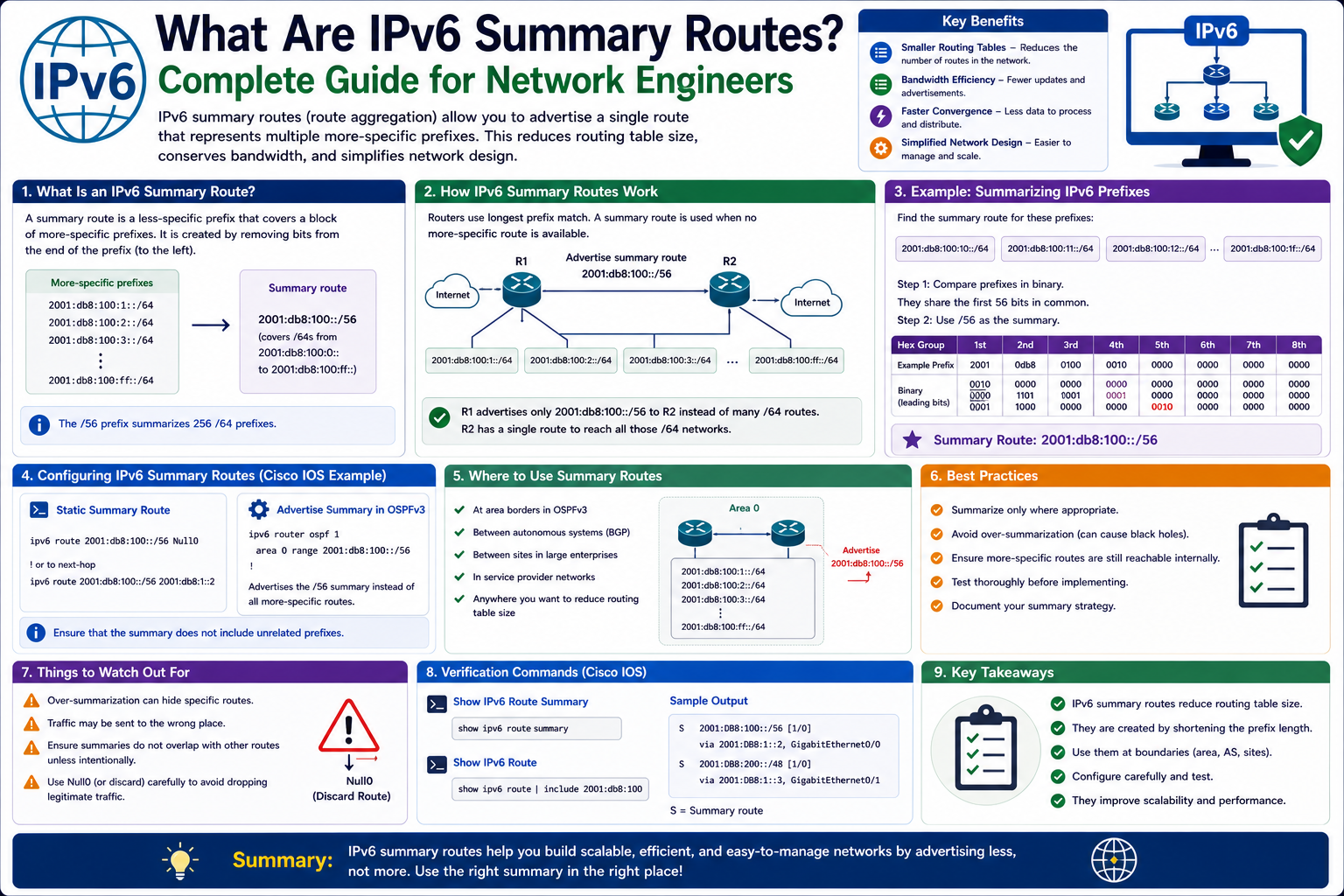
IPv6 was designed to solve the long-term limitations of IPv4, particularly the exhaustion of address space and the increasing complexity of global networking. While IPv6 introduces a vastly larger pool of addresses, it also brings a new scale of routing complexity. Modern networks are no longer small, isolated systems. They are interconnected ecosystems that span across enterprises, data centers, cloud environments, and service providers. Each of these environments may contain thousands or even millions of individual endpoints.
In such a large environment, routing becomes one of the most critical functions of network communication. Every packet that moves across a network must be directed toward its destination, and routers are responsible for making those decisions. Without efficient routing mechanisms, the sheer number of possible destinations would overwhelm routing devices, leading to slower performance, higher memory consumption, and increased processing demands.
This is where the idea of IPv6 summary routes becomes important. Instead of treating every network destination as an individual entry, routers can group multiple destinations into a single, more general route. This allows routers to make forwarding decisions based on broader patterns rather than detailed, individual mappings. The result is a more scalable and manageable routing environment.
Understanding this concept begins with recognizing that IPv6 networks are not just larger versions of IPv4 networks. They are structurally different, designed with hierarchy and aggregation in mind. This structural difference allows network engineers to design routing systems that remain efficient even as the number of connected devices grows dramatically.
Why IPv6 Networks Need Abstraction
At a fundamental level, abstraction in networking refers to simplifying complex systems by grouping related elements together. IPv6 summary routes are a direct application of this principle. Without abstraction, every router would need to maintain a detailed record of every reachable subnet, which is not practical in large-scale environments.
Imagine a global organization with offices across multiple continents. Each office may have its own internal networks, subnets, and devices. If every router in the organization had to store detailed information about every single subnet in every office, the routing tables would become extremely large and difficult to manage. Even modern hardware has limitations when it comes to memory and processing power.
Abstraction solves this problem by allowing routers to view networks in broader categories. Instead of storing every specific route, a router can store a summarized version that represents multiple related destinations. This reduces the number of entries in the routing table and improves efficiency when forwarding packets.
In IPv6 environments, this abstraction is even more valuable because address blocks are designed to be hierarchical. Organizations are typically assigned large contiguous blocks of addresses, which can be subdivided internally. Because these sub-blocks share a common structure, they can often be grouped into a single summarized route.
This hierarchical design is not accidental. It is a deliberate feature of IPv6 that supports scalability. By encouraging structured allocation of address space, IPv6 makes it easier for networks to implement summarization strategies that reduce complexity.
Without this level of abstraction, IPv6 would still face many of the same scalability challenges that IPv4 struggled with. The ability to generalize routing information ensures that the protocol remains efficient even as the number of connected devices continues to grow.
Understanding Routing Tables in Large Networks
Routing tables are one of the most important components of any router. They act as a map that tells the device where to send incoming packets based on destination addresses. Each entry in a routing table represents a known network path, including information about how to reach that destination and what interface should be used.
In small networks, routing tables are relatively simple. A router might only need to track a handful of routes, making decisions quickly and efficiently. However, in large-scale IPv6 networks, routing tables can become extremely complex. Thousands or even millions of routes may need to be stored and processed.
As the size of the routing table increases, so does the demand on system resources. Memory usage grows, and the time required to search through routing entries can increase. This can lead to delays in packet forwarding, which negatively affects network performance.
To manage this complexity, network engineers rely on techniques that reduce the number of entries in the routing table. One of the most effective techniques is route summarization. By combining multiple specific routes into a single summarized entry, routers can significantly reduce the size of their routing tables.
This does not mean that detailed routing information is lost. Instead, it is represented in a more compact form. When a packet arrives, the router uses the summarized entry to determine the general direction in which the packet should be forwarded. Once it reaches a more specific part of the network, additional routing decisions can be made.
This layered approach to routing ensures that no single device is responsible for storing every possible route. Instead, responsibility is distributed across the network, allowing each router to maintain only the level of detail it needs.
Concept of Route Aggregation in Simple Terms
Route aggregation is the process of combining multiple IP routes into a single, more general route. In the context of IPv6, this means taking several related subnets and representing them with a shorter prefix that covers all of them.
To understand this concept, it helps to think in terms of grouping. If multiple networks share a common beginning portion of their address, they can often be grouped together under a single summarized prefix. This reduces the number of entries that need to be stored in routing tables.
The key idea behind aggregation is similarity. When addresses are structured in a way that they share a common pattern, they can be treated as part of a larger block. Instead of listing each individual route separately, the router can store one entry that represents the entire group.
This approach is especially effective in IPv6 because of the way addresses are allocated. Large blocks are often assigned to organizations, which then subdivide them internally. These subdivisions usually maintain a predictable structure, making them ideal candidates for summarization.
However, route aggregation is only possible when addresses are contiguous. This means they must follow a logical sequence without gaps that break the shared structure. If addresses are scattered randomly, summarization becomes impossible because there is no common pattern to represent them accurately.
Aggregation is not just about reducing size. It is also about improving efficiency. With fewer entries to process, routers can make forwarding decisions more quickly. This improves overall network performance and reduces the likelihood of bottlenecks in high-traffic environments.
How IPv6 Address Structure Enables Summarization
IPv6 addresses are 128 bits long, which provides an enormous address space. This structure is divided into multiple segments, each serving a specific purpose. One of the most important features of this structure is its hierarchical design, which supports aggregation at different levels.
At the top level, IPv6 addresses are assigned in large blocks. These blocks are then subdivided into smaller networks, which can further be divided into subnets. This hierarchical structure ensures that addresses within a given block share common prefixes, making summarization possible.
When multiple subnets share the same higher-level prefix, they can often be combined into a single summarized route. This is because the shared portion of the address represents a common path in the network hierarchy.
For example, if two subnets differ only in their lower bits, those differences can be ignored when creating a summary route. The router only needs to consider the common higher-order bits to represent both subnets.
This design is intentional and reflects the goals of IPv6 as a scalable and hierarchical protocol. By ensuring that address allocation follows structured patterns, IPv6 makes it easier for network administrators to implement efficient routing strategies.
The ability to summarize routes depends heavily on this structured allocation. Without it, each subnet would need to be treated independently, significantly increasing the size of routing tables and reducing efficiency.
The Role of Contiguous Address Blocks
Contiguity plays a critical role in route summarization. A contiguous block of addresses is a set of IP ranges that follow one another without interruption. In IPv6 networks, these contiguous blocks are essential for creating effective summary routes.
When addresses are contiguous, they share a predictable pattern that can be represented using a shorter prefix. This allows multiple networks to be grouped under a single routing entry. If addresses are not contiguous, summarization becomes inaccurate because the summary would include destinations that do not actually exist within the intended range.
Contiguous addressing simplifies routing decisions by reducing complexity. Instead of evaluating multiple individual routes, a router can rely on a single summarized entry that represents the entire block. This reduces processing time and improves forwarding efficiency.
In practice, network designers try to allocate address space in a way that preserves contiguity. This involves careful planning during network design to ensure that related subnets are grouped together logically. When done correctly, this allows for efficient summarization at various levels of the network hierarchy.
Without contiguity, routing tables become fragmented. This fragmentation increases the number of entries that routers must manage, which can negatively impact performance. Therefore, maintaining contiguous address blocks is a key principle in scalable IPv6 network design.
Administrative Domains and Route Distribution
Large networks are often divided into administrative domains, each responsible for managing its own portion of the network. These domains may represent different geographic locations, departments, or organizational units. Each domain manages its own routing information internally, but must also communicate with other domains.
Route summarization plays a crucial role in how these domains exchange routing information. Instead of advertising every internal subnet to external routers, an administrative domain can advertise a summarized route. This reduces the amount of routing information that must be shared between domains.
By limiting the level of detail shared externally, networks can maintain both efficiency and security. External routers do not need to know every internal subnet; they only need enough information to forward traffic in the correct general direction.
This separation of internal and external routing information helps reduce complexity at the network boundary. It also ensures that changes within one domain do not unnecessarily impact routing in other domains.
Administrative control over route distribution allows network engineers to design more scalable systems. By carefully deciding what level of detail should be shared, they can optimize routing performance while maintaining flexibility within each domain.
The Difference Between Specific and Summary Routes
Specific routes and summary routes serve different purposes in a network. A specific route points to an exact destination or subnet. It provides detailed information about how to reach a particular network segment. These routes are highly precise but can become numerous in large environments.
Summary routes, on the other hand, represent a group of specific routes. Instead of pointing to a single destination, they represent a broader range of addresses. This makes them less precise but far more efficient in terms of storage and processing.
The key difference lies in the level of detail. Specific routes prioritize accuracy, while summary routes prioritize efficiency. Both are necessary for proper network operation, but they are used in different parts of the routing hierarchy.
Routers often use summary routes to make initial forwarding decisions. Once a packet reaches a more specific area of the network, specific routes take over to guide it to its exact destination.
This combination of broad and detailed routing ensures that networks remain both scalable and accurate. It allows large systems to function efficiently without sacrificing precision where it matters most.
How Routers Interpret Summary Information
When a router receives a packet, it examines the destination address and compares it against entries in its routing table. If a summary route matches the destination, the router uses that entry to determine the next hop.
A summary route does not provide the final destination. Instead, it provides a general direction. The router forwards the packet closer to the destination network, where more specific routing information may be available.
This layered decision-making process is what allows large networks to function efficiently. Each router only needs to know enough information to move the packet closer to its destination, rather than knowing the full path from start to finish.
Summary routes act as shortcuts in this process. They reduce the number of decisions a router must make and simplify the structure of routing tables. This leads to faster processing and improved scalability across the network.
Routers are designed to prioritize the most specific match available. If a specific route exists, it will be used instead of a summary route. However, if only a summary route is available, the router will use it to guide the packet forward.
The Logic Behind Reducing Routing Overhead
Routing overhead refers to the resources required to store, process, and maintain routing information. In large IPv6 networks, overhead can become significant if every route is stored individually.
Reducing routing overhead is essential for maintaining performance. Summary routes help achieve this by decreasing the number of entries in routing tables. Fewer entries mean less memory usage and faster lookup times.
This reduction in overhead also improves scalability. As networks grow, the routing system does not need to grow at the same rate. Instead, summarized entries allow the system to represent large numbers of destinations efficiently.
By minimizing overhead, networks can support more devices without requiring proportional increases in hardware resources. This makes IPv6 networks more sustainable and cost-effective in the long term.
Real-World Scale Challenges in IPv6 Environments
In real-world environments, IPv6 networks can span across global infrastructures. Service providers, cloud platforms, and enterprise systems all rely on IPv6 to manage vast numbers of devices and services.
At this scale, routing efficiency becomes critical. Without summarization, routing tables would grow uncontrollably, leading to performance issues and increased operational complexity.
Network engineers must therefore carefully design address allocations and routing policies to ensure that summarization can be applied effectively. This involves planning hierarchical structures, maintaining contiguity, and organizing networks in logical groupings.
These challenges highlight the importance of route summarization not just as a technical feature, but as a foundational design principle in modern networking.
The Role of Hierarchy in IPv6 Network Design
Modern IPv6 networks are built around hierarchy rather than flat structure. This is one of the most important architectural differences compared to early networking designs. Hierarchy means that networks are organized in layers, where each layer has a different level of detail and responsibility.
At the lowest level, individual devices such as servers, laptops, and IoT systems exist within small subnets. These subnets are grouped into larger networks, which are then grouped into even larger routing domains. This layered structure allows network engineers to manage complexity by dividing responsibility across different levels.
IPv6 summary routes depend heavily on this hierarchical structure. Without hierarchy, summarization would not be possible because there would be no logical grouping of addresses. Instead of dealing with millions of unrelated destinations, routers can focus on structured blocks that represent meaningful sections of the network.
This hierarchy also reflects how organizations design their internal systems. For example, different departments may receive separate address blocks, but all of those blocks may still fall under a larger organizational prefix. This allows higher-level routers to treat entire departments as single routing units.
The deeper the hierarchy, the more effective summarization becomes. Each level of the network can reduce complexity by representing multiple lower-level networks as a single summarized route. This reduces the burden on core routing devices and improves overall scalability.
How Routing Protocols Handle IPv6 Summarization
Routing protocols play a central role in how IPv6 summary routes are created and distributed. Protocols such as OSPFv3 and IS-IS are designed to support hierarchical routing environments where summarization is a key requirement.
These protocols do not simply pass raw network information between routers. Instead, they organize routing data into structured messages that reflect the topology of the network. Within this structure, summarization can be applied at specific boundaries to reduce unnecessary detail.
When a router participates in a routing protocol, it learns about network destinations from neighboring routers. Without summarization, every individual subnet would be advertised separately. With summarization, routers can instead advertise a single aggregated route that represents multiple subnets.
This process reduces the size of routing updates and limits the amount of processing required when network changes occur. It also ensures that routing information remains manageable even in large environments with frequent topology changes.
Routing protocols are designed to respect summarization boundaries. This means that summarization typically occurs at specific points in the network rather than randomly. These points are carefully chosen to align with the hierarchical structure of the network.
Area Boundaries and Their Importance in Summarization
In structured IPv6 networks, area boundaries are one of the most important points where summarization occurs. An area boundary separates different sections of the network and controls how routing information is exchanged between them.
Routers that sit at these boundaries have a special role. They are responsible for translating detailed internal routes into summarized external routes. This allows internal complexity to remain hidden from other parts of the network.
By summarizing routes at area boundaries, network engineers can significantly reduce the amount of routing information that is shared across the network. Instead of advertising every internal subnet, only a summarized representation is shared.
This approach improves scalability and reduces unnecessary routing overhead. It also helps isolate changes within one area so they do not affect the entire network. If a subnet changes internally, the summarized route may remain the same, preventing widespread routing updates.
Area boundaries also help enforce logical separation between different parts of the network. This separation is not just technical but also organizational, as different teams may manage different areas independently.
The Function of Border Routers in IPv6 Environments
Border routers act as critical control points in IPv6 networks. These routers connect different areas or domains and are responsible for managing how routing information flows between them.
One of their key responsibilities is route summarization. Instead of passing every internal route to neighboring areas, border routers aggregate multiple routes into a single summary entry. This reduces complexity and improves efficiency across the network.
Border routers also help enforce routing policies. They can decide which routes should be advertised externally and which should remain internal. This ensures that sensitive or unnecessary routing information is not exposed beyond its intended scope.
Because border routers handle both detailed internal routes and summarized external routes, they must maintain a balance between accuracy and efficiency. They need enough detail to make correct forwarding decisions internally, but not so much detail that external routing becomes overloaded.
In large-scale IPv6 networks, border routers often handle thousands of routes. Without summarization, this number could grow much larger, leading to performance issues. Summarization helps keep this load manageable.
Interaction Between Summary Routes and Longest Prefix Matching
One of the most important mechanisms in IPv6 routing is longest prefix matching. This rule determines how routers select the best route when multiple options are available for a destination.
When a packet arrives, the router compares the destination address against all entries in its routing table. If multiple routes match, the router chooses the one with the longest matching prefix. This ensures that the most specific route is always preferred.
Summary routes introduce an interesting dynamic into this process. Since summary routes are less specific than individual routes, they are only used when no more specific route exists. This means they act as a fallback mechanism in the routing hierarchy.
If a router has both a specific route and a summary route for the same destination, the specific route will always take priority. The summary route is only used when detailed information is not available.
This interaction ensures that summarization does not interfere with routing accuracy. Instead, it complements detailed routing by providing a backup path when needed.
The combination of longest prefix matching and summarization allows IPv6 networks to maintain both precision and efficiency at the same time.
Binary Structure and Address Grouping Logic
IPv6 addresses are represented in hexadecimal, but at their core, they are binary values. Understanding how summary routes work requires a basic understanding of how these binary structures relate to address grouping.
When two IPv6 subnets share a common binary prefix, they can often be summarized into a single route. The longer the shared prefix, the more specific the summary becomes.
For example, if two subnets differ only in the last few bits of their network portion, those differences can be ignored when creating a summary route. The shared portion becomes the basis of the summarized entry.
This binary similarity is what allows route aggregation to function. Without shared binary structure, there would be no logical way to combine routes.
Network engineers often design address allocations with this binary structure in mind. By ensuring that related networks share common prefixes, they make summarization easier and more efficient.
This approach requires careful planning during network design. If addresses are assigned randomly, summarization becomes difficult or impossible because there is no shared structure to rely on.
The Importance of Routing Efficiency in Large Systems
Efficiency is one of the most important goals in network design. As IPv6 networks continue to grow, efficiency becomes even more critical.
Routing efficiency refers to how quickly and effectively a router can make forwarding decisions. If routing tables become too large or complex, efficiency decreases, leading to slower packet processing.
Summary routes improve efficiency by reducing the number of entries in routing tables. Instead of searching through thousands of individual routes, a router can use a smaller set of summarized entries.
This reduction in complexity also improves convergence speed. When network changes occur, fewer routing entries need to be updated, allowing the network to stabilize more quickly.
Efficiency also affects scalability. A highly efficient routing system can support more devices without requiring proportional increases in hardware resources.
Without summarization, IPv6 networks would struggle to maintain efficiency at scale. The ability to group routes is therefore essential for long-term network sustainability.
Multi-Layer Routing Decision Processes
Routing in IPv6 is not a single-step process. Instead, it involves multiple layers of decision-making. Each router contributes a small part of the overall path selection process.
At the highest level, summary routes guide packets toward general network regions. These routes do not provide exact destinations but instead indicate the correct direction.
As packets move closer to their destination, more specific routing information becomes available. At this stage, detailed routes take over and guide the packet to its final endpoint.
This multi-layer approach allows networks to scale efficiently. No single router needs to know the entire path from source to destination. Instead, each router only needs to know the next step.
Summary routes are essential in this process because they provide the initial direction. Without them, routers would need to store far more detailed information, which would reduce efficiency.
This layered decision-making structure is one of the reasons IPv6 networks can support such large numbers of devices without becoming unmanageable.
Convergence Behavior in Summarized Networks
Convergence refers to the process by which routers update their routing tables after a change in the network. In IPv6 networks, convergence speed is an important performance factor.
When route summarization is used, convergence behavior changes significantly. Instead of updating multiple individual routes, routers may only need to update a single summarized entry.
This reduces the amount of information that must be processed during network changes. As a result, convergence can occur more quickly and with less impact on network performance.
However, summarization can also introduce complexity in certain scenarios. If a summarized route covers multiple subnets, a change in one subnet may not immediately reflect in external routing tables.
This delay is usually acceptable because the summary still represents the general direction correctly. However, it requires careful design to ensure that convergence behavior remains predictable.
Proper summarization design ensures that network changes are contained within appropriate boundaries. This prevents unnecessary propagation of routing updates across the entire network.
Potential Challenges in Misconfigured Summarization
While IPv6 summary routes provide many benefits, they must be configured carefully. Misconfiguration can lead to routing issues that are difficult to diagnose.
One common issue occurs when summary boundaries are incorrectly defined. If a summary route includes addresses that do not actually exist within the network, packets may be forwarded incorrectly.
Another issue arises when summarization hides too much detail. In some cases, routers may lose visibility of specific routes that are needed for optimal forwarding.
Misconfigured summarization can also lead to routing loops or black holes, where packets are sent to incorrect destinations or dropped entirely.
These problems highlight the importance of careful planning when implementing summary routes. Engineers must ensure that summarized ranges accurately reflect the underlying network structure.
Testing and validation are essential steps in this process. Without proper verification, summarization can introduce more problems than it solves.
The Relationship Between Summarization and Network Stability
Network stability refers to the ability of a network to maintain consistent performance even when changes occur. IPv6 summary routes contribute significantly to stability by reducing routing complexity.
When fewer routes are advertised and stored, there are fewer opportunities for inconsistency. This makes the network easier to manage and less prone to instability caused by frequent updates.
Stability is especially important in large environments where changes occur regularly. Without summarization, each change could trigger a large number of routing updates, potentially destabilizing the network.
By reducing the number of routes that must be managed, summarization helps maintain a stable routing environment even under heavy load.
This stability is one of the key reasons why summarization is widely used in large-scale IPv6 deployments.
Traffic Flow Optimization Through Route Aggregation
Route aggregation also plays an important role in optimizing traffic flow. By reducing the number of routing entries, routers can make faster decisions about where to send packets.
This leads to more predictable traffic patterns and reduces unnecessary routing overhead. Packets are guided through broader network paths initially and then refined as they approach their destination.
This structured flow ensures that traffic is distributed efficiently across the network. It also prevents routers from becoming overloaded with unnecessary detail.
In large IPv6 networks, this optimization is essential for maintaining performance. Without it, traffic flow would become inefficient and difficult to manage.
Aggregation ensures that routing decisions remain scalable, even as the number of devices continues to grow.
Strategic Role of Summarization in Network Design
IPv6 summary routes are not just a technical feature. They are a strategic design tool that influences how entire networks are structured.
Network engineers must consider summarization during the planning phase of network design. Address allocation, hierarchy structure, and routing boundaries must all be designed with summarization in mind.
When done correctly, summarization simplifies network management and improves long-term scalability. It allows networks to grow without becoming overly complex.
This strategic role makes summarization one of the most important concepts in modern IPv6 networking design.
Advanced Behavior of IPv6 Summary Routes in Real Networks
As IPv6 networks scale into large enterprise systems, cloud infrastructures, and service provider backbones, summary routes begin to show their deeper impact on overall network behavior. At a basic level, summarization reduces routing table size, but in real deployments, it also influences how traffic flows, how failures are isolated, and how quickly networks recover from changes.
One of the most important advanced behaviors is how summary routes hide internal topology details. When a router advertises a summarized prefix, it is intentionally abstracting away the internal structure of the network behind it. This means that external routers do not see the individual subnets or how they are connected internally. They only see a single aggregated route that represents a whole group of destinations.
This abstraction is extremely useful in large-scale environments because it reduces dependency between network segments. If internal topology changes—such as adding a new subnet or moving devices between networks—external routers are not affected, as long as the summary range remains the same. This reduces routing churn and stabilizes the overall system.
However, this also means that summarization introduces a level of “intentional blindness.” Routers outside the summarized domain are no longer aware of internal path changes. While this improves efficiency, it also requires careful design to ensure that traffic still flows optimally.
Impact of Summarization on Traffic Engineering
Traffic engineering refers to the process of controlling how data flows through a network to optimize performance, reduce congestion, and balance loads. IPv6 summary routes play an indirect but powerful role in this process.
When routes are summarized, traffic is guided toward broader network regions rather than specific endpoints. This means that early-stage routing decisions are less precise. As packets move deeper into the network, more specific routing takes over and directs them to their final destinations.
This layered routing approach allows engineers to influence traffic flow at a macro level. For example, by adjusting summary boundaries, they can shift large volumes of traffic toward different core routers or backbone paths.
However, this also limits fine-grained control. Because summary routes represent multiple destinations, they cannot be used to selectively influence individual subnets. Instead, they influence entire groups of destinations at once.
This trade-off between scalability and control is a defining characteristic of IPv6 summarization. It allows networks to scale efficiently, but it also requires careful planning when precise traffic engineering is needed.
Failure Containment and Route Stability
One of the less obvious benefits of IPv6 summary routes is failure containment. In large networks, failures are inevitable—links go down, routers restart, and configurations change. Without summarization, each of these events could trigger widespread routing updates across the entire network.
Summary routes help limit the impact of such failures. Because multiple subnets are represented as a single route, internal changes do not always propagate outward. This means that many failures are contained within the local routing domain.
For example, if a specific subnet becomes unreachable, external routers may still see the summary route as valid. They continue forwarding traffic toward the general area, while internal routing protocols handle the failure locally.
This containment improves stability by preventing unnecessary global updates. It also reduces convergence load on core routers, which might otherwise need to process large numbers of route changes simultaneously.
However, this benefit comes with a responsibility: internal routing must be robust enough to handle failures transparently. If internal redundancy is weak, summarization can mask underlying issues rather than resolving them.
Summarization and Routing Loop Prevention
Routing loops occur when packets circulate between routers without reaching their destination. In IPv6 networks, summarization can both help and complicate loop prevention depending on how it is implemented.
On the positive side, summarization reduces the number of routing entries, which decreases the chance of conflicting routes that could contribute to loops. A simplified routing table is easier to manage and less prone to inconsistencies.
However, summarization can also hide important details that are needed for loop detection. If multiple internal paths exist behind a summary route, external routers may not have enough visibility to detect certain misconfigurations.
This is why routing protocols that support IPv6 summarization also include loop prevention mechanisms such as sequence numbers, topology databases, and strict hierarchy rules. These systems ensure that even when details are abstracted, consistency is maintained.
Proper design ensures that summarization does not interfere with loop-free routing principles. Instead, it works alongside them to simplify the routing environment while preserving correctness.
The Role of Summarization in Internet-Scale Routing
At the scale of the global internet, routing tables contain hundreds of thousands of entries. Without summarization, this number would be significantly higher, potentially exceeding the capabilities of modern routers.
Internet service providers rely heavily on IPv6 summary routes to manage this complexity. Entire blocks of addresses are aggregated into large prefixes that represent regions, organizations, or upstream providers.
This aggregation allows backbone routers to operate efficiently. Instead of storing detailed information about every individual network, they store summarized routes that represent large portions of the address space.
This is one of the reasons the internet remains scalable despite continuous growth. Without summarization, global routing infrastructure would require exponentially more resources.
At this level, summarization is not just an optimization—it is a necessity. It enables the internet to function as a coherent system rather than a fragmented collection of individual networks.
Interaction Between Static and Dynamic Summarization
IPv6 summary routes can be implemented in both static and dynamic ways. Static summarization is manually configured by network engineers, while dynamic summarization is handled automatically by routing protocols.
Static summarization provides precise control. Engineers define exactly which routes are grouped together and how they are advertised. This is useful in environments where network structure is stable and predictable.
Dynamic summarization, on the other hand, adapts to changes in the network. Routing protocols can automatically adjust summarized routes based on topology changes or learned information.
Each approach has advantages. Static summarization offers stability and control, while dynamic summarization provides flexibility and automation. In large networks, both are often used together to balance predictability and adaptability.
The interaction between these two methods must be carefully managed. Conflicts between static and dynamic summarization can lead to inconsistent routing behavior if not properly aligned.
Security Implications of IPv6 Summary Routes
While IPv6 summary routes are primarily a performance optimization tool, they also have important security implications. By hiding internal network structure, summarization reduces the amount of information exposed to external networks.
This form of abstraction makes it more difficult for external observers to map internal topology. Without detailed routing information, attackers have less visibility into the internal structure of the network.
However, summarization is not a security mechanism on its own. It does not encrypt traffic or prevent unauthorized access. Instead, it acts as a form of information reduction that supports broader security strategies.
In some cases, summarization can also complicate troubleshooting during security incidents. Because internal details are hidden, identifying the exact source of malicious traffic may require deeper inspection within the summarized domain.
Therefore, summarization should be viewed as part of a layered security approach rather than a standalone solution.
Performance Trade-offs in Large-Scale Summarization
While summarization improves routing efficiency, it is not without trade-offs. One of the primary trade-offs is loss of granularity. When multiple networks are grouped into a single route, routers lose visibility into individual subnets at higher levels of the network.
This can sometimes lead to suboptimal routing decisions. Traffic may be directed toward a general area rather than the most efficient specific path. Once inside the summarized domain, it is then refined, but initial routing may not always be optimal.
Another trade-off involves troubleshooting complexity. When issues arise, summarized routes make it harder to immediately identify which specific subnet is affected. Engineers must inspect deeper layers of the network to locate the problem.
Despite these trade-offs, the performance benefits of summarization typically outweigh the disadvantages in large-scale environments. The reduction in routing table size and processing overhead is essential for maintaining scalability.
Conclusion
IPv6 summary routes play a crucial role in keeping modern networks scalable, efficient, and manageable. As IPv6 adoption continues to expand across enterprise systems, cloud platforms, and global internet infrastructure, the number of reachable networks grows exponentially. Without a mechanism to reduce routing complexity, this growth would quickly overwhelm routing tables, increase memory usage, and slow down packet forwarding performance.
Summary routes solve this challenge by grouping multiple specific IPv6 networks into a single, more generalized route. Instead of requiring routers to store and process every individual subnet, summarization allows them to work with aggregated address blocks. This significantly reduces routing overhead while still maintaining accurate connectivity across the network.
Beyond efficiency, IPv6 summary routes also contribute to network stability. By limiting the spread of detailed routing information, they reduce the impact of topology changes and help contain failures within localized areas of the network. This ensures that large-scale routing systems remain resilient even when individual components change or fail.
Another important advantage is improved hierarchy and structure. IPv6 networks are designed with layered addressing in mind, making them ideal for summarization. This hierarchical design allows network engineers to organize address space logically, which simplifies both routing and long-term network planning.
However, summarization must be carefully designed. Poorly planned summary routes can lead to routing inefficiencies, reduced visibility, or even traffic misdirection. Successful implementation requires a clear understanding of address structure, network boundaries, and routing protocol behavior.
Overall, IPv6 summary routes are not just a technical optimization—they are a foundational design principle that supports the growth of modern networking. By reducing complexity while preserving connectivity, they ensure that large-scale IPv6 environments remain functional, efficient, and capable of supporting the increasing demands of global digital communication.